
Augmented Reality Field Service Explained
Augmented reality in field service isn't science fiction. It closes the gap between digital blueprints and the physical machine in front of a technician. AR provides your team with real-time data overlays and a direct line to remote experts, cutting through operational delays and skill shortages by putting knowledge exactly where it's needed: on the job site. The outcome is a service operation that's faster, more precise, and far more resilient.
The Future of Field Service Is Already Here
The old image of a field technician, buried in a thick paper manual or waiting on hold for a senior expert, is fading. Today's service challenges are a different beast: incredibly complex machinery, a widening skills gap, and heightened customer expectations. This reality calls for a dynamic solution, and that's where augmented reality steps in—not as a far-off concept, but as a practical tool delivering real results right now.
Think of AR as a digital co-pilot for your frontline team. It layers interactive diagrams, step-by-step instructions, and live data directly onto a technician’s view of their physical workspace. This immediate access to information changes how work gets done, turning complex problems into clear, manageable tasks.
Bridging the Knowledge Gap
One of the biggest challenges in the service industry is the wave of experienced professionals heading into retirement, leaving a knowledge vacuum. It takes significant time to get new talent up to speed, and AR tackles this problem head-on. It forges a powerful connection between junior and senior technicians, no matter their physical location.
An expert can digitally "look over the shoulder" of a field technician from hundreds of miles away, providing real-time guidance by drawing annotations and sharing technical documents directly into their field of view.
This capability transforms the traditional support model. Instead of flying a high-cost expert to every tough job, you can empower your entire workforce. This remote assistance doesn't just solve immediate problems; it serves as a powerful on-the-job training tool, radically accelerating skill development across the board.
Solving Core Operational Problems
The practical applications of augmented reality field service are built to solve persistent operational challenges. When technicians are equipped with the right information at the right time, significant improvements follow.
- Improving First-Time Fix Rates: With schematics, service histories, and expert help instantly available, technicians are far more likely to complete the repair on the first visit, boosting first-time fix rates by as much as 25%.
- Reducing Operational Delays: AR slashes the time wasted searching for information or waiting for support. That means shorter repair times and less costly downtime for customers.
- Enhancing Workforce Safety: Technicians can view safety checklists and hazard warnings hands-free through smart glasses, allowing them to follow every protocol without taking their eyes or hands off the task.
Ultimately, integrating AR into your operations builds a more agile, knowledgeable, and effective field service team. This guide will lay out a clear roadmap to help you use this technology not just to solve today’s challenges, but to secure a competitive edge for years to come.
How AR Technology Transforms Field Operations

To understand the impact of an augmented reality field service solution, one must look past the buzzwords to its practical application. It is less a single gadget and more an ecosystem of hardware and software designed to inject digital information directly into a technician’s real-world workspace.
The system starts with a device, which can be a common smartphone or tablet. In many industrial settings, however, specialized smart glasses are the preferred tool. These are built for hands-free work, letting a technician view critical data while keeping their hands on the tools and equipment.
Supporting this hardware is a powerful software platform. This is the central nervous system of the operation, managing everything from digital work guides to the live video feeds that enable remote collaboration. The software intelligently pulls in asset data, service histories, and 3D models from existing systems and delivers them to the technician precisely when needed.
Core Features That Drive Efficiency
The true power of AR lies in the actions it enables. Key features are designed to tackle specific, long-standing challenges in field service, turning a complex repair into a clear, guided process.
- Live Remote Expert Guidance: This is a transformative feature for most teams. A technician facing a difficult problem can instantly launch a secure video call with a senior expert located anywhere. The expert sees exactly what the field technician sees.
- Interactive Digital Work Instructions: AR platforms can deliver step-by-step instructions with 3D models and animations layered directly on top of physical equipment. This provides visual, intuitive guidance that ensures tasks are done correctly and safely.
- Contextual Data Overlays: A technician can look at a machine and instantly see vital data—such as operational status, error codes, or live temperature readings from IoT sensors—hovering in their line of sight. This immediate data access radically speeds up diagnostics.
AR in a Real-World Scenario
Consider this practical scenario: A new technician is dispatched to a customer site to repair a complex industrial machine for the first time. Upon arrival, she uses her AR smart glasses to scan a QR code on the machine.
Instantly, the full service history and standard procedures appear in her vision. As she begins her diagnosis, an unfamiliar error code appears. Instead of spending an hour on the phone trying to explain the problem, she initiates a remote assistance call with a single tap.
A senior specialist at the main office answers, seeing her live feed. He immediately guides her, using on-screen drawings to circle the exact valve that needs adjusting and displaying the correct pressure setting right next to it. He also pulls up the relevant schematic from the knowledge base and sends it straight to her display.
Guided by the expert's real-time instructions, the technician resolves the issue in under 30 minutes—a task that might have otherwise required a second visit from a more experienced engineer.
This is how augmented reality industrial applications empower technicians, reduce travel costs, and dramatically cut equipment downtime. It makes your best expertise available on any job site, instantly. To see how extended reality (XR) is already reshaping field communication, you can check out innovations like GMES XR Connect Crewtalk solutions. The demand for this immediate support is a key reason the global AR market, valued at USD 83.65 billion, is projected to exceed USD 599 billion by 2030.
The Strategic Business Benefits of AR Integration
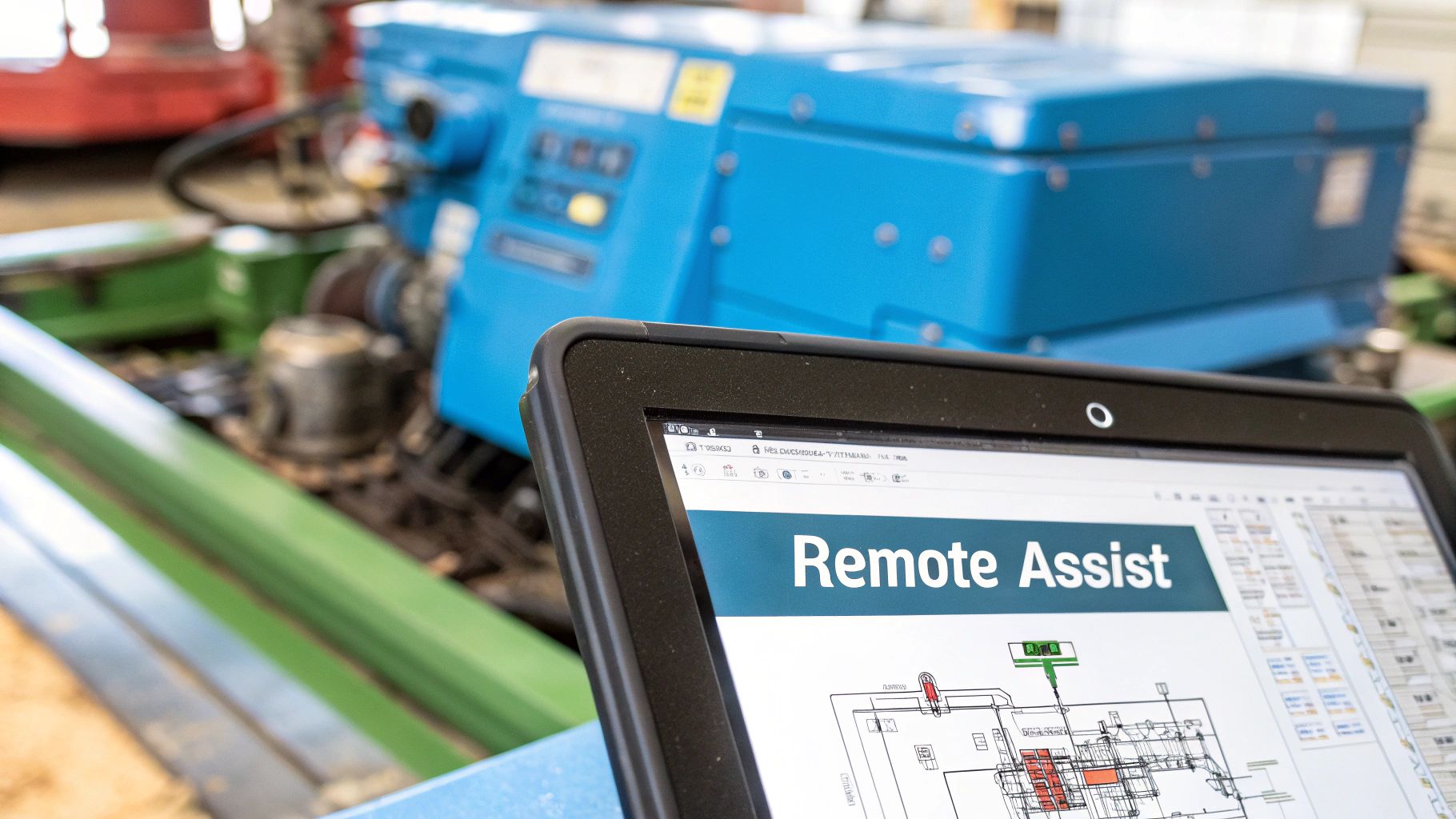
The real value of an augmented reality field service solution is its impact on the bottom line. This is a strategic investment to streamline operations, empower personnel, and deliver a superior customer experience. The benefits create a ripple effect across the entire service organization, making the return on investment clear and compelling.
These advantages fall into four key areas, each addressing a persistent challenge in the field service industry. From improving efficiency to enhancing safety, AR delivers tangible solutions that drive growth and provide a solid competitive edge.
Boosting Operational Efficiency
A significant jump in operational efficiency is often the first noticeable benefit. This directly impacts the balance sheet by cutting costs and boosting productivity, primarily by improving two critical metrics: first-time fix rates and expert travel expenses.
When a technician arrives on-site with AR, they are equipped with instant access to schematics, service histories, and step-by-step digital instructions. This knowledge availability dramatically increases the probability of resolving the issue on the first visit.
By connecting a field technician to a live video feed with a remote expert, the need for senior specialists to travel is significantly reduced. This not only cuts travel costs by as much as 75% but also allows top experts to guide multiple junior technicians through complex jobs in a single day, multiplying their impact.
This drive for efficiency is a primary reason the global Field Service Management (FSM) market, currently valued around USD 6 billion, is projected to nearly double to USD 11.5 billion by 2030. The demand for real-time visibility and automation tools like AR is fueling this growth, as detailed in this global FSM market report.
Empowering the Workforce
AR is a game-changer for bridging the skills gap and capturing institutional knowledge. As veteran technicians retire, they take decades of experience with them. AR provides a way to document that expertise and transfer it to the next generation.
New hires can tackle complex jobs with confidence far earlier in their careers, thanks to guided workflows and on-demand remote mentorship. This shortens the learning curve, making them productive faster. The hands-on, see-what-I-see nature of AR training is far more effective than traditional manuals and classroom sessions. For a deeper analysis, explore the significant virtual reality training benefits that immersive technology brings to skill development.
- Accelerated Onboarding: New technicians can follow visual, step-by-step guides overlaid directly on equipment, reducing training time by up to 30%.
- Knowledge Preservation: Service calls conducted with AR can be recorded and archived, building a digital library of best practices for future reference.
- Increased Confidence: Knowing an expert is just a call away makes technicians feel more supported and prepared to take on challenging jobs independently.
Enhancing Workplace Safety
In industrial environments, safety is paramount. AR contributes directly by giving technicians hands-free access to critical information. Using smart glasses, they can view safety checklists, see hazard warnings, and follow procedural guides without taking their hands off their tools or their eyes off the job.
This approach helps ensure strict compliance with safety protocols because every step can be visually verified and logged. A digital overlay can highlight a high-voltage area, or an alert can appear if a required safety check is missed, reducing human error and minimizing accident risk.
Driving Superior Customer Satisfaction
Ultimately, these operational gains translate into a better customer experience. With augmented reality, customers benefit from less equipment downtime and faster, more accurate repairs.
When a technician can solve an issue on the first visit, the customer's operations are back online faster, preventing costly disruptions. The ability to resolve problems quickly—whether remotely or on-site—builds trust and demonstrates a high level of competence. This leads directly to the customer loyalty and retention that form the foundation of long-term success.
To quantify these improvements, here is a look at how AR impacts key performance indicators for field service organizations.
Key Performance Indicators Improved by AR in Field Service
| Metric | Traditional Method Challenge | AR-Enabled Improvement |
|---|---|---|
| First-Time Fix Rate | Incomplete information or lack of expertise leads to repeat visits. | Up to 25% increase with instant access to data and remote experts. |
| Technician Training Time | Long and costly onboarding process for complex equipment. | Up to 30% faster training through immersive, on-the-job guidance. |
| Mean Time to Repair (MTTR) | Delays caused by searching for information or waiting for support. | Up to 40% reduction by providing immediate, contextual work instructions. |
| Expert Travel Costs | High expenses associated with flying senior specialists to job sites. | Up to 75% reduction through effective remote assistance and collaboration. |
As these figures show, the improvements are not marginal. AR provides a significant, measurable lift across the board, turning operational challenges into competitive strengths.
Practical AR Field Service Use Cases
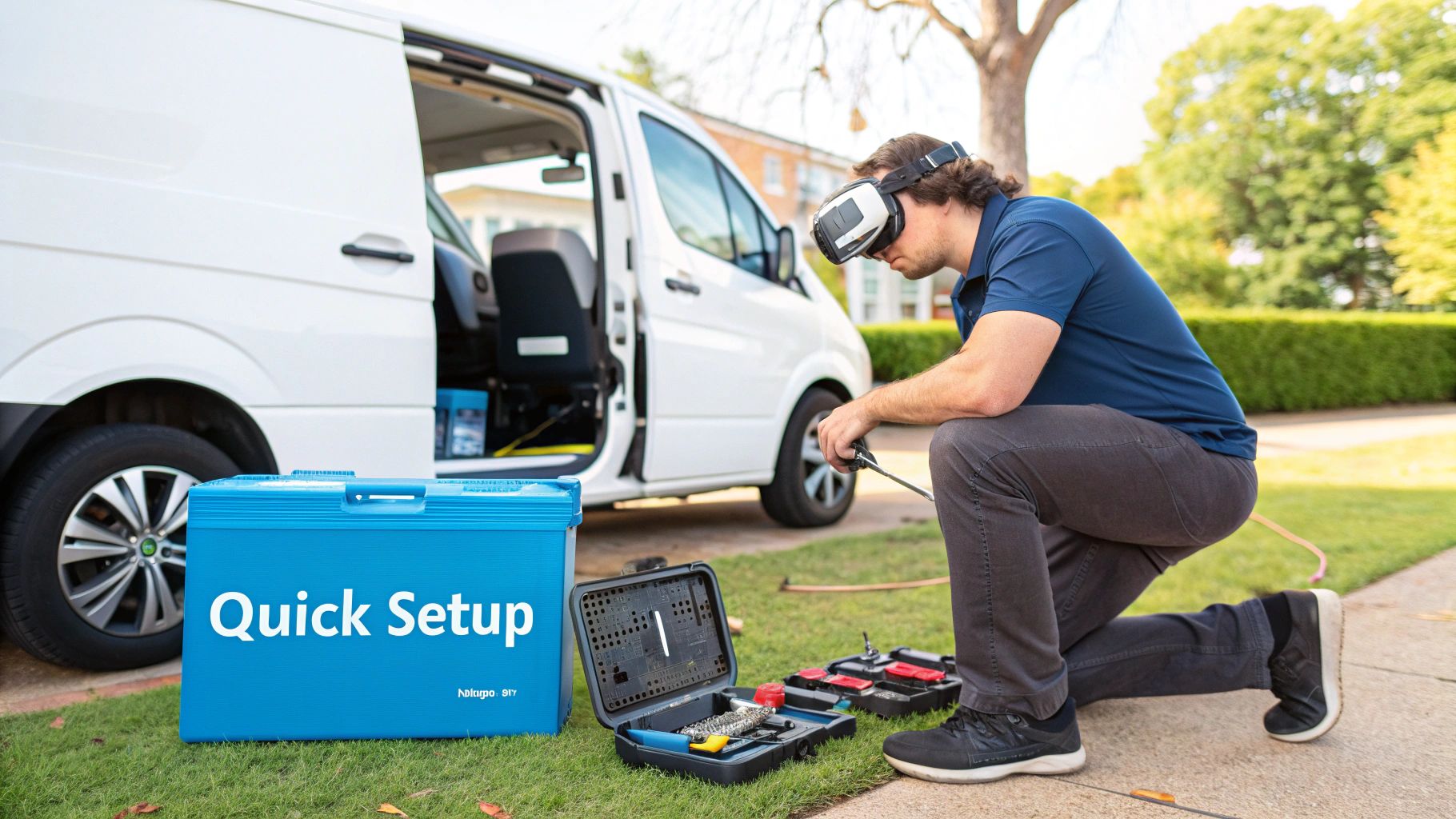
While the high-level benefits are compelling, the true value of an augmented reality field service solution is realized during high-stakes jobs. This is where AR solves tangible, costly problems by delivering the right information to the right person at the right time.
The following three scenarios illustrate how AR can transform a potentially chaotic situation into a controlled, efficient workflow.
Complex Equipment Repair in Manufacturing
The Problem: A junior technician faces a critical failure on a complex CNC machine, bringing production to a halt. The only senior expert who fully understands this machine is at another facility hundreds of miles away. Every hour of downtime costs the company thousands of dollars.
The Solution: The on-site technician puts on a pair of AR smart glasses and initiates a call with the remote expert. The expert instantly sees a clear, first-person view of the machine. Using AR tools, the expert draws digital arrows and highlights specific components directly onto the technician's real-world view, pointing out the exact parts to check.
The Outcome: The junior technician is not trying to interpret vague instructions over the phone; they are following precise, visual guidance. The expert walks them through the entire repair, even displaying the correct torque specifications for each bolt in their line of sight. The machine is back online in under an hour. What could have been a full day of costly downtime is resolved quickly, saving significant money in lost production and travel costs.
By delivering instant visual context, AR turns a potential crisis into a collaborative success. This is the core strength of using augmented reality for maintenance; expertise is no longer limited by geography.
Remote Inspections in the Utilities Sector
The Problem: A utility company needs to conduct a mandatory safety inspection at a remote electrical substation. Previously, this required sending a specialized team, resulting in logistical challenges and high travel expenses. Furthermore, documenting compliance with photos and paper forms was slow and prone to human error.
The Solution: Now, a local field worker goes to the substation with an AR-enabled tablet and pulls up a guided workflow—a step-by-step digital checklist. As they proceed with the inspection, they capture time-stamped, geotagged photos and videos that automatically link to each checklist item.
If they encounter an unusual reading, they can initiate a remote assistance call. A compliance officer at headquarters views their live feed, verifies the data, and provides a verbal confirmation that is recorded directly into the official inspection log.
The Outcome: The inspection is completed in a fraction of the time and at a much lower cost. The company now has a verifiable digital audit trail, which improves compliance and reduces risk. The remote expert can oversee multiple inspections in a single day without leaving the office.
On-The-Job Training for New Technicians
The Problem: Training new hires on sophisticated industrial equipment is a persistent challenge. Classroom sessions can be too abstract, and shadowing a senior technician often slows down an active service call. As a result, new technicians may lack the hands-on confidence to perform tasks correctly.
The Solution: Trainees now use AR smart glasses to work on a physical, non-operational piece of training equipment. The AR software overlays animated, 3D work instructions directly onto the machine. They can practice a complex procedure, like a full disassembly and reassembly, by following the visual prompts at their own pace.
The Outcome: This method builds muscle memory. Trainees learn in a safe, controlled environment where mistakes have no cost. They can repeat modules as needed to build proficiency. This hands-on, self-guided approach accelerates their learning, with some organizations reporting up to a 30% reduction in training time. When they encounter the equipment in the field, they do so with confidence.
Your Roadmap for Implementing AR Technology
Adopting augmented reality for field service is a structured rollout, not an all-or-nothing leap. By breaking the journey into manageable steps, you can prove the value at each stage and scale intelligently, ensuring each phase builds on the last for a successful deployment.
This roadmap guides you from the initial planning conversation to a full-scale implementation, focusing on practical actions that deliver measurable results. Starting with a focused pilot project helps gain stakeholder buy-in and fine-tune your strategy for maximum impact.
Phase One: Define Your Business Case and Pilot
Before considering hardware or software, pinpoint a specific, high-impact problem to solve. Focus on a recurring issue where augmented reality field service offers a clear solution. This could be reducing repeat visits for a particularly complex piece of equipment or accelerating the onboarding of new technicians.
Once you have identified the problem, design a pilot project to prove the technology's value. A strong pilot project should be:
- Measurable: Define clear KPIs, such as a reduction in Mean Time to Repair (MTTR) or an increase in first-time fix rates.
- Visible: Choose a project whose success will be noticed by key stakeholders across the organization.
- Contained: Start small. A few technicians and one specific type of equipment or task will keep the project manageable.
Phase Two: Select the Right Hardware and Software
With a clear pilot in mind, you can select your tools. This involves two key components: the hardware for your field team and the software platform that powers the experience.
Hardware generally includes smart glasses or mobile devices like smartphones and tablets. Smart glasses provide a true hands-free experience, ideal for complex jobs requiring both hands. Mobile devices offer a lower-cost entry point and are already familiar to your team, making them suitable for simpler tasks like remote inspections.
The software is the brain of your AR solution. A good platform must integrate with your existing systems, offer intuitive remote assistance tools, and allow you to create or upload digital work instructions. It can be helpful to consult specialists during this phase; for example, Augmented Reality UI Design agencies can help ensure the final solution is user-friendly for your technicians.
Phase Three: Prepare Your Team and Content
Technology is only effective if people use it. A solid change management and training plan is critical. Begin by explaining the "why" behind the move to AR—how it will make technicians' jobs easier, safer, and more effective. This builds excitement and mitigates resistance.
Training must be hands-on. Allow technicians to become comfortable with the devices and software in a low-pressure environment. As highlighted in our guide on augmented reality for training, proper training is non-negotiable. You will also need to prepare your content by converting existing service manuals and schematics into AR-friendly formats like interactive 3D models and step-by-step digital guides.
Phase Four: Measure, Iterate, and Scale
Once your pilot is running, closely monitor the KPIs you defined. More importantly, gather feedback from the technicians using the technology. What is working well? What is causing friction? Use this feedback to refine your approach and build a strong case for the pilot's success.
The image below illustrates a common adoption curve. Adoption starts low, but with proper training and support, efficiency gains begin to accelerate.
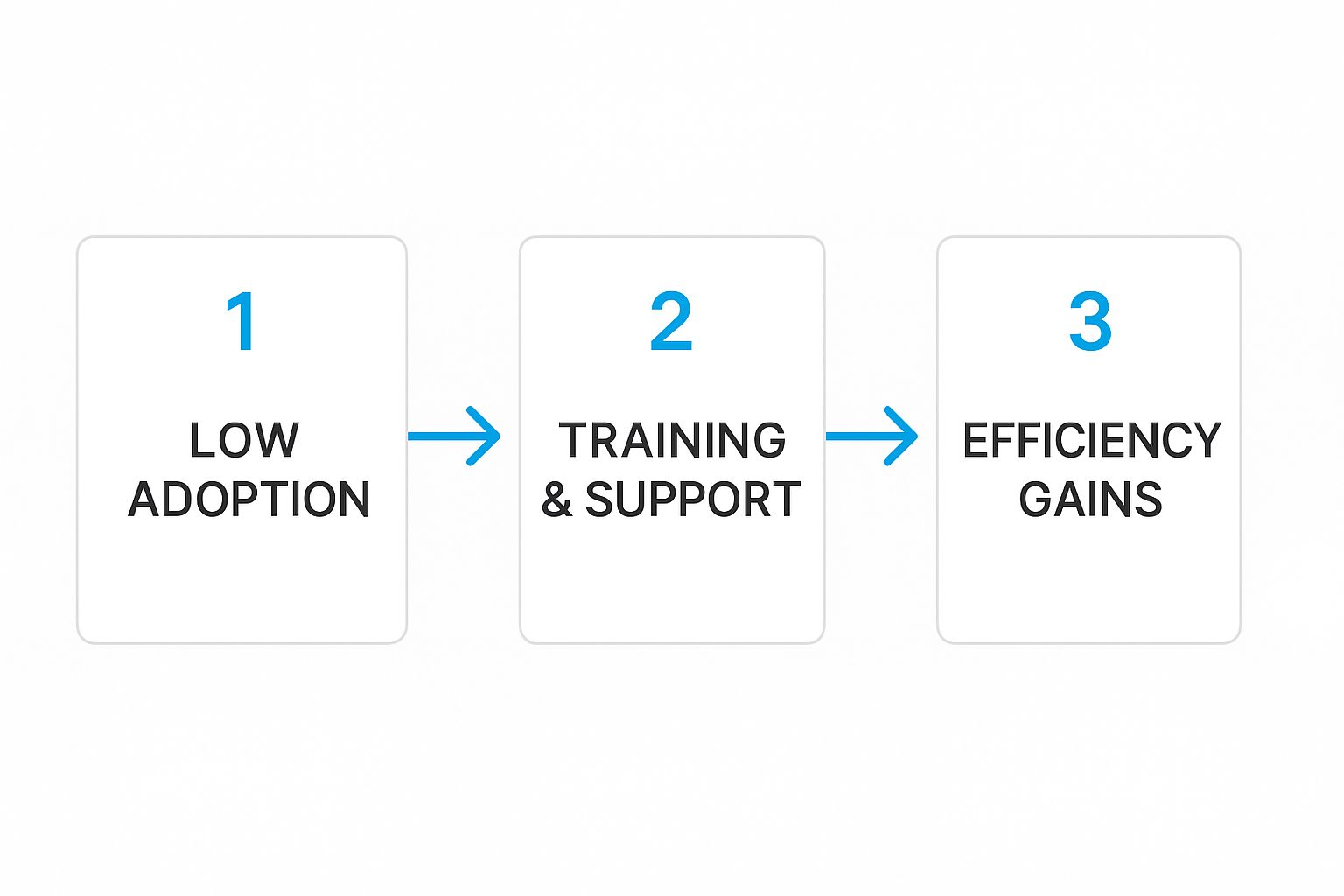
This demonstrates how overcoming initial learning curves with effective training leads directly to better performance. With a successful pilot, you have the evidence needed to scale the solution to other teams and regions. This measured approach is why experts predict that over 50% of field service deployments will include mobile AR tools by 2025—a significant increase from less than 10% in 2019. The growth is driven by the undeniable value AR delivers when implemented correctly.
Your Top Questions About AR in Field Service, Answered
Adopting any new technology raises questions. When considering a move to an augmented reality field service solution, you need practical answers, not just buzzwords. You need to understand how this will affect your team, your current systems, and your budget.
This section addresses those common questions directly to provide the straightforward information you need to move forward with confidence.
"What Kind of Network Do We Actually Need for This to Work?"
This is a frequent and important question. Remote expertise is only valuable if the connection is reliable.
The good news is that a complete infrastructure overhaul is likely unnecessary. Most modern AR platforms are designed to run smoothly on standard cellular networks like 4G LTE.
For a clear, two-way video call with on-screen annotations, a connection of about 5-10 Mbps is ideal. However, leading platforms are designed to handle less-than-perfect signals.
- Adaptive Streaming: The system automatically adjusts video quality to match network strength, maintaining call stability even in areas with spotty coverage.
- Offline Access: For guided instructions or digital manuals, technicians can download necessary materials beforehand, ensuring access to critical information even without a network connection.
- The 5G Advantage: As 5G becomes more widespread, its low latency and high bandwidth will enable even more powerful, data-intensive AR experiences.
"How Long Will It Take to Get My Techs Up to Speed?"
You might be surprised by how quickly your team adopts this technology. Learning to use an AR headset is often far simpler than mastering a new piece of complex industrial machinery. Most AR applications are designed with a familiar, user-friendly interface similar to apps your technicians already use on their phones.
Simplicity is a key design principle. A typical training session to familiarize a technician with core functions—like starting a remote call or accessing a workflow—can often be completed in a couple of hours.
True proficiency develops with use, but the hands-on nature of the technology facilitates rapid adoption. After a few real service calls using AR, most technicians become self-sufficient. This rapid onboarding is a major reason why AR is so effective at closing skills gaps quickly.
"How Does This Plug Into Our Existing Software?"
This is a critical consideration. A new tool should enhance, not complicate, existing workflows. It needs to integrate seamlessly with the software your team already uses, such as a Field Service Management (FSM) or Enterprise Asset Management (EAM) system.
Leading augmented reality field service platforms are built for integration. They use APIs (Application Programming Interfaces) to create a seamless, two-way flow of information.
- Launch from the Work Order: A technician can initiate an AR remote support call directly from the work order in their FSM application.
- Sync Automatically: All photos, videos, and notes captured during an AR session can be automatically saved back into the work order or asset history, creating a digital record.
- Instant Asset Info: Technicians can scan a QR code on a machine, and the AR platform can instantly pull up the correct service manuals and repair history from your EAM.
This deep integration makes AR a natural part of the workflow, not an interruption.
"What Are the Best Ways to Measure the ROI?"
To prove the value of your AR investment, look beyond the upfront software and hardware costs. The real return lies in the operational efficiencies and cost savings it generates. To build a powerful business case, track a few key metrics that speak directly to the bottom line.
Focus on these key performance indicators:
- First-Time Fix Rate (FTFR): This is a primary metric. Track the percentage of jobs resolved on the first visit before and after implementing AR. An increase in this number means fewer truck rolls, lower costs, and higher customer satisfaction.
- Mean Time to Repair (MTTR): Measure the average time a repair takes. AR-guided instructions and instant expert access reduce this time, leading to less equipment downtime and more jobs completed per day.
- Expert Travel Costs: Tally the expenses for flights, hotels, and travel time for your senior specialists. This is often the most immediate and significant cost reduction.
- Technician Onboarding Time: Measure how long it takes for a new hire to become a fully productive team member. AR shortens this learning curve, reducing training overhead and accelerating new technicians' contributions.
Tracking these metrics will make the financial and operational impact of an augmented reality field service solution clear.
Ready to see how augmented reality can drive measurable results for your team? AIDAR Solutions provides immersive AR and VR applications that cut service times in half, reduce expert travel by 75%, and accelerate workforce training. Discover our tailored solutions and start your journey today.


Comment(01)