5 Production Innovation Examples to Boost Efficiency
In a competitive landscape, 'innovation' is more than a popular term; it's the core driver of efficiency, profitability, and market leadership. While transforming production is an exciting prospect, managers and engineers need concrete strategies, not just abstract ideas. This article cuts through the noise to provide a deep dive into proven production innovation examples, moving from foundational methodologies like Lean Manufacturing to cutting-edge digital transformations like Industry 4.0.
We will analyze the mechanics behind each example, providing a strategic breakdown of its implementation, quantifiable benefits, and actionable takeaways. More importantly, we explore how emerging immersive technologies like Augmented Reality (AR) and Virtual Reality (VR) are supercharging these innovations.
For instance, VR solutions can drastically accelerate the adoption of complex methodologies by providing risk-free, hands-on virtual training for assembly or maintenance procedures. Similarly, tools that leverage AR can amplify operational effectiveness by connecting frontline workers with remote experts, using AR overlays to guide complex tasks in real-time. This list is a practical playbook for leaders ready to implement changes that deliver measurable results, demonstrating how each innovation, enhanced by AR/VR, can revolutionize your operations.
1. Lean Manufacturing: The Foundation of Waste Elimination
Lean manufacturing is a production methodology centered on systematically eliminating waste (muda) within a manufacturing system while maximizing productivity and customer value. Originating from the Toyota Production System (TPS), it is a foundational concept that drives many modern production innovation examples. The core idea is to produce only what is needed, when it is needed, and with the minimum amount of materials, equipment, and labor.
This philosophy is built on principles like Just-In-Time (JIT) production, continuous improvement (kaizen), and empowering employees to identify and solve problems. By focusing on the seven types of waste (overproduction, waiting, transport, over-processing, inventory, motion, and defects), companies can streamline operations, reduce costs, and improve quality.
Strategic Analysis: Why Lean is Foundational
Lean isn't just a set of tools; it's a cultural shift. It creates an environment where efficiency is everyone's responsibility. This makes it the perfect groundwork for introducing advanced technologies like AR and VR.
Key Insight: A lean culture actively seeks out inefficiencies. This makes teams more receptive to adopting innovative tools like AR, as they can clearly see how the technology targets specific wastes, such as unnecessary motion or defects from human error.
Actionable Takeaways & Implementation
- Map Your Value Stream: Before implementing any changes, use Value Stream Mapping (VSM) to visualize your current production process. Identify every step, from raw material to final product, and pinpoint areas of waste.
- Empower Your Team: Train employees in lean principles and give them the authority to suggest and implement improvements. This creates a culture of continuous improvement from the ground up.
- Integrate AR for Precision: Use Augmented Reality to enhance lean practices. For example, AR-guided workflows can overlay step-by-step instructions directly onto a worker's field of view, drastically reducing errors (defects) and search time (motion). This modernizes the traditional lean approach for today's complex manufacturing environment.
2. Additive Manufacturing (3D Printing): Beyond Prototypes
Additive manufacturing, commonly known as 3D printing, is a transformative production process that builds three-dimensional objects layer-by-layer from a digital file. Unlike traditional subtractive methods that cut material away from a larger block, this approach adds material only where needed, enabling the creation of complex, lightweight, and highly customized geometries.
This technology has moved far beyond simple prototyping. Companies in aerospace now produce critical jet engine components, and the medical industry creates millions of custom dental aligners, showcasing its power in mass customization and high-performance applications. This method is a prime example of a production innovation that unlocks new design possibilities while minimizing material waste. Learn more about how additive manufacturing is reshaping industries.
Strategic Analysis: Why Additive is a Game-Changer
Additive manufacturing breaks the constraints of traditional tooling. It allows for rapid design iteration, on-demand production of spare parts, and the creation of products with internal structures that are impossible to machine or mold. This capability fundamentally changes supply chain dynamics and product development cycles.
Key Insight: The true value of 3D printing isn't just making existing parts cheaper; it's about designing and producing entirely new types of products. It shifts the focus from "design for manufacturability" to "manufacturing for design-driven innovation."
Actionable Takeaways & Implementation
- Identify High-Value Applications: Start by targeting low-volume, high-complexity parts, custom tools, or jigs and fixtures where the benefits of customization and speed outweigh higher per-unit costs.
- Design for Additive (DfAM): Train your design and engineering teams on DfAM principles. This involves optimizing part geometry for strength, light-weighting, and minimizing the need for support structures during printing.
- Integrate AR for Quality Assurance: Use AR to overlay a digital twin of the CAD model onto a finished 3D-printed part. This allows for rapid, precise quality control and verification, ensuring that complex geometries meet exact specifications without cumbersome manual measurement.
3. Industry 4.0 / Smart Manufacturing
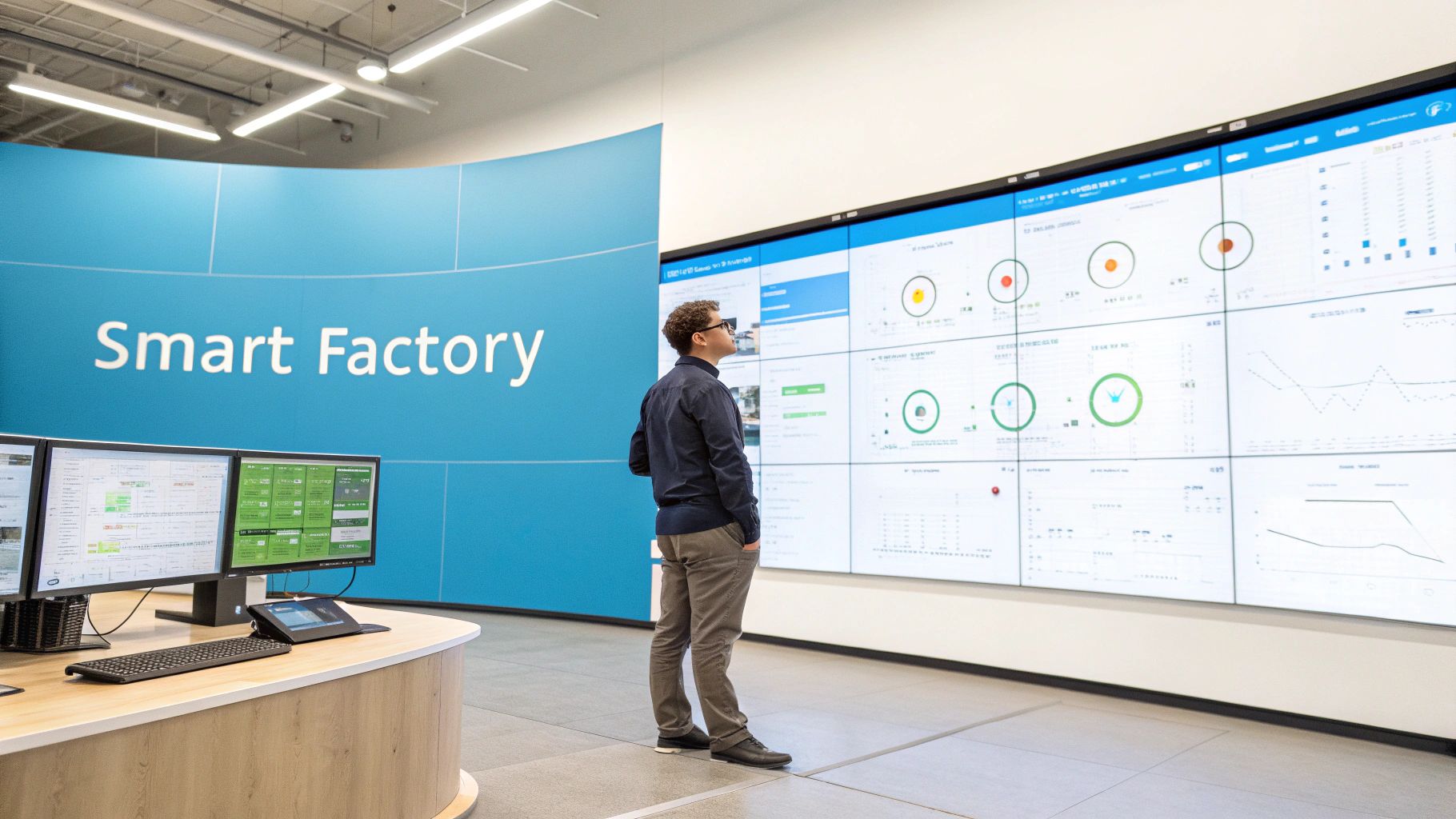
Industry 4.0, or Smart Manufacturing, represents the fourth industrial revolution, driven by the integration of digital technologies like the Internet of Things (IoT), AI, and cloud computing directly into production processes. This fusion of the physical and digital worlds creates a "smart factory" where machines, systems, and people communicate in real-time. This interconnected ecosystem enables autonomous decision-making, predictive maintenance, and unprecedented operational transparency.
Leading companies have pioneered this approach, transforming their facilities into highly efficient, data-driven operations. By collecting and analyzing vast amounts of data from sensors and equipment, they can preemptively address maintenance needs, optimize energy consumption, and adapt production lines dynamically to changing demands, showcasing powerful production innovation examples in action.
Strategic Analysis: Why Industry 4.0 is Transformative
Industry 4.0 is not merely about automation; it's about creating intelligent, self-optimizing production environments. This shift allows manufacturers to move from a reactive "break-fix" model to a proactive, predictive one, which is a cornerstone of modern manufacturing innovations. To better understand how modern production models integrate with these trends, you might explore this insightful guide to Smart Manufacturing.
Key Insight: The core value of Industry 4.0 is its ability to turn data into actionable intelligence. This intelligence is the foundation for enhancing decision-making, improving efficiency, and unlocking new business models based on production agility and customization.
Actionable Takeaways & Implementation
- Start with a Pilot Project: Begin your Industry 4.0 journey by implementing a focused pilot project, such as predictive maintenance on a single critical production line. This minimizes risk and demonstrates ROI before a full-scale rollout.
- Prioritize Cybersecurity: As you connect more devices, your vulnerability to cyber threats increases. Integrate robust cybersecurity protocols from the outset to protect your operational technology (OT) and intellectual property.
- Leverage VR for System Design: Use Virtual Reality to simulate and test new smart factory layouts or robotic cell integrations before physical implementation. This digital twinning approach de-risks capital investment and optimizes workflows virtually, ensuring a smoother transition to an interconnected system.
4. Six Sigma: Data-Driven Pursuit of Perfection
Six Sigma is a disciplined, statistical-based methodology that aims to eliminate defects and reduce variability in any business or manufacturing process. Developed at Motorola in the 1980s, its goal is to achieve near-perfect quality, allowing no more than 3.4 defects per million opportunities. This is accomplished through a structured problem-solving framework, most commonly DMAIC (Define, Measure, Analyze, Improve, Control).
By focusing on quantifiable data and statistical analysis, Six Sigma moves quality control from a reactive "find and fix" model to a proactive, predictive science. It identifies the root causes of errors and implements sustainable solutions, making it a powerful example of process-driven production innovation. Companies across sectors have used it to enhance product safety, streamline operations, and drastically reduce costly waste.
Strategic Analysis: Why Six Sigma Creates Predictability
Six Sigma’s core strength is its ability to make processes predictable and repeatable. By systematically removing variation, it creates a stable operational foundation where quality is not an accident but an engineered outcome. This stability is crucial before layering on more complex digital solutions.
Key Insight: A process controlled by Six Sigma principles is highly standardized. This makes it an ideal candidate for automation or AR-enhanced workflows, as the technology can be applied to a consistent, well-understood procedure, maximizing ROI and minimizing implementation risks.
Actionable Takeaways & Implementation
- Define High-Impact Projects: Start with a critical process where defects or variability have a significant financial impact. Use the DMAIC framework to structure your improvement project.
- Invest in Training: Proper training and certification (e.g., Green Belt, Black Belt) are essential. Empowered experts are needed to lead projects and analyze data effectively using statistical software.
- Enhance with VR Training: Use Virtual Reality to create simulated environments for Six Sigma training. Trainees can practice identifying process variations and testing improvement theories in a risk-free digital space, accelerating their learning and problem-solving skills before they touch the actual production line.
5. Agile Manufacturing: Mastering Flexibility and Speed
Agile manufacturing is a production methodology designed for rapid response to unpredictable market changes and customer demands. While sharing roots with Lean in its focus on efficiency, Agile prioritizes flexibility and adaptability above all else. Its goal is to thrive in a high-variety, fast-changing environment, enabling companies in industries like fashion and consumer electronics to rapidly iterate on products and meet fluctuating demand.
This approach relies on modular product design, cross-functional teams, and highly adaptable technology and processes. Unlike traditional mass production, which excels at making one thing cheaply, Agile excels at making many things quickly. It represents a crucial step in modern production innovation examples, where speed to market is a primary competitive advantage.
Strategic Analysis: Why Agile Thrives in Modern Markets
Agile isn't just about being fast; it's about being strategically responsive. It allows a company to pivot production based on real-time data, from customer feedback to supply chain disruptions. This creates a resilient and market-aligned manufacturing operation.
Key Insight: Agile manufacturing turns market volatility from a threat into an opportunity. By building a system capable of rapid changeovers and customization, a company can capture niche markets and react to trends faster than competitors locked into rigid production schedules.
Actionable Takeaways & Implementation
- Implement Modular Design: Design products with interchangeable components or modules. This simplifies assembly, allows for easy customization, and accelerates the introduction of new product variations without overhauling the entire production line.
- Invest in Flexible Automation: Utilize robotics and automation systems that can be quickly reprogrammed for different tasks or products. This reduces dependency on specialized, single-purpose machinery and supports rapid production pivots.
- Leverage VR for Prototyping: Use Virtual Reality to test and refine assembly line configurations for new products before committing to physical changes. VR simulations allow teams to validate workflows, identify bottlenecks, and train operators on new processes in a virtual environment, drastically accelerating the switch-over time between product runs.
6. Kaizen (Continuous Improvement): Small Steps, Giant Leaps
Kaizen is a Japanese management philosophy that translates to "change for the better" or "continuous improvement." It is a cultural cornerstone where small, incremental changes are consistently made across all functions of a business, from the CEO to the assembly line worker. Rather than waiting for large-scale, disruptive innovation, Kaizen focuses on empowering every employee to identify and solve minor problems daily, creating a compound effect of significant long-term gains.
This approach, famously implemented by manufacturers like Toyota, creates a culture of perpetual enhancement. By involving everyone in the improvement process, companies have optimized production lines, reduced waste, and boosted morale, making it one of the most powerful and enduring production innovation examples.
Strategic Analysis: Why Kaizen Cultivates Innovation
Kaizen democratizes innovation. It shifts the responsibility for improvement from a dedicated R&D department to the entire workforce, tapping into the collective intelligence of those closest to the actual work. This fosters deep engagement and ownership.
Key Insight: A Kaizen culture makes teams agile and receptive to new tools. When employees are already trained to spot inefficiencies, introducing technologies like AR for remote assistance becomes a natural evolution, not a forced mandate. They see it as another tool to solve problems more effectively.
Actionable Takeaways & Implementation
- Establish Suggestion Systems: Create a clear, simple process for employees to submit improvement ideas. Ensure feedback is fast and transparent to maintain momentum.
- Use Visual Management: Employ tools like Kanban boards or digital dashboards to track suggested improvements, their implementation status, and their impact. This makes progress visible and motivating.
- Enhance with AR Remote Support: Use Augmented Reality to supercharge your Kaizen events. When a team identifies a machine issue, an operator can instantly connect with a remote expert via AR, who can annotate their live view to guide the fix. This accelerates the problem-solving cycle and rapidly upskills the local team.
7. Robotic Process Automation (RPA)
Robotic Process Automation (RPA) is a production innovation example that uses software "bots" to automate repetitive, rules-based digital tasks. Unlike physical robots, RPA operates on user interfaces to mimic human actions like data entry, processing transactions, and communicating with other digital systems. It's designed to handle high-volume administrative and operational workloads, freeing human employees for more complex, value-added activities.
This technology automates workflows across disparate applications without requiring deep systems integration. Expanding beyond traditional industrial robotics, the realm of Robotic Process Automation (RPA) also encompasses the automation of digital tasks using sophisticated IT process automation software. Businesses can build, deploy, and manage these software bots efficiently to streamline operations.
Strategic Analysis: Why RPA is a Digital Accelerator
RPA acts as a digital workforce that bridges gaps between legacy systems and modern applications. It streamlines back-office operations that support production, such as order processing, inventory management, and compliance reporting. This automation enhances speed, accuracy, and scalability without the high cost of custom software development.
Key Insight: RPA delivers a rapid return on investment by targeting high-volume, low-complexity tasks first. This allows organizations to build momentum for digital transformation and fund more ambitious automation projects with the initial cost savings.
Actionable Takeaways & Implementation
- Identify High-Impact Processes: Begin with tasks that are highly repetitive, prone to human error, and rule-based. Examples include generating production reports, processing invoices, or updating inventory records in an ERP system.
- Document and Standardize: Before automating, thoroughly document the existing process. Standardization is key, as bots require clear, unambiguous instructions to operate effectively.
- Start Small and Scale: Launch a pilot project to automate a single, well-defined process. Use this pilot to measure ROI, refine your implementation strategy, and demonstrate value to stakeholders before scaling across the organization.
8. Total Productive Maintenance (TPM)
Total Productive Maintenance (TPM) is a comprehensive strategy for maximizing equipment effectiveness by involving all employees in maintenance efforts. Evolving from preventive maintenance concepts, TPM shifts the responsibility for routine maintenance from dedicated technicians to the machine operators themselves. This creates a culture of ownership and proactive care, aiming to eliminate breakdowns, defects, and accidents.
The methodology is built on pillars such as autonomous maintenance, planned maintenance, and focused improvement. By empowering operators to clean, inspect, and lubricate their own equipment, TPM frees up skilled maintenance staff to focus on more complex predictive and preventative tasks, making it a powerful production innovation example.
Strategic Analysis: Why TPM is a Cultural Catalyst
TPM fundamentally changes the relationship between operators and their machines. It's not just a maintenance schedule; it's a philosophy that equipment health is a shared responsibility. This empowers the frontline workforce and builds a deep, practical understanding of equipment operations across the entire team.
Key Insight: An empowered operator who understands their machine is the first line of defense against downtime. TPM creates an environment where potential issues are identified and addressed long before they become critical failures, directly boosting Overall Equipment Effectiveness (OEE).
Actionable Takeaways & Implementation
- Launch Autonomous Maintenance: Start by training operators on basic maintenance tasks for their specific workstations. This includes cleaning, inspection, and lubrication (CIL) routines. This initial step builds ownership and confidence.
- Establish OEE as a Core KPI: Track Overall Equipment Effectiveness (Availability, Performance, and Quality) to measure the impact of your TPM program. Use this data to identify chronic issues and guide improvement efforts.
- Enhance with AR and Predictive Tech: Equip operators and technicians with AR-powered smart glasses to display digital maintenance checklists and schematics. This ensures tasks are done correctly and consistently. Integrating this with predictive maintenance tools allows your team to address potential failures flagged by sensors, transforming TPM into a highly data-driven process.
9. Digital Twin Technology: Virtualizing Production for Predictive Power
Digital twin technology involves creating a virtual, real-time replica of a physical asset, process, or system. This dynamic model is fed constant data from IoT sensors, allowing it to mirror the exact state and condition of its real-world counterpart. This concept enables manufacturers to simulate, predict, and optimize operations without any physical risk.
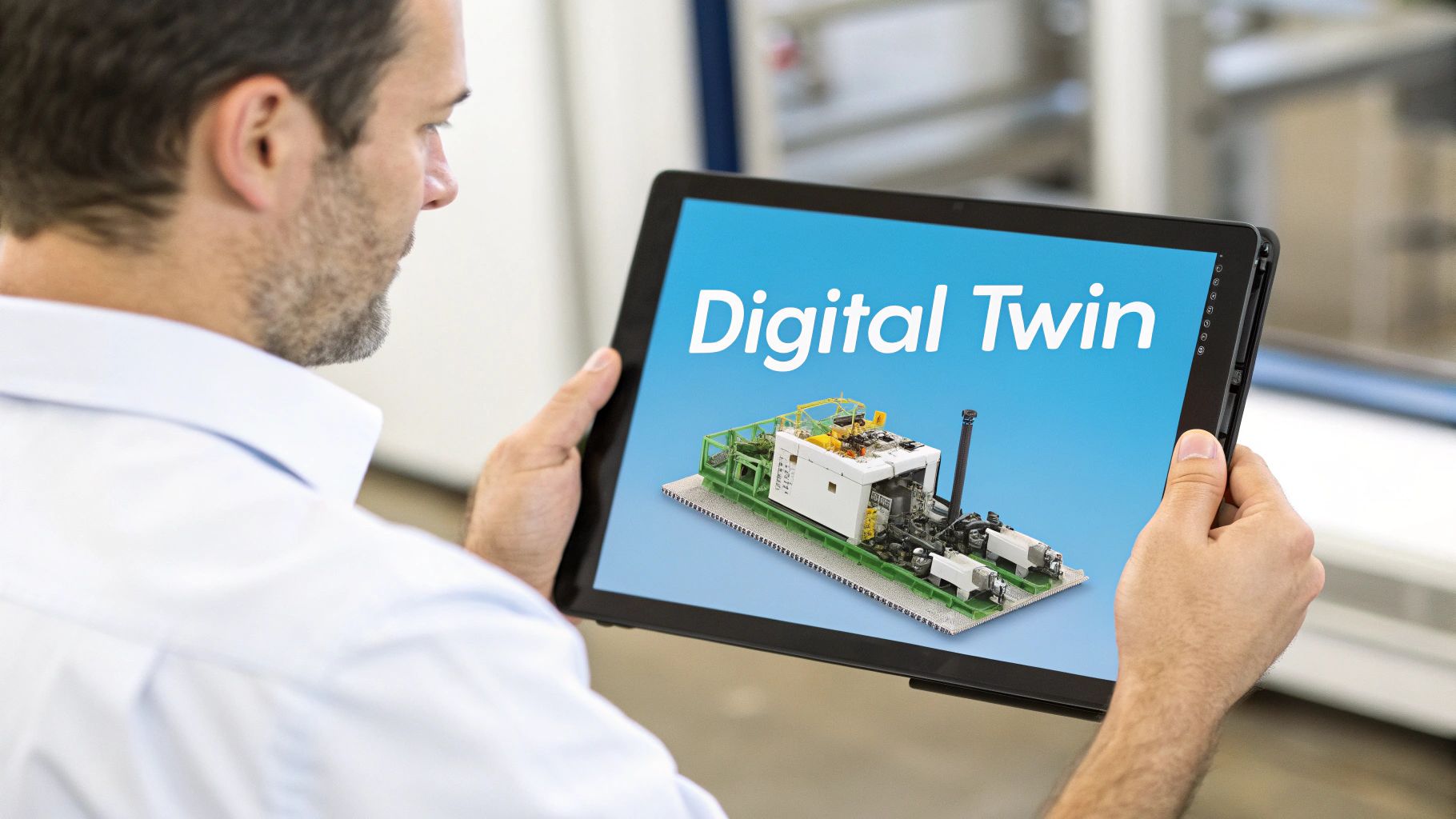
By bridging the physical and digital worlds, a digital twin can run thousands of "what-if" scenarios, from testing a new production layout to predicting equipment failure before it happens. This makes it one of the most powerful production innovation examples for achieving proactive, data-driven decision-making.
Strategic Analysis: Why Digital Twins Unlock Predictive Insight
Digital twins move operations from a reactive state (fixing problems after they occur) to a predictive one (preventing them entirely). They serve as a risk-free sandbox where new ideas and process changes can be validated virtually, saving immense time and capital.
Key Insight: The true power of a digital twin lies in its ability to forecast future performance based on real-time data. This allows for predictive maintenance schedules that drastically reduce unplanned downtime and optimize asset lifecycle management.
Actionable Takeaways & Implementation
- Start with a Critical Asset: Begin your digital twin journey by focusing on a single, high-value piece of equipment or a bottleneck process. This allows you to prove ROI and refine your data strategy on a manageable scale.
- Establish a Robust Data Pipeline: Ensure you have reliable IoT sensors and a solid infrastructure to collect, process, and validate data in real-time. Data quality is the foundation of an effective digital twin.
- Integrate VR for Immersive Analysis: Use Virtual Reality to step inside your digital twin. Engineers and operators can interact with the virtual model to visualize data, troubleshoot complex issues, and train on simulated emergency scenarios in a safe, immersive environment. If you want to explore this concept further, you can learn more about the differences and synergies between digital twins and simulations on aidarsolutions.com.
10. Mass Customization: Delivering Personalization at Scale
Mass customization is a powerful production strategy that bridges the gap between the efficiency of mass production and the personalization of custom manufacturing. It enables companies to offer tailored products that meet individual customer needs at a cost and speed comparable to standard mass-produced goods. This approach relies heavily on modular design, flexible manufacturing systems, and robust IT integration, allowing customers to configure products from personal computers to vehicles.
This production innovation example flips the traditional "one-size-fits-all" model on its head. By creating a system of interchangeable modules and components, manufacturers can offer variety without sacrificing the economies of scale. The result is a highly responsive production line that assembles products to order, directly based on customer specifications.
Strategic Analysis: Why Mass Customization Wins Markets
This strategy shifts the value proposition from simply providing a product to co-creating a solution with the customer. It fosters higher customer loyalty and allows companies to command premium prices by offering unique value that competitors with standardized products cannot match.
Key Insight: Mass customization transforms the supply chain from a forecast-driven model to a demand-driven one. This drastically reduces the risk of overproduction and obsolete inventory, directly addressing two of the most significant wastes identified in lean manufacturing.
Actionable Takeaways & Implementation
- Embrace Modular Design: Break down your products into a core platform and a set of interchangeable modules. This is the foundational step that makes customization manageable and cost-effective.
- Invest in a Product Configurator: Develop user-friendly online tools that allow customers to easily visualize and select their desired options. This simplifies the ordering process and feeds data directly into your production system.
- Leverage AR for Assembly: Use Augmented Reality to guide technicians through the assembly of unique product configurations. AR overlays can display the correct sequence and specific components for each custom order, minimizing errors and speeding up the final assembly-to-order process. This is a critical tool for managing high-variety, low-volume production runs efficiently.
10 Production Innovations Compared
| Method | 🔄 Implementation Complexity | ⚡ Resource Requirements & Speed | 📊 Expected Outcomes & Key Advantages | Use Cases | 💡 Tips |
|---|---|---|---|---|---|
| Lean Manufacturing | 🔄 High — cultural change, ongoing management | ⚡ Moderate upfront investment; improves throughput/lead time | 📊 Waste reduction 20–40%, cost savings; ⭐ Improved quality & flexibility | Continuous production, automotive, large assembly lines | 💡 Start with value-stream mapping; involve frontline; implement 5S |
| Additive Manufacturing (3D Printing) | 🔄 Moderate — new design/process thinking required | ⚡ Variable investment; fast prototyping, slower for high-volume | 📊 Material waste ↓ up to 90%; ⭐ Enables complex geometries & customization | Prototyping, low-volume complex parts, custom medical/aviation parts | 💡 Optimize designs for AM; plan post-processing; use hybrid workflows |
| Industry 4.0 / Smart Manufacturing | 🔄 Very high — IT/OT integration and systems complexity | ⚡ High infrastructure & data costs; enables real-time gains | 📊 Downtime ↓ 50%+, higher throughput & visibility; ⭐ Predictive, data-driven operations | Factories needing predictive maintenance, real-time analytics, advanced automation | 💡 Pilot before scale; invest in cybersecurity and workforce training |
| Six Sigma | 🔄 High — extensive training, structured statistical methods | ⚡ Significant training/time investment; results emerge over months–years | 📊 Major defect reduction; typical ROI 4–6x in 3–5 years; ⭐ High process quality/control | Quality-critical manufacturing and large process-improvement projects | 💡 Secure executive sponsorship; focus projects on high-impact areas; use DMAIC |
| Agile Manufacturing | 🔄 Medium — requires flexible systems and cross-functional teams | ⚡ May raise initial costs; enables rapid market response and iteration | 📊 Faster time-to-market; ⭐ High responsiveness and customization capability | Fast-fashion, electronics, markets with volatile demand | 💡 Use modular design; cross-train staff; maintain fast feedback loops |
| Kaizen (Continuous Improvement) | 🔄 Low–Medium — cultural commitment and steady practice | ⚡ Low-cost incremental actions; slow cumulative speed gains | 📊 Sustainable improvements and engagement; ⭐ High employee involvement & morale | Any organization aiming for continuous small gains | 💡 Establish suggestion systems; recognize contributors; track small wins |
| Robotic Process Automation (RPA) | 🔄 Low–Moderate — fits rule-based processes, simple deployment | ⚡ Low infrastructure change; very fast processing (10–30x) | 📊 Labor cost ↓ 50–70% in targeted areas; ⭐ High accuracy for repetitive tasks | Back-office finance, HR, legacy system automation | 💡 Start with high-volume, well-documented processes; plan change management |
| Total Productive Maintenance (TPM) | 🔄 Medium–High — training, cultural adoption, data collection | ⚡ Investment in monitoring and training; reduces downtime substantially | 📊 Downtime ↓ 50–80%, longer equipment life; ⭐ Improved OEE and safety | Asset-intensive plants: automotive, pharma, food & beverage | 💡 Start with critical equipment; use CMMS; train operators in autonomous maintenance |
| Digital Twin Technology | 🔄 Very high — complex data integration and modeling | ⚡ High investment in data infrastructure; enables fast scenario testing | 📊 Predicts failures, optimizes operations; ⭐ High-fidelity decision support & simulation | R&D, critical equipment/process optimization, large-scale plants | 💡 Start small (critical asset); ensure data quality and cybersecurity from day one |
| Mass Customization | 🔄 High — complex supply-chain coordination and systems | ⚡ Higher per-unit complexity/cost; can approach mass speeds with modularity | 📊 Increased customer satisfaction and premium pricing; ⭐ Strong market differentiation | Consumer goods with personalization (shoes, PCs, vehicles) | 💡 Limit option sets; use modular architectures and configuration software |
From Theory to Reality: Your Next Steps in Production Innovation
Throughout this deep dive, we have explored a powerful spectrum of production innovation examples, moving from the foundational philosophies of Lean Manufacturing and Kaizen to the disruptive technological shifts of Industry 4.0 and Digital Twins. Each case illustrates a core truth: innovation is the engine of competitive advantage.
The most critical insight, however, is not found in any single methodology but in their modern-day convergence. These proven strategies are no longer isolated initiatives. Their true potential is unleashed when they are amplified by immersive technologies like augmented and virtual reality. AR and VR act as the crucial bridge between abstract data and tangible action on the production floor.
The Synergy of Strategy and Technology
The examples have shown that the most successful companies are not just adopting one new thing; they are creating a powerful synergy. Imagine implementing Total Productive Maintenance (TPM) not with paper checklists, but with AR overlays guiding technicians through complex procedures in real time. Consider training new team members on intricate Agile Manufacturing cell changeovers in a risk-free, hyper-realistic VR environment, cutting ramp-up time in half.
This fusion transforms complex concepts into intuitive, actionable steps:
- Accelerated Learning: VR can simulate complex Six Sigma problem-solving scenarios, allowing teams to practice and master DMAIC principles without impacting live production.
- Enhanced Execution: AR provides on-the-spot guidance for Kaizen events, overlaying digital instructions onto physical equipment to ensure changes are implemented correctly the first time.
- Democratized Expertise: A technician struggling with a robotic process automation (RPA) bot can use an AR-powered remote assistance tool to get immediate expert help, drastically reducing downtime.
Charting Your Path Forward
The journey toward a more innovative, resilient, and intelligent operation begins with a single, focused question: What is your most significant production bottleneck right now? Is it employee training and skill gaps? Unexpected equipment downtime? Quality control and high defect rates?
Once you pinpoint that primary pain point, you can strategically map the right production innovation methodology, and just as importantly, the right immersive tool to solve it. Don't view these as massive, all-or-nothing transformations. Start with a targeted pilot project focused on a high-impact area. By embracing this powerful synergy between proven industrial strategies and next-generation immersive tools, you move beyond merely reading about production innovation examples and begin to create your own success story.
Ready to turn these innovative concepts into tangible results on your factory floor? Explore how AR-powered platforms can help you seamlessly integrate remote assistance, digital work instructions, and immersive training into your operations. Visit AIDAR Solutions to see how leading enterprises bridge the gap between their workforce and their technology.