
Preventive maintenance and predictive maintenance: Guide
At the heart of it, the difference between preventive and predictive maintenance boils down to one thing: timing. Preventive maintenance is all about sticking to a schedule, performing tasks at set intervals like clockwork. Predictive maintenance, on the other hand, is about listening to your equipment and acting only when the data tells you it's necessary.
The choice you make hinges on whether you value routine consistency or data-driven precision more.
Understanding Proactive Maintenance Strategies
Getting away from the "fix-it-when-it-breaks" treadmill is the first real step toward operational excellence. Proactive strategies are designed to stop failures before they start, but they go about it in completely different ways. The two most common approaches, preventive and predictive maintenance, offer unique philosophies for protecting your assets and keeping things running smoothly.
Grasping how each one works is fundamental to building a maintenance program that's genuinely resilient. Each has its own playbook, its own set of benefits, and its own ideal scenarios.
The Foundation of Maintenance Planning
Preventive maintenance is the time-tested, foundational method. It runs on a fixed schedule, not unlike getting your car's oil changed every 5,000 miles.
- Trigger: Maintenance happens based on the calendar (say, every quarter) or usage (like every 1,000 hours of operation).
- Methodology: Technicians work through a predetermined checklist—lubrication, inspections, parts swaps—no matter how the asset is actually performing at that moment.
- Goal: The aim is simple: reduce the odds of a failure by servicing equipment before problems are expected to show up, based on past experience and averages.
In stark contrast, predictive maintenance is a more dynamic, intelligent philosophy. It uses technology to hear what the equipment is actually saying in real time. For a deeper dive into this approach, check out our guide on effective maintenance problem-solving strategies.
- Trigger: The work order is initiated by real data from sensors tracking things like vibration, temperature, or other vital signs that whisper of an impending failure.
- Methodology: This is where AI and machine learning algorithms come in. They analyze the data streams to forecast when a component is likely to fail, letting teams step in with surgical precision.
- Goal: To perform maintenance at the perfect moment—just before failure strikes—which maximizes the life of the asset and cuts out wasted effort.
Of course, shifting to a fully predictive model isn't without its challenges. Many companies are wrestling with older equipment—a major hurdle for 67% of managers—along with tight budgets and a simple lack of familiarity with the new tech. You can discover more insights about maintenance trends on infraspeak.com to see the bigger picture.
| Aspect | Preventive Maintenance (Time-Based) | Predictive Maintenance (Condition-Based) |
|---|---|---|
| Trigger | Fixed schedule (time or usage) | Real-time asset data and analytics |
| Data Reliance | Low (manufacturer specs, historical averages) | High (IoT sensors, AI, machine learning) |
| Cost Profile | Lower initial cost, potential for over-servicing | Higher initial investment, lower long-term costs |
| Efficiency | Can lead to unnecessary labor and parts replacement | Optimizes resources by acting only when needed |
Comparing Maintenance Approaches In-Depth
To really get the difference between preventive and predictive maintenance, you have to look past the textbook definitions and see how they play out on the factory floor. Their core philosophies, data appetites, and cost structures are worlds apart, leading to completely different outcomes. The right choice for you will always come down to the specific asset, its role in your operation, and how much risk you’re willing to stomach.
This decision tree gives you a great visual on the fundamental choice: do you follow a schedule (preventive), or do you listen to what your machines are telling you in real time (predictive)?
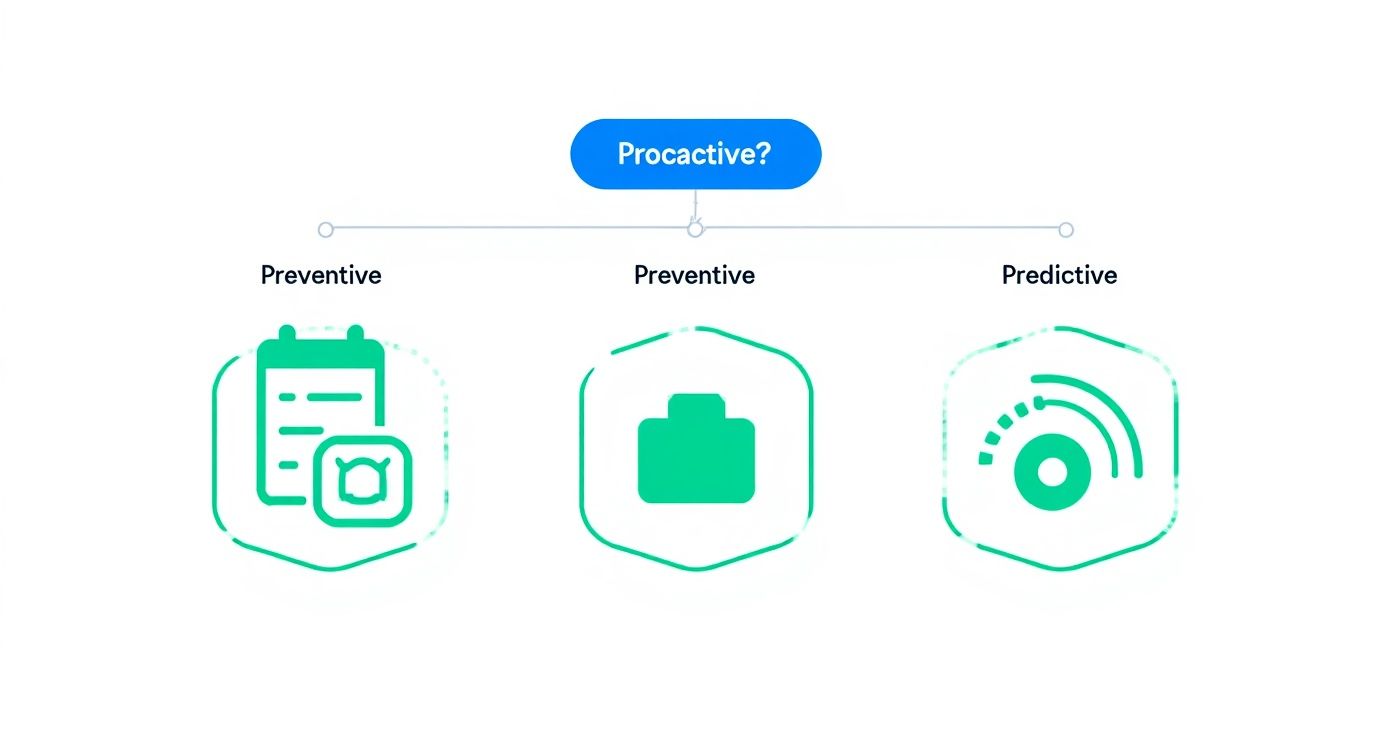
As the graphic shows, both are proactive strategies. But one is guided by the calendar, while the other is guided by live data coming straight from your equipment.
Preventive vs Predictive Maintenance A Strategic Comparison
Diving deeper, the strategic differences between these two approaches become much clearer. This table breaks down the comparison across key operational, financial, and technological criteria to help you see where each one shines.
| Criterion | Preventive Maintenance | Predictive Maintenance |
|---|---|---|
| Trigger | Time-based or usage-based schedule (e.g., every 90 days, every 1,000 hours). | Real-time data and analytics indicating a potential failure. |
| Methodology | Perform routine service regardless of the asset’s current condition. | Intervene only when data-driven forecasts predict an issue. |
| Data Needs | Minimal. Relies on manufacturer specs and historical averages. | Extensive. Requires IoT sensors, data pipelines, and machine learning models. |
| Cost Structure | Lower initial cost, but potentially higher long-term costs from unnecessary labor and parts. | Higher upfront investment in tech, but significant long-term savings. |
| Asset Longevity | Helps prevent neglect but can shorten component life by replacing parts too early. | Maximizes the life of every component by addressing issues just in time. |
| Downtime Impact | Reduces unplanned failures but requires planned downtime for servicing. | Drastically cuts unplanned downtime and minimizes planned service interruptions. |
| Best For | Non-critical assets, assets with predictable failure patterns, or organizations with limited tech resources. | Critical assets, complex machinery, and operations focused on maximizing uptime and efficiency. |
Ultimately, the choice isn't just about swapping one maintenance plan for another. It's about fundamentally changing how you manage your most valuable assets, moving from a "just-in-case" to a "just-in-time" mindset.
Methodology and Triggers
Preventive maintenance runs on a simple, consistent clock. A task gets scheduled because a certain number of days have gone by or a machine has hit a specific number of operating hours. It’s an approach that’s refreshingly straightforward and easy to plan, but it works in a vacuum, completely disconnected from the asset’s actual health.
Predictive maintenance, on the other hand, is only triggered when data flags an incoming failure. Sophisticated algorithms chew through continuous streams of information from sensors monitoring things like vibration, temperature, and oil quality. A maintenance order is only cut when those analytics spot a drift from normal operating conditions, signaling a genuine need to step in.
The key differentiator is this: preventive maintenance assumes wear and tear is a straight, predictable line. Predictive maintenance knows that real-world operating conditions are messy and that failure can speed up or slow down based on countless factors.
Data Dependency and Complexity
The data requirements for each strategy couldn't be more different. Preventive maintenance gets by on historical averages and what the manufacturer recommends, demanding very little in the way of real-time info. Its simplicity is its biggest selling point for organizations that don't have a massive tech infrastructure.
Predictive maintenance, however, is a data-driven beast. It needs a whole ecosystem to work properly:
- IoT Sensors to grab high-quality, real-time operational data.
- Data Processing Pipelines to clean, organize, and manage huge volumes of information.
- Machine Learning Models to analyze patterns and forecast the remaining useful life (RUL) of components.
This complexity means you’ll have a heavier lift at the start, but the payoff is far more precise and actionable intelligence—the very foundation of a modern asset management program.
Cost Implications and Return on Investment
When you stack preventive against predictive maintenance, cost is often the deciding factor. Preventive plans usually have a lower upfront price tag but can quietly drain your budget over time through unnecessary labor and swapping out perfectly good parts.
Predictive maintenance demands a much bigger initial investment in both technology and talent. But the numbers don't lie; studies show this approach can deliver massive returns by:
- Slashing maintenance costs by 25-30%.
- Wiping out 70-75% of unexpected breakdowns.
- Cutting unplanned downtime by a staggering 45%.
The ROI comes from smarter resource allocation. Technicians only intervene when they're actually needed, which maximizes both their efficiency and the lifespan of every single component.
Impact on Asset Longevity
At the end of the day, the goal is to keep your equipment running for as long and as well as possible. Preventive maintenance definitely helps by ensuring regular upkeep, which stops failures caused by simple neglect. The catch is that it can also accidentally shorten a component’s life if you replace parts that still have plenty of miles left on them.
Predictive maintenance extends asset life by getting to the root cause of wear before it spirals out of control. By catching tiny issues like early bearing fatigue or slight misalignment, it prevents the domino effect of damage that often leads to a catastrophic failure. This level of precision ensures you get the full value out of every part without exposing your operation to unnecessary risk, hitting that perfect balance between performance and longevity.
The Business Case for Predictive Maintenance
While preventive maintenance gives you a solid, schedule-based game plan, the move to predictive maintenance (PdM) is more than just a tactical shift. It’s a complete strategic evolution.
Organizations are putting their money behind PdM not just to fix things, but to gain a serious competitive advantage. Why? Because it replaces assumptions with data-backed certainty. It flips the script, turning asset management from a cost center into a value driver.
This whole transition is fueled by a perfect storm of technologies. The Internet of Things (IoT) acts as the sensory nervous system, with countless sensors gathering real-time data on how every piece of equipment is feeling. Then, Artificial Intelligence (AI) and machine learning (ML) step in as the brain, sifting through that data to spot the subtle, almost invisible patterns that scream "failure is coming."
This data-first framework lets businesses see problems on the horizon with stunning accuracy, finally moving beyond reactive chaos and calendar-based guesswork.
The Financial Drivers of Adoption
The main reason everyone is jumping on the PdM bandwagon is its incredible return on investment. Let's be honest: unplanned downtime is one of the biggest profit killers in any industrial operation. By forecasting failures, you can schedule repairs during planned outages, keeping disruptions to a minimum and production humming.
This proactive approach leads directly to big savings. To really appreciate the financial upside, you have to look at the role of precision instruments. For example, understanding the purpose of LVDT sensors in critical industrial applications like gas and steam turbines shows how critical good data is. Collecting precise data is the first and most important step in preventing catastrophic failures in your most valuable assets.
The global predictive maintenance market is exploding, which tells you everything you need to know about its financial impact. It was valued at around USD 10.93 billion and is expected to hit USD 41.90 billion by 2030, growing at a compound annual growth rate (CAGR) of about 25.1%. That growth is all thanks to the widespread adoption of AI, IoT, and big data analytics—all aimed at one thing: predicting failures accurately.
Gaining a Competitive and Sustainable Edge
But it's not just about the immediate cost savings. Predictive maintenance creates wider business advantages that build long-term strength and competitiveness. When equipment is optimized, it runs more efficiently, uses less energy, and produces less waste. That’s a direct win for any company's sustainability goals, lowering its carbon footprint and making better use of resources.
Predictive maintenance redefines what operational excellence looks like. It lets businesses squeeze more life out of their assets, improve product quality with more reliable machinery, and shift maintenance teams from tedious routine checks to high-impact strategic work.
This boost in operational efficiency creates a powerful ripple effect across the entire business.
- Enhanced Safety: Pinpointing potential hazards before they become real problems makes the workplace a whole lot safer for your technicians.
- Optimized Inventory: No more stockpiling parts "just in case." You can move to a just-in-time model, ordering replacements based on data-driven forecasts.
- Improved Planning: When you know what’s going to fail and when, planning becomes a breeze. You can schedule labor, order parts, and coordinate work with incredible precision, smoothing out your entire operational workflow.
Ultimately, the business case for predictive maintenance is about building an operation that’s more resilient, more efficient, and more forward-thinking. By embracing a truly data-driven approach, you can unlock new levels of performance and lock in a lasting advantage. For anyone ready to make the leap, diving into the details of condition monitoring and predictive maintenance is the essential next step.
How XR Solutions Elevate Maintenance Workflows
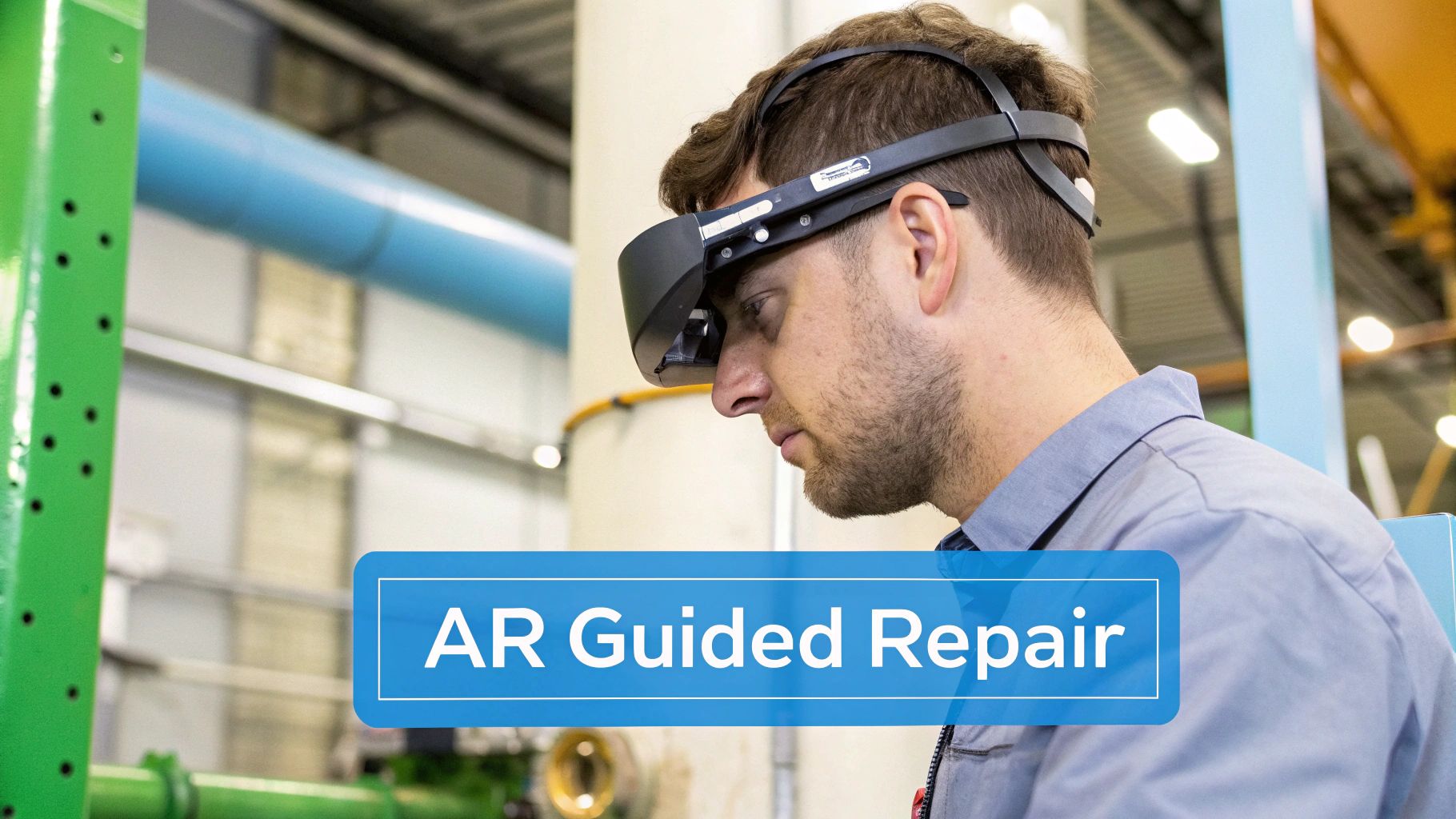
While the philosophies behind preventive and predictive maintenance may be different, both hinge on one critical component: the technician. No strategy succeeds unless the people on the floor have the tools they need to execute it well. This is exactly where Extended Reality (XR)—the umbrella for Augmented Reality (AR) and Virtual Reality (VR)—is making its mark, fundamentally changing how tasks get done, how knowledge is shared, and how data is understood.
XR acts as a powerful bridge between the digital and physical worlds, giving technicians the right information at the exact moment they need it. Instead of fumbling with a paper manual or walking back to a computer terminal, they get critical data and step-by-step guidance hands-free, right in their field of view. This simple shift makes maintenance workflows safer, faster, and far more accurate.
Supercharging Preventive Maintenance with Augmented Reality
Preventive maintenance lives and dies by consistency and doing things by the book. AR takes this schedule-based approach to a whole new level by overlaying digital instructions, interactive checklists, and 3D diagrams directly onto a piece of machinery. A technician wearing AR glasses can see the exact lubrication points highlighted in green, view the correct torque sequence for a series of bolts, or pull up a machine’s full service history without ever looking away.
This real-time, on-the-spot guidance is a game-changer for compliance and safety, ensuring every step is done right, in the right order. For example, a junior technician can tackle a complex inspection with the same precision as a seasoned expert because the AR system is walking them through it, verifying each step as they go.
By digitizing standard operating procedures and putting them directly in the technician's line of sight, AR drastically cuts down the risk of human error. This reinforcement of best practices guarantees that preventive tasks actually deliver the value they're supposed to, every single time.
This doesn't just improve accuracy; it also makes the whole process faster. Technicians spend less time hunting for information and more time doing the hands-on work that matters, making the entire preventive maintenance program more efficient.
Visualizing the Future with AR-Powered Predictive Maintenance
Predictive maintenance is all about data, usually from a network of IoT sensors. The problem is, a screen full of raw numbers and charts can be tough to interpret on the fly. AR changes that by turning abstract data into visual, actionable intelligence. A technician can look at a motor and see a real-time thermal overlay showing a developing hotspot, or view vibration analysis data as a color-coded animation, instantly pinpointing the source of a potential failure.
This capability is a massive leap forward. Instead of trying to cross-reference sensor readings with a schematic, the technician sees the problem right there on the asset. Key benefits here include:
- Faster Root Cause Analysis: Visual data overlays help technicians diagnose issues in minutes, not hours.
- Pinpoint Precision: AR can guide technicians to the exact component that needs attention, getting rid of the guesswork.
- Better First-Time Fix Rates: When you can visually confirm the problem before you even grab your tools, you show up prepared with the right parts and knowledge.
By making complex sensor data intuitive, AR ensures the powerful insights from your predictive analytics don't get lost in translation. Technicians can confidently fix developing issues long before they become catastrophic failures. Our detailed guide on augmented reality for maintenance dives even deeper into these practical uses.
Building Expertise with Immersive VR Training
One of the biggest hurdles for any maintenance department is training new hires and keeping the skills of the existing team sharp. Virtual Reality (VR) offers a solution by creating a safe, controlled, and endlessly repeatable environment for technicians to practice complex procedures without any risk to themselves or to expensive equipment. Trainees can learn to disassemble a critical pump, troubleshoot a faulty electrical panel, or run through an emergency shutdown protocol in a hyper-realistic simulation.
This hands-on, immersive learning is incredibly effective. It allows technicians to build muscle memory and diagnostic instincts in a setting where mistakes have no consequences, making them far more prepared for the real thing on the factory floor. VR training helps close the skills gap, making both your preventive and predictive maintenance programs stronger by ensuring your team has the expertise to execute them perfectly.
Demonstrating Real-World ROI
Let's stop talking strategy and start looking at the real-world results. This is where the true value of smart maintenance really comes to light. While both preventive and predictive maintenance try to keep equipment from failing, their impact on your finances and operations couldn't be more different. The proof is in the numbers: less downtime, smarter spending, and a return on investment that turns maintenance from a cost center into a genuine business advantage.
The whole reason we’re even having this conversation is because of the massive cost of things going wrong. When a critical piece of equipment just stops, the financial shockwaves can be devastating.
The Staggering Cost of Unplanned Downtime
Unplanned downtime is a killer for profitability. It’s not just the repair bill you have to worry about. It’s the lost production, the wasted materials, the crew you’re paying to stand around, and the deadlines you’re about to miss. The numbers alone paint a pretty stark picture of why being proactive isn't just a good idea—it's essential.
For industrial manufacturing, these breakdowns are a huge liability. We’re talking about an estimated USD 50 billion in losses globally every year. The median cost of downtime can climb past USD 125,000 per hour. By contrast, companies using predictive maintenance—powered by AI and IoT sensor data—have slashed their maintenance costs by 25-30% and cut downtime by a staggering 35-50%. A massive 95% of organizations that adopt predictive maintenance see a positive ROI, with 27% getting their money back within the first year. If you want to dive deeper, you can explore more predictive maintenance trends to see the full scope.
A hybrid maintenance model, blending preventive tasks with predictive insights, offers a practical path to mitigating these risks. It allows an organization to apply the right level of scrutiny to the right assets, maximizing ROI without a complete operational overhaul.
This balanced approach makes sure your resources are aimed where they’ll make the biggest difference for uptime and your bottom line.
Case Study: A Hybrid Model in Manufacturing
Let's look at a real-world example. A mid-sized automotive parts factory was running its entire production line on a traditional preventive maintenance schedule. It helped, but they were still getting hit with about three major unplanned shutdowns every quarter on their CNC milling machines—the heart of their operation. Each time a machine went down, production stopped for an average of eight hours, leading to huge financial hits and a chaotic schedule.
Realizing the CNC machines were their most critical assets, the plant managers decided to try a hybrid strategy.
- Predictive Maintenance for Critical Assets: They retrofitted the CNC machines with vibration and thermal sensors. This data fed into a predictive analytics platform designed to forecast failures in key parts like spindles and ball screws.
- Preventive Maintenance for Supporting Equipment: For everything else—the conveyors, the standard pumps—they stuck with their existing time-based maintenance schedules. This kept the foundation solid without the bigger investment of predictive tech across the board.
The results were dramatic, and they came fast. Within six months, the predictive system flagged two upcoming spindle failures and one ball screw issue. This heads-up allowed the maintenance team to schedule the repairs during planned weekend shutdowns. The result? They completely eliminated unplanned downtime on their CNC machines for two straight quarters. The factory didn't just save hundreds of thousands in lost production; it also improved its on-time delivery rates and made its customers a whole lot happier.
Putting Your Ideal Maintenance Program Into Action

Moving to a modern maintenance program isn’t like flipping a switch overnight—it’s a strategic shift. The best way to get started is often with a focused pilot project. Pick a handful of your most critical assets, the ones known for causing bottlenecks or carrying the highest risk of downtime.
This approach lets you demonstrate real value, fast. You get to test new workflows, validate the tech, and gather hard data on your ROI. The success stories from this initial phase become your best tool for getting the whole team and key stakeholders on board, making it much easier to scale up with confidence.
Building Your Technology Stack
A solid program is built on the right tools for collecting and analyzing data. Your first move is to select and install the right IoT sensors for the assets in your pilot. Think of these devices as your program’s nervous system, capturing real-time data on critical parameters like vibration, temperature, and pressure.
Once that data starts flowing, you need a powerful software platform to make sense of it all. This is the brain of your operation, using algorithms to sift through data streams, flag anomalies, and forecast potential failures. As you start digging into a modern maintenance program, especially a predictive one, exploring the best AI tools for small businesses can give you a major advantage in leveraging your data.
Phased Rollout and Change Management
For most organizations, the smart money isn’t on a complete rip-and-replace of one system for another. A hybrid model is almost always the most practical and cost-effective path forward.
- Predictive for Critical Assets: Use predictive maintenance for your high-value, complex machinery where a failure would be a disaster.
- Preventive for Standard Equipment: Stick with your schedule-based preventive tasks for less critical or more predictable equipment.
This balanced approach helps you focus your resources where they’ll have the biggest impact. You apply the highest level of scrutiny to your most important gear while keeping a solid foundation of routine care for everything else, giving you the benefits of both preventive and predictive maintenance.
Finally, don’t ever forget the human side of the equation. Any new program’s success depends on solid training and a clear plan for managing change. Your team needs to feel comfortable with the new tools and understand exactly how these new workflows will make their jobs safer and more effective. Investing in your people is what turns powerful data insights into real action on the facility floor. To see how this comes together in the real world, check out our deep dive on predictive maintenance in manufacturing.
Common Questions About Maintenance Strategies
When you're shifting from a "if it ain't broke, don't fix it" mindset to a more proactive one, a lot of questions pop up. It’s natural. Teams want to know where to start, what to prioritize, and how to strike the right balance between cost and performance. Getting clear on these points is the first step to making a smart decision.
Here are some of the most common questions we hear about choosing and implementing preventive and predictive maintenance.
Is Predictive Maintenance Always Better Than Preventive?
Not at all. The best strategy is all about the asset itself. Predictive maintenance is the undisputed champion for your critical, high-value equipment—the machinery that brings everything to a halt if it goes down. For these assets, failure means massive downtime, safety risks, or eye-watering repair bills, and the precision of predictive analytics is worth its weight in gold.
That said, preventive maintenance is still the workhorse for a reason. It’s a perfectly practical and cost-effective choice for non-critical assets with predictable wear and tear, or for equipment that’s cheap and easy to replace. It gives you a solid baseline of care without needing a big upfront investment in sensors and data analytics.
Can We Use Both Maintenance Strategies Together?
Absolutely. In fact, you probably should. The most effective approach is almost always a hybrid model. This lets you apply the right level of attention to the right asset, which is how you really maximize your return on investment.
A smart strategy applies predictive maintenance to your most critical machinery while keeping a schedule-based preventive plan for less vital, more stable equipment. This blend optimizes resources, slashes risk, and keeps the entire operation running smoothly.
What Is the Biggest Hurdle to Implementation?
You might think it’s the tech, but the most common challenge is actually the cultural shift. Moving from a reactive or schedule-based mindset to a data-driven one requires everyone to get on board. Technicians have to learn to trust the data, and leadership has to be willing to invest in new training and workflows.
The best way to get past this? Start small. Kick off a pilot project on a handful of key assets. It’s the perfect way to demonstrate real value and build the confidence your team needs for a full-scale rollout.
Ready to see how immersive AR/VR tools can elevate your maintenance workflows? AIDAR Solutions provides practical platforms that cut down on errors, speed up training, and give technicians the confidence to perform with greater precision. Discover how our solutions can transform your operations.