
A Guide to Manufacturing Productivity Improvement
To achieve meaningful manufacturing productivity improvement, operations must be assessed with an objective, data-driven approach. It requires looking beyond surface-level symptoms, such as late orders, to identify the fundamental root causes of inefficiency. These often include hidden skill gaps, maintenance delays, and workflow friction that quietly erode output.
By systematically identifying and addressing production bottlenecks, manufacturers can optimize resource allocation and solve the core problems that directly impact performance.
Pinpointing Your Real Production Bottlenecks
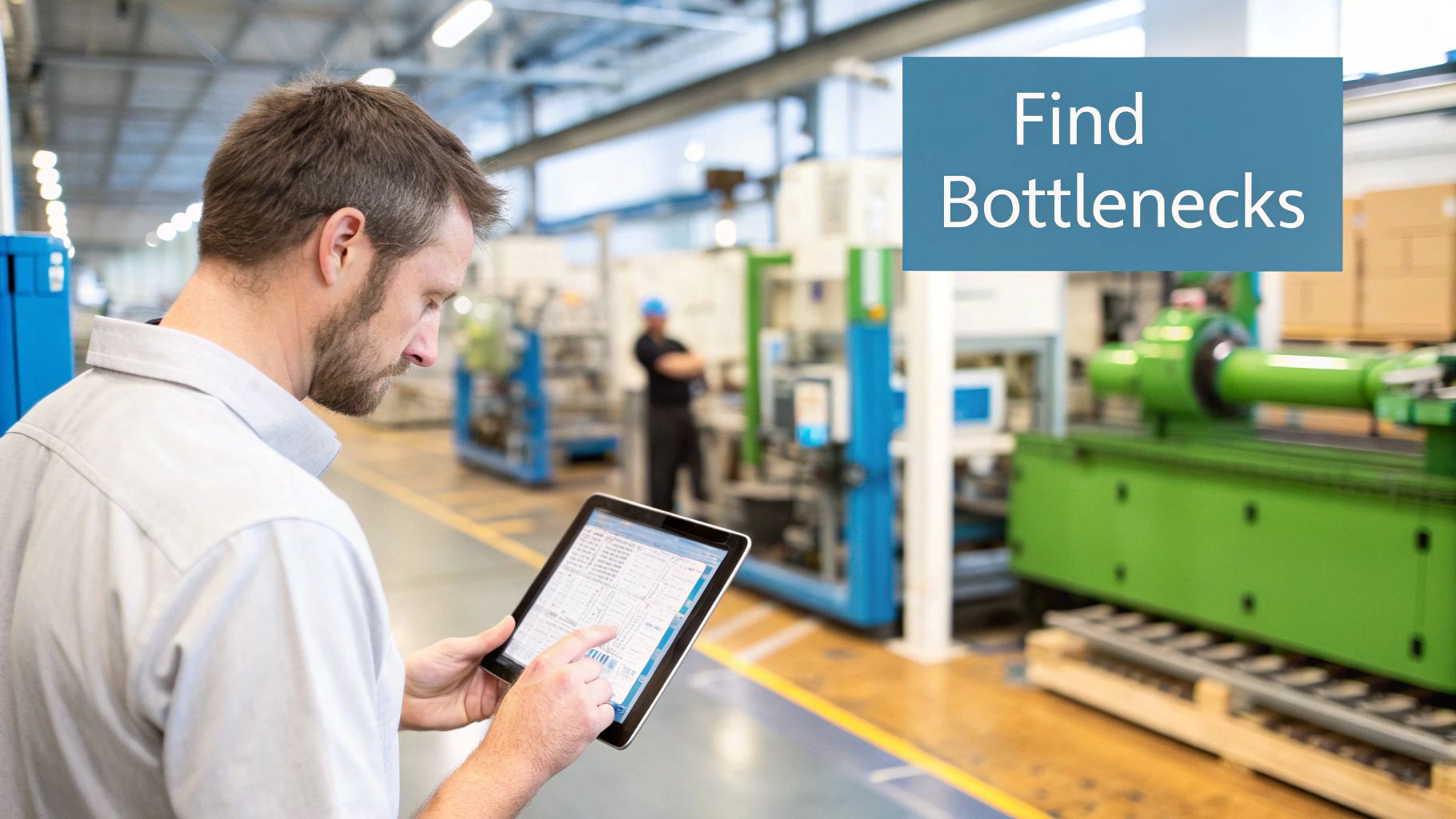
Effective improvement begins with a precise diagnosis of operational weaknesses. A production bottleneck is any point in the manufacturing process that limits the overall throughput of the entire system. It is the single machine, process, or human factor that sets the maximum speed for the operation, causing everything else to back up behind it.
Identifying these constraints is the essential first step. Many companies invest in new equipment hoping for a quick fix, only to find the problem persists. Without a proper diagnosis, the bottleneck often simply shifts to another part of the line, leaving the core issue unresolved.
Start by Mapping Your Entire Workflow
To locate the true source of delays, a complete, end-to-end map of the production process is necessary. This requires granular analysis, tracking material movement, observing operator actions, and measuring cycle times at every stage.
This detailed process mapping frequently uncovers surprising inefficiencies. A critical tool stored too far from its workstation can cost valuable minutes every hour. Mismatched cycle times between sequential steps can create a "hurry up and wait" dynamic that disrupts momentum.
While focusing on major production issues, applying general productivity tips can also highlight smaller, overlooked areas for easy improvements.
Look Beyond the Machines
It is easy to blame machinery for slowdowns, but bottlenecks are often rooted in people and processes. A thorough audit must investigate several key areas:
- Skill Gaps: Does a single expert handle all complex tasks? Production can grind to a halt when that person is unavailable, revealing a critical knowledge-transfer bottleneck.
- Maintenance Delays: When a machine breaks down, the total time to resolution is crucial. Slow response times, difficulty finding spare parts, or a lack of real-time alerts can turn a minor issue into a major stoppage. A proactive approach is vital; learn more in our guide on condition monitoring and predictive maintenance.
- Workflow Friction: Are teams still relying on paper-based processes? Unclear work instructions can lead to frequent rework. These small points of friction accumulate, creating a significant drag on the entire operation.
A common mistake is focusing only on the most obvious bottleneck. Once one is resolved, the next-slowest step in the process will become the new constraint. The goal is a continuous cycle of identification, analysis, and improvement.
This diagnostic phase sets the stage for all subsequent actions. With global manufacturing output recently growing by 1.9% to $46.7 trillion, companies that can rapidly identify and solve internal slowdowns gain a significant competitive advantage. This expansion creates opportunities for solutions that accelerate workforce skills and drive operational excellence.
By gathering the right data now, you ensure that every dollar invested in new technology and training is targeted for the highest possible return.
Prioritizing Fixes for the Highest ROI
After mapping the workflow and identifying bottlenecks, the next step is to prioritize solutions from a potentially long list of options. Attempting to fix everything at once often leads to diluted focus, stretched resources, and minimal impact.
A strategic, surgical approach is far more effective. It involves concentrating time, capital, and energy on initiatives that will deliver the greatest return on investment (ROI).
Not all solutions carry the same weight. A simple process tweak might unlock surprising gains, while a major technology investment could offer a slower but more substantial long-term payback. To make the right decision, a clear evaluation framework is needed.
Using an Impact-Effort Matrix
One of the most effective tools for this task is the impact-effort matrix. It provides a straightforward yet powerful method to visually categorize potential projects based on two key criteria: the benefit they will deliver (Impact) and the resources required to implement them (Effort).
Each initiative is plotted on a simple four-quadrant grid:
- Quick Wins (High Impact, Low Effort): These are the top priorities. Examples include optimizing a workstation layout or standardizing a problematic changeover procedure. These wins build momentum and demonstrate immediate value.
- Major Projects (High Impact, High Effort): These are transformational initiatives. Examples include implementing an AR remote assistance platform to reduce expert travel or launching a comprehensive VR training program. They require a robust business case and careful planning, but the long-term rewards are significant.
- Fill-Ins (Low Impact, Low Effort): These are "nice-to-have" improvements, such as reorganizing a secondary tool cabinet. They are suitable for periods of downtime but should not divert focus from higher-impact projects.
- Reconsider (Low Impact, High Effort): These projects should be avoided. They consume significant resources for minimal payoff and distract from initiatives that truly drive progress.
Using a matrix transforms a daunting list into an actionable roadmap. It forces a realistic assessment of both the potential reward and the true cost of implementation, ensuring capital is not wasted on low-value activities.
Building a Compelling Business Case
For "Major Projects," securing leadership buy-in is essential. This requires building a business case that translates operational improvements into clear financial terms.
Consider the example of AR-guided remote service. Instead of simply stating it will "reduce downtime," quantify the benefit.
If a critical machine's downtime costs the company $50,000 per hour, and remote guidance can reduce the average repair time by two hours, the solution presents a $100,000 saving per incident. This type of quantifiable data commands attention.
The same logic applies to a VR training program. Forecast the gains by analyzing metrics such as:
- Reduced onboarding time for new hires.
- Lower material waste from trainee errors.
- A decrease in accident rates and associated costs.
When hard numbers support proposed solutions, the pitch shifts from an idea to a sound investment. This detailed forecasting is essential for getting major projects approved. To explore this topic further, refer to our guide on how to calculate return on investment. Getting this right clarifies goals and aligns stakeholders on the initiatives that will genuinely advance manufacturing productivity.
Launching A Smart Technology Pilot Program
With bottlenecks identified and high-impact fixes prioritized, it is time to translate strategy into tangible results on the factory floor.
A targeted pilot program is an ideal next step. It offers a low-risk, high-reward method for testing new technologies like Augmented Reality (AR) and Virtual Reality (VR) before committing to a full-scale investment.
A pilot is not a technology showcase; it is a strategic experiment. The primary goal is to prove, in a controlled environment, that a specific technology can solve a persistent and costly problem. By focusing on a single, well-defined use case, you can gather the hard data needed to build an undeniable business case for wider adoption.
The framework below offers a simple but effective way to think through evaluating, prioritizing, and costing out potential pilot initiatives.
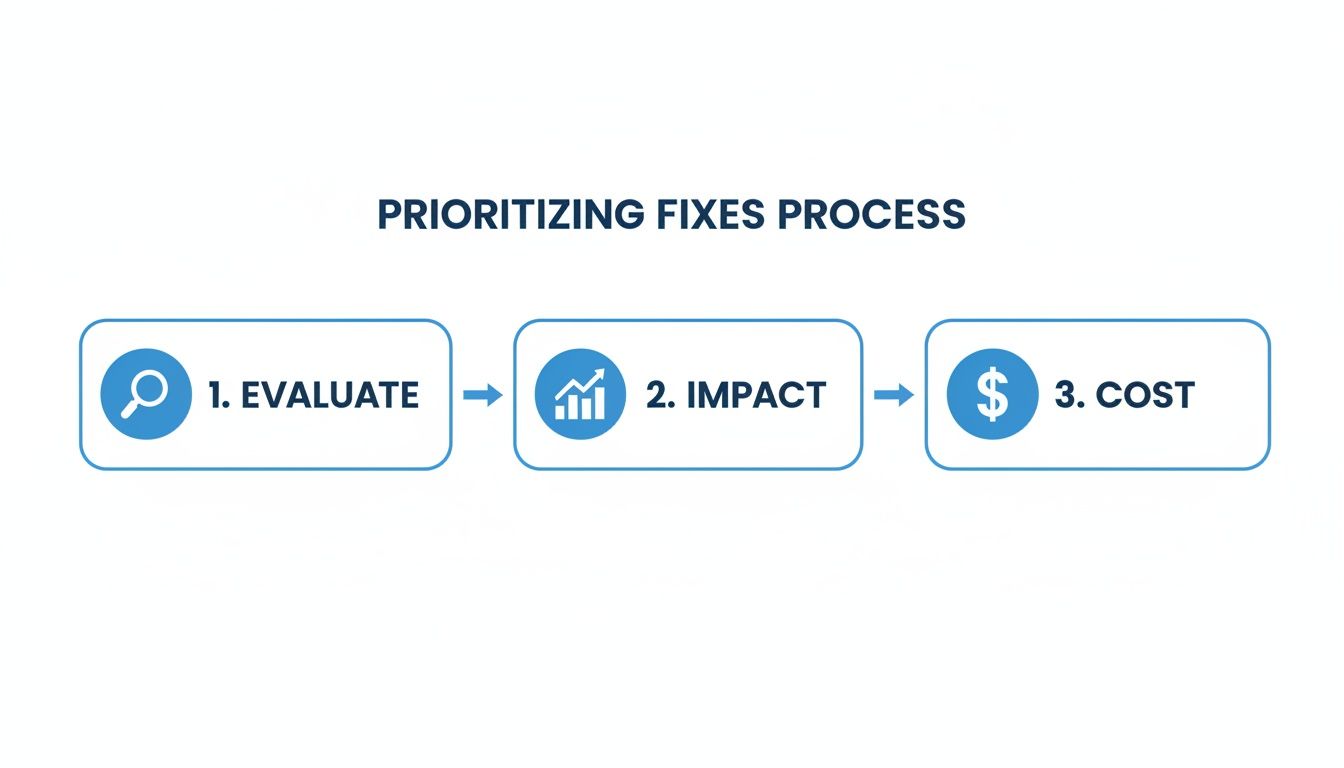
Following a structured process ensures the selection of a project with the best possible combination of high impact and manageable cost.
Choosing The Right Use Case For Your Pilot
The success of a pilot program hinges on selecting the right problem to solve. A common mistake is attempting to address too many issues at once, which dilutes focus and makes it nearly impossible to measure a clear outcome.
Instead, concentrate on a specific, high-pain area where AR or VR offers a distinct advantage. Two of the most effective and practical starting points are remote assistance and immersive training.
These technologies provide clear value in specific scenarios:
AR for Remote Assistance: When a critical machine fails, an on-site technician may lack the expertise to resolve the issue, while the necessary expert is located hours or even continents away. With an AR-powered solution, the remote expert can see exactly what the local technician sees in real-time, annotating their field of view with instructions. This capability dramatically reduces machine downtime and eliminates associated travel costs.
VR for Complex Training: Onboarding new employees for a complex assembly task often involves slow, traditional methods that can waste materials and lead to costly production errors. A VR simulation provides a realistic, risk-free virtual environment where trainees can practice procedures repeatedly until they achieve mastery, without impacting the production line.
A strong pilot use case is one where the ROI is easy to track. Demonstrating direct reductions in travel expenses, machine downtime, or training-related material scrap provides a compelling narrative when it is time to scale the solution.
This strategic focus aligns with broader industry trends. A recent Deloitte manufacturing outlook revealed that 80% of manufacturing executives plan to allocate 20% or more of their improvement budgets to smart factory projects. The industry is investing heavily in digital tools that empower the workforce, making immersive technology a core component of modern manufacturing productivity improvement.
Defining The Scope And Success Metrics
Once the use case is selected, the pilot's scope must be defined with absolute clarity. Establish firm boundaries regarding participants, specific tasks, and duration. A tightly scoped project prevents "scope creep" and maintains focus on the primary objective.
For an AR remote assistance pilot, the scope might be:
- Participants: Five junior maintenance technicians and two senior remote experts.
- Scope: The pilot will be limited to troubleshooting and repairing three specific types of high-priority machinery.
- Duration: A 90-day period to gather sufficient data.
Equally important is defining success metrics before the pilot begins. Set clear Key Performance Indicators (KPIs) that directly relate to the problem being addressed.
The following table illustrates how specific manufacturing challenges can be addressed with XR solutions and their corresponding benefits.
Targeted XR Use Cases for Manufacturing
| Challenge | XR Solution (Example) | Primary Benefit |
|---|---|---|
| High Machine Downtime | AR-guided remote assistance for technicians | Reduce Mean Time to Repair (MTTR) by connecting on-site staff with remote experts instantly. |
| Lengthy Employee Onboarding | VR-based training simulations for complex assembly | Decrease time-to-competency by allowing new hires to practice in a safe, repeatable virtual environment. |
| Inconsistent Quality Control | AR overlays with step-by-step assembly instructions | Lower defect rates by ensuring every operator follows the exact standard operating procedure. |
| High Travel Costs for Experts | Remote AR service calls for troubleshooting | Cut operational expenses by eliminating the need for experts to travel for routine diagnostics and fixes. |
By meticulously planning a pilot around a specific pain point and defining clear success metrics, you create a powerful, data-driven argument for change. This approach elevates a technology trial into a strategic business initiative, proving the real-world value of these solutions and paving the way for a broader, more impactful rollout.
Measuring the Metrics That Actually Matter
A successful pilot is a promising start, but the true test is proving its value with objective data.
Without measuring the impact of an AR or VR initiative, securing buy-in for a full-scale rollout is impossible. A successful program requires tracking the right Key Performance Indicators (KPIs) to demonstrate a clear and undeniable Return on Investment (ROI).
This process is not about qualitative observations; it is about translating operational gains on the factory floor into the language of business value that resonates with executive leadership.
Focus on Core Operational KPIs
To accurately measure the impact of a new technology, a solid baseline is essential. Before introducing any new tools, performance must be meticulously tracked against a few critical metrics. This "before" data is the only way to prove the "after" represents a genuine success.
Three KPIs are particularly effective in most manufacturing settings:
- Overall Equipment Effectiveness (OEE): As the industry gold standard, OEE combines availability (run time), performance (speed), and quality (good parts) into a single, powerful score. An increase in OEE directly indicates greater output from existing assets.
- First-Time Fix Rate (FTFR): This metric is critical for evaluating remote assistance tools. It measures the percentage of repairs completed correctly on the first attempt. A higher FTFR signifies less wasted time, reduced rework, and more productive technicians.
- Mean Time to Repair (MTTR): This KPI tracks the average time required to repair a machine, from the moment it fails to the moment it is back online. Every minute of downtime has a cost, and reducing MTTR is one of the fastest ways to mitigate the financial impact of unplanned stoppages.
By focusing on these specific metrics, you establish a direct link between the pilot activities and tangible results. For a deeper analysis, review our guide on essential operational efficiency metrics.
A common pitfall is tracking "vanity metrics"—numbers that sound impressive but do not connect to business outcomes. Focus on what matters: time, cost, and quality. These are the metrics that drive leadership decisions.
Calculating the ROI of Your XR Pilot
With baseline KPIs established, calculating the ROI becomes a more straightforward process. The goal is to build a business case that accounts for both direct savings and the powerful, though sometimes less tangible, gains that drive long-term manufacturing productivity improvement.
The cost side includes upfront investments in hardware, software licenses, and initial training. However, the savings side reveals the true value of the initiative.
Quantify gains in these key areas:
Hard Savings (Directly Measurable):
- Reduced Travel Costs: Calculate the total savings from every trip an expert avoided by using an AR remote assistance call.
- Decreased Material Waste: Measure the reduction in scrap and rework, particularly when using VR for training or AR for guided assembly.
- Lower Downtime Costs: Quantify the value of restoring machine operation faster by tracking the reduction in MTTR.
Powerful Gains (Indirectly Measurable but Highly Valuable):
- Improved Knowledge Retention: While difficult to assign a dollar value, VR training helps new hires achieve proficiency faster and retain skills longer, building a more capable and flexible workforce.
- Enhanced Workforce Safety: Preventing a single major accident is invaluable. Allowing technicians to practice complex or dangerous tasks in a risk-free VR simulation has an immense, albeit unquantifiable, ROI.
This type of strategic technology adoption is what separates industry leaders from followers. Recent data from the U.S. Bureau of Labor Statistics shows that labor productivity in U.S. manufacturing grew by 3.7%, a trend largely driven by technology investments.
Furthermore, over 80% of manufacturers are now accelerating their AI implementation, a significant increase from just a few years ago. By measuring what matters, you are not just justifying a pilot; you are demonstrating how your team can contribute to this vital industry transformation.
Scaling Your Success Across the Enterprise

A successful pilot is a significant achievement, but it is only the beginning. The ultimate goal—one that fundamentally transforms business operations—is to scale that initial success across the entire organization. This is the point where a promising project becomes the new, more efficient standard.
However, the transition from a controlled pilot to a full-scale rollout is where many initiatives fail. It requires a strategic blend of people-centric change management and robust technical integration. A failure in either area can hinder the adoption of even the most effective technology.
Build a Network of Internal Champions
Technology itself does not drive adoption; people do. The most effective way to ensure a successful rollout is to identify and empower internal champions. These are the respected, proficient operators and technicians on the floor who understand the value of the new tools and can advocate for them from the ground up.
These individuals are your most valuable assets during the transition. They provide peer-to-peer coaching, answer questions with credibility, and offer honest, real-world feedback. Provide them with early access, additional training, and a direct communication channel to project leaders.
When employees see their peers succeeding with a new tool, it overcomes skepticism far more effectively than a top-down mandate.
Communicate What’s in It for the Frontline
For any change to be sustainable, frontline teams need a clear answer to the question: “What’s in it for me?” If they perceive a new tool as an additional burden or a threat, they will resist its implementation.
A clear communication strategy is therefore critical. Frame the benefits in terms that matter to them: making their jobs easier, safer, and less frustrating.
- Less Frustration: "This tool connects you directly to an expert, so you are never left alone to solve a difficult repair."
- More Confidence: "Our VR training allows you to master complex procedures in a safe environment, so you can approach your tasks with full confidence."
- Skill Growth: "Learning this technology enhances your skills and makes you an even more valuable member of our team."
A common mistake is to communicate only high-level business metrics like ROI and OEE. While these figures are important to leadership, they have little meaning to an operator on the production line. Translate corporate objectives into personal benefits for your team.
This shift in framing transforms the implementation from something being done to them into something being done for them. This buy-in is essential for achieving the widespread manufacturing productivity improvement you are targeting.
Integrate with Your Existing Tech Stack
To unlock the full potential of immersive technology, it cannot exist in isolation. The greatest value is realized when new AR and VR tools are integrated with existing systems, such as your Manufacturing Execution System (MES) or Enterprise Resource Planning (ERP) platform.
This integration creates a connected factory where information flows directly to the point of action. An AR-equipped technician could, for example, access a machine’s complete maintenance history from the MES without taking their eyes off the task.
Consider the practical benefits of integration:
- MES Integration: An operator using an AR-guided workflow for a quality check can have the results automatically logged in the MES, creating a real-time, error-proof digital record.
- ERP Integration: A remote expert guiding a repair via an AR call could instantly trigger a parts order in the ERP as soon as a faulty component is identified.
This level of integration does more than save a few clicks. It eliminates data entry errors, simplifies complex processes, and provides your team with the precise information needed to make faster, smarter decisions. This is how you move beyond isolated wins and begin building a smarter, more connected, and fundamentally more productive operation.
Frequently Asked Questions About Smart Manufacturing
Embarking on a smart manufacturing journey raises many practical questions. Understanding how to select a starting point and ensure that changes are sustainable is key to a smooth and successful transition.
Here, we address some of the most common questions about using AR and VR to drive significant manufacturing productivity improvement.
How Do We Choose the Right Starting Point for an AR or VR Pilot?
The key is to identify a problem that is both high-impact and low-complexity. Look for a persistent, costly challenge, such as critical machine downtime that always requires an expert to travel to the site, or a complex assembly step with a stubbornly high error rate.
A remote assistance pilot using AR is often an excellent first step because the ROI is clear and immediate. The savings from reduced travel costs and decreased downtime are easily quantifiable. Another strong option is a VR training pilot for a role with high turnover or a steep learning curve. The impact on new hire ramp-up time and job performance can be measured quickly.
What Is the Biggest Barrier to Scaling a Successful Pilot?
The primary hurdle is rarely the technology itself. More often, it is a combination of cultural resistance and the absence of a robust change management plan. If frontline workers view a new tool as a complication—or worse, a threat—adoption will fail.
Overcome this barrier by involving operators and technicians in the process from the beginning. Clearly demonstrate how the technology makes their jobs easier, safer, or less frustrating. By cultivating a network of internal champions who believe in the solution, adoption can grow organically from the ground up.
The success of any scaled initiative depends on answering one question for every user: "What's in it for me?" When the team views the technology as a tool that provides genuine help, adoption becomes a natural outcome.
How Do AR and VR Solutions Integrate With Our Existing Systems?
Modern XR platforms are designed for interoperability. Through APIs, they can connect directly to your MES, ERP, and PLM systems, creating a seamless flow of information that empowers your team with the right data at the right time.
For example, a technician using an AR tool for remote assistance could pull a machine's entire maintenance history from the MES and view it as an overlay on the equipment. Similarly, a VR training module could pull the latest 3D models and specifications from your PLM, ensuring the simulation is always 100% accurate. This level of integration is where the full power of a smart factory is realized.
What Kind of IT Infrastructure Is Required to Support XR?
The required infrastructure depends on the specific tools selected and whether you opt for a cloud-based or on-premise deployment.
- For cloud-based AR tools, the primary requirement is reliable, high-coverage Wi-Fi across your factory floor.
- For high-fidelity VR simulations, the typical setup includes powerful PC-based VR headsets and the corresponding workstations to run them.
However, the hardware barrier is continually lowering, particularly with the advent of powerful standalone headsets. A qualified technology partner can conduct a thorough technical assessment of your current environment to outline the specific requirements for a successful rollout.
Ready to see how immersive technology can transform your operations? The experts at AIDAR Solutions can help you design and implement a pilot program that delivers measurable results. Explore our AR and VR solutions today.

