
Industry 4.0 Augmented Reality: A Practical Guide
Industry 4.0 represents the digital transformation of manufacturing, connecting machinery and processes to create an intelligent, data-driven environment. Within this framework, augmented reality (AR) serves as a critical interface, empowering the workforce with real-time, contextual information.
This is the core of Industry 4.0 augmented reality: the convergence of the physical manufacturing environment with a rich layer of actionable digital data.
The New Reality of Smart Manufacturing
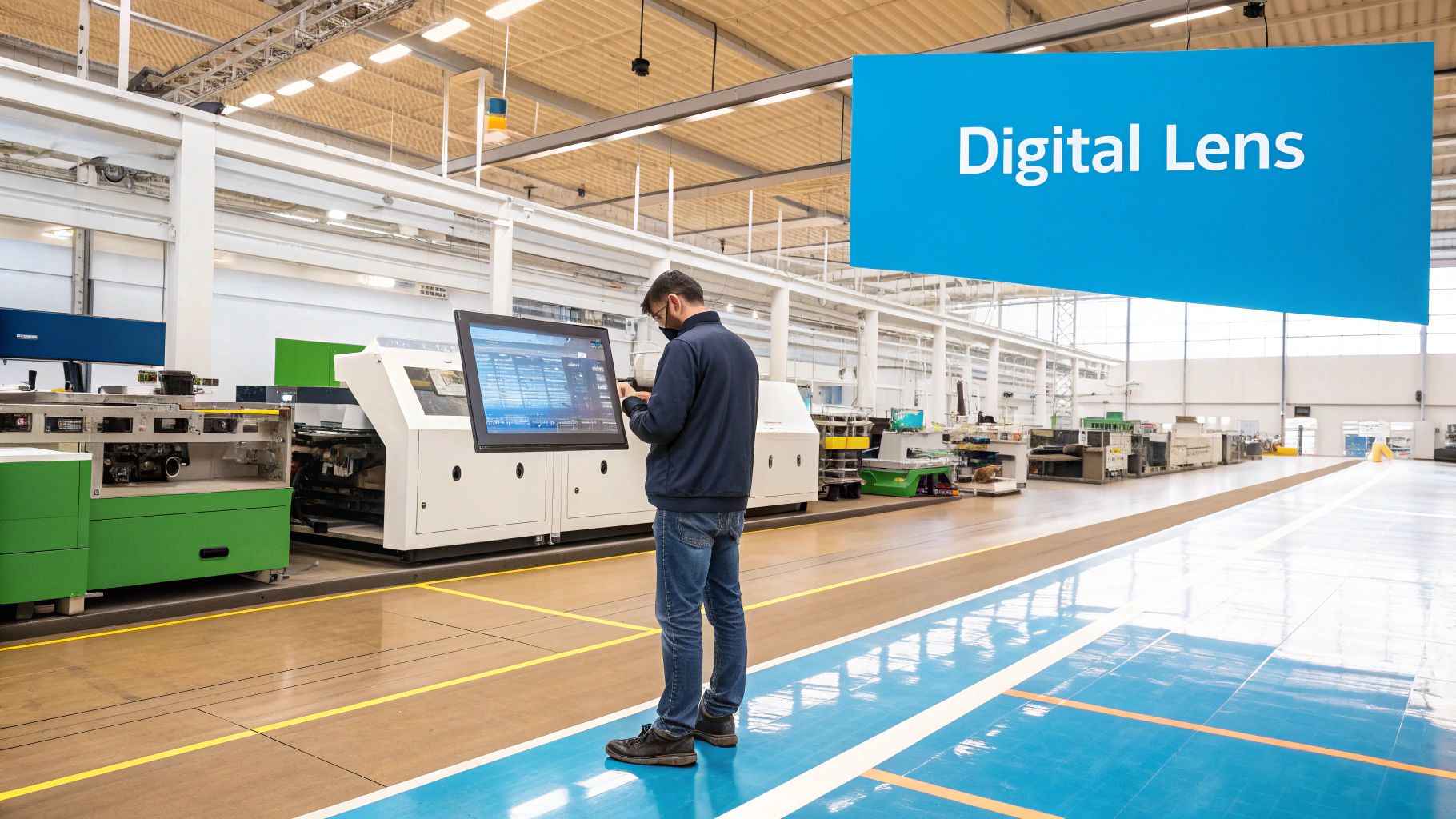
At its heart, Industry 4.0 is focused on creating the "smart factory." This concept extends beyond simple automation to an intelligent, interconnected network where machinery, systems, and IoT sensors generate vast amounts of operational data.
However, raw data alone provides limited value. The breakthrough occurs when this information is made useful and intuitive for personnel on the factory floor. This is where augmented reality (AR) functions as an essential visualization tool.
AR as the Interactive Digital Lens
AR acts as the user interface for the modern factory. It empowers teams by layering critical digital information directly onto their view of the physical world. Instead of consulting a terminal or manual, a technician can look at a piece of equipment and instantly see relevant operational data.
This provides immediate access to:
- Real-time performance data: IoT sensors feed information like temperature, pressure, or output metrics directly onto the machine being viewed.
- Step-by-step instructions: Animated guides for complex assembly or repairs are projected onto the specific parts a worker needs to address.
- Hidden components: An AR overlay can render a machine's housing transparent, revealing its internal workings without physical disassembly.
This convergence marks a fundamental shift in operations, moving from reactive problem-solving to proactive, data-informed decision-making. The workforce evolves from operating machinery to becoming empowered analysts with digital insights available at a glance.
This is not a future concept; it is actively reshaping modern production. The global augmented reality market is expanding rapidly, driven by industrial adoption. It is projected to grow from USD 94.82 billion in 2025 to USD 511.75 billion by 2030.
The table below outlines how AR integrates with the core components of an Industry 4.0 ecosystem.
Core Components of Industry 4.0 and AR
| Industry 4.0 Component | Role of Augmented Reality |
|---|---|
| IoT Sensors | AR visualizes sensor data in real-time, providing immediate context on machine health, performance, and environmental conditions. |
| Big Data & Analytics | AR translates complex data analytics into actionable, visual instructions and predictive maintenance alerts for frontline workers. |
| Cloud Computing | AR devices access vast libraries of schematics, instructions, and collaborative tools stored in the cloud from anywhere on-site. |
| Cyber-Physical Systems | AR serves as the human-machine interface (HMI), allowing workers to intuitively monitor and control physical processes. |
| Digital Twins | AR brings digital twin simulations into the real world, enabling interaction with a virtual model overlaid on its physical counterpart. |
By bridging the gap between digital data and human action, Industry 4.0 augmented reality is unlocking unprecedented levels of efficiency and expertise. For a broader overview of emerging factory floor technologies, see our guide on new technologies in manufacturing.
Practical Applications of Industrial AR in Your Facility
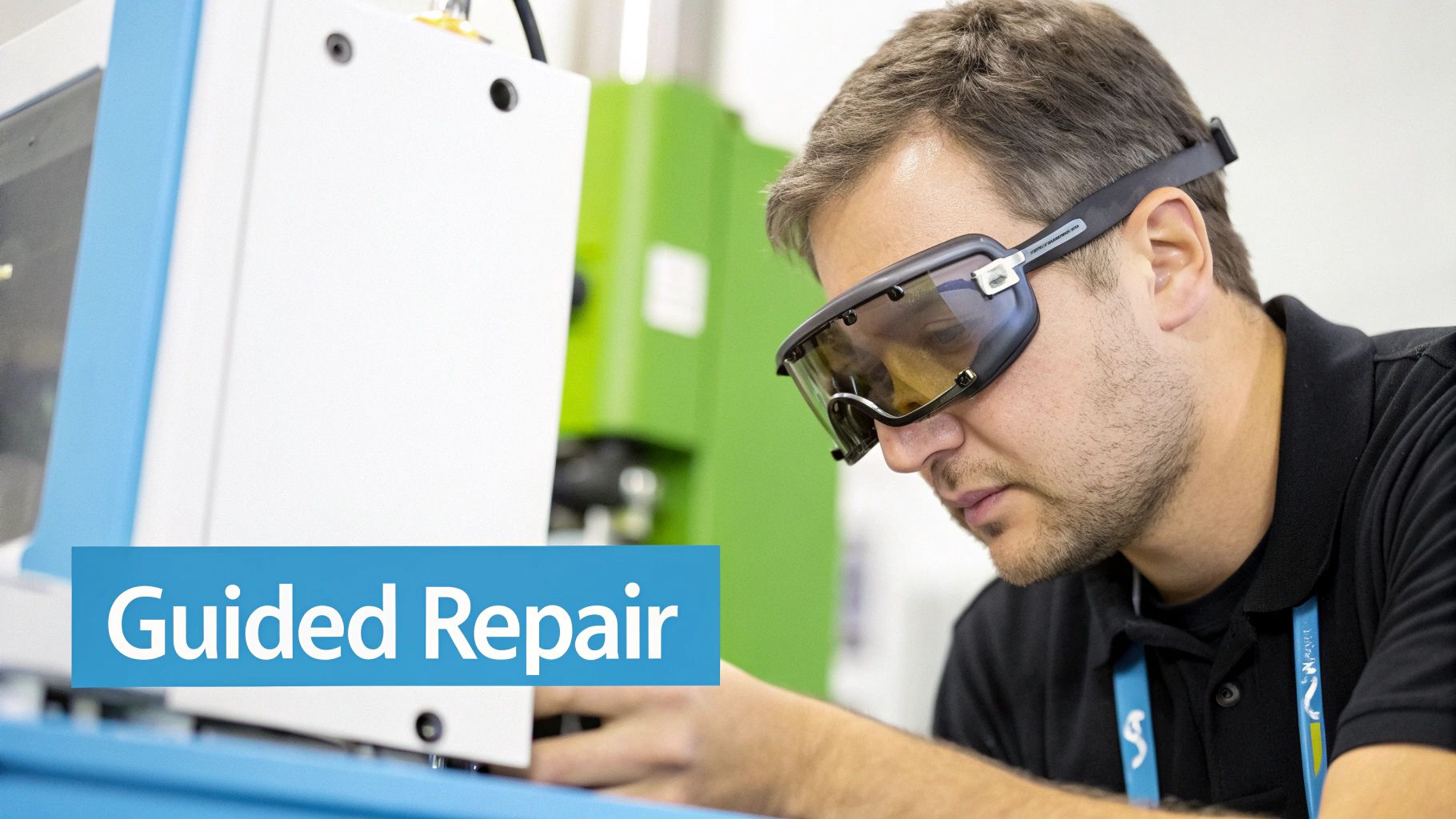
Understanding how Industry 4.0 augmented reality integrates data into an operator's view is the first step. The next is implementing it on the production floor to drive tangible business outcomes.
Below are four practical applications that deliver significant operational impact:
- Interactive Training and Skills Transfer overlays step-by-step assembly guidance directly on equipment.
- Remote Expert Assistance connects on-site technicians to off-site engineers via live, annotated video.
- Guided Maintenance and Repair delivers visual instructions at the point of work.
- Digital Twin Visualization projects 3D machine models into the physical world for planning and analysis.
Beginning with employee onboarding, AR can significantly accelerate proficiency. It has been shown to reduce training time by up to 75%, while minimizing scrap and rework.
Interactive Training And Skills Transfer
Industrial AR is highly effective for experiential learning. Instead of traditional classroom instruction, technicians learn by performing tasks, guided by digital overlays projected onto the actual parts they are handling.
A typical workflow includes:
- Scanning a component with an AR device to instantly identify part numbers.
- Following color-coded arrows that indicate assembly order and torque specifications.
- Monitoring real-time dashboards that track skill acquisition and progress.
Remote Expert Assistance
When an issue requires specialized knowledge, AR provides an immediate solution. AR headsets stream a live, first-person view to engineers anywhere in the world, who can then annotate the technician's field of view with precise instructions.
Field service teams report up to a 50% reduction in mean time to repair, achieved by eliminating repeat site visits and reducing equipment idle time.
Key features include:
- Live annotations anchored to physical machine parts.
- Two-way audio for real-time communication and problem-solving.
- Session recording for subsequent training and compliance audits.
Guided Maintenance And Repair
When equipment requires service, AR provides step-by-step guidance for each action and tool selection directly in the technician's line of sight. This level of clarity can reduce error rates by 40% on average, contributing to greater operational uptime.
Read our in-depth guide on augmented reality workflow for best practices you can apply today.
- Wiring diagrams overlaid directly on control panels.
- Automated parts reordering triggered by predictive wear-and-tear analysis.
- Safety alerts that appear when a potential hazard is detected.
Digital Twin Visualization
AR enables technicians to visualize a machine's digital twin in real-time. This allows for the overlay of operational data—such as flow maps and temperature readings—or the simulation of layout changes before physical implementation.
- Projecting pipeline flow rates and thermal maps onto the actual equipment.
- Testing new workstation layouts virtually to optimize floor space.
- Running "what-if" production scenarios to balance workloads and reduce waste.
Every AR implementation should be linked to analytics to refine processes and guide future expansion with confidence.
To begin implementation:
- Select a pilot project with high visibility, such as critical machine training or first-time fix rates.
- Define clear KPIs, including reduced downtime and faster repair cycles.
- Use AR usage data to optimize workflows and identify new application areas.
By integrating augmented reality into training, support, maintenance, and simulation, organizations can unlock new levels of insight and efficiency.
The Business Case for Augmented Reality
Beyond its innovative technology, the value of Industry 4.0 augmented reality is measured in tangible business results. Adopting AR is a strategic investment designed to address core operational challenges and directly enhance profitability. The objective is to convert technological capabilities into measurable gains in efficiency, quality, and safety.
Consider a common production line disruption—a minor but frequent shutdown. Traditionally, a technician would consult a paper manual to diagnose the problem. Every moment spent searching for information translates to lost output. This approach is slow, prone to error, and reliant on individual experience.
With an AR solution, the scenario changes. The same technician, equipped with smart glasses, looks at the machine. An overlay instantly highlights the faulty component. Step-by-step repair instructions appear in their line of sight, enabling a swift and accurate resolution. This single change fundamentally alters the financial equation of daily operations.
From Downtime to Uptime
The most compelling argument for AR is its impact on operational efficiency. By providing workers with the right information at the right time, AR eliminates friction that causes delays. Guided digital workflows can reduce task completion times by 30-50%, and these savings accumulate with every shift.
This increase in speed generates a positive ripple effect across the factory floor:
- Fewer Mistakes: With clear visual guidance, errors during complex assembly or maintenance tasks decrease significantly—often by as much as 90%.
- Safer Workers: AR can flag potential dangers in real time, such as high-voltage zones or moving machinery, creating a safer work environment.
- More Machine Uptime: Faster diagnostics and repairs lead to less equipment downtime, which directly translates to higher production capacity and revenue.
AR transforms a team into a more effective, accurate, and safe workforce. It addresses skills gaps by delivering expert knowledge to every employee, precisely when and where it is needed.
Quantifying the Return on Investment
These operational gains are not abstract; they generate a measurable return on investment. A comparison between traditional methods and an AR-integrated approach illustrates the financial benefits.
ROI Impact of Augmented Reality in Manufacturing
A comparative look at key industrial metrics before and after the implementation of AR solutions, demonstrating clear business value.
| Metric | Traditional Approach | With AR Integration | Typical Improvement |
|---|---|---|---|
| Technician Training Time | 4-6 weeks of shadowing & manuals | 1-2 weeks with guided workflows | 50-75% Faster |
| Mean Time to Repair (MTTR) | 60-90 minutes | 20-30 minutes | 60-70% Reduction |
| First-Time Fix Rate | 75-85% | 95-98% | 10-20% Increase |
| Error Rate (Assembly/Maint.) | 5-10% | <1% | Up to 90% Reduction |
The data clearly demonstrates the value proposition. The economic impact is so significant that the market for AR services is projected to grow from USD 194.44 billion in 2024 to USD 1,072.3 billion by 2029, a surge driven primarily by industrial demand. You can explore the full market projections on the future of AR services.
Calculating this return for a specific facility is a straightforward process. By tracking key performance indicators (KPIs) before and after an AR rollout, the financial benefits become undeniable.
To model the ROI for training initiatives, use our training ROI calculator. The business case for AR is ultimately about achieving a new standard of operational excellence.
Your Roadmap for AR Implementation
Deploying Industry 4.0 augmented reality can seem complex. However, by breaking the journey into four clear phases, organizations can follow a structured path from proof of concept to full-scale rollout, with each stage designed to deliver measurable value.
This approach is analogous to constructing a building: start with a solid foundation, add one level at a time, and ensure stability before proceeding.
Start With A High-Impact Pilot
Instead of overhauling entire operations at once, focus on one process where AR can deliver an immediate and significant impact. Ideal candidates include a complex assembly line with high error rates or a critical piece of machinery that frequently requires expert support.
By addressing a single, well-defined challenge, you minimize risk and generate quick wins. A successful pilot project builds internal support and provides a foundation for expansion.
Pilot Selection Tips:
- Choose a process with clear metrics (e.g., error rates, downtime, support requests).
- Engage a team that is open to experimenting with new technology.
- Define success criteria in business terms (e.g., reduced cycle time, fewer defects).
Select The Right Tools
With a pilot project defined, the next step is to choose hardware and software that align with the specific use case. This decision is critical for user adoption and achieving the desired ROI.
Hardware Options:
- Smart Glasses: Ideal for hands-free guidance during maintenance or assembly tasks.
- Tablets & Mobile Devices: Cost-effective for digital checklists, quality inspections, and mobile work instructions.
On the software side, select a platform that is intuitive, integrates with existing ERP or MES systems, and provides robust analytics. For expert guidance on aligning technology with your objectives, consider professional augmented reality consulting services.
The following infographic illustrates the journey from AR adoption to tangible financial returns:
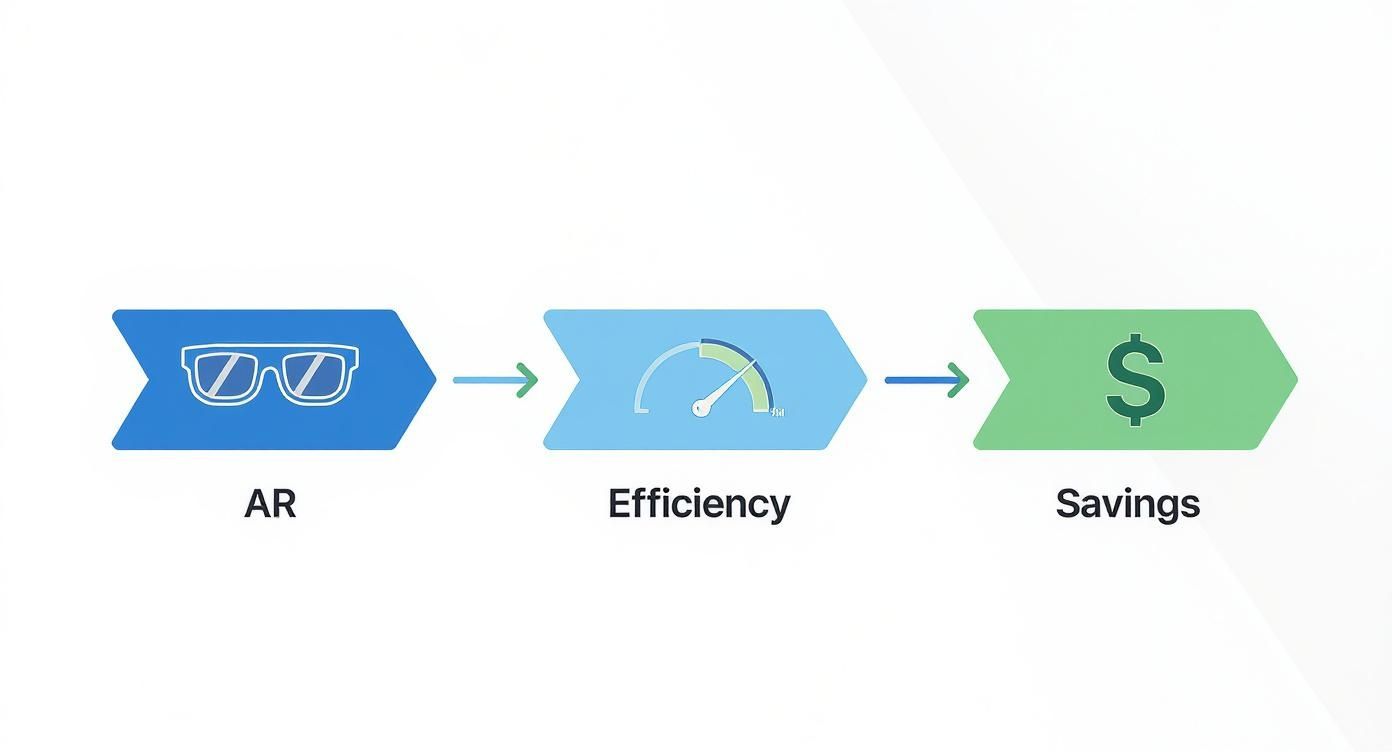
This visual demonstrates how the right combination of tools accelerates efficiency gains, reduces costs, and improves ROI.
Integrate With Existing Systems
An AR solution should not operate in isolation. To maximize its impact, integrate it with your existing ERP, MES, and IoT platforms.
When AR devices pull real-time machine data and push task completion status back into your enterprise systems, you create a continuous data loop. This loop enhances both the AR user experience and your overall operational intelligence.
Develop A Scaling Strategy
Following a successful pilot, it is time to expand the scope of implementation. Use insights from the initial rollout to identify other operational pain points that can be addressed with AR.
Plan the expansion in phases:
- Outline deployments by department or function.
- Create tailored training programs for each new user group.
- Establish clear metrics to measure adoption and ongoing impact.
A well-designed scaling roadmap transforms an isolated success into an enterprise-wide competitive advantage, making Industry 4.0 augmented reality a cornerstone of operational excellence.
Measuring Success and Proving ROI
Implementing Industry 4.0 augmented reality is a significant investment. Consequently, demonstrating its value requires more than anecdotal feedback; it demands hard data.
To justify the expenditure and secure approval for future projects, a robust case for its return on investment (ROI) is essential. This requires tracking clear, quantifiable results that align with executive-level business objectives. The first step is to benchmark current performance. Before deploying the first AR device, establish baseline metrics. This allows for a direct "before and after" comparison that proves tangible improvement.
Key Quantitative Metrics to Track
The AR analytics dashboard should focus on metrics that directly correlate with operational efficiency and financial outcomes. These KPIs provide the evidence connecting the technology to business value.
Critical KPIs to monitor include:
- Mean Time to Repair (MTTR): Measure the time required for a technician to diagnose and resolve an issue. AR solutions have been shown to reduce this metric by up to 70% by providing expert guidance and digital work instructions directly in the user's line of sight.
- First-Time Fix Rate (FTFR): Track the percentage of tasks completed correctly on the first attempt. Guided AR workflows and remote expert support can increase this rate to over 95%, reducing costly repeat service calls.
- Training Completion Time: Quantify how quickly a new employee can be trained and become productive. Interactive AR training can shorten this period by 50% or more, providing a significant advantage in a competitive labor market.
Assessing Critical Qualitative Gains
Quantitative data tells only part of the story. It is also important to assess the qualitative benefits that contribute to a more skilled and resilient workforce. While these gains may be more challenging to assign a precise dollar value, they are vital for long-term organizational health and employee retention.
Proving the value of AR involves presenting a complete narrative. It is not only about faster repairs but also about building a more confident, capable, and connected workforce for the future.
Track the impact in these areas as well:
- Improved Knowledge Retention: Replace traditional manuals with immersive, hands-on AR learning. Use post-training assessments to demonstrate how this method improves skill retention compared to conventional approaches.
- Higher Employee Engagement: Conduct surveys to gauge changes in employee confidence and job satisfaction. Providing tools that reduce frustration and empower autonomous problem-solving is a significant morale booster.
- Enhanced Safety and Compliance: Maintain logs of safety incidents and procedural errors. A measurable reduction in both demonstrates how AR guidance helps create a safer, more compliant work environment.
By combining quantitative metrics with these qualitative wins, you can build a powerful business case that demonstrates the full, comprehensive value of your AR investment.
The Future is an Empowered Workforce
Looking ahead, the convergence of augmented reality, AI, and high-speed 5G connectivity is set to create an even more intelligent industrial landscape. The future of this work environment is not about replacing skilled personnel but about amplifying their capabilities. This marks the emergence of the "connected worker"—an individual with seamless, instantaneous access to live data and expert guidance from any location.
Imagine a technician on the factory floor who can instantly retrieve a machine's complete performance history, consult with a virtual expert, and view complex schematics, all without leaving their workstation. This is no longer a futuristic concept but the new standard for operational agility.
Building Smart Factories Around People
This technological shift fundamentally redefines job roles within a factory. Technology evolves from a simple tool into a collaborative partner, enhancing human intuition and creative problem-solving. Workers are empowered to make faster, better-informed decisions, transforming them from operators into data-driven analysts on the shop floor. To realize this potential, a strategic approach to workforce optimization is essential.
The objective is to create a system where technology manages routine data processing, freeing human workers to focus on their core strengths: critical thinking and complex problem-solving.
Integrating Industry 4.0 augmented reality into operations is more than a technological upgrade. It is a strategic initiative to build the resilient, competitive, and human-centric smart factories of the future—where people remain the most valuable asset.
This people-first approach ensures that as factories become smarter, the workforce becomes more capable and engaged, driving sustainable growth and establishing a powerful competitive advantage in a constantly evolving market.
Common Questions About Industrial AR
When planning an AR implementation for the factory floor, practical concerns are common. Decision-makers require clear information regarding costs, training requirements, and integration with existing infrastructure. Below are answers to the most frequently asked questions.
What Is The Typical Cost To Start An Industrial AR Pilot
There is no single price for an AR pilot; the budget is typically allocated across three core areas:
- Hardware: Devices such as smart glasses or ruggedized tablets generally cost between $500 and $5,000 per unit, depending on features and durability.
- Software Licensing: Most AR platforms are offered on an annual subscription basis, typically priced per user or per device.
- Content Development: The initial creation of 3D models, step-by-step instructions, and interactive workflows involves upfront investment. Modern authoring tools now enable in-house teams to manage much of this development.
By focusing on a single, high-impact use case, a pilot project can often be launched for a fraction of the cost of a full-scale deployment.
How Much Training Is Needed To Use AR Devices
Modern AR hardware is designed to be intuitive, with user interfaces similar to smartphones. Technicians typically adapt quickly to the visual and touch-driven controls. A brief onboarding session that covers device handling, application navigation, and the specific AR use cases is generally sufficient.
Most frontline workers become comfortable with AR equipment after a single training session. The primary focus of training is on learning the new AR-guided workflow, not the technology itself.
Can AR Integrate With Our Company’s Legacy Equipment
New machinery is not a prerequisite for leveraging the benefits of AR. Legacy assets can be retrofitted with cost-effective IoT sensors to capture live data, such as temperature, vibration, and production speed.
This data can then be fed into your AR platform, allowing technicians to see real-time metrics overlaid on their view of the machine. This process effectively provides a digital upgrade to legacy equipment without requiring a complete replacement of existing infrastructure.
Ready to explore how AR can reshape your operations? The experts at AIDAR Solutions will help you design a pilot, choose the right tools, and measure ROI. Learn more at AIDAR Solutions.