
How to Train Employees Effectively: A Modern Playbook
Effective training is not a one-off event but a continuous process tied directly to business goals. It requires setting clear objectives, using modern, engaging methods, and measuring performance improvements in the real world. This strategic approach ensures every training dollar delivers a tangible return on investment.
Laying the Groundwork for High-Impact Training
Effective employee training has evolved beyond compliance checklists and annual seminars. It is a critical driver of business success, impacting everything from productivity to employee retention. The era of passive, lecture-based learning is over, replaced by dynamic, hands-on approaches that prepare employees for real-world job challenges.
This shift is especially critical for industries like manufacturing and field service, where theoretical knowledge is insufficient. A presentation slide cannot guide a technician through troubleshooting complex machinery. This is where modern methods, including immersive technologies like Augmented and Virtual Reality (AR/VR), provide a significant advantage. They offer employees a safe, controlled environment to practice, make mistakes, and master skills before interacting with live equipment.
Aligning Training with Business Objectives
The most effective training programs begin by identifying core business needs. Before developing any curriculum, it is essential to define the key skills for specific roles that your team must master. This step transforms training from a cost center into a strategic investment.
Instead of asking, "What should we train on?" the question should be, "What skills will help us reduce downtime, improve first-time fix rates, or enhance production quality?"
This strategic mindset requires a thorough analysis of operational pain points. A curriculum cannot be built without understanding where knowledge gaps exist. A formal assessment is the only way to gather reliable data. Linking training directly to Key Performance Indicators (KPIs) builds an undeniable case for its value.
Let's compare the two approaches.
Traditional vs. Modern Training Approaches
| Attribute | Traditional Training (e.g., Classroom) | Modern Training (e.g., AR/VR) |
|---|---|---|
| Engagement | Passive; relies on lectures and note-taking. | Active and immersive; hands-on practice. |
| Retention | Lower; typically around 5-10% after one day. | Higher; up to 75% due to experiential learning. |
| Scalability | Limited by instructor and physical space. | Highly scalable; deployable to anyone, anywhere. |
| Safety | Requires training on live equipment, posing risks. | 100% safe; simulations eliminate physical danger. |
| Measurement | Difficult to track real-world application. | Easy to measure performance with detailed analytics. |
| Cost | High costs for travel, venues, and instructor time. | Higher initial setup, but lower long-term cost. |
The difference is stark. While traditional methods have their place, modern, technology-driven training provides a much clearer path to measurable skill development and business impact.
Fostering a Culture of Continuous Learning
Effective training is an ongoing process, not a singular event. It is crucial to build a culture where employees view skill development as an integral part of their job, not a periodic interruption. This mindset is essential for keeping pace with new technology and evolving job roles.
The financial impact is significant. Companies with strong learning cultures report a staggering 218% higher income per employee compared to those without formalized training. This demonstrates that sustained investment in people directly fuels the bottom line.
To build this culture:
- Make resources easily accessible. Offer learning in various formats—from short video tutorials to comprehensive AR simulations available on demand.
- Involve managers. Equip team leaders to coach their staff and reinforce new skills on the factory floor or in the field.
- Recognize and reward growth. Acknowledge employees who proactively learn and apply new knowledge to drive results.
Designing a Training Program That Actually Works

A successful training program is engineered from a deep understanding of your team's specific needs. To create a curriculum that resonates, you must move beyond generic templates and focus on the real-world challenges your employees face daily.
This begins with a thorough needs analysis to pinpoint where skill gaps exist. For technical roles in manufacturing or field service, this means observing workflows, consulting with supervisors, and analyzing performance data. Are technicians struggling with new equipment? Are error rates increasing at a particular stage of the assembly line? This data-driven approach ensures that training resources are directed at solving tangible business problems.
Pinpointing Specific Skill Gaps
To train employees effectively, you must first identify where they need support. A skill gap analysis is the foundation of your training strategy. The process involves comparing your workforce's current skills against the skills required to achieve future business goals.
The objective is to identify precise areas for improvement. Vague goals like "improve troubleshooting" are ineffective. You need specifics, such as "reduce diagnostic time for the new HVAC-3000 unit by 25%." This level of detail allows you to design targeted training modules that address the root cause of performance issues.
A well-executed needs analysis provides a clear roadmap, ensuring that every minute and dollar spent on training is invested in a skill that will directly improve on-the-job performance and operational efficiency.
By focusing on these specific deficits, you can create learning paths that employees find relevant and valuable—a critical factor in engagement and adoption.
Setting Clear and Measurable Learning Objectives
Once you have identified the gaps, you must define what success looks like. Clear, measurable learning objectives bridge the gap between your needs analysis and your content. Every training module should have a quantifiable purpose.
A strong learning objective is action-oriented and specific. It answers the question: "What will the employee be able to do after this training?"
Consider these examples:
- Weak Objective: "Understand safety procedures."
- Strong Objective: "Demonstrate the correct lockout/tagout procedure for the CNC machine with 100% accuracy in a simulated environment."
- Weak Objective: "Learn about the new software."
- Strong Objective: "Generate a quarterly performance report using the new CRM system in under 15 minutes without assistance."
These objectives tie directly to job performance and provide clear benchmarks for evaluating training effectiveness. This principle is central to building successful competency-based training programs.
Developing Engaging and Varied Content
With your objectives defined, it's time to create the content. Variety is key to maintaining engagement. Mixing formats caters to different learning styles and prevents content from becoming monotonous. Today’s employees are increasingly proactive in their development; recent data shows that 68% of workers engage in skill development on their own time, a significant increase from 57% the previous year. This indicates a strong demand for accessible, self-directed learning.
When designing flexible training, exploring the best tools for effective distance learning can significantly improve reach and accessibility. Consider blending different methods:
- Microlearning: Short, focused video tutorials or interactive quizzes that employees can access on demand to solve immediate problems.
- E-Learning Modules: Ideal for foundational knowledge, such as theory of operation or compliance standards.
- Immersive Simulations: Utilize Augmented Reality (AR) and Virtual Reality (VR) for hands-on practice of complex or high-stakes tasks.
With AR, for instance, a technician can practice a complex repair on a virtual model of a machine, with digital instructions overlaid in their field of view. This creates a safe environment to practice, fail, and build muscle memory without risking damage to expensive equipment or compromising safety. This is how true skill mastery is achieved.
Using Immersive Technology for Hands-On Skills
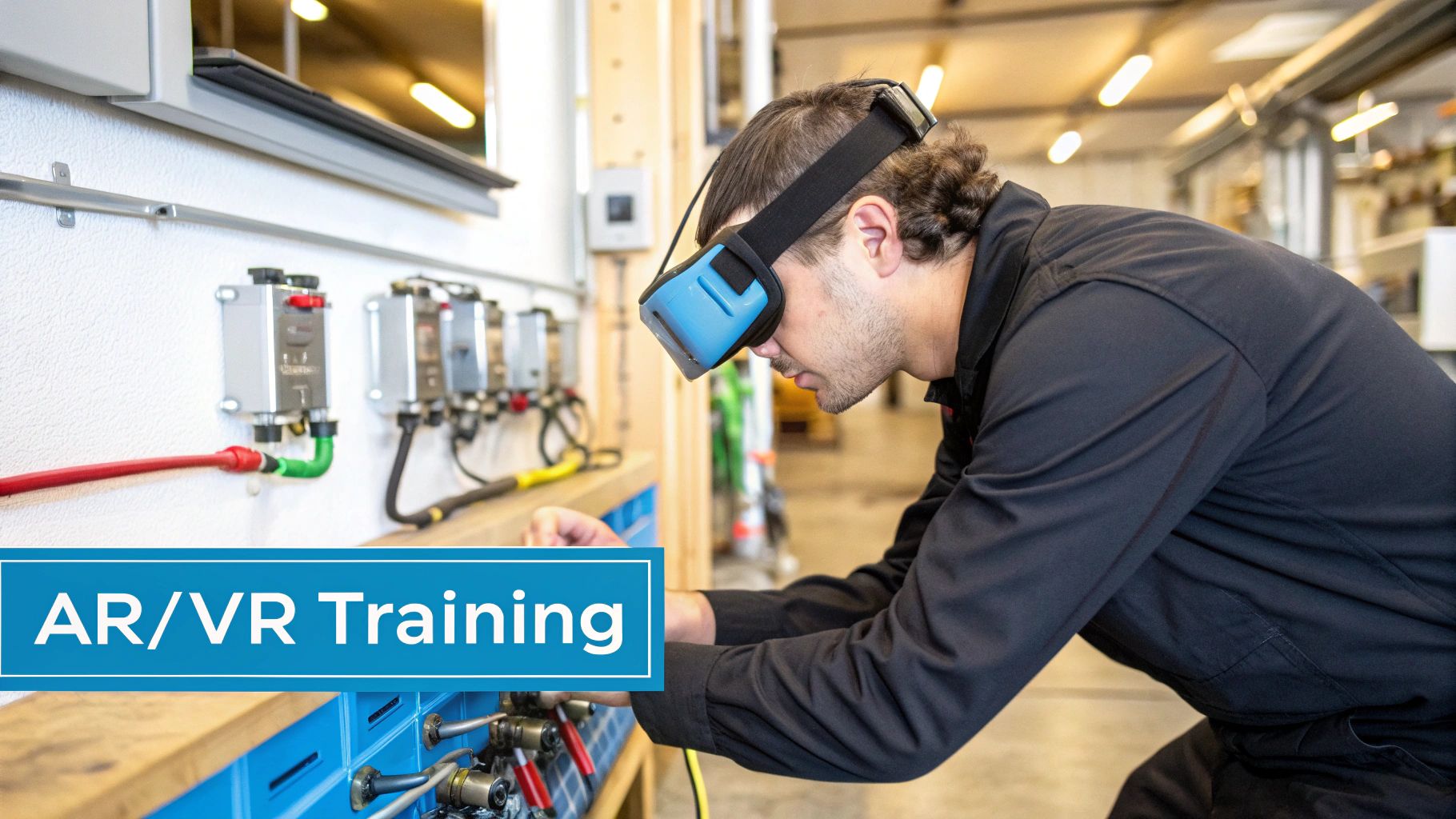
Now that we have established the "why" and "what" of your training plan, let's focus on the "how." For hands-on industries like manufacturing and field service, practical application is what truly matters.
Immersive technologies like Augmented Reality (AR) and Virtual Reality (VR) are transforming this landscape. They bridge the gap between classroom knowledge and real-world performance. Instead of passively watching a video, your team can interact with equipment, practice procedures, and build crucial muscle memory in a controlled environment.
This marks a shift from passive observation to active participation, which is critical for effective learning.
AR for Real-Time Guidance on the Job
Augmented Reality acts as a digital expert, providing real-time guidance by overlaying information—such as instructions, diagrams, or checklists—directly onto the physical world through a headset or tablet.
For a field service technician working on complex machinery, this is a game-changer. There is no need to consult a manual or call a supervisor. They can view an engine and see digital arrows pointing to the exact part that needs replacement. This reinforces learning at the most critical moment: during task execution.
The benefits are immediate and measurable:
- Reduced errors. Clear, step-by-step visual cues minimize guesswork in complex tasks, especially with unfamiliar equipment.
- Faster troubleshooting and repairs. On-demand guidance in the user's line of sight accelerates problem-solving, increasing first-time fix rates and reducing machine downtime.
- Remote expert assistance. A senior engineer can see what the on-site technician sees and provide guidance from any location, saving time and travel costs.
VR for Mastering High-Stakes Skills—Safely
While AR enhances the real world, Virtual Reality creates a new, fully simulated environment. VR platforms immerse employees in a digital space where they can practice high-stakes or dangerous procedures with zero real-world risk.
Imagine a new hire learning to operate a forklift. In a VR simulation, they can experience the controls, understand the machine's turning radius, and even make a mistake like tipping the vehicle. The cost of this error is zero—no injuries, no damaged equipment, just a valuable lesson learned. This safe, repeatable practice builds confidence and competence before they operate real machinery.
Virtual Reality gives your team permission to fail. Creating a space where mistakes are a core part of the learning process fast-tracks employees to genuine expertise and builds a more resilient workforce.
This type of accelerated learning is becoming a business necessity. The World Economic Forum predicts that 39% of workers' core skills will be obsolete within five years, placing immense pressure on companies to upskill their teams quickly and effectively.
How This Looks in the Real World
This is not just theory; it is delivering tangible results today. Here are a few practical use cases:
1. Complex Assembly Training
An aerospace manufacturer uses VR to train technicians on assembling intricate engine components. The simulation guides them through each step, highlighting the correct sequence and torque specifications. As a result, they have reduced assembly errors by over 80% and cut training time by half compared to traditional shadowing methods.
2. Equipment Maintenance and Upskilling
A factory installs a new piece of automated machinery. Instead of relying on the vendor's trainer, the maintenance team uses an AR headset. The device overlays 3D diagrams and instructions directly onto the machine, allowing them to learn new repair procedures on their own schedule.
3. Safety Protocol Drills
A chemical plant uses VR to drill employees on emergency shutdown procedures for a hazardous material leak. Workers practice the high-stress sequence in a realistic but completely safe simulation. This builds the muscle memory needed to react correctly under pressure in a situation they hope never occurs.
These tools directly address real operational challenges. To better understand the principles behind these methods, explore our guide on what is immersive learning. The goal is to move beyond simple memorization to build true competence—the foundation of any effective training program.
Making Your Training Program Stick: A Successful Rollout
A brilliant training program is worthless if it is not adopted. The real test is the rollout, where careful planning meets the reality of your team's daily work. A solid change management strategy is essential, particularly when introducing new technologies like AR/VR.
Without a thoughtful launch, even the best technology can be perceived as another top-down mandate rather than a valuable tool. How you introduce the training sets the tone for its reception. The goal is not just compliance but to generate genuine excitement and demonstrate value from the outset.
Don't Go Big—Go Smart. Start with a Pilot.
Before a company-wide launch, start with a small-scale pilot program involving a select group of employees. This provides an opportunity to test the program in a controlled environment, gather honest feedback, and resolve any issues.
This initial group will provide invaluable on-the-ground intelligence about what works, what is confusing, and what needs improvement. For an AR/VR rollout, this step is non-negotiable, as it allows you to address any technical or user comfort issues before they become widespread problems.
The feedback from this pilot group is the most valuable data you will collect.
A pilot program is also an opportunity to identify your champions. Pinpoint the "power users" and early adopters who can become internal advocates, building momentum organically for the full launch.
Get Your Leaders and Managers on Board
For any training initiative to succeed, it needs visible support from leadership. Securing buy-in involves more than just budget approval; leaders must be active, vocal champions of the program. Frame the initiative in their language: reduced operational costs, improved productivity, and a clear ROI.
Manager buy-in is equally critical. Frontline managers are the gatekeepers. If they are not invested, their teams are unlikely to be.
To win them over:
- Train Your Managers First: Ensure all managers complete the training before their teams. This equips them to answer questions and reinforce new skills.
- Provide a "Manager's Playbook": Give them a simple guide with key talking points, the training schedule, and practical tips for supporting their employees.
- Connect Training to Team Goals: Clearly demonstrate how the skills learned in training will help their team achieve its performance targets.
When managers are equipped and engaged, they transition from supervisors to coaches, ensuring that new skills are applied and sustained.
Answer the "What's In It for Me?" Question
Once leadership is aligned, it's time to communicate with your employees. Your communication strategy should focus on answering the question: "What's in it for me?" (WIIFM). Employees will only become engaged if they see a direct, personal benefit.
Avoid corporate jargon. Focus on practical advantages. Will this training make their job easier? Safer? Will it create opportunities for career advancement?
When introducing new tools like AR/VR, frame them as solutions that eliminate guesswork and provide expert guidance when needed, rather than as complex technologies they must learn. A clear, honest communication plan can turn skepticism into curiosity and lay the groundwork for a successful launch.
Measuring Training Effectiveness and ROI
Once your training program is live, the real work begins. The final and most crucial step is to answer the question: "Did it work?" Measuring effectiveness is the only way to prove the program's value, justify its budget, and refine your approach for future initiatives.
It is tempting to rely on simple metrics like course completion rates. While knowing that 90% of your team finished a module is a start, it doesn't indicate whether they learned anything or if their on-the-job performance has improved. To understand the true impact, you must go deeper.
Going Beyond Completion Rates With The Kirkpatrick Model
The Kirkpatrick Model is a proven framework for evaluating training effectiveness. It breaks down evaluation into four levels, creating a roadmap for connecting training activities to tangible business outcomes. It helps you see the full picture, from initial employee reactions to the ultimate business impact.
Here's how this plays out in a practical setting for technical teams:
- Level 1: Reaction. This level assesses how participants felt about the training. Was the AR headset comfortable? Was the VR simulation relevant to their job? This immediate feedback is crucial for evaluating the learning experience.
- Level 2: Learning. This measures whether participants acquired the intended knowledge and skills. This can be assessed through pre- and post-training assessments, practical skill demonstrations, or in-simulation performance evaluations.
- Level 3: Behavior. This critical, often-overlooked step assesses whether the training changed on-the-job behavior. This can be measured through supervisor observations, performance reviews, or analysis of work order data for changes in procedure adherence.
- Level 4: Results. This level connects the training to the KPIs that matter to leadership. Did the program lead to a measurable decrease in safety incidents, an increase in first-time fix rates, or reduced machine downtime? This is the data that proves value.
To learn more about this structured approach, see our detailed guide on how to measure training effectiveness.
Calculating The Return on Investment for AR and VR Training
Ultimately, leadership wants to see a clear Return on Investment (ROI), particularly for advanced solutions like AR and VR. While the initial investment may be higher, the ROI often materializes faster than with traditional methods due to significant gains in efficiency, safety, and speed.
A simple formula for ROI is:
(Net Program Benefits – Program Costs) / Program Costs x 100 = ROI
To calculate this, you must first quantify the benefits by benchmarking key metrics before the training begins. This baseline is essential for demonstrating a clear "before and after" picture.
The process for rolling out and measuring a new training initiative typically flows from the top down, starting with leadership buy-in and moving through a pilot phase before the full launch.
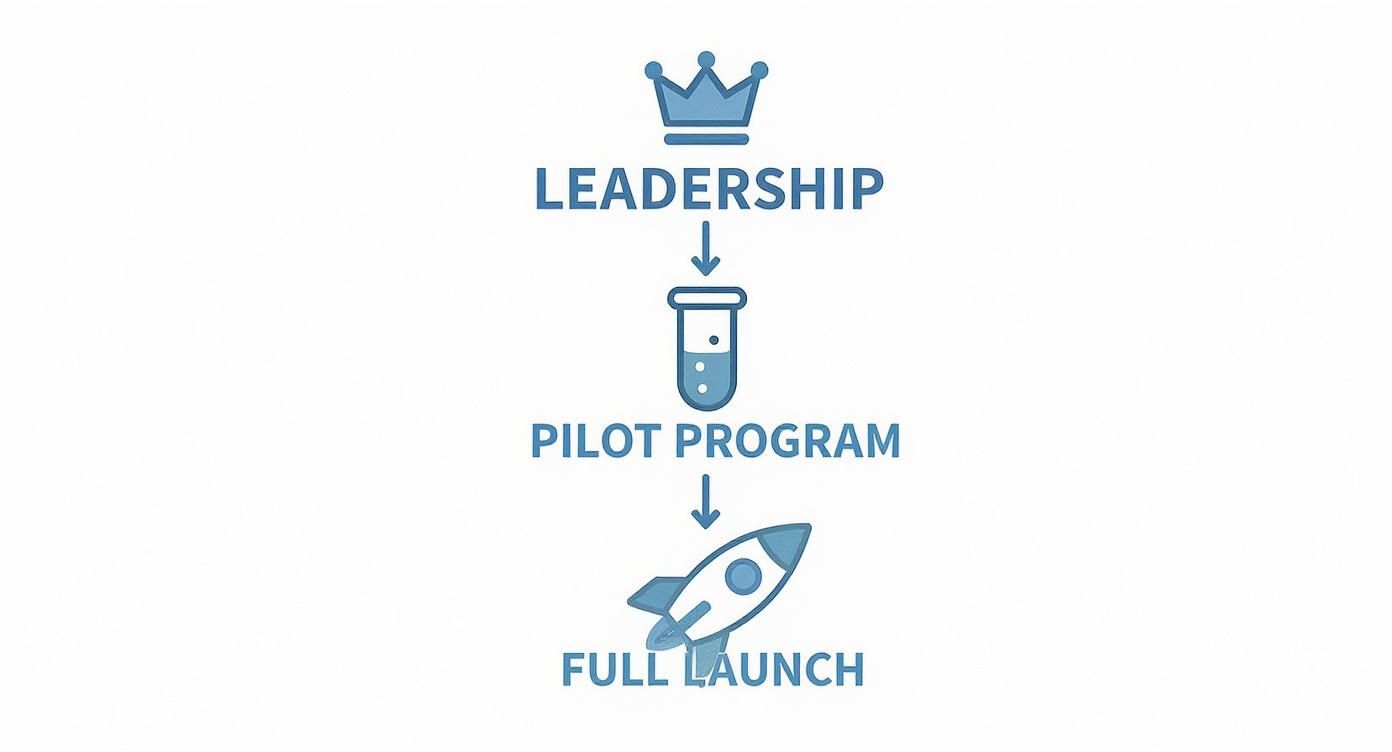
This structured rollout ensures that by the time you launch company-wide, you have already validated the program's value and gathered the initial data needed to build a solid ROI case.
Tying Metrics to Real-World Business Impact
So, what specific metrics should you track to build your business case? For technical roles in manufacturing and field service, the data points are often clear and directly tied to operational costs.
To help translate training outcomes into concrete business value, we've put together a table of key metrics you should be tracking. This is how you start speaking the language of the C-suite.
Key Metrics for Measuring Training ROI in Technical Roles
| Metric Category | Example Metric | Business Impact |
|---|---|---|
| Efficiency & Speed | Time-to-Competency | Reduced onboarding costs, faster deployment of skilled technicians. |
| Quality & Accuracy | First-Time Fix Rate | Fewer repeat visits, lower operational costs, higher customer satisfaction. |
| Quality & Accuracy | Error & Rework Rates | Decreased scrap material, less wasted labor, improved product quality. |
| Safety & Compliance | OSHA-Recordable Incidents | Lower insurance premiums, reduced risk of fines, improved employee morale. |
| Asset Management | Mean Time to Repair (MTTR) | Increased equipment uptime, higher production output. |
By focusing on these hard numbers, you shift the conversation from "training is a cost" to "training is an investment with a clear, predictable return."
The goal is to translate training outcomes into the language of business—dollars saved, time reclaimed, and risk avoided. When you can show that a $50,000 investment in VR training prevented $200,000 in equipment damage and lost production time, the value becomes undeniable.
Consider focusing on a few high-impact KPIs to start:
- Time-to-Competency: How long does it take a new hire to perform a task independently? VR training can reduce this by as much as 40%.
- Error Rates: Track the frequency of mistakes on a specific procedure before and after training. Immersive, hands-on practice can significantly reduce these rates.
- First-Time Fix Rate: For field service, this is a crucial metric. A higher rate means fewer service calls and more satisfied customers.
- Safety Incidents: Measure the reduction in reportable incidents or near-misses for tasks practiced first in a safe VR environment.
When you focus on these figures, you're not just showing how to train employees effectively for skill development—you're proving how it builds a stronger, safer, and more profitable business.
Got Questions About Modern Training? We’ve Got Answers.
Implementing a new training program will inevitably raise questions from all levels of the organization. People will want to understand what is changing, why, and how it affects them.
Anticipating these questions is the best way to ensure a smooth transition, turning skepticism into support and ensuring your program's success. Let's address some of the most common inquiries.
How Do I Actually Get My Team on Board with New Training?
Gaining buy-in starts by answering the question on every team member's mind: “What’s in it for me?”
You must clearly articulate the personal benefits. Explain how the new training will make their jobs easier, safer, or help them advance their careers.
A practical tip is to identify and empower champions. Involve respected team members in a pilot program to let them experience the benefits firsthand. Their endorsement will be more influential than any corporate announcement. Additionally, ensure managers are trained first; their engagement is crucial for driving adoption.
What's the Best Way to Train for Complex, Hands-On Skills?
For intricate technical skills, a blended learning approach is most effective. This combines foundational online theory with hands-on practical application.
Immersive technology is particularly well-suited for this:
- Virtual Reality (VR) simulations allow employees to practice complex or dangerous tasks in a 100% safe environment. They can make mistakes and learn from them without real-world consequences like equipment damage or injury.
- Augmented Reality (AR) tools act as an on-demand expert, overlaying digital instructions onto the physical equipment. This guides employees step-by-step, ensuring tasks are performed correctly the first time.
By combining foundational knowledge with guided, hands-on practice, you build not just knowledge but also muscle memory, leading to faster learning and better retention.
How Can I Justify the Cost of AR and VR?
When discussing the cost with stakeholders, especially the finance department, frame it as an investment that solves expensive problems, not as an expense.
Don't focus on the price of the technology. Focus on the cost of not having it. Quantify the current costs associated with high error rates, machine downtime, slow onboarding, and expert travel. That is the number that matters.
Build your business case on a clear return on investment. Calculate the tangible savings and productivity gains you expect. Leadership needs to see the impact on the bottom line, so highlight metrics such as:
- A 50% reduction in onboarding time for new hires.
- A 30% increase in first-time fix rates for field service technicians.
- Lower rates of safety incidents and less material waste.
When presented this way, the conversation shifts. You are no longer requesting funds for a new technology; you are proposing a strategic solution to some of the business's most persistent and costly challenges.
Ready to see how immersive technology can solve your most pressing training challenges? At AIDAR Solutions, we specialize in AR and VR platforms that deliver measurable results, from accelerating employee learning to boosting operational efficiency. Discover our tailored solutions at https://aidarsolutions.com.

