
Build Better Teams with Competency-Based Training Programs
Competency-based training programs are all about one simple shift: moving the goalposts from time spent learning to skills actually mastered. Instead of pushing everyone through a standardized timeline, these programs let people move forward the moment they can prove they’ve got a skill down cold. The result? A workforce that’s consistently capable.
Shifting from Clock-Watching to Skill Mastery
Think of most traditional training programs like a fixed-length flight. Everyone gets on, the plane takes off, and everyone lands at the same time—whether they paid attention to the safety briefing or not. This time-based model almost always leaves skill gaps, because completion is tied to attendance, not genuine ability.
Now, contrast that with a competency-based model, which is a lot more like getting a pilot’s license. You don’t get your wings just for showing up. You pass when you can actually, demonstrably fly the plane safely and confidently. The hours you log are secondary to your proven ability to handle the critical tasks.
This approach completely changes the game for corporate learning. It tosses out the "one-size-fits-all" mentality and brings in personalized, outcome-driven development.
The Core Difference Explained
The real goal here is to make sure every single employee meets a high, consistent standard of performance. It gets there by focusing on what an employee can do, not just what they know. This practical, “prove it” mindset builds a more capable and confident team that’s ready for anything the real world throws at them.
So, what does this look like in practice?
- Learner-Paced Progression: Employees advance as soon as they master a skill, not when the calendar tells them to. Faster learners can accelerate their development, while others can take the time they need to really nail the concepts.
- Clear Performance Standards: Success is defined with crystal clarity right from the start. Everyone knows the exact benchmarks they need to hit to be considered proficient.
- Practical Assessments: Evaluations are all about performing tasks that directly mirror on-the-job duties, making sure the skills are not just learned, but are truly applicable and stick.
This infographic does a great job of breaking down the key differences between the old way and the new.
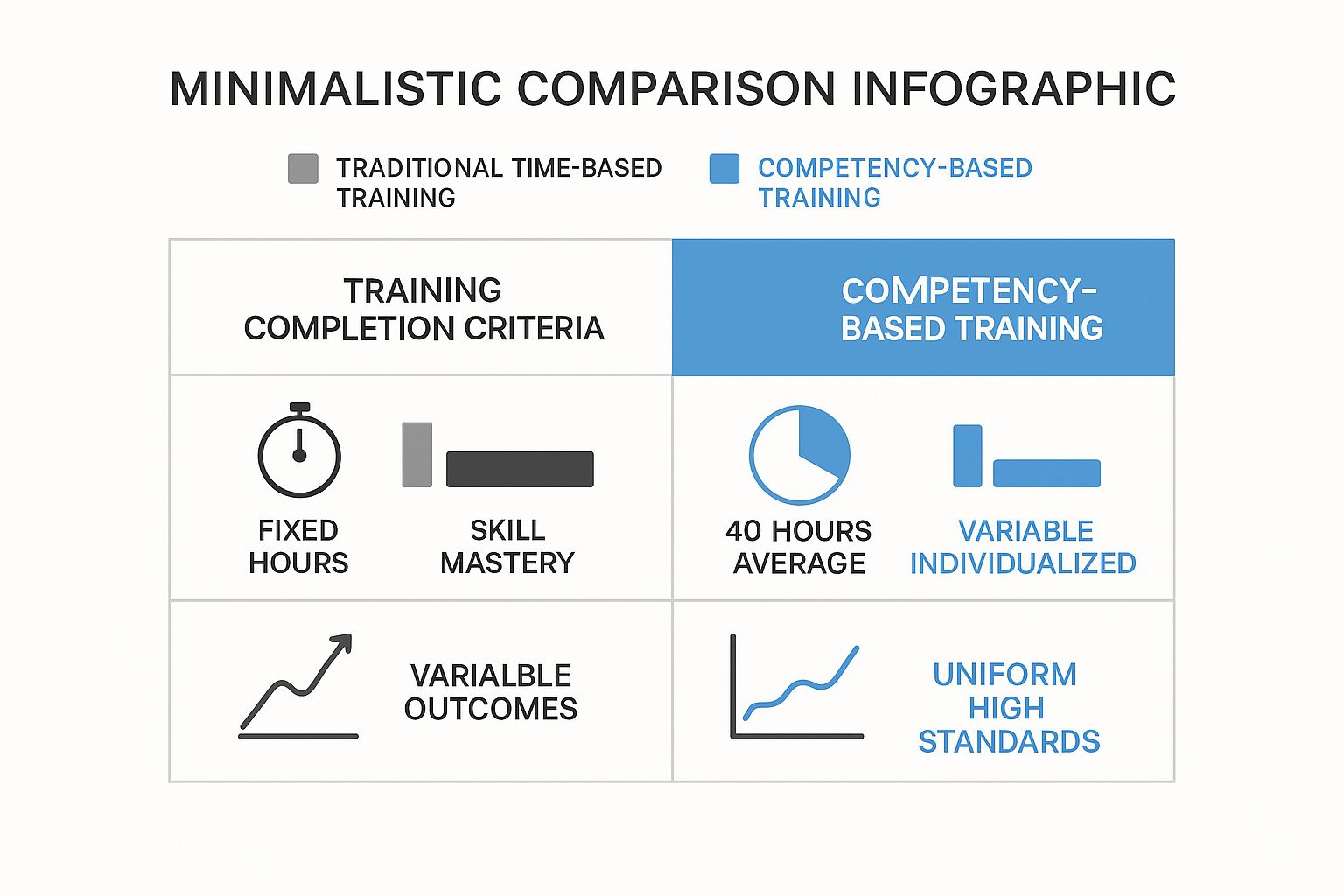
As you can see, making the switch from fixed hours to skill mastery has a direct line to performance consistency. It leads to far more reliable and predictable outcomes across your teams. By embracing this model, organizations can build a workforce where every single person is verifiably equipped for their role.
The Pillars of a Powerful Training Program

To really get what makes competency-based training so effective, you have to look at its core structure. Think of it as a building held up by four distinct pillars. Each one works with the others to shift the focus away from just sitting through training to actively doing and proving skills.
This is all about making sure your training investment actually shows up on the job.
Mastery Over Minutes
The first pillar is a game-changer: Mastery Over Minutes. Here, the clock is totally irrelevant. All that matters is whether an employee can perform a task to a clearly defined standard. It completely dismantles the old "one-size-fits-all" approach where everyone moves at the same pace.
An experienced technician might master a new diagnostic tool in just a few hours and get back to work. Meanwhile, a rookie can take the extra day or two they need to really get it, without feeling rushed or left behind. This flexibility means nobody is held back, and nobody gets pushed ahead before they're ready.
Crystal-Clear Competencies
Next up is the pillar of Crystal-Clear Competencies. You can't measure mastery if you don't define what "good" looks like. This means breaking down job roles into the specific skills, knowledge, and behaviors that actually drive success.
And we're not talking about vague goals. Instead of saying "improve communication," a sharp competency would be: "Demonstrate active listening by summarizing customer concerns accurately and empathetically in 95% of support calls."
This kind of clarity gives employees a roadmap. They know exactly what's expected, how they'll be measured, and what they need to do to knock it out of the park.
A big part of building high-level competencies involves the cognitive skills needed for tough decisions and strategic thinking. This is where you can improve executive function, laying a foundation for stronger leadership and problem-solving.
Personalized Learning Journeys
With clear goals defined, the third pillar follows naturally: Personalized Learning Journeys. Everyone starts from a different place and learns at their own speed, so their path to competency should be just as unique. This approach lets learners put their energy right where they need it most.
An employee who’s already a data wizard can skip the intro modules and jump straight to advanced techniques. At the same time, a team member struggling with new software can get extra resources and practice until they feel confident. Training becomes more relevant, more engaging, and a whole lot more efficient.
Real-World Performance Assessments
The final pillar ties it all together: Real-World Performance Assessments. This is where employees prove their skills in action—not on a multiple-choice quiz. Assessments are designed to mimic the actual challenges they'll face on the job.
- A salesperson might run through a role-play scenario with a tough, skeptical client.
- A software developer could be asked to find and fix a real bug in a piece of code.
- A machine operator might have to demonstrate they can safely set up and run a complex piece of equipment.
Before we move on, it's helpful to see just how different this approach is. Here’s a quick breakdown comparing the old way with the new.
Traditional Training vs Competency-Based Training
| Aspect | Traditional Training | Competency-Based Training |
|---|---|---|
| Focus | Time spent, course completion | Demonstrated mastery of skills |
| Pacing | Fixed, same for everyone | Flexible, self-paced |
| Assessment | Quizzes, final exams | Real-world tasks, simulations |
| Outcome | Certificate of completion | Verifiable skills and abilities |
| Structure | Linear, one-size-fits-all | Personalized, modular |
This table really highlights the fundamental shift. Competency-based training isn't just a small tweak; it's a completely different philosophy centered on what people can do.
This focus on practical application ensures skills are immediately useful. It's a move that's been gaining steam for years; by 2017, over 600 institutions were already developing competency-based programs. It’s a clear signal that the world is moving away from theory and toward proven mastery.
Unlock Tangible Business Advantages

Let's be honest—the ultimate goal of any training program is to connect the dots between learning and bottom-line results. Competency-based training is designed to do exactly that, moving beyond abstract goals to deliver specific, high-impact business outcomes you can actually see and measure.
This model is less about just teaching skills and more about ensuring they are consistently proven on the job. It establishes a reliable performance baseline across the entire organization, so you know every single employee has truly mastered the critical abilities needed for their role.
Cultivating a Consistently Skilled Workforce
Imagine a customer support team where every agent resolves issues with the same high level of proficiency. That’s what competency-based training delivers. It gets rid of the "luck of the draw" for customers by replacing inconsistent skill levels with a standardized, verified capability.
The same logic applies to a manufacturing floor. When every operator demonstrates mastery of complex machinery before they touch it, you see fewer errors, less material waste, and a safer environment. Costly mistakes and production delays plummet. You're building a foundation of reliable expertise, not just hoping for it.
A consistent workforce isn't just about everyone doing things the same way. It's about everyone achieving the same high-quality outcome, every time, because they have verifiably mastered the necessary skills.
This drive for proven skills is a game-changer, especially in high-stakes fields. A 2021 study of a competency-based curriculum for healthcare workers in Nepal, Peru, and Uganda found significant improvements in foundational skills after an average of just 20 hours of training. You can learn more about these competency training findings and see just how powerful this shift can be.
Accelerating Time to Proficiency
Traditional training often forces everyone—new hires and veterans alike—to sit through the same content. It's a massive waste of time for those who already know the material. Competency-based models flip this script. They let employees test out of modules where they’re already skilled, focusing their energy exclusively on closing their specific knowledge gaps.
This targeted approach dramatically shrinks the time it takes for a new team member to become a fully productive contributor. Instead of a rigid six-week onboarding, an experienced hire might get up to speed in two weeks, while a true newcomer gets the dedicated time they need to build a strong foundation without being rushed.
This acceleration unlocks several key benefits:
- Faster Onboarding: New hires start adding real value to the company much sooner.
- Increased Agility: The workforce can be upskilled rapidly to respond to new market demands or technologies.
- Efficient Resource Use: Training budgets and time are directed only where they are needed most.
Boosting Retention and Optimizing ROI
People want to work for companies that invest in their growth and show them a clear path forward. Competency-based training programs create a transparent map for career progression, showing employees exactly which skills they need to master to reach the next level.
This clarity is a powerful motivator. It reduces turnover and boosts morale because team members see a direct link between their effort and their career opportunities. That connection builds deep engagement and loyalty.
Better still, this model optimizes your training return on investment (ROI). By channeling resources directly into closing identified skill gaps, you stop spending on redundant learning. Every dollar and hour is aimed at a specific, measurable performance improvement. Of course, you need to track these outcomes, and there are great strategies for how to measure training effectiveness to prove the value of your programs.
Ultimately, you create a far more efficient and impactful learning ecosystem.
How to Build Your Competency Framework
Think of building a competency framework as drafting the architectural blueprint for a skyscraper. Before you can even think about pouring the foundation or raising the first steel beam, you need a precise plan detailing every single component. Without one, you’re just guessing—and that’s a risky way to build both skyscrapers and skilled teams.
This framework is the absolute backbone of your entire competency-based training program. It spells out what "good" actually looks like for every role and creates a clear, measurable path for employees to get there. The whole process is a mix of collaboration, sharp analysis, and a serious commitment to linking skills directly to business outcomes.
Align with Core Business Goals
First things first: anchor your framework to what the business is actually trying to accomplish. A competency model that exists in a vacuum is completely useless. You have to ask the big questions: What are we trying to achieve as a company? Are we pushing to grab more market share, make our customers happier, or get products out the door faster?
The answers will immediately shine a light on the critical skills your workforce needs. For instance, if the main goal is to bump up customer retention by 15%, then competencies like "Problem Resolution," "Active Listening," and "Product Expertise" suddenly become non-negotiable for your support teams.
This alignment makes sure your training efforts aren't just busywork. They become direct drivers of the company's success, where every skill developed is a deliberate step toward hitting a key business objective.
Define Critical Roles and Functions
Once you’ve got your strategic direction, it's time to pinpoint the key job roles that will get you there. Not every role contributes equally, so focus on the ones that have the biggest impact on your goals.
Get together with department heads and team leaders to map out the core functions of these critical roles. What are their main responsibilities? What are the key results they are accountable for? This stage is all about understanding the "what" before you get bogged down in the "how."
Pinpoint Essential Skills and Behaviors
Now we get into the nitty-gritty. With the critical roles defined, you can start dissecting them to identify the specific skills, knowledge, and behaviors that fuel success. This usually means doing a thorough task analysis where you watch your top performers in action and pick the brains of subject matter experts.
Ask questions like:
- What specific moves do our best salespeople make during a tough negotiation?
- What technical knowledge does a senior engineer lean on to troubleshoot a catastrophic system failure?
- What kind of communication does a great project manager use to keep a team aligned and motivated?
The goal here is to move past generic job descriptions and uncover the tangible actions that separate the average from the exceptional. This is how you build a realistic and highly relevant list of essential skills.
Group Skills into Clear Competencies
Staring at a massive, unorganized list of individual skills is overwhelming for anyone. The next move is to group related skills and behaviors into broader, more meaningful competencies. A competency is really just a cluster of related abilities that lets someone knock it out of the park in their job.
For example, the individual skills of "summarizing client needs," "asking clarifying questions," and "showing empathy" can all be rolled up under the single competency of "Effective Communication."
This tidies up the framework, making it way easier for employees and managers to actually understand and use. A well-defined competency should have a clear title, a simple definition, and a list of the specific behaviors that show it's being used. Managing all this often requires robust systems; many organizations use enterprise learning management systems to track and assign these competencies efficiently.
Establish Proficiency Levels
The final step in building your blueprint is to define what mastery actually looks like. Not everyone needs to be a world-class expert in every single competency, so creating proficiency levels gives you a clear ladder for people to climb.
A common approach is to use a multi-tiered scale:
- Foundational: The employee has a basic grasp and can perform tasks with some help.
- Proficient: The employee can work independently and consistently hits the mark.
- Advanced: The employee can navigate complex or ambiguous situations and is a go-to person for others.
- Expert: The employee is seen as a thought leader who can innovate and teach others in this area.
By defining these levels for each competency, you create a transparent roadmap for career growth. Employees know exactly where they stand and what they need to do to get to the next level, turning the framework from a static document into a living, breathing tool for continuous development.
Putting Your CBT Program Into Action

Alright, your competency framework is built. It’s a solid blueprint, but now comes the real challenge: turning that detailed plan into a living, breathing program that actually builds skill. This is where the rubber meets the road.
A thoughtful implementation strategy is the bridge between your well-defined competencies and true skill mastery on the ground. It’s what ensures your competency-based training program delivers tangible results, not just good intentions. Let's walk through how to make it happen.
Start With a Thorough Skills Gap Analysis
Before you can build, you have to measure. Your first practical step is a skills gap analysis. Think of it as a diagnostic—it compares the ideal competencies you've defined against the skills your employees have right now.
It’s all about answering one critical question: "Where are the biggest gaps between the skills we need and the skills we have?" This isn't about finding fault; it’s about spotting opportunities for targeted, high-impact development. Without this baseline, you're just training in the dark.
Select and Develop Mapped Learning Content
Once you know which skill gaps to prioritize, it's time to find or create learning content that maps directly to those needs. Generic, off-the-shelf courses just won't cut it here. Every single piece of material—from an e-learning module to a hands-on workshop—has to be purpose-built to develop a specific competency from your framework.
Creating great learning content is a craft. For example, if you're making instructional videos, it's worth learning from experts on how to make training videos that are clear, engaging, and get the job done. The goal is to build a library of resources that gives employees a clear path from novice to expert.
This direct alignment between content and competency is non-negotiable. It’s what transforms your training from a collection of disconnected activities into a cohesive system for professional growth.
Choose the Right Mix of Delivery Methods
How you deliver the content is just as important as the content itself. The best programs use a blended approach, because different skills demand different learning environments. Your strategy should be a smart mix of methods tailored to the competency you're teaching.
- Immersive VR/AR Simulations: For complex, high-stakes tasks, nothing beats immersive tech. It provides a safe, repeatable space for people to practice until they get it right, without any real-world risk.
- On-the-Job Coaching: This is perfect for refining skills in a real-world context, where experienced mentors can give direct, immediate feedback.
- Self-Paced E-Learning: For foundational knowledge and theory, self-paced modules let employees learn at a speed that works for them.
- Peer-to-Peer Learning: Don't underestimate the power of collaboration. It reinforces skills and helps build a supportive learning culture within your teams.
Launch a Pilot Program
Before you go all-in with a company-wide rollout, launch a pilot program. Pick a smaller, representative group of employees and treat it as a trial run. This is your chance to work out the kinks, gather honest feedback, and fine-tune your approach.
Use the pilot to test everything—from the clarity of your content to the effectiveness of your assessments. This iterative process helps ensure that when you do launch the program for everyone, it’s polished, effective, and ready to make a real impact.
Secure Buy-In and Communicate the Value
Finally, no program succeeds without buy-in. Leadership needs to be its biggest champion, constantly reinforcing why this matters to the company's future. For employees, you have to clearly answer the "what's in it for me?" question.
Frame the program as a clear path for their own professional growth—a transparent roadmap for advancing their career. Our guide on how to train staff effectively offers some great strategies for this. When people understand the value and see that leadership is committed, they’ll jump on board with genuine enthusiasm.
Accelerate Skill Mastery with Immersive Tech
The true power of competency-based training is unlocked when it closes the gap between knowing what to do and actually being able to do it under pressure. This is where immersive technologies like Virtual Reality (VR) and Augmented Reality (AR) come in. They are powerful tools for bridging this exact divide, transforming how skills are practiced and proven.
These technologies build hyper-realistic, safe environments where employees can master complex tasks without any of the real-world risk. It’s one thing to read a manual about a delicate repair procedure; it’s another thing entirely to perform it step-by-step in a simulated world where mistakes have zero costly consequences. This is the core advantage immersive tech brings to the table.
Practice in a Risk-Free Reality
Picture a technician learning to service a new, multi-million dollar piece of industrial machinery. In a traditional training setup, their first hands-on experience might be on the live equipment, where a single slip-up could cause catastrophic damage or halt production.
With VR, that same technician can walk through the entire procedure dozens of times in a perfect digital replica. They build muscle memory and confidence, making mistakes and learning from them in a space where the only consequence is hitting a reset button. This approach ensures that by the time they step up to the real machine, they have already demonstrated verifiable mastery.
The ability to fail safely is a cornerstone of deep learning. Immersive technology provides a sandbox where employees can experiment, troubleshoot, and perfect their skills, ensuring they are truly competent before facing high-stakes situations.
Similarly, AR can overlay digital instructions and diagrams onto a physical object, guiding a new employee through a complex assembly process in real-time. They see precisely where each part goes, slashing error rates and dramatically shortening their time to proficiency.
Objective Data-Driven Assessments
One of the toughest challenges in any training program is figuring out how to measure skill objectively. Immersive technologies solve this problem by capturing incredibly precise performance data.
A VR simulation can track every single action a user takes—from the tools they select to the sequence of their steps and the exact time it takes to complete a task.
This flood of data provides an unbiased, crystal-clear picture of an employee’s proficiency. It elevates assessment beyond simple observation and into the realm of hard metrics. Managers can see exactly where a team member excels and where they need more practice, which aligns perfectly with the data-first nature of competency-based training programs. This is a massive shift in corporate education, and you can learn more about what is immersive learning in our detailed guide.
Getting this level of detailed, objective feedback is nearly impossible with traditional methods alone.
Real-World Use Cases
The practical applications of this technology are already driving huge results across industries.
- Manufacturing: Operators use VR to master complex machine setups and safety protocols, which helps reduce on-the-job accidents and expensive equipment damage.
- Healthcare: Surgeons can practice intricate procedures in a simulated operating room, refining their techniques and ultimately improving patient outcomes.
- Leadership Development: Aspiring managers can sharpen their public speaking or conflict resolution skills by interacting with virtual avatars in realistic, challenging scenarios.
At the end of the day, immersive tech provides the critical "hands-on" practice that makes competency-based training so effective. It allows you to measure proficiency, not just participation, ensuring every employee has genuinely mastered the skills they need to succeed.
Answering Your Questions About Competency-Based Training
When organizations first explore competency-based training, a few key questions always pop up. The most common one? "How is this really different from what we already do?" After all, traditional training has tests and quizzes.
The big difference isn't in the testing, but in the definition of "done." Traditional training measures success by hours spent in a classroom or modules completed. Competency-based training, on the other hand, only cares about one thing: can the employee consistently and correctly apply the skill in a real-world setting? That's it. Time is irrelevant; verified skill is everything.
Another frequent question is about where to even begin. It’s tempting to jump straight to finding a new software platform, but that’s putting the cart before the horse. The real first step is to build a rock-solid competency framework. This means sitting down and identifying the critical skills that directly impact your business goals, then defining exactly what successful performance looks like for each one.
How Do You Measure Success and ROI?
Naturally, leaders want to know how to measure the return on investment (ROI). With traditional training, you're often stuck with vanity metrics like completion rates. But with competency-based models, you get to track what actually matters: direct business impact.
Your Key Performance Indicators (KPIs) become the star of the show here. Instead of tracking attendance, you start measuring things like:
- Reduced Time to Proficiency: How much faster are your new hires hitting their full stride and becoming productive team members?
- Lower Error Rates: Are you seeing a measurable drop in costly mistakes on the production line or in customer service?
- Increased Productivity: Is your output per employee or team climbing in a tangible way?
The whole point is to connect every single learning objective to a business outcome you can actually see and measure. When you can prove that mastering a specific competency led to a 15% drop in customer support tickets, you've got a crystal-clear case for ROI.
Ultimately, this approach flips the entire conversation. You stop asking, "Who finished the training?" and start asking, "What business results did this training drive?" This sharp focus on performance is what makes a competency-based model a true strategic asset, not just another HR program.
Ready to accelerate skill mastery and see measurable results? AIDAR Solutions can help. Our immersive AR/VR platforms are built to develop and verify critical job skills in a safe, controlled environment, making sure your teams aren’t just trained—they’re truly competent. Learn how our solutions can transform your training outcomes at aidarsolutions.com.