Augmented Reality Manufacturing Industry: Transforming Production
Imagine a factory technician examining a complex piece of machinery. Instead of flipping through a thick manual, digital instructions are layered directly over their view, pointing out exactly which part to fix. This isn't science fiction; it's a practical application happening right now in the augmented reality manufacturing industry. This technology is a practical tool solving real production challenges today.
Seeing a New Reality on the Factory Floor
Augmented reality, or AR, is fundamentally changing manufacturing by connecting the digital world with the physical one. It is different from virtual reality, which immerses users in a completely computer-generated space. AR simply adds to what you already see, layering helpful computer-generated data, images, and instructions onto your real-world view.
Think of it as a transparent, interactive blueprint for the factory floor. A technician wearing a pair of smart glasses can look at a pump and instantly see its live performance data, pull up its entire maintenance history, or follow a step-by-step repair guide that moves with them. A complicated job becomes a simple, visually guided process.
Empowering the Frontline Worker
The primary goal of AR is not to replace people, but to enhance their skills and capabilities. By putting critical information directly into a worker’s line of sight—right when they need it—AR makes your team more efficient, faster, and safer. This eliminates the need to move back and forth to a computer terminal or decipher a paper schematic.
This direct line to information creates a ripple effect of improvements across the entire operation. The main benefits include:
- Fewer Mistakes: When instructions are visual and overlaid on the actual task, it is much harder to make a costly error during a complex assembly or repair.
- More Uptime: Workers complete tasks faster when the information they need is right in front of them, which means less machine downtime.
- A Safer Workplace: AR can actively flag potential dangers, like hot surfaces or high-voltage areas, creating a much safer environment for everyone.
At its core, AR is about getting the right information to the right person at the exact moment they need it. It is a powerful way to close skills gaps and boost productivity without years of traditional training.
The augmented reality manufacturing industry is one of the most exciting areas in industrial technology right now. It stands alongside other key innovations that define the modern factory. You can get a broader view of these advancements by exploring the new technologies in manufacturing that are reshaping production as we know it.
Beyond the Buzzwords
Once you get past the hype, you find that AR is a practical solution for real-world problems. It marks a significant shift away from reactive problem-solving and toward a proactive, data-driven operation. Companies are already using it for everything from onboarding new hires to performing complex quality control checks.
Ultimately, bringing AR to your factory floor is about empowering your people. By giving your workforce tools that make them more knowledgeable and effective, you build a more agile team that can handle the demands of modern production. It’s about making every worker your best worker.
How AR Works in an Industrial Setting
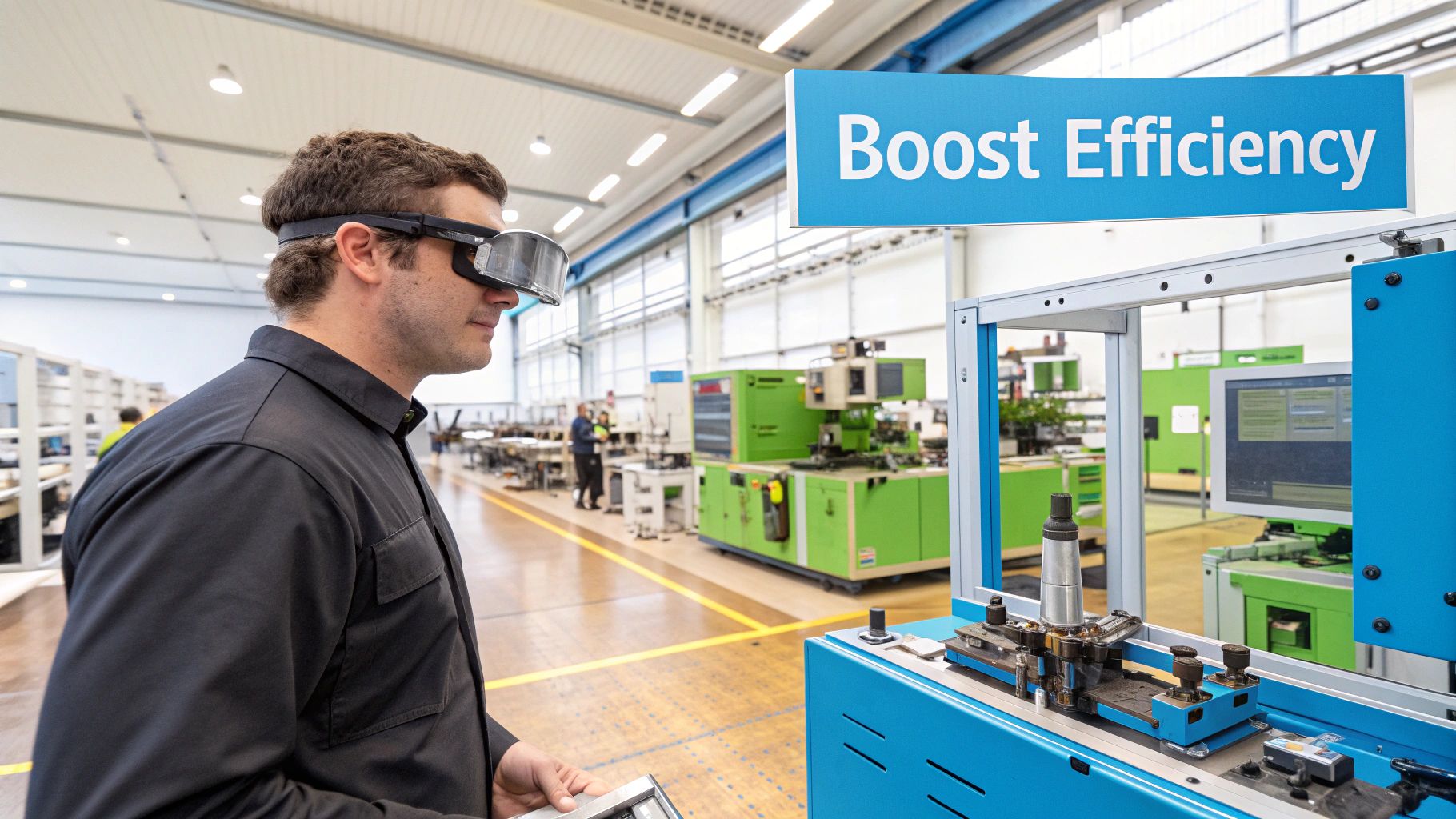
To fully appreciate why augmented reality is making such an impact in manufacturing, it helps to understand how it functions on the factory floor. Think of industrial AR as a dynamic, interactive blueprint that comes to life right in front of your eyes. It overlays your physical world with layers of critical digital information.
Unlike Virtual Reality (VR), which immerses you in a completely digital world, AR keeps you grounded in your real-world surroundings. The technology works when three core components operate in sync to deliver real, actionable insights to your frontline workers: the hardware, the software, and the data that ties it all together.
The Hardware: The Window to Digital Information
The first piece of the puzzle is the hardware. This is the physical device your team looks through to see this blend of real and digital worlds. Without the right device, the AR experience remains on a server. The choice of hardware depends on the specific job at hand.
Common hardware in manufacturing settings includes:
- Smart Glasses: These are ideal for hands-free work. A technician repairing a complex machine can see step-by-step visual instructions projected into their line of sight without ever having to put down their tools.
- Tablets and Smartphones: Already widely available, these devices are a highly accessible entry point into AR. An operator can point a tablet’s camera at a piece of equipment, and the screen will instantly display data overlays like temperature readings or pressure levels.
- Projection Systems: For stationary tasks like assembly or quality control, fixed projectors can beam instructions or templates directly onto a workbench or even the product itself. This guides workers with exceptional precision.
The Software: The Brains of the Operation
If the hardware is the window, then the software is the brain deciding what to show and where to place it. This is where the application's core logic resides. The software platform is responsible for tracking the user's position and orientation in the physical world with pinpoint accuracy.
It then renders the right digital content—whether it's a 3D model, a text instruction, or a video—and aligns it perfectly with the real-world object. This process, known as spatial mapping and registration, is what makes the digital overlay appear anchored to the physical equipment, creating an experience that is both believable and genuinely useful.
Data Integration: The Fuel for AR Insights
Finally, the most powerful AR systems are those that integrate with your existing data streams. This is the fuel that makes the information both relevant and timely. The AR software integrates with the systems you already depend on to run your facility.
By connecting to real-time data streams, AR moves from being a static instruction manual to a live, dynamic dashboard for the physical world. It transforms raw data into contextual, actionable knowledge for your team.
This integration can pull information from various sources, such as your Enterprise Resource Planning (ERP) system, Manufacturing Execution System (MES), or even live data streaming from IoT sensors on your machinery. The ability to tap into various augmented reality industrial applications is exactly what makes the technology so flexible.
Looking ahead, the industry is moving toward more flexibility. By 2025, manufacturers will no longer be locked into a single AR hardware provider. This means companies can switch between smart glasses, tablets, or projectors without running into compatibility issues, letting them perfectly tailor the AR tool to the task and get the most out of their investment. You can find out more about upcoming manufacturing trends on 3ds.com.
Where AR is Actually Changing the Game on the Factory Floor
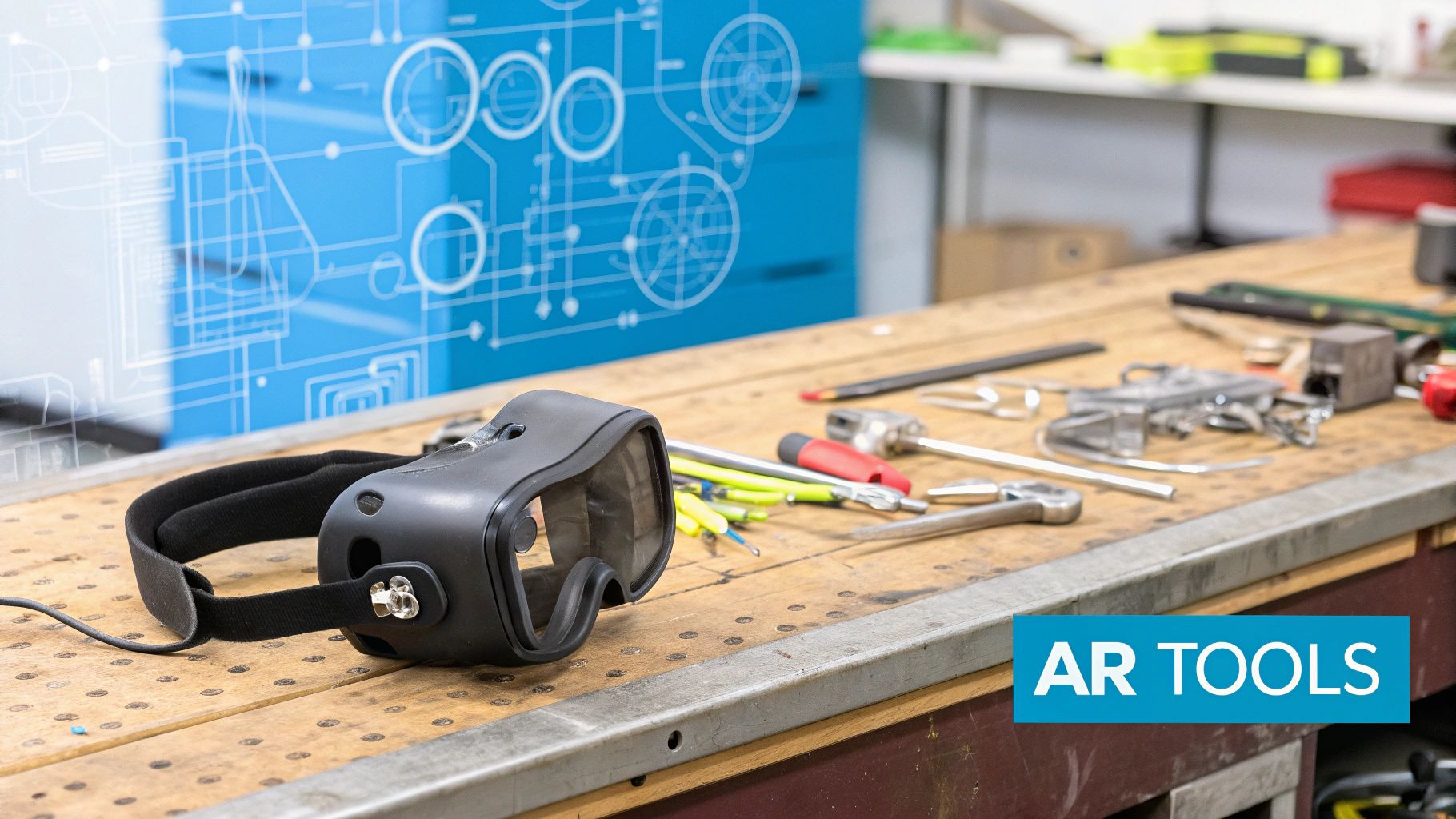
It is one thing to discuss technology in theory, but where does AR really deliver value? The answer is on the factory floor, solving high-stakes challenges where speed, precision, and accuracy are absolutely critical.
This is where augmented reality stops being an interesting concept and becomes an indispensable tool. The augmented reality manufacturing industry isn't just selling a vision of the future; it's delivering real results today. Let's look at three core areas where AR is already making a huge difference: complex assembly, maintenance, and quality control.
Guiding Complex Assembly with Digital Precision
Modern products are incredibly complex. Assembling an aircraft engine or a server rack involves thousands of intricate parts where one wrong move can lead to expensive rework or scrapped materials. This is an ideal application for AR.
Instead of constantly glancing between a paper manual and the actual part, a technician wearing smart glasses gets a direct overlay of the instructions. The AR system can highlight the exact bolt to tighten, show the required torque value, and even display a green checkmark once the step is completed correctly. The information is right there, in their line of sight, exactly when they need it.
The benefits here are immediate and clear:
- Fewer Mistakes: With a visual guide projected directly onto the work, it is far more difficult to make an error. Some companies have seen error rates drop by as much as 90% after implementing AR-guided assembly.
- Faster Work: Workers no longer stop to find the right page in a binder. They can move through tasks more smoothly and confidently, which shaves significant time off the assembly process.
- Quicker Onboarding: New hires can become proficient in a fraction of the time. The AR system acts as a personal coach, guiding them through complex jobs from day one.
A New Era for Maintenance and Repair
When a key piece of machinery goes down, the clock starts ticking. Every minute of downtime is lost revenue, and bringing in a specialist from another location is a logistical and financial challenge.
AR-powered remote assistance completely changes this equation. An on-site technician can wear a pair of smart glasses and stream their exact point of view to an expert located anywhere in the world.
This “see-what-I-see” capability is a game-changer. The remote expert isn't just talking them through the repair; they can digitally draw, place arrows, or pull up schematics directly into the technician's view. It is as if they are right there, pointing at the problem.
This is a significant benefit for both internal maintenance teams and field service operations. It reduces travel costs and gets machinery back online dramatically faster, which directly boosts Overall Equipment Effectiveness (OEE). For a much deeper look at this, check out our full guide on augmented reality for maintenance.
Supercharging Quality Assurance and Inspections
Maintaining quality is paramount in manufacturing. However, traditional quality control often involves manual inspections that are slow and can be subjective, especially when identifying minor imperfections.
AR makes this process faster and far more objective. An inspector can use a tablet or smart glasses to overlay a product's digital CAD model directly onto the finished, physical item. Instantly, they can see any difference between the design and the reality. It makes spotting a misaligned panel, a missing screw, or a surface flaw almost effortless.
For example, an inspector checking a finished car door can hold up a tablet, and the AR app will superimpose the digital blueprint over the real door, immediately flagging any spot where the panel gap is outside of the allowed tolerance.
Each of these examples shows that augmented reality is a practical tool that helps people build things correctly, fix things faster, and verify quality with a level of precision that was previously impossible.
Key AR Applications in Manufacturing
To summarize, the table below provides a quick snapshot of how AR is being used across the manufacturing landscape and the core benefits each application delivers.
| Application Area | Description | Primary Benefit |
|---|---|---|
| Complex Assembly | Overlays step-by-step 3D instructions and specifications directly onto the physical workpiece. | Reduces assembly errors and accelerates production cycle times. |
| Remote Assistance | Enables experts to see through a local technician's eyes and provide real-time, interactive guidance. | Slashes machine downtime and eliminates expert travel expenses. |
| Quality Assurance | Superimposes digital design models onto finished products to instantly detect physical deviations. | Increases inspection speed and improves defect detection accuracy. |
By bringing the right digital information into the physical world at the right time, AR empowers the workforce to perform at a higher level across the board.
Measuring the Real-World Impact of AR

Any new technology, no matter how innovative, requires a solid business case for adoption. For augmented reality in manufacturing, this means moving beyond the initial excitement and connecting it directly to the key performance indicators (KPIs) that impact your bottom line.
To gain approval, decision-makers need to see a clear connection between adopting AR tools and seeing tangible improvements on the shop floor. The goal is not about adding futuristic gadgets; it is about solving real-world production challenges in a way that is reflected in the numbers.
Connecting AR to Core Manufacturing KPIs
The true value of AR becomes evident when you track its impact on the metrics that define a plant's health and efficiency. These are the numbers everyone understands, making them the perfect benchmarks to prove AR’s value.
Here are the primary KPIs that AR directly impacts:
- Overall Equipment Effectiveness (OEE): This is the gold standard for measuring manufacturing productivity. AR drastically cuts down on downtime—a major drag on OEE—by enabling faster changeovers and providing instant remote assistance for repairs.
- First-Time Fix Rate (FTFR): For any maintenance crew, getting a repair right the first time is crucial. AR-guided instructions and live expert support put the right information in a technician's hands, dramatically boosting the odds of a first-time fix and eliminating costly follow-up visits.
- Scrap and Rework Reduction: This is where AR can have a massive impact. AR-assisted assembly and quality control can slash error rates by up to 90%. By overlaying digital blueprints and specs onto physical parts, workers can spot tiny deviations on the fly, minimizing wasted materials and the hours spent on rework.
By zeroing in on these measurable outcomes, you change the conversation from "this is a nice-to-have" to "this is a strategic investment with a predictable return." The data itself builds the financial case you need to move forward.
The Financial Case for Augmented Reality
Beyond factory floor metrics, the financial argument for AR is getting stronger every day. The explosive growth in demand for AR hardware is a powerful sign of its perceived value.
The economic footprint of augmented reality is massive. Revenue from AR glasses alone shot up from $1.85 billion in 2021 and is projected to hit an incredible $35.06 billion by 2026. That's a nearly 19-fold increase in just five years. This surge shows a widespread industry commitment to adopting AR for core operations. You can dig into more data on AR’s market growth at market.us.
Quantifying the Impact on Your Workforce
One of the most immediate and profound benefits of AR is how it transforms employee training and performance. Traditional onboarding is often slow and requires your most experienced employees to mentor new hires, taking them away from their primary tasks. It is a significant drain on resources.
AR-guided training completely changes that model.
New employees can follow interactive, step-by-step instructions overlaid directly onto their real-world workspace. They learn by doing in a safe and controlled way. This approach has been shown to cut onboarding and training time by more than 50%, getting new team members up to full productivity in a fraction of the time. Getting an accurate read on these improvements is key, and our guide on how to measure training effectiveness gives you a clear framework for tracking this crucial ROI.
This isn't just about saving money on training. This accelerated learning curve helps close the skills gap that plagues so many manufacturers. By making decades of institutional knowledge available through an AR headset, you empower every single worker to tackle complex tasks with the confidence and precision of a seasoned expert. The result is a more flexible, skilled, and efficient workforce ready for anything.
Your Roadmap to AR Implementation
Bringing augmented reality to your factory floor is a strategic journey that starts small, proves its value, and then scales up intelligently. A solid implementation roadmap is essential—it will help you navigate the process, gain stakeholder buy-in, and ensure the rollout delivers the desired results.
The best approach is to work in phases, starting with a focused pilot project. The goal is simple: achieve a quick, high-impact win. This builds momentum and makes it much easier to justify a larger investment down the line. By targeting one specific, well-defined problem, you can demonstrate exactly what AR can do in your unique environment.
Identifying Your High-Impact Pilot Project
First, you need to find the perfect opportunity for an initial AR deployment. Think of a problem that is significant enough to matter but small enough to manage. Walk your factory floor and identify the most persistent pain points.
Look for areas known for:
- High Error Rates: Is there a complex assembly process where mistakes are frequent and costly? That is a perfect candidate.
- Significant Downtime: Is there a critical machine that is notoriously difficult to repair? Proving AR can expedite that process is a powerful demonstration.
- Lengthy Training Cycles: Is there a workstation that takes new hires months to master? AR-guided learning could be a game-changer there.
By picking a process where you can easily measure improvement, you set yourself up to build a strong business case. Your pilot project becomes your own internal case study, proving the value of the augmented reality manufacturing industry with your own data.
Selecting the Right Technology Stack
Once you have identified your target, it is time to choose the right tools for the job. Your technology stack consists of two main components: hardware and software. The key is to match them to your specific needs.
On the hardware side, consider the physical reality of the task. If a technician needs both hands free to work on an engine, smart glasses are the clear winner. However, if the job is a quality inspection at a fixed station, a mounted tablet or an overhead projector might be a more practical and cost-effective choice.
The software platform is the brain of the operation. You will want a platform with intuitive tools for creating and managing your AR content. Just as importantly, it needs to connect with your existing systems, like your MES or ERP. That connectivity is what transforms a simple visual overlay into a smart, data-fed tool.
This visual gives you a good idea of the core stages for bringing an AR solution to life, from the initial planning all the way to deployment.
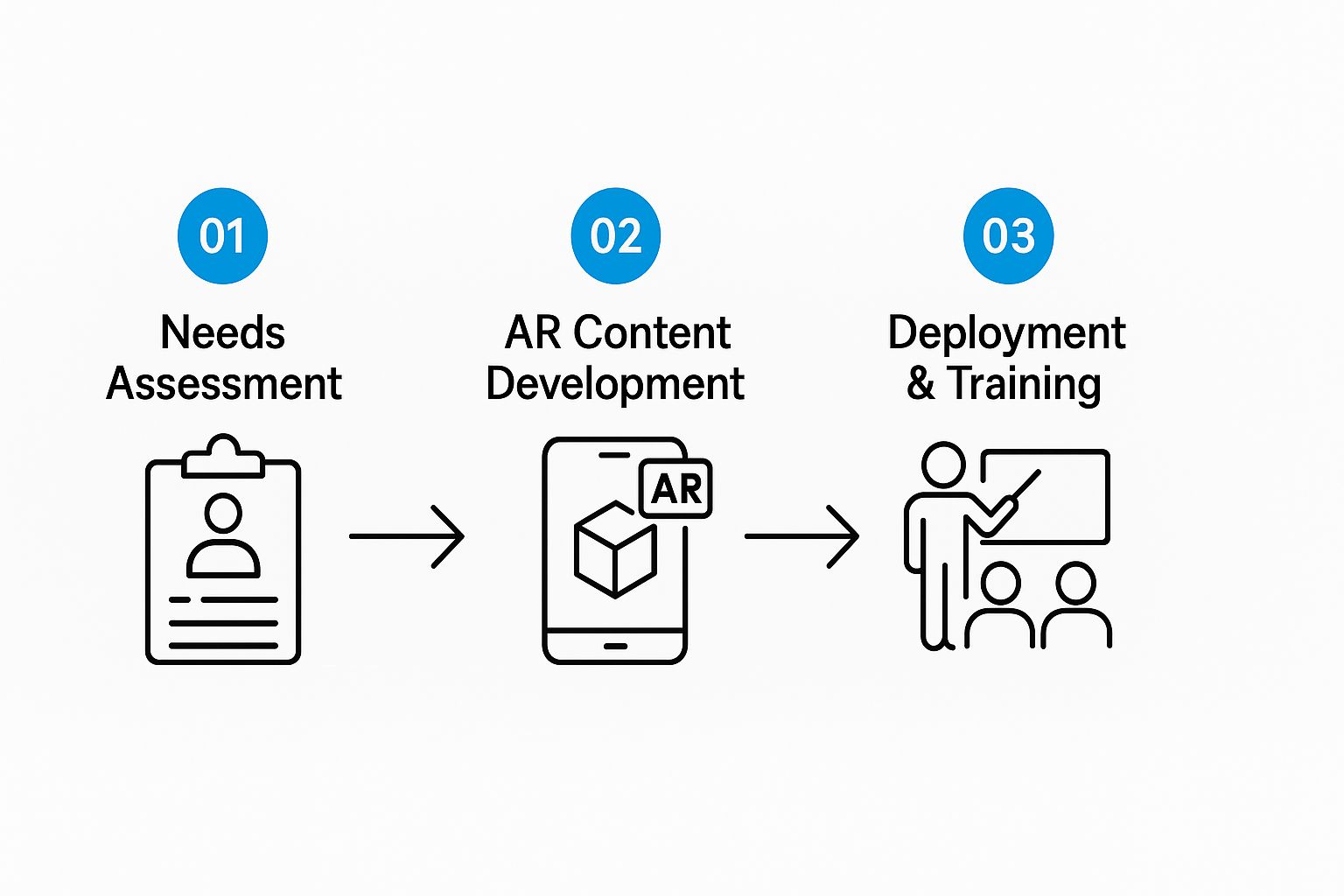
As you can see, it is a structured approach where each phase builds logically on the one before it, setting you up for a successful implementation.
Developing and Deploying Your First Workflows
With your technology selected, it is time to create the AR content your team will actually use. This is where you convert dense standard operating procedures (SOPs), technical manuals, and—most importantly—the institutional knowledge from your most experienced experts into interactive, step-by-step digital guides.
The best workflows are clean, simple, and visual. They break down complex jobs into small, digestible steps, using 3D models, text callouts, and short video clips to show the user exactly what to do next. Think of it as building a GPS for a complex manual task.
A successful deployment is about more than just technology; it is about the user experience. Involve your frontline workers in the development process. Ensure the AR guides are intuitive and genuinely helpful—that they actually make their jobs easier.
Once your content is built, you can begin deployment. This usually means training a small group of users on the new hardware and software. Do not overlook this step—good training and clear communication are essential for getting people on board and excited to use the new tools.
Measuring Success and Planning for Scale
The final step of your pilot is measuring its impact. Remember those KPIs you set at the beginning? Now is the time to review them. Did the error rate drop? Was that machine repaired faster? Are new hires getting up to speed in half the time? Collect all of this data meticulously.
These results are the evidence you need for the next stage: scaling up. A successful pilot with clear, positive metrics provides undeniable proof of ROI, making it much easier to get approval from executives for a broader rollout. Your scaling strategy should be just as thoughtful as your pilot, expanding the solution to other similar tasks or different departments across the facility.
By following this roadmap, you systematically de-risk the adoption of AR. You start with a focused proof of concept, learn valuable lessons in a controlled setting, and build a data-backed case for transforming your operations, one process at a time.
So, Where Do We Go From Here?
If this guide has made one thing clear, it is that augmented reality is no longer a futuristic concept. It is here, right now, empowering a smarter, safer, and more productive workforce on factory floors across the globe. The augmented reality manufacturing industry isn't a future trend; it's a present-day reality.
AR reaches its full potential when paired with other Industry 4.0 mainstays like the Internet of Things (IoT) and artificial intelligence (AI). This creates a truly connected ecosystem where digital insights and physical actions merge, paving the way for capabilities like predictive maintenance and adaptive workflows. It is the difference between reacting to problems and preventing them.
The Time to Act is Now
The adoption numbers tell the real story. AR smart glasses are quickly becoming essential equipment, with projections showing shipments for manufacturing will skyrocket to 27 million units by 2025. This massive jump is happening for one simple reason: this technology works. Workers using real-time digital overlays complete jobs faster and with fewer mistakes.
The investment follows the results. The market for AR smart glasses is expected to exceed $175 billion by 2026. If you are curious about what is driving that growth, you can dive deeper into the nine key uses of AR in manufacturing on pluto-men.com.
The competitive advantage in modern manufacturing belongs to those who act, not those who wait. If you wait for a technology to become mainstream, you are already playing catch-up.
So, what is the final word? Do not let the future happen to you—get out there and build it. The journey starts with a single, focused pilot project. Identify one of your biggest challenges, roll out a targeted AR solution, and see the results for yourself.
That first win is all it takes to build the momentum you need for a wider rollout. It is how you secure your position as a leader, not a follower. Your AR journey can start today.
Common Questions About AR in Manufacturing
Adopting new technology always comes with questions. When it comes to implementing augmented reality on the factory floor, leaders are rightfully curious about the cost, integration with existing systems, and security.
Getting clear answers to these questions is the first step toward making an informed decision for your facility.
What Does an AR Solution Actually Cost?
This is usually the first question, and the answer is that it is more accessible than you might think. You do not need a massive budget to get started. A pilot project can often be launched with a modest investment, especially if you use existing hardware, like tablets, to keep initial costs down.
The total investment depends on a few key factors:
- Hardware: The price will vary depending on whether you choose smart glasses, tablets, or projection systems.
- Software Licensing: The cost depends on the platform’s capabilities and the number of users.
- Content Creation: Developing custom digital work instructions is a key part of the budget.
It is helpful to view AR not as a cost, but as an investment. The real value comes from the return—slashing error rates and boosting efficiency across the board.
Will AR Play Nice With My Existing Systems?
Absolutely. Modern AR platforms are designed to connect with the systems you already rely on. Integration with your Manufacturing Execution System (MES) or Enterprise Resource Planning (ERP) is standard practice.
This connection is where the technology truly shines. It allows the AR system to pull real-time data—such as live work orders or inventory levels—and overlay it directly in a technician's line of sight. Your AR tool transforms from a static manual into a dynamic interface for your entire operation.
The true power of AR is unlocked when it integrates seamlessly into your existing digital ecosystem, delivering the right information to the right person at the exact moment they need it.
How Do You Handle Data Security?
Security is non-negotiable. In a manufacturing environment, AR systems handle sensitive data, from proprietary product designs to critical operational information. Any reputable AR provider makes security a top priority with robust measures.
This typically includes end-to-end encryption for all data, secure user authentication, and granular access controls based on user roles. For facilities with stringent security requirements, on-premise deployments are almost always an option, keeping all your data safely behind your own firewall. You maintain complete control over your most valuable information.
Ready to see how augmented reality can solve your real-world operational challenges? The experts at AIDAR Solutions can map out a focused plan to integrate AR into your workflows, drive up efficiency, and deliver a fast return on your investment. Explore what's possible at https://aidarsolutions.com.