Augmented Reality for Cars Explained: The Ultimate Guide
Imagine your car's windshield doing more than just keeping the rain out. What if it could transform into a smart, transparent screen, painting critical information right onto the road ahead? That’s the core promise of augmented reality for cars—a practical technology that’s actively making driving safer and vehicle maintenance a whole lot smarter.
What Exactly Is Augmented Reality for Cars?
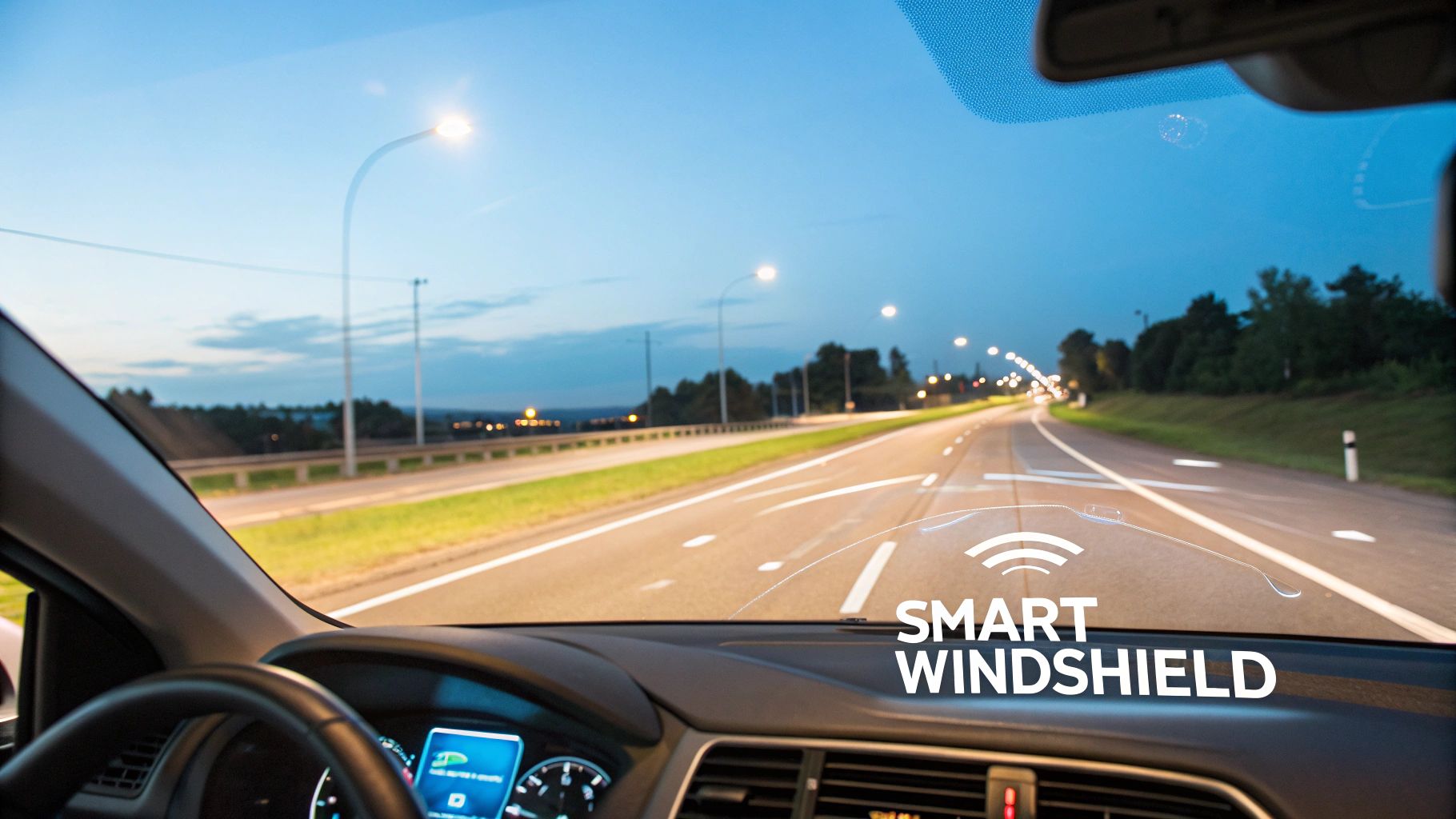
Augmented reality doesn't replace your view of the real world; it enhances it. The technology overlays computer-generated images, text, and graphics onto your physical environment. Think of it as a see-through digital layer that interacts with the world you see, whether through your car's windshield or on a technician's smart device.
This technology essentially bridges the gap between digital data and the physical world of driving and vehicle mechanics. It pulls information from the car's sensors and systems, then presents it visually, right where you need it most.
From Science Fiction to Practical Application
What once felt like a concept straight out of a futuristic movie is now a rapidly growing segment of the automotive industry. We’ve moved past impressive tech demos into real-world applications with measurable market value.
A recent analysis, for instance, valued the automotive AR market at USD 800.81 million and projected it to hit USD 944.88 million the following year. That’s not all—it’s expected to grow at a compound annual growth rate (CAGR) of 17.99% over the next decade.
This technology is making its mark in two primary areas:
- In-Car Experience: This is all about the driver and passengers. AR enhances navigation, safety, and awareness through intuitive heads-up displays (HUDs).
- Automotive Enterprise: Beyond the driver's seat, AR is used in manufacturing, maintenance, sales, and employee training.
At its heart, automotive AR is designed to make complex information simple. It translates abstract data—like a navigation turn or a diagnostic error code—into an intuitive visual instruction placed in a real-world context.
The Broader Context of Immersive Technology
Augmented reality is a key player in the larger family of immersive technologies. It’s important to distinguish it from its well-known cousin, Virtual Reality (VR), which creates a completely digital world. AR adds to reality, while VR replaces it.
To get a better handle on this ecosystem, you can learn more about what XR technology is and how these tools fit together. This guide will dig into how AR, specifically, is reshaping the automotive world, from the applications you can see in the driver's seat to the processes that happen across the entire vehicle lifecycle.
Enhancing Driver Awareness with AR Navigation and HUDs
The most immediate and visible impact of augmented reality for cars happens right in the driver's line of sight. Advanced AR heads-up displays (HUDs) and navigation systems are completely changing the driving experience by projecting intuitive, real-time information directly onto the windshield.
Instead of glancing down at a separate screen, an AR HUD allows the driver to see critical data overlaid onto their view of the road ahead. This seamless blend of digital guidance and the physical world is the core benefit of in-car AR, turning the entire windshield into a smart, context-aware interface.
A New Way to Navigate and Stay Safe
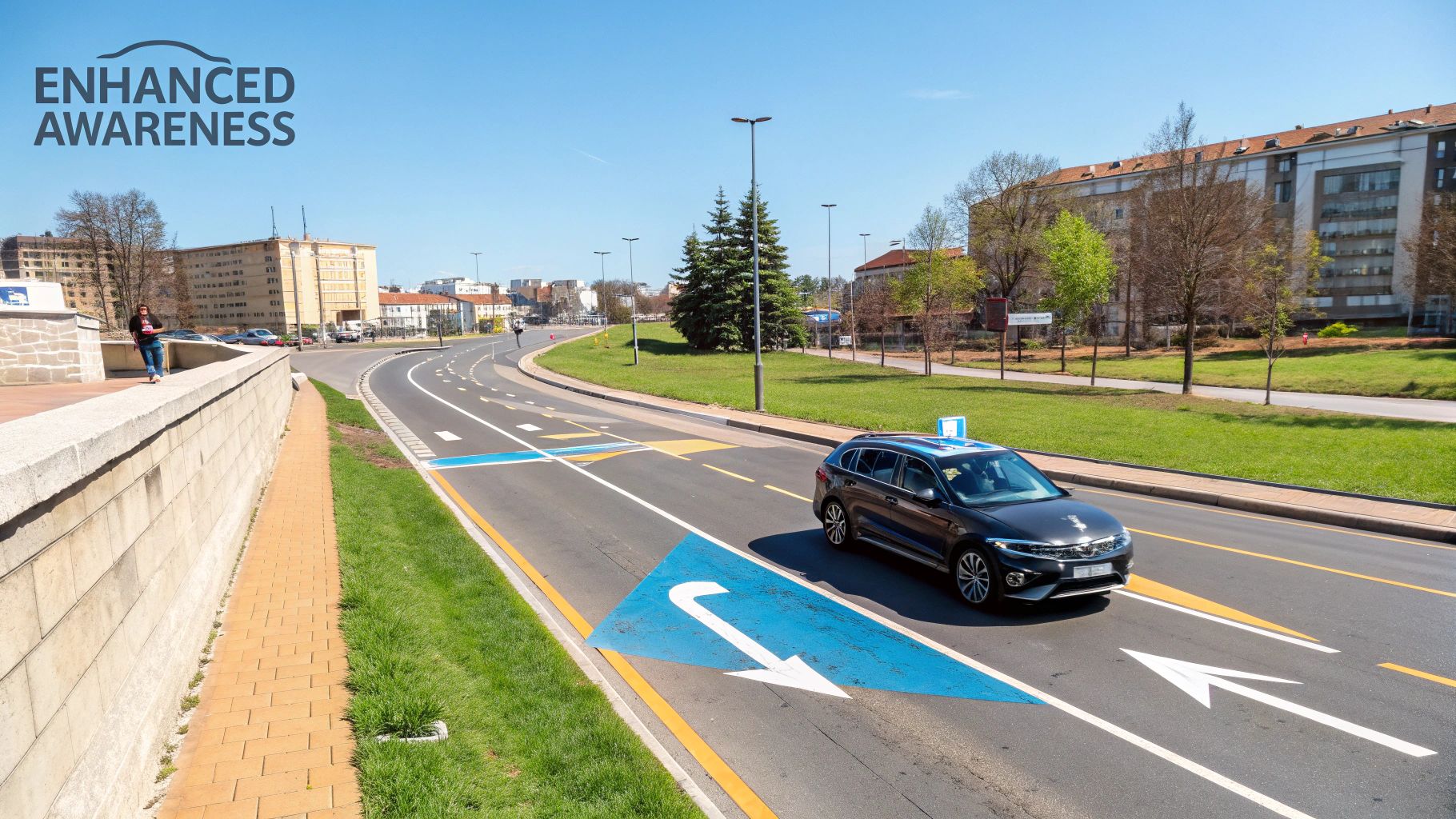
Consider a common driving scenario: you're navigating a complex, multi-lane highway interchange. A traditional GPS might say "keep right," leaving you to guess which of the three right-hand exits is the correct one. An AR system, on the other hand, virtually "paints" glowing arrows onto the correct lane, showing you exactly where to go.
This approach goes way beyond simple turn-by-turn directions. These systems pull in data from onboard sensors to deliver alerts that feel natural and immediate, reducing the cognitive load required to make split-second decisions.
Here’s how this technology plays out on the road:
- Intuitive Turn Indicators: Animated arrows appear to float on the road ahead, clearly marking your next turn.
- Lane Guidance: In fog or heavy rain, virtual lines are drawn along your lane's edges to keep you on track.
- Hazard Highlighting: If a pedestrian steps into the road, the system can draw a bright, attention-grabbing box around them.
- Following Distance: A visual marker can be projected onto the car in front to help you maintain a safe distance.
By putting this information directly in the driver's field of view, AR HUDs reduce the need to look away from the road. This slashes distractions and keeps your focus where it belongs.
The primary goal of an AR HUD is to increase situational awareness. By merging digital alerts with real-world context, the technology helps drivers see and react to potential dangers more quickly and confidently.
The table below breaks down just how different the experience is compared to the screens we're all used to.
AR HUD Features and Driver Benefits
| Feature | Traditional Display | Augmented Reality HUD | Primary Driver Benefit |
|---|---|---|---|
| Navigation Cues | 2D map on a center console screen | 3D arrows projected onto the road | Reduces confusion at complex intersections |
| Hazard Alerts | Beep or icon on the dashboard | Highlighting of objects in the real world | Faster reaction time to unexpected dangers |
| Lane Assist | Small icon on the instrument cluster | Virtual lines painted on the actual lane | Improved safety in low-visibility conditions |
| Information Display | Static speed/RPM on a fixed screen | Data appears to float in the driver's view | Minimizes eye movement away from the road |
As you can see, the shift to AR is less about adding new information and more about presenting it in a way that feels like a natural extension of the driver’s own senses.
Merging AR with Advanced Driver Assistance Systems
The real power of in-car AR is unlocked when it is connected to a vehicle's Advanced Driver Assistance Systems (ADAS). ADAS uses a whole suite of sensors—cameras, radar, and LiDAR—to constantly monitor the car's surroundings, feeding a stream of environmental data to the AR system. This fusion creates a powerful safety net.
For example, when ADAS spots a car in your blind spot, the AR HUD can project a subtle visual warning right on the side of the windshield. If the forward collision warning system detects an imminent rear-end collision, a large red braking symbol can flash on the windshield, grabbing your attention instantly. This direct feedback makes ADAS alerts far more effective.
This combination of smarter safety and navigation is attracting serious market interest. Market trackers valued the automotive AR navigation segment at around USD 356.62 million, with projections showing a massive 25.1% compound annual growth rate over the next decade. That growth is tied directly to the rising adoption of ADAS and consumer demand for smarter in-vehicle safety.
The technology that powers these displays, often involving specialized projectors and films, is a fascinating field on its own. If you’re curious about the mechanics behind it all, you can read our guide on how smart glass works to see how a transparent surface becomes a dynamic screen. Ultimately, these systems are designed to make driving not just easier, but fundamentally safer.
Where AR Really Shines: Beyond the Driver's Seat
While heads-up displays tend to grab the headlines, some of the most powerful applications of augmented reality for cars are happening far from the open road. From the factory floor to the service bay, AR is solving tough problems, increasing efficiency, and giving the automotive workforce a completely new set of tools.
Think of it as a digital mentor, laying crucial information right over the physical world. For a technician, that means seeing a complex wiring diagram mapped directly onto an engine block. For an assembly worker, it’s having the correct torque sequence pop up right beside the bolts they need to tighten.
A Game-Changer for Vehicle Maintenance and Support
Today's vehicles are marvels of complexity, which can make repairs a real challenge. Augmented reality cuts through that complexity by giving service technicians a way to diagnose issues faster and get repairs right the first time. Instead of flipping through a thick manual or glancing back and forth to a laptop, they can wear AR glasses and see step-by-step instructions overlaid on the actual vehicle.
This "see-what-I-see" approach is especially powerful for remote assistance.
- Real-Time Expert Backup: A junior technician facing an unfamiliar component can stream their first-person view to a senior expert, who could be anywhere in the world.
- Digital Pointers: The remote expert can then "draw" on the technician's view, circling the exact part to inspect or laying out the sequence to follow with digital markers.
This slashes vehicle downtime and eliminates the steep costs of flying specialists out to different service centers. Garages see their first-time-fix rates climb, which is a win for both operational efficiency and customer satisfaction. To get a better sense of the impact, you can see how businesses are using augmented reality for maintenance to tackle these exact challenges.
Bringing Precision and Guidance to the Assembly Line
On a fast-moving vehicle assembly line, precision is non-negotiable. One small mistake can cause expensive rework or, worse, a quality issue that makes it to the customer. AR steps in by delivering crystal-clear work instructions exactly when and where they’re needed most.
A worker with an AR device can see a digital overlay showing which part to grab, where it goes, and the precise steps to install it. This kind of visual guidance is highly effective for minimizing human error, particularly on complex assembly tasks with lots of variations. For instance, the system can highlight the right bolts and display the required torque specs in real time, making sure every single component is secured perfectly.
AR on the factory floor isn't just about preventing mistakes—it's about building worker confidence and consistency. It effectively turns every employee into a seasoned expert by putting the correct procedure for any task directly in their line of sight.
Supercharging Quality Assurance and Inspection
Quality assurance (QA) is another area getting a major boost from AR. Traditionally, inspectors have to rely on checklists and physical templates to check if parts meet tight specifications—a process that can be slow and prone to error.
Augmented reality flips the script by overlaying a digital twin—a perfect 3D model of the component—onto the real-world part. The AR system can instantly flag any differences, like a misaligned bracket or a missing weld. This allows inspectors to catch defects with a speed and accuracy that’s nearly impossible to achieve by eye alone. In some cases, this digital-first approach has cut inspection times by over 50%, helping manufacturers catch problems earlier and maintain higher standards across the board.
Building Skills Safely with Immersive Training
Getting new technicians and assembly workers up to speed is a huge investment in time and resources, often requiring expensive physical mock-ups for them to practice on. Augmented reality, along with its cousin virtual reality, creates immersive training simulations that are both incredibly effective and completely safe.
New hires can practice complex jobs, like an engine assembly or wiring harness installation, in a risk-free virtual space. They can make mistakes, learn from them, and try again without any danger to themselves or to costly equipment. With AR, trainees can even work on physical parts while getting digital guidance, which helps build the muscle memory and hands-on skills they need far faster than old-school training methods.
Crafting Interactive Showroom Experiences
Finally, AR is also changing the way cars are sold. In the showroom, a potential buyer can use a tablet or AR glasses to see a car in different colors, trims, and with all the optional features. They can point their device at a car on the lot and watch it instantly change its wheels or swap its interior from cloth to leather.
This creates a far more engaging and interactive way for customers to explore every possible configuration than just flipping through a brochure. They can even get virtual "x-ray" views of the car, highlighting hidden safety features or the engineering behind the powertrain. It’s not just a gimmick; it’s a memorable experience that helps salespeople better communicate the vehicle’s true value.
Understanding the Technology Powering Automotive AR
So, how does augmented reality for cars actually work? It's easy to get lost in the technical jargon, but the core idea is surprisingly intuitive. The best way to think about it is to compare it to our own senses. An AR system basically sees, thinks, and communicates with the world in a way that mimics human perception.
This simple framework helps peel back the layers of complexity, showing how different pieces of tech have to work together perfectly to create a fluid AR experience. Each part, from the sensors collecting data to the final image you see, plays a vital role.
The Eyes and Brain of the System
At the heart of any automotive AR setup is a powerful combination: the sensors and the processing unit. These act as the system's "eyes" and "brain." Just like our own eyes are constantly scanning our surroundings, the vehicle’s sensors are pulling in a non-stop stream of data about everything happening around it.
These sensors are what give the system its awareness:
- Cameras: These are the most direct parallel to our eyes. They provide rich visual information, letting the system actually see the road, lane markings, and other cars.
- LiDAR (Light Detection and Ranging): Think of this as the system’s ability to judge distance with superhuman precision. It shoots out laser pulses to build a detailed 3D map of the car's environment.
- Radar: This sensor is a pro at detecting the speed and distance of other objects, and it isn't fazed by bad weather like heavy rain or fog.
All that raw information gets sent to the "brain"—a central processor running on artificial intelligence. This is where the magic really happens. Complex algorithms like Simultaneous Localization and Mapping (SLAM) get to work, allowing the system to figure out its own location while building a map of its surroundings. This is absolutely critical for placing digital graphics accurately into the real world. When building the AI that powers all this, developers have to navigate critical balances, like the AI speed-accuracy trade-off, to ensure the system is both responsive and reliable.
The Canvas and Nervous System
Okay, so the system understands its environment. Now what? It needs a way to show that information to you. That's the job of the display technology, which is basically the "canvas." For in-car AR, this is usually a Heads-Up Display (HUD) that projects information right onto the windshield. For industrial jobs like maintenance or assembly, a technician would more likely be using smart glasses or a tablet.
The final piece of the puzzle is the "nervous system"—the car's connectivity. Technologies like 5G and Vehicle-to-Everything (V2X) communication let the car chat in real-time with other vehicles, traffic lights, and the cloud. This constant flow of data provides live updates on traffic jams or road hazards, making the whole AR experience far more dynamic and genuinely useful.
Think of it as a coordinated orchestra. The sensors gather the musical notes (data), the AI core conducts the performance (processing), the display brings it to the audience (you), and the connectivity makes sure everyone is perfectly in sync.
The diagram below shows how this tech comes together in some key industrial automotive scenarios.
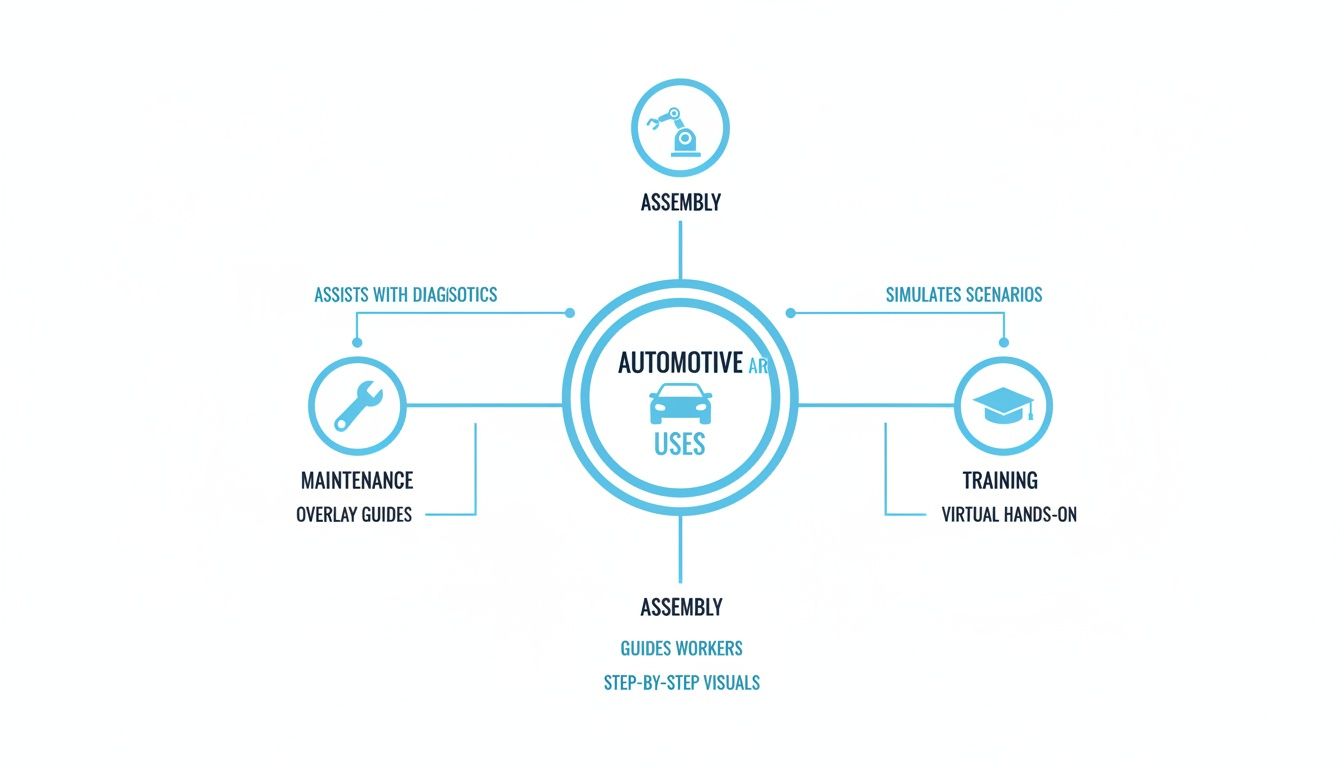
It’s clear how one solid technological foundation can support a huge range of applications, from guiding a worker on the factory floor to training a mechanic on a brand-new engine. By truly getting how AI and AR work together, businesses can unlock entirely new ways to make their operations better. To dig deeper into this, check out our detailed article on how AI-driven augmented reality has accelerated XR technologies.
So, Where's the Real ROI with AR?
The tech behind augmented reality in cars is undeniably cool, but for any business, the conversation has to move past the "wow" factor and focus on tangible, measurable returns. This isn't just about flashy demos. AR applications are delivering real financial and operational wins up and down the automotive value chain. Adopting this technology isn't about chasing trends; it’s about making smarter decisions backed by solid data.
To get buy-in, you need to show a clear path from investment to return. That means tracking specific Key Performance Indicators (KPIs) that draw a straight line between implementing AR and improving the bottom line. For every use case, from the factory floor to the service bay, there are hard numbers that prove its worth.
Driving Real-World Efficiency in the Factory and the Garage
In industrial settings, AR’s impact is felt almost immediately, and it’s easy to measure. When you equip technicians and assembly workers with AR tools, you take the guesswork out of the equation. The result? Significant jumps in both speed and quality.
You can track these gains with some pretty straightforward KPIs:
- Fewer Assembly Errors: When workers have step-by-step instructions floating right in their line of sight, mistakes plummet. A drop in rework orders and warranty claims is a direct measure of AR's impact on quality control.
- Faster Vehicle Service: AR-guided diagnostics and remote expert support help techs find and fix problems much faster. Measuring a decrease in the average service time per vehicle is a powerful KPI that means higher throughput and happier customers.
- More First-Time Fixes: Getting a repair right the first time is the holy grail of any service operation. By providing clear visual guidance, AR helps technicians nail it on the first attempt, boosting this critical metric.
For example, a service center can clock the average time a car spends on the lift for a complex transmission repair. After implementing an AR remote support tool like AIDAR.SERVICE, they can measure that same repair time again. A sharp drop, combined with fewer customers coming back for the same issue, builds a rock-solid business case.
Getting People Skilled-Up and Productive, Faster
The skills gap is a nagging headache for the entire auto industry. AR offers a practical solution by making training more engaging and effective, which leads to measurable improvements in how quickly your workforce gets up to speed.
AR completely changes the training game. Instead of trying to memorize complex procedures from a manual, employees learn by doing—all within a guided, interactive environment. It just shortens the path to proficiency.
You can validate the success of AR-based training with specific metrics that show a clear return on investment.
- Quicker Skill Acquisition: Companies can track how long it takes a new technician to get certified or become proficient in a key task. AR training programs have been shown to slash this learning curve by up to 75%.
- Faster Onboarding: The time it takes for a new hire to become a productive team member is a critical business metric. With AR tools like AIDAR.SKILLS, trainees get hands-on experience in a safe, simulated environment, letting them contribute to real-world operations much sooner.
These metrics translate directly into cost savings. Faster onboarding means less training overhead and a quicker return on your hiring investment. And by enabling remote expert support, companies can drastically cut the travel costs associated with flying specialists out to different sites, delivering an immediate and substantial financial win.
A Practical Roadmap for AR Implementation
Getting augmented reality for cars right is about more than just picking the flashiest tech. It requires a smart, strategic plan. Trying to go from zero to a full-scale deployment overnight is a recipe for disaster. Instead, the real wins come from a phased approach that proves its value every step of the way.
Think of it like building a house. You wouldn't put the roof on before you have a solid foundation. The same logic applies here. Don't start with a massive, company-wide rollout. Kick things off with a focused pilot project.
This lets you test the technology on a specific, high-impact problem, see what works, and get hard data to show for it—all with minimal risk. A successful pilot creates the momentum you need to get everyone else on board for the bigger picture.
From a Focused Pilot to Full Deployment
The key is to start small and aim for a clear win. A good pilot project targets a single, well-defined problem in your operations where AR can make a real difference. Maybe it's a notoriously tricky repair procedure in one of your service centers, or a quality check on the assembly line that’s always causing bottlenecks.
The goal here is simple: generate measurable results and learn as you go.
- Find the Core Problem: Pick a workflow that’s slow, error-prone, or costly. Find a spot where AR can deliver an immediate and obvious improvement.
- Define What Success Looks Like: Set clear KPIs from the get-go. This isn't abstract; it's concrete numbers like a 20% cut in service time for a specific task or a 15% drop in assembly errors at a single workstation.
- Run the Test and Measure Everything: Deploy the AR solution with a small, dedicated crew. Track those KPIs relentlessly to build a business case that’s backed by real performance data, not just promises.
- Analyze and Scale Up: Use what you learned from the pilot to fine-tune your approach. Once you’ve proven the value and ironed out the kinks, you can build a rollout strategy for other teams, departments, or locations.
This methodical, evidence-based approach makes sure that every stage of your AR implementation is built on a foundation of proven success.
Navigating Common Implementation Hurdles
While the potential payoff is huge, bringing AR into the automotive world isn’t without its challenges. Getting ahead of these issues is the secret to a smooth and successful rollout.
For in-car applications, driver safety is paramount. An AR Head-Up Display has to enhance awareness, not distract from the road. That means designing minimalist interfaces that only show what’s critical, right when it’s needed. The goal is to reduce cognitive load, not add to it.
Integrating new technology into established enterprise systems can seem daunting. The key is to select a versatile technology partner who understands the complexities of industrial environments and can ensure seamless integration with your existing infrastructure, from ERPs to inventory management systems.
Other challenges, like data latency and navigating changing regulations, are also part of the territory. You need real-time performance, and that means lag is not an option. Overcoming these hurdles comes down to having a partner who offers flexible deployment models—whether that's on-premise for total security with AIDAR.SERVICE or in the cloud for scalability with AIDAR.SKILLS.
A strong partnership with a provider who understands your operational needs turns these potential roadblocks into manageable steps on your path to a smarter, more efficient future.
Got Questions About AR in Cars? We've Got Answers.
As augmented reality starts showing up in everything from our windshields to the service bay, it's natural to have a few questions. How does this technology actually work? Is it safe? Let's clear up some of the most common questions people ask about AR in the automotive world.
What’s the Real Difference Between AR and VR in Automotive?
The easiest way to think about it is that Augmented Reality (AR) adds to your world, while Virtual Reality (VR) replaces it.
AR overlays digital information onto your real-world view. Picture navigation arrows that seem to be painted directly on the road ahead of you, visible right through your windshield. That’s AR. In the auto industry, you’ll find it used for things like driver assistance and giving technicians real-time guidance while they work on a physical car.
VR, on the other hand, puts you in a completely digital environment. Once the headset is on, the real world is gone. This makes it perfect for offline work where you need total immersion, like walking through a virtual car showroom, prototyping new vehicle designs, or running training simulations in a safe, controlled digital space.
Are AR Heads-Up Displays Actually Safe for Drivers?
Yes, absolutely—when they’re designed with safety as the number one priority. In fact, they can be much safer than traditional dashboard screens or trying to glance at your phone. By projecting vital info like your speed or next turn directly into your line of sight, AR HUDs drastically reduce the time you spend looking away from the road.
A well-designed system is all about minimalism. It shows you only what you need to know, right when you need it. The goal is to boost your awareness, not to create a cluttered, distracting view.
This approach keeps your eyes forward and your mind on the task of driving, which can improve your reaction time and help you spot potential hazards sooner.
How Hard Is It to Get AR Working in Our Current Operations?
The complexity really depends on the scale of what you're trying to do, but modern AR platforms are built to be flexible. The smartest way to start is with a targeted pilot project. Pick one specific workflow, prove the value there, and work out any kinks on a small scale. This gives you tangible results and a solid business case before you even think about a company-wide rollout.
A smooth integration hinges on choosing a solution with solid APIs, support for different hardware (from smart glasses to tablets), and flexible deployment options. Partnering with a team that has been down this road before is a game-changer. They can help you navigate the tricky parts, like connecting with your existing enterprise systems, and ensure the whole process is focused on delivering real value.
Ready to see how AR can reshape your automotive operations? At AIDAR Solutions, we build powerful AR and VR tools that deliver measurable results—from cutting down training time to making maintenance faster and more accurate. Explore our solutions today and let's get started on your implementation journey.