
Grow with augmented reality consulting — expert AR strategy
Think of augmented reality consulting as less of a technology purchase and more of a strategic partnership. It’s about bringing in an expert who can help your business use AR to tackle real-world operational challenges and boost efficiency. This isn't just about buying software; it's about embedding a powerful new capability right into the heart of your processes, from training new hires to supporting field technicians.
What Is Augmented Reality Consulting?

Many businesses dismiss augmented reality as a futuristic concept, but its real power lies in solving very practical, present-day problems. A useful way to think about AR consulting is like hiring a specialized architect to build a new wing for your operational headquarters. This expert doesn't just hand you a set of blueprints. They work alongside you to map out your current workflows, pinpoint inefficiencies, and then design a custom-built solution that strengthens your company's core functions.
This kind of partnership is designed to help you navigate the complex landscape of AR hardware, software, and deployment. At its core, a consultant's job is to close the gap between AR’s potential and your actual business goals.
The Role of an AR Consultant
An AR consultant is your guide, there to help you make informed decisions every step of the way. They take your challenges—like extended repair times or cumbersome training manuals—and translate them into a clear, actionable technology roadmap. Their work is always rooted in delivering specific, measurable results.
Here’s what they typically handle:
- Strategic Planning: Ensuring your AR initiatives are perfectly aligned with your main business goals so that the technology creates tangible value.
- Technology Selection: Sifting through the options to find the right hardware (from a simple smartphone to advanced headsets) and software for your specific needs.
- Solution Design: Architecting a custom AR experience that integrates seamlessly into the systems and workflows you already have.
- Implementation and Support: Guiding the project from a small-scale proof-of-concept all the way to a full rollout, ensuring it launches smoothly and your team adopts it effectively.
Augmented reality isn’t really about the technology itself. It’s about the new business capabilities it unlocks. It’s a tool for operational excellence, giving your team the power to handle complex jobs with more accuracy and speed than ever before.
The global augmented reality market was valued at around USD 77.3 billion in 2024 and is expected to grow to over USD 1,127.94 billion by 2032. This explosive growth, highlighted in recent market analysis, shows just how much demand there is for expert guidance as more companies seek to leverage AR's benefits.
Ultimately, bringing in an augmented reality consulting expert is an investment in a new strategic capability for your business. Whether you’re empowering field technicians with digital instructions overlaid on machinery or transforming sales presentations with interactive 3D product models, the goal is always the same: solving real problems. By exploring the practical applications of augmented reality for businesses, you can start to uncover significant opportunities for improvement.
Unlock Your Competitive Advantage with AR

Implementing an augmented reality strategy is no longer a question of if, but when. Businesses adopting AR today aren't just acquiring new technology; they're building a significant competitive advantage in their operations. This advantage comes from finally resolving tough, persistent bottlenecks that have impacted the bottom line for years.
For example, what if your most seasoned technician could virtually stand beside a junior employee on the factory floor, guiding them through a complex repair from halfway across the world? That's not a future concept. It’s a real-world AR application that reduces machine downtime and travel expenses.
Or consider sales. Imagine letting customers see your product in their own home or factory before they even consider purchasing. This is a proven way to boost conversions and dramatically slash the costly issue of returns.
Driving Real-World Business Outcomes
The true measure of AR isn't about flashy demos; it’s about tangible results. A proper augmented reality consulting engagement focuses on your specific business problems to deliver improvements you can actually see and measure.
Here’s where AR immediately starts providing value:
- Enhanced Workforce Efficiency: By overlaying digital, step-by-step instructions directly onto a real-world view, AR gives your people the confidence to tackle complex assembly or maintenance tasks faster and with far fewer mistakes.
- Improved Safety and Training: AR lets you create a completely risk-free training environment. New hires can learn to operate complex equipment in a controlled simulation, building muscle memory and confidence before they ever touch the real thing. It’s a game-changer for reducing workplace accidents.
- Next-Level Customer Engagement: Interactive AR lets your customers explore products in 3D, virtually try on apparel, or see how a new piece of furniture looks in their living room. It turns the buying journey from a passive scroll into an engaging, personalized experience.
The most powerful AR solutions are rarely the most complicated. They are the ones that slide seamlessly into your team's existing workflow to solve one critical challenge with elegant precision. The goal is simple: make your people better at what they already do.
Gaining a Lasting Edge
These benefits aren't just one-off wins; they compound over time, building a competitive advantage that’s difficult to replicate. While other companies are stuck wrestling with paper manuals and old-school training seminars, your teams are operating with more speed, accuracy, and confidence.
A manufacturer, for example, can use AR to provide instant visual guidance, cutting assembly errors down to almost zero. That directly translates to less material waste and fewer costly reworks. In retail, a brand using virtual try-on technology sees return rates drop, which immediately boosts the bottom line.
This is the real promise of investing in AR. It’s not about theory. It’s about practical, everyday improvements that make your entire operation stronger. By working with augmented reality consulting experts, you can pinpoint the high-impact opportunities in your business and build a clear roadmap for turning this technology into a cornerstone of your success.
See How AR Transforms Key Industries
https://www.youtube.com/embed/WxzcD04rwc8
To really understand the value of augmented reality, it's necessary to look past the technology and focus on the real-world problems it solves. AR isn’t an abstract concept; it's a practical tool that delivers tangible improvements, one industry at a time. Every application is about connecting a specific business challenge to a clear, effective AR solution.
Take manufacturing, for instance. A complex piece of machinery breaks down, and suddenly the whole production line grinds to a halt. An augmented reality consulting expert can implement a system where a technician simply points a tablet at the equipment and sees digital overlays pinpointing exactly which part needs fixing. This kind of visual guidance reduces repair times and prevents costly mistakes.
In retail, the story is all about elevating the customer experience. High return rates, especially for items like furniture and clothing, can be a massive drain on profits. Virtual try-on technology tackles this head-on, letting customers see how a jacket looks on them or how a new sofa fits in their living room before they make a purchase.
AR Applications In Core Business Areas
This is a powerful way to boost buyer confidence and, in turn, increase average order values. If you want to dive deeper into this, it's worth exploring the future of augmented reality in ecommerce.
- Manufacturing and Field Service: Imagine digital work instructions guiding a technician through a complex assembly or maintenance task step-by-step. This dramatically reduces human error and boosts first-time fix rates. You can learn more about these specific augmented reality industrial applications.
- Retail and Ecommerce: Interactive 3D product visualizations allow customers to place a virtual sofa right in their living room. They can instantly see if it fits the space and matches their style, which significantly reduces the hassle of returns.
- Healthcare and Medical Training: Surgeons can practice incredibly complex procedures on hyper-realistic 3D anatomical models. This creates a risk-free virtual environment where they can hone their skills long before they ever step into an actual operating room.
The most effective AR solutions don't try to reinvent the wheel. Instead, they provide the right information, at the right time, directly within an employee's field of view, making their job simpler, safer, and more efficient.
The growth in this field is undeniable. The healthcare AR segment, in particular, is expanding rapidly, with the AR/VR healthcare market projected to reach $10.82 billion by 2025. This shows just how critical AR is becoming for applications like augmented surgeries, diagnostics, and medical education.
From reducing machine downtime on the factory floor to creating unforgettable shopping experiences, AR is proving its worth with clear, measurable results.
Charting Your Course for AR Implementation
Embarking on a new augmented reality project can feel like navigating uncharted territory. But when you partner with an AR consulting firm, that journey becomes less about guesswork and more about following a clear map. Instead of a risky experiment, you get a structured roadmap with predictable stages and milestones designed to protect your investment and ensure the final solution meets its objectives.
The entire process is a partnership. We start with your high-level goals and methodically work our way toward a real, working solution that’s deployed in the field. It’s a deliberate, step-by-step approach that ensures we’re on the right track before committing to the next phase, keeping the project on time, on budget, and on its way to delivering real value.
From Discovery to Deployment
A typical AR project doesn’t just happen; it unfolds in a logical sequence. This isn't about applying technology to a problem—it's about building momentum and ensuring alignment at every step.
The journey usually breaks down into three core phases:
- Discovery Workshop: This is where it all begins. We sit down with your team to get a deep understanding of your business, your workflows, and your biggest challenges. We want to know what you're trying to achieve. The goal here is to define the problem we're solving and sketch out a high-level concept for an AR solution.
- Proof of Concept (PoC): Before committing to a full build, we create a PoC. Think of it as a small-scale pilot program. It’s designed to prove that the core idea works and that the technology is viable. This lets your team get their hands on it, test it in a controlled setting, and provide crucial feedback. It's the ultimate reality check.
- Full-Scale Rollout and Integration: Once the PoC is approved, we move into full development. We build out the complete solution, test it rigorously, and then roll it out to your teams. This often means integrating it with your existing systems—like an ERP or LMS—so it fits into your daily operations like a missing puzzle piece.
The whole point of a phased rollout is simple: prove the value early and often. A successful proof-of-concept becomes your best internal case study, building buy-in from stakeholders and showing tangible results before you make a bigger investment.
This systematic approach means you’re not just buying a piece of technology. You’re co-creating a capability that’s custom-built for your operational reality. Getting familiar with the complete augmented reality workflow from start to finish helps demystify the process, giving you a clear picture of what to expect at every turn.
Finding the Right AR Consulting Partner
Choosing a partner to bring your augmented reality project to life is one of the most important decisions you'll make. This isn't just about hiring someone to build a flashy demo. It’s about finding a strategic guide who can translate your real-world business challenges into a practical, high-impact AR solution.
The success of any AR project is built on trust and proven competence. You need a team that not only understands the technology but also deeply understands the specific hurdles in your industry. A firm with a portfolio of successful, real-world deployments shows they deliver results, not just promises.
To get started, a comprehensive business technology assessment is a smart first move. It helps you see where you stand and what you'll need for a smooth AR implementation.
Key Evaluation Criteria
When you start vetting potential partners, you'll want to focus on three critical areas. These pillars give you a clear picture of a firm’s ability to deliver a solution that provides genuine business value and a measurable return on your investment.
This visual shows the typical journey with an AR partner, from the initial discovery and proof-of-concept all the way to a full-scale rollout.
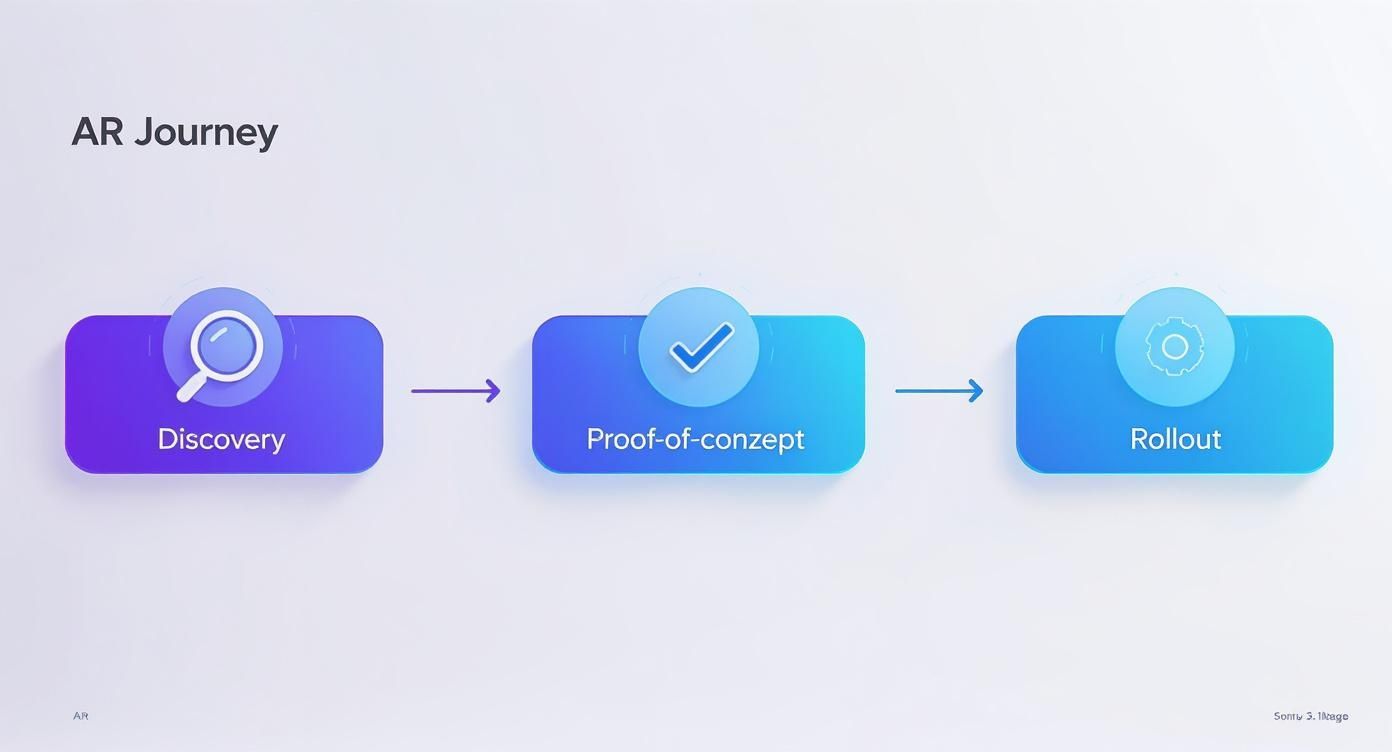
The process underscores just how crucial it is to start with a deep dive into your business needs, validate the idea with a pilot, and then move to a full deployment.
The best AR consultants don't lead with technology; they lead with curiosity. Their first goal isn't to sell you a solution, but to deeply understand the problem you're trying to solve.
A thorough evaluation process ensures you find a partner who’s in it for the long haul and truly aligned with your goals.
Questions to Ask Potential Partners
To really dig in during your evaluation, come prepared with specific, insightful questions. This will help you get past the sales pitch and see which firms are truly ready to be your long-term partner.
- Industry Experience: "Can you show us case studies of AR solutions you've built for companies with operational challenges like ours?"
- Technical Expertise: "Which AR hardware and software platforms do you specialize in? Why would you recommend a specific tech stack for our use case?"
- Process and Methodology: "How do you handle the initial discovery and proof-of-concept stages to make sure project goals are clear and validated from the start?"
- Integration Capabilities: "Talk to us about your experience integrating AR solutions with existing enterprise systems like ERP, PLM, or our LMS."
- Support and Scalability: "What does your post-launch support look like? How do you help clients scale a successful pilot across the entire organization?"
Asking these pointed questions will help you find a true strategic partner. An expert augmented reality consulting firm will have confident, detailed answers rooted in real-world experience, giving you the confidence to move forward with a team that can actually deliver.
How to Measure AR Project ROI
Investing in augmented reality isn't just about adopting the latest technology. It's about getting real, measurable results for your business. Defining the return on investment (ROI) for an AR project is the key to proving its worth and gaining approval for future initiatives.
The first step is moving past abstract metrics and getting a clear "before" picture. You have to establish a baseline. How long does it currently take your technicians to complete a standard repair? What is the actual training cost for a new hire? Getting those hard numbers now is what lets you prove the impact once your AR solution goes live.
Identifying Your Core ROI Metrics
The most powerful business cases are always built on solid data. A seasoned augmented reality consulting expert can help you cut through the noise and focus on the KPIs that truly matter for your specific situation. The whole point is to draw a straight line from the AR solution to either money saved or money earned.
Here are a few of the most common—and impactful—metrics we see:
- Reduced Training Time and Costs: AR can radically shorten the learning curve for new employees. Imagine reducing onboarding from 80 hours to 40 hours per person. The savings on wages and instructor time add up fast, and that’s a simple, powerful calculation.
- Increased First-Time Fix Rates: When you arm field service technicians with AR-powered guidance, they solve problems correctly on the first try far more often. A better first-time fix rate means fewer costly repeat visits and, just as importantly, more satisfied customers.
- Lower Material Waste: In complex manufacturing, AR overlays guide workers through intricate assembly steps, reducing human error. This directly translates to less scrap material and fewer expensive reworks.
- Higher Sales Conversion Rates: For retail, AR is a game-changer. Letting customers see how a sofa looks in their living room before they buy it doesn't just increase sales—it also brings down the rate of costly product returns.
A strong ROI calculation shifts the conversation. Suddenly, your AR project isn't a "cost center" anymore; it's a "value generator." It’s about showing leadership, in black and white, that this investment pays for itself through better efficiency, quality, and sales.
Calculating ROI doesn't have to be a complex formula. Often, the simplest approach is best: (Financial Gain – Project Cost) / Project Cost. By focusing on how to reduce operational costs, you can build a rock-solid business case that resonates with leadership and clears the path for rolling out AR across the organization.
Common Questions About AR Consulting
When you first start exploring augmented reality, it’s natural to have a few practical questions. Thinking through the budget, timeline, and hardware is part of the process, and getting clear answers is what gives you the confidence to move forward.
Let’s tackle some of the most common questions we hear about augmented reality consulting.
How Much Do AR Projects Typically Cost?
There’s no single price for an AR project. The cost is tied directly to the project's scope and objectives. A tight, focused proof-of-concept (PoC) designed to validate a single idea might start in the tens of thousands of dollars.
On the other end of the spectrum, a full-scale enterprise solution with custom software and hardware integration represents a more significant six-figure investment.
A good consulting partner will never give you a vague number. They’ll work with you to map out a phased approach, often starting with a paid discovery workshop. This allows them to analyze the specifics and provide a detailed, accurate budget before any major development work begins.
What Is a Realistic Timeline for Implementation?
Just like cost, the timeline depends entirely on the project's complexity. A lean pilot program or PoC can often be operational in as little as 2-3 months. This quick turnaround is excellent for demonstrating value early and building stakeholder support for what’s next.
For a more ambitious project—for instance, one that requires integration with your existing ERP or Product Lifecycle Management (PLM) systems—you're looking at a timeline closer to 6 to 12 months. The key is that the entire process is always broken down into clear stages with firm milestones from the start, so you always know the project's status.
Do We Need Expensive Headsets to Use AR?
Not necessarily. In fact, many of the most effective AR solutions run on the smartphones and tablets your teams already use. Starting with a mobile-first approach is a smart way to prove AR’s value without a large upfront investment in new hardware. It’s a low-barrier, cost-effective way to get started.
That said, for more intensive industrial jobs where workers need their hands free or require more immersive 3D visuals, specialized AR glasses might be the right choice. An experienced consultant will analyze your specific workflows and help you decide on the right hardware that fits your goals and your budget.
Ready to see how AR can solve your operational challenges? AIDAR Solutions provides expert guidance and custom-built AR/VR applications that deliver measurable results, from accelerating employee training to streamlining remote support. Explore our solutions at https://aidarsolutions.com.

