
A Practical Guide to AR in Training for Modern Industries
When we talk about augmented reality (AR) in training, we're not talking about science fiction. We're talking about a practical tool that overlays digital information—like instructions, diagrams, or 3D models—directly onto an employee's view of the real world.
This is usually done through a smartphone, tablet, or smart glasses. The result is a hands-on, interactive learning experience that is moving corporate training from an era of passive observation to one of active participation. It is a more effective, safer, and faster way to build a skilled team.
What Is AR in Training
Picture a new technician looking at a complex piece of industrial machinery. Traditionally, they would be flipping through a dense paper manual, hoping to find the right diagram.
With augmented reality, that same technician looks at the machine through a device and sees digital arrows pointing to the exact bolts that need loosening. Step-by-step instructions float right beside the components they need to work on.
That’s the essence of AR in training. It’s like having a digital expert standing right there with your employee, offering guidance in real-time and in their direct line of sight. It's important to remember this isn't Virtual Reality (VR), which creates a completely artificial world. AR doesn't replace reality; it enhances it.
Shifting from Passive to Active Learning
Much of traditional training is passive. Employees sit through presentations, read thick manuals, or watch videos. This approach often creates a gap between knowing the theory and actually being able to do the job.
AR closes that gap by enabling "learning by doing" in the actual work environment. It's a fundamental shift toward active, hands-on digital experiences that are changing how skills get transferred.
The benefits are immediate and tangible:
- Accelerated Skill Acquisition: People learn faster when they're performing tasks with digital guidance. The time it takes to become competent shrinks dramatically.
- Reduced Error Rates: With clear, contextual instructions right where you need them, mistakes become far less common, especially on complex or unfamiliar jobs.
- Enhanced Safety: Trainees can practice on real equipment with guided digital overlays, making sure they follow critical safety protocols correctly from day one.
The image below breaks down the key pieces that make an effective AR training system.

It comes down to this: the right hardware combined with compelling, useful content creates an engaging experience that drives business results.
Before we go further, let's put these two approaches side-by-side to highlight the difference AR makes.
Traditional Training vs AR-Enhanced Training
| Feature | Traditional Training | AR in Training |
|---|---|---|
| Learning Mode | Passive (reading, listening) | Active (doing, interacting) |
| Information Context | Abstract, out of context (manuals, classrooms) | In-context, real-time (on the equipment) |
| Skill Retention | Lower, prone to the "forgetting curve" | Higher, reinforced by muscle memory |
| Error Potential | High, especially for new tasks | Low, guided steps prevent mistakes |
| Expert Dependency | Relies on a human expert being physically present | Reduces dependency, expert knowledge is digitized |
| Scalability | Difficult and expensive to scale | Easily scalable to any number of employees |
As you can see, AR isn't just a minor upgrade; it's a completely different way of thinking about how we build competence and confidence in the workforce.
The Growing Demand for Immersive Skills Development
The market is showing clear trends. The AR training market was valued at around USD 2.6 billion in 2024 and is expected to grow, hitting an estimated USD 8.6 billion by 2030. This growth is being driven by real corporate demand for training that improves knowledge retention and cuts costs.
Augmented reality bridges the gap between digital information and the physical world, creating a powerful new medium for instruction. By placing guidance directly into the context of the task, AR makes complex jobs simpler and safer to learn, directly addressing the skills gap in today's industries.
By completely rethinking how information is delivered, AR in training gives employees the tools they need to perform at their best from the moment they start. If you want to see more of how this technology is being put to work, you can explore our detailed guide on augmented reality and training. It's about preparing the workforce for the realities of modern industry, where speed, accuracy, and safety are everything.
The Business Value of Immersive Learning
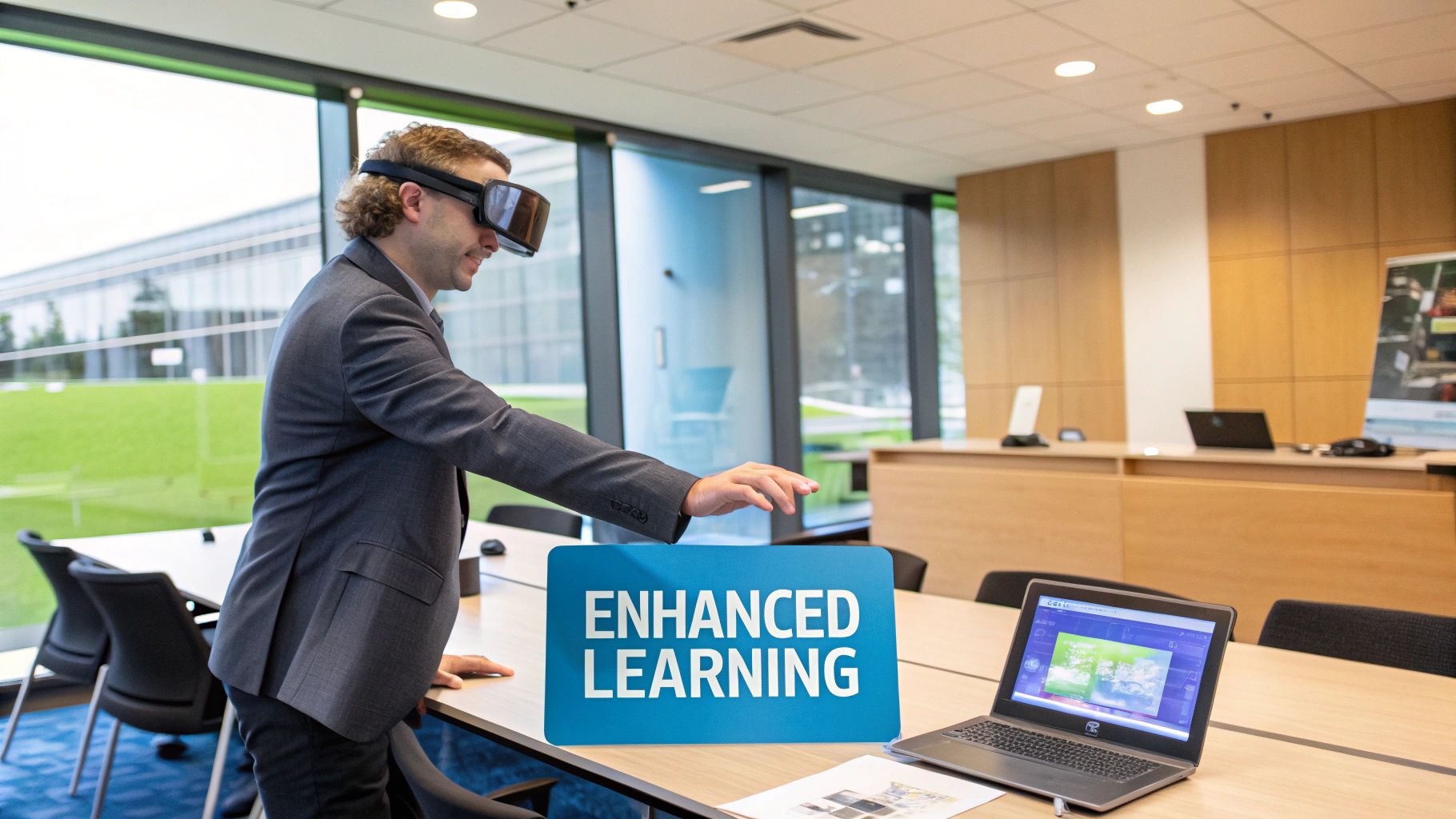
It’s one thing to understand what augmented reality does. It's another thing entirely to grasp its strategic importance. The real power of AR in training isn't just about the technology; it's about its direct impact on core business goals. It turns learning initiatives into measurable drivers of performance, efficiency, and safety.
AR gets training out of the classroom and onto the actual work floor, transforming abstract theory into hands-on skills. This isn’t just a more engaging way to learn. It’s a fundamentally better one, creating stronger neural pathways that boost employee confidence and competence from day one.
The result? A massive improvement in knowledge retention. With traditional methods, people often forget most of what they learned within weeks. AR training, through active participation, makes the lessons stick.
Driving Operational Excellence and Efficiency
One of the biggest reasons businesses are adopting AR is its power to reduce costly errors. When a technician gets real-time, step-by-step instructions overlaid directly onto a machine, the chance of a mistake decreases significantly. This is critical in fields like manufacturing, aviation, and healthcare, where one error can have serious consequences.
Fewer mistakes mean less wasted material, less equipment downtime, and more first-time fixes. These aren’t just minor improvements—they translate directly into a healthier bottom line. Plus, it drastically cuts down the time it takes for a new hire to become a fully productive team member.
Think about the financial domino effect. Immersive training can shorten the time-to-competency by an average of 30-40%. At the same time, companies can save up to 70% on costs tied to materials, travel, and instructors. Some technology leaders, for instance, estimate that personalized AR in training platforms help generate around $1 billion in extra revenue each year through faster onboarding and higher productivity. You can discover more insights about AI-driven training statistics and see the data for yourself.
Enhancing Workplace Safety
Beyond the balance sheet, AR creates a profoundly safer training environment. It lets employees learn complex or even dangerous procedures without putting themselves, their colleagues, or expensive equipment at any real-world risk.
By providing a digitally guided, risk-free practice ground, augmented reality builds not just skill but also safety-conscious habits. Trainees can master critical protocols in a controlled setting, ensuring they are fully prepared before ever facing a high-consequence situation.
This approach is invaluable for tasks involving:
- Complex Machinery Operation: Employees can learn to operate heavy equipment with digital safeguards and prompts guiding their every move.
- Hazardous Material Handling: AR can simulate spills or emergencies, allowing workers to practice response protocols without any actual danger.
- Lockout-Tagout Procedures: Digital checklists and visual confirmations ensure that critical safety steps are never missed during maintenance.
By weaving safety directly into the learning process from the start, companies build a much stronger safety culture and can dramatically reduce workplace incidents.
Building a More Competent and Agile Workforce
Ultimately, the business value of AR in training comes down to building a more capable, confident, and adaptable team. When employees have instant access to digital guidance, they feel empowered to tackle unfamiliar tasks and solve problems on their own. This cuts down on their reliance on senior experts and fosters a more self-sufficient crew.
In a world where technology and processes are always in flux, the ability to upskill your team quickly is a massive competitive edge. AR offers a scalable and consistent training platform that works anywhere, anytime, making sure your entire workforce has the knowledge they need to perform at their best. This isn't just an investment in training; it's an investment in long-term operational resilience and success.
Practical AR Use Cases Across Major Industries
The theory behind immersive learning becomes clearer when you see it in action. Across different industries, AR in training is no longer a novelty; it's becoming an essential tool for solving persistent, real-world operational problems. It's all about delivering on-demand, contextual guidance that gives employees the confidence to execute complex tasks.
From a busy factory floor to a sterile operating room, the impact is tangible. Companies aren't just training people faster—they're building a more capable and resilient workforce. Let's look at how AR is being put to work in key sectors to get real results.
Manufacturing and Assembly
In manufacturing, the sheer complexity of modern machinery is a constant training challenge. A single piece of equipment might have thousands of parts, and every assembly or maintenance step has to be precise. Trying to follow a paper manual or a static PDF for this kind of work is slow, cumbersome, and a recipe for error.
This is exactly where AR excels. Imagine a technician pointing a tablet at a machine and seeing digital instructions pop up right on top of the physical parts. Arrows show the correct sequence, 3D animations demonstrate a tricky maneuver, and critical torque values appear right next to the bolt that needs tightening.
- The Problem: High error rates during complex assembly, which means costly rework and wasted materials. It also takes a long time to get new technicians up to speed on maintenance routines.
- The AR Solution: Step-by-step digital instructions are overlaid directly onto the equipment, giving technicians real-time guidance right where they need it and eliminating guesswork.
- The Result: Companies using AR in training for assembly have seen error rates drop by as much as 90% on the very first try. Technicians are completing tasks 30-50% faster, which means a significant boost in productivity and less machine downtime.
AR essentially turns a complex machine into its own interactive instruction manual. It removes ambiguity, ensuring every step is done right the first time and turning a novice into a competent operator in a fraction of the time.
Healthcare and Medical Training
Healthcare is built on a foundation of precision and skill, where there's little room for error. Traditionally, training new medical professionals meant studying textbooks, sitting through lectures, and practicing on cadavers or basic mannequins—all of which have limitations in realism or availability.
AR changes this model. Medical students can now see detailed 3D anatomical models overlaid onto training mannequins. They can visualize the entire circulatory system in context, practice surgical incisions on a virtual patient, or learn to operate a complex medical device with an interactive, guided simulation. It creates a safe, repeatable space to master critical skills long before they ever work with a real patient.
- The Problem: Insufficient hands-on practice for complex surgical procedures and the inherent difficulty of visualizing complex anatomy from a 2D textbook.
- The AR Solution: Interactive 3D models of organs and systems are projected onto physical mannequins. Surgeons can even rehearse procedures with haptic feedback, guided by digital overlays that show exactly where to make an incision.
- The Result: AR-based medical training has been shown to improve surgical accuracy and reduce procedure time. It offers students and doctors unlimited, risk-free practice to build the muscle memory and confidence they need. For a deeper dive, you can explore the various augmented reality industrial applications making an impact today.
Logistics and Warehousing
In the fast-moving world of logistics, speed and accuracy are paramount. A warehouse picker has to navigate a massive facility, and one small mistake can cause shipping delays and frustrate customers. The traditional method of using paper pick lists or even handheld scanners works, but it still leaves room for human error.
AR makes this entire process much smoother. A worker wearing AR smart glasses sees a digital pick list right in their line of sight. Navigational arrows guide them down the most efficient route to the right shelf, and the item they need to grab is highlighted with a digital box. One quick scan confirms they have the right product, and the inventory is updated automatically.
- The Problem: High error rates in order picking and slow, inefficient navigation through large warehouses. Onboarding new seasonal workers is also time-consuming.
- The AR Solution: AR glasses provide hands-free, vision-guided picking instructions. The system shows workers exactly where to go and what to pick up, making the job incredibly intuitive.
- The Result: Logistics companies have reported a 40% increase in picking speed while cutting errors down to nearly zero. Going hands-free also makes the job safer, as workers can stay more aware of their surroundings.
The examples above are just a glimpse of what's possible. Here’s a quick breakdown of how different industries are applying AR training to solve specific challenges.
AR Training Applications by Industry
| Industry | Primary Application | Key Benefit |
|---|---|---|
| Aerospace | Complex wiring harness assembly and jet engine maintenance | 90%+ reduction in errors and 40% faster task completion. |
| Automotive | Vehicle inspection, quality assurance, and assembly line guidance | Faster, more consistent quality checks and reduced training time. |
| Energy | Field service for wind turbines and remote equipment repair | Improved first-time fix rates and reduced need for expert travel. |
| Telecommunications | Cell tower installation and fiber optic cable splicing | Increased technician safety and procedural adherence. |
| Construction | On-site blueprint visualization and safety training | Fewer rework errors and enhanced hazard awareness. |
From aerospace to construction, the pattern is clear: AR provides intuitive, on-the-job guidance that boosts performance and safety. It's not just about showing someone what to do; it's about empowering them to do it right, right now.
Getting Started With an AR Training Program
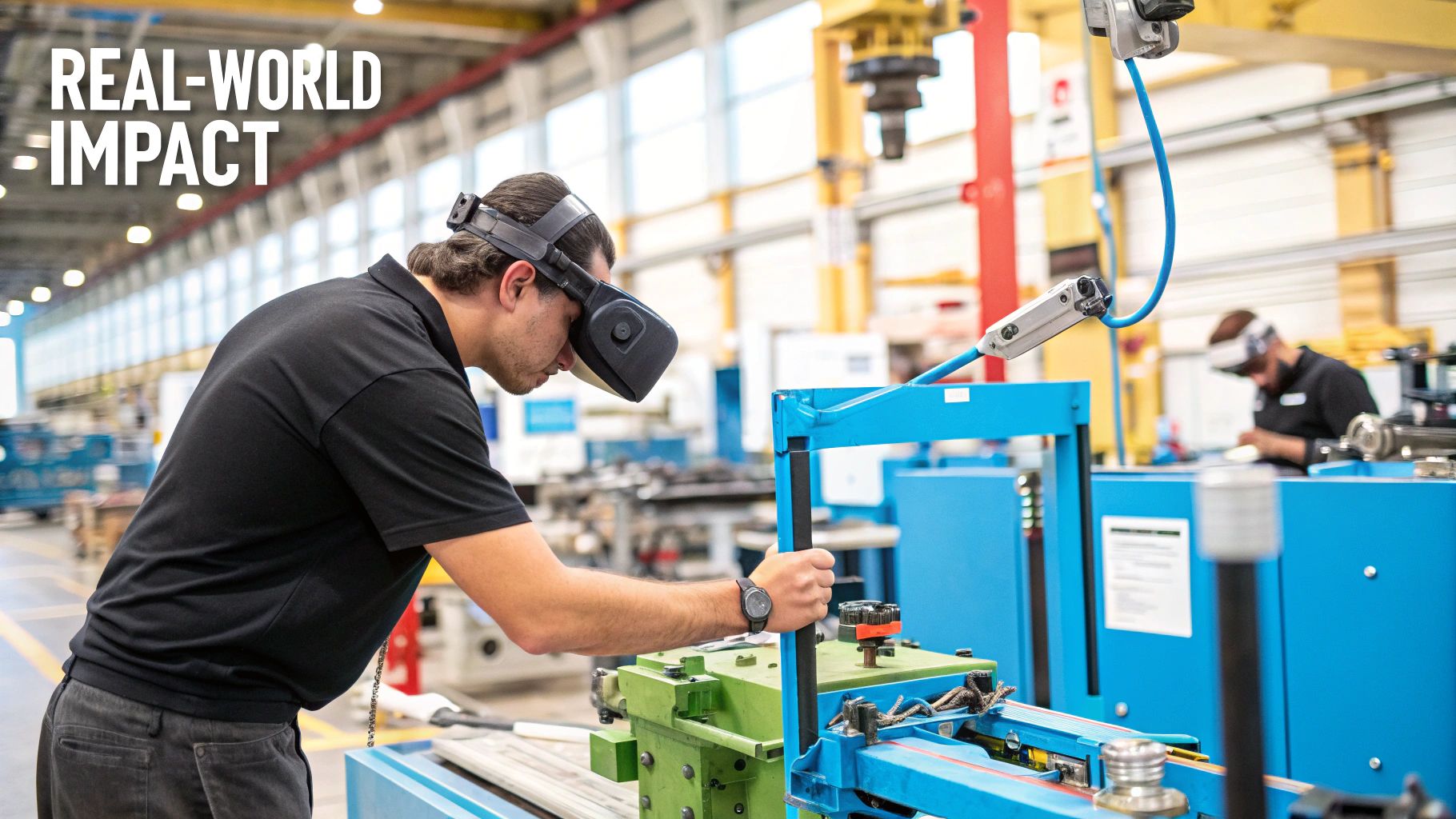
Transitioning from traditional training methods to an augmented reality framework might feel like a significant undertaking. But with a structured approach, the process becomes manageable and effective. The secret to successfully implementing AR in training isn't a sudden, massive technology overhaul. It’s about a thoughtful, phased rollout that proves its worth every step of the way.
The key is to start small. Think strategically and focus on solving one real, persistent business problem first. By following a clear roadmap, you can build a powerful AR training program that delivers tangible results, wins over stakeholders, and gives your workforce the skills they need to excel.
Phase 1: Define Your Objectives
Before you consider hardware or software, the first and most crucial step is to pinpoint the right problem to solve. A successful AR implementation always starts with a clear, high-impact use case.
Examine the training bottlenecks in your organization. Where are mistakes most common? Which procedures take the longest to teach? Where do safety incidents happen most often? The answers will point you directly to the perfect candidate for an AR pilot project.
Once you have a use case, define what success looks like with specific, measurable goals. These objectives will be the yardstick you use to measure your program's performance.
- Objective Example 1: Reduce assembly errors on Product Line X by 50% within three months.
- Objective Example 2: Decrease the onboarding time for new field technicians by 30% in the next quarter.
- Objective Example 3: Eliminate 90% of procedural violations during lockout-tagout safety training.
Phase 2: Select the Right Tools
With clear goals in hand, you can now pick the technology that best fits your needs. This decision boils down to two components: hardware and software.
On the hardware side, the choice is usually between smart glasses and mobile devices like tablets or smartphones. Smart glasses are ideal for a hands-free experience, which is beneficial for complex assembly or maintenance tasks. Mobile devices, on the other hand, are a more accessible and budget-friendly starting point, often using technology your team already has.
For software, you're looking for an AR platform that lets you create, manage, and deploy your training content. Look for user-friendly authoring tools that allow your own subject matter experts to build interactive guides without needing to write code. Also, consider how the platform will integrate with your existing Learning Management System (LMS) to track progress and performance data seamlessly.
Phase 3: Develop and Pilot Your Program
This is where your AR training program comes to life. Start by developing the content for the pilot use case you chose. Work closely with your most experienced employees to capture their expert knowledge and turn it into clear, step-by-step AR instructions.
A pilot program is your proof-of-concept. It lets you test the technology, get direct feedback from users, and collect performance data in a controlled setting. This evidence is crucial when you need to build a strong business case for a wider rollout.
Once your content is ready, launch a small-scale pilot with a select group of employees. This initial test run is invaluable for identifying any usability issues and refining the content before a larger deployment. Make sure to actively solicit feedback from participants to understand what’s working and what needs adjustment.
Phase 4: Scale and Integrate
After a successful pilot, you'll have the data—and the internal support—you need to expand your AR in training initiative. Use the lessons you learned to fine-tune your strategy as you roll the program out to larger teams or tackle new use cases.
At this point, a solid infrastructure becomes critical for managing a larger deployment. Ensuring you have the right systems in place will prevent performance bottlenecks as you grow. For any organization looking to scale its immersive programs, understanding the role of supporting systems is a must; you can learn more about how infrastructure is the next frontier for AI-powered XR to get ahead of the curve.
By taking this phased approach—defining objectives, selecting tools, piloting, and then scaling—you can build a sustainable and highly effective AR training ecosystem. This methodical process reduces risk and ensures your investment delivers a powerful return.
Measuring the ROI of Your AR Training Initiative
Investing in any new technology demands a clear path to value, and AR training is no different. For business leaders, it all boils down to one question: what’s the return on investment? Fortunately, the impact of AR is highly measurable, blending hard numbers with significant operational improvements that build a compelling business case.
Justifying the investment starts with tracking the right key performance indicators (KPIs). These metrics tend to fall into two categories: quantitative—the direct, bottom-line figures—and qualitative, which capture the less tangible but equally critical gains in your team's skills and confidence. Together, they paint the full picture of what AR brings to the organization.
Tracking Quantitative Metrics
Quantitative metrics are the most straightforward way to see the financial impact. They show you concrete savings in time, resources, and operational costs.
These hard numbers provide the proof points that get stakeholders' attention.
- Reduced Training Time: One of the quickest wins with AR is a shorter learning curve. Measure how long it takes a new hire to become fully competent using AR versus your old methods. A 30-40% reduction is common.
- Lower Error Rates: AR guidance is like having an expert looking over your shoulder, which naturally minimizes mistakes. Track the number of errors or rejected parts on an assembly line before and after you roll it out. Fewer errors mean less wasted material and rework.
- Decreased Equipment Downtime: When a maintenance technician can fix an issue faster with AR support, that expensive machine gets back online sooner. Monitor a machine's total downtime for repairs—the improvement is often immediate.
- Fewer Safety Incidents: You can’t put a price on safety. By giving employees a risk-free space to practice dangerous procedures, AR training makes the workplace safer. A drop in reported safety incidents is a powerful ROI metric.
Assessing Qualitative Gains
Qualitative metrics measure the human side of your training program. While these don't show up on a balance sheet, they’re strong indicators of a healthier, more capable, and more engaged workforce—the kind that drives long-term success.
These factors create a more resilient and agile team.
Improved employee confidence is a cornerstone of effective training. When employees feel competent and supported by AR tools, they are more proactive, better at problem-solving, and more likely to stay with the company, reducing turnover costs.
Key qualitative KPIs include:
- Employee Confidence Levels: Use simple surveys before and after training to ask employees how confident they feel performing complex tasks. A significant jump in self-reported confidence is a sure sign the training is working.
- Skill Retention Over Time: Test employees on procedures a few weeks or even months after their initial training. If they remember more, it proves AR-based learning sticks, reducing the need for constant refreshers.
- Increased Engagement and Satisfaction: Interactive and effective training leads to more satisfied employees. Monitor this through feedback sessions and surveys to capture this important cultural benefit.
You don't need a PhD in finance to calculate the ROI from these metrics. A simple approach is to add up all the cost savings and efficiency gains (your "return") and divide that by what you spent on the AR program (your "investment").
For organizations looking to build a solid measurement framework, it helps to explore different approaches. To get started, you can learn more about how to measure training effectiveness in our detailed guide. By tracking both the hard numbers and the human impact, you can clearly demonstrate the immense value that AR in training delivers.
The Future of AR in Training and Development

The road ahead for AR in training is paved with more intelligence, connectivity, and adaptability. We’re already seeing a significant impact from current AR applications, but the next wave is all about weaving in advanced technologies to make learning completely intuitive and personal. The field is shifting from static digital checklists to dynamic learning environments that respond to the user.
At the center of this shift is the growing partnership between AR and Artificial Intelligence (AI). This combination is set to push training beyond pre-programmed instructions and into the realm of truly adaptive learning. Picture an AI-driven system that watches an employee's performance in real time, picking up on hesitation, repeated mistakes, or moments of quick mastery.
Based on that live feedback, the AR experience can change on the fly. It might serve up more detailed guidance for a tricky step, fast-track a section the user is mastering, or even display a quick quiz to reinforce a concept. This forges a unique learning path for every single employee, making sure they get the exact help they need to become proficient.
The Rise of Collaborative AR
Another major leap forward is the growth of collaborative AR, which makes physical distance irrelevant. Imagine a new field technician facing an unusual equipment failure they’ve never seen before. Instead of waiting hours—or days—for a senior expert to travel to the site, the tech can use their AR glasses to share their exact point-of-view in real time.
The remote expert, potentially hundreds of miles away, sees precisely what the technician on the ground sees. They can then draw digital annotations, display diagrams, and place instructions right into the technician's field of view, walking them through the fix step-by-step.
Collaborative AR effectively clones your top experts, allowing their knowledge to be deployed anywhere, instantly. This not only dramatically cuts down on travel costs and machine downtime but also creates invaluable on-the-job mentoring opportunities.
This “see-what-I-see” capability is transformative for service, maintenance, and support teams. It turns every frontline worker into a direct extension of your most seasoned professionals.
Balancing Innovation with Sustainability
As these powerful AR and AI systems become the new standard, we have to consider their environmental footprint. The computational power needed for complex simulations and real-time AI analysis is significant. For perspective, training a high-end AI model like GPT-4 in 2023 was estimated to produce 5,184 tons of CO2 emissions, and newer models are even more resource-intensive. While better hardware makes AR in training more accessible, it brings sustainability challenges with its energy use. You can dive into the full research on AI's growing energy demands.
The future of AR in training isn't just about pushing the technological envelope; it's about finding a balance with energy-efficient solutions. This means smarter algorithms, more efficient hardware, and a move toward greener data center practices. By getting ahead of these trends and challenges, companies can do more than just capitalize on future innovations—they can lead the charge in doing it responsibly.
Your Questions, Answered
Thinking about bringing augmented reality into your training programs? It’s a big step, but you’re not the first to have questions. Here are a few of the most common ones we hear from organizations just starting to explore immersive learning.
Where Do I Even Begin with AR Training?
The best advice? Start small. Forget trying to overhaul your entire training department at once. Instead, pinpoint a single, high-impact problem that AR in training is perfectly suited to solve.
Pick a specific, persistent challenge—maybe it's a complex assembly task that always trips up new hires, or a routine maintenance procedure that’s surprisingly easy to get wrong. By focusing on one pilot project, you can prove the concept on a manageable scale. More importantly, it gives you a chance to measure clear, tangible results and build that crucial internal buy-in before expanding the program.
Is This Going to Be Expensive to Implement?
It’s true that initial costs can vary, but modern AR solutions are far more accessible than you might think. We have moved past the days when every project required expensive, dedicated smart glasses. Many of the most effective platforms today run on the standard smartphones and tablets your team already uses.
The real key is to shift the focus from cost to ROI. When you factor in the money saved from fewer production errors, faster onboarding, and a significant boost in workplace safety, the initial investment often pays for itself surprisingly quickly. It makes good business sense.
Do We Need to Hire a Bunch of Developers to Create AR Content?
Not necessarily. While you might want a developer for a highly complex, custom simulation, many of today’s leading AR platforms are built for a broader audience.
Many platforms now have no-code or low-code authoring tools. This puts the power to create interactive AR guides and tutorials directly into the hands of your subject matter experts—without them ever needing to write a line of code.
This is a game-changer. It means the people who know the procedures inside and out are the ones building the training, which is the surest way to make it accurate, practical, and incredibly effective.
Ready to transform your workforce training? AIDAR Solutions provides immersive AR and VR applications that accelerate learning, reduce errors, and improve operational efficiency. Discover how our tailored solutions can deliver a rapid return on investment for your business at https://aidarsolutions.com.

