AR for Manufacturing Your Guide to Real-World Efficiency Gains
Picture a factory floor. A technician, wearing smart glasses, looks at a complex piece of machinery. Instead of fumbling with a tablet or a thick paper manual, digital instructions are overlaid directly onto the equipment, guiding their hands with pinpoint accuracy. This isn't a scene from a sci-fi movie; it's the very real power of AR for manufacturing, a tool that's already solving today's biggest industrial challenges.
Seeing Your Factory in a New Light
Augmented reality completely changes how frontline workers see and interact with their physical environment. It bridges the gap between the mountain of digital data your factory produces and the real world where the work actually happens. The best way to think about AR is as a 'digital co-pilot' for your team, delivering exactly the right information at the right time, right where they need it.
The technology layers computer-generated images, text, and data onto a user's view of their surroundings. For a machine operator, this could mean seeing real-time performance metrics hovering right next to the equipment they're running. For someone on the assembly line, it might be a sequence of animated 3D models showing exactly how parts snap together.
Empowering the Frontline Worker
At its core, AR in manufacturing is all about empowering your people. By providing contextual, hands-free information, AR systems reduce the mental load that comes with juggling complex tasks. Instead of stopping to consult a separate screen, the worker has all the guidance they need directly in their line of sight. This translates to immediate, tangible benefits on the floor:
- Fewer mistakes: Clear, step-by-step visual guidance dramatically cuts down on errors in assembly, maintenance, and quality control.
- Faster training: New hires get up to speed in a fraction of the time. They learn by "seeing" how a task is done on the actual equipment, which is far more effective than just reading about it.
- A safer workplace: AR can actively highlight potential hazards, display critical safety warnings, and ensure procedures are followed to the letter.
Augmented reality isn’t here to replace human expertise—it’s here to amplify it. The technology acts as an intelligent assistant that enhances a worker's own skills, judgment, and efficiency.
The market growth reflects this shift. The AR market in manufacturing is projected to expand significantly, from an estimated $8 billion in 2025 to roughly $35 billion by 2033. This isn't just a trend; it's a fundamental shift, showing how AR is becoming a strategic must-have for any competitive manufacturer.
From Niche Technology to Strategic Tool
Ultimately, AR is becoming a cornerstone of modern industrial strategy, tying in perfectly with the principles of Industry 4.0. It connects your workforce directly to the smart factory's digital ecosystem. All that data from IoT sensors and management systems isn't just collected and stored anymore—it's made actionable right on the shop floor.
You can learn more about how augmented reality fits into the Industry 4.0 framework in our detailed guide. This integration is what turns abstract data into practical, step-by-step instructions that drive real-world efficiency and quality.
How AR Is Actually Changing the Game on the Factory Floor
Let's get practical. Augmented reality isn't just a tech demo anymore; it's delivering tangible, bottom-line results by tackling some of the oldest and most stubborn challenges in manufacturing. The core idea is simple but powerful: overlaying digital information—like instructions, warnings, or data—directly onto physical equipment. This gives your team the exact context they need, right when they need it, fundamentally changing how work gets done.
It's not a minor tweak. It’s a complete shift in executing core operations.
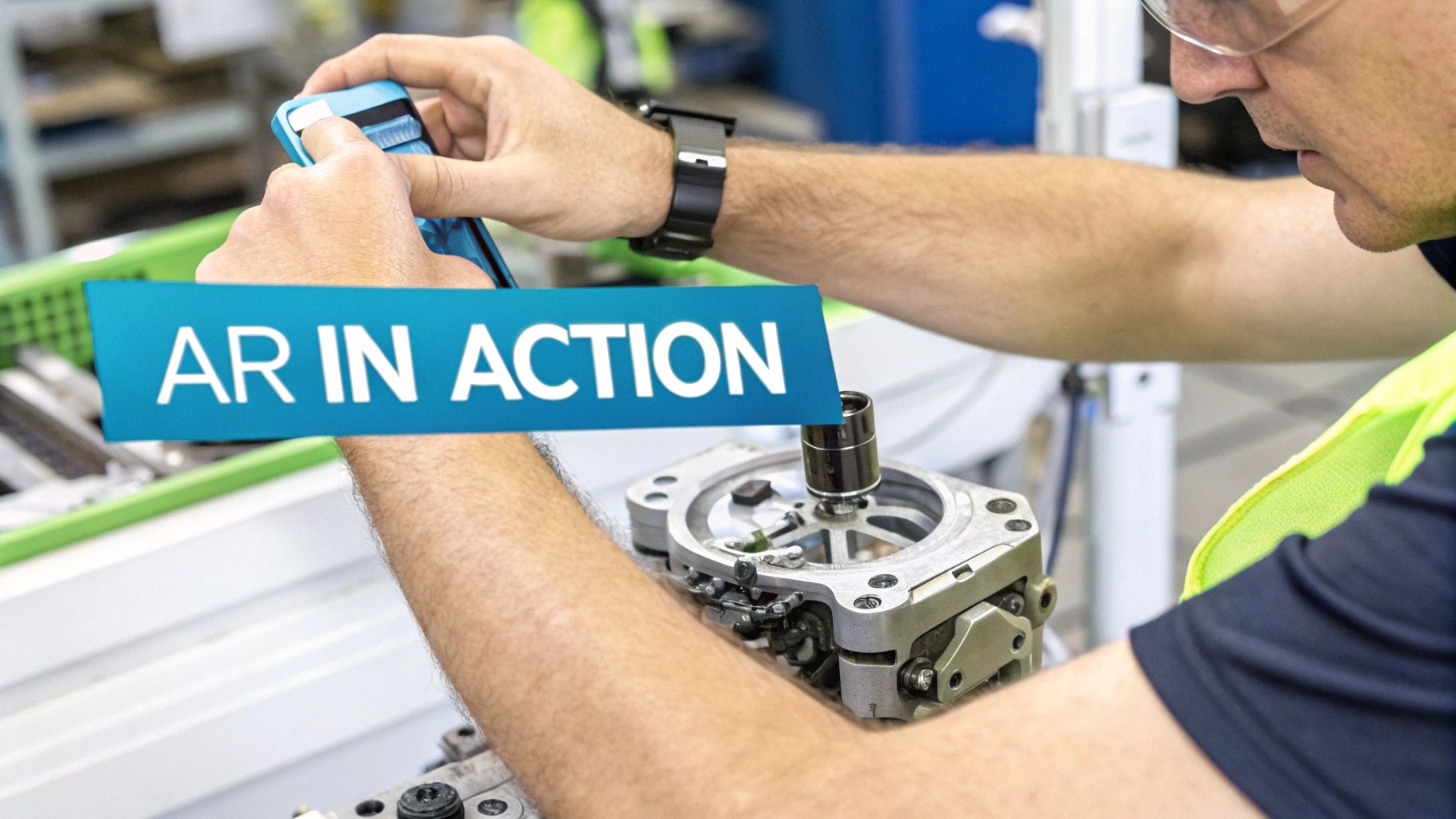
We see the biggest impact of AR for manufacturing across four critical areas. Each one solves a very specific, costly problem by delivering information in a way that's just more intuitive for the human brain.
Closing the Skills Gap, Fast
One of the quickest wins with AR is slashing the time it takes to get people up to speed. Think about traditional training: days in a classroom, followed by flipping through dense manuals on the floor. It's completely disconnected from the actual job.
AR flips that entire model on its head. Imagine a new hire putting on a pair of smart glasses and seeing a 3D animation of an assembly process overlaid right onto the real-world parts. They learn by doing, with guidance every step of the way. This builds muscle memory and confidence far more effectively than reading a PDF, getting your workforce skilled up and productive in a fraction of the time.
Reinventing Equipment Maintenance and Repair
Downtime is the enemy. Every minute a machine is down, you're losing money. The clock is always ticking while technicians hunt for the right manual or try to diagnose a cryptic error code. AR gives them a powerful toolkit to solve problems faster.
Picture a technician wearing an AR headset. They see interactive work instructions, real-time performance data, and digital schematics floating right beside the machine they’re fixing. Their hands stay free to do the actual work while following expert guidance. Companies putting this into practice are seeing huge drops in repair times and major boosts in first-time fix rates. To dig deeper, check out our guide on how augmented reality for maintenance delivers these kinds of results.
By providing instant access to contextual data and visual instructions, AR transforms a reactive maintenance process into a proactive, data-driven operation. Technicians are no longer just fixing a problem; they are executing a precise, guided solution.
This gets even more powerful when you connect AR to your live machine data. Integrating with advancements in IoT application development allows the AR system to pull in live sensor readings, error codes, and performance history, giving technicians a complete, 360-degree view of the machine's health.
Making Perfect Quality the Standard
Product quality isn't just a goal; it's your reputation. But manual inspections can be slow and subjective. When you're dealing with complex parts and tiny tolerances, human error is always a risk.
AR-powered quality control essentially provides a digital blueprint for perfection. An inspector can look at a finished product through an AR device and see a 3D model of the design specs overlaid perfectly on top. The system instantly flags any deviation—a misaligned component, a missing screw, a tiny surface flaw—that the naked eye would easily miss.
This approach gives you a few key advantages:
- Objectivity: It reduces guesswork. The product either matches the digital model or it doesn't.
- Speed: Inspections that used to take minutes can now be done in seconds.
- Accuracy: It catches the subtle defects that lead to rework and customer returns.
Getting Expert Help, Instantly
Finally, AR is demolishing geographical barriers. When a really tricky or unique problem pops up, the local team might not have the answer. In the past, that meant flying in your top expert, which costs a fortune in time and travel expenses.
With AR remote assistance, that's no longer necessary. The on-site tech can share their live, first-person point-of-view through their smart glasses with an expert anywhere on the globe. The remote expert sees exactly what the technician sees. They can then draw annotations, circle parts, and share documents directly into the technician's field of view. This "see-what-I-see" capability means problems that once caused days of downtime can now be solved in a matter of minutes.
This table breaks down how these applications create value across the entire manufacturing process.
AR Applications Across the Manufacturing Value Chain
| Use Case | Problem Solved | Key Benefit with AR/VR Solutions |
|---|---|---|
| Training & Onboarding | Slow learning curves, inconsistent knowledge transfer, high training costs. | Immersive, hands-on training modules reduce ramp-up time by up to 75% and improve knowledge retention. |
| Maintenance & Repair | Machine downtime, low first-time fix rates, reliance on paper manuals. | Guided workflows and remote expert assistance cut repair times by 30-50% and increase first-time fixes. |
| Quality Control | Human error in inspections, rework costs, inconsistent quality standards. | Digital overlays and automated checklists increase inspection accuracy by over 90%, reducing defects and waste. |
| Remote Assistance | Travel costs for experts, long delays in problem resolution, knowledge silos. | Instantly connect on-site staff with remote experts to solve complex issues in minutes, not days. |
By targeting these core operational pain points, AR provides clear, measurable returns that go straight to the bottom line.
Connecting AR Adoption to Your Bottom Line
Bringing augmented reality onto the factory floor isn't just an operational upgrade; it’s a direct investment in your financial performance. While the technology is impressive, decision-makers rightly ask how these improvements actually appear in the numbers. The answer is found by linking AR-driven efficiencies to the hard metrics that define manufacturing success, shifting the conversation from interesting features to measurable return on investment.
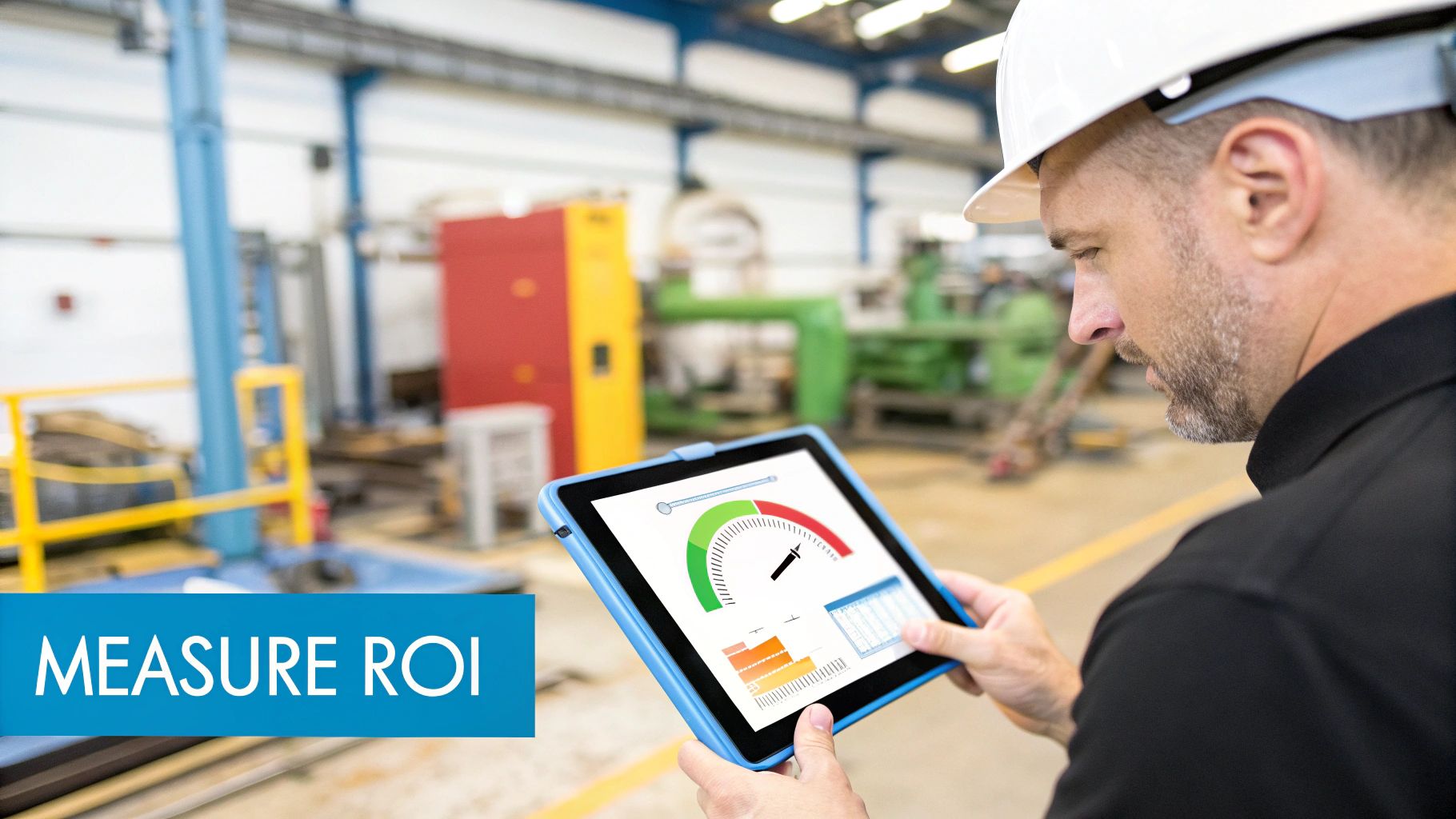
This connection becomes crystal clear when you look at key performance indicators (KPIs) before and after AR comes into the picture. By zeroing in on specific, data-backed outcomes, you can build a powerful business case that speaks directly to stakeholders who care about the bottom line.
Driving Down Error Rates and Rework Costs
Every mistake on the assembly line costs money through wasted materials, lost time, and increased labor. AR-guided assembly and quality control tackle this problem head-on by giving workers a clear, digital overlay of the correct procedures and specifications right in their line of sight.
Instead of trying to remember a step or interpret a complex diagram, an employee sees exactly where each part goes, highlighted in their field of view. This simple visual confirmation makes it much harder to make errors. In fact, data shows AR inspection tools can slash error rates by 25%, which translates directly to a significant reduction in expensive rework and scrap.
Accelerating Repair Times and Boosting Uptime
In any plant, equipment downtime is a direct threat to profitability. The longer a machine sits idle, the more production value evaporates. This is where AR makes a massive impact on two critical metrics: Mean Time to Repair (MTTR) and First-Time Fix Rate.
AR gives technicians hands-free access to step-by-step instructions and immediate remote expert support. No more wasted hours hunting for manuals or waiting for a specialist to fly in. This has a direct effect on how fast and effective repairs are. Consider the financial win when remote assistance cuts out 75% of expert travel costs and gets a machine running in minutes, not days.
By improving MTTR and First-Time Fix Rates, AR directly contributes to a higher Overall Equipment Effectiveness (OEE)—a core metric of manufacturing productivity that multiplies profitability.
These improvements aren't just theoretical. For a deeper look at how technology can move these needles, check out our detailed overview of key operational efficiency metrics that smart manufacturers are tracking.
Shortening Training Cycles and Improving Safety
The financial upside of AR for manufacturing also appears in workforce development and safety. AR is completely changing how employees are trained, offering immersive, on-the-job guidance that helps people learn faster and retain more information.
In heavy equipment training, AR has been shown to cut incident rates by over 40%. In logistics, it can boost picking accuracy by up to 20%. And with remote AR assistance, you can even quadruple training throughput and slice resolution times in half. It all points to a more skilled, efficient, and safer workforce, built with less investment.
By putting numbers to these improvements—from fewer errors to faster training—you can clearly articulate the business value of AR. Purpose-built platforms are designed to deliver these specific, measurable results, ensuring your investment pays off.
Your Roadmap from Pilot Project to Full Deployment
So, how do you actually get started with augmented reality? A successful integration isn’t magic; it’s the result of a deliberate, step-by-step plan. Jumping straight into a massive factory-wide overhaul is a recipe for failure. The real journey begins with a small, focused win.
This roadmap is your playbook. It’s designed to guide you through the critical stages, from that first small-scale test to a solution that’s part of your daily operations.
Identify Your High-Impact Pilot Project
The goal of a pilot isn't to solve every problem at once. It's to prove the value of AR for manufacturing—quickly and decisively. You need to find a single, nagging problem where the technology can deliver a clear, measurable victory. Forget about complex, multi-departmental projects for now. Instead, hunt for a significant, yet contained, "pain point."
Good candidates for a pilot project usually look like this:
- High Error Rates: That one assembly step where mistakes are frustratingly common and expensive to fix.
- Long Repair Times: A specific machine that always seems to cause a bottleneck because its maintenance is so complex.
- Lengthy Training: A particular skill or process that takes new hires forever to master.
By picking a low-risk, high-impact area, you create a controlled experiment. You can gather clean data, demonstrate a real ROI, and start building momentum. Think of your successful pilot as an internal case study—it makes getting buy-in from other stakeholders a whole lot easier.
Build Your Foundational Groundwork
Once you’ve pinpointed your pilot project, it's time to lay the groundwork. This is where you make some key decisions about the hardware and software that will power your AR initiative. You don't need to choose your entire enterprise tech stack right now, but you do need the right tools for this first test.
The big hardware question is usually smart glasses versus tablets. Smart glasses are fantastic for hands-free operation, which is a game-changer for complex assembly or maintenance tasks. On the other hand, tablets are a lower-cost entry point and your team already knows how to use them. The right choice depends entirely on the workflow you're trying to fix.
Choosing the right software model—SaaS versus on-premise—is just as crucial. A SaaS platform gets you up and running faster with lower upfront costs. An on-premise solution, however, gives you total control over data security, which is a non-negotiable for many manufacturers.
Integrate for a Seamless Information Flow
An AR solution that’s isolated from other systems has limited value. To really unlock its potential, your AR platform must talk to your existing manufacturing systems. This connection is what creates a seamless flow of information, putting critical data directly into your team's line of sight when and where they need it.
Key integrations to think about include:
- Enterprise Resource Planning (ERP): Pulling work orders, bills of materials, and live inventory data.
- Manufacturing Execution System (MES): Accessing real-time production schedules, machine status, and quality checks.
- Product Lifecycle Management (PLM): Displaying the latest CAD models, schematics, and engineering specs.
This is what turns a simple AR display into an intelligent, context-aware tool. A technician shouldn't have to walk over to a terminal to look up a part number. The AR system should recognize the component and pull that info from your ERP automatically. That’s the core of a truly effective augmented reality workflow.
Scale Success Across the Organization
With a successful pilot under your belt, the final stage is to scale that win across the entire organization. This is less about tech and more about people—it’s a change management challenge. You'll take the lessons from your pilot and build a repeatable process for a much broader rollout.
Scaling effectively means creating standardized digital work instructions. You need a system to turn your old paper manuals and that "tribal knowledge" locked in your experts' heads into clear, consistent AR-guided procedures. This ensures every worker, no matter their experience level, does the job the right way, every time.
Ultimately, scaling is about fostering a culture of continuous improvement. As more teams get their hands on the technology, they’ll discover new ways to use it. A great AR deployment isn't a one-and-done project; it’s the foundation for a more connected, agile, and data-driven factory floor.
Choosing Your Ideal AR Technology Partner
Picking the right technology is only half the battle. The partner you choose to guide you on your AR journey is just as critical to your success. A great partner does more than just sell you a product; they become a strategic advisor, helping you cut through the complexity of implementation and scale your solution for maximum impact.
Instead of focusing only on a features checklist, you need a partner who understands the unique pressures of the manufacturing world, from the noisy, demanding environment of the factory floor to the strict security requirements of your IT department. A true partner brings that deep industry experience to the table.
Does Your Vendor Understand Manufacturing?
The first question to ask is simple: Does this vendor actually speak the language of manufacturing? A provider with a proven track record in industrial settings gets your specific pain points and workflows without needing a crash course. They won't just offer generic software; they’ll have a solution built to withstand the rigors of your environment.
This industry expertise shows up in a few key ways:
- Purpose-Built Solutions: Their platform is designed from the ground up for industrial use cases like maintenance, quality control, and on-the-job training.
- Relevant Case Studies: They can show you exactly how other manufacturers have successfully used their technology to solve problems just like yours.
- Deep Integration Knowledge: They understand how to connect their AR platform with the systems you already rely on, like your MES and ERP.
When considering partners, it's also worth understanding the role of experienced industrial automation system integrators. Their know-how is often essential for making sure new tech plays nice with your existing factory equipment and software.
Can the Platform Scale and Integrate with Your Operations?
Your AR initiative will likely start small with a single pilot project, but it shouldn't end there. The platform you choose has to be able to grow with you. Scalability isn't just about adding more users; it's about the platform's ability to handle more complex workflows and integrate more deeply into your operations as your needs change.
A scalable solution offers a clear path from a small pilot to a full-blown deployment across multiple facilities. This is where a clear deployment roadmap becomes absolutely invaluable.
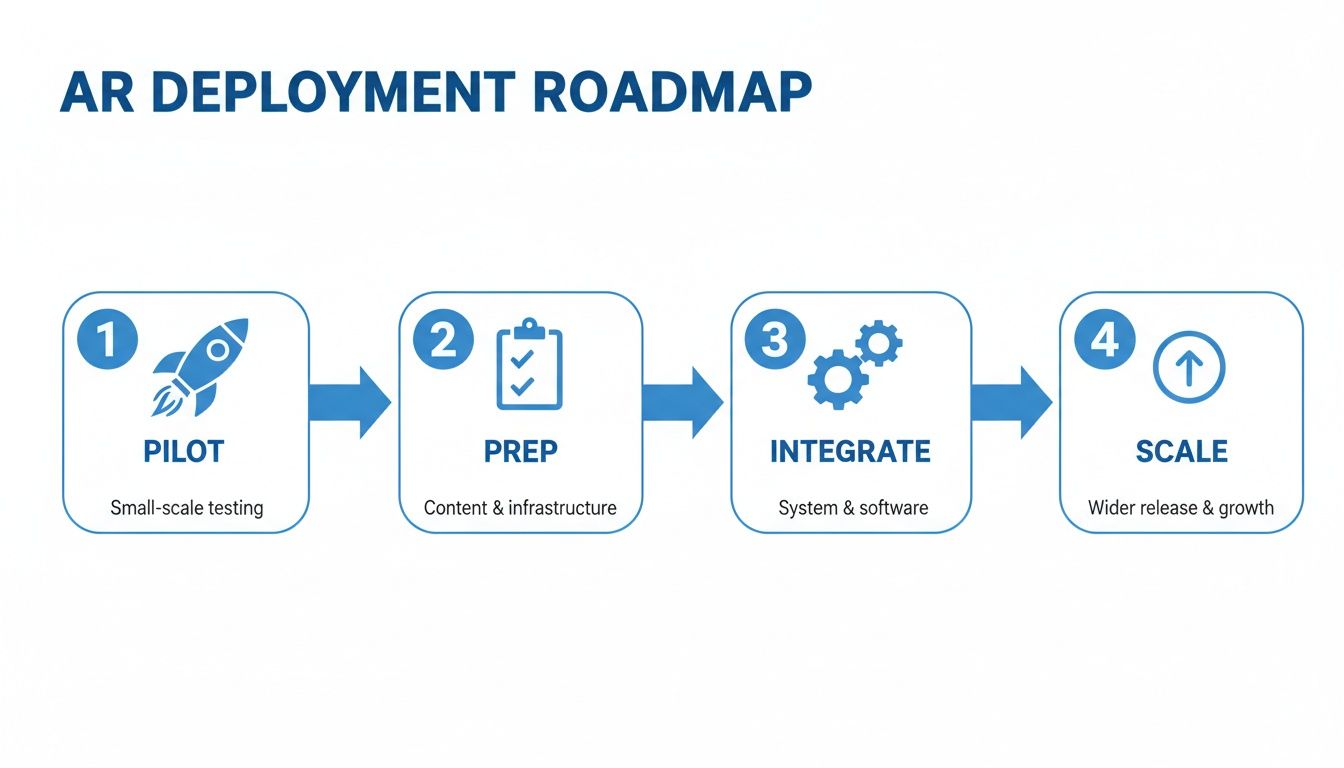
This roadmap lays out the typical four-step journey, starting with a focused pilot project and building toward a widespread, value-driving implementation. It highlights that success in AR for manufacturing comes from a structured approach: start with a proven win, then build momentum through careful preparation, integration, and scaling.
What Deployment and Support Options Are Available?
Finally, a top-tier partner provides the flexibility and support you need to build a long-term relationship. This starts with deployment options. Your IT and security teams will have specific requirements, and your partner should be able to meet them.
The right partner offers a choice between a cloud-based SaaS model for rapid deployment and an on-premise solution for maximum data control. This flexibility is non-negotiable for many enterprises with strict data governance policies.
Beyond the initial setup, think about the level of ongoing support. A strong partner doesn't just disappear after the deal is signed. They provide comprehensive training for your team, responsive technical support to troubleshoot issues, and a dedicated success manager who is truly invested in helping you hit your business goals.
Ask potential vendors these essential questions to get a feel for their long-term value:
- What is your experience specifically within our manufacturing sub-sector?
- How does your platform handle integration with systems like SAP or Oracle?
- What does your customer support model look like after we go live?
- Can you share your product roadmap for the next 18-24 months?
Choosing a partner is a commitment. By focusing on manufacturing expertise, scalability, and robust support, you can select a provider who will not only deliver powerful technology but will also guide you every step of the way.
Answering Your Questions About AR in Manufacturing
Stepping into any new technology brings up a lot of questions, and augmented reality is no different. For leaders in manufacturing, those questions usually boil down to practicality, cost, and the real-world headaches of actually getting it implemented. You need straight answers to make a confident decision.
This section tackles the most common questions we hear from manufacturing professionals. We'll cut through the noise and give you direct answers to help you see the path forward and understand how this technology fits into your operational reality.
AR vs. VR vs. MR: What’s the Real Difference on the Floor?
It’s easy to get tangled in the acronyms, but the distinction on the factory floor is actually pretty simple. Think of it as choosing the right tool for a specific job.
-
Augmented Reality (AR): This is your go-to for hands-on tasks. AR overlays digital instructions, diagrams, or data onto your real-world view. It’s perfect for guiding a technician through a complex repair on a physical machine because they never lose sight of their actual workspace.
-
Virtual Reality (VR): VR creates a completely digital, simulated world. It’s ideal for training someone on a dangerous or expensive piece of equipment safely, far away from the active production line. A new hire can practice on a virtual machine without any risk to themselves or the real hardware.
-
Mixed Reality (MR): This is a more advanced version of AR where digital objects don't just appear on your screen but can actually interact with your physical environment. While powerful, for most core manufacturing needs today—like guided instructions or remote support—AR delivers the most direct and proven value.
When it comes to the day-to-day work of assembly, quality checks, and maintenance, AR is the most widely adopted and effective of the three because it enhances how your workers interact with physical machinery, rather than replacing that interaction entirely.
Do We Need Expensive Hardware to Get Started?
This is probably the biggest myth holding companies back, and the answer is a firm no. You absolutely do not need to buy a fleet of expensive smart glasses to get started. In fact, that's often the worst way to begin.
A successful AR initiative proves its value first, then justifies the hardware spend. The smart approach is to launch a low-cost, high-impact pilot project using the devices your team already has in their pockets.
Modern AR platforms are built to be device-agnostic. That means you can run your first pilot project using standard smartphones and tablets. This lets you demonstrate a clear, measurable ROI on a specific use case without a big upfront capital investment. Once you have the hard data to prove the benefits, then you can make a strategic, data-backed decision to invest in hands-free hardware like smart glasses where it will deliver the biggest productivity jump.
How Difficult Is It to Integrate with Our Existing Systems?
The thought of plugging a new platform into your web of existing systems is enough to give any IT manager a headache. But modern, enterprise-grade AR solutions are built precisely to solve this problem. The difficulty of integration really depends on the AR platform you choose.
A good AR partner will provide a solution with standard APIs (Application Programming Interfaces) designed to connect smoothly with your core systems, like your ERP, MES, or PLM. The goal is to create one unified workflow.
This means your technicians can access everything they need—work orders, machine data, or technical drawings—all within a single AR interface. No more wasting time jumping between different screens and apps. A solid partner will work hand-in-hand with your IT team to map out the integration points and ensure a seamless flow of data right from the start.
How Do We Actually Measure the ROI?
Measuring the return on your AR investment isn’t about guesswork; it's about data. The process starts before you even deploy the tech, by establishing clear baseline metrics for the specific job you want to improve. You can't prove how far you've come if you don't know where you started.
To build a powerful, data-driven business case, zero in on these key performance indicators:
- For Maintenance: What’s your average Mean Time to Repair (MTTR) and First-Time Fix Rate before AR? Track these numbers for a specific machine or process.
- For Training: How many hours does it take for a new hire to become fully proficient on a task? What’s their error rate during the first 90 days?
- For Quality Control: What’s your current defect rate (PPM) for a particular product line? How long does a standard inspection take?
By benchmarking these KPIs before you start and measuring them again after your AR pilot is live, the financial impact becomes undeniable. You can walk into a boardroom and say, "AR reduced our MTTR by 30%," turning an operational improvement into a tangible financial win that everyone understands.
Ready to see how augmented reality can deliver measurable results for your operations? The team at AIDAR Solutions specializes in creating practical AR and VR applications that solve real-world manufacturing challenges. Discover our solutions and start building your business case today.