
Preventive Predictive Maintenance: A Guide to Smarter Operations
When discussing preventive vs. predictive maintenance, the fundamental difference is straightforward. Consider the analogy of maintaining a car.
- Preventive maintenance is time-based. It is analogous to changing your oil every 5,000 miles, regardless of its condition. You are following a schedule to prevent a potential problem.
- Predictive maintenance is condition-based. It is like your car's dashboard flashing a warning that your tire pressure is low. You are acting on real-time data to fix a problem that is about to happen.
This guide explains how blending these two strategies creates a much smarter, more resilient maintenance program for your entire operation.
Moving Beyond Calendar-Based Maintenance
For decades, maintenance has followed the rhythm of the calendar. Teams performed tasks at fixed intervals—weekly, monthly, or based on runtime hours—with the simple goal of stopping failures before they could happen. This is the heart of preventive maintenance, and it was a significant improvement over purely reactive, "run-to-failure" approaches.
This scheduled approach provides a solid layer of defense against sudden equipment failure and brings a welcome sense of order to operations. Its biggest flaw, however, is that it assumes every component wears down at the exact same, predictable rate, which is rarely the case in real-world operating conditions.

The Shift to Data-Driven Decisions
In reality, your assets do not fail on a neat schedule. One machine might be running under higher stress or in a harsher environment, causing it to wear out much faster than an identical one right next to it. A purely preventive plan cannot account for these nuances, which often leads to two significant problems:
- Unnecessary Work: Technicians spend valuable time and resources servicing or replacing parts that are still in perfectly good condition.
- Missed Warnings: A critical component could fail just days after a scheduled inspection, causing the very downtime the program was designed to avoid.
This is where predictive maintenance fundamentally changes the approach. Instead of relying on schedules, it uses real-time data from sensors and analytics to monitor the actual health of an asset. This allows your teams to intervene precisely when maintenance is needed—no sooner, no later. Our guide on condition monitoring and predictive maintenance digs much deeper into the technologies that make this possible.
Adopting a Smarter Maintenance Strategy
The move toward this more intelligent maintenance model is accelerating across industries. While preventive strategies are nearly universal, with 80–90% of facilities using them, true predictive maintenance is still in its early adoption phase. Industry reports from the early 2020s showed that only a small fraction of facilities had fully implemented predictive programs, though many were actively launching pilot projects.
The ultimate goal isn't to eliminate preventive tasks entirely. It's to build a blended strategy. You use powerful predictive insights for your most critical, high-value assets while applying cost-effective preventive schedules to less essential equipment. It’s all about optimizing resources and maximizing every minute of uptime.
Comparing Preventive and Predictive Strategies
Deciding on the right maintenance strategy is not just an operational choice—it's a critical business decision that impacts your efficiency, budget, and the lifespan of your most important assets. While both preventive and predictive maintenance share the goal of stopping failures before they happen, they achieve it through entirely different means. Understanding their strategic trade-offs is the first step toward building a smarter, more resilient maintenance program.
Preventive maintenance is built on simplicity and predictability. It functions like a recurring calendar appointment for your equipment, ensuring every asset receives regular attention. This scheduled approach makes planning for labor and parts straightforward, creating a reliable first line of defense against unexpected breakdowns.
However, that simplicity has a hidden cost. Preventive maintenance operates on a one-size-fits-all timeline for wear and tear, which often means performing work that isn’t actually necessary. Technicians may end up replacing perfectly good components simply because the schedule dictates it, which not only creates waste but also introduces the risk of human error during an otherwise unneeded service.
The Strategic Shift to Condition-Based Actions
Predictive maintenance, on the other hand, moves beyond the calendar to listen directly to the equipment. It uses real-time data from sensors to monitor the actual health of an asset, allowing your team to intervene with surgical precision only when a problem is developing. This is how you maximize asset uptime and get the most out of every resource.
Instead of over-servicing healthy machines, your skilled technicians can focus their time on assets that genuinely need attention. This data-driven model doesn't just prevent failures; it extends the operational life of your components by ensuring they are used to their full, intended potential. For a deeper look at how these two approaches compare, check out our complete guide on the differences between preventive and predictive maintenance strategies.
The real change here is the philosophy on data. To truly understand the significance of this shift, it helps to look at the data processing behind it. A good primer on understanding real-time vs. batch processing shows exactly why predictive models depend on continuous data streams to function effectively.
Preventive vs Predictive Maintenance: A Head-to-Head Comparison
Sometimes, the best way to understand the difference is to see things side-by-side. The table below breaks down the two strategies across the operational factors that matter most, highlighting the trade-offs between a time-based schedule and a condition-based approach.
| Attribute | Preventive Maintenance | Predictive Maintenance |
|---|---|---|
| Trigger | Fixed schedule (time or usage) | Real-time asset condition |
| Labor Allocation | Planned but potentially inefficient | Optimized based on actual need |
| Part Usage | Higher; replaces parts on schedule | Lower; replaces parts only when failing |
| Downtime | Scheduled downtime for service | Minimized; only when necessary |
| Initial Cost | Low; easy to implement | Higher; requires sensors & software |
| Long-Term ROI | Moderate; prevents some failures | High; maximizes asset life & uptime |
This side-by-side comparison makes the core differences crystal clear. One is about routine, the other is about response.
Predictive maintenance isn't about replacing preventive tasks entirely. It's about strategically applying the right approach to the right asset. High-value, critical machinery benefits most from predictive insights, while less critical or more predictable assets can be managed effectively with a preventive schedule.
By striking this balance, organizations can achieve the absolute most from their maintenance budget and technical talent.
Of course, transitioning to a predictive model comes with its own set of hurdles. It requires an upfront investment in technology like IoT sensors and analytics software, and just as importantly, it demands a cultural shift toward making decisions based on data. Building a solid business case means being honest about these needs while clearly demonstrating the significant long-term payoff in efficiency and cost savings. When leaders understand the strengths and weaknesses of both strategies, they can evolve their operations with confidence.
The Technology Powering Predictive Insights
Predictive maintenance is not based on speculation—it is a sophisticated strategy built on a powerful ecosystem of interconnected technologies. This system is designed to turn millions of raw data points from your equipment into clear, actionable warnings about what’s going to fail and when. Understanding these core components is the first step toward shifting your entire operation from reactive to proactive.
It all starts with the sensors. These small but powerful devices are the digital nervous system of your machinery, constantly monitoring vital signs like vibration, temperature, and acoustic signatures. They act as a permanent stethoscope on your most critical assets, detecting the faint signals that indicate an impending problem long before a human could.
This constant stream of information then needs to be processed. While some data gets sent to the cloud for heavy-duty analysis, a growing trend is edge computing. This is where initial processing happens right on a device near the machine, allowing for almost instant alerts on critical issues without the latency of sending everything to a central server. When a machine is about to fail, every second counts.
The Brains Behind the Operation
Once collected, all that data is funneled into the core of the predictive system: the analytics platform. This is where Artificial Intelligence (AI) and Machine Learning (ML) models perform the heavy lifting. These algorithms are trained on vast amounts of historical data, learning to recognize the subtle patterns and combinations of sensor readings that typically precede a specific type of failure.
This is the key differentiator between predictive and preventive maintenance. Instead of just following a rigid calendar, the AI models forecast component failure with remarkable accuracy based on what’s happening right now. This intelligence is the backbone of any modern program, and you can dive deeper into its role in our guide to predictive maintenance in manufacturing.
The same principle of using data to anticipate future events extends far beyond asset maintenance. For instance, exploring applications like predictive safety analytics shows how these methods can be used for proactive improvements in areas from equipment health to workforce safety.
Bridging the Gap with Immersive Technology
Receiving a predictive alert is powerful, but the real value is unlocked when a technician can act on that insight quickly and correctly. This is where immersive technologies like Augmented Reality (AR) create a seamless link between the digital alert and the physical repair, serving as the final, crucial piece of the predictive maintenance puzzle.
Imagine a technician wearing an AR headset. As they approach a complex piece of machinery, the headset overlays live sensor data, thermal imaging, and step-by-step repair instructions directly onto their field of view. They see the alert, the affected component, and the solution without ever looking away from the equipment.
This integration provides instant context and diagnostics, empowering technicians to resolve issues faster and with far fewer errors. They are not fumbling with a clunky manual or squinting at a separate screen; all the intelligence they need is presented right where they need it. It is how the valuable insights from your predictive models get translated into immediate, effective action on the factory floor.
Your Roadmap to Implementing Predictive Maintenance
Making the leap to predictive maintenance is not just about plugging in new technology. It is a full strategic journey that reshapes your people, processes, and the culture of your maintenance department. To ensure your investment pays off, you need a smart, well-planned roadmap. The most successful programs start small and focused rather than attempting to overhaul an entire facility at once.
This journey is about moving away from the traditional calendar-based mindset and learning to trust data. The real goal is to build a program that listens to your equipment, anticipates its needs before failure, and empowers your team to act with precision. Let's walk through the critical stages, from proving initial value to scaling success across the entire operation.
Start with a Strategic Pilot Project
To gain organizational buy-in for a preventive predictive maintenance program, demonstrate a clear, fast win. Attempting to monitor every single asset from the start is a common recipe for chaos and suboptimal results. Instead, kick things off with a targeted pilot project focused on a handful of your most critical machines.
Pinpoint the equipment where a failure would cause the most significant disruption—think major production losses, safety hazards, or extremely high repair costs. These high-impact assets are your ideal starting point. By focusing on them first, you can create powerful success stories and hard data that make an undeniable case for expanding the program.
A successful pilot project is not just a technical victory; it is a cultural one. The moment a technician sees the system correctly flag a failure they would have missed, you build the trust needed to change how maintenance is performed for good.
This focused approach also allows you to resolve any process kinks on a manageable scale. Furthermore, it helps your team get comfortable with a new way of working—responding to data-driven alerts instead of just looking at a calendar.
Build a Solid Data Foundation
Predictive maintenance is fueled by data. Before you can predict future events, you need a steady, reliable stream of information flowing from your assets. This stage is all about selecting the right sensors and setting up the infrastructure to collect and manage the data they produce.
A few key steps to establish:
- Asset Assessment: Determine which specific failure modes you want to predict for your pilot machines. This informs you exactly what kind of sensors you will need—vibration, temperature, oil analysis, etc.
- Sensor Installation: Deploy the chosen sensors on your critical equipment. Modern wireless sensors have made this a much faster and less disruptive process than it once was.
- Data Integration: Pipe all that sensor data into a central platform where the analysis occurs. This system should also integrate with your existing Computerized Maintenance Management System (CMMS) to automate work orders and keep all stakeholders informed.
This diagram breaks down the typical technology process, from the sensor on the machine to the actionable insights your team sees.
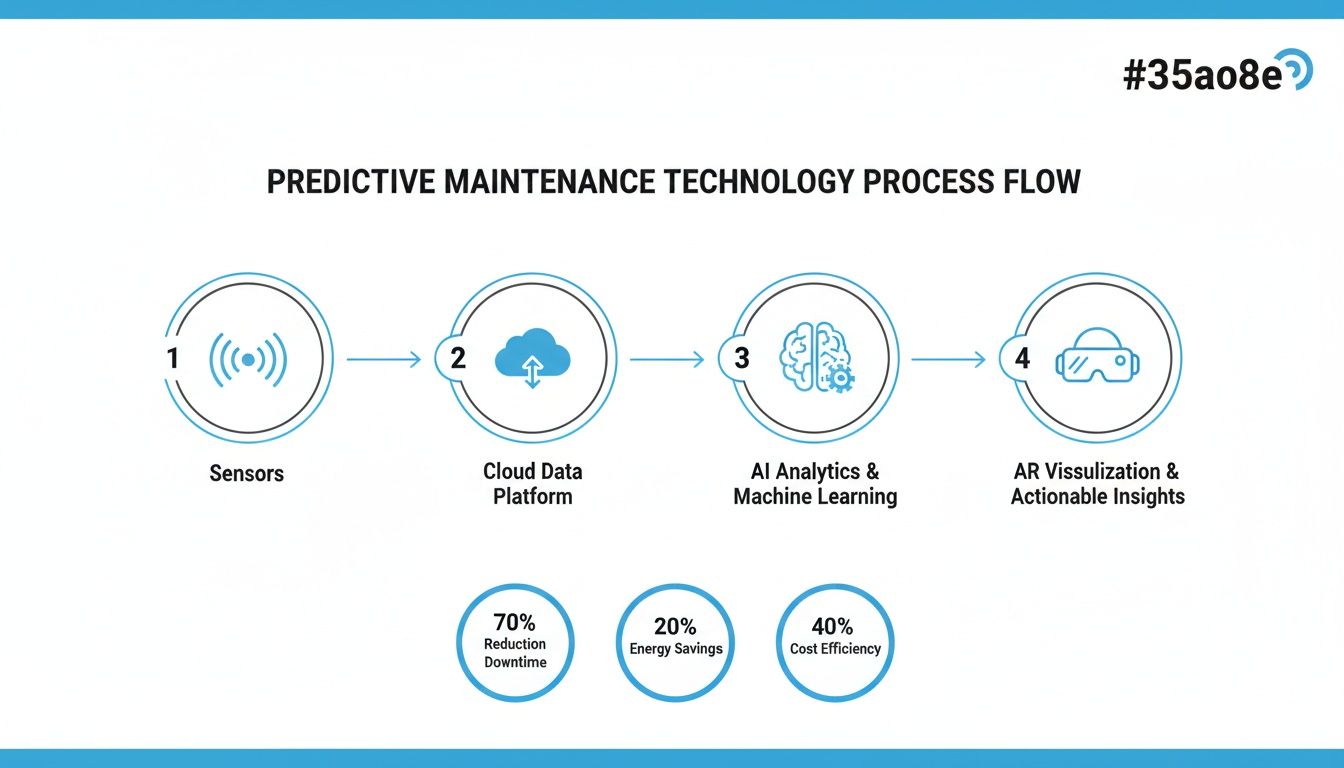
As you can see, raw data is transformed by cloud analytics and AI before it’s visualized for technicians—often using AR to guide them on the job.
Develop Models and Empower Your Team
Once the data is flowing, it's time to activate the predictive models that will make sense of it all. AI and machine learning algorithms begin learning from your equipment's historical and real-time behavior to spot the subtle clues that indicate a "failure on the horizon." Initially, these models learn what "normal" looks like before they can accurately identify anomalies.
However, the most important element is the human one. The most sophisticated algorithms are useless if your team is not prepared to act on their findings. You must commit to training and upskilling your maintenance technicians. They need to understand the alerts, trust the data, and feel confident in carrying out the recommended work.
This is where immersive training tools become a game-changer. With Virtual Reality (VR), technicians can practice complex repairs based on predictive alerts in a totally safe, simulated environment. When a real alert occurs, they are already proficient.
Then, Augmented Reality (AR) closes the loop between the digital alert and the physical machine. A technician wearing an AR headset can see step-by-step instructions, diagrams, or even get live remote assistance overlaid directly onto their view of the equipment. This not only makes the repair faster but also drastically reduces errors, ensuring the value of your predictive insights translates directly to the bottom line.
How AR and VR Accelerate Maintenance ROI
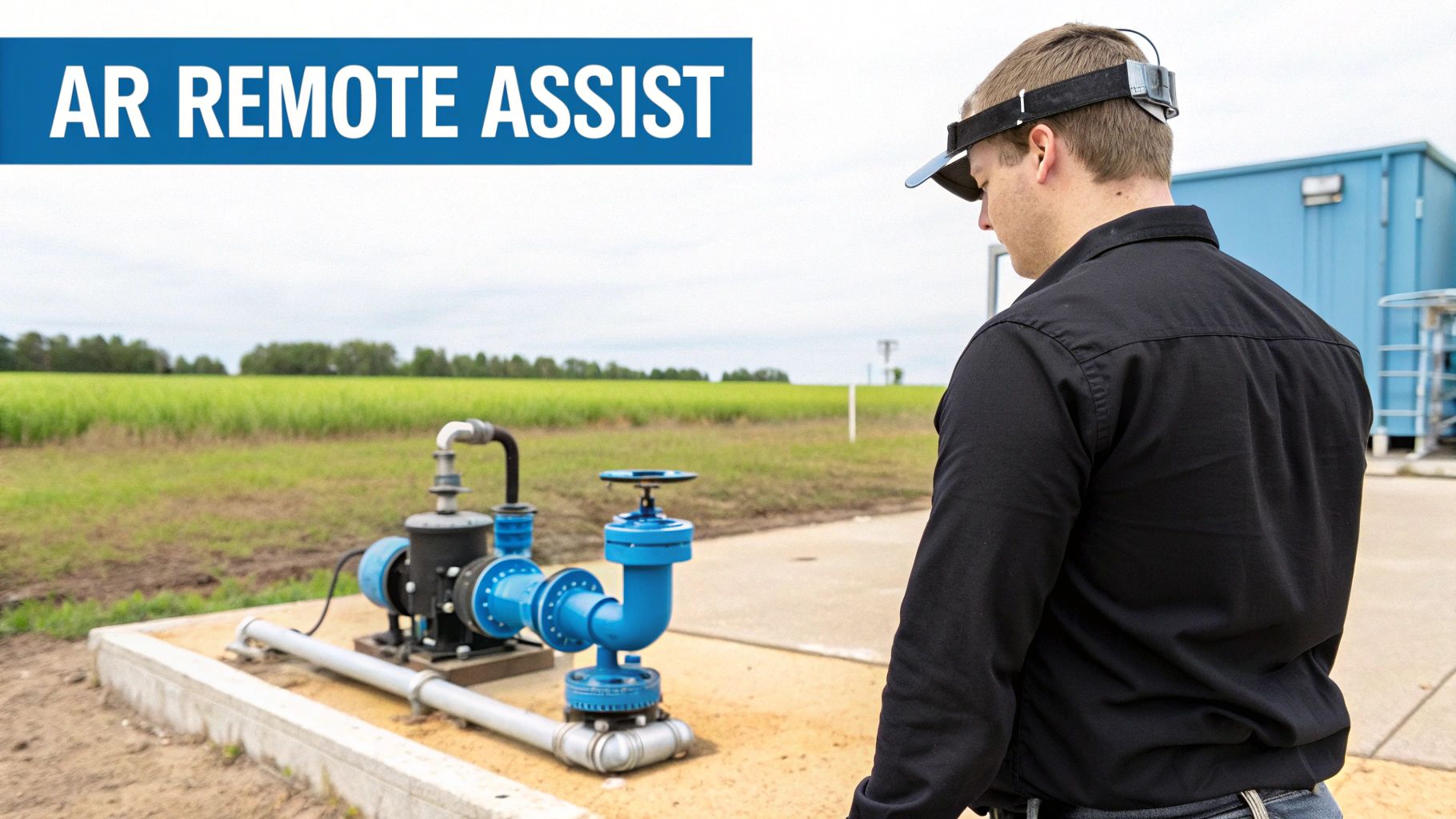
Predictive insights are powerful, but their true value is only unlocked when a technician successfully translates a digital alert into a first-time fix on the factory floor. This is where the roadmap to a preventive predictive maintenance program meets the real world. Immersive technologies like Augmented Reality (AR) and Virtual Reality (VR) are the critical final link, bridging the gap between a system alert and a completed repair.
These tools are not just a futuristic layer on your operations; they solve fundamental maintenance challenges. They directly address skill gaps, reduce human error, and drastically shorten the time it takes to resolve an issue. By doing so, AR and VR ensure the insights from your predictive analytics platform deliver a faster, more substantial return on investment.
AR-Powered Remote Assistance for Instant Expertise
Consider this scenario: an on-site technician faces a complex repair flagged by your predictive system. The machine is unfamiliar, and the nearest senior expert is hundreds of miles away. In the past, this meant costly travel and crippling downtime. With AR-powered remote assistance, this problem is eliminated.
The on-site technician can wear an AR headset or use a tablet to stream their exact point of view to the remote expert. The expert sees what the technician sees in real-time and can provide precise, hands-on guidance. They can overlay digital instructions, diagrams, and annotations directly onto the physical equipment, guiding the technician's every move.
This isn't just a video call; it's a shared, interactive workspace. The expert can freeze the video, circle a specific bolt, and display the correct torque value right next to it. That level of guided precision ensures the repair is done correctly the first time, slashing downtime and eliminating repeat visits.
This immediate access to expertise completely transforms your maintenance workflow. It empowers junior technicians to handle complex tasks with confidence, disseminates specialist knowledge across your entire organization, and gets critical assets back online in a fraction of the time. You can learn more about how this works in our detailed guide on using augmented reality for maintenance.
VR Training for High-Stakes Procedures
While AR excels in real-time support, Virtual Reality shines in preparing your team before they ever touch the equipment. Predictive maintenance often identifies failure modes that require new or infrequently practiced repairs. Asking a technician to perform a high-stakes task for the first time on a live, multi-million-dollar asset is a recipe for error.
VR training creates a risk-free digital twin of your equipment and facility. Technicians can practice complex, hazardous procedures—like electrical system lockouts or intricate component replacements—in a completely safe and realistic virtual environment.
This approach delivers significant benefits:
- Mastery Through Repetition: Technicians can repeat a procedure as many times as needed to build muscle memory and confidence without using physical parts or risking damage.
- Simulating Rare Events: VR can simulate the exact failure conditions predicted by your analytics, allowing teams to train for specific scenarios they might rarely encounter otherwise.
- Enhanced Safety: Teams can practice emergency shutdowns and hazardous material handling in a controlled setting, ensuring they are fully prepared for any situation.
This proactive training ensures that when a predictive alert does come in, your team is not only ready but has already mastered the required fix. This dramatically reduces repair times, minimizes errors, and improves overall technician safety and performance.
The industry is taking notice. The global predictive maintenance market is expanding rapidly, with one forecast estimating it will grow from USD 10.93 billion in 2025 to USD 44.00 billion by 2032, reflecting widespread adoption across key industrial sectors. You can read more about these market expansion insights on coherentmarketinsights.com. By integrating immersive tools, companies can maximize the value of their predictive investments and lead this operational evolution.
Answering Your Top Questions About Modern Maintenance

As leaders begin to consider upgrading their maintenance programs, a few practical questions almost always arise. Moving to a data-first approach is not just about new technology—it's a significant shift in how your team works and thinks. We will tackle those common questions here.
Building an effective preventive predictive maintenance strategy depends on having full organizational alignment. Addressing these concerns openly helps lay the groundwork for a successful transformation and gets your entire team prepared.
What Is the Biggest Hurdle in Adopting Predictive Maintenance?
The biggest challenge is typically cultural, not technological. The real hurdle is shifting a team from a comfortable, schedule-based routine to a proactive culture that operates on data. This requires technicians who trust the predictive alerts and leaders who are committed to building the necessary data infrastructure.
Overcoming the "this is how we've always done it" mindset is crucial. Investing in modern training tools is key to a smooth transition. For example, VR simulations can help technicians get comfortable with new procedures and build their trust in the system's recommendations before they ever touch live equipment.
This cultural shift is what truly powers the change, turning a technology investment into a genuine operational advantage.
Can Small Businesses Actually Afford Predictive Maintenance?
Yes, absolutely. The landscape has changed. With scalable cloud platforms and affordable IoT sensors now widely available, predictive maintenance is no longer exclusively for large corporations. The days of needing a massive, upfront investment to overhaul an entire facility are gone.
Small businesses can start smart by launching a pilot program on one or two of their most critical assets. This allows you to prove the ROI quickly without a significant capital outlay. Using subscription-based software to tackle a specific, high-impact problem is the perfect way to get started on a budget and secure the wins needed to justify future expansion.
How Do AR and VR Really Improve Technician Safety?
Immersive technology creates a much safer work environment by addressing risks both before a job begins and during the task itself. With VR training, technicians can practice high-stakes procedures—like equipment lockouts or working with high-voltage systems—in a completely safe virtual space. They can make mistakes and learn from them with zero real-world consequences.
Then, out on the floor, AR remote support allows a senior expert to guide a less experienced technician through a complex job, drastically reducing the risk of an error that could lead to injury. AR can also overlay critical safety warnings or live operational data directly onto a machine, giving technicians better situational awareness and helping keep them out of harm's way.
Ready to fast-track your team’s skills and see a quicker ROI on your maintenance strategy? AIDAR Solutions offers immersive AR and VR tools that give your technicians the expertise they need, right when they need it. Find out how our remote support and virtual training platforms can transform your operations by visiting us at https://aidarsolutions.com.