10 Game-Changing Benefits of VR Training in 2025
Virtual Reality (VR) is no longer a futuristic concept; it's a powerful, practical tool transforming how organizations train their workforce. In today's competitive landscape, businesses in manufacturing, maintenance, and corporate sectors require training solutions that are not only effective but also efficient, safe, and scalable. Traditional methods often fall short, struggling with engagement, knowledge retention, and logistical challenges. This is where VR steps in, offering a fundamentally different approach. It creates realistic, risk-free environments where employees can learn by doing, leading to unprecedented gains in skill mastery, confidence, and operational efficiency.
This article explores the 10 tangible benefits of VR training that deliver measurable results, demonstrating why immersive learning has become a strategic imperative for forward-thinking companies. VR training is at the forefront of innovation in corporate learning. To fully grasp its impact and future direction, consider the broader discussion on 9 Key Technological Trends in Education for 2025. We will dive into real-world applications and data-backed insights that showcase how immersive platforms are accelerating employee learning and driving significant return on investment. You will learn precisely how these advantages translate into improved operational outcomes and a more capable, confident workforce.
1. Cost Reduction and ROI Improvement
One of the most compelling benefits of VR training is its significant impact on an organization's bottom line. By transitioning from traditional, in-person training methods to immersive virtual environments, companies can drastically cut costs associated with travel, physical equipment, and instructor time. This approach allows for scalable training without the logistical complexities and expenses of coordinating large groups in a single physical location.
How VR Training Drives Down Costs
Virtual reality eliminates the need for expensive physical mock-ups, reduces material waste from practice runs, and minimizes wear and tear on actual machinery. For example, a global logistics company uses VR to train its ground support equipment operators, which has led to a significant reduction in training time and associated costs by avoiding the need for dedicated training aircraft. Similarly, a major retailer has trained over a million associates using VR, creating a standardized, efficient, and highly scalable program that saves millions annually by avoiding travel and on-site instructor fees.
This technology allows organizations to:
- Eliminate Travel Expenses: Train a global workforce simultaneously without incurring costs for flights, accommodations, or venue rentals.
- Reduce Equipment and Material Costs: Employees can practice on virtual replicas of expensive or dangerous machinery without risk of damage or material consumption.
- Decrease Training Time: A PwC study found employees in VR courses can be trained up to four times faster than in a traditional classroom setting.
Actionable Tips for Maximizing ROI
To ensure a strong return on investment, begin by identifying high-volume or high-risk training programs where VR can deliver the most immediate impact. Calculate the total cost of ownership, factoring in hardware, content development, and platform licensing. Investing in a scalable platform ensures that your VR training program can grow alongside your organization, delivering long-term value. Exploring strategies for how to reduce operational costs can further amplify the financial benefits of implementing a VR solution.
2. Enhanced Skill Retention and Knowledge Transfer
A core benefit of VR training lies in its ability to create lasting, transferable skills through deep, multi-sensory immersion. Unlike passive learning from lectures or videos, VR engages users actively, creating strong neural pathways that lead to superior long-term retention. Studies have shown learners can retain information far more effectively through immersive experiences, ensuring skills are remembered and applied correctly on the job.
How VR Training Boosts Retention
VR training leverages "learning by doing" in a controlled environment, which engages auditory, visual, and kinesthetic senses simultaneously. This active participation triggers a stronger cognitive and emotional response, solidifying memory. For instance, medical students using VR for anatomy training have shown significantly better retention rates compared to traditional methods. Similarly, military personnel practicing complex protocols in VR scenarios demonstrate higher accuracy and recall under pressure, a key advantage in high-stakes situations.
This technology allows organizations to:
- Create Lasting Memories: Engaging multiple senses and emotional responses helps embed information in long-term memory.
- Improve Skill Accuracy: Learners can practice procedures repeatedly, leading to near-perfect recall.
- Accelerate Competency: A PwC study confirms VR learners feel more confident in applying their new skills, demonstrating the effectiveness of immersive practice.
Actionable Tips for Maximizing Knowledge Transfer
To maximize retention, design VR scenarios that elicit a genuine emotional response, as this deepens the learning experience. Incorporate spaced repetition within the VR curriculum, allowing trainees to revisit key concepts and skills at optimal intervals. The most effective approach is a practice-then-apply model, where employees first master a skill in VR and then immediately apply it in their real-world job functions, cementing the knowledge transfer process.
3. Safe Practice in High-Risk Environments
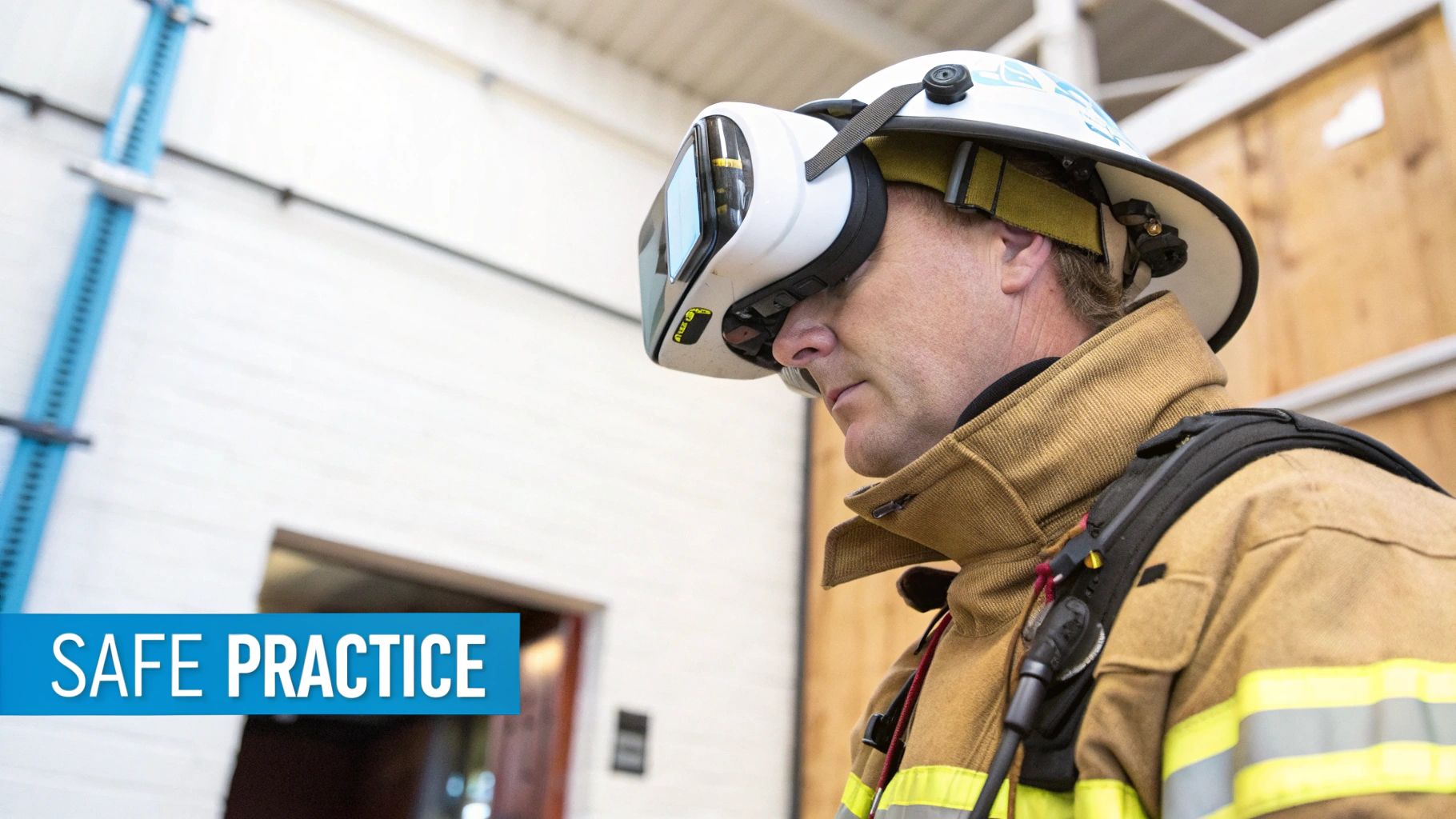
One of the most transformative benefits of VR training is its ability to create a completely safe space for practicing high-stakes tasks. Immersive simulations allow employees to learn and make mistakes without facing real-world dangers, protecting both personnel and expensive equipment. This risk-free environment builds confidence and muscle memory, ensuring that when a critical situation arises, the team is competent and prepared.
How VR Training Mitigates Risk
In industries where on-the-job training carries inherent risks, VR offers a revolutionary alternative. For instance, firefighters can practice building rescue scenarios in simulated fires without any physical threat, while oil rig workers can drill for emergency evacuations in a controlled digital setting. This approach allows trainees to experience the consequences of errors, reinforcing correct procedures and improving decision-making under pressure.
VR training is particularly impactful for:
- Emergency Response: Simulating events like chemical spills, equipment malfunctions, or natural disasters to prepare teams for swift, coordinated action.
- Complex Procedures: Allowing surgeons to rehearse intricate operations before patient contact, as demonstrated by pioneering medical institutions.
- Equipment Operation: Training employees on heavy machinery like forklifts or cranes, where mistakes can have catastrophic consequences.
Actionable Tips for Maximizing Safety Training
To create effective high-risk simulations, design scenarios based on actual incident reports to ensure relevance and impact. Start with basic tasks and gradually increase the difficulty and pressure as trainee competence grows. Incorporate realistic feedback and consequences for both correct and incorrect actions to reinforce learning. Combining VR practice with supervised, real-world application creates a blended learning path that bridges the gap between simulation and reality. You can discover more about how VR is revolutionizing high-stakes fields like medical training.
4. Increased Confidence and Reduced Anxiety
A significant advantage of VR training is its ability to build employee confidence and reduce performance anxiety. By allowing trainees to practice complex or high-stress tasks in a controlled, private environment, VR removes the fear of failure. This psychological safety encourages repetition and mastery, ensuring that when employees face real-world situations, they do so with a foundation of successful experiences.
How VR Training Builds Confidence
Virtual reality provides a safe space for employees to make mistakes, learn from them, and try again without real-world consequences. This iterative learning process is crucial for roles that involve high-stakes interactions or public performance. For example, a sales representative can practice handling difficult objections in a VR simulation, or a new manager can rehearse a challenging conversation with a virtual employee. This repetition builds muscle memory and reinforces correct procedures, translating into higher confidence and competence on the job.
This technology allows organizations to:
- Provide a Safe Practice Ground: Employees can tackle intimidating tasks, such as public speaking or de-escalation scenarios, without an audience.
- Encourage Learning from Failure: Mistakes become valuable learning opportunities rather than public errors, reducing the anxiety associated with new responsibilities.
- Develop Soft Skills: Practicing difficult customer interactions or leadership scenarios in VR helps employees build the confidence needed for effective communication.
Actionable Tips for Boosting Employee Confidence
To effectively use VR for confidence building, start with low-stress scenarios and progressively increase the difficulty as the trainee shows improvement. Implement systems that provide immediate, positive feedback for correct actions and display performance metrics to track progress over time. Designing the VR experience to include explicit confidence-building elements, such as positive reinforcement and achievement milestones, is key to reducing anxiety and preparing employees for real-world challenges.
5. Personalized and Adaptive Learning Experiences
Another significant benefit of VR training is its ability to deliver personalized learning journeys tailored to individual needs. Unlike one-size-fits-all classroom sessions, VR platforms can monitor learner performance, track key metrics, and dynamically adjust the training content, pace, and difficulty in real-time. This ensures every employee receives an optimized experience that addresses their specific skill gaps and learning style.
How VR Enables Adaptive Learning
VR training systems capture granular data on user actions, from decision-making processes to physical movements and task completion times. This data fuels algorithms that adapt the simulation, providing immediate feedback or introducing new challenges based on performance. For instance, a technician struggling with a specific diagnostic step can be given additional guidance and repetition, while a proficient user can advance to more complex scenarios, maximizing engagement and learning efficiency for everyone.
This technology allows organizations to:
- Create Tailored Learning Paths: VR can automatically guide employees through modules that match their current skill level.
- Provide Real-Time Feedback: Learners receive instant, contextual feedback on their performance, helping correct mistakes immediately rather than waiting for an instructor’s review.
- Optimize Training Pacing: The system can speed up for quick learners or slow down for those needing more time, ensuring comprehension without causing frustration or boredom.
Actionable Tips for Implementing Personalization
To leverage adaptive learning, integrate your VR training platform with a Learning Management System (LMS) to track progress and personalize content at scale. Start by designing modules with multiple difficulty levels and branching narratives that respond to user choices. Use the performance data collected in VR to continuously refine and update your training curriculum, ensuring it remains relevant and effective. This data-driven approach transforms training from a static event into a dynamic, continuous improvement process.
6. Consistency and Standardization Across Multiple Locations
Ensuring every employee receives the exact same high-quality training is a major challenge for global organizations. VR training solves this by delivering perfectly standardized content to every user, regardless of their location or the individual trainer. This guarantees that all employees, from a new hire in one country to a veteran in another, learn procedures and protocols in the exact same way, ensuring compliance and operational uniformity.
How VR Training Enforces Standardization
Virtual reality creates a single source of truth for training materials, eliminating the "human variable" that often leads to inconsistencies in delivery. For large enterprises, this means every employee can learn customer service standards or complex operational recipes through identical, repeatable simulations. Similarly, healthcare networks can use VR to ensure thousands of clinicians across different hospitals are trained on the same critical clinical protocols, reducing errors and improving patient outcomes.
This technology allows organizations to:
- Deploy Identical Scenarios: Every user experiences the same situations, instructions, and performance metrics, creating a reliable baseline for assessment.
- Centralize Content Updates: When a procedure changes, the VR module can be updated once and instantly deployed across the entire organization.
- Eliminate Trainer Bias: VR removes variations in teaching styles and knowledge gaps, providing a consistent learning path for everyone.
Actionable Tips for Maintaining Consistency
To leverage VR for standardization, focus on centralized management. Implement a robust version control system for all training content to track updates and ensure only the most current modules are in use. Utilize cloud-based platforms to manage and distribute training, which allows for seamless, organization-wide rollouts. Finally, develop standardized assessment rubrics within the VR experience to objectively measure performance and verify compliance across all teams and locations.
7. Immediate Feedback and Performance Analytics
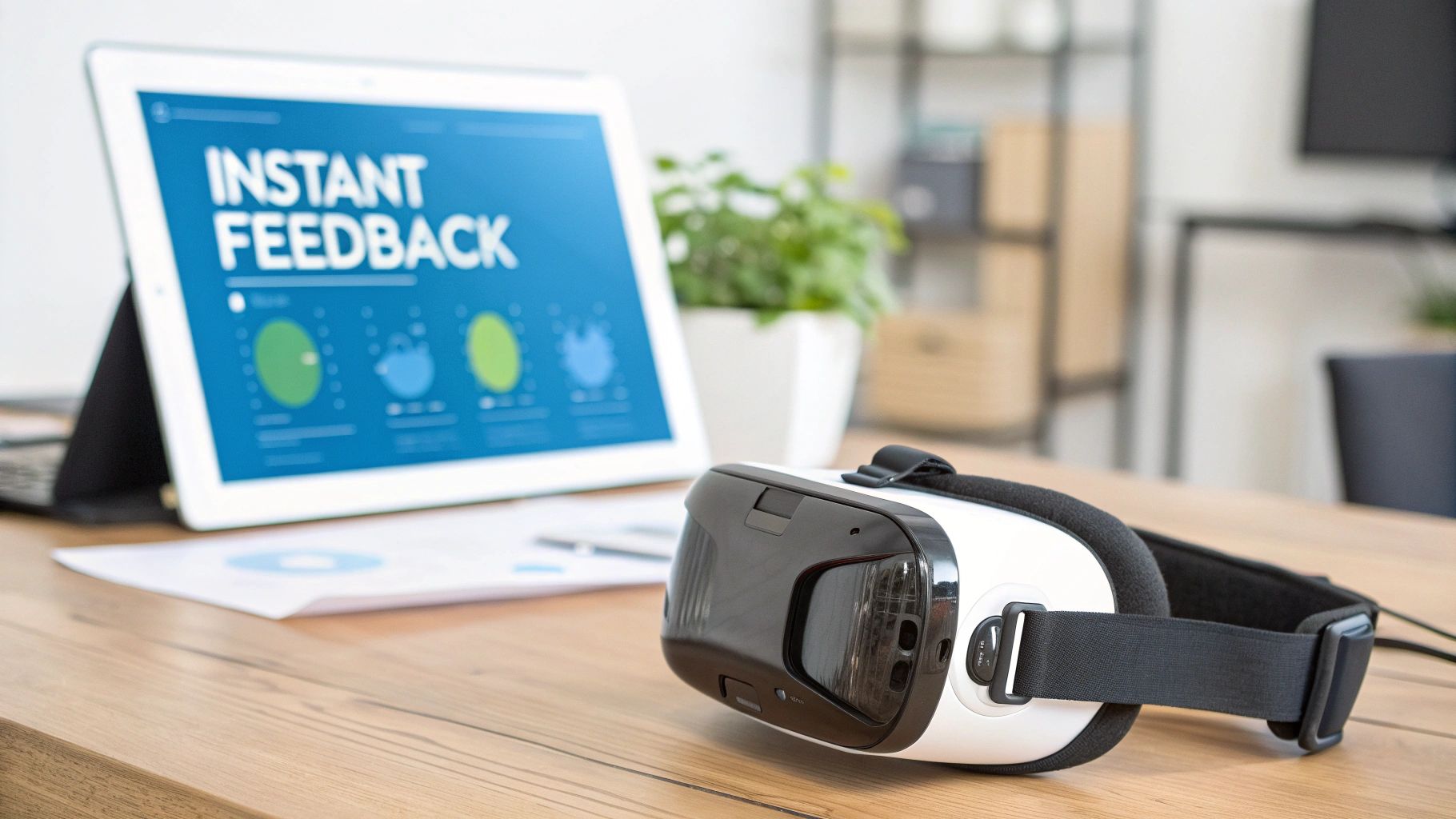
One of the most transformative benefits of VR training is the ability to provide instant, objective feedback and capture detailed performance analytics. Unlike traditional methods that rely on subjective observation, VR systems can track every movement, decision, and outcome, offering learners real-time guidance and supplying trainers with rich, data-driven insights to measure and improve training effectiveness.
How VR Training Delivers Data-Driven Insights
The embedded analytics within VR platforms create a powerful feedback loop that accelerates skill acquisition. For instance, a logistics leader utilizes VR to track metrics like delivery accuracy and driver safety behaviors, providing immediate corrections. Similarly, a multinational healthcare company's surgical training modules monitor procedural precision, giving surgeons objective data on their performance. This data-centric approach pinpoints specific skill gaps and quantifies progress without human bias.
This technology allows organizations to:
- Provide Instantaneous Correction: Offer real-time, automated feedback to help trainees correct mistakes as they happen, reinforcing proper procedures.
- Track Granular Performance Data: Monitor KPIs such as task completion time, accuracy, decision-making pathways, and adherence to safety protocols.
- Generate Objective Assessments: Eliminate subjective scoring and provide standardized, data-backed evaluations of employee competency.
Actionable Tips for Maximizing Data Insights
To leverage performance analytics effectively, create intuitive dashboards that allow trainers to easily visualize learner progress and identify trends across cohorts. Use this data to continuously refine and improve training scenarios, ensuring they address the most common or critical errors. Sharing performance data transparently with learners empowers them to take ownership of their development. By implementing these practices, you can gain a deeper understanding of how to measure training effectiveness and optimize your entire program for better outcomes.
8. Accessibility and Remote Training Delivery
Another of the core benefits of VR training is its ability to democratize access to high-quality learning, regardless of an employee's physical location. Virtual reality breaks down geographical barriers, allowing organizations to deliver consistent, standardized training to a dispersed workforce. This means employees in remote field offices, international locations, or even at home can access the same immersive experiences as those at a central headquarters.
How VR Training Enhances Accessibility
VR training eliminates the need for employees to travel to a centralized facility, making professional development more inclusive and flexible. For instance, a field service technician in a rural area can practice complex repair procedures on specialized machinery without leaving their post. Similarly, global manufacturing teams can receive simultaneous training on new safety protocols, ensuring uniform compliance across all sites. Moreover, a key benefit is the enhanced accessibility of training, with continued efforts towards ensuring VR usability for everyone.
This technology enables organizations to:
- Train Geographically Dispersed Teams: Deliver identical, high-quality training modules to employees across different cities, countries, and continents.
- Support Remote and Hybrid Work: Provide flexible, asynchronous learning options that fit modern work schedules and diverse time zones.
- Democratize Skill Development: Give all employees, including those in underserved or isolated regions, equal access to expert instruction and career growth opportunities.
Actionable Tips for Remote Deployment
To successfully deploy VR training for a remote workforce, begin by documenting clear internet and hardware requirements for all users. Offer flexible device options, including standalone headsets that don't require a high-powered PC, to improve accessibility. Consider implementing a hybrid delivery model where remote learners can access on-demand virtual support from a live instructor. Finally, create asynchronous options, such as recorded VR sessions, to accommodate employees across different time zones.
9. Engagement and Motivation Improvement
A significant benefit of VR training is its ability to transform mundane learning modules into highly engaging, gamified experiences. The immersive nature of virtual reality captures and holds employee attention, boosting motivation and participation. By making training interactive and enjoyable, companies can combat learner fatigue and turn what is often a compliance-driven task into a compelling and memorable experience.
How VR Training Boosts Engagement
VR training platforms often incorporate game mechanics like points, leaderboards, and achievement badges, which foster healthy competition and a sense of accomplishment. This approach makes learning feel less like a chore and more like a challenge to be mastered. For example, a leading professional services company reported that incorporating gamification into its VR training modules increased completion rates significantly. Similarly, a major technology firm's networking training programs utilize achievement badges and clear progression paths to keep learners motivated and invested in their development.
This technology allows organizations to:
- Increase Participation: Make training more appealing and reduce the likelihood of employees disengaging or skipping modules.
- Improve Focus: The immersive headset environment minimizes external distractions, ensuring learners are fully focused on the task at hand.
- Foster a Positive Learning Culture: Gamified elements and interactive scenarios make training an experience employees look forward to, rather than dread.
Actionable Tips for Maximizing Motivation
To effectively boost engagement, focus on creating meaningful challenges that are directly tied to learning objectives, not just busy work. Balance game mechanics with educational goals to ensure the experience is both fun and impactful. Implement leaderboards or team-based activities to foster healthy competition without adding unnecessary stress. Finally, remember to recognize and celebrate learner accomplishments to reinforce positive behavior and keep motivation high.
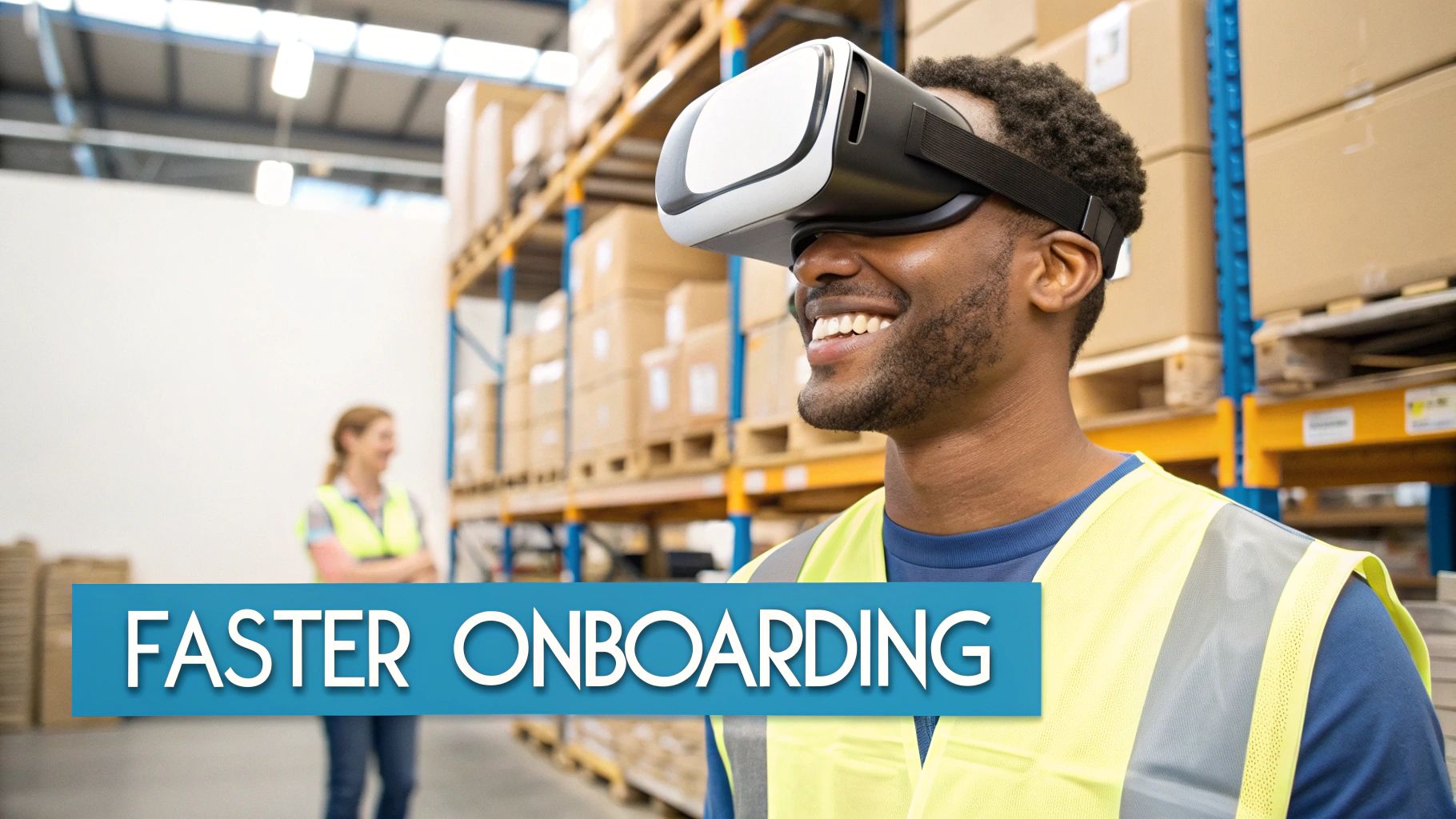
10. Faster Onboarding and Time-to-Productivity
One of the most impactful benefits of VR training is its ability to radically accelerate new employee onboarding. By immersing new hires in realistic, interactive job simulations from day one, organizations can significantly shorten the traditional ramp-up period. This approach allows employees to gain hands-on experience and build confidence in a controlled environment, leading to faster integration and a quicker path to full productivity.
How VR Training Accelerates Onboarding
Virtual reality bridges the gap between theoretical knowledge and practical application, a common bottleneck in traditional onboarding. For instance, logistics giants use VR to train package handlers and delivery drivers, reducing onboarding time by simulating complex sorting and driving scenarios. Similarly, a major retailer has leveraged VR to compress weeks of conventional training into just a few days, enabling new associates to master critical tasks much faster.
This technology helps organizations to:
- Reduce Time-to-Competency: Allow new hires to practice core job functions repeatedly without waiting for real-world opportunities or tying up senior staff.
- Improve Skill Retention: Immersive learning creates stronger neural pathways, leading to better long-term retention of procedures and protocols.
- Standardize Onboarding: Ensure every new employee receives the exact same high-quality training, regardless of their location or assigned trainer.
Actionable Tips for Maximizing Onboarding Speed
To effectively speed up your onboarding, start by identifying the most critical, high-impact skills that new hires must learn. Develop modular VR training scenarios that focus on these specific tasks, allowing for targeted and efficient skill development. Track key performance indicators before and after implementation to quantify the reduction in time-to-productivity. Integrating VR with structured mentoring programs can further enhance the learning experience. For more insights on structuring your program, explore these employee onboarding best practices to complement your VR initiatives.
VR Training Benefits — 10-Point Comparison
| Item | Implementation Complexity 🔄 | Resource Requirements 💡 | Expected Outcomes ⭐ / 📊 / ⚡ | Ideal Use Cases |
|---|---|---|---|---|
| Cost Reduction and ROI Improvement | 🔄 High initial development and platform setup; moderate ongoing upkeep | 💡 VR hardware, platform dev, content authoring, maintenance | ⚡ Faster onboarding; 📊 Lower per‑trainee costs; ⭐ Improved ROI | High‑volume training, distributed workforces, recurring certifications |
| Enhanced Skill Retention and Knowledge Transfer | 🔄 High — requires expert instructional design and scenario fidelity | 💡 Skilled content designers, multimodal assets, VR HW/software | ⭐ Strong long‑term retention; ⚡ Faster learning; 📊 Better transfer to job tasks | Medical training, technical procedures, military simulations |
| Safe Practice in High‑Risk Environments | 🔄 Moderate–high scenario realism and consequence modeling needed | 💡 Realistic simulation dev, scenario authors, validation with SMEs | ⭐ Zero real‑world injury risk; 📊 Reduced liability; ⚡ Safe practice of rare events | Emergency response, surgery, oil & gas, heavy equipment |
| Increased Confidence and Reduced Anxiety | 🔄 Low–moderate — progressive scenarios and feedback loops | 💡 Scenario design, performance tracking, supportive UX | ⭐ Higher confidence; 📊 Reduced performance anxiety; ⚡ Smoother transition to live work | Customer service, public speaking, de‑escalation, sales |
| Personalized and Adaptive Learning Experiences | 🔄 High — requires AI/ML, branching logic and analytics | 💡 AI/ML systems, learning analytics, data privacy controls | ⭐ Tailored mastery; ⚡ Faster progression for skilled learners; 📊 Efficient remediation | Individualized upskilling, technical certification, continuous learning |
| Consistency and Standardization Across Locations | 🔄 Moderate — centralized content management and versioning | 💡 Cloud platform, content pipeline, network sync, governance | 📊 Uniform quality and assessments; ⭐ Regulatory compliance; ⚡ Rapid global rollouts | Franchises, multi‑site operations, regulated industries |
| Immediate Feedback and Performance Analytics | 🔄 High — robust data pipelines and dashboarding required | 💡 Analytics stack, sensors/biometrics, storage, analyst expertise | 📊 Real‑time actionable insights; ⭐ Objective evaluation; ⚡ Faster error correction | Skill mastery programs, surgical simulation, certification tracking |
| Accessibility and Remote Training Delivery | 🔄 Low–moderate — cloud delivery and device support planning | 💡 Reliable internet, standalone headsets or device options, cloud services | ⚡ 24/7 remote access; 📊 Broader reach; ⭐ Democratized training access | Remote teams, rural healthcare, distributed field technicians |
| Engagement and Motivation Improvement | 🔄 Moderate — gamification, narrative and reward systems design | 💡 Game designers, UX, reward/leaderboard systems, content updates | ⭐ Higher engagement and completion; 📊 Increased participation; ⚡ Improved voluntary uptake | Compliance training, elective learning, onboarding with gamified elements |
| Faster Onboarding and Time‑to‑Productivity | 🔄 Moderate — requires comprehensive role‑based curricula | 💡 Role‑specific modules, LMS integration, assessment design | ⚡ 40–50% faster onboarding (typical); 📊 Faster productivity; ⭐ Lower ramp costs | High‑volume hires: retail, warehousing, delivery, field service |
Unlocking Your Organization's Potential with Immersive Training
The journey through the transformative landscape of virtual reality training reveals a clear and compelling narrative: immersive learning is no longer a futuristic concept but a present-day strategic imperative. We have explored a wide array of advantages, from tangible cost reductions and accelerated onboarding to the critical enhancement of safety protocols in high-risk environments. The evidence overwhelmingly demonstrates that the benefits of VR training are not isolated perks; they represent a fundamental shift in how organizations can cultivate a more skilled, confident, and agile workforce.
Synthesizing the Impact: From Theory to Measurable Results
The power of this technology lies in its ability to bridge the gap between knowing and doing. Consider the key takeaways from our exploration:
- Financial and Operational Efficiency: VR training slashes expenses tied to travel, physical equipment, and material waste, delivering a strong and quantifiable return on investment. It also accelerates time-to-productivity, getting new hires and reskilled employees contributing to your bottom line faster than ever.
- Enhanced Human Performance: By creating realistic, repeatable scenarios, VR training dramatically improves skill retention. This "muscle memory" development, combined with immediate, data-driven feedback, builds genuine competence and reduces performance anxiety.
- Scalable and Consistent Excellence: One of the most significant benefits of VR training is its power to standardize excellence. Whether your teams are in different cities or on different continents, you can deploy identical, high-quality training modules, ensuring every employee receives the same expert instruction and adheres to the same critical procedures.
This holistic approach moves beyond simple instruction. It fosters an environment where employees can practice complex tasks, make mistakes without real-world consequences, and build the confidence needed to excel in their roles. The result is a workforce that is not only better trained but also more engaged, motivated, and prepared for the challenges of a dynamic industrial landscape.
Your Next Steps: Implementing an Immersive Strategy
The transition to immersive learning may seem complex, but it begins with a simple, strategic first step: identifying a critical business challenge that VR can solve. Start with a specific, high-impact use case. Is it reducing errors in a complex assembly process? Improving safety compliance on the factory floor? Or perhaps accelerating the diagnostic skills of your maintenance technicians?
Once you have identified your target area, the path forward involves a phased approach:
- Define Clear Objectives: What specific metrics do you want to improve? (e.g., reduce training time by 40%, decrease workplace accidents by 25%).
- Select the Right Partner: Collaborate with experts who understand both the technology and your industry's unique demands to develop a tailored solution.
- Launch a Pilot Program: Test the VR training module with a small group to gather feedback, measure initial results, and build a business case for a wider rollout.
By embracing this technology, you are not just adopting a new training tool; you are investing in your organization's most valuable asset: its people. The benefits of VR training culminate in a more resilient, capable, and future-ready workforce, positioning your enterprise for sustained growth and a decisive competitive advantage.
Ready to move from understanding the benefits to realizing them? The expert team at AIDAR Solutions specializes in creating custom-tailored AR and VR training programs that address your most critical operational challenges. Visit AIDAR Solutions to discover how we can help you design and deploy an immersive learning strategy that delivers measurable results and unlocks your team's full potential.