
Predictive and Preventive Maintenance Guide
Unplanned downtime isn’t just an inconvenience; it’s a direct hit to your production and profits. The real difference between predictive and preventive maintenance comes down to timing and triggers. Predictive maintenance is all about using real-time data to see a failure coming, while preventive maintenance works on a fixed schedule to keep things running smoothly.
Why Your Maintenance Strategy Is Your Biggest Asset
In today's industrial world, shifting from reactive fixes to proactive strategies isn't just a good idea—it's essential for survival. The old "fix it when it breaks" model is a recipe for disaster, leading to sudden shutdowns, eye-watering emergency repair bills, and huge production losses.
A smart maintenance strategy is more than just a cost center; it's a powerful competitive edge. It keeps your equipment humming reliably, squeezes every bit of life out of your assets, and ultimately protects your bottom line.
The Shift to Proactive Operations
Think of predictive maintenance as a fitness tracker for your most important machines. It’s constantly monitoring vital signs—like vibration, temperature, and performance—to catch the earliest warning signs of trouble. This lets you fix a small problem before it snowballs into a catastrophic failure.
Preventive maintenance, on the other hand, is like your car’s scheduled oil change. It’s a series of routine tasks, like inspections and lubrications, done at regular intervals to keep equipment in prime condition. Both are absolutely critical pieces of a modern operational puzzle.
The market certainly agrees. The global predictive maintenance sector was valued at around USD 10.93 billion and is on track to hit USD 41.90 billion by 2030, all thanks to the rise of AI and IoT.
Creating a Powerful System
The real magic happens when you blend these two approaches. You can use predictive monitoring for your most critical, high-value assets while sticking to a simple preventive schedule for everything else. This hybrid approach optimizes your resources and minimizes risk across the board. For certain roles, like property managers, understanding this balance is key to operational stability, which is exactly why property managers should prioritize routine HVAC maintenance.
This guide will give you a clear roadmap to putting these strategies into action, and we’ll show you how AR and VR can take them to a whole new level. By diving into these industrial best practices, you can transform your maintenance operations from a necessary evil into a cornerstone of your success.
Understanding the Core Maintenance Models
To build a maintenance program that actually works, you have to get the fundamentals right. Two strategies form the foundation of almost every modern industrial operation: preventive maintenance and predictive maintenance. They both have the same goal—stopping equipment from breaking down—but they get there in completely different ways. One runs on a schedule, the other runs on data.
Think of it like this: your car has a manufacturer-recommended service schedule, right? It tells you to change the oil every 5,000 miles, regardless of how you drive. That’s preventive. Now, imagine an expert mechanic who can listen to your engine's unique hums and whirs and know, just from the sound, that a specific part is about to wear out. That’s predictive.
One is a solid "just-in-case" plan. The other is a hyper-accurate, "just-in-time" intervention.
What Is Preventive Maintenance?
Preventive maintenance is the old-school, tried-and-true approach. It’s all about routine checks, lubrications, and part replacements done at fixed intervals—based on calendar time, running hours, or how many widgets you’ve produced.
This model works on the assumption that equipment wears down at a fairly predictable rate. A factory might, for example, schedule a full lubrication for its conveyor belts every 100 hours of operation. The goal is simple: service the equipment before it has a chance to fail, avoiding those sudden, expensive shutdowns. It's a reliable, straightforward method that’s been the backbone of maintenance for decades.
The downside? It’s not very precise. Preventive maintenance doesn't care about the actual condition of the asset. That often leads to wasted resources, like replacing a part that still had plenty of life left in it. Worse, a machine can still fail between scheduled check-ups, catching you completely off guard.
The Power of Predictive Maintenance
Predictive maintenance is where things get really smart. Instead of a rigid schedule, this approach uses condition-monitoring tech to listen to the real-time health of your equipment. It doesn't guess when a machine might fail; it tells you when a specific component will fail.
By analyzing live data streams from sensors tracking things like vibration, temperature, and electrical currents, predictive maintenance catches the tiny, almost invisible signs of trouble. This allows your team to step in at the perfect moment—right before a small issue becomes a full-blown crisis.
This is a much sharper, more surgical way to work. On a factory floor, IoT sensors can constantly monitor the vibration patterns of a critical motor. The second that data shifts from its normal baseline, an alert goes out, and a technician is sent to inspect it. The work is targeted, efficient, and avoids wasting time on healthy machines.
If you’re curious about the nuts and bolts, you can dig deeper in our guide on condition monitoring and predictive maintenance.
By shifting from a scheduled routine to an intelligent, responsive process, organizations can slash downtime and dramatically cut maintenance costs. It’s about moving from "just-in-case" to "just-in-time," protecting your most valuable assets with incredible accuracy.
Comparing Predictive vs Preventive Approaches
Picking between predictive and preventive maintenance is a bit like choosing a home security system. Do you go with the classic alarm you set every night at 10 PM (preventive)? Or do you install a smart system with sensors that learn your family’s habits to flag a real threat (predictive)? Both are designed to protect your home, but they work on completely different philosophies.
Preventive maintenance runs on a calendar. It's the tried-and-true method, built on schedules and historical averages, working from the assumption that equipment wears out at a steady, predictable pace.
Predictive maintenance, on the other hand, is all about listening to the machine itself. It uses real-time data and sophisticated analytics to understand the actual condition of an asset, letting you know when a failure is genuinely on the horizon. This difference is the key, as it changes everything from cost and complexity to how effective your entire maintenance program is.
Data Dependency and Implementation
The biggest split between the two comes down to data. To get a preventive maintenance plan off the ground, you don't need much—usually just the manufacturer's recommendations and maybe some past work orders. Implementation is pretty straightforward: you plug a schedule into your CMMS and your team gets to work.
Predictive maintenance is a different beast entirely—it's hungry for data. It needs a constant flow of information from IoT sensors tracking things like vibration, temperature, and performance output. This live data is then channeled into an analytics platform where algorithms spot tiny anomalies and forecast potential breakdowns long before they happen.
Yes, setting up a predictive program takes more effort. You're investing in sensors, software, and getting your team up to speed. But what you get in return is a laser-focused, proactive strategy that turns maintenance from a routine chore into a precise, tactical intervention.
Cost Versus Value
On the surface, preventive maintenance looks like the cheaper option. The tools are simpler and the initial outlay is smaller. But there are hidden costs baked into its schedule-based approach, like swapping out parts that still have plenty of life left in them or, worse, having a critical component fail in between scheduled check-ups.
Predictive maintenance definitely asks for a bigger upfront investment in technology and setup. However, the long-term payoff is massive. Industry data consistently shows that a well-run predictive strategy can slash maintenance costs by 25-30% and chop unplanned downtime by as much as 50%. By only servicing assets when they actually need it, you stop wasting money and start extending the life of your equipment.
The core trade-off is between the predictable, recurring costs of a preventive schedule and the upfront investment of a predictive system that delivers greater long-term savings and operational stability.
A Head-to-Head Comparison
To lay it all out, let's look at the key differences side-by-side. This table really highlights the give-and-take between the two main approaches to proactive maintenance.
Maintenance Strategy Comparison
| Dimension | Predictive Maintenance | Preventive Maintenance |
|---|---|---|
| Trigger | Real-time asset condition data | Fixed schedule (time or usage) |
| Data Needs | High (IoT sensors, analytics) | Low (schedules, checklists) |
| Cost Profile | Higher initial investment, lower long-term costs | Lower initial investment, potential for waste |
| Risk Mitigation | Highly effective at preventing unexpected failures | Good for common wear and tear, but can miss anomalies |
| Complexity | More complex to implement and manage | Simple to set up and execute |
The visual below really drives home just how powerful a shift toward data-driven maintenance can be for the metrics that matter most.
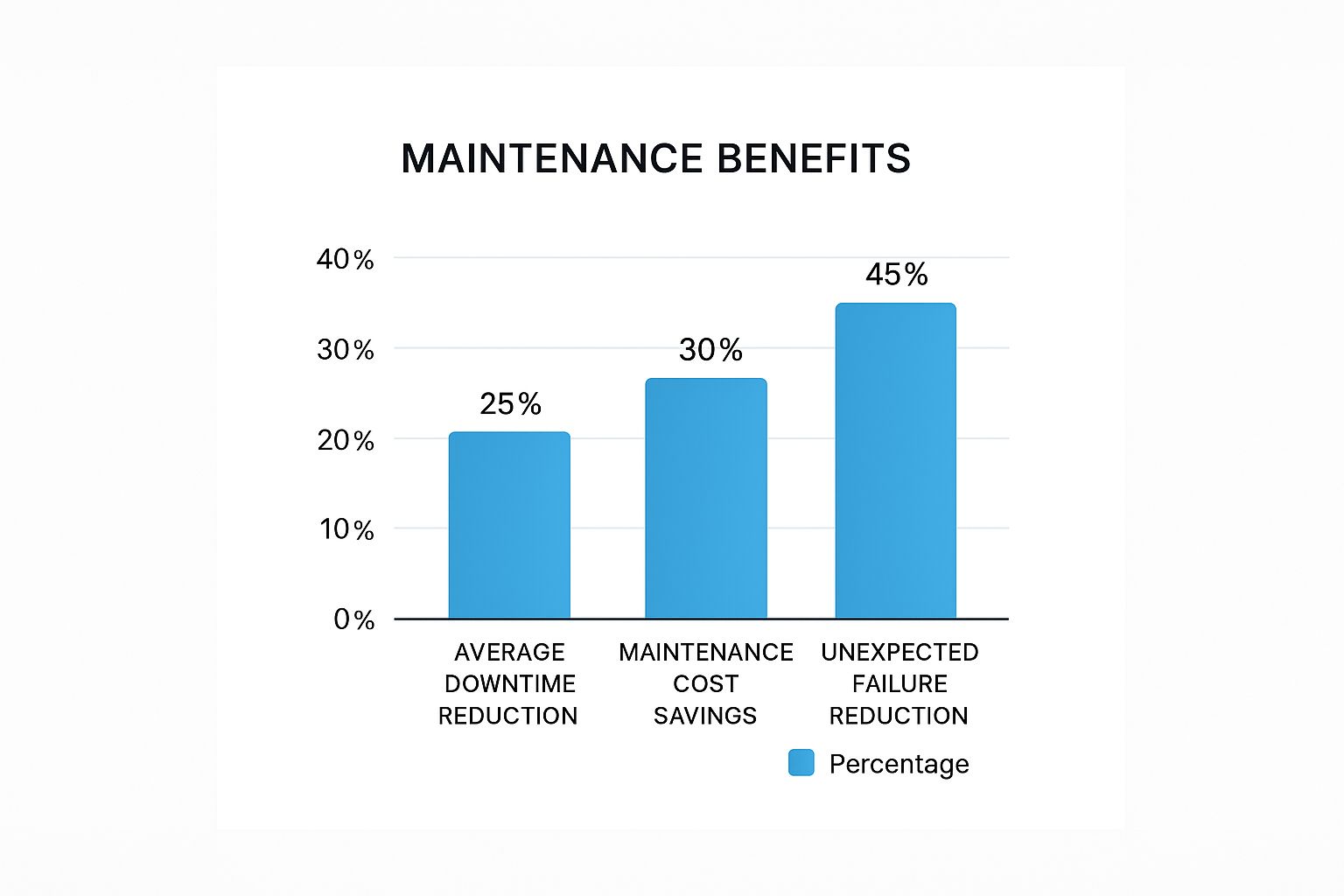
As you can see, embracing a predictive model brings major gains across the board, especially when it comes to stamping out those costly, unexpected equipment failures.
Ultimately, the smartest move isn't necessarily choosing one over the other. The best strategies often blend the two, applying predictive and preventive maintenance where each offers the most bang for your buck. You might use predictive analytics for your most critical, high-cost assets while keeping a simple, effective preventive schedule for everything else. It's all about creating a balanced, resilient operation that works for you.
The Tangible Benefits of a Proactive Strategy
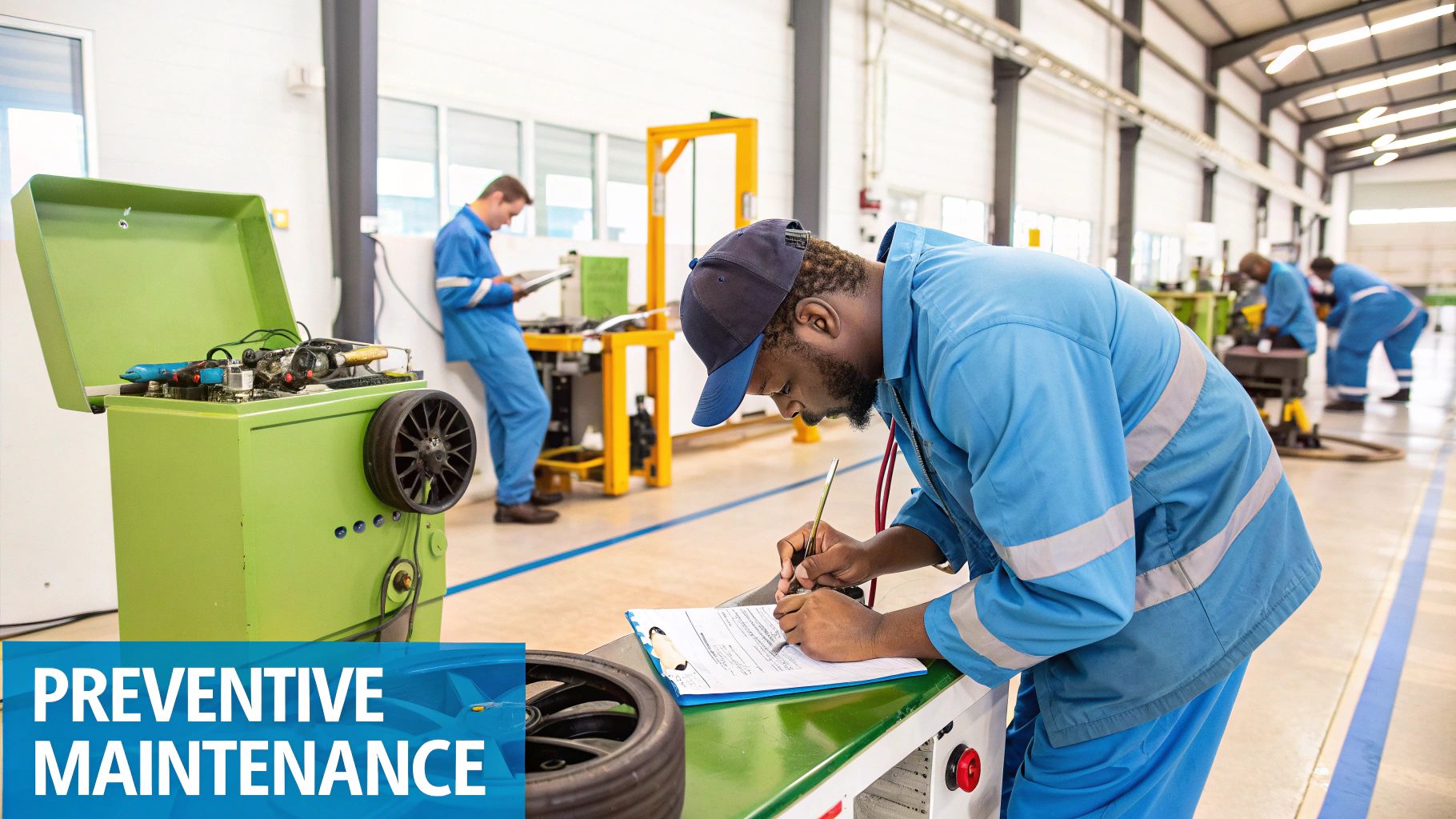
Moving away from a "fix-it-when-it-breaks" model isn't just a minor process tweak. It's a fundamental investment in your company's operational stability and financial health. The benefits aren't just theoretical—they deliver real, measurable returns that show up on your bottom line.
Instead of your team scrambling to fix a broken asset in the middle of a production run, they can act with precision. Potential catastrophes become manageable, scheduled tasks.
Think about a critical robotic arm on a busy assembly line. A traditional maintenance schedule might completely miss the subtle, early signs of motor fatigue. But with a predictive and preventive strategy, sensors could detect a tiny increase in vibration. That triggers an alert, allowing a technician to replace the component during planned downtime.
Just like that, you've avoided a line-stopping failure that could have cost tens of thousands in lost production. This one scenario gets to the heart of what proactive maintenance is all about: turning expensive, unplanned emergencies into controlled, cost-effective jobs.
Boosting Financial Performance
The financial case for going proactive is impossible to ignore. By catching problems before they spiral out of control, companies slash what they spend on emergency repairs, overtime labor, and rush shipping for spare parts. It's simply a smarter way to manage resources.
The numbers really do speak for themselves. Here’s a look at the kind of ROI companies are seeing when they make the switch.
Maintenance ROI Data
| Metric | Predictive Maintenance | Preventive Maintenance |
|---|---|---|
| Maintenance Cost Reduction | 25–30% | 12–18% |
| Unplanned Downtime Reduction | 35–50% | Up to 25% |
| Return on Investment (ROI) | 95% of adopters see positive ROI | Positive, but lower than predictive |
| Time to Recoup Costs | 27% recoup within the first year | Varies, typically longer than predictive |
As the data shows, organizations adopting predictive maintenance report some seriously impressive results, including maintenance cost reductions of 25–30% and downtime reductions between 35–50%. A massive 95% of adopters see a positive return, with 27% getting their initial investment back within the first year alone.
This shift means maintenance stops being a reactive cost center and starts being a strategic driver of profitability. It actively contributes to the company's financial success.
Extending Equipment Lifespan and Enhancing Safety
A smart maintenance strategy does more than just stop failures; it actually extends the operational life of your most valuable assets. When you catch minor issues like a slight misalignment or poor lubrication early on, you prevent the cumulative wear and tear that sends equipment to the scrap heap prematurely. It's all about maximizing the return on your big capital investments.
And let's not forget one of the most important benefits: a safer place to work. Equipment that fails without warning is a huge risk to your people. A proactive system flags these hazards before they can cause an accident, helping you build a culture of safety and operational excellence.
This focus on reliability is a critical piece of the puzzle to improve manufacturing productivity and build real, long-term operational resilience. The combination of financial wins, longer asset life, and a safer shop floor creates a powerful business case. A proactive strategy isn't just about fixing machines—it's about building a more resilient, efficient, and profitable operation from the ground up.
Implementing Your Maintenance Program
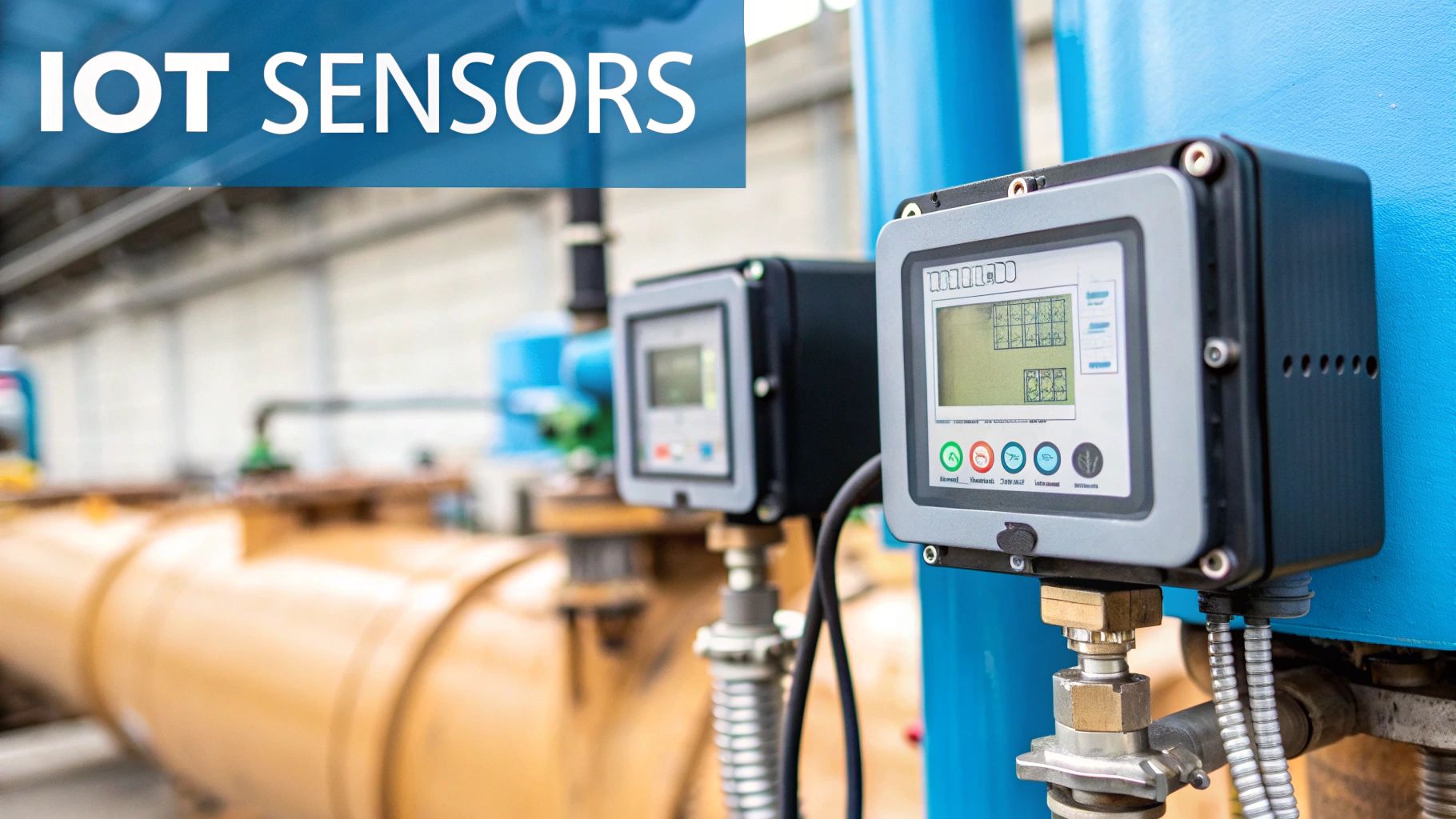
Putting a predictive and preventive maintenance program into practice isn’t about flipping a switch. It’s more like building a new operational nervous system for your facility—a methodical process of moving from theory to a tangible, data-driven workflow that actually gets results.
Think of it like setting up a smart irrigation system for a massive farm. You wouldn't just scatter sprinklers around and hope for the best. You'd analyze the soil, put moisture sensors in the most critical zones, and wire everything into a central hub that reacts to real-time weather data. In the same way, getting a modern maintenance program off the ground starts with knowing your most critical assets.
Identifying and Prioritizing Assets
First things first, you need to run an asset criticality analysis. Let's be honest, not every piece of equipment deserves the same level of attention. The key is to pinpoint the machinery where a failure would cause the biggest headache—whether that’s a safety risk, a production bottleneck, or a sky-high repair bill.
Start by tiering your assets. Your high-priority list will likely include that custom-built machine that’s a nightmare to replace or the equipment that sits at the very heart of your production line. These are the perfect candidates for a full-blown predictive maintenance strategy. The less critical gear? That can usually be managed just fine with a solid preventive schedule.
Selecting the Right Technology
Once you know what to watch, you have to decide how to watch it. This is where you choose and install the right condition-monitoring tech. The most common tools for the job are Internet of Things (IoT) sensors designed to track key performance indicators.
These sensors are the eyes and ears of your whole program, gathering the raw data you need to make smart decisions. A few key types include:
- Vibration Sensors: These are fantastic for catching mechanical hiccups in rotating equipment like motors, pumps, and gearboxes long before they become catastrophic.
- Thermal Imagers: Perfect for spotting overheating components, which often points to electrical faults or friction issues.
- Acoustic Sensors: These can literally "hear" problems, like tiny air leaks in pneumatic systems that would be impossible for a person to detect otherwise.
All the data from these sensors gets piped into an analytics platform. This software is the brain of the operation. It uses smart algorithms to spot tiny deviations from normal performance and flags them for your team, giving you a heads-up long before a breakdown. This is where predictive and preventive maintenance goes from being a good idea to a real, actionable process.
By bringing in these technologies, you shift maintenance from a rigid, calendar-based routine to an intelligent, condition-based response. It gives your team the power to intervene with surgical precision, saving a ton of time and money.
Overcoming Common Implementation Hurdles
Of course, launching a new maintenance program isn't always smooth sailing. Two of the biggest hurdles are getting new technology to play nice with your older equipment and making sure your team has the skills to use it all. Most facilities are a mashup of old and new machines, and getting them to communicate can be a real puzzle.
The human element is just as critical. Handing your team a bunch of new tools means you also have to upskill your technicians. One study of 268 European companies found that while predictive maintenance can slash costs by 12% and boost asset availability by 9%, success hinges on tackling challenges like aging equipment and proper training. You can dig deeper into these maintenance statistics and trends.
Providing great training and clear standard operating procedures is non-negotiable. It’s what builds trust in the data and empowers your team to act confidently on the insights it provides.
How AR and VR Transform Maintenance Workflows
Predictive and preventive maintenance strategies are built on data and schedules. But their real power is unlocked only when that information gets to the right technician at the right time. This is where immersive technologies like Augmented Reality (AR) and Virtual Reality (VR) completely change the game.
Think of them as the ultimate bridge connecting complex machine data with the frontline workers who keep your operations running.
Imagine a technician wearing AR glasses, looking at a maze of pipes and machinery. Instead of fumbling with a tablet or a greasy manual, they see real-time data—like temperature or vibration readings from an IoT sensor—overlaid directly onto the physical asset. This immediate context turns abstract numbers into something they can act on, helping them pinpoint a problem in seconds, not hours.
This fusion of the digital and physical worlds makes maintenance smarter, faster, and a whole lot safer. It gives technicians a kind of superpower, allowing them to see the invisible health status of their equipment right on the spot.
Enhancing Predictive Maintenance with Augmented Reality
Predictive maintenance is all about spotting trouble before it happens. AR makes this process incredibly efficient by putting critical insights directly into a technician's line of sight. When an analytics platform flags a potential issue, AR is there to guide the technician with surgical precision.
For example, say an algorithm predicts a bearing is about to fail because of tiny changes in its vibration pattern. With AR, the response looks like this:
- Visualize the Anomaly: The technician’s AR glasses highlight the exact component with a glowing overlay. No more guesswork.
- Display Live Data: Real-time performance stats appear right next to the physical part, confirming the diagnosis instantly.
- Provide Guided Instructions: Step-by-step animated instructions pop up in their field of view, showing them exactly how to perform the repair.
This approach takes a huge mental load off the technicians. Even less experienced staff can tackle complex diagnostics with confidence because they’re not just investigating—they’re following a data-driven, guided intervention.
Revolutionizing Training with Virtual Reality
While AR shines on the factory floor, Virtual Reality (VR) offers a powerful, totally risk-free environment for training. You can't run a top-tier maintenance program without a well-trained team, and VR simulations let technicians practice complex procedures without ever touching real, live equipment.
A new hire could perform a complete teardown and reassembly of a critical engine, all within a VR simulation. They can make mistakes, learn the proper sequence, and build muscle memory in a controlled world where a wrong move costs nothing.
This hands-on, immersive training has been shown to speed up learning by up to 75%. It’s a powerful way to close skill gaps and build a more competent, confident workforce, ensuring that when a real alert comes in, the team is ready to act fast.
By mastering tricky tasks in a virtual world, technicians are far better prepared for both routine preventive checks and high-stakes predictive repairs on the actual factory floor.
Streamlining Preventive Maintenance with AR Checklists
Preventive maintenance is all about consistency. AR-guided checklists and workflows make sure routine inspections are done perfectly, every single time.
Instead of a paper checklist or a clunky tablet app, a technician can wear AR glasses and see their task list overlaid on the equipment itself. As they finish each step, the system can even use image recognition to automatically verify their work.
For instance, a major logistics company implemented AR-guided inspection checklists for its sorting equipment and cut inspection times by a massive 40%. The AR system walked technicians through each checkpoint, showed visual aids for complex parts, and logged the results automatically. It didn't just save time; it boosted the quality and consistency of their entire PM program.
The benefits are crystal clear:
- Improved Accuracy: Digital guidance minimizes human error and ensures no steps are missed.
- Increased Efficiency: Technicians fly through tasks without stopping to consult a manual.
- Automatic Documentation: Work orders are updated in real-time, creating a perfect digital audit trail.
To see more about how this is being used in the real world, you can explore more about augmented reality for maintenance and its practical applications.
The Power of Remote Expert Assistance
One of the biggest game-changers in AR-powered maintenance is remote expert support. A common scenario involves a frontline technician encountering a problem they can’t solve. Historically, that meant expensive downtime while waiting for a senior expert to travel to the site.
With AR, the technician on-site can start a "see-what-I-see" video call. An expert, who could be anywhere in the world, sees exactly what the technician sees. They can then drop digital notes, diagrams, or instructions right into the technician's field of view. This simple capability has been shown to halve service times and slash expert travel by as much as 75%.
It’s like teleporting your best expert to any job site, instantly. This gives every technician, no matter their skill level, immediate access to the company's top minds. That kind of on-demand support is invaluable for both predictive and preventive maintenance, ensuring problems get solved quickly and correctly the first time.
Answering Your Top Maintenance Questions
When you're thinking about moving from a "fix-it-when-it-breaks" mindset to something more proactive, a lot of questions pop up. It’s a big shift, and getting clear on the operational details—from costs to team training—is the first step. Let's tackle some of the most common ones we hear.
Which Strategy Is Better For My Business?
Honestly, it’s almost never an "either/or" situation. The smartest approach is usually a hybrid model.
Think of it this way: use predictive maintenance for your absolute mission-critical assets. These are the machines where an unexpected failure would bring operations to a grinding halt or create a serious safety hazard. For everything else—the less critical equipment—a solid preventive maintenance schedule is often more than enough and much easier on the budget.
How Much Does It Cost To Start?
This is where the short-term vs. long-term view really matters. Preventive maintenance is cheaper to get going. The initial setup is minimal. But over time, the costs add up with all the scheduled part replacements and the risk of missing a failure that a calendar-based checkup can't catch.
Predictive maintenance, on the other hand, requires a bigger investment upfront for sensors and the software to make sense of the data. But the ROI is where it shines. You stop doing unnecessary work and prevent those catastrophic, budget-killing breakdowns. The trick is to not boil the ocean. Start small. Pick a few high-value assets for a pilot program, prove the value, and then scale up.
A common misconception is that you have to roll out a predictive program across the entire facility from day one. A much smarter path is to start with a focused pilot, monitoring a handful of high-risk assets to get some clear wins on the board and build momentum.
This targeted approach keeps the initial risk low while showing everyone the massive operational and financial perks of a data-driven maintenance culture.
Ready to transform your maintenance workflows with AR and VR? AIDAR Solutions provides immersive tools that turn complex data into actionable intelligence, empowering your team to work smarter, faster, and safer. Discover how our solutions can enhance your predictive and preventive maintenance programs by visiting https://aidarsolutions.com.