A Guide to Manufacturing Quality Improvement
Improving quality in manufacturing isn't just about catching mistakes at the end of the line. It’s a systematic overhaul aimed at finding, analyzing, and stamping out the root causes of defects to make your products more consistent and reliable. The goal is to build a system that prevents bad parts from ever being made.
Why Modernize Your Quality Improvement Strategy
The factory floor is changing fast. If you're still relying on old-school, reactive quality checks, you’re already falling behind a market that demands absolute precision and speed. Yesterday's methods—think manual inspections and data analysis that comes a day too late—create huge bottlenecks, open you up to costly recalls, and chip away at customer trust.
Today's market demands a proactive, tech-forward game plan for quality. This isn't just about trimming costs; it's a core strategy for driving growth and cementing your reputation for excellence. A modern approach moves beyond simply spotting defects to creating a holistic system that actually predicts and stops issues before they ever hit the production line.
Moving from Reactive to Proactive Quality Control
The traditional way of handling quality is often reactive. You make a batch of parts, inspect them, and toss the bad ones. This approach is incredibly wasteful. You've already spent money on materials, energy, and labor to produce items that end up in the scrap heap or require time-consuming rework, hitting your bottom line directly.
A proactive strategy flips the script by focusing on the integrity of the process itself. By weaving in real-time monitoring and data analytics, you can spot tiny deviations in machine performance or material consistency that signal a potential quality issue. A cornerstone of any modern quality strategy is embracing data-driven decision making to unlock smart growth and efficiency. This shift lets you fix the root cause, not just patch up the symptom.
By focusing on the process rather than just the final product, you transform quality control from a cost center into a powerful driver of operational excellence and profitability.
The Tangible Benefits of a Modern Approach
Switching to a modern framework for manufacturing quality improvement delivers results you can actually see and measure. It’s all about creating a more resilient, efficient production environment.
Here’s what you stand to gain:
- Reduced Waste and Rework: When you catch potential defects early, you slash scrap material and the labor costs tied to fixing mistakes. That goes straight to a healthier profit margin.
- Enhanced Consistency: Automated monitoring and standardized digital work instructions mean every single product is made to the exact same high standard, no matter who's on shift.
- Improved Efficiency and Throughput: A proactive approach means fewer production stops because of quality failures. This boosts your Overall Equipment Effectiveness (OEE) and makes your output far more predictable. For more on this, check out our guide on how to improve manufacturing productivity.
- Greater Customer Satisfaction: Consistently shipping top-notch products builds rock-solid brand loyalty and minimizes the financial and reputational bleeding from warranty claims and product recalls.
This guide is your practical roadmap to making this happen, showing you how to get from theory to real-world implementation. We'll dig into how integrating smart data, AR/VR solutions, and predictive analytics can deliver tangible results and build a robust foundation for lasting success.
Build Your Foundation with Smart Manufacturing Data
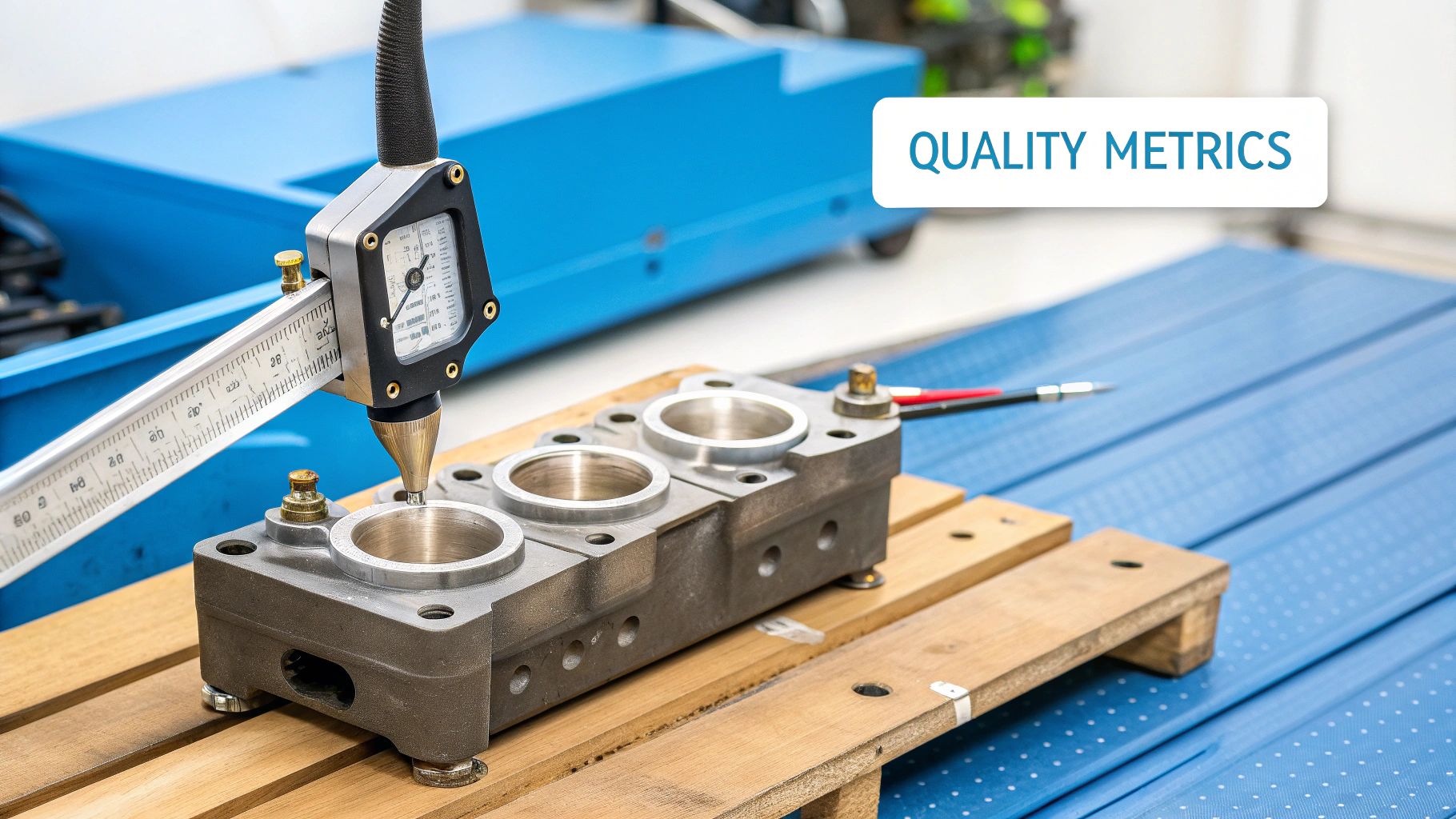
Before you can fix anything, you have to know what’s broken. In manufacturing, guesswork and gut feelings are a direct path to wasted resources and missed targets. A solid data foundation is the only way to get a real, unbiased picture of what's happening on your factory floor.
This is the bedrock of any serious manufacturing quality improvement initiative. It's about swapping ambiguity for clear, actionable insights and moving away from dusty clipboards and manual data entry.
The first step is to start capturing real-time information directly from your production lines. This usually means putting Internet of Things (IoT) sensors on your critical machinery. These small devices are workhorses, monitoring everything from temperature and vibration to pressure and cycle times. They provide a constant, objective stream of data that tells the true story of your equipment's health.
But raw data is just noise until you give it context. The real magic happens when you integrate this IoT data with your existing Enterprise Resource Planning (ERP) systems. This creates a single source of truth, breaking down the walls between departments and giving you a complete view of your operation, from raw materials coming in the door to the final product going out.
Identifying Your Most Important KPIs
With data flowing in, it’s easy to get overwhelmed. The trick is to focus on the metrics that actually matter. Tracking too many Key Performance Indicators (KPIs) can be just as useless as tracking none at all. You need to zero in on the KPIs that directly reflect production quality and the overall health of your operations.
If you're just starting out, focus on these three core quality metrics:
- Defect Rate: This is the most straightforward measure of quality. It’s simply the percentage of units you produce that don’t meet spec. If this number starts climbing, you know you have a problem that needs immediate attention.
- First Pass Yield (FPY): FPY tells you what percentage of your products are made correctly the very first time, without needing any rework or repairs. A high FPY is a sign of a healthy, stable, and efficient process.
- Overall Equipment Effectiveness (OEE): This is a powerhouse metric that combines availability (is the machine running when it should be?), performance (is it running at full speed?), and quality (is it making good parts?). OEE gives you a fantastic big-picture view of how your equipment is really performing.
By consistently tracking these core KPIs, you create a clear baseline. This allows you to accurately measure the impact of any changes you implement and prove the value of your quality improvement efforts to stakeholders.
Turning Data into Actionable Decisions
Once you have a reliable stream of data and a sharp focus on your KPIs, you can graduate from just measuring things to actually solving problems. This is where you put your data to work, digging in to find the root causes of your quality issues. This shift is at the heart of Industry 4.0.
To truly build a robust foundation, it’s worth looking into dedicated MDM solutions for the manufacturing industry to ensure all your data is accurate and consistent across the board.
Let’s imagine a real-world scenario. The defect rate on a key component suddenly spikes by 15% during the second shift. In the old days, this might have kicked off a blame game or a series of wild guesses. With a smart data foundation, your approach is completely different.
You can now dive into the sensor data from the machine making that part. Maybe you discover its operating temperature consistently creeps up a few degrees about three hours into the shift—and that spike lines up perfectly with when the defects start appearing. The data points directly to an overheating issue. Now you can schedule targeted maintenance instead of fumbling in the dark.
This move toward data-driven analysis is what modern manufacturing quality improvement is all about. The smart manufacturing market is expected to hit $589 billion by 2028 for a reason—it works. In fact, AI-powered systems are already helping companies reduce defect rates by around 30%. Building this data foundation isn't just about tech; it's about creating a culture where decisions are backed by hard evidence, moving your team from putting out fires to preventing them in the first place.
Use AR and VR to Elevate Workforce Skills
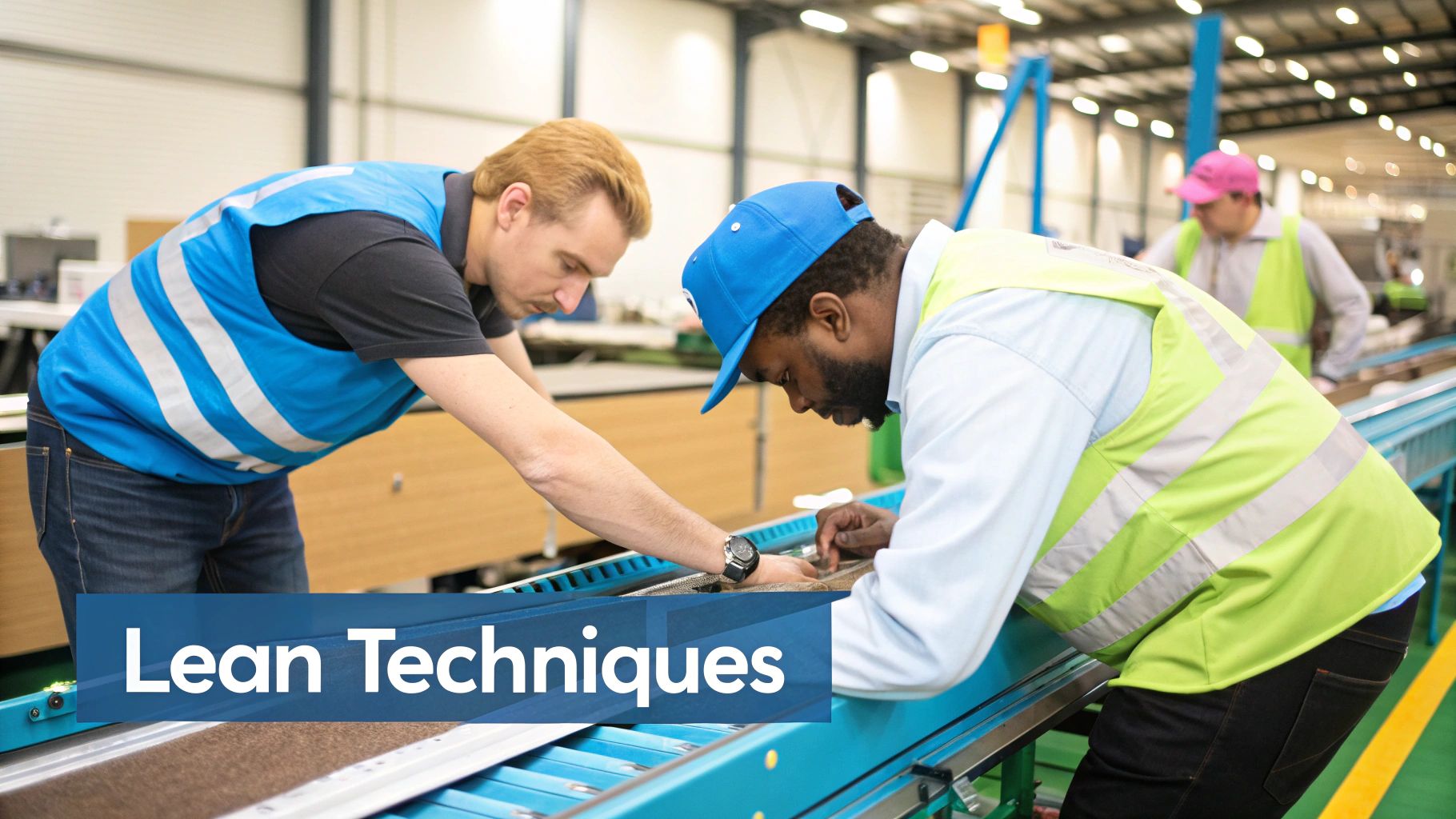
Even with the most dialed-in processes and perfect data, your quality goals can still get derailed by the one variable that’s notoriously hard to control: human error. It’s a constant battle. Inconsistent training, increasingly complex assembly tasks, and that "tribal knowledge" that walks out the door when an experienced worker retires—all of these create openings for mistakes that hit your bottom line.
This is where immersive tech like Augmented Reality (AR) and Virtual Reality (VR) stop being buzzwords and become powerful tools for manufacturing quality improvement. These technologies offer interactive, in-the-moment guidance that reduces errors and builds a more skilled, consistent, and confident team right on the factory floor.
Bridging the Gap with Augmented Reality Guidance
Augmented Reality overlays digital information—think instructions, 3D diagrams, or critical alerts—onto an employee's real-world view, usually through smart glasses or a tablet. It provides a direct, contextual guide that cuts through ambiguity and dramatically reduces the chance of error.
Picture a technician assembling a complex gearbox. Instead of constantly glancing away to check a laptop or a printed manual, they see a step-by-step digital overlay projected right onto the equipment itself.
AR can walk them through the entire process:
- Highlighting Correct Parts: The system can visually confirm the right bolt or component for each step, preventing frustrating mix-ups.
- Showing Torque Sequences: AR can display the exact tightening pattern and torque specs, making sure every fastener is secured correctly the first time.
- Automating Quality Checks: The device can use its camera to verify a step was done right before letting the technician move on.
This kind of real-time support turns complex procedures into guided, virtually error-proof workflows. The payoff? A massive boost in first-time-right rates and a steep drop in defects caused by simple procedural mistakes.
By putting critical information directly in the operator's line of sight, AR takes the mental load off of trying to remember complex instructions. This frees them up to focus on the quality of their work, which leads to better outcomes and rock-solid procedural adherence.
Building Muscle Memory with Virtual Reality Training
While AR shines with on-the-job guidance, Virtual Reality (VR) offers a completely safe, controlled environment to build skills and reinforce best practices before an employee ever touches live equipment. VR creates fully immersive, computer-generated simulations where trainees can practice complex tasks without any real-world risk.
Imagine training a new machine operator. In a VR simulation, they can learn to run a multi-million-dollar CNC machine, troubleshoot common faults, and practice emergency shutdown procedures—all without taking up valuable production time or risking damage to the actual machine.
This approach has some huge advantages for quality:
- Accelerated Learning: Trainees can repeat procedures over and over to build proficiency and muscle memory. Immersive learning has been shown to shorten the learning curve significantly.
- Safe Failure: In VR, mistakes are learning opportunities, not costly accidents. An operator can see the consequences of an incorrect setup without creating scrap or causing a safety incident.
- Standardized Instruction: Every new hire gets the exact same high-quality training, ensuring a consistent skill level across your entire workforce.
This kind of training is a direct investment in your manufacturing quality improvement efforts. By building competence in a risk-free environment, you empower your team to perform with higher accuracy and confidence when they reach the factory floor.
Practical Steps for Implementation
You don't need to rip and replace everything to integrate AR and VR. The key is to start small and solve a specific, high-impact problem. Find an assembly process with a stubbornly high defect rate or a machine that requires extensive training, and make that your pilot project.
Start by mapping out the existing workflow to pinpoint exactly where mistakes happen most often. From there, you can work with a technology partner to build out digital work instructions for an AR device or a targeted training simulation in VR.
Choosing the right hardware is also crucial. For AR, that might mean ruggedized smart glasses built for a tough industrial environment. For VR, you'll want user-friendly headsets that are comfortable for longer training sessions. By focusing on a clear use case and proving the value on a small scale, you can build momentum for a wider rollout and create a workforce that’s equipped to deliver exceptional quality, every single time.
Improve Consistency with Predictive Maintenance
Nothing torpedoes quality faster than unexpected equipment failure. One minute, your line is humming along, and the next, a critical machine is down. The result? An immediate production halt, wasted materials, and a whole batch of products that might not make the cut. This reactive "break-fix" cycle is a huge source of inconsistency and a major roadblock to any real manufacturing quality improvement.
If you're serious about protecting your quality standards, you have to get ahead of the problem. That's where predictive maintenance comes in. It's a game-changer that uses real-time data from IoT sensors and AI-powered analysis to see into the future, forecasting when a machine is likely to fail so you can schedule repairs before it ever breaks down.
Making this shift—from reactive to predictive—is foundational for consistent, high-quality output. When your machinery is always running in peak condition, you're eliminating the variables that cause defects, ensuring every single product is made under the best possible conditions.
From Guesswork to Data-Driven Maintenance
So, how do you get started with a predictive maintenance program? It all begins by identifying your most critical assets. Let's be realistic: not every piece of equipment needs to be monitored 24/7. Zero in on the machinery whose failure would cause the most damage to your production schedule and product quality. Those are your VIPs for the initial rollout.
Once you know which machines to focus on, the next step is installing IoT sensors. These little devices are your eyes and ears on the shop floor, tracking key operational data like:
- Vibration Analysis: Strange vibrations are often the first whisper of trouble, signaling everything from mechanical wear and bearing failure to simple imbalance.
- Thermal Monitoring: Overheating is a dead giveaway for friction, poor lubrication, or electrical issues, often appearing long before a component actually fails.
- Acoustic Analysis: Sometimes, a machine just sounds different. Changes in acoustics can point to developing problems that are completely invisible to the naked eye.
This constant stream of data gets fed into an analytics platform where AI algorithms get to work. They're trained to spot patterns and flag tiny anomalies that signal a future breakdown, giving your maintenance crew the heads-up they need to act.
The real magic of predictive maintenance is that it turns equipment upkeep from a chaotic emergency response into a scheduled, controlled activity. This doesn't just prevent downtime; it protects the integrity of your entire quality management system by stamping out a major source of process disruption.
The Real-World Impact on Quality and OEE
Predictive maintenance isn't just a maintenance strategy—it's a powerful quality assurance tool. There's a reason the market for this technology is expected to grow by 25% annually. It flat-out delivers. By using sensors and AI to see failures coming, companies can perform repairs preemptively, slash unexpected downtime, and prevent the very production hiccups that lead to defects.
Imagine a CNC machine producing high-tolerance aerospace components. A predictive system might detect a microscopic increase in spindle vibration, indicating a bearing is starting to wear. The system alerts the maintenance team, who then schedule a replacement for that bearing during planned downtime over the weekend. Problem solved.
Without that foresight, the bearing would have failed mid-production, potentially scrapping an entire batch of expensive parts and causing days of lost output. This proactive approach gives your Overall Equipment Effectiveness (OEE) a direct and measurable boost by improving both machine availability and performance.
To really see the difference, it's helpful to compare the various maintenance philosophies. Each one impacts your operations and quality outcomes in a very different way.
Comparing Maintenance Strategies and Their Impact on Quality
This table breaks down how reactive, preventive, and predictive approaches stack up against each other when it comes to quality, downtime, and cost.
| Maintenance Strategy | Impact on Quality | Effect on Downtime | Typical Cost Profile |
|---|---|---|---|
| Reactive (Break-Fix) | Highly Negative. Prone to defects and inconsistency due to sudden failures. | Highest. Unplanned downtime is frequent and often lengthy. | Unpredictable. Low upfront costs but very high emergency repair costs. |
| Preventive | Moderate. Reduces failures but can miss issues between scheduled services. | Reduced. Scheduled downtime is predictable but can be unnecessary. | Moderate. Consistent spending on scheduled parts and labor. |
| Predictive | Highly Positive. Maintains optimal conditions, leading to consistent quality. | Lowest. Maintenance is performed only when needed, maximizing uptime. | Higher initial investment but lower long-term operational costs. |
As you can see, moving towards a predictive model isn't just about fixing things smarter; it's about building a more resilient and quality-focused operation from the ground up. While it requires an upfront investment, the long-term payoff in reduced costs and superior quality is undeniable.
You can dive deeper into the nuances by exploring how predictive maintenance stacks up against traditional preventive strategies. While preventive maintenance is a solid step up from being purely reactive, it’s still based on a fixed schedule. Predictive is far more efficient because it's based on the actual condition of your equipment.
The image below gives you a clear picture of the impact that systematic improvements, like the kind enabled by predictive maintenance, can have on your most important metrics.
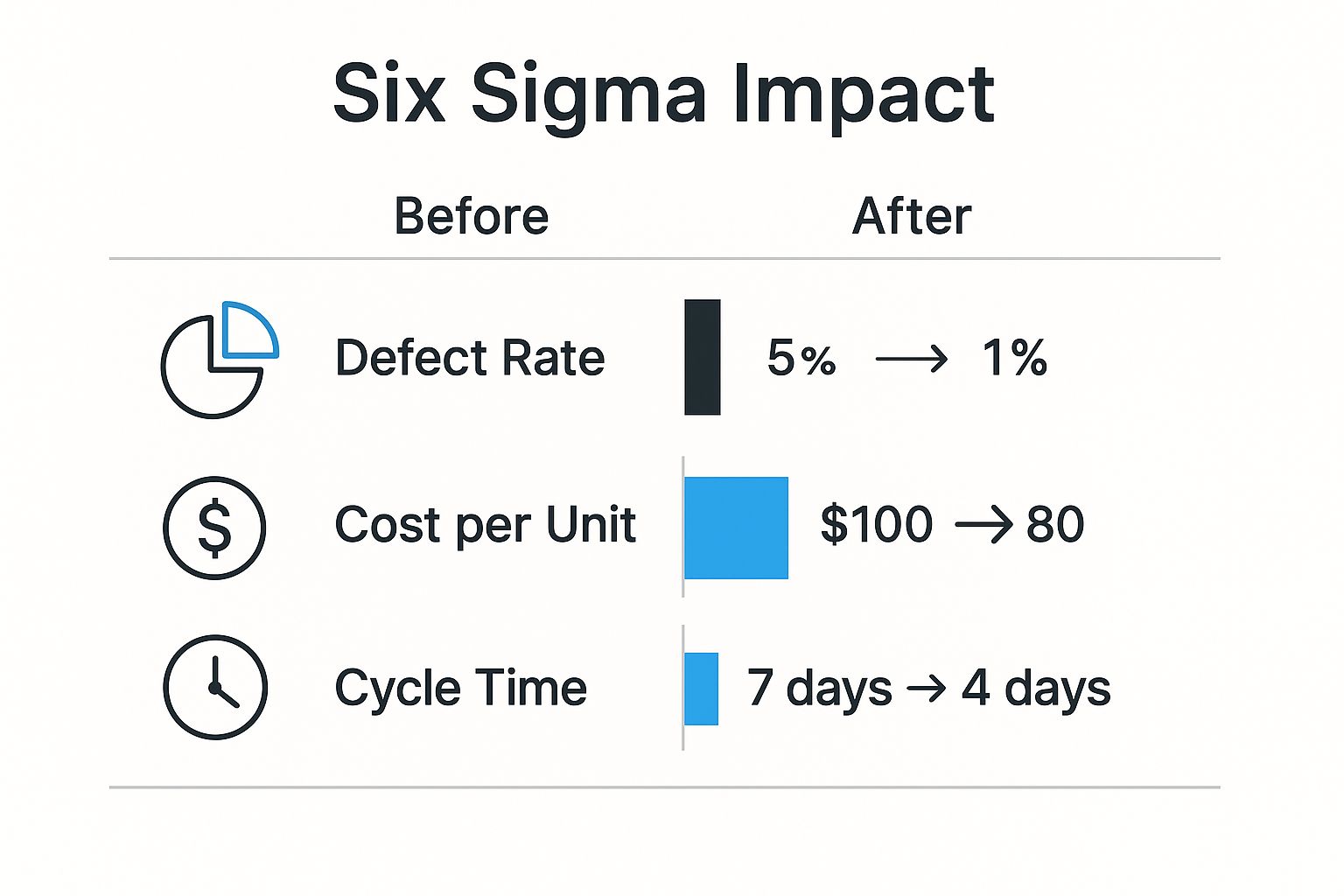
The data doesn't lie. A structured approach to quality can dramatically cut your defect rates while simultaneously lowering costs and shortening production cycles. By keeping your machinery reliable through predictive analytics, you’re building the stable foundation needed to make these kinds of gains a reality.
Measure Success and Calculate Your ROI
Sooner or later, every new initiative in your plant—no matter how promising—runs into one critical question from leadership: "What's the return on this investment?" Rolling out new tech and strategies for manufacturing quality improvement is no different. You have to prove its worth with clear, compelling numbers.
This is where the baseline data you gathered earlier becomes your most valuable asset. It’s the yardstick you'll use to measure all your progress, turning abstract ideas like "better quality" into the tangible financial results that get stakeholders to sit up and take notice.
Connecting KPIs to Financial Metrics
To build a rock-solid business case, you need to translate your operational KPIs directly into dollars and cents. The goal is simple: show how improvements in things like defect rates and rework time are cutting costs and boosting the bottom line. This connection makes the value of your efforts impossible to ignore.
Start by tracking these key financial indicators, comparing your new performance against that old baseline:
- Cost of Poor Quality (COPQ): This is the grand total of every cost tied to making bad parts. Think scrap material, rework labor, and warranty claims. A falling COPQ is one of the clearest signs your quality initiatives are hitting the mark.
- Reduced Scrap and Waste: Do the math on the material costs you've saved by producing fewer defective parts. If your defect rate dropped by 2% on a high-volume part, what's the raw material value of the product you no longer have to throw away?
- Lower Rework Costs: Put a number on the labor hours you used to spend fixing mistakes. If your technicians are spending fewer hours on rework, those hours can be pumped back into value-adding production—a huge cost saving.
A Simple Framework for Calculating ROI
Calculating ROI doesn't have to be a nightmare of complex spreadsheets. At its heart, it’s a straightforward comparison of what you've gained versus what you've spent. This simple formula gives you a clear, defensible number to present to the C-suite.
ROI Formula: (Financial Gain from Investment – Cost of Investment) / Cost of Investment
Let’s walk through this with a real-world scenario. Imagine you invested $100,000 in an AR-guided work instruction solution for a tricky assembly line.
- Calculate the Financial Gain: After six months, you measure the impact. You find you've saved $60,000 in reduced scrap, $40,000 in lower rework labor costs, and dodged a $50,000 bullet by avoiding a potential warranty claim. Your total financial gain is $150,000.
- Apply the Formula:
- ($150,000 – $100,000) / $100,000 = 0.5
- Multiply that by 100 to get your percentage: 50% ROI
This simple calculation proves that for every dollar you put in, you got it back plus an extra 50 cents. It's a powerful and easy-to-understand metric that leaves no doubt about the project's financial success.
Presenting Your Success to Stakeholders
Once you have the data, you need to tell a compelling story. Don't just slide a spreadsheet across the table; give the numbers context. Explain how the new processes led to these improvements. And don't forget to highlight the softer benefits, which are just as important.
Think about these less tangible but powerful wins:
- Increased Customer Satisfaction: Fewer defects mean happier customers. That builds brand loyalty, drives repeat business, and gets you glowing reviews.
- Improved Employee Morale: When you give your teams tools like AR and VR that actually help them succeed, it cuts down on frustration and boosts engagement. Understanding how to measure training effectiveness can even give you extra data to back this up.
- Enhanced Throughput: Less time spent on rework means more time spent on production. You’ve just increased your plant's capacity without adding a single new machine or person.
By presenting a holistic view—combining those hard ROI numbers with these qualitative wins—you create a powerful narrative. This approach doesn't just justify the initial investment. It builds incredible support for future manufacturing quality improvement projects, making sure your journey toward operational excellence keeps moving forward.
Common Questions About Quality Improvement
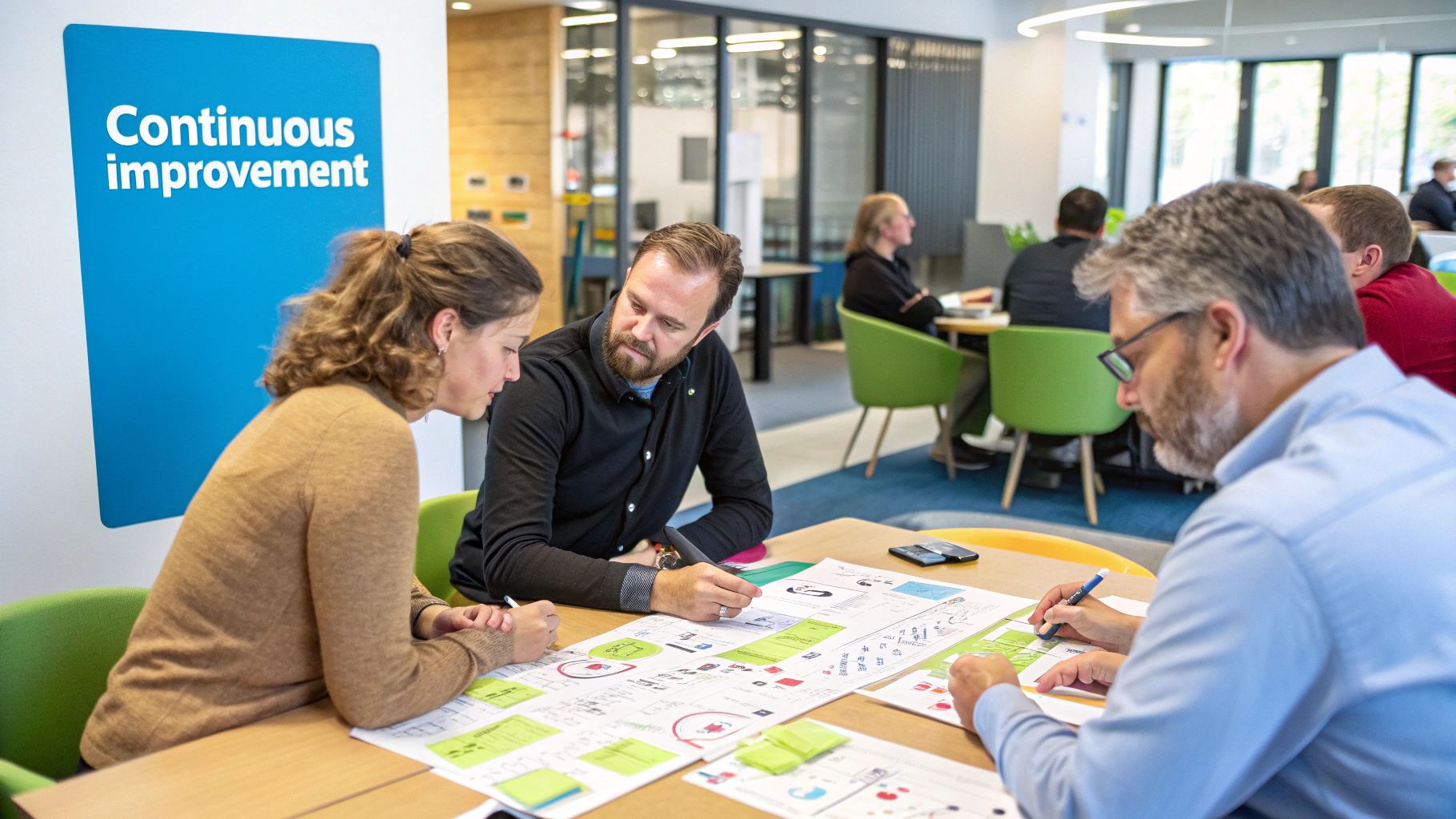
When you start talking about a modern manufacturing quality improvement program, a few questions always come up. It's natural. People want to know about the investment, whether their team will actually use the new tech, and how it will really impact the bottom line. These are good, honest questions, and answering them head-on is the best way to build the confidence you need to move forward.
Let's dive into some of the most frequent questions we hear from operations leaders. We'll give you clear, practical answers to help you get past the hurdles and make the right calls for your plant.
How Much Does a Modern Quality Program Cost?
This is usually the first—and biggest—question. The truth is, there's no single price tag. It all depends on where you're starting from and what you want to achieve. A small pilot project using AR on one assembly line will have a completely different cost than a full-scale predictive maintenance system across the entire facility.
Instead of getting stuck on the upfront cost, reframe it as an investment. What's your biggest quality headache right now? Find the one issue that’s costing you the most in scrap, rework, or warranty claims. A focused investment there can generate savings that pay for the next phase of your program.
Don't get fixated on the price of the technology. Focus on the cost of doing nothing. How much are you losing every single month to preventable defects, unplanned downtime, and slow training? That's the real cost you're trying to eliminate.
Will My Team Be Able to Use This New Technology?
Team adoption is a huge deal. Handing out AR headsets or rolling out new analytics software can feel intimidating, especially for a crew that’s used to doing things a certain way. The secret to getting it right is picking intuitive tools and providing fantastic training.
Today's AR and VR tools are built for the user on the floor. They usually don't require deep technical skills, featuring guided instructions and simple interfaces. The whole point is to make an employee's job easier, not more complicated.
Here’s how you get a smooth transition:
- Bring Your Team in Early: Ask the operators who will be using the tools for their feedback. Their insights are gold for picking the right solution and spotting problems before they happen.
- Let Them Get Hands-On: Give your team a chance to play with the technology in a low-pressure setting. VR simulations are perfect for this—they can practice without any real-world consequences.
- Show Them What’s in It for Them: Point out how these tools cut down on frustration, prevent common mistakes, and make tough tasks way more manageable. When people see how it directly helps their day-to-day work, adoption skyrockets.
How Quickly Can We Expect to See Results?
The timeline for a real ROI depends on the project's scope, but a lot of initiatives deliver results faster than you’d think. For example, if you implement AR-guided work instructions on a single, problematic assembly line, you can often see a measurable drop in defects within the first few weeks.
Predictive maintenance programs might take a bit longer to show their full value, since they need to collect data to build accurate models. But even then, you can often get your first "good save"—preventing a machine failure before it happens—within a couple of months.
The key to any manufacturing quality improvement program is tracking your progress against the baseline you set at the beginning. This lets you celebrate early wins and build momentum for the long haul.
Is This Only for Large Corporations?
Not at all. While the big players were early adopters, the technology has become much more accessible and affordable for small and mid-sized manufacturers. For instance, SaaS (Software-as-a-Service) models for AR/VR platforms mean you don't need a massive upfront capital investment in software.
Smaller companies can often be more nimble, letting them test and scale new solutions faster than their larger competitors. The core principles of cutting waste, improving consistency, and boosting efficiency are universal, no matter how big your company is.
The need for solid quality systems is growing everywhere. Just look at the quality management trends in highly regulated fields like life sciences. That industry has seen a 115% spike in recalls since 2018, with annual costs hitting $5 billion, showing just how urgent it is to get these systems right. You can find more insights on these manufacturing trends on MasterControl.com.
Ready to elevate your workforce skills and reduce errors with immersive technology? AIDAR Solutions provides tailored AR and VR applications that accelerate employee learning and streamline support workflows. See how our virtual trainings and remote service tools can deliver a rapid return on investment for your manufacturing operations.
Explore our solutions at aidarsolutions.com