A Guide to VR Education Apps in Corporate Training
VR education apps are powerful training tools that replace conventional learning materials with realistic, interactive simulations. Unlike traditional methods that often involve passive observation, these applications enable employees to learn by performing tasks in a safe, controlled virtual environment. This hands-on approach is highly effective for acquiring and retaining new skills.
The Immersive Shift in Workforce Development
Traditional training methods, such as static manuals and classroom lectures, often struggle to maintain engagement. They require employees to passively absorb complex information, providing little opportunity for application until they are on the job—where mistakes can be costly or dangerous.
This gap between theory and practice is where skills often fail to develop.
VR education apps are designed to bridge this gap. They transform a one-way lecture into an active, hands-on experience, which is the core principle of immersive learning. This method uses technology to create highly realistic scenarios. You can explore this training philosophy in greater detail in our guide on what is immersive learning.
Beyond Passive Learning
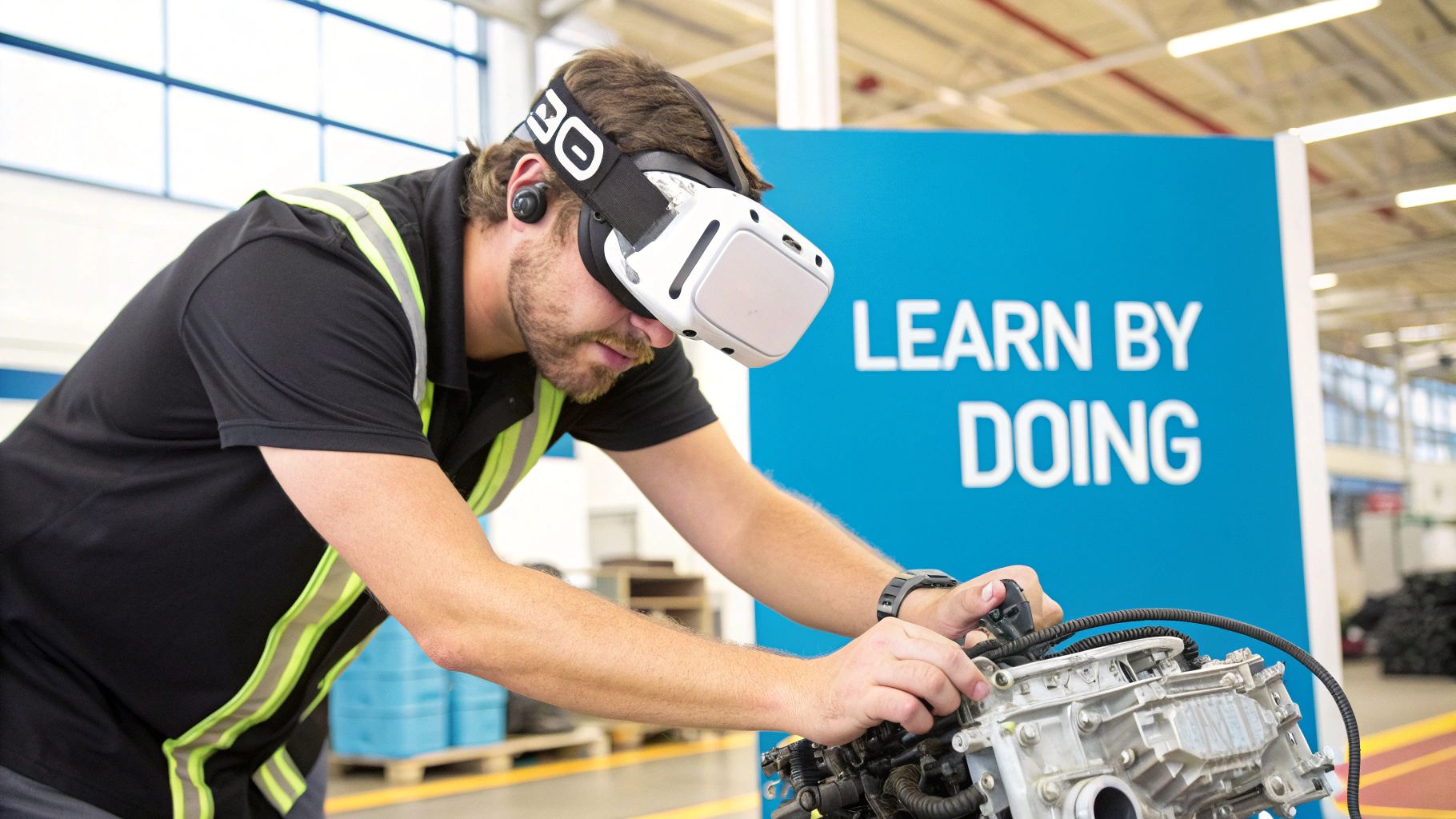
Consider a new technician practicing a complex engine assembly without touching any physical parts, or a customer service agent learning to navigate a difficult conversation in a lifelike simulation. This is the current reality of advanced corporate training.
This "learn-by-doing" model offers immediate, tangible benefits:
- Safe Practice: Employees can engage in high-stakes tasks, such as operating heavy machinery or performing delicate repairs, in a setting with zero real-world risk.
- Repetition and Mastery: A trainee can repeat a procedure as many times as needed to build muscle memory and confidence, without consuming materials or an instructor's time.
- Standardized Instruction: Every employee receives the exact same high-quality, perfectly executed training, ensuring consistency across the entire organization.
The primary advantage of VR training is its ability to replicate real-world challenges. It allows individuals to build not just knowledge, but genuine competence and confidence before they ever enter the work environment.
A Market Poised for Growth
The shift toward active learning is not a passing trend; it represents a significant market evolution. The global market for VR in education is expanding rapidly. Projections indicate its value will surge from USD 31.28 billion in 2025 to USD 81.13 billion by 2030.
This growth, at a compound annual rate of 21%, sends a clear signal. Companies worldwide are adopting VR as a strategic tool to build more skilled, safe, and efficient teams. You can find more data on this educational market shift over on Mordor Intelligence.
Why VR Training Delivers Better Business Outcomes
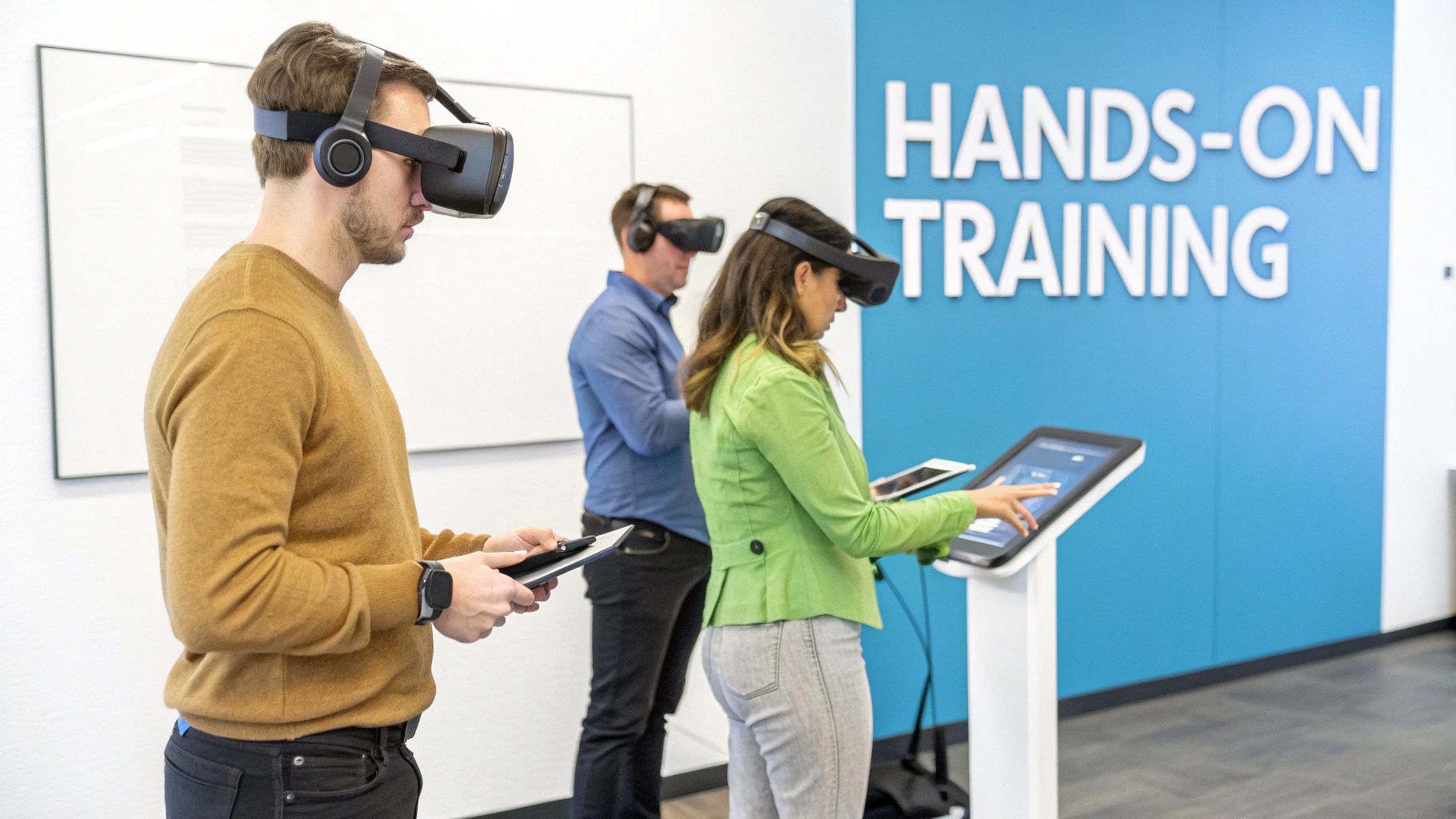
Beyond the theory, the business case for integrating VR education apps into corporate training is built on solid, measurable results. These platforms are not merely an innovative way to train; they represent a fundamentally more effective method for developing a skilled and confident workforce.
The key advantage emerges when learning transitions from a passive activity to an active, hands-on experience. One cannot learn to ride a bicycle by reading a manual; practical application is essential. VR functions as a set of training wheels for complex corporate tasks, allowing employees to practice, make mistakes, and eventually master skills in a safe environment where errors have no real-world cost.
Supercharging Knowledge Retention
One of the most significant benefits of VR is the substantial increase in knowledge retention. When a team learns by doing, the brain forms much stronger neural connections to the task, far surpassing the effectiveness of memorizing slides from a presentation.
Instead of only hearing about a safety procedure, a trainee in a VR simulation physically performs the steps. This muscle memory and contextual experience make the knowledge last.
Studies consistently validate this. A year after training, employees who used VR can retain up to 80% of what they learned. This figure significantly outperforms traditional methods.
This is why the market is expanding so quickly. The VR education sector is projected to grow by USD 11.37 billion between 2025 and 2029. This growth is fueled by undeniable results—research shows VR can be 76% more effective and achieve proficiency 75% faster than traditional training.
When we compare traditional training methods side-by-side with VR, the difference becomes clear.
Traditional Training vs VR Education Apps
| Metric | Traditional Training (e.g., Classroom, Videos) | VR Education Apps |
|---|---|---|
| Engagement | Passive; relies on listening and reading | Active; fully immersive and hands-on |
| Retention | Low; often drops below 20% within weeks | High; up to 80% retention after one year |
| Safety | Requires on-site practice, risking injury or damage | 100% safe; simulates hazardous scenarios with zero risk |
| Practice | Limited by instructor availability and equipment access | Unlimited; practice complex tasks anytime, anywhere |
| Consistency | Varies by instructor and location | Standardized; every employee gets the exact same training |
| Cost | High costs for travel, instructors, and materials | Lower long-term cost; scalable with minimal recurring expenses |
| Time to Proficiency | Slower; often requires multiple sessions | Faster; accelerates the learning curve significantly |
As the table illustrates, VR is not just a minor improvement—it is a complete paradigm shift in how we build competence and confidence in the workplace.
Accelerating Skill Acquisition Safely
VR training platforms drastically reduce the time it takes for an employee to become proficient in their role. A trainee can run through a complex procedure repeatedly without waiting for a supervisor or occupying expensive equipment. This significantly shortens the learning curve, enabling new hires to become productive in record time.
All of this occurs within a completely safe environment. For example:
- Hazardous Environments: A technician can practice on high-voltage equipment or work at heights without any physical danger.
- Costly Machinery: An operator can learn the controls of high-value machinery without the risk of causing expensive damage.
- High-Stakes Procedures: A medical professional can rehearse a delicate operation dozens of times before entering the operating room.
By removing risk from the equation and offering unlimited practice, VR education apps build true confidence, not just theoretical knowledge. For a deeper analysis, please see our article on the core benefits of virtual reality training.
Driving Efficiency and Standardization
Finally, VR brings a level of consistency and cost-efficiency that is unmatched by traditional methods. Every employee receives the exact same high-quality training, ensuring that best practices and safety protocols are understood and followed uniformly across the organization. This level of standardization is difficult to achieve with human instructors, who may have varying teaching styles.
From a budgetary perspective, the savings accumulate quickly. Costs for travel, physical trainers, and consumable materials for practice are significantly reduced. VR transforms a major operational expense into a strategic, scalable investment in personnel.
Practical Applications in Key Industries
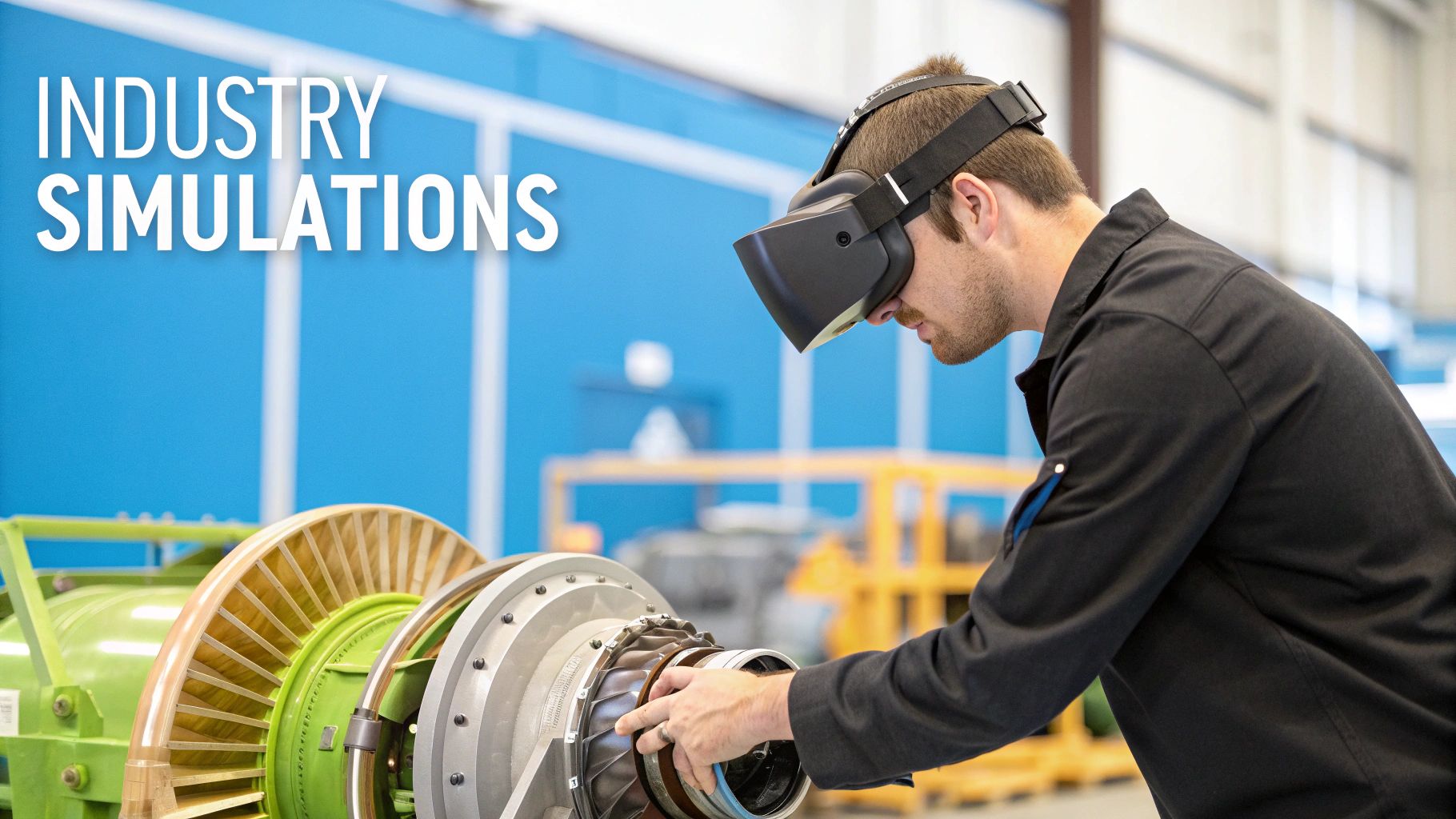
The true value of VR education apps becomes apparent when we move from theory to practical application. In high-stakes fields like manufacturing and field service, these tools are solving persistent training challenges, improving safety, and developing more skilled, confident teams.
By creating true-to-life simulations of complex—and often dangerous—work environments, companies can deliver the kind of hands-on training that was previously too expensive, risky, or logistically impossible. Let’s examine a few ways VR is already delivering a significant impact.
Revolutionizing Manufacturing Training
A modern factory floor is a dynamic environment of sophisticated machinery and strict safety protocols. Traditional onboarding is often slow and risky, typically requiring a senior employee to step away from their duties to mentor a new hire. VR changes this dynamic by creating a precise "digital twin" of the factory.
A new recruit can wear a headset to practice a complex multi-step assembly. They can follow a digital guide showing them exact hand placements, handle virtual parts, and repeat the process until it becomes second nature. This can all be done without using a single real component or disrupting a live production line. The focus is on building muscle memory and confidence before the employee ever steps onto the actual floor.
Safety training is another area where VR provides a clear advantage.
Consider a lockout/tagout (LOTO) procedure—a critical but hazardous process for shutting down machinery for maintenance. In VR, a trainee can walk through every single step, make mistakes, and learn from them in a 100% safe environment. The simulation can even show them the consequences of a missed step, creating a powerful, memorable lesson that a textbook or video cannot replicate.
The results are compelling:
- Faster Onboarding: Companies have reported reducing the time it takes to get new hires up to speed by as much as 75%.
- Reduced Errors: When employees practice in a realistic simulation first, they make fewer mistakes on the job, leading to less material waste and rework.
- Improved Safety: Immersive safety drills result in teams that adhere more closely to protocols, leading to a measurable reduction in workplace accidents.
Empowering Field Service Technicians
Field service teams face unique challenges, including complex equipment, demanding customers, and the need for expert support at remote job sites. VR education apps provide a powerful solution for both technical and interpersonal skills, directly improving key metrics like first-time fix rates.
Imagine a technician about to service a new, complex HVAC unit. Instead of studying a dense manual, they can use a headset to run through a full virtual repair. They can "see" inside the machine, identify parts, and follow a guided process to diagnose and fix common issues. This pre-job preparation means they arrive on-site better prepared, increasing the likelihood of resolving the problem on the first visit.
This digital approach builds a strong knowledge base. To learn more about how visual tools amplify learning, it is useful to see the perspective on video as a new teacher's helper, which underscores the impact of visual instruction.
The training is not limited to technical skills. VR is also an excellent tool for practicing customer interactions. Technicians can develop soft skills, such as explaining a technical problem in simple terms or de-escalating a situation with an upset client. These simulations often use AI-powered avatars to create realistic conversations, helping technicians build the communication skills essential for excellent service.
To get a broader view of how this technology is being used, you can explore the many uses for VR across different business functions. The results are clear, with companies reporting higher customer satisfaction scores and improved overall technician performance.
Picking Your VR Training Content Strategy
The success of any VR training program is determined by its content. Effective simulations lead to significant performance improvements, while poorly designed content can undermine the entire investment. This brings every organization to a critical decision: should you use a ready-made, off-the-shelf (OTS) VR education app, or invest in developing custom content tailored precisely to your needs?
There is no single correct answer. The optimal choice depends on a thorough analysis of your specific training goals, budget, and long-term program vision. Each path offers distinct advantages suited to different situations. The key is to align your content strategy with your desired outcomes from the outset.
The Case for Off-the-Shelf VR Apps
For many companies, particularly those new to immersive training, starting with off-the-shelf content is the most practical first step. These are pre-built VR education apps created by specialized developers to address common training needs across various industries—such as general safety procedures, soft skills development, or basic equipment familiarization.
This approach is analogous to purchasing standard business software. The primary advantages are speed and cost.
- Launch Almost Immediately: You can acquire licenses and begin training your team within days or weeks, rather than months. This allows you to start demonstrating the value of VR and collecting data quickly.
- Lower Upfront Cost: OTS solutions allow you to avoid the significant initial investment associated with custom development, making it an accessible entry point.
- Tried and True Content: Reputable vendors have typically refined their applications based on feedback from a large user base, ensuring the content is effective and engaging.
However, this approach comes with a trade-off: a lack of specificity. A generic safety simulation may not perfectly match your facility's layout or your company’s unique protocols, which can reduce its overall impact.
Key Takeaway: Off-the-shelf content is an excellent choice for standardized training where universal principles apply. It provides a fast, low-risk method for introducing VR and building momentum for your program.
When evaluating OTS libraries, look for content that closely matches your core tasks and includes robust analytics to track team performance.
When Custom Content Becomes a Must
As your training requirements become more specialized, the argument for custom content grows stronger. If your company utilizes proprietary machinery, follows unique internal processes, or needs to train for highly specific scenarios, a one-size-fits-all solution will not suffice. Custom development involves building a VR simulation from the ground up to be a precise digital replica of your work environment.
This approach is essential when absolute precision and realism are required. For example, training a technician on a one-of-a-kind manufacturing line or guiding them through a complex repair on unique equipment. In these cases, the training must be a perfect mirror of reality to be effective. It's no wonder the market for these solutions is growing. Learners can retain an incredible 80% of what they learn in VR a year later, a massive jump from the 20% retained from old-school methods. Plus, training time can be slashed by up to 75%. You can dig into more insights on the growth of VR in education on futuremarketinsights.com.
Pursuing custom development means finding a skilled development studio or technology partner. When vetting potential partners, inquire about:
- Industry Experience: Have they built simulations for your industry before?
- Learning Design: Do they understand how to structure a learning experience for optimal retention?
- Technical Capabilities: Can they deliver a polished, bug-free experience on your intended hardware?
The Emerging Middle Ground: No-Code Platforms
A third option is emerging, striking a balance between the convenience of OTS and the tailored fit of custom builds. No-code or low-code VR authoring tools are platforms that enable your own in-house subject matter experts—without requiring coding skills—to create simple, interactive VR training scenarios.
Using drag-and-drop interfaces, an experienced manager or trainer can create basic procedural training, such as a multi-step checklist or an equipment familiarization module. While these tools may not deliver the hyper-realism of a full custom build, they empower your team to create and update relevant content quickly and cost-effectively. This approach places content creation directly in the hands of those who know the job best.
How To Get VR Education Apps Up and Running in Your Organization
You are convinced of the potential of VR education apps. The next step is translating that concept into a fully operational program that your teams will use effectively. This process requires more than just purchasing headsets; it demands a thoughtful, phased rollout that addresses hardware, software, and—most importantly—your employees.
First, consider the hardware. This is a foundational decision. Will you use standalone headsets or tethered ones? Standalone devices are the most common choice for enterprise training. They are wireless, easy to set up, and can be used anywhere, which is a significant advantage for training large groups across multiple locations. Tethered headsets, which connect to a high-powered PC, offer superior graphics but restrict user mobility. They are best suited for highly detailed, stationary simulations where visual fidelity is paramount.
Once the hardware is selected, you must address logistics. Managing a fleet of VR headsets involves more than storage. You need a robust system for charging, updating software, and maintaining hygiene. Mobile Device Management (MDM) platforms are invaluable for this purpose. They allow your IT team to manage applications, security, and updates on all devices from a central dashboard. This step is critical.
Start Small with a Strategic Pilot Program
Avoid attempting a large-scale, simultaneous launch. A comprehensive, "big-bang" rollout is often difficult to manage. The prudent approach is to begin with a focused pilot program. This provides an opportunity to test all components, gather candid feedback, and collect tangible data to build a strong business case before requesting a larger budget.
Here’s a simple blueprint for an effective pilot:
- Select a High-Impact Problem: Identify a specific training bottleneck where VR can make a demonstrable difference, such as a complex assembly task that slows onboarding or a high-risk procedure where errors are costly.
- Identify Your Champions: Assemble a small, enthusiastic team that is genuinely interested in new technology. Their energy and feedback will be invaluable.
- Define Success Metrics: Before beginning, clearly define what you will measure. This could be faster training completion times, fewer errors on the factory floor, or higher confidence scores from new hires. Document these metrics.
- Listen, Learn, and Refine: After the pilot concludes, consult with all participants. Use their feedback to improve the content, streamline logistics, and perfect your plan for a company-wide rollout.
This is also the stage where you finalize your content strategy, deciding whether to purchase an off-the-shelf solution or build it from scratch.
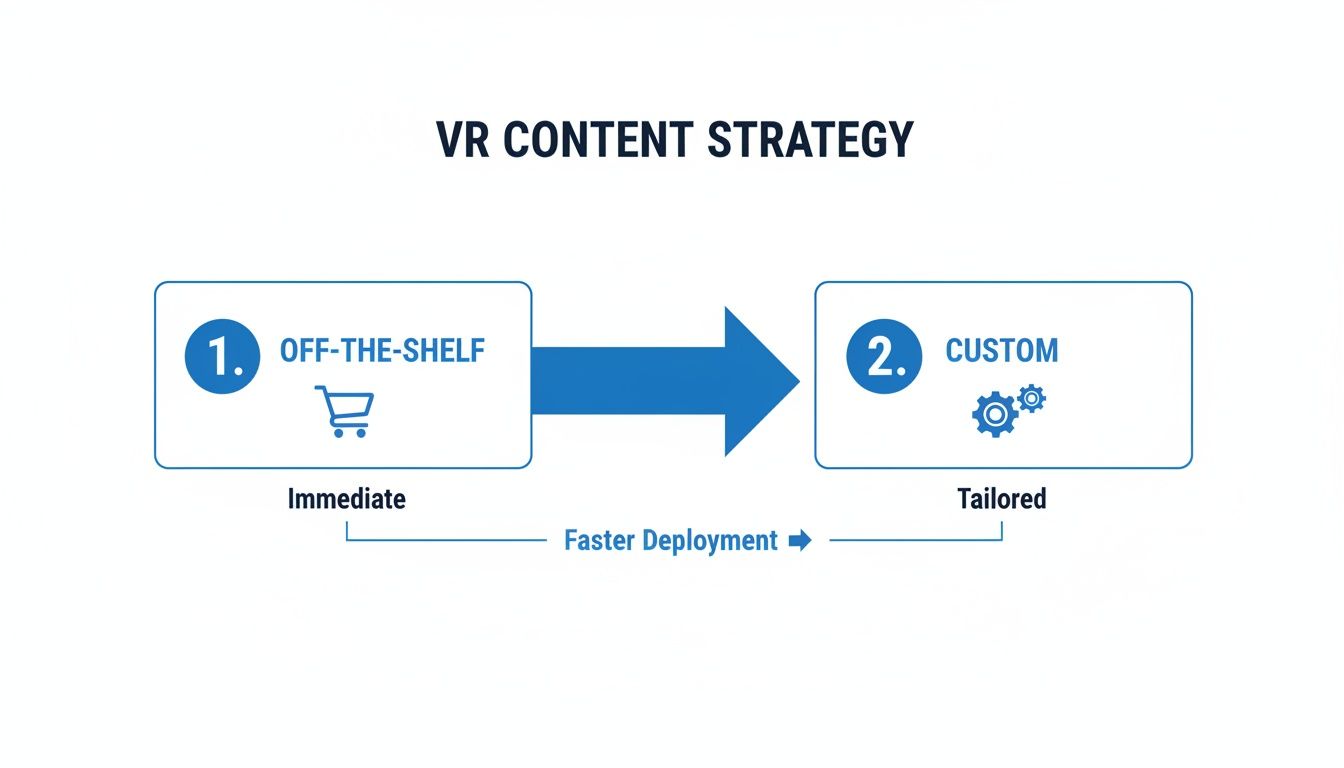
As shown, off-the-shelf apps offer a rapid and budget-friendly start. Custom content, conversely, delivers a perfectly tailored simulation of your unique processes. The right choice depends entirely on your specific objectives.
To help you stay organized, here is a checklist to guide you through the process from planning to full deployment.
VR Training Implementation Checklist
| Phase | Key Action Items | Considerations |
|---|---|---|
| 1. Planning & Strategy | Define objectives and success metrics. Identify a high-impact use case for a pilot. Secure budget and executive buy-in. | What specific problem are you solving? Who is your executive champion? How will you measure ROI? |
| 2. Technology Selection | Choose hardware (standalone vs. tethered). Select a content provider or authoring tool. Set up a Mobile Device Management (MDM) solution. | Consider user mobility, graphical needs, and scalability. Does the content align with your training goals? |
| 3. Pilot Program | Select a small, engaged user group. Deploy hardware and content. Gather qualitative and quantitative feedback. | Are the participants tech-savvy or beginners? Is the environment safe and suitable for VR? |
| 4. Analysis & Iteration | Analyze pilot data against success metrics. Refine content and logistics based on feedback. Build a business case for a full-scale rollout. | Did you meet your goals? What were the biggest friction points for users? How can the experience be improved? |
| 5. Full Rollout & Change Management | Develop a "train-the-trainer" program. Integrate VR data with your existing LMS. Communicate the benefits to all employees. | How will you support trainers? Can you track completion data automatically? How will you handle scheduling and device checkout? |
| 6. Ongoing Measurement | Continuously track key performance indicators (KPIs). Survey users regularly for feedback. Report on program ROI and impact to stakeholders. | Are you still seeing efficiency gains? Is the content up-to-date? How does VR training impact long-term employee performance? |
This structured approach ensures you are not just adopting new technology but are embedding it thoughtfully into your training culture.
Win Hearts and Minds to Drive Adoption
Remember, technology is only half the equation. You must also gain the support of your employees. To many, VR can seem intimidating or like just another corporate initiative. Your objective is to foster excitement, not anxiety. How you introduce them to the platform is crucial; reviewing effective user onboarding strategies can significantly improve user comfort from day one.
Start at the top. Use the results from your pilot to demonstrate tangible benefits to executives—the ROI, safety improvements, and time savings. Securing a senior leader to champion the program is one of the most effective actions you can take. Next, focus on the trainers. A robust "train-the-trainer" program ensures your instructors are not just proficient but are true advocates who can help their teams become comfortable and confident in the virtual environment.
The goal is to make VR feel less like intimidating technology and more like a powerful new tool that makes work safer, easier, and more engaging.
Finally, do not operate VR in a silo. Integrating the platform with your existing Learning Management System (LMS) is key to scaling effectively. By connecting the two systems (often using standards like xAPI), you can track VR training progress alongside all your other learning data. This provides a complete picture of employee development and makes it much easier to prove the program's long-term value.
If you are planning a full-scale implementation, our guide on designing a complete virtual reality training program offers a deeper dive into these critical steps.
Measuring Success and Calculating Your ROI
Investing in VR education apps is a significant business decision, and like any strategic investment, its value must be proven. To gain and maintain executive support, you must present clear data. The focus should be on real, tangible impacts on the business, not simply on participation metrics.
The objective is to connect immersive training directly to the bottom line. We must focus on the key performance indicators (KPIs) that leadership values: efficiency, safety, and profitability. When you can demonstrate how VR improves these metrics, you are communicating in a language everyone understands.
Identifying Key Performance Indicators
Before you can report on your ROI, you must define what "success" means for your organization. What problem did you initially aim to solve with VR? Your KPIs should be directly linked to that objective.
Here are the metrics that consistently provide the most impact:
- Faster Ramp-Up Time: How long does it take for a new hire to become fully proficient? VR can significantly reduce this time, allowing employees to become productive members of the team much faster.
- Fewer Accidents: For any hands-on role, safety is paramount. Track on-the-job incidents and near-misses before and after the VR rollout. A reduction in these figures is a major win for both employee well-being and the company's financials.
- Better Work Quality: Examine metrics like first-time fix rates for field service technicians, or production output and error rates in manufacturing. VR practice builds muscle memory, which leads to fewer mistakes and higher-quality work.
- Hard Cost Savings: This is the most direct financial benefit. Calculate all eliminated expenses, such as travel costs for instructors, wasted materials from practice runs, and reduced downtime for critical equipment.
By focusing on these operational KPIs, you shift the conversation from training as a cost center to training as a strategic driver of business value. It provides clear evidence that your VR education apps are delivering real-world results.
A Practical Formula for Calculating ROI
Once you have your data, calculating the ROI is straightforward. The formula provides a clear perspective on the financial gains relative to the investment.
The standard formula is:
ROI (%) = [(Net Financial Gain – Cost of Investment) / Cost of Investment] x 100
Let’s review a brief example. Imagine a manufacturing company implementing a new VR training program.
-
Cost of Investment:
- Hardware (20 headsets): $10,000
- Software Licenses (annual): $5,000
- Content Customization: $15,000
- Total Investment: $30,000
-
Net Financial Gain (over one year):
- Reduced material waste from fewer mistakes: $15,000
- Savings from eliminating two instructor-led trips: $10,000
- Productivity boost from 25% faster onboarding: $20,000
- Total Gain: $45,000
Now, let's apply the formula:
[($45,000 – $30,000) / $30,000] x 100 = 50%
In this scenario, the company achieved a 50% ROI in the first year. When you can present clear, data-backed calculations like this in a budget meeting, you are not just requesting to continue your program—you are making a powerful case to expand it.
Questions We Hear All the Time About VR Training
Exploring any new training technology naturally raises practical questions. Here are straightforward answers to the inquiries businesses most frequently have when considering VR for their teams.
How Much Does a VR Training Program Cost?
There is no single price, as the cost depends on the scale and objectives of your program. Key factors include hardware (headsets can range from a few hundred to several thousand dollars each), software licenses for ready-made content, and potentially a management platform. A small pilot program can often be launched for a few thousand dollars.
The most effective way to approach cost is to begin with a well-defined use case. Pinpoint an area where you can clearly measure the return—such as reduced errors, faster onboarding, or fewer safety incidents. This allows you to build a compelling business case.
Do My Employees Need To Be Tech-Savvy?
Not at all. While this is a common concern, modern standalone VR headsets and well-designed VR education apps are engineered to be highly intuitive. The user experience is kept simple, and most people become comfortable with the controls within a few minutes.
The goal is to make the technology fade into the background. The focus should be on the training task itself, not the hardware. This simplicity is a significant factor in the successful adoption of VR across diverse workforces.
Can VR Training Plug Into Our Current Systems?
Absolutely. Leading enterprise VR training platforms are specifically designed for integration. They use standard data formats like xAPI or SCORM, allowing them to connect directly with the Learning Management System (LMS) you already use.
This integration is essential. It enables you to capture important data from your VR training—completion rates, performance scores, and even detailed user interactions within a simulation. This rich, immersive data can be viewed alongside your other corporate training metrics, providing a comprehensive picture of employee development.
Ready to see how immersive training can really move the needle on your team's performance? AIDAR Solutions offers expert guidance and powerful VR/AR platforms to help you build a more skilled, efficient, and safer workforce. Start your journey with us at https://aidarsolutions.com.