
Predictive Maintenance vs Preventive Maintenance: A Practical Guide
At its heart, the difference between predictive and preventive maintenance is straightforward: preventive maintenance is driven by a schedule, while predictive maintenance is driven by condition.
Consider this analogy: preventive maintenance is your routine car oil change every 5,000 miles, regardless of the oil's actual condition. The calendar dictates the action. Predictive maintenance, in contrast, is like having a sensor that tells you precisely when the oil is starting to degrade, allowing you to maximize its useful life before a replacement is necessary.
Choosing Your Maintenance Strategy: A High-Level Overview
Selecting the right maintenance strategy is a critical decision for any operation focused on maximizing asset uptime and controlling costs. The two most common proactive approaches, preventive and predictive, are based on fundamentally different philosophies. Understanding their core principles is the first step toward building a more resilient and cost-effective workflow.
Core Principles Compared
Preventive maintenance (PM) operates on a fixed schedule. Tasks are performed based on time, runtime hours, or production cycles, with the goal of preventing failures before they can occur. It is a proven strategy that brings order and predictability to maintenance operations.
Predictive maintenance (PdM), however, is a data-driven approach. It relies on real-time information from sensors monitoring operational parameters like vibration, temperature, and acoustic signatures. The objective is to forecast a failure and trigger maintenance only when it is genuinely required, moving beyond a rigid, one-size-fits-all schedule.
Predictive maintenance represents a shift from "might fail" to "will fail." It replaces educated guesses based on averages with precise, data-backed insights, ensuring resources are deployed at the exact right moment.
To quickly see how these two powerful strategies stack up, here’s a clear, side-by-side comparison.
Predictive vs Preventive Maintenance At a Glance
The table below breaks down the key distinctions between each approach, from what triggers the work to which assets benefit the most.
| Attribute | Preventive Maintenance | Predictive Maintenance |
|---|---|---|
| Trigger | Fixed schedule (time, usage, cycles) | Real-time asset condition data |
| Approach | Proactive, schedule-based | Proactive, condition-based |
| Goal | Reduce failures through routine upkeep | Predict failures and act just-in-time |
| Data Reliance | Manufacturer guidelines, historical averages | Live sensor data, AI, machine learning |
| Risk | Potential over-maintenance and unnecessary parts replacement | Higher initial investment in technology and expertise |
| Best For | Lower-cost assets with predictable failure patterns | Critical, high-value assets where downtime is costly |
This high-level view sets the stage for a deeper analysis. While preventive maintenance offers simplicity and structure, predictive maintenance delivers precision and advanced efficiency, transforming how organizations protect their most critical equipment.
Understanding Preventive Maintenance: The Time-Tested Approach
Preventive maintenance (PM) is the foundation of most industrial maintenance programs. It operates on a simple but effective principle: address potential problems before they occur by following a set schedule. This strategy uses predetermined triggers—such as calendar dates, machine runtime hours, or production cycles—to initiate maintenance tasks. It is a disciplined, proactive method for bringing order and predictability to operations.
The workflow is straightforward. It begins with a master schedule, typically built from original equipment manufacturer (OEM) recommendations and historical performance data. Technicians adhere to this schedule, performing routine inspections, lubrications, parts replacements, and adjustments. The primary goal is to mitigate known, wear-based failures.
The Core Strengths of a Scheduled Approach
The primary advantage of preventive maintenance is its simplicity. It does not require complex sensor technology or advanced data analysis to implement, which means most organizations can deploy a PM program relatively quickly and without a significant upfront investment. It is an accessible first step away from a reactive "break-fix" model.
A well-executed PM program delivers significant benefits:
- Increased Asset Lifespan: Regular service manages wear and tear, extending the operational life of equipment by addressing minor issues before they escalate.
- Improved Safety: Proactively maintaining equipment reduces the likelihood of catastrophic failures that could pose a risk to personnel.
- Enhanced Reliability: A structured schedule helps prevent common, predictable breakdowns, leading to more consistent production and fewer unplanned downtimes.
- Simplified Planning: Maintenance is scheduled in advance, simplifying labor planning, spare parts inventory management, and production shutdowns. The value of proactive care is universal, as seen in applications like professional boat stove maintenance.
Analyzing the Hidden Costs and Limitations
Despite its strengths, the one-size-fits-all nature of preventive maintenance has inherent limitations. PM assumes that assets degrade on a predictable timeline, but operational reality is often more complex. Varying operating conditions, machine usage intensity, and environmental factors can cause components to fail sooner—or last longer—than the schedule predicts.
A purely schedule-based approach can lead to "maintenance for maintenance's sake." Teams may spend valuable time and resources on assets that are functioning perfectly, while potentially overlooking subtle signs of an impending failure not aligned with the calendar.
This rigidity creates hidden costs and operational challenges. A major issue is over-maintenance, where technicians replace parts that still have significant useful life remaining. This not only increases the spare parts budget but also introduces the risk of human error—each unnecessary intervention presents an opportunity for incorrect installation or reassembly.
Furthermore, PM is generally ineffective against random or complex failures that do not follow a predictable pattern. A scheduled inspection might miss the early signs of a bearing fault that develops between service intervals, leading to the unplanned downtime the strategy was designed to prevent. While PM is a crucial part of any maintenance plan, understanding advanced industrial equipment repair techniques can unlock new efficiencies. These limitations clarify why data-driven approaches are gaining prominence as companies seek to optimize resource allocation and maximize uptime.
Exploring Predictive Maintenance: The Data-Driven Strategy
While preventive maintenance operates on a calendar, predictive maintenance (PdM) operates on data. This is not about routine check-ups; it is an intelligent, condition-based approach that uses advanced tools to interpret an asset's real-time health status.
At its core, predictive maintenance integrates Internet of Things (IoT) sensors, artificial intelligence (AI), and machine learning. These technologies work in concert to analyze a continuous stream of operational data, such as vibration patterns, temperature shifts, and acoustic signatures. The goal is not just to detect failures but to forecast them with high accuracy.
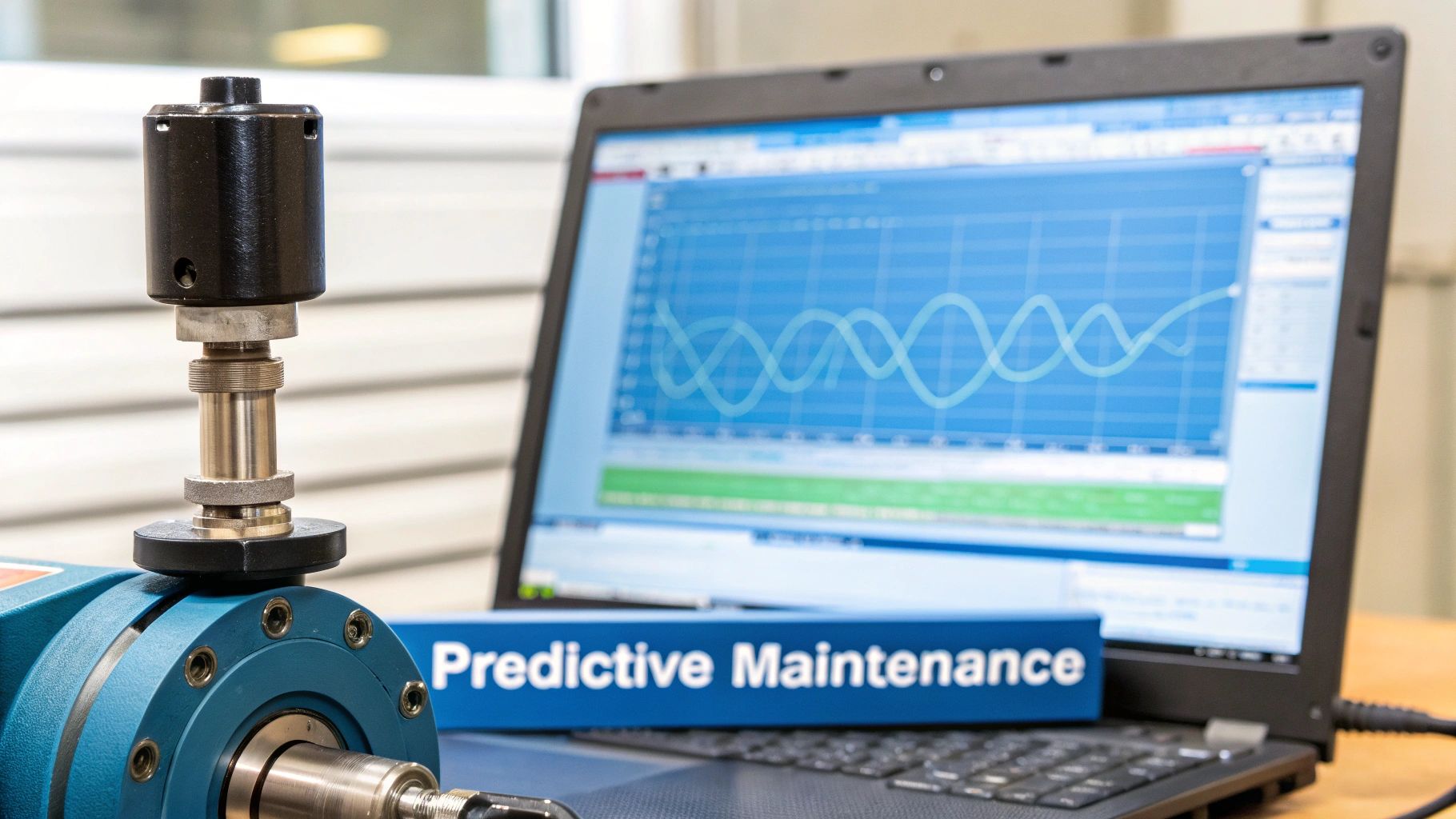
The Predictive Maintenance Workflow in Action
The PdM process represents a significant shift from acting on schedules to acting on insights. It focuses on converting raw data into specific, actionable guidance for maintenance teams, ensuring personnel and parts are deployed exactly when and where they are needed most.
A typical workflow consists of several key stages:
- Data Collection: IoT sensors are installed on critical assets to gather real-time performance data, which is the foundation of the strategy.
- Data Transmission: The collected data is securely transmitted to a central system, either on-premise or in the cloud, for analysis.
- Data Analysis: AI and machine learning models analyze the incoming data, comparing it against normal performance baselines to identify subtle anomalies that signal potential issues.
- Failure Prediction: Once the system flags a deviation, it predicts the likelihood of a future failure and estimates the component’s remaining useful life.
- Alert Generation: The system automatically generates a detailed alert or work order, notifying the maintenance team of the impending problem, its probable cause, and recommended actions.
The Strategic Value of Data-Driven Decisions
Adopting predictive maintenance is a strategic initiative to maximize asset uptime and optimize resource allocation. By intervening only when necessary, companies can avoid the costs associated with both over-maintenance and unexpected downtime. A solid grasp of condition monitoring and predictive maintenance principles is essential for successful implementation.
Despite its advantages, the industry is still in transition. Preventive maintenance remains the dominant strategy, with 71% of professionals reporting its active use, while only 27% have implemented predictive methods. However, for those who adopt PdM, the results are compelling: 85% of teams report improved downtime forecasting, and 55% of plants see a noticeable increase in maintenance staff productivity.
Predictive maintenance transforms maintenance from an operational cost center into a strategic business function. By forecasting failures, it allows teams to schedule repairs during planned shutdowns, order parts just-in-time, and align maintenance activities directly with production goals.
Overcoming Implementation Hurdles
While powerful, predictive maintenance presents implementation challenges. The primary hurdles are the initial investment in sensor technology and data infrastructure, along with the need for specialized skills to manage and interpret the data. Building accurate predictive models requires a significant amount of historical data and data science expertise, which can be a barrier for some organizations.
For most, a phased rollout, beginning with the most critical assets, is the most practical path forward.
Analyzing Financial Impact and Long-Term ROI
Ultimately, the discussion of predictive versus preventive maintenance centers on financial impact. On the surface, a preventive strategy may appear more affordable due to its lower initial setup costs. However, a deeper analysis of the numbers reveals a more complex picture.
The true cost of any maintenance strategy extends beyond the initial investment. It includes labor deployment, spare parts inventory, and the significant financial impact of unplanned downtime.
The Hidden Costs of Playing it “Safe”
A preventive maintenance program offers predictable, recurring costs, including scheduled labor hours and a consistent budget for replacement parts. This is beneficial for organizations requiring stable, foreseeable expenses. The issue is that this model contains hidden costs stemming from inefficiency.
The largest financial drain in a purely preventive model is over-maintenance. By adhering to a rigid calendar, teams inevitably replace parts that still have useful life remaining. This inflates the parts budget and consumes technician hours that could be allocated to more pressing issues.

Consider these direct financial impacts:
- Wasted Parts Inventory: Capital becomes tied up in spare parts that are used prematurely, increasing inventory holding costs.
- Inefficient Labor: Technicians spend time performing unnecessary checks on healthy equipment, reducing overall productivity.
- Risk of Human Error: Every time a machine is opened for service, there is a small but real chance of introducing a new problem.
These inefficiencies accumulate, gradually eroding operational margins. Over time, the "cheaper" option can result in higher overall costs.
Making the Business Case for Predictive Maintenance
Predictive maintenance (PdM) requires a greater upfront investment in sensors, software, and training. While this initial expenditure can be significant, the long-term return on investment (ROI) is compelling. By targeting maintenance with precision, PdM eliminates the waste inherent in calendar-based schedules.
Data supports this conclusion. Recent reports indicate that predictive maintenance can reduce maintenance costs by 8-12% compared to preventive strategies. Although the initial outlay is 3-4 times higher, the ROI for PdM systems is typically realized within 18-30 months.
Another in-depth study found that PdM reduces operational costs by 12%, increases asset availability by 9%, and adds 20% to the lifespan of aging equipment. More details on these maintenance cost savings on oxmaint.com are available.
The financial argument for predictive maintenance is simple: it shifts maintenance from a fixed operational cost to a strategic investment in uptime. It directly targets the single most expensive threat in any industrial operation—unplanned downtime.
The ability to foresee failures allows companies to schedule repairs during planned shutdowns, order parts just-in-time, and align maintenance with production goals. This level of control is essential to reduce downtime in manufacturing and maintain smooth operations.
Finding a Practical Middle Ground with Hybrid Models
A full-scale transition to predictive maintenance is not always practical or necessary for every organization. Often, a hybrid strategy is the most intelligent and cost-effective path forward.
This involves applying PdM to the most critical, high-value assets where failure would be catastrophic. For other assets—those that are less critical or have more predictable failure patterns—a cost-effective preventive schedule can be maintained.
By starting with a focused pilot program on a few key machines, organizations can prove the ROI on a smaller scale. This builds a powerful business case for wider adoption, allowing the savings from critical assets to fund the expansion of the PdM program. It is a phased approach that manages costs while steadily unlocking the significant long-term financial benefits of data-driven maintenance.
Weaving AR and VR into Your Maintenance Strategy
The conversation has evolved beyond predictive vs. preventive maintenance. A new wave of technology is fundamentally changing how work is executed on the factory floor. Immersive tools like Augmented Reality (AR) and Virtual Reality (VR) have become practical assets that enhance both maintenance approaches.
These technologies act as a force multiplier for technicians, making them more efficient, accurate, and safe, whether they are following a routine preventive schedule or responding to a predictive alert. They bridge the gap between digital data and physical, hands-on action.
Standardizing Excellence in Preventive Maintenance
In preventive maintenance, the primary challenges are often inconsistency and human error. Even with detailed manuals, complex tasks can be misinterpreted, leading to variations in execution. AR and VR help enforce a single, optimal standard.
Imagine a technician wearing AR glasses to service complex machinery. Instead of consulting a binder or tablet, they see digital instructions overlaid directly onto the equipment. Arrows point to specific bolts, animations demonstrate the correct sequence, and real-time data like torque specifications appear in their line of sight.
This technology delivers tangible results:
- Reduce Human Error: Step-by-step visual guidance ensures procedures are followed perfectly every time, minimizing mistakes.
- Guarantee Consistency: Whether the task is performed by a seasoned veteran or a new hire, it is done the same way, ensuring uniform quality.
- Accelerate Onboarding: New technicians can train on complex equipment in safe, realistic VR simulations or get up to speed on the floor with AR-guided support.
By transforming static manuals into dynamic, interactive guides, AR and VR ensure preventive maintenance is not just done on time—it's done right. This elevates the reliability that a PM schedule is designed to create.
Supercharging Predictive Maintenance with Remote Expertise
The power of AR is particularly evident in predictive maintenance scenarios. When a PdM system flags an impending failure on a critical asset, time is of the essence. Often, the expert best equipped to handle the issue is located off-site, leading to costly travel and extended downtime.
AR-powered remote assistance changes this dynamic. A technician on-site can instantly connect with a senior expert anywhere in the world.
Through the headset, the remote expert sees exactly what the field technician sees. From their own location, they can provide immediate, hands-on guidance by:
- Annotating the live video feed with digital arrows, circles, and text.
- Sharing technical documents or schematics directly into the technician's field of view.
- Walking the technician through complex diagnostics and repair steps as if they were physically present.
This provides a powerful solution to the industrial skills gap. A single expert can support multiple teams in one day, reducing travel costs by 75% or more and significantly shortening repair times. By connecting your team to the right expertise instantly, AR transforms operations and multiplies the ROI of your PdM program.
Ultimately, whether you rely on a preventive schedule or a data-first predictive model, immersive tools empower your team to execute that strategy with precision. They turn your maintenance vision into flawless, real-world action that protects assets and ensures uptime.
How to Choose the Right Strategy for Your Operations
The decision between predictive and preventive maintenance is not an either-or choice. Committing exclusively to one strategy is often a mistake. The most intelligent and cost-effective approach is typically a hybrid model, where the maintenance tactic is matched to the asset based on its value to the operation.
This involves a strategic allocation of your maintenance budget and team's time. The key is to evaluate your equipment portfolio through the lens of criticality. This allows you to build a maintenance plan that protects uptime where it matters most and controls costs on less vital machinery.
Assessing Asset Criticality and Risk
The first step is to categorize your assets. Not all equipment holds equal importance. The failure of a main production line conveyor is far more impactful than a non-essential ventilation fan failing. A practical tool for this is implementing a comprehensive risk register to systematically manage potential risks.
For each piece of equipment, consider the following questions:
- What is the cost of downtime? Consider direct financial impacts like lost production, idle labor, and potential penalties.
- Are there safety implications? Does a failure pose a risk to employees or create environmental compliance issues?
- How difficult is the repair? Evaluate both the cost and complexity of restoring the asset to service.
Assets that are high-risk, high-cost, and central to production are prime candidates for predictive maintenance. The potential consequences of their failure justify the investment in advanced monitoring.
The optimal strategy isn't about choosing one method over the other; it's about creating a balanced ecosystem. You deploy precise, data-driven predictive maintenance for your mission-critical assets while applying cost-effective, schedule-based preventive care for everything else.
Building a Hybrid Maintenance Model
A hybrid model provides a blend of precision and practicality. It allows you to focus investment where it generates the highest return, creating a more resilient and financially sound operation.
Here is a simple way to segment your assets for a hybrid approach:
- Predictive Maintenance (PdM) for Critical Assets: Apply this to your most valuable and failure-prone equipment—machines whose failure would cause major production stoppages or safety hazards.
- Preventive Maintenance (PM) for Standard Assets: Use a traditional PM schedule for equipment with predictable wear patterns and a lower operational impact. These are often assets that are less expensive to repair or have built-in redundancies.
This visual illustrates how an alert can initiate an AR-guided response, connecting detection to resolution.
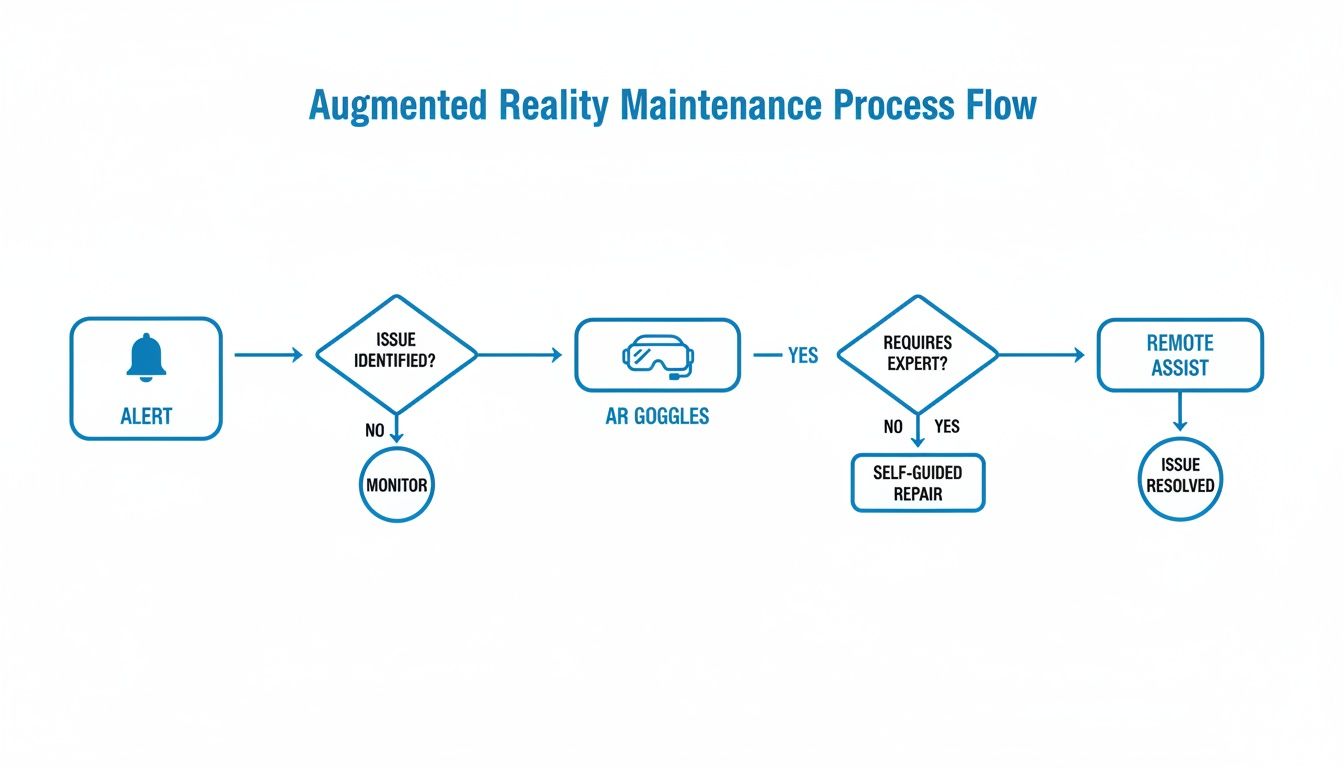
As shown, technology like AR integrates seamlessly into either maintenance strategy. It provides technicians with remote expertise and clear guidance the moment an issue is flagged, whether by a sensor or a calendar.
Frequently Asked Questions
Transitioning from traditional to modern maintenance strategies raises many practical questions. Here, we address common concerns about costs, implementation, and finding the right fit for your business to help you move forward with confidence.
Is Predictive Maintenance Too Expensive for a Small Business?
While predictive maintenance (PdM) has a higher upfront cost than a simple preventive schedule, it is an investment that typically pays for itself, even for smaller businesses. The key is to be strategic. Avoid overhauling everything at once.
Instead, start by identifying one or two of your most critical assets—those whose failure would cause the most significant financial damage. By focusing your initial investment there, you can achieve a rapid return. Often, the savings from preventing a single catastrophic failure on that one machine will cover the cost of the entire pilot program. This approach proves the business case and makes the financial commitment more manageable.
The question isn't whether you can afford predictive maintenance, but whether you can afford the unplanned downtime it prevents. A smart, focused implementation on high-value assets delivers maximum impact with minimal initial spend.
How Can We Start a Predictive Maintenance Pilot Program?
Initiating a pilot program is the most effective way to validate predictive maintenance for your facility. The goal is to prove its value on a small scale before committing to a full rollout. A successful pilot typically follows these steps:
- Select Your Assets: Choose a couple of high-value, failure-prone, or historically problematic machines. Having good historical data on their past failures will serve as a benchmark for success.
- Define Success Metrics: Set clear Key Performance Indicators (KPIs), such as reducing unplanned downtime, cutting repair costs, or extending the operational life of the selected assets.
- Deploy Technology: Install sensors on the chosen assets and connect them to a monitoring platform to begin gathering real-time data.
- Analyze and Act: Monitor the data for anomalies that could signal a future failure. When an alert is received, act on it promptly and document the process and outcome. This will allow you to compare the results directly to previous failure scenarios.
Can a Hybrid Maintenance Approach Really Work?
Absolutely. In fact, a hybrid approach is the most practical and effective strategy for the vast majority of industrial operations. It is rare for a facility to have assets that are all equally critical, so a one-size-fits-all approach in the predictive maintenance vs preventive maintenance debate is rarely efficient.
A hybrid model allows you to apply the precision of PdM to your mission-critical equipment while keeping less vital, more predictable assets on cost-effective PM schedules. This balanced strategy enables you to allocate resources where they matter most—providing advanced protection for your most important assets without overspending on equipment where the risk is lower. It truly offers the best of both worlds.
Empower your maintenance teams with cutting-edge tools that bring data to life. AIDAR Solutions provides AR and VR platforms that integrate seamlessly with your maintenance strategy, reducing errors, speeding up repairs, and delivering expertise right when you need it. Discover how our immersive solutions can maximize your ROI at https://aidarsolutions.com.