
The automotive industry trains in virtual reality

The automotive industry is one of the fastest-growing and most competitive industries in the world. In addition to innovations such as autonomous cars and electric vehicles, the sector is actively looking for ways to keep up with current trends and market expectations. It’s no wonder that vehicle manufacturers worldwide are using virtual reality technology, reaping huge benefits from it. Training is a particular area where VR is of interest to the automotive industry.
Car production involves many processes that involve specialists with a wide range of diverse competencies. Cars must be produced efficiently, but also meet the highest quality and safety standards, otherwise the company risks severe legal repercussions and risks its reputation. Industrial metaverse technologies, led by virtual reality, offer the automotive industry a range of supporting solutions that manufacturers are eager to adopt. A Fortune Business Insights report states that the global VR market in automotive will grow at a rate of 45 percent annually, reaching a value of over $14 billion by 2027.
The development of this segment is driven by the green transformation of transport and automotive. Soon, car manufacturers will have to use alternative drives in vehicles – electric motors and hydrogen-powered ones. The challenge for manufacturers is also to create stronger and more efficient batteries. This involves changing the way cars are produced, and thus the competencies of production teams, the appearance of their work and the scope of responsibilities. There is therefore a growing demand for workers specialized in the production of vehicle parts, including engines and batteries for electric cars. Meanwhile, the automotive industry, like other branches of the market, is experiencing a serious shortage of specialists. The challenge is to attract people to work, hire them, train them properly, and at the same time ensure that they stay with the company for as long as possible.
Recruitment, onboarding, training and knowledge transfer are processes that can build great (or not necessarily) employee experiences that will determine their success and that of companies. Using VR technology for these undoubtedly contributes to this. With this in mind, Aidar, a company specializing in creating Virtual Reality/Augmented Reality software for knowledge transfer and remote service for industry, operates. Its founding partners, Przemysław Maliszewski and Marek Czarzbon, observe growing interest in this solution in the automotive industry.
“We look at the training process through the prism of enabling companies to build a knowledge base that can be developed and passed on within the organization. The common denominator of our solutions is people, because there is no place here to transfer their competencies into the ‘hands’ of a robot, but to raise the rank of expert skills and ensure that they are not lacking. In mixed reality, people are trained by people,” argues Przemysław Maliszewski, CEO, co-founder of Aidar sp. z o.o.
The goal of training in a virtual environment is to enable employees to perform tasks under conditions of limited resource availability – a significant distance separating the expert from the company or a competency gap, the elimination of which would involve a complex and time-consuming process. On one side are specialists who, without organizing repetitive, time-consuming training meetings, reach a wide audience. On the other side are employees who have a chance to gain valuable knowledge about often very complex processes in an express mode. Virtual simulations provide a number of benefits for car and car parts manufacturers – they reduce research and development costs, optimize production, open up new possibilities for marketing and sales strategies through the creation of virtual car models or showrooms. The role of VR in minimizing the risk associated with driving by adopting prototypes and test drives, all in a virtual environment, is also invaluable. Although there is a huge scope for VR adoption and integration in the automotive industry, learning and training seem to be key here at the moment.
Virtual production line
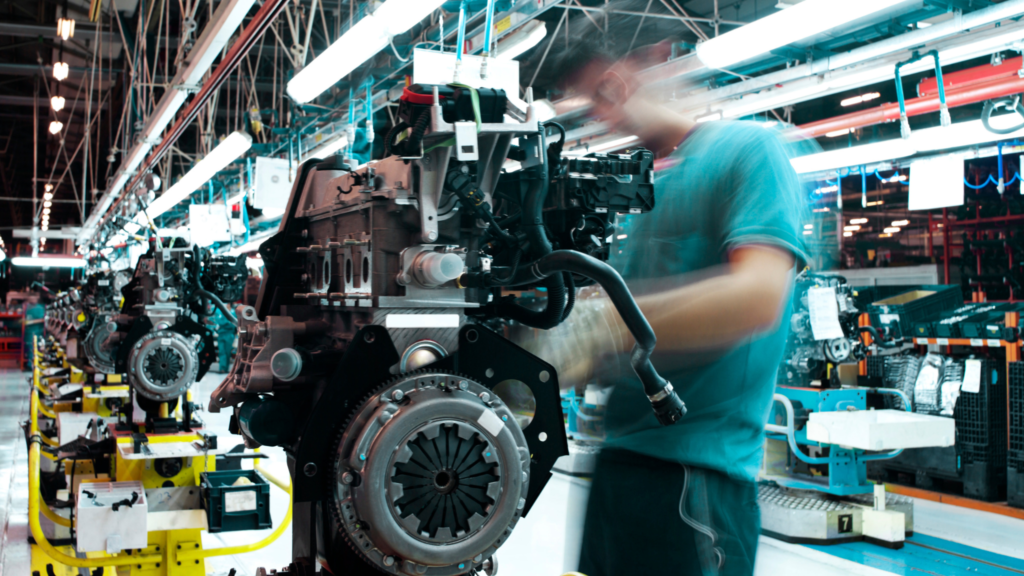
Most car manufacturers use a standard approach to training their employees. First and foremost, they undergo theoretical training, and then practice working with real operational equipment and materials under supervision.
At the practical stage, employees experience a lot of stress and – obviously – make mistakes. Some of these can be harmful to humans or lead to equipment damage. Meanwhile, VR training immerses the trainee in a three-dimensional space, simulating a real work environment. This allows the trainee to start practicing skills in a safe environment right from the start. Mistakes cause no harm, so the trainee feels quite confident and can repeat actions as many times as necessary to achieve perfection.
Vehicle assembly: Volkswagen, Ford and Mercedes
Traditional assembly training in the automotive industry does not allow assembly line workers to master the appropriate gestures. Learners need a different, more practical approach, and VR training comes to the rescue.
A controlled and safe learning environment increases training effectiveness and, as a result, reduces the number of workplace accidents. BMW’s training program has for years been supported by a virtual assembly line where participants practice performing their duties correctly. VR training data shared by Ford shows that the manufacturer has made improvements to the production process that have reduced assembly line injuries by 70 percent.
Ford has created a virtual laboratory that allows its engineers and designers to collaborate in real time, even if they are in different countries. The company has also created FIVE (Ford’s Immersive Vehicle Environment), which uses motion capture markers and sensors to understand how users and drivers interact with the vehicle.

The Volkswagen Group, on the other hand, has turned to VR training to educate its employees and support their concentration and motivation. Students are immersed in a virtual environment that replicates a real logistics center. The program provides guidance on which objects to interact with and how to do so correctly. The VR training was created with increasing levels of difficulty, allowing employees to repeat levels as many times as they want, at their own pace, until they achieve optimal results. Assembly training at Volkswagen includes more than 30 different tasks, such as installing a door or brake in a specified time. In addition to production training, VR also includes customer service training and new employee onboarding. During the training, a supervisor is available to observe progress, providing advice and tips for improvement. Training can be recorded to improve quality and best match the learner’s pace and needs. Volkswagen makes good use of the scalability of training and, with the help of virtual reality, creates a more effective knowledge transfer environment.
VR applications are used in many areas throughout the Volkswagen Group, bringing huge benefits to the company. They play a particularly important role in the early stages of vehicle development, making it unnecessary to build physical prototypes of vehicles or their parts. VR tools reduce material and business travel expenses, thus helping to achieve sustainability goals. They also simplify coordination and evaluation processes. Overall, they save a lot of time and money.
The Mercedes-Benz Manufacturing Poland Engine and Electric Battery Factory in Jawor – the manufacturer’s first engine and battery factory for electric cars in Poland – has opted for assembly training in the digital space. The plant recreated a car engine in virtual reality, based on detailed CAD data, i.e. created its faithful digital copy – the so-called digital twin. The next stages of assembly were then mapped in VR. This created 110 virtual workstations, through which the company could conduct effective employee training while still building the machine park and assembling the team for the new factory. Each stage was assigned a package of lessons in the form of exercises that equipped employees with theoretical and practical knowledge.
Before implementing VR technology for employee training, the automotive company had its own training center with physical workstations with tables and tools. To make it easier for employees to transition from traditional training to the virtual world, the same tables and tools were transferred to it, placing them in exactly the same configuration as in reality. So when employees put on VR goggles, they saw a digital reflection of the world they knew.
BMW: comprehensive VR/AR training
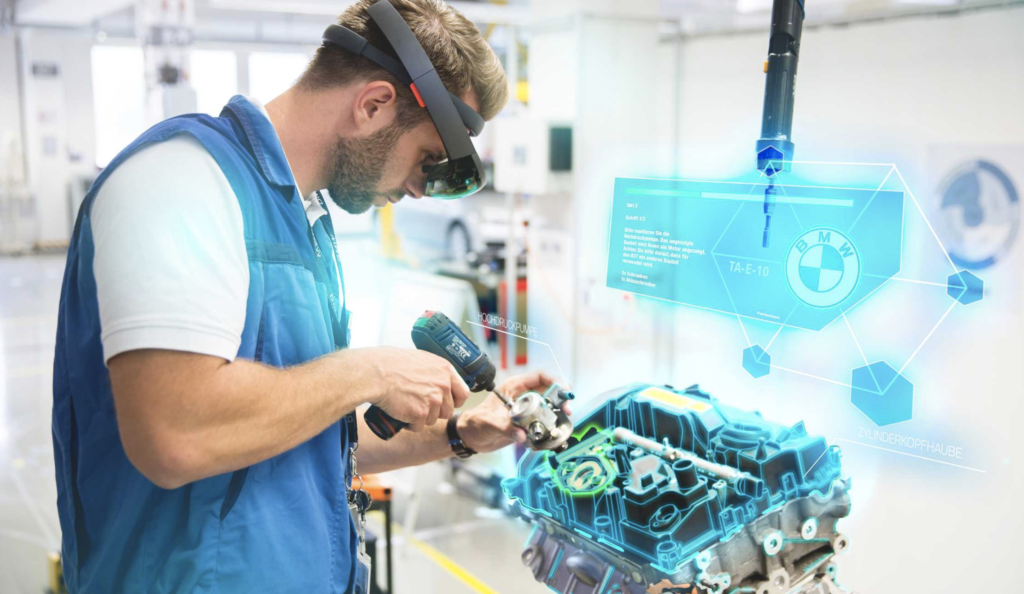
BMW has been using various types of virtual reality since the 1990s, which it systematically expands and develops. The German company focuses on discovering ever newer possibilities for VR training and has a complete training package developed in this environment. BMW’s training enables hyper-realistic simulations of work on the assembly line, in customer service or the duties of safety managers. Each VR course consists of three different areas; workplace planning, knowledge and qualification acquisition, and comparison of component and construction data. BMW notes that employees make great progress through immersive learning methods. The company therefore uses them on a daily basis, appreciating that virtual training consumes much less money and time. https://www.bmw.com/en/events/nextgen/driving-simulator.html
Peugeot: learning everyday life in the company
The PSA Group, manufacturer of the Peugeot brand, has developed training in which employees learn how to make their workday as effective as possible. The training transports employees to a virtual space and there trains them in having a safe, healthy and productive workday.
The method is already being used in five countries. The training begins with a session with a physiotherapist, where the employee learns stretching. Next, activities are trained that are later verified. The training offers voice interaction, and activities are trained with the help of images and texts. Finally, it also includes soft skills, for example communication with co-workers in a virtual workplace reflecting offices and production halls. The PSA Group uses more than a hundred headsets for this. More than 60 training variants have been developed so that 40,000 employees spread across five countries can benefit from it.
Logistics: Audi and Volkswagen
Audi recognizes that VR training can have many advantages, for example, it is not tied to a fixed location or equipment. It is an extensive training system that requires exceptional accuracy from the employee. Good training is necessary to maintain and eliminate production errors.
Audi trains its employees using VR to work as efficiently as possible with the logistics system. The trainee enters a virtual version of their workplace at the Logistics Center in Ingolstadt. Using VR goggles and controllers, logisticians train the activities they use on a daily basis. Audi also uses VR training for salespeople, who learn communication skills by talking to consumers in VR and receive points for making the right choice. The program tallies points and indicates areas for improvement.
Volkswagen, where similar training takes place, appreciates their additional benefit – reducing the need for physical space and equipment for logistics employee training.
The future of learning and training in VR for automotive
Car manufacturers, observing the benefits of employee training in VR, are gradually increasing the scope of using virtual reality and complementary immersive technologies in other processes. The technology is developing rapidly and becoming more accessible, which is why more and more manufacturers are using it.
Digital space allows people to experience the real world in an incredibly immersive way, which is why it seems invaluable in any field where field practice is necessary to achieve proficiency and perfection. An obvious direction, then, is to use it to train vehicle drivers, who could get behind the wheel and practice maneuvers without the risk associated with the future driver’s participation in actual road traffic.
VR simulators have long been proven in training pilots, who gain experience at the controls of aircraft in a safe, virtual environment. They can learn from mistakes without endangering the lives of crew and passengers, without creating danger to the environment. Today, when technology development has influenced its wider availability, greater choice of options and lower costs, an analogous solution is already being used in some driving schools. There, students gain experience, practice motor memory and – no less importantly – become familiar with the new role of driver and gain self-confidence, which no theoretical course can replace.
Metoda okazuje się tak skuteczna, że w Korei Południowej, która jest światowym liderem w dziedzinie nowych technologii, w tym cyfrowych, oraz jednym z najważniejszych partnerów UE w dziedzinie badań i innowacji, do 2025 r. to właśnie VR ma decydować o tym, czy seniorzy oraz osoby z niepełnosprawnościami zachowają prawo jazdy. Wyższe ryzyko powodowania wypadków drogowych w grupie 65+ zachęciło władze kraju do wprowadzenia technologii symulacji prowadzenia pojazdu, badającej przy okazji funkcje poznawcze badanych np. zdolność zapamiętywania, do oficjalnego systemu podejmowania i wykonywania transportu drogowego.

