Enhance Manufacturing Efficiency Improvement with AR & VR
Improving manufacturing efficiency is a powerful concept: maximizing output while using the fewest possible resources. Achieving this directly boosts profitability by cutting costs, reducing waste, and minimizing downtime. The key is to systematically identify and eliminate the bottlenecks holding back your production workflow.
Auditing Your Operations for AR and VR Opportunities
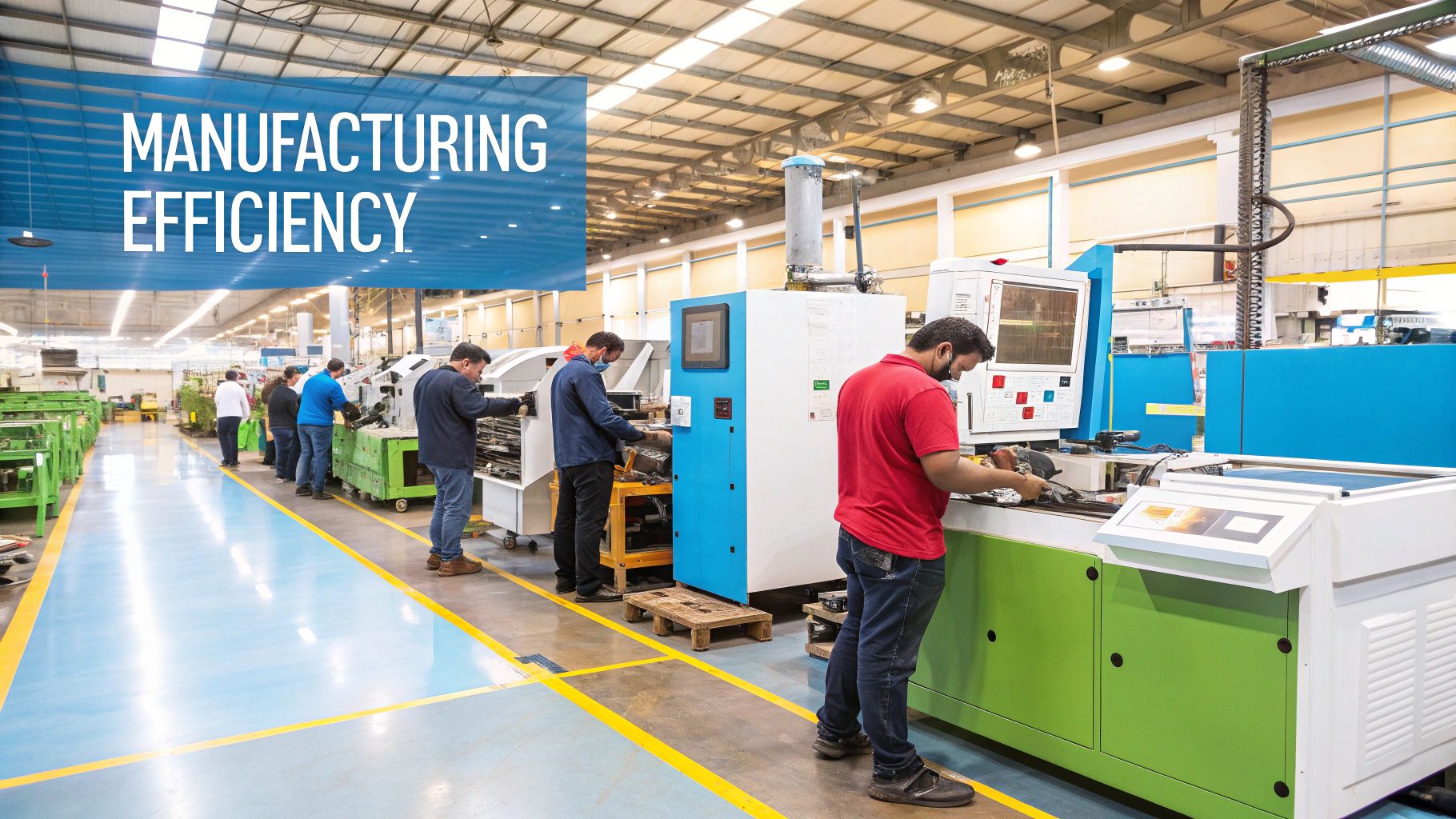
Before you can improve your processes, you must understand your current performance. Implementing AR/VR technology without a clear picture of your operational baseline is an inefficient use of capital. You risk investing in solutions that don't address your most critical needs.
A thorough audit of your production lines is the essential first step. It provides the hard data needed to pinpoint the most impactful opportunities for a manufacturing efficiency improvement project. This is not a generic checklist exercise; it's a detailed analysis of your entire workflow from start to finish.
The objective is to move beyond assumptions and make decisions based on solid evidence. By mapping every process, from raw material intake to final product shipment, you uncover the hidden inefficiencies that erode your bottom line. This process highlights the exact points where delays, errors, or waste occur, making them prime targets for a technology-driven solution.
Establishing Your Performance Baseline
To build a robust business case for AR/VR integration, you need concrete data. Establishing baseline metrics provides the crucial "before" picture, allowing you to accurately measure the "after" and prove a tangible return on investment. Without this benchmark, justifying the expenditure becomes a significant challenge.
Before implementing new technology, it is essential to measure your current state. This table outlines the critical KPIs that will form your performance baseline, helping you quantify the impact of AR/VR initiatives.
| Metric | What It Measures | Common Target Goal |
|---|---|---|
| Overall Equipment Effectiveness (OEE) | A composite score of machine availability, performance, and quality. A true measure of productivity. | 85% is considered world-class. |
| Cycle Times | The total time it takes to complete one unit or a specific task from start to finish. | Varies by process, but goal is consistent reduction. |
| Defect and Scrap Rates | The percentage of products that fail quality checks or are discarded as waste. | Aim for <1%. Zero defects is the ultimate goal. |
| Operator Downtime | Time operators spend not working, e.g., waiting for parts, info, or expert help. | Minimize as much as possible, aiming for <10% of shift time. |
These metrics are more than just numbers; they form the foundation of your business case. They tell a clear story about your operational health and point directly to areas requiring improvement.
This data-driven approach is about building a compelling narrative that demonstrates a clear need and a measurable path to improvement. A well-defined problem backed by solid metrics is the most effective way to gain stakeholder buy-in for new technology.
Pinpointing High-Impact Opportunities
Once your baseline is set, you can analyze the data to identify where AR/VR can deliver the most significant impact.
For example, consistently high defect rates on a complex assembly line suggest that AR-powered digital work instructions—projecting step-by-step guidance directly onto the workstation—could dramatically improve accuracy and reduce costly rework.
Alternatively, if machines are idle for hours while waiting for a senior technician, this presents a powerful use case for remote assistance via AR smart glasses. An expert can see what the on-site operator sees and guide them through a fix in minutes, not hours, drastically reducing equipment downtime.
The smart manufacturing market is projected to reach $589 billion by 2028, signaling a massive industry-wide push for operational excellence. Furthermore, by 2025, approximately 70% of manufacturers are expected to use IoT for real-time monitoring, creating richer data streams to inform strategic decisions. You can explore these manufacturing industry statistics on e-bi.com.
By starting with a thorough audit, you are not just acquiring new technology—you are making an informed, strategic investment that positions your organization for future growth.
Choosing the Right Immersive Tech for Your Factory
Selecting the appropriate immersive technology for your factory is a critical decision that must be grounded in the specific, real-world problems you aim to solve. The key is to match the technology—Augmented Reality (AR) or Virtual Reality (VR)—to the precise challenge hindering your efficiency.
AR enhances a worker’s perception of their immediate, physical environment. A technician wearing smart glasses, for instance, can view a piece of machinery and see digital instructions, schematics, or performance data overlaid directly on top of it. This is a practical solution for reducing assembly errors and accelerating maintenance, as it eliminates the need to consult paper manuals or tablets.
VR, in contrast, immerses the user in a completely simulated, computer-generated environment. Its primary value in manufacturing lies in creating a safe, controlled space for training and planning. New hires can learn to operate heavy machinery in a realistic simulation without occupying production equipment or risking injury.
Distinguishing Between AR and VR Use Cases
To make an informed decision, you must understand where each technology excels.
A simple way to differentiate them is: AR is an on-the-job digital assistant, while VR is an off-the-floor virtual training ground. This distinction is crucial for maximizing your return on investment.
Consider these common manufacturing scenarios:
- For quality control, an inspector using AR can overlay a digital template directly onto a physical part. Any deviation from the specification is instantly highlighted, improving accuracy and speed.
- For factory layout planning, engineers can use VR to walk through a full-scale digital twin of a new production line. This allows them to identify ergonomic issues or workflow bottlenecks before any physical equipment is installed.
This visualization demonstrates how targeted improvements, often enabled by immersive technology, can significantly impact key metrics.
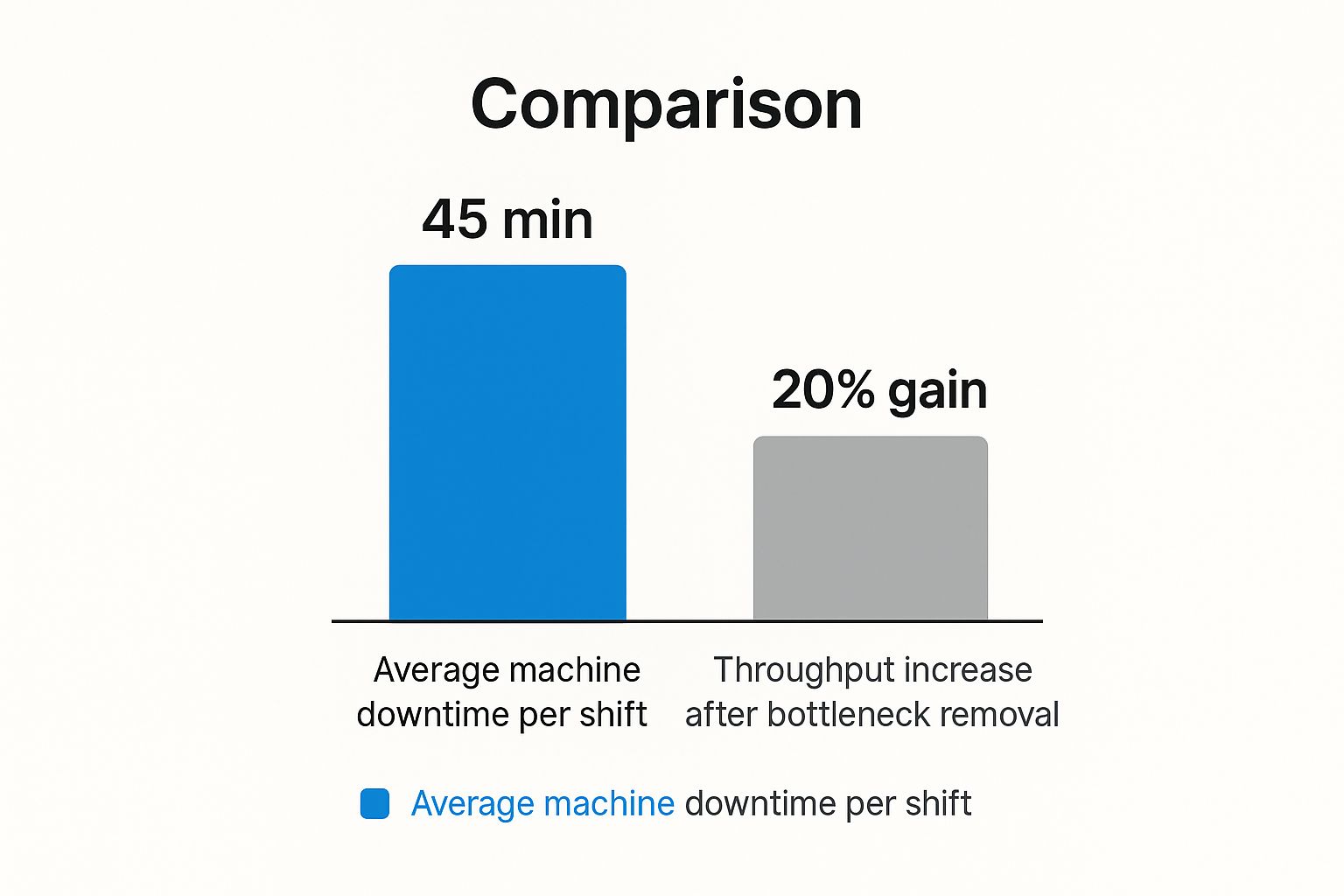
The data speaks for itself. Addressing a specific issue like a production bottleneck can directly lead to a major increase in throughput while slashing expensive downtime.
To clarify which technology is best suited for various tasks, here’s a breakdown comparing common applications.
AR vs VR Application Comparison for Manufacturing
This table contrasts some of the most effective use cases for both AR and VR on the factory floor, helping you determine where each technology delivers the most value.
| Application Area | Augmented Reality (AR) Solution | Virtual Reality (VR) Solution |
|---|---|---|
| Training & Onboarding | Guided, step-by-step instructions overlaid on real equipment for on-the-job learning. | Immersive, risk-free simulations for operating complex machinery or practicing emergency procedures. |
| Maintenance & Repair | Real-time diagnostic data and remote expert assistance displayed in the technician's field of view. | Not typically used; AR is the stronger fit for real-world repair tasks. |
| Assembly & Quality | Digital work instructions and quality checklists projected directly onto the workstation or part. | Pre-production ergonomic assessments and assembly process validation in a virtual environment. |
| Design & Prototyping | Visualizing 3D models at full scale in the physical factory space to check for fit and clearance. | Full-scale virtual walkthroughs of new factory layouts or production lines before physical build-out. |
As shown, the choice is not about which technology is superior, but which one is the right tool for the specific job at hand.
Integrating Tech with Your Existing Systems
A successful rollout depends on how well the new technology integrates with your existing systems, such as your Manufacturing Execution System (MES) or ERP. The goal is a seamless flow of information, not another data silo. An AR solution, for instance, should pull a work order from your ERP, display it to the operator, and feed completion data back into the system automatically.
This integration is part of a larger trend. A recent Manufacturing Leadership Council survey found that approximately 40% of manufacturing executives are focusing on smart factory strategies to reduce costs and improve customer satisfaction. This technology is becoming a core part of the operational fabric.
The right technology should not be a standalone gadget. It should be a strategic enabler, deeply woven into your operations, empowering your team instead of complicating their work.
Viewing this technology as a strategic asset is key. You can learn more about how to use XR as a strategic enabler for competitive advantage in our detailed guide. Success comes down to aligning the solution with your specific goals, ensuring it integrates with your current systems, and selecting a use case that will deliver measurable value.
Rolling Out AR and VR Without Disrupting Production
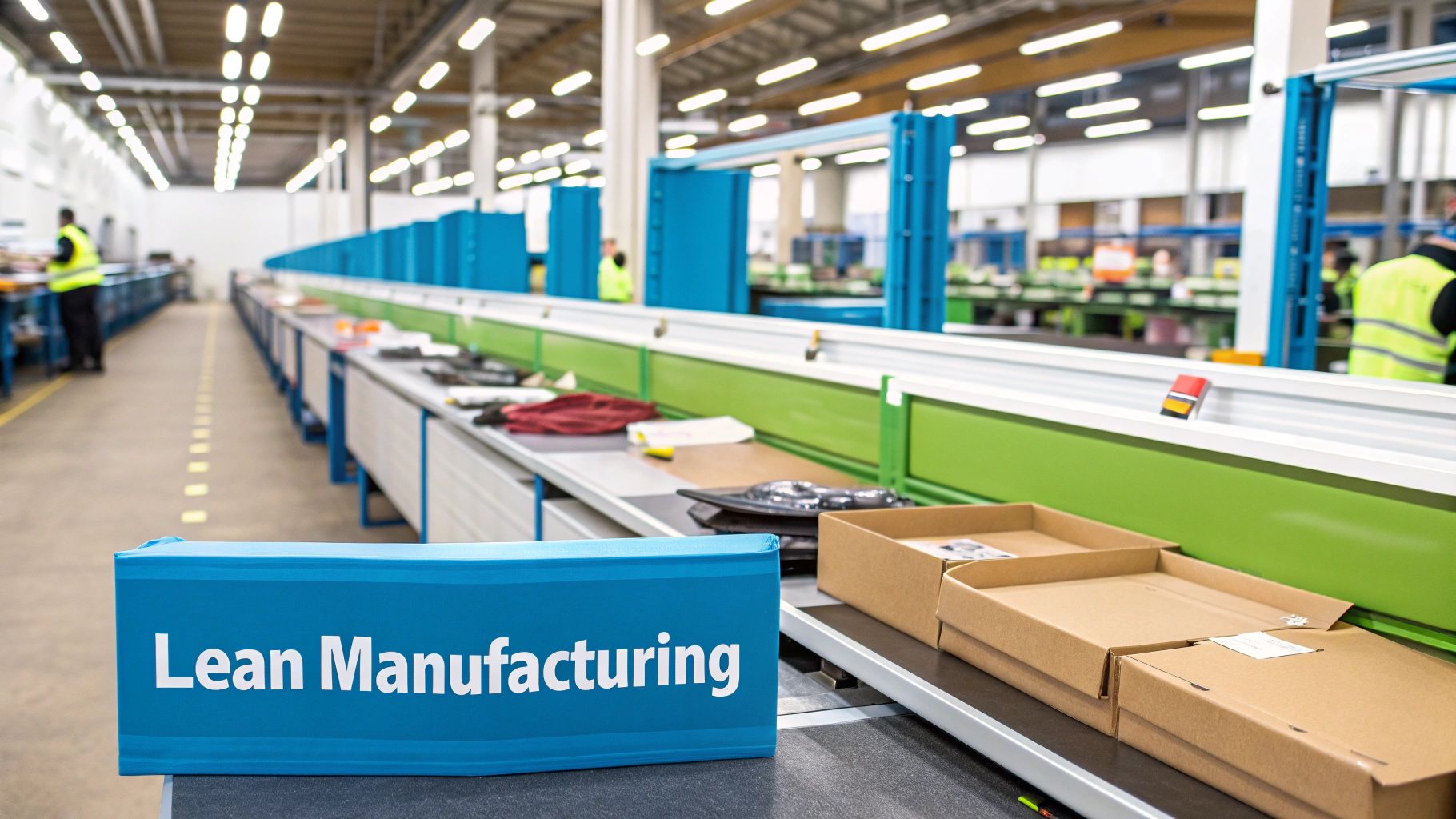
Even the most advanced technology is ineffective if your team does not adopt it. A successful AR and VR rollout is less about the hardware and more about the people. To achieve a real manufacturing efficiency improvement, you need a strategic, phased approach that minimizes disruption and secures team buy-in from the outset.
Avoid a sweeping, facility-wide launch, which can lead to chaos and resistance. Instead, start small with a targeted pilot program. This controlled test allows you to refine the process, gather real-world feedback, and build a powerful case study before scaling up.
Launching a Targeted Pilot Program
The success of your pilot hinges on selecting the right area. Do not begin with your most complex or problematic production line. Instead, refer to your initial audit and choose an area with a clear, high-impact opportunity where a quick win is likely.
Once you have identified the line, set clear, achievable objectives for the pilot. These goals must tie directly back to the baseline metrics you have already established.
- Example Goal: Reduce the error rate on Assembly Line 3 by 15% within 60 days using AR-guided work instructions.
- Example Goal: Decrease the average training time for new hires on the CNC machine by 25% with a new VR simulation module.
A smooth rollout is impossible without effective change management. This is non-negotiable. You must secure early buy-in from both leadership and, critically, the line operators who will use this technology daily.
Building Operator Confidence and Overcoming Resistance
Resistance to new technology is a natural response. The most effective way to overcome it is through hands-on training and clear communication. Your pilot program must include a dedicated training phase where operators can become comfortable with the AR glasses or VR headsets in a low-pressure environment.
Identify a few enthusiastic team members to act as "champions." These individuals can help train their peers, answer questions, and provide invaluable on-the-ground feedback. Their endorsement will be far more influential than any top-down directive. A key part of this is ensuring the training is effective. For a deeper analysis, review our guide on how to measure training effectiveness.
The feedback collected during this pilot is invaluable. Listen carefully to what your operators report. Are the headsets uncomfortable after an hour? Are the on-screen instructions unclear? Use this input to refine your approach, adjust the software, and perfect the process.
This iterative feedback loop ensures that when you decide to scale, the solution is already proven, polished, and—most importantly—accepted by the people who will use it every day.
Measuring Real-World Impact on Your KPIs
Deploying AR and VR technology is just the beginning—proving its value is what anchors it in your long-term strategy. To demonstrate a genuine manufacturing efficiency improvement, you must connect every result directly back to the baseline Key Performance Indicators (KPIs) established during your initial audit.
This is where you move from qualitative benefits to quantitative data. By comparing metrics from before and after the technology rollout, you can present a clear, undeniable picture of its real-world impact on your bottom line.
Connecting Tech to Tangible Results
The most compelling proof comes from tracking specific, high-impact KPIs where AR and VR are known to make a significant difference. Instead of focusing on broad, facility-wide numbers, concentrate on the direct results from your pilot programs. This targeted approach provides clear cause-and-effect evidence.
Focus your analysis on these critical areas:
- Reduced Error Rates: Compare defect and scrap rates on an assembly line before and after implementing AR-guided work instructions. A measurable drop from 3% to 0.5% is a powerful testament to improved accuracy.
- Accelerated Training: Analyze onboarding data for new hires. If operators trained with VR simulations reach full productivity in two weeks instead of the previous average of five, you have quantified a massive efficiency gain. Explore more about this process in our guide on virtual reality training solutions.
- Decreased Machine Downtime: Track the average time to resolve equipment failures. When AR-assisted remote expert guidance cuts that time by 50%, you establish a direct link between the technology and increased operational uptime.
The goal is to build a narrative supported by numbers. Showcasing a 40% reduction in quality control errors or a 60% faster maintenance response time provides the concrete evidence stakeholders need to see.
Calculating a Compelling Return on Investment
Calculating the ROI is the final, crucial step. It translates your operational wins into a financial argument that resonates with leadership and justifies further investment in the technology.
The formula is straightforward: compare the total cost of the AR/VR implementation (hardware, software, training) against the financial gains it produced. These gains derive directly from the KPI improvements you have been meticulously tracking. For a deeper dive into tracking the overall health and productivity of your operations, it's worth checking out resources on measuring operational efficiency.
This data-driven approach is becoming standard in modern manufacturing. Projections indicate that AI-driven smart factories will boost global manufacturing productivity by about 30%, primarily by reducing downtime and defects. The adoption of digital twins—virtual models of physical processes—is expected to reach 70% usage by 2035, creating opportunities for even greater remote process optimization. By meticulously measuring your impact, you create a powerful case for continued innovation and secure the budget needed to scale your successes.
Scaling Your Strategy for Continuous Improvement

Your successful pilot program was the test flight; now it is time to build the fleet. A pilot's success is not the finish line—it's the launchpad for a long-term strategy that embeds manufacturing efficiency improvement into your company's culture. This is how you transform a single project into a sustainable competitive advantage.
The first step is to leverage the data and success stories from your pilot to build a powerful business case. The metrics on lower error rates, faster training, and reduced downtime are your most persuasive assets. Present this not as a technical report, but as a financial narrative demonstrating a proven ROI.
Building the Business Case for Expansion
To secure the budget and buy-in for a broader rollout, you must connect your pilot's operational wins directly to the bottom line. Communicate in the language of leadership: cost savings, increased throughput, and enhanced production capacity.
For instance, show how a 30% reduction in assembly errors on one line will translate to millions in saved material and rework costs when scaled across five additional lines. This reframes the conversation from a technology expense to a strategic investment with predictable returns.
The most compelling case for scaling is a story backed by hard evidence. When you can show how a single AR/VR implementation solved a specific, costly problem, you’re providing an undeniable blueprint for success that leadership can confidently get behind for other facilities.
The concept of continuous improvement in manufacturing has deep historical roots. For context on how pioneering companies have transformed production, it's worth learning about Toyota's innovative manufacturing approaches. This reinforces that your efforts are part of a proven legacy of operational excellence.
Fostering a Culture of Continuous Improvement
Technology alone cannot sustain efficiency; your people must be the driving force. True scalability is achieved when you cultivate a culture where every team member is empowered to identify new opportunities for improvement. This requires moving beyond top-down directives and encouraging operators, technicians, and supervisors to find creative uses for AR and VR in their daily work.
Establish feedback channels where employees can suggest new applications. A maintenance technician might realize the AR remote support tool used for machine repair could also be applied to remote quality inspections with suppliers. Recognizing and rewarding such insights transforms your workforce into an engine for innovation.
This cultural shift enhances organizational agility. When your team is actively involved, they become more adaptable and resilient. They don't just use the tools provided; they actively seek new problems to solve with them, creating a self-sustaining cycle of improvement. For more on this, explore how to deploy augmented reality for manufacturing to support this cultural change.
Staying Ahead of Emerging Trends
Finally, successful scaling requires keeping an eye on the future. AR and VR capabilities are constantly evolving, with new developments in AI integration, lighter hardware, and more sophisticated software. Staying current ensures your manufacturing operations remain agile and prepared for what's next.
- Establish a dedicated innovation team to evaluate emerging technologies.
- Encourage participation in industry webinars and trade shows to stay informed about new trends.
- Maintain strong relationships with technology partners to gain insights into their product roadmaps.
By systematically building your business case, nurturing a culture of employee-led innovation, and staying attuned to future trends, you ensure your initial success with AR and VR becomes the foundation of a more efficient, agile, and competitive manufacturing operation for years to come.
Common Questions About AR and VR in Manufacturing
Adopting new technology often raises practical questions from manufacturing leaders. Addressing these common concerns is a critical first step toward developing an effective implementation plan.
One of the first questions is always about the return on investment. Leaders need assurance that the upfront cost will deliver tangible, bottom-line benefits. The ROI for AR and VR can be both significant and rapid, particularly when targeting specific, high-cost problems.
For instance, using AR for remote assistance can reduce machine downtime by up to 50% by eliminating the need for specialists to travel to a site. In assembly, AR guidance has been shown to reduce error rates by over 30%, directly cutting scrap and rework costs.
How Hard Is System Integration?
Another major concern is how these new tools will integrate with the existing technology stack. The prospect of a complex integration with an established Manufacturing Execution System (MES) or Enterprise Resource Planning (ERP) platform can be a significant deterrent.
Modern AR and VR platforms are designed with this challenge in mind. Most reputable solutions offer robust APIs (Application Programming Interfaces) and SDKs (Software Development Kits) to facilitate smooth connections with existing systems. A common integration involves pulling work orders or product schematics from an ERP directly into an operator's AR headset, creating a seamless flow of information where it's needed most.
The key is to address integration during the pilot phase. Discuss these capabilities with potential vendors and test the data flow early on to prevent major issues during a full-scale rollout. This ensures the technology enhances existing workflows rather than disrupting them.
What About the Learning Curve for Employees?
Finally, there is the human element: how difficult will it be for factory workers to adapt to using AR glasses or VR headsets daily? Experience shows that the learning curve is often shorter than decision-makers anticipate.
Industrial AR and VR interfaces are designed for simplicity, often relying on intuitive controls like voice commands, simple hand gestures, or gaze tracking. A successful rollout always includes a structured training program where employees can get comfortable with the hardware in a low-pressure setting.
Here’s a practical approach:
- Start with 'Champions': Identify a small group of tech-savvy or enthusiastic employees to learn the system first. They can become peer trainers, accelerating adoption across the team.
- Focus on a Single Use Case: Introduce the technology for one specific, high-impact task. Allow the team to build confidence before expanding to other applications.
- Gather Feedback: Actively solicit input from users. This helps you make necessary adjustments and demonstrates that their experience is valued.
This strategy helps turn potential resistance into enthusiastic adoption, ensuring the technology empowers your workforce from day one.
Ready to get answers to your own questions about how this technology can transform your operations? AIDAR Solutions provides expert-led implementation of AR and VR tools that deliver measurable results—from halving service times to quadrupling training throughput. Discover how we can tailor a solution for your unique challenges at https://aidarsolutions.com.