
Experiential Learning Examples: 10 Ways to Elevate Training
In today's fast-paced industrial and corporate environments, traditional training methods are falling short. The demand for adaptable, skilled, and resilient teams has never been higher, pushing organizations to adopt more effective learning strategies. Experiential learning, the process of learning through direct experience, is no longer a novel concept but a strategic imperative.
This approach moves beyond passive observation to active participation. It allows employees to build muscle memory, hone critical thinking, and make decisions in safe, controlled environments. The most effective methodologies often combine practical application with focused guidance. To reinforce the 'learning by doing' principle, consider how real-world training institutions implement practical, hands-on development through expert-led training programs like the Tait Radio Academy.
This article explores 10 powerful experiential learning examples, with a special focus on how immersive technologies like Augmented and Virtual Reality (AR/VR) are revolutionizing corporate training. These methods are boosting retention and delivering measurable ROI. We will break down the strategic value of each method, providing actionable takeaways so you can implement them within your own organization and see immediate results.
1. High-Stakes Simulations & Immersive Role-Playing
At the forefront of modern training, immersive simulations place learners in hyper-realistic scenarios that replicate real-world challenges. This is where abstract knowledge becomes applied skill. Using Virtual Reality (VR) and Augmented Reality (AR), companies create complex, interactive environments for everything from intricate machinery operation to high-pressure customer interactions. This method allows training without the risks or costs associated with live exercises. Participants don't just learn a process; they experience it, making critical decisions and seeing immediate consequences in a safe, repeatable setting.
Strategic Breakdown
This approach is one of the most powerful experiential learning examples because it directly bridges the gap between knowing and doing. By simulating high-stakes situations, it builds procedural memory and critical thinking under duress, something passive learning cannot achieve.
- Objective: Develop muscle memory and decision-making skills for high-consequence tasks in a zero-risk environment.
- Mechanism: VR headsets create a fully immersive digital twin of a workspace, while AR solutions overlay digital instructions and data onto the real world, providing on-the-spot guidance.
- Key Benefit: Reduces cognitive load during real-world performance. Trainees who have performed a task virtually can act more decisively and accurately when it counts, leading to significant reductions in human error and faster task completion.
Strategic Insight: The goal isn't just task repetition. It's about conditioning the brain to handle stress and complexity, making correct actions feel instinctual. AR/VR solutions excel here by providing consistent, scalable, and data-driven training.
Actionable Takeaways
To effectively implement immersive simulations:
- Identify High-Impact Scenarios: Focus on training for tasks that are either too dangerous, expensive, or infrequent to practice in real life, such as emergency shutdowns, complex equipment repairs, or high-value assembly processes.
- Prioritize Realistic Feedback: Ensure the simulation provides immediate sensory and data-driven feedback on performance. This helps learners connect their actions to specific outcomes and accelerates the learning cycle.
- Integrate with Blended Learning: Use AR/VR simulations to supplement, not replace, traditional training. They serve as the practical application phase after foundational knowledge is established, delivering measurable improvements in proficiency.
2. Project-Based Learning (PBL)
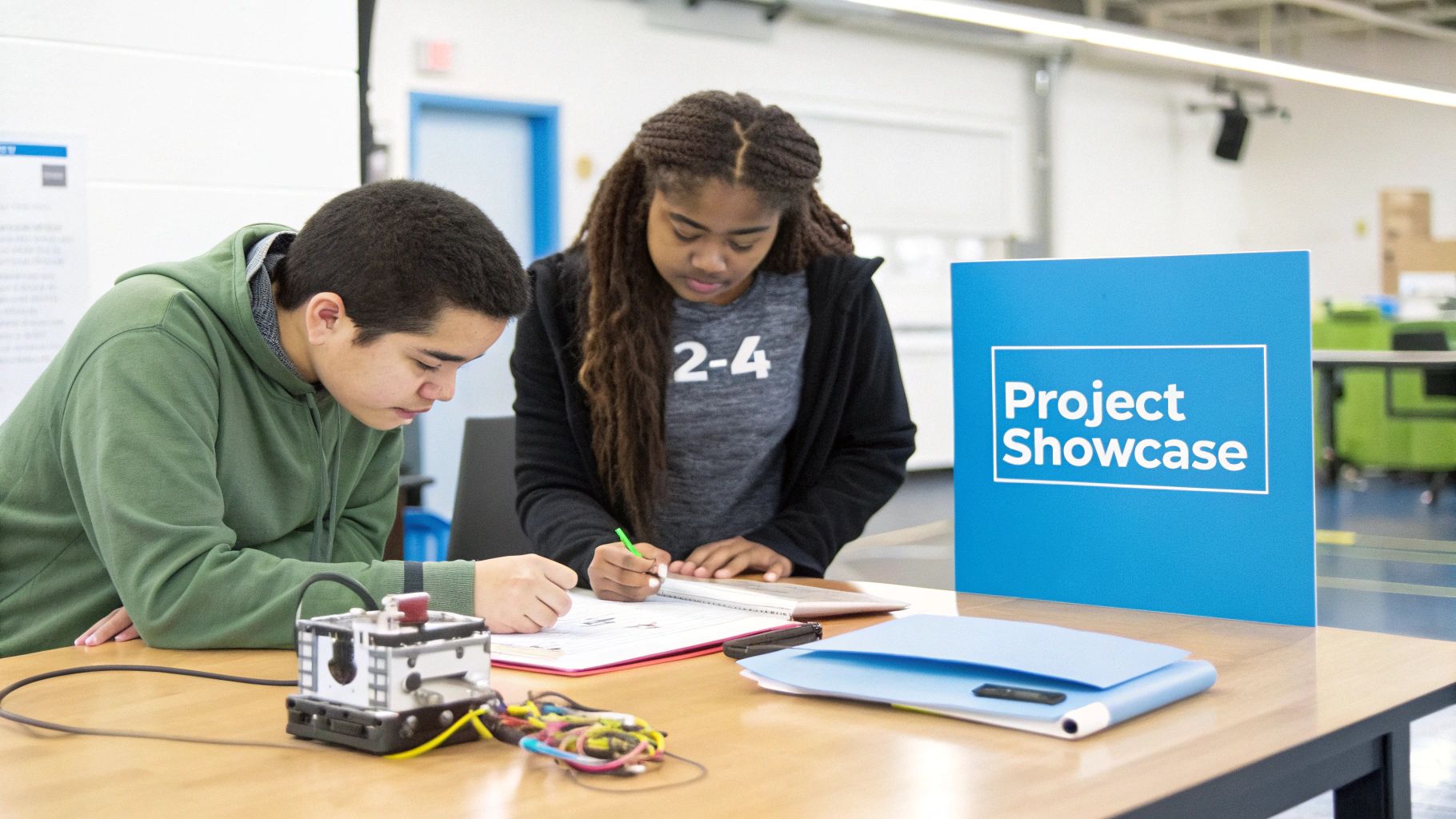
A cornerstone of active learning, project-based learning (PBL) moves beyond rote memorization by challenging learners to solve complex, real-world problems over an extended period. This method requires participants to investigate, collaborate, and create a tangible product or presentation. In settings like engineering programs or corporate innovation labs, teams might design a functional prototype or develop a comprehensive business plan, integrating knowledge from multiple disciplines to achieve a concrete goal.
Strategic Breakdown
PBL is a powerful form of experiential learning examples because it mirrors the demands of the modern workplace, where cross-functional collaboration and problem-solving are paramount. It transforms passive knowledge recipients into active creators, fostering deep, contextual understanding that is directly applicable to professional challenges.
- Objective: Develop critical thinking, collaboration, and problem-solving skills by engaging in a complex, multi-stage project.
- Mechanism: Learners work in teams to address an open-ended question or challenge, managing their time and resources to produce a final deliverable.
- Key Benefit: Cultivates ownership and intrinsic motivation. By working on a meaningful project, learners become more invested in the outcomes and retain information more effectively.
Strategic Insight: The value of PBL isn't just the final product. It's the entire process of navigating ambiguity, managing team dynamics, and overcoming obstacles that builds lasting professional competence.
Actionable Takeaways
To successfully implement project-based learning:
- Define a Compelling Challenge: Frame the project around an authentic problem or question relevant to the industry. The challenge should be complex enough to require sustained inquiry.
- Provide Structured Scaffolding: Equip teams with the necessary resources, templates, and expert guidance. Implement regular checkpoints for feedback and course correction to keep projects on track.
- Establish Clear Assessment Criteria: Develop a detailed rubric that evaluates not only the final deliverable but also the process, including teamwork, critical thinking, and communication skills.
3. Internships and Apprenticeships
A cornerstone of professional development, internships and apprenticeships immerse learners directly into a workplace environment. These structured programs allow participants to apply academic knowledge to real-world tasks under the guidance of experienced mentors. Internships, often shorter-term, provide a snapshot of an industry, while apprenticeships offer a longer, more comprehensive path to mastering a trade or profession, integrating on-the-job training with formal instruction.

Strategic Breakdown
This method is one of the most foundational experiential learning examples because it provides direct, hands-on engagement with actual job responsibilities. It is designed to cultivate practical skills, professional networks, and an understanding of workplace culture that classroom settings cannot replicate. This real-world application is a critical component of many successful workforce development strategies.
- Objective: To transition learners from academic theory to professional practice by embedding them in a real work environment.
- Mechanism: Participants perform meaningful job functions, contribute to team projects, and receive continuous feedback from mentors and supervisors.
- Key Benefit: Accelerates skill acquisition and professional maturity while providing organizations a pipeline of vetted, job-ready talent.
Strategic Insight: The value lies in the authenticity of the experience. Participants aren't just observing; they are contributing team members solving real problems, which solidifies learning and builds confidence.
Actionable Takeaways
To maximize the impact of internships and apprenticeships:
- Establish Clear Learning Objectives: Work with the participant to define specific, measurable goals at the outset to guide their experience and ensure accountability.
- Implement a Robust Mentorship Program: Pair learners with dedicated mentors who can provide regular guidance, feedback, and professional insights beyond daily task supervision.
- Integrate Reflection and Feedback: Schedule regular check-ins and reflection sessions to help participants connect their hands-on work with their learning objectives and career goals.
4. Service Learning
Service learning integrates meaningful community service with instruction and reflection to enrich the learning experience, teach civic responsibility, and strengthen communities. This method moves beyond simple volunteerism by intentionally connecting hands-on service activities, such as environmental restoration projects or running community health clinics, to specific academic curricula. Learners apply classroom knowledge to address real-world community needs, creating a reciprocal relationship where both students and the community benefit from the engagement.
Strategic Breakdown
This model is one of the most impactful experiential learning examples for developing civic and social responsibility alongside professional skills. It grounds theoretical knowledge in the context of tangible human and environmental needs, fostering empathy, critical thinking, and a deeper understanding of complex societal issues.
- Objective: To connect academic learning with civic engagement, developing both practical skills and a sense of social responsibility.
- Mechanism: A structured partnership between an educational institution and a community organization where students perform service that directly relates to their field of study.
- Key Benefit: Fosters a deeper connection to the material by showing its real-world application and impact, which significantly increases learner motivation and retention.
Strategic Insight: The critical element is structured reflection. It's the bridge that transforms the service activity from a standalone good deed into a profound learning experience.
Actionable Takeaways
To implement a successful service learning program:
- Build Reciprocal Partnerships: Work collaboratively with community organizations to identify genuine needs, ensuring the project is beneficial for them and not just a learning exercise for students.
- Integrate Reflection Continuously: Embed reflection activities (journals, group discussions, presentations) before, during, and after the service to help learners process their experiences and connect them to academic concepts.
- Align with Curriculum Goals: Ensure the service work directly supports and enhances specific learning objectives from the course. The connection must be explicit and intentional.
5. Outdoor and Adventure Education
Outdoor and adventure education uses the natural environment as a dynamic classroom, leveraging challenging activities to build resilience, teamwork, and leadership. This method moves learning beyond theory by placing participants in situations where they must collaborate, manage risks, and solve real-time problems. Whether it's a corporate team navigating a wilderness challenge or students learning survival skills, the environment itself becomes the instructor, teaching lessons in adaptability and self-reliance that are difficult to replicate in a traditional setting.

Strategic Breakdown
This approach stands out among experiential learning examples for its focus on developing soft skills and emotional intelligence through managed adversity. The unpredictable nature of the outdoors forces participants to confront their limitations and work together, forging strong interpersonal bonds and a deeper understanding of group dynamics.
- Objective: Cultivate leadership, communication, and problem-solving skills by overcoming tangible, shared challenges in an unfamiliar environment.
- Mechanism: Structured activities like rock climbing, kayaking, or orienteering create scenarios requiring trust, strategic planning, and effective communication to succeed.
- Key Benefit: Fosters profound personal growth and team cohesion. Shared success in a challenging environment translates directly to improved collaboration and resilience in the workplace.
Strategic Insight: The core value is not the activity itself, but the structured reflection that follows. Debriefing sessions help participants connect their outdoor experiences to professional behaviors and challenges.
Actionable Takeaways
To effectively implement outdoor and adventure education:
- Align Activities with Goals: Choose challenges that directly mirror the skills you want to develop. For a team struggling with communication, select an activity that requires constant, clear dialogue for safety and success.
- Prioritize Psychological Safety: While the activities are physically challenging, ensure the emotional environment is supportive. Professional facilitators are crucial for managing group dynamics and ensuring a positive learning outcome.
- Embed Structured Debriefing: The most critical phase is reflection. Schedule dedicated time after each activity for guided discussions that link the experience back to specific workplace scenarios and personal development objectives.
6. Field Trips and Site Visits
A foundational experiential method, field trips and site visits move learning from the abstract to the tangible by immersing participants in authentic, real-world environments. This approach allows learners to connect theoretical knowledge with practical application by observing processes, interacting with experts, and experiencing a professional setting firsthand. Whether it’s a factory tour for engineering students or a hospital observation for nursing trainees, these visits provide context that a classroom or manual cannot replicate. The effectiveness hinges on a structured approach that includes pre-visit preparation and post-visit debriefing.
Strategic Breakdown
This method is a classic and effective form of experiential learning examples because it provides direct observational context, making abstract concepts concrete and memorable. It answers the crucial "why" behind theoretical training by showing learners where their skills will be applied.
- Objective: To bridge the gap between classroom theory and real-world practice by providing firsthand exposure to operational environments.
- Mechanism: Structured, guided visits to relevant sites (e.g., manufacturing plants, active construction sites, corporate offices) where learners can observe, ask questions, and connect concepts to reality.
- Key Benefit: Enhances learner engagement and motivation by demonstrating the real-world relevance of their training, which can improve knowledge retention and application.
Strategic Insight: The value of a site visit isn't just seeing the environment; it's about understanding the complex interplay of people, processes, and technology within that space.
Actionable Takeaways
To maximize the impact of field trips and site visits:
- Define Clear Learning Objectives: Before the visit, establish what specific knowledge or insights learners should gain. Provide them with a structured guide or checklist for observation.
- Facilitate Expert Interaction: Arrange for learners to engage with on-site professionals. A Q&A session with a seasoned engineer or floor manager provides invaluable, practical insights.
- Mandate Post-Visit Reflection: Require a debriefing session or written report where learners connect their observations to their formal training curriculum. Ask them to identify key processes, challenges, or innovations they witnessed.
7. Case Study Analysis
A cornerstone of professional education, case study analysis immerses learners in complex, real-world situations to deconstruct problems and formulate strategic solutions. This method moves beyond textbook theory by presenting detailed narratives of actual business, medical, or engineering challenges. Learners must sift through information, identify core issues, and apply analytical frameworks to propose and defend a course of action. This process sharpens critical thinking and decision-making in a contextually rich environment.
Strategic Breakdown
This method is one of the most established experiential learning examples because it forces learners to confront the ambiguity and complexity of real-world problems. It develops analytical rigor and the ability to synthesize information from multiple sources to justify a decision, mirroring executive-level problem-solving. To broaden perspectives, learners can explore a wider array of case studies that present unique industry challenges.
- Objective: Enhance analytical reasoning, problem-solving, and strategic decision-making by examining real-world scenarios.
- Mechanism: Participants analyze a detailed case, apply relevant theories, and engage in facilitated discussions to explore different viewpoints and potential outcomes.
- Key Benefit: Develops diagnostic and decision-making skills in a low-risk setting, allowing learners to practice high-stakes thinking without high-stakes consequences.
Strategic Insight: The value is not in finding the one "right" answer. Instead, it lies in the process of analysis, debate, and defending a well-reasoned position against alternatives.
Actionable Takeaways
To effectively implement case study analysis:
- Select Relevant and Rich Cases: Choose cases that align directly with learning objectives and contain sufficient complexity to spark deep discussion and critical thought.
- Provide a Structured Framework: Guide learners with an analytical model (like SWOT or a specific diagnostic process) to ensure their analysis is thorough and evidence-based.
- Facilitate Socratic Discussion: Act as a facilitator, not a lecturer. Pose probing questions that challenge assumptions and encourage learners to explore the nuances of the case from multiple angles.
8. Experiential Games and Gamification
Experiential games and gamification transform learning into an engaging, interactive quest. Instead of passively receiving information, learners actively participate in challenges, narratives, and problem-solving scenarios. Gamification applies game-like elements such as points, leaderboards, and badges to non-game contexts, while experiential games are built from the ground up as complete learning environments. This method leverages intrinsic human motivation for competition, achievement, and discovery, making skill acquisition feel less like a task and more like a rewarding experience.
Strategic Breakdown
This approach stands out among experiential learning examples because it masterfully blends cognitive engagement with emotional investment. By framing learning objectives within a game's rules and narrative, it encourages repeated practice, experimentation, and resilience in the face of failure.
- Objective: Enhance learner engagement, motivation, and knowledge retention by embedding educational content within interactive game mechanics.
- Mechanism: Utilizes game design principles like progression systems, instant feedback loops, and compelling narratives to guide learners through complex subjects.
- Key Benefit: Lowers the barrier to entry for difficult topics and promotes a "growth mindset" by reframing mistakes as learning opportunities integral to winning the game.
Strategic Insight: Effective gamification isn't just about adding points. It's about aligning game mechanics directly with learning outcomes to drive specific behaviors and skill development.
Actionable Takeaways
To successfully leverage games for learning:
- Align Mechanics with Objectives: Ensure the core gameplay loop directly reinforces the skill you want to teach. For example, a game about diagnostic skills should reward accurate problem-solving, not just speed.
- Balance Challenge and Achievement: The difficulty must be carefully tuned to keep learners in a state of "flow," where the task is challenging enough to be engaging but not so hard that it becomes frustrating.
- Integrate Meaningful Feedback: Provide immediate, constructive feedback within the game that explains why an action was right or wrong, connecting gameplay directly to the learning principles.
9. Peer Teaching and Collaborative Learning
In this model, learners become teachers. Peer teaching flips the traditional classroom dynamic by having individuals or groups instruct their colleagues, solidifying their own understanding in the process. This method relies on the principle that to teach something effectively, one must first master it. It transforms passive recipients of information into active participants who must organize, articulate, and defend their knowledge. From student-led seminars to structured jigsaw classroom techniques, this approach builds both expertise and interpersonal skills.
Strategic Breakdown
This method is one of the most effective experiential learning examples because it forces a deeper level of cognitive processing. Articulating complex ideas to others requires learners to move beyond simple memorization and engage in true synthesis.
- Objective: Deepen individual comprehension and develop communication, leadership, and feedback skills by having learners teach their peers.
- Mechanism: Learners are assigned a topic to master and then tasked with creating materials and leading a session to teach it to their colleagues, followed by Q&A and group discussion.
- Key Benefit: Identifies knowledge gaps instantly. When a learner struggles to explain a concept, it signals an area needing reinforcement for both the "teacher" and the "students."
Strategic Insight: The act of preparing to teach is a powerful learning tool in itself. It forces learners to anticipate questions, simplify complex information, and structure knowledge logically.
Actionable Takeaways
To successfully implement peer teaching:
- Provide Clear Guardrails: Equip peer teachers with a structured framework, key learning objectives, and resource materials to ensure the content taught is accurate and aligned with goals.
- Train the Trainer (Briefly): Offer short sessions on effective communication and facilitation skills. This builds confidence and improves the quality of the peer-led instruction.
- Incorporate Accountability: Use a combination of individual assessments and peer evaluations to ensure all participants are engaged and held responsible for both learning and teaching. To explore this further, you can read more about interactive learning strategies on aidarsolutions.com.
10. Mentorship and Coaching Programs
Structured mentorship and coaching programs formalize the transfer of institutional knowledge and professional wisdom. This approach pairs experienced individuals with learners in a guided relationship, focusing on targeted skill development, career navigation, and real-world problem-solving. Unlike passive learning, mentorship provides a dynamic, personalized feedback loop where mentees can apply concepts to their specific roles and receive immediate, context-rich guidance from a seasoned expert. This transforms abstract career advice into tangible action.
Strategic Breakdown
This method is one of the most enduring experiential learning examples because it fosters learning through guided practice and reflective dialogue. It accelerates professional growth by allowing learners to draw directly from the lived experiences of experts, avoiding common pitfalls and building confidence through validated decision-making.
- Objective: Accelerate skill acquisition and career development by leveraging the expertise of seasoned professionals in a one-on-one or small-group setting.
- Mechanism: A structured relationship with defined goals, regular meetings, and a focus on applying learned concepts to ongoing work challenges.
- Key Benefit: Builds a strong support system for professional growth and strengthens organizational culture by fostering inter-level connections and knowledge sharing. This is a core element in many successful competency-based training programs on aidarsolutions.com.
Strategic Insight: Effective mentorship is not about giving answers. It's about asking the right questions that guide the mentee to discover solutions for themselves, thereby building critical thinking and self-reliance.
Actionable Takeaways
To implement a successful mentorship program:
- Establish Clear Guardrails: Define the program's purpose, set expectations for both mentors and mentees, and provide a framework for their interactions, including frequency and goals.
- Train Your Mentors: Equip experienced staff with essential coaching techniques. Teach them how to provide constructive feedback, ask powerful questions, and guide rather than direct.
- Facilitate Thoughtful Pairing: Match participants based not just on job function but also on communication styles, career aspirations, and personality, using a structured intake process.
Comparison of 10 Experiential Learning Methods
| Method | Implementation Complexity 🔄 | Resource Requirements ⚡ | Expected Outcomes ⭐ | Ideal Use Cases 💡 | Key Advantages 📊 |
|---|---|---|---|---|---|
| Simulations and Role-Playing | 🔄🔄🔄🔄 (high design & facilitation) | ⚡⚡⚡⚡ (tech, facilitators, prep time) | ⭐⭐⭐⭐ (skill transfer, decision-making) | Clinical training, crisis response, high-stakes practice | Realistic practice; safe failure; empathy development |
| Project-Based Learning (PBL) | 🔄🔄🔄 (complex planning & assessment) | ⚡⚡⚡⚡ (materials, time, teacher coaching) | ⭐⭐⭐⭐ (deep, applied learning) | Interdisciplinary capstones, STEM, community projects | Integrates disciplines; sustained engagement; creativity |
| Internships and Apprenticeships | 🔄🔄 (coordination & placement) | ⚡⚡⚡⚡ (partner organizations, mentor time) | ⭐⭐⭐⭐ (work-ready skills, employability) | Professional skill development, industry pipelines | Authentic experience; networking; career outcomes |
| Service Learning | 🔄🔄🔄 (partnerships + reflection design) | ⚡⚡⚡ (community coordination, logistics) | ⭐⭐⭐ (civic competence; applied learning) | Community-engaged courses, civic education | Mutual community benefit; civic responsibility; reflection |
| Outdoor and Adventure Education | 🔄🔄🔄🔄 (risk mgmt & specialized staff) | ⚡⚡⚡⚡ (facilities, equipment, certified guides) | ⭐⭐⭐ (personal growth; resilience) | Leadership retreats, wilderness programs, team building | Builds resilience, teamwork, environmental stewardship |
| Field Trips and Site Visits | 🔄🔄 (planning & safety logistics) | ⚡⚡ (transport, entry fees, guides) | ⭐⭐⭐ (contextualized understanding) | Museum visits, factory tours, ecological studies | Cost-effective real-world exposure; multisensory learning |
| Case Study Analysis | 🔄🔄 (case selection & facilitation) | ⚡⚡ (preparation and instructor time) | ⭐⭐⭐⭐ (analytical & decision-making skills) | Business, law, medicine, engineering problem-solving | Teaches critical analysis; scalable; theory-practice link |
| Experiential Games & Gamification | 🔄🔄🔄 (design & alignment needed) | ⚡⚡⚡ (tech, design resources) | ⭐⭐⭐⭐ (engagement + instant feedback) | Language learning, simulations, motivation-focused courses | High engagement; immediate feedback; scalable digitally |
| Peer Teaching & Collaborative Learning | 🔄🔄 (structure & monitoring) | ⚡⚡ (training, coordination) | ⭐⭐⭐ (deeper understanding through teaching) | Seminars, tutorials, group projects, peer review | Enhances mastery; lowers instructor load; builds communication |
| Mentorship & Coaching Programs | 🔄🔄 (matching & oversight) | ⚡⚡⚡ (mentor time, program management) | ⭐⭐⭐⭐ (personalized growth; career progress) | Career development, leadership pipelines, research labs | Personalized guidance; accelerates development; networking |
From Theory to Practice: Integrating Experiential Learning into Your Strategy
The diverse range of experiential learning examples explored in this article, from internships to immersive VR simulations, all converge on a single, powerful principle: learning is most effective when it is active, not passive. Moving beyond traditional lectures and manuals is no longer an innovative edge; it is a strategic imperative for building a resilient, skilled, and adaptable workforce. The common thread weaving through each example is the deliberate shift from abstract knowledge consumption to concrete skill application in a controlled, relevant context.
This transition from theory to practice is where true mastery is forged. Whether it's a field service technician using augmented reality to troubleshoot complex machinery or a leadership team navigating a simulated crisis, these methods build muscle memory and critical thinking skills that passive learning cannot replicate. By creating psychologically safe environments for practice, mirroring real-world complexities, and providing immediate, contextual feedback, organizations can dramatically shorten the learning curve and improve performance outcomes.
Synthesizing the Key Takeaways
Reflecting on the methods discussed, several core themes emerge as critical for successful implementation:
- Context is King: The most impactful experiential learning is directly tied to the learner's actual work environment and challenges. Generic scenarios yield generic results; bespoke, contextualized experiences drive specific, measurable improvements.
- Safety Enables Failure (and Learning): True learning requires the freedom to make mistakes without severe real-world consequences. This is a primary advantage of simulations and VR environments, where trainees can experiment, fail, and recalibrate their approach in a zero-risk setting.
- Feedback Loops are Non-Negotiable: The "experience" itself is only half of the equation. The other half is structured reflection and immediate, actionable feedback. This cycle of do, review, and adjust is the engine of skill development.
Your Actionable Roadmap to Implementation
Integrating these powerful learning models into your organization does not require a complete overhaul of your existing training programs. The most effective approach is often incremental and targeted.
- Identify a Critical Bottleneck: Start by pinpointing a single, high-impact business challenge. This could be a process with a high error rate, a complex skill with a long training ramp-up time, or a critical safety procedure.
- Select the Right Modality: Match the learning method to the challenge. A complex, hands-on assembly task is a perfect candidate for an AR-guided workflow, while developing soft skills like conflict resolution may be better suited for role-playing simulations.
- Launch a Pilot Program: Choose a small, controlled group to test your approach. This allows you to gather data, refine the experience, and build a strong business case for wider adoption.
- Measure and Iterate: Define clear success metrics from the outset. Track key performance indicators like completion time, error reduction, knowledge retention, and employee feedback to quantify the impact and justify expansion.
The future of workforce development lies not in a lecture hall but in the heart of the experience itself. As technologies like AR and VR make sophisticated, immersive training more accessible and scalable, the capacity to transform human potential and drive operational excellence has never been more attainable. By embracing these experiential learning examples, you are not just modernizing your training; you are investing in a more capable, confident, and future-ready workforce.
Ready to see how immersive technology can transform your training programs? Explore how AIDAR Solutions provides cutting-edge AR and VR platforms that bring these powerful experiential learning examples to life, reducing errors and accelerating skill acquisition for industrial and corporate teams. Visit AIDAR Solutions to discover how you can build a more effective workforce today.
Comment(01)