
Digital Twin Examples: 7 Real-World Industry Success Stories
The term 'digital twin' has moved from a theoretical concept to a powerful, practical tool driving unprecedented efficiency and innovation across major industries. By creating dynamic, data-rich virtual models of physical assets and systems, organizations are unlocking new capabilities in predictive maintenance, operational optimization, and strategic planning. These aren't just static 3D models; they are living replicas continuously updated with real-time IoT sensor data, enabling a seamless feedback loop between the physical and digital worlds.
This article explores seven powerful digital twin examples, moving beyond surface-level descriptions to provide a deep strategic analysis of their implementation. We will dissect the objectives, the technologies used, and the measurable outcomes achieved. For businesses looking to harness this transformative power, we will highlight replicable strategies and actionable takeaways from each case.
A special focus will be given to how immersive technologies like Augmented and Virtual Reality (AR/VR) act as the human interface for these complex digital models. This connection allows technicians and engineers to visualize data, train in risk-free environments, and collaborate on maintenance tasks with unprecedented clarity. By understanding these practical use cases, you can identify concrete opportunities to implement similar strategies in your own operations.
1. Tesla Vehicle Digital Twins
Tesla has revolutionized the automotive industry not just with electric vehicles, but by treating each car as a dynamic, data-generating asset connected to a central nervous system. This is one of the most sophisticated and large-scale digital twin examples in the consumer world. Each Tesla vehicle has a comprehensive digital replica that lives in the cloud, constantly updated with real-time data from hundreds of onboard sensors, cameras, and computer systems.
This continuous data stream allows Tesla to create a living, evolving model of every single car in its fleet. This is not a static blueprint; it’s a high-fidelity simulation that mirrors the physical vehicle's condition, environment, and performance history. This powerful capability enables proactive maintenance, software enhancements, and the continuous improvement of autonomous driving features.
Strategic Breakdown
Tesla’s strategy moves beyond traditional automotive manufacturing, positioning them as a tech company. The digital twin is the core of this approach, transforming a depreciating physical asset into an appreciating data asset.
Key Strategic Insight: By creating a digital twin for every vehicle, Tesla established a direct, continuous feedback loop between the product in the field and its engineering teams. This allows for unprecedented speed in product iteration and improvement via over-the-air (OTA) updates, a feat legacy automakers struggle to match.
The benefits are twofold:
- For the Customer: The vehicle improves over time with new features, enhanced safety, and optimized performance, all delivered seamlessly. Predictive maintenance alerts can flag potential issues before they become critical failures, saving time and money.
- For Tesla: The aggregated, anonymized data from millions of vehicles provides an unparalleled resource for R&D, particularly for training its Autopilot and Full Self-Driving (FS) neural networks.
Actionable Takeaways
Organizations can learn from Tesla's model by focusing on creating a symbiotic relationship between physical products and their digital counterparts.
- Establish Robust Data Pipelines: Ensure secure and efficient data transfer from the physical asset to its digital twin. Invest in edge computing to process data locally and reduce latency for critical functions.
- Design for Scalability: Build a modular digital twin architecture. This allows the system to scale efficiently as your fleet of connected devices grows, without requiring a complete overhaul.
- Prioritize User Privacy: Be transparent about data collection. Implement strong encryption and clear user consent mechanisms to build and maintain customer trust.
The following infographic highlights the core functions enabled by Tesla's vehicle digital twin architecture.
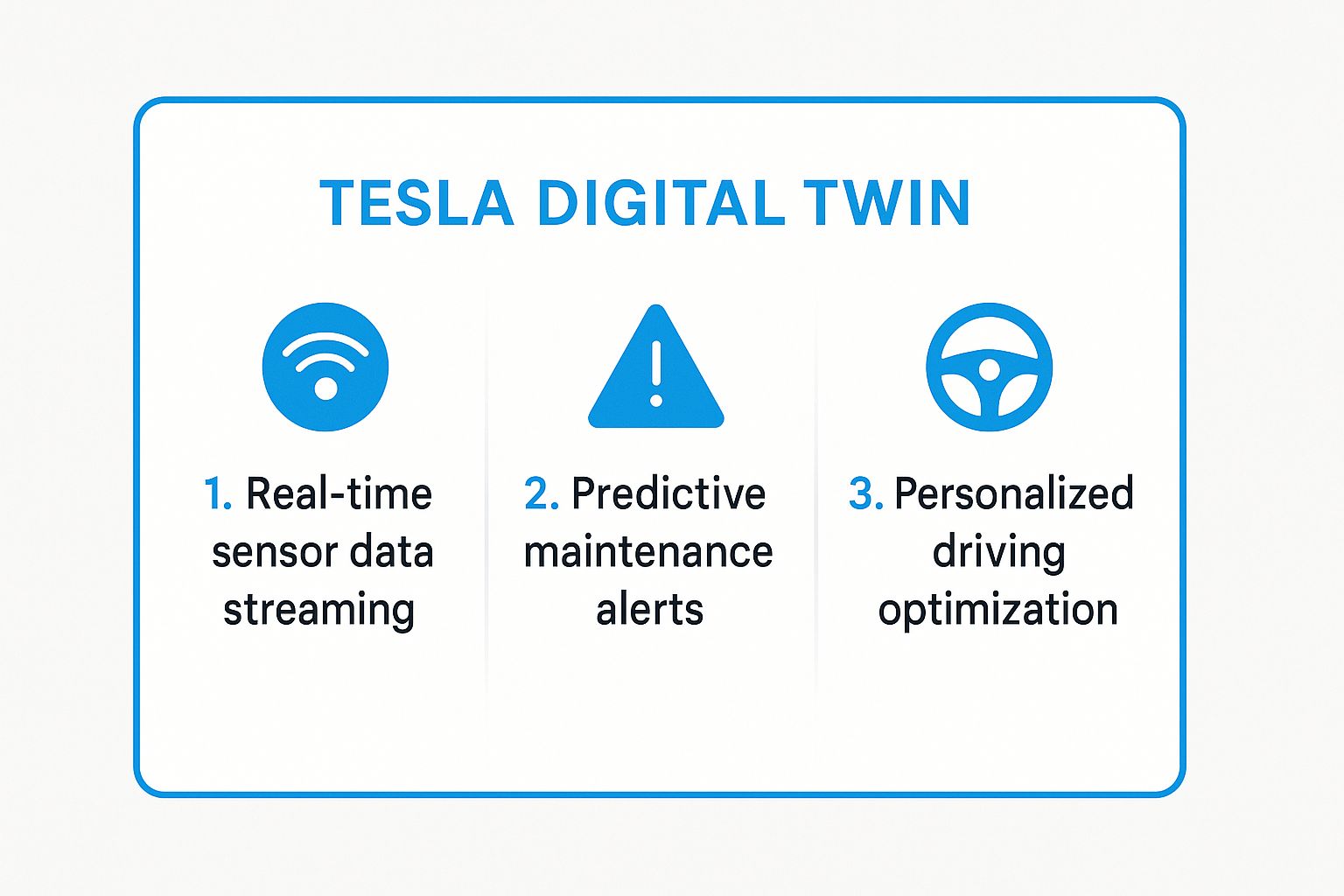
This visual summary underscores how Tesla’s digital twins directly translate into tangible benefits like enhanced safety through predictive alerts and a superior user experience through personalization. These features are not just add-ons; they are fundamental outcomes of a deeply integrated digital twin strategy.
2. GE Digital Wind Farm Optimization
General Electric (GE) harnesses the power of digital twins to manage and optimize entire wind farms, creating one of the most compelling digital twin examples in the renewable energy sector. Each wind turbine is mirrored by a virtual replica that integrates data from IoT sensors, real-time weather feeds, and historical performance models. This creates a dynamic, high-fidelity simulation of the entire wind farm's operations.
This living model allows GE and its customers to go beyond reactive maintenance. The system analyzes how atmospheric conditions, such as wind speed and air density, affect each turbine's performance. By comparing the digital twin's predicted output with the physical turbine's actual output, operators can identify inefficiencies, diagnose component wear, and schedule proactive maintenance to prevent costly downtime and maximize energy production.
Strategic Breakdown
GE's strategy leverages digital twins to transform wind turbines from static energy-generating machines into intelligent, interconnected assets. This approach creates a continuous cycle of performance optimization and operational efficiency, significantly boosting the profitability of wind energy projects.
Key Strategic Insight: By simulating the performance of each individual turbine in relation to its neighbors and the environment, GE can optimize the entire farm's output. The digital twin can test micro-adjustments to a turbine's pitch and yaw to reduce "wake effect," where turbulence from one turbine negatively impacts another.
This optimization delivers significant value:
- For Operators: They gain the ability to increase Annual Energy Production (AEP) by several percentage points, a substantial revenue boost for a utility-scale farm. Predictive analytics also drastically reduce unplanned maintenance and extend the operational lifespan of high-value components.
- For GE: The aggregated data provides invaluable insights for designing more efficient and resilient turbines. It also creates a powerful, ongoing service-based revenue stream centered on performance optimization rather than just break-fix maintenance.
Actionable Takeaways
Organizations in the energy or heavy industrial sectors can apply GE's approach to enhance asset performance and operational intelligence.
- Integrate Multiple Data Sources: Combine asset sensor data with external feeds like weather forecasts and grid demand. This holistic view is crucial for creating a truly predictive and context-aware digital twin.
- Start with Pilot Projects: Begin with a digital twin for a small subset of critical assets, such as a single turbine or a small farm. Use this pilot to establish ROI metrics and refine data models before scaling across the entire operation.
- Focus on System-Level Optimization: Look beyond individual asset performance. Use digital twins to model and optimize the interactions between connected assets to unlock system-wide efficiency gains, just as GE does with turbine wake effects.
3. NASA Spacecraft and Mission Digital Twins
NASA has long been a pioneer in using simulation and modeling, making its work a foundational case among digital twin examples. For missions where physical intervention is impossible, NASA creates highly complex digital replicas of spacecraft, rovers, and entire mission systems. These are not static 3D models but dynamic, physics-based simulations that evolve based on real-time data from the actual asset operating millions of miles away.
This approach allows engineers to create a living laboratory on Earth that mirrors the conditions and performance of assets like the Mars Perseverance rover or the International Space Station (ISS). By feeding telemetry data into the digital twin, NASA can test command sequences, troubleshoot anomalies, predict component wear, and simulate future scenarios to optimize mission success and ensure astronaut safety, all before sending a single command to the physical spacecraft.

Strategic Breakdown
NASA's strategy elevates the digital twin from a design tool to an essential operational component for remote, high-stakes environments. The digital twin becomes the primary interface for interaction with an asset that is otherwise inaccessible, turning predictive analysis into a mission-critical function.
Key Strategic Insight: By developing a "test-as-you-fly" philosophy, NASA uses digital twins to de-risk operations in extreme environments. Every software patch, maneuver, or scientific experiment is first validated on the digital replica, drastically reducing the probability of catastrophic failure in the physical asset.
The benefits are critical for space exploration:
- For the Mission: Engineers can diagnose and resolve unforeseen problems, such as the famous Apollo 13 crisis, by replicating the issue on the ground-based twin. It enables proactive maintenance on the ISS and optimized path planning for rovers on Mars.
- For NASA: This capability maximizes the scientific return and operational lifespan of multi-billion dollar assets. It provides a persistent, data-rich environment for training new flight controllers and designing future missions with greater resilience and capability.
Actionable Takeaways
Organizations managing critical, remote, or complex assets can adopt NASA’s rigorous digital twin methodology to enhance operational resilience and efficiency.
- Invest in High-Fidelity Modeling: Start with a robust, physics-based model of your asset. Validate it relentlessly against historical performance data and real-world test results to ensure its predictions are trustworthy.
- Establish a "Single Source of Truth": Ensure the digital twin is the central, authoritative model used by all engineering, operations, and maintenance teams. This alignment prevents conflicting data and ensures decisions are based on consistent information.
- Develop Clear Decision-Making Protocols: Define procedures for how insights from the digital twin translate into operational decisions. This is crucial for high-stakes situations where speed and accuracy are paramount.
4. Siemens Smart City Infrastructure Digital Twins
Siemens is a global leader in creating comprehensive digital replicas of entire urban environments, a powerful application of digital twin examples for smart city development. These are not just 3D models but dynamic, data-rich simulations of a city's critical systems, including transportation networks, energy grids, water management, and public buildings. This holistic approach helps city planners and administrators manage complexity on a massive scale.
By integrating data from IoT sensors, public records, and operational systems, Siemens' digital twins create a living model of a city's pulse. This virtual environment allows for the simulation of various scenarios, from traffic flow during major events to the impact of new infrastructure projects on energy consumption. The goal is to optimize operations, improve sustainability, and enhance the quality of life for citizens through data-driven decision-making.
Strategic Breakdown
Siemens’ strategy transforms urban management from a reactive practice to a proactive and predictive one. By creating an integrated digital replica of interconnected city systems, they provide a unified platform for analysis and planning that breaks down traditional departmental silos.
Key Strategic Insight: Siemens’ approach is to create a "system of systems" digital twin. Instead of modeling isolated components, they integrate multiple urban domains into a single, cohesive virtual environment. This allows stakeholders to understand the complex, cascading effects of a decision in one area (e.g., transportation) on another (e.g., air quality or energy demand).
The advantages of this integrated model are significant:
- For City Planners: They gain the ability to test policies and infrastructure plans in a risk-free virtual world before committing vast public funds. This helps optimize designs, predict outcomes, and mitigate potential negative consequences.
- For Operators: The digital twin enables real-time monitoring and predictive maintenance of critical infrastructure, reducing downtime and operational costs for utilities and transport networks.
Actionable Takeaways
Organizations, particularly public sector entities and urban developers, can adopt Siemens' methodology to build smarter, more resilient communities.
- Start with Pilot Projects: Begin with a specific district or a single system (like traffic management) to prove value and refine the approach before attempting a city-wide deployment.
- Establish Strong Public-Private Partnerships: Collaborate with technology leaders, utility companies, and academic institutions to secure the necessary funding, data, and expertise for such a large-scale project.
- Develop Clear Data Governance: Create robust frameworks for data sharing, privacy, and security. Engaging citizens in the process is crucial to ensure public trust and adoption of new smart city services.
These technologies are often discussed at industry events. To see how these technologies are discussed in the industry, you can learn more about developments shared at the Siemens Digi Conference. This collaborative approach is key to driving innovation in smart city infrastructure.
5. Boeing Aircraft Manufacturing and Maintenance Digital Twins
Boeing has pioneered one of the most comprehensive uses of digital twin technology in the aerospace industry, creating detailed virtual replicas for aircraft across their entire lifecycle. These high-fidelity models span from initial design and complex manufacturing to in-service operations and maintenance. This represents a monumental entry in our list of digital twin examples, showcasing how the technology can manage assets of immense complexity and value.
Each digital twin aggregates data from thousands of sources, including CAD models, manufacturing logs, real-time flight data, and maintenance records. This creates a living "digital thread" that follows a specific aircraft from the factory floor to its final flight years later. For instance, the Boeing 787 Dreamliner’s development heavily relied on this, allowing engineers to simulate and validate every component before physical production began, significantly reducing errors and costs.
Strategic Breakdown
Boeing’s strategy leverages the digital twin to create a unified source of truth for an asset that involves countless stakeholders, including designers, suppliers, production teams, and airline operators. This digital continuity breaks down traditional silos and enhances safety, efficiency, and innovation.
Key Strategic Insight: By maintaining a digital twin throughout an aircraft's lifecycle, Boeing transforms the relationship between manufacturer and operator. It moves from a transactional sale to a continuous partnership focused on data-driven performance optimization and predictive maintenance.
The benefits of this approach are substantial:
- For Airlines: Operators gain access to predictive maintenance insights, allowing them to schedule repairs proactively and minimize costly aircraft-on-ground (AOG) situations. It also helps optimize fuel consumption and flight operations based on real-world performance data.
- For Boeing: Aggregated fleet data provides invaluable feedback for designing next-generation aircraft and improving existing models. This level of insight is a key driver for innovation in manufacturing. To delve deeper into this topic, explore more about innovation in the manufacturing industry on aidarsolutions.com.
Actionable Takeaways
Organizations in high-stakes industries can replicate Boeing’s success by treating digital twins as a lifecycle management tool, not just a design or operational one.
- Establish a "Digital Thread": Ensure data continuity from the design phase through manufacturing, operation, and service. This requires standardized data formats and integrated platforms accessible to all stakeholders.
- Invest in Robust Cybersecurity: For flight-critical systems, protecting the digital twin from cyber threats is paramount. Implement multi-layered security protocols and conduct regular vulnerability assessments.
- Develop Collaborative Platforms: Create secure portals where insights from the digital twin can be shared with partners and customers. This fosters a collaborative ecosystem focused on mutual success and operational excellence.
6. Rolls-Royce Aircraft Engine Digital Twins
Rolls-Royce has been a pioneer in the aerospace industry, not just by building world-class jet engines, but by reimagining how these complex assets are managed throughout their lifecycle. This is one of the most impactful B2B digital twin examples, where each engine has a dynamic virtual counterpart that lives in the cloud. These digital twins are fed by thousands of real-time data points from sensors on the physical engine during flight.
This constant stream of data allows Rolls-Royce to create a high-fidelity simulation that mirrors the engine's operational state, health, and performance history. This isn't a static engineering model; it’s a living, breathing replica that evolves with its physical twin. This capability has revolutionized engine maintenance from a reactive or scheduled process to a proactive and predictive one, enhancing safety and operational efficiency for airlines.
Strategic Breakdown
Rolls-Royce’s strategy shifted its business model from solely selling engines to offering "power-by-the-hour" service agreements, where airlines pay for operational uptime. The digital twin is the technological backbone of this model, enabling Rolls-Royce to guarantee performance and manage maintenance costs effectively.
Key Strategic Insight: By creating a digital twin for every engine, Rolls-Royce transformed its relationship with customers. It established a shared data ecosystem that aligns its incentives with the airline's goal of maximizing flight availability and fuel efficiency, turning maintenance into a value-added service rather than a cost center.
The benefits are transformative for the aviation industry:
- For the Airline: Enhanced safety through early fault detection, optimized fuel consumption based on real-world performance data, and increased aircraft availability due to predictive, on-condition maintenance.
- For Rolls-Royce: The ability to offer competitive service contracts, reduce unexpected maintenance costs, and gather invaluable data from its global fleet to inform future engine designs and improvements.
Actionable Takeaways
Organizations in high-value asset industries can replicate Rolls-Royce's success by viewing digital twins as a cornerstone for service-based business models. The use of innovative technologies like augmented reality in manufacturing can further enhance the maintenance process by providing technicians with real-time data overlays.
- Develop Collaborative Data Partnerships: Establish clear data-sharing agreements with customers. Build trust by demonstrating how shared data creates mutual value, such as improved asset performance and reduced operational risks.
- Invest in Advanced Analytics: Go beyond simple monitoring. Implement machine learning and AI algorithms to analyze data from the digital twin, enabling accurate predictions for component wear, potential failures, and optimal performance settings.
- Create a Clear Value Proposition: Clearly articulate the ROI of the digital twin-enabled service to customers. Use performance data to demonstrate tangible benefits like cost savings, increased uptime, and enhanced safety.
7. Microsoft Azure Digital Twins for Smart Buildings
Microsoft has taken the abstract concept of a smart environment and made it tangible with its Azure Digital Twins platform. This service allows organizations to create comprehensive models of entire physical environments, from a single room to an entire campus. This is one of the most scalable and powerful digital twin examples for facilities management, integrating disparate data sources like IoT sensors, HVAC systems, and occupancy logs into a single, cohesive digital model.
This isn't just about visualization; it's about creating a living, breathing replica of a physical space. By modeling the relationships between people, places, and devices, Azure Digital Twins provides a dynamic context that allows for real-time analysis and control. This enables facility managers to move from reactive problem-solving to proactive optimization, improving energy efficiency, space utilization, and occupant comfort.
Strategic Breakdown
Microsoft’s strategy is to provide a foundational platform-as-a-service (PaaS) that democratizes the creation of sophisticated spatial intelligence solutions. Instead of building a complex system from scratch, organizations can leverage Azure's infrastructure to build and scale their own smart building applications. For a deeper dive into understanding how cloud platforms facilitate these innovations, consider this resource on how the cloud can benefit your business, specifically with Microsoft Azure.
Key Strategic Insight: By offering a flexible, graph-based modeling environment, Azure Digital Twins allows organizations to define what "smart" means for them. A hospital can prioritize patient comfort and air quality, while a corporate office can focus on energy savings and meeting room availability, all using the same underlying platform.
The benefits extend across the organization:
- For Facility Managers: The platform provides a holistic view of building operations, enabling predictive maintenance on equipment, optimizing energy consumption based on real-time occupancy, and improving emergency response coordination.
- For Occupants: The technology enhances the user experience through personalized climate control, simplified room booking, and improved safety protocols, creating a more productive and comfortable environment.
Actionable Takeaways
Organizations can leverage the Azure platform to build intelligent environments by focusing on integration and clear objectives.
- Start with a Defined Scope: Begin with a pilot project in a single building or a specific system (e.g., HVAC) to demonstrate value. Establish clear ROI metrics, such as a 15% reduction in energy costs, before scaling.
- Prioritize System Integration: Develop a clear strategy for integrating both modern IoT sensors and legacy building management systems (BMS). Use Azure IoT Hub as a gateway to standardize data streams from diverse hardware.
- Invest in Team Enablement: Train facility management and IT staff on the Azure platform to ensure they can effectively manage, interpret, and act on the data from the digital twin. This is crucial for long-term success and adoption.
Microsoft's own campus serves as a primary showcase for this technology, demonstrating its power in optimizing large-scale, complex facilities. AIDAR Solutions, as a Microsoft partner, leverages this powerful platform to deliver innovative solutions.
Digital Twin Use Case Comparison
| Digital Twin Example | Implementation Complexity 🔄 | Resource Requirements ⚡ | Expected Outcomes 📊 | Ideal Use Cases 💡 | Key Advantages ⭐ |
|---|---|---|---|---|---|
| Tesla Vehicle Digital Twins | High – requires real-time data streaming, OTA updates, advanced analytics | Very high – needs massive data processing, connectivity, cybersecurity | Continuous vehicle improvement, predictive maintenance, autonomous driving enhancement | Automotive fleet management, autonomous vehicle R&D | Reduces maintenance costs, accelerates autonomous tech, personalized vehicle optimization |
| GE Digital Wind Farm Optimization | High – involves IoT sensor networks, weather data integration, complex analytics | High – sensor infrastructure, remote communication, expert staff needed | Up to 20% energy production increase, downtime reduction, turbine optimization | Renewable energy production, wind farm management | Boosts energy efficiency, extends equipment lifespan, data-driven asset performance |
| NASA Spacecraft and Mission Twins | Extremely high – requires physics-based models, telemetry integration, multi-disciplinary collaboration | Very high – extensive computational power, validation, expert engineering | Mission risk reduction, remote troubleshooting, performance optimization | Space missions, remote vehicle operations, mission planning | Enables remote fixes, scenario testing, mission life extension, astronaut training |
| Siemens Smart City Infrastructure | Very high – multisystem integration, large IoT deployment, stakeholder coordination | Very high – extensive sensor networks, long-term investment | Holistic urban planning, resource optimization, improved citizen services | Smart city development, urban infrastructure management | Enhances sustainability, emergency response, cross-system optimization |
| Boeing Aircraft Manufacturing Twins | High – requires lifecycle data integration, complex system modeling | High – integration with operational systems, real-time analytics | Improved safety, maintenance cost reduction, fuel efficiency | Commercial and defense aircraft design, manufacturing, operation | Enhances safety, accelerates certification, operational efficiency improvements |
| Rolls-Royce Aircraft Engine Twins | High – real-time flight data, integration with airlines, predictive analytics | High – sensor tech, secure communications, expert analysis | Prevents engine failures, reduces fuel consumption, extends engine life | Aircraft engine monitoring and maintenance | Superior engine reliability, predictive maintenance, new service models |
| Microsoft Azure Digital Twins (Smart Buildings) | Moderate to high – IoT integration, cloud platform deployment | Moderate to high – IoT sensors, cloud services, skilled staff | Energy use reduction, occupant comfort improvement, facility management | Smart buildings, campuses, healthcare, education facilities | Scalable platform, sustainability support, integrated building management |
The Future is Twinned: Integrating Digital Replicas into Your Operational Fabric
The diverse array of digital twin examples we have explored, from Tesla's connected vehicles to NASA's interplanetary spacecraft, illuminates a transformative shift in operational strategy. These are not merely sophisticated 3D models; they are dynamic, data-driven ecosystems that bridge the gap between the physical and digital worlds. The overarching lesson from pioneers like GE, Siemens, and Boeing is clear: the greatest value is unlocked when digital twins move beyond passive monitoring and become active participants in the decision-making lifecycle.
This transition from a reactive to a predictive operational model is the core benefit. Instead of fixing a jet engine after it fails, Rolls-Royce predicts maintenance needs based on real-time performance data. Rather than responding to city-wide power outages, Siemens simulates grid stress to prevent them. This proactive stance, powered by a constant influx of sensor data and sophisticated analytics, is what separates a simple digital model from a true, value-generating digital twin.
Your Roadmap to a Twinned Future
Translating these powerful examples into a strategy for your own organization requires a focused approach. The journey doesn't start with building a complex, all-encompassing replica of your entire operation. Instead, it begins with identifying a single, high-impact problem that a digital twin can solve.
Consider these actionable first steps:
- Identify a Critical Asset or Process: Pinpoint an area where downtime is costly, maintenance is complex, or efficiency gains would be significant. This could be a single production line, a critical piece of machinery, or a specific logistics workflow.
- Define a Clear Objective: What specific outcome do you want to achieve? Examples include reducing unplanned downtime by 20%, improving first-time fix rates for field technicians, or optimizing energy consumption in a facility.
- Assess Your Data Infrastructure: The fidelity of a digital twin is directly tied to the quality and velocity of its data. To maintain accurate and live digital replicas, exploring solutions for real-time data streaming with Change Data Capture (CDC) is paramount, especially when integrating with robust platforms like Snowflake. This ensures your twin reflects reality second by second.
Making Digital Insights Actionable with AR/VR
Ultimately, the power of a digital twin is wasted if its insights are not easily accessible and actionable for your frontline workforce. This is where the synergy with extended reality (XR) technologies like Augmented and Virtual Reality becomes critical. An AR interface can overlay a digital twin's data directly onto a physical asset, guiding a technician through a complex repair with step-by-step visual instructions. A key benefit is enabling technicians to "see" inside machinery without disassembly, viewing real-time sensor data and historical performance metrics overlaid on the equipment itself.
VR solutions offer immense value for training and simulation. Employees can practice complex procedures on a virtual replica of a new facility or production line before it is even built, ensuring safety, reducing the learning curve, and achieving operational readiness from day one. This immersive, risk-free environment is a powerful tool for building muscle memory and improving decision-making under pressure. By integrating these human-centric interfaces, you empower your team to interact with complex data intuitively and turn insights into immediate, effective action.
Ready to bridge the gap between your digital twin's insights and your frontline team's actions? AIDAR Solutions provides the AR and VR tools to make complex data intuitive and actionable, empowering your workforce with immersive training and remote expert support. Visit AIDAR Solutions to see how you can bring your digital twin to life.