
A Modern Digital Transformation Strategy Framework
A digital transformation strategy framework is your master plan for bringing your business into the future. Think of it as a comprehensive roadmap that aligns your company's vision, people, processes, and technology—all pulling in the same direction to hit specific goals. This structured approach takes a massive, complex initiative and breaks it down into a clear, manageable path for growth.
Why a Framework Is Your Transformation Blueprint
Kicking off a digital transformation without a plan is like trying to build a state-of-the-art manufacturing plant without a blueprint. Sure, you can buy all the advanced machinery and hire a top-notch crew, but without a clear architectural vision, the project will drift. You'll end up with wasted resources and a final structure that just doesn't work together. A digital transformation strategy framework is that essential blueprint, especially for industrial enterprises.
It's what ensures every decision—from a new technology investment to a process redesign on the shop floor—is intentional and directly supports your big-picture business objectives. This structure is absolutely critical in manufacturing and other industrial sectors, where any change can directly impact production, safety, and the bottom line. A solid framework helps you manage risks, get different departments on the same page, and makes sure everyone from the C-suite to the factory floor is working from the same set of plans.
The Core Components of Transformation
A strong framework isn't just a to-do list; it’s a holistic system designed to balance four critical pillars of your organization.
This map shows how a digital transformation framework acts as the central hub connecting your vision, people, processes, and technology.
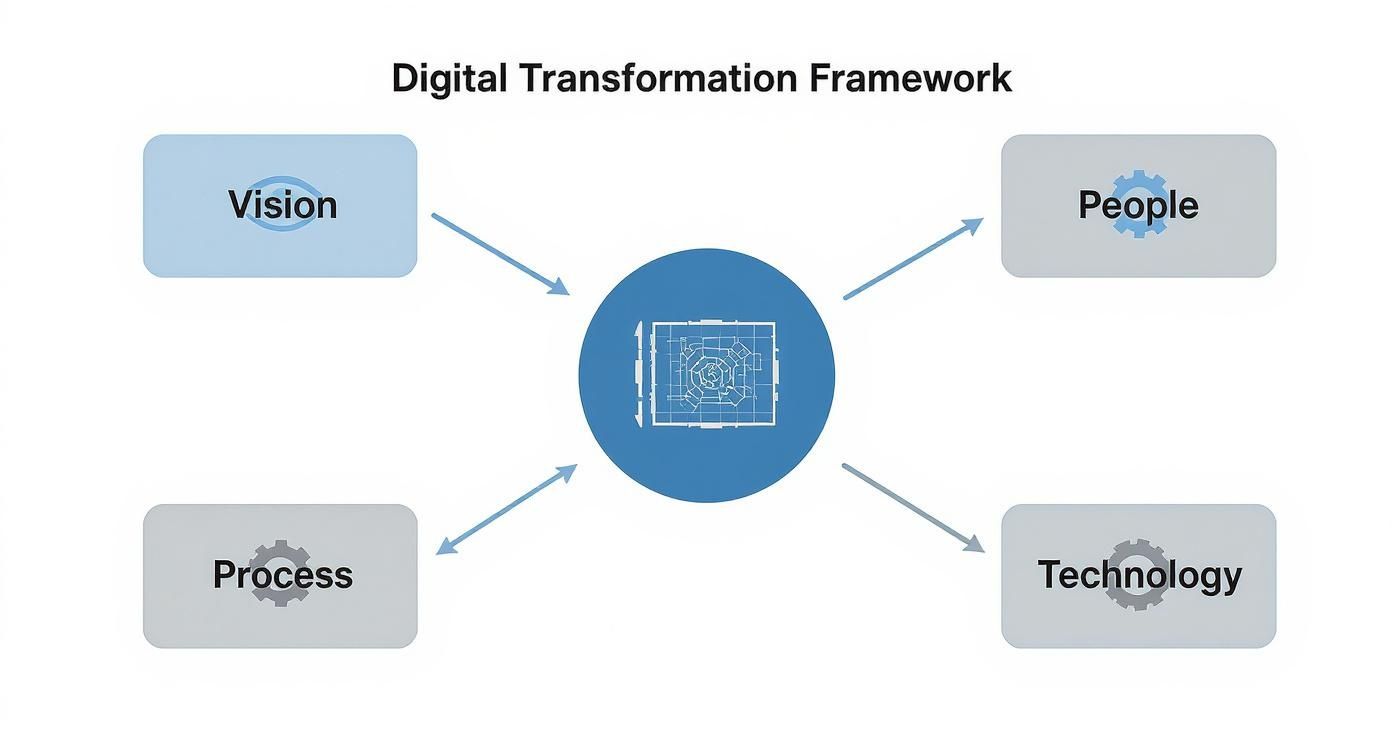
As you can see, technology is just one piece of a much bigger puzzle. The real magic happens when you have a strategy that weaves all four elements together.
These components work in tandem to build a strong foundation for change:
- Vision and Objectives: This is where you define what "done" looks like. What are the specific business outcomes you're chasing? Maybe it's a 20% increase in operational efficiency or launching a new digital service for your customers.
- People and Culture: Change is human. This pillar addresses the people side of the equation, focusing on training, clear communication, and nurturing a culture that's open to new ways of working.
- Processes and Governance: Here, you'll re-engineer workflows to be more agile and data-driven. It's also about establishing clear ownership and decision-making structures so everyone knows their role.
- Technology and Tools: Finally, the tech. This is about selecting and implementing the right digital solutions—like AR/VR, IoT, or AI—that solve the specific problems you've already identified.
A successful digital transformation is not a technology project; it's a business strategy enabled by technology. It demands a fundamental shift in how an organization operates and delivers value to its customers.
Turning a Daunting Challenge into a Clear Path
Without a structured approach, digital initiatives often become a collection of isolated experiments that never really go anywhere or deliver a meaningful return on investment. A framework is what connects these individual projects to the bigger picture, creating synergy instead of fragmentation. If you want to dive deeper, you can find a great collection of articles and insights in these dedicated digital transformation resources.
By laying out a clear path forward, the framework demystifies the entire process. It helps leaders get ahead of the common digital transformation challenges that so often derail progress. Ultimately, a strong framework converts a daunting, ambiguous goal into an actionable, step-by-step journey toward sustainable growth and a real competitive edge.
Establishing Your Vision and Governance
Every successful digital transformation kicks off by answering two simple but critical questions: "What does success look like?" and "Who is going to lead us there?" Getting these right establishes the 'why' and the 'who' that will anchor your entire journey. Without a clear destination and a dedicated crew, even the most ambitious projects will just drift.
First things first, you need a compelling vision. This isn’t some vague statement about "becoming more digital." It's a sharp, business-focused goal tied to outcomes you can actually see and measure. For a manufacturer, this might look like boosting operational efficiency by 20% within three years or launching new service-based revenue streams that account for 10% of total income.
Your vision absolutely must connect directly to your core business objectives. This alignment is what gets you executive sponsorship and, just as important, the budget to make it all happen. When you frame your goals as strategic investments instead of isolated IT experiments, they build the kind of momentum needed to go the distance.
Crafting a Quantifiable Vision
To get from big ideas to a real plan, your vision has to be specific and measurable. Vague goals only lead to vague results. Instead of a fuzzy aim like "improve production," a much stronger vision would be to "reduce machine downtime by 15% and decrease material waste by 5% through predictive maintenance."
Here’s how you can turn broad ambitions into concrete objectives:
- Operational Excellence: Go after specific metrics like Overall Equipment Effectiveness (OEE), first-pass yield, or a reduction in safety incidents.
- Customer Experience: Focus on improving order accuracy, slashing lead times, or boosting customer satisfaction scores with new digital tools.
- New Business Models: Set clear goals for creating new revenue, like offering equipment-as-a-service or selling data-driven insights to your clients.
A well-defined vision acts as your North Star. It guides every decision, helps you prioritize what’s important, and keeps the entire organization focused on a shared outcome.
This kind of clarity stops teams from chasing disconnected side projects and makes sure every dollar you spend is pushing the main strategy forward.
Building a Strong Governance Structure
Once you've nailed down the 'why,' you need to figure out the 'who.' A solid governance structure is the engine that drives your digital transformation. It provides the leadership, accountability, and cross-functional teamwork needed to break down those old departmental silos and get everyone on board.
The heart of this structure is a cross-functional steering committee. This group can't just be the IT department; you need leaders from operations, finance, HR, and sales at the table. This diversity ensures decisions reflect the needs of the whole business and are practical from every angle.
It's also essential to assign clear roles and responsibilities. The key players usually include:
- Executive Sponsor: A C-suite leader who champions the vision, clears high-level roadblocks, and secures the resources you need.
- Program Lead: The day-to-day manager of the transformation, responsible for coordinating projects, tracking progress, and keeping everyone in the loop.
- Departmental Champions: Leaders from various business units who advocate for the changes within their own teams and provide crucial on-the-ground feedback.
Effective governance makes all the difference. Globally, only about 35% of digital transformation initiatives actually hit their targets. But here's the kicker: integrated efforts that combine technology with strong governance and cultural change show a massive 10.3x return on investment. That number blows away the 3.7x ROI seen in organizations with poor integration. Proper governance is also non-negotiable for security and compliance—with regulatory fines in Europe topping €1.2 billion for data breaches, it’s a critical piece of the puzzle. You can find more on these data transformation challenges and statistics and see why getting this right is so important.
Assessing Your Capabilities and Selecting Technology
Before you build, you need to know your foundation. A solid digital transformation strategy doesn't start with a shopping spree for new software; it begins with a clear-eyed assessment of where your company stands right now. This means taking an honest look at your current digital maturity—your people, your processes, and your tech—to find your biggest gaps and most promising opportunities.
Think of it like a mechanic diagnosing an engine before ordering parts. You have to understand the symptoms (inefficiencies, downtime), run the diagnostics (a capability assessment), and then you can pick the right tool for the job. Jumping straight to a solution without a proper diagnosis is a surefire way to waste money on a project that’s doomed from the start.
This initial audit gives you the context to make smart decisions. It gets you past guesswork and lets you base your strategy on hard data, ensuring every dollar is aimed at a specific weakness or a clear path to growth.
Conducting a Digital Maturity Assessment
A digital maturity assessment is your baseline. It’s a structured look at how your current capabilities stack up against industry benchmarks and your own strategic goals. And this isn't just an IT checklist; it's a holistic review of your entire operation.
To get the full picture, you need to dig into three core areas:
- People: Do your teams have the digital skills to run new systems? Is there a culture of learning and adapting, or is there a deep-rooted resistance to change? You need to look at training programs, employee skill sets, and the general level of digital literacy across the board.
- Processes: Are your current workflows actually optimized, or are they clogged with manual handoffs and bottlenecks? Map out how information moves from the shop floor to the front office. Just documenting this stuff often reveals some shocking inefficiencies.
- Technology: What’s the state of your existing tech stack? Are your systems modern and integrated, or are you limping along with outdated, siloed legacy software? Evaluate your data management, your cybersecurity posture, and the tools you already have.
A thorough assessment stops you from simply digitizing a broken process. It forces you to fix the underlying operational problems first, making sure new technology delivers a real impact instead of just automating old mistakes.
Choosing Technology That Solves Real Problems
Once you have a clear map of your gaps, you can turn to technology. The golden rule here is to stay laser-focused on the problem. Instead of asking, "What's the hot new tech?" you should be asking, "Which tool best solves the specific challenge we just uncovered?" This practical mindset ties every tech investment directly to a measurable business outcome.
For manufacturers and industrial companies, this often means looking beyond traditional IT and exploring tech that makes a direct impact on the factory floor and in the field. Some of the most powerful tools emerging today are Augmented and Virtual Reality (AR/VR), often just called Extended Reality (XR).
These immersive technologies are proving to be game-changers for some of the manufacturing world's oldest and toughest challenges. Companies are seeing incredible results in areas like workforce training and remote support. You can dive deeper into specific examples in our guide on new technologies in manufacturing.
To help you navigate the options, it's useful to compare how different technologies address common industrial pain points.
Evaluating Technology for Industrial Transformation
Here’s a look at some key technologies and their direct impact on common industrial challenges, helping you prioritize where to invest.
| Technology Category | Primary Use Case | Key Business Benefit | Implementation Focus |
|---|---|---|---|
| AR/VR (XR) | Remote expert assistance, hands-on training simulations, guided work instructions. | Reduces machine downtime, accelerates skill development, and improves first-time fix rates. | Integrating with existing workflows and creating high-quality, relevant 3D content. |
| IIoT & Sensors | Predictive maintenance, real-time asset tracking, and remote monitoring of equipment. | Minimizes unplanned downtime, optimizes asset utilization, and improves operational visibility. | Data connectivity, platform integration, and developing analytics capabilities. |
| AI & Machine Learning | Quality control automation (computer vision), demand forecasting, and process optimization. | Increases production quality, reduces waste, and improves supply chain efficiency. | Access to clean data, building accurate models, and integrating insights into decision-making. |
| Cloud Computing | Centralized data storage, scalable computing power for analytics, and accessible software. | Enhances data accessibility, reduces IT infrastructure costs, and enables collaboration. | Data security, migration strategy from legacy systems, and choosing the right service model. |
Choosing the right technology isn't about finding a single silver bullet. It's about building a connected ecosystem where each tool addresses a specific, identified need and works together to drive your business forward.
Practical Use Cases for AR and VR in Industry
Let’s get out of the clouds and talk about real-world applications. XR isn't some far-off concept; it’s delivering real value today by completely changing how employees learn and how experts provide support.
Immersive Employee Training and Upskilling
Traditional training methods often miss the mark. Classroom learning can feel disconnected from the actual job, and on-the-job training can be risky, slow, and often requires taking valuable equipment offline.
- AR-Guided Training: Augmented reality overlays digital instructions, diagrams, and 3D models right onto a technician's view of the real equipment. This is hands-on, contextual guidance at its best, cutting down on errors and dramatically shortening the learning curve for complex assembly or maintenance tasks. The benefit is immediate: technicians learn faster, retain more information, and perform tasks with higher accuracy from day one.
- VR Safety Simulations: Virtual reality creates a totally immersive, simulated environment where employees can practice responding to dangerous situations—like an equipment malfunction or a chemical spill—in a 100% safe setting. This builds muscle memory and critical thinking skills without putting any personnel or assets at risk, leading to a safer, more prepared workforce.
Remote Expert Assistance and Field Service
One of the largest operational costs in manufacturing is machine downtime. When a critical piece of equipment goes down, every hour spent waiting for a senior expert to travel to the site can result in thousands of dollars in lost production.
- See-What-I-See Support: With an AR remote assistance tool, a frontline technician can share their live point-of-view with an expert located anywhere in the world. That expert can then annotate the technician's screen, share schematics, and walk them through the repair step-by-step, as if they were standing right there.
- Benefits: This capability dramatically reduces machine downtime by delivering expertise instantly. It eliminates the significant costs and carbon footprint associated with travel, offering a rapid and substantial return on investment. The key advantage is empowering your best minds to solve problems anywhere, immediately.
Building Your Roadmap and Launching Pilot Programs
Alright, you’ve defined your vision and taken a hard look at your current capabilities. Now it’s time to get your hands dirty and turn that high-level strategy into a real, actionable plan. This is the moment your digital transformation strategy moves from the boardroom PowerPoint to the factory floor.
What you need is a detailed, phased roadmap—one that breaks down massive, intimidating goals into a series of smaller, manageable projects.
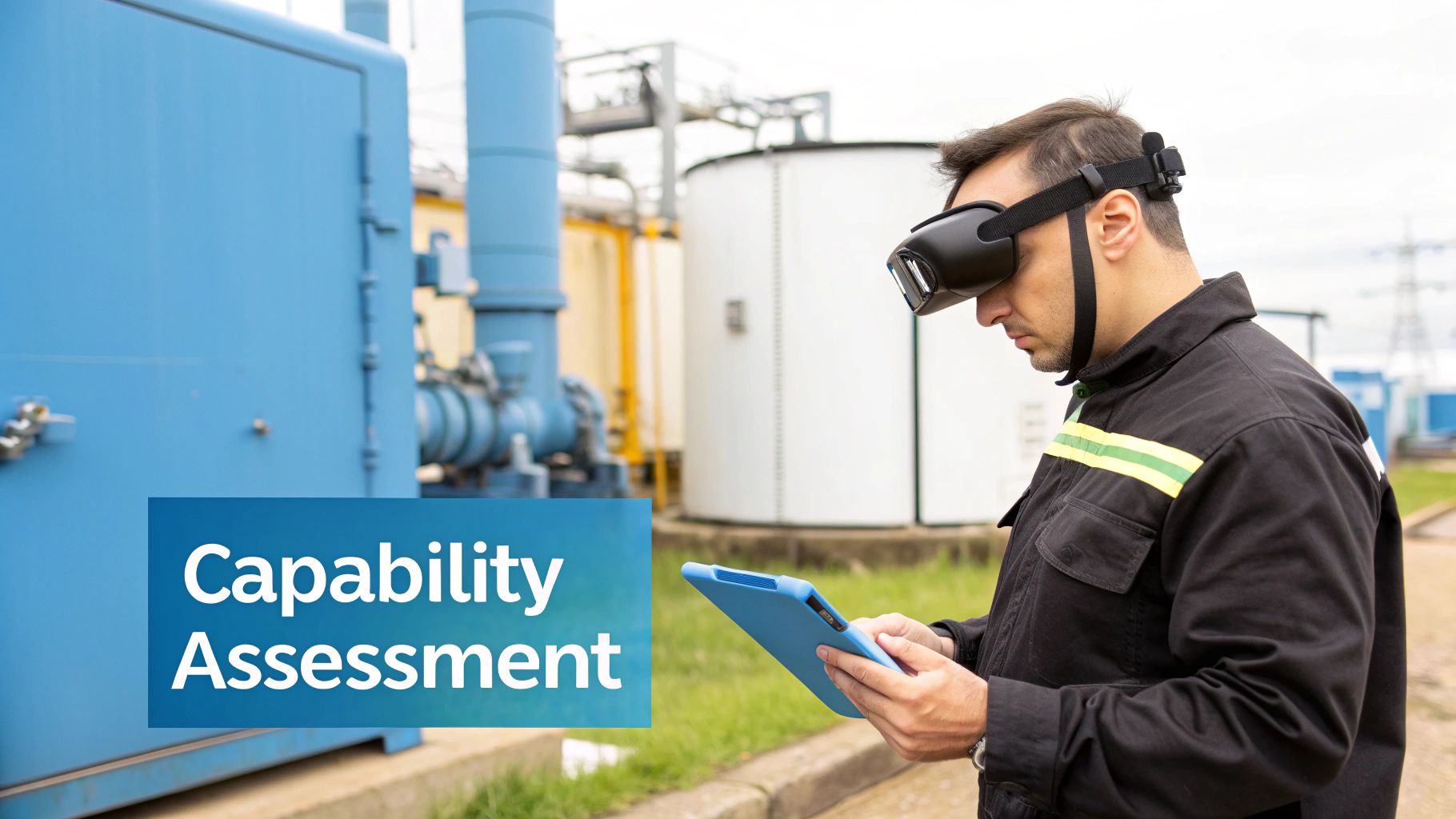
This isn’t about trying to boil the ocean and do everything at once. It’s about smart sequencing. You need to prioritize projects based on their potential impact and, just as importantly, their feasibility. A solid roadmap perfectly balances quick wins that build momentum with the bigger, long-term plays that will fundamentally change your business.
Prioritizing Your Initiatives
A successful roadmap always starts with a clear-eyed, honest prioritization process. Let's face it: not all projects are created equal. Some deliver massive value, while others are a huge pain to implement for minimal gain. A simple but incredibly effective tool here is the classic impact/effort matrix.
This helps you sort your potential initiatives into a balanced portfolio:
- Quick Wins (High Impact, Low Effort): These are your low-hanging fruit and should be at the top of your list. They deliver visible results fast, which is crucial for building confidence and getting buy-in across the organization.
- Major Projects (High Impact, High Effort): Think of these as your big strategic bets. They’ll require serious investment but promise the most significant returns. Plan these carefully and break them down into smaller, distinct phases.
- Fill-Ins (Low Impact, Low Effort): These are smaller tweaks and improvements you can tackle when you have spare resources. They won't transform the company, but they can definitely smooth out minor operational wrinkles.
- Reconsider (Low Impact, High Effort): These are the projects to avoid like the plague. They drain valuable time, money, and morale for very little payback.
The global digital transformation market is set to hit an eye-watering $3.4 trillion by 2025. The pandemic kicked this into high gear, pushing 97% of businesses to speed up their plans. But here’s the reality check: over half (54%) of companies stumble during implementation because they lack the right internal expertise. This just goes to show that a brilliant strategy is useless without an equally brilliant execution plan.
The Power of Pilot Programs
Before you go all-in on a full-scale, enterprise-wide rollout of a new technology, you absolutely have to test it in a controlled environment. This is where pilot programs come in—and they are non-negotiable. Pilots are small-scale experiments designed to prove value, collect real-world feedback, and iron out all the kinks before you commit to a major investment.
A pilot program is your transformation's safety net. It allows you to fail small and learn fast, dramatically reducing the financial and operational risks associated with large-scale change.
For any industrial company, pilots are essential. It means testing things like AR-guided work instructions on a single production line or rolling out a remote assistance platform to a small field service team first. This iterative process lets you build an undeniable business case, backed by hard data from your own operations. Getting this right can be tricky, which is why augmented reality consulting can be a game-changer, helping you structure pilots that deliver clear, measurable results.
As you map out these stages, it's helpful to understand the structured process behind any technology deployment. For a great overview, check out this guide to the mobile app development lifecycle—the principles apply well beyond just mobile apps.
From Pilot to Full-Scale Rollout
A successful pilot does more than just prove a technology works. It creates the blueprint for scaling it across the entire organization. The trick is to meticulously document everything, from the initial setup to the final results.
Your pilot needs to answer some critical questions before you can even think about a wider implementation:
- What was the measurable ROI? Did you actually reduce downtime, speed up training, or cut down on errors? Track those specific KPIs.
- What feedback did employees provide? Get honest input on usability, how it fits into their workflow, and whether the training was effective.
- What technical hurdles did we encounter? Document every integration headache, hardware limitation, or network issue.
- What is the true total cost of ownership? Look past the sticker price. What are the real ongoing costs for support, licensing, and maintenance?
By treating your pilot as a learning exercise, you build a rock-solid foundation for what comes next. You’ll have the data, the experience, and—most importantly—the internal champions you need to move forward with confidence and make your digital transformation a widespread, sustainable success.
5. Fostering a Culture of Digital Adoption
Here’s a hard truth about digital transformation: it’s not really about technology. It's about people. You can roll out the most sophisticated platforms and incredible tools, but if your workforce isn’t skilled, confident, and motivated to actually use them, your investment will stall out. The human element is the ultimate tipping point where these initiatives either create lasting value or fizzle into a collection of expensive, underused software licenses.
Successful adoption depends entirely on a thoughtful change management plan. The goal is to turn employees from passive observers into active participants. This means tackling the natural resistance to change head-on and creating clear pathways for your teams to build the skills they need. It’s about cultivating a resilient culture of continuous learning that keeps the momentum going long after the initial projects are complete.
Communicating the "Why" Behind the Change
The very first step is clear, consistent, and empathetic communication. People need to understand why the change is happening, not just what is happening. It’s not enough to announce a new system. You have to connect it to a compelling vision that shows how it benefits both the company and them as individuals.
This calls for a communication strategy that goes way beyond a single company-wide email.
- Town Halls and Q&A Sessions: Create open forums. Get leaders in front of people to share the vision, answer honest questions, and address concerns directly.
- Department-Specific Briefings: Tailor the message. Explain how new tools will specifically impact a team’s daily workflow, solve their biggest headaches, and help them hit their goals more easily.
- Identify and Empower Champions: Find those enthusiastic early adopters within your teams. These internal champions can advocate for the changes, offer peer support, and give you credible, on-the-ground feedback.
Bridging the Skill Gap with Targeted Training
Once you've built buy-in, the next hurdle is competence. A huge source of resistance is the simple fear of not being able to master the new tools. To get past this, your digital transformation framework has to include solid upskilling and reskilling programs that are directly tied to the new tech.
Modern industrial problems demand modern training solutions. This is where immersive technologies like Augmented and Virtual Reality (AR/VR) offer a significant advantage. AR/VR solutions allow employees to practice complex procedures in a realistic, completely risk-free virtual environment. This hands-on approach accelerates learning, improves knowledge retention, and builds confidence before they ever touch live equipment.
This focus on practical skills is a global priority. Strategic frameworks guiding digital transformation in both government and industry consistently highlight skill enhancement. A huge part of this involves embedding digital competencies into lifelong learning programs to meet what the market demands. It confirms that transformation isn't just a tech upgrade—it's a deep cultural shift toward continuous learning. You can learn more about how these global digital transformation strategies put human development first.
Creating a Culture of Continuous Improvement
Ultimately, driving digital adoption isn't a one-and-done project. It’s about building a permanent cultural shift toward agility, experimentation, and data-driven thinking. This means putting systems in place that support ongoing learning and adaptation.
True digital adoption happens when employees stop seeing new technology as a mandate and start seeing it as an opportunity—a better way to solve problems, collaborate, and create value.
To build this culture, leaders have to create an environment of psychological safety where people feel comfortable trying new things, and yes, even failing sometimes. Celebrate the small wins, share success stories far and wide, and create feedback loops that empower your teams to suggest improvements to the new tools and processes. This approach turns your workforce into a powerful engine for innovation, ensuring your organization not only adapts to change but actually thrives on it.
7. Measuring Success and Scaling Your Initiatives
A digital transformation strategy is just a nice-sounding plan until you can prove it works. You have to move beyond gut feelings and show real, sustainable value with hard data. This final piece of the puzzle is all about defining the right metrics to prove success and then using those wins to scale your efforts intelligently across the whole company.

It all comes down to setting Key Performance Indicators (KPIs) that tie directly back to your original vision. Think of these metrics as the scoreboard for your transformation. They tell you what’s working, what’s not, and where to put your resources. Vague goals only lead to vague results; specific, measurable targets are what drive real progress and justify spending more money.
Defining Your Key Performance Indicators
To get the full picture of your ROI, you need a balanced mix of both operational and financial metrics. This proves you’re not just saving a few bucks but are fundamentally improving how your business actually runs.
A solid KPI scorecard should include:
- Operational Metrics: These track improvements right on the factory floor. Think in terms of Overall Equipment Effectiveness (OEE), less machine downtime, fewer assembly errors, or faster first-time fix rates for your field technicians.
- Financial Metrics: These are the bottom-line numbers that grab the C-suite’s attention. Track direct cost savings from things like reduced travel, new revenue streams from digital services, or better profit margins thanks to being more efficient.
- Adoption Metrics: Never forget the human side. Keep an eye on the usage rates for new tools and check in on employee satisfaction scores. This tells you if the technology is actually being embraced by your teams or just collecting dust.
Measuring success isn't something you do once at the end of a project. It’s a constant feedback loop. The real-time data you get from your operations should directly inform the next phase of your digital transformation strategy.
From Pilot Insights to Enterprise-Wide Scaling
The insights you get from your pilot programs are pure gold. They give you the hard evidence you need to build a business case for a much bigger rollout. A successful pilot doesn't just show that a new technology works; it proves that it delivers real, measurable value in your specific environment.
Before you even think about scaling, your pilot data needs to answer a few key questions:
- What was the real ROI? You have to be able to calculate the return on your investment. For new training programs, for instance, you can use a training ROI calculator to put a hard number on the financial benefits of immersive learning.
- What did we learn about implementation? Write down every technical headache, every workflow adjustment, and every bit of employee feedback. This becomes your playbook for a smoother, faster rollout in other departments or facilities.
- Who are our internal champions? Find the employees who got excited and became advocates during the pilot. These people will be your most valuable allies in getting the rest of the organization on board.
Establishing an Evolving Governance Model
Finally, your digital transformation can't be a one-and-done project that you set and forget. Technology changes, business needs shift, and your framework has to be able to adapt. This is where an innovation governance model comes in, one that’s built for continuous improvement.
This means putting together a permanent, cross-functional team. Their job is to regularly review performance against your KPIs, scout for new technologies, and keep refining the strategic roadmap. This is how "digital transformation" stops being a temporary buzzword and becomes a permanent competitive advantage, making sure your company isn't just reacting to the future but is actively creating it.
Have Questions? We Have Answers.
Rolling out a digital transformation strategy always kicks up a few questions. It’s a big shift, after all. Here are some of the most common ones we hear from industrial leaders as they get started.
What’s the Single Biggest Challenge in Digital Transformation?
You might think it’s the tech, but it’s not. The biggest hurdle, almost every single time, is cultural resistance. Getting the technology to work is the easy part. The real challenge is shifting how your people work, think, and collaborate.
Overcoming ingrained habits and the natural fear of the unknown is far tougher than installing a new piece of software. That’s precisely why a serious focus on change management, constant communication, and employee upskilling isn't just a nice-to-have—it’s a non-negotiable part of making this work.
How Long Does a Digital Transformation Take?
This is a great question, but the answer might surprise you: it never really stops. Digital transformation isn't a project with a neat start and finish line. It's a continuous journey of improvement and adaptation.
Think of it less like a one-time upgrade and more like building up your business’s core fitness. The goal is to become an agile organization that can consistently absorb and adapt to new technologies and market shifts.
Sure, the initial phases and pilot projects will have clear timelines—maybe three to six months. But the overall strategy should be viewed as a permanent business function, not a temporary initiative.
How Do We Actually Measure the ROI of AR and VR?
When it comes to measuring the return on investment for immersive tech like AR and VR, you have to get specific. Forget vague benefits and focus on tracking hard numbers that hit your bottom line.
Here are a few key metrics you should be measuring:
- Faster Training: How many fewer hours does it take to get a new technician up to speed and fully productive?
- Fewer Mistakes: Track the drop in error rates during complex assembly or maintenance tasks when technicians are guided by AR.
- Less Downtime: Calculate the hours of machine downtime you’ve eliminated by using remote AR assistance to fix equipment issues faster.
At AIDAR Solutions, we're all about delivering measurable results with immersive AR and VR. Our platforms are built to accelerate skill development and cut operational costs, giving you a clear and rapid return on your investment. Find out how we can help at https://aidarsolutions.com.

Comment(01)