
Challenges of Augmented Reality: Navigating Enterprise Adoption and Costs
Augmented Reality holds incredible promise for training, maintenance, and day-to-day operations on the factory floor. But as many organizations are finding out, the road from a technology demonstration to a fully adopted solution is paved with significant obstacles. Once you get past the initial hype, the real challenges of augmented reality come into focus: high hardware costs, complex user experience (UX) design, demanding content creation, and the difficulty of integrating it with existing enterprise systems.
Understanding the Hurdles of Enterprise AR Adoption
The potential of AR is compelling. Imagine a technician seeing step-by-step repair instructions overlaid directly onto a complex machine, or a new hire learning a difficult assembly process in a safe, guided virtual environment. These are not just futuristic scenarios; they represent real, tangible gains in productivity and safety.
But turning that potential into a reality that can be measured on a balance sheet means facing key challenges head-on. For operations leaders and IT managers, the initial excitement can quickly fade when practical questions about cost, feasibility, and user buy-in arise. A successful AR strategy is one that anticipates and addresses these issues from the outset.
Key Obstacles on the Path to AR Integration
The primary hurdles tend to fall into a few distinct but connected categories. If you don't address each one, your entire project can grind to a halt.
- High Upfront Hardware Costs: Specialized smart glasses and other AR devices represent a significant capital investment. This can make it difficult to scale a project beyond a small, contained pilot program.
- User Experience and Adoption: If an AR solution isn't intuitive, comfortable, and genuinely helpful, frontline workers will be reluctant to use it. That resistance can undermine the entire initiative.
- Complex Content Creation: Building the 3D models and digital instructions that make AR experiences work often requires specialized skills that most companies do not have in-house.
- System Integration Difficulties: For AR to deliver maximum value, it needs to communicate with existing enterprise systems—like your ERP and maintenance databases. Getting these different technologies to work together can be a major technical challenge.
Successfully navigating these challenges is not about finding a single piece of technology. It’s about adopting a strategic approach with a solution that’s flexible, user-friendly, and built for integration from the ground up.
This guide will provide a clear roadmap for understanding these obstacles and putting actionable strategies in place. By exploring how to use flexible deployment options, you'll get a much better picture of how augmented reality for businesses can deliver a powerful return on your investment.
Navigating High Hardware Costs and Scalability
Let's talk about one of the biggest hurdles in bringing augmented reality to your teams: the initial investment. While the long-term payoff of AR is clear, the upfront cost for specialized hardware can stop promising projects dead in their tracks. It's not just about buying one or two devices; it's the daunting cost of equipping an entire workforce that puts the brakes on innovation.
Consider this: deploying a new app on your team's existing smartphones is a relatively small lift. However, outfitting that same team with a fleet of specialized devices is a massive capital expense. This is the exact challenge with AR solutions that depend on custom hardware. Rolling out industrial-grade smart glasses to hundreds of technicians is a serious financial commitment, one that can complicate ROI calculations and get tangled in budget approvals for months.
As this infographic shows, cost is a primary barrier, right alongside user experience and integration headaches.
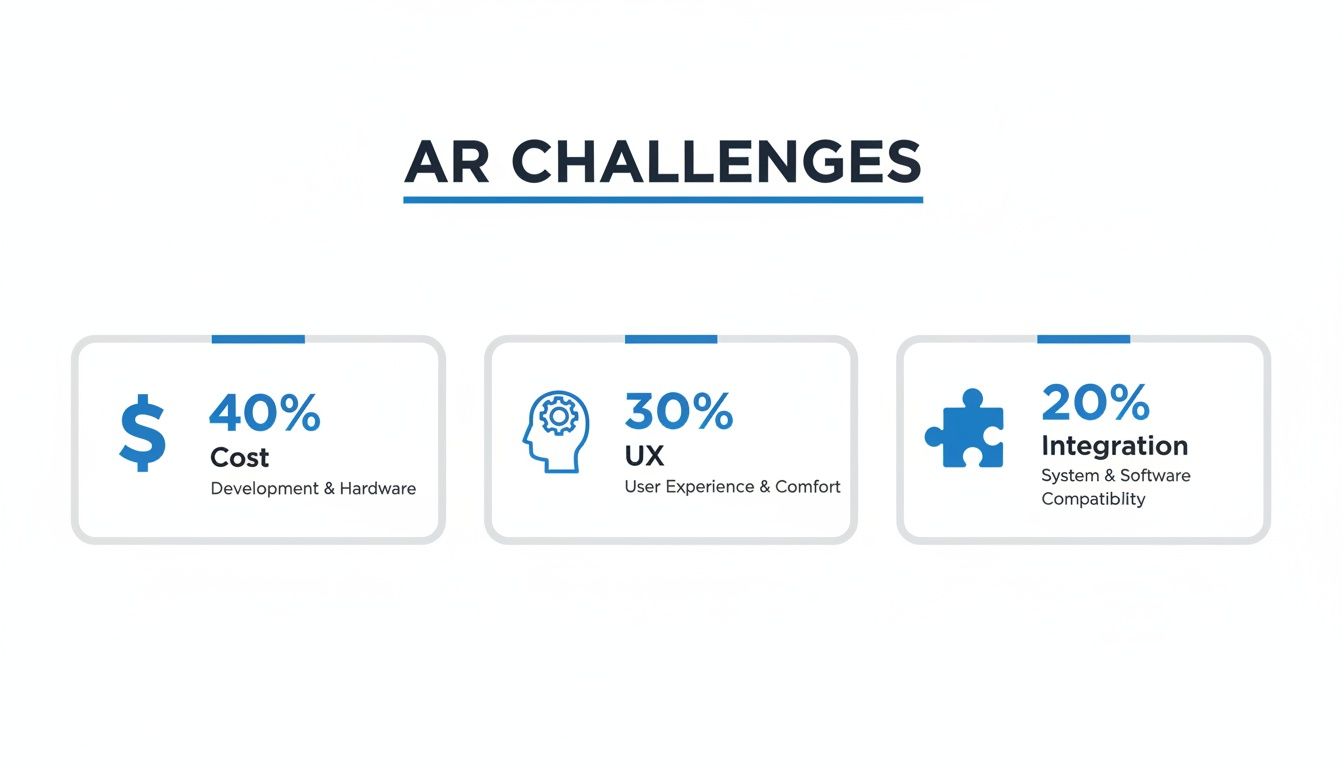
It’s clear that budget isn't just one of many concerns—it’s often the first and toughest obstacle to overcome.
The Financial Realities of Enterprise AR Hardware
The numbers are clear. While the global AR hardware market is expected to reach $8.6 billion by 2025, its growth is slower compared to the software side. This gap points directly to the hardware bottleneck.
High-end gear can cost thousands of dollars per unit, which makes a company-wide deployment a tough pill for any operations leader to swallow. In fact, many companies find that hardware eats up 40-50% of their total AR project budget, making it incredibly difficult to see a quick return on that investment.
This financial pressure is exactly why so many AR projects stall out after the pilot phase. A 2023 study found that a staggering 62% of executives named high upfront costs as their number one blocker, and only 28% of companies have managed to successfully scale their AR initiatives.
The real question for decision-makers isn't just "How much does it cost?" It's "How do we roll this out in a way that minimizes our initial risk and gives us the best shot at a successful, scalable program?"
The answer lies in a flexible deployment strategy. By starting with solutions that run on the devices your team already has in their pockets—smartphones and tablets—you create an easy on-ramp. This lets you prove AR's value for practical use cases like remote assistance or digital work instructions without a massive upfront hardware bill.
Once you’ve built momentum, you can explore specialized gear for tasks that truly demand it. If you're curious about hands-free options, you can learn more about what is a smart glass and see how it fits into a mixed-device strategy.
A Phased Approach to Scaling AR
Instead of a high-stakes, all-or-nothing hardware purchase, a much smarter route is a phased rollout. This approach lets you balance cost with capability, prove tangible benefits, and build a rock-solid business case before committing to larger investments.
Of course, this requires a solid plan for managing your technology. For any enterprise AR program, having a handle on the entire lifecycle of your hardware is critical. Digging into best practices for IT asset lifecycle management can help you control costs and scale smoothly over the long run.
By starting small with existing devices and strategically adding specialized hardware where it makes the most sense, you de-risk the entire investment and build a sustainable foundation for taking AR company-wide.
Solving the Human Factor for Seamless User Adoption
Even the most powerful technology is destined to collect dust if the people it’s meant for won’t use it. Beyond the price tag on the hardware, this “human factor” is one of the biggest hurdles in augmented reality. Getting this right is the difference between a project that succeeds and an investment that fails, especially in tough industrial environments where every second counts.
Powerful AR tools are useless if they frustrate your team. A clunky, confusing interface can create significant problems, sparking resistance from the very workforce the technology is supposed to help. This isn’t just a design problem—it’s a productivity problem.
Overcoming Physical and Cognitive Barriers
One of the first hurdles is the physical experience itself. Wearing AR headsets for extended periods can lead to motion sickness, or "cybersickness"—that feeling of nausea and disorientation. It often happens when there’s a mismatch between what your eyes are seeing and what your body is feeling.
Then there’s the issue of cognitive overload. Imagine a pilot trying to land a plane while the dashboard flashes a hundred different warnings at once. That’s what a poorly designed AR interface can feel like to a technician performing a complex repair. When digital instructions, diagrams, and data points all compete for attention, it can shatter concentration and actually increase the risk of errors.
These user experience roadblocks can seriously slow down AR adoption. In fact, up to 60% of first-time AR users report feeling nauseous after just 10-20 minutes. That figure can jump to a staggering 80% during the longer sessions common in industrial training.
The High Cost of a Steep Learning Curve
In an industrial setting, intuitive design isn’t a luxury; it’s a basic requirement. Frontline workers are focused on getting the job done safely and efficiently, and they don’t have time to wrestle with a complicated system. If an AR solution has a steep learning curve, you've created instant resistance.
The goal of enterprise AR is to simplify complex tasks, not to add another layer of complexity to a worker's day. A solution that requires extensive training just to get started is already failing to deliver on its core promise.
A tool that feels natural and requires minimal training is far more likely to be embraced. It should feel like an extension of the user's workflow, not an interruption.
To make that happen, a successful AR platform has to be built with the end-user in mind from day one. This means:
- Minimizing On-Screen Clutter: Only show information that’s absolutely critical for the task at hand.
- Intuitive Controls: Use simple gestures, voice commands, or on-screen buttons that are easy to pick up and remember.
- Clear, Step-by-Step Guidance: Break down complex procedures into simple, manageable actions.
Nailing these principles drastically cuts down the learning curve and encourages people to actually use the technology.
Designing for Empowerment, Not Frustration
The ultimate goal is to create an AR experience that empowers your workforce, making their jobs easier, safer, and more efficient. When users feel confident and capable with a new tool, they’re far more likely to embrace it and even champion its use across the organization.
This human-centered approach is the secret sauce for any successful AR rollout. Solutions that put the user experience first see higher adoption rates, bigger productivity gains, and a much better return on investment. Designing platforms that are both powerful and easy to use turns a potential obstacle into your greatest advantage. You can also see how this applies to skill-building by learning more about using augmented reality for training to fast-track employee learning.
Breaking Through the Content and Integration Bottleneck
An augmented reality solution is only as good as the information it delivers. You can have the best hardware and a slick user interface, but the whole project will fall flat if it’s cut off from your core business systems or doesn’t have the right digital content. This is a huge bottleneck, and frankly, it's one of the most common challenges of augmented reality that can stop a project in its tracks.
Many organizations underestimate the work it takes to build the 3D models and digital instructions that make AR experiences effective. Imagine trying to open a library with no books on the shelves—that's what you're doing if you deploy an AR platform without a scalable content strategy. Creating custom 3D assets is a specialized skill, and most industrial companies simply don’t have that talent in-house.
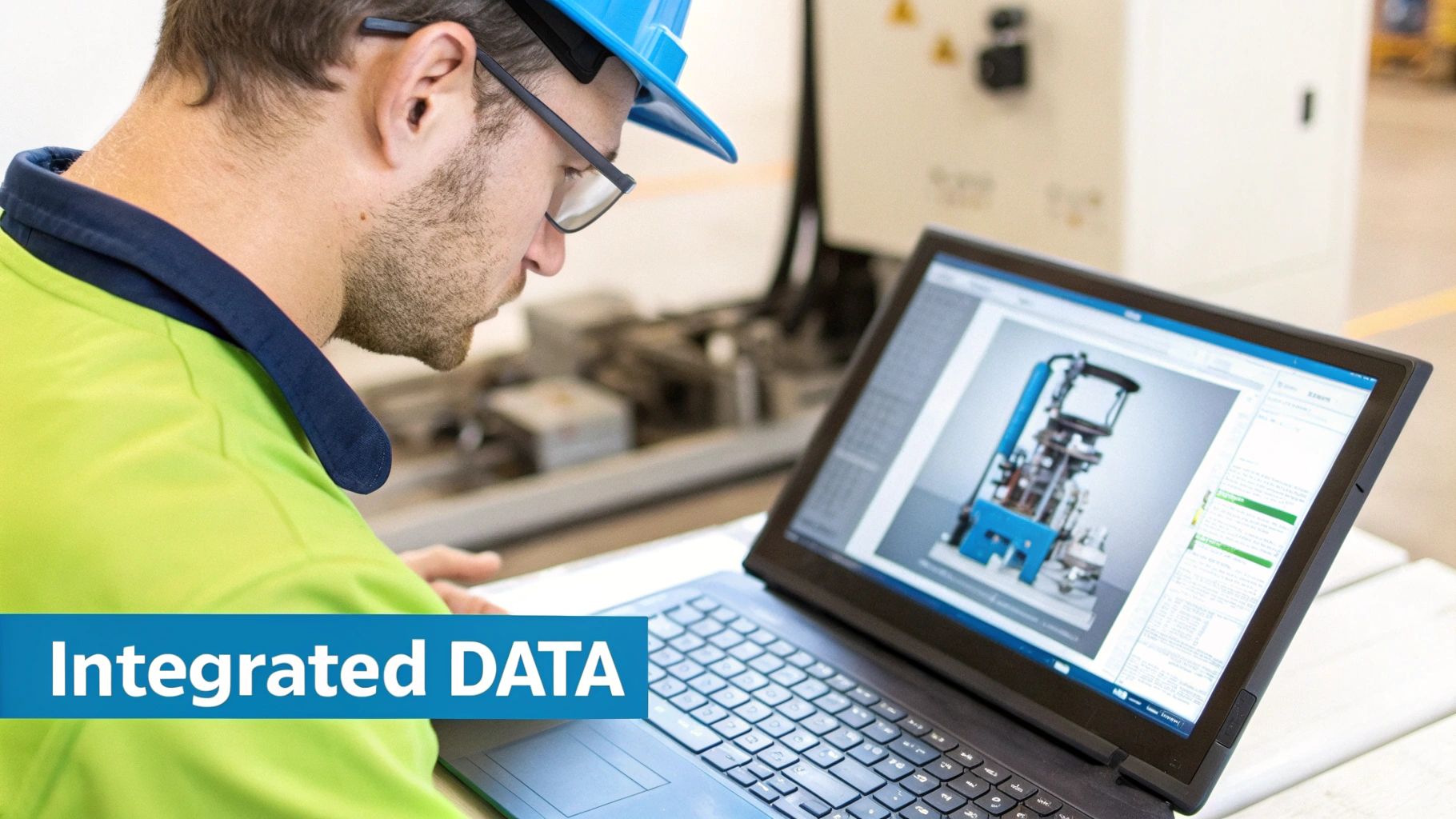
The content problem usually comes hand-in-hand with a technical integration headache. For AR to be truly useful, it cannot operate in isolation. It has to feel like a natural extension of your entire digital ecosystem, pulling real-time data from the systems you already depend on.
The Challenge of Creating Rich AR Content
The first part of the problem is content creation. Your technicians need accurate, detailed 3D models of machinery and clear, step-by-step digital work instructions. Historically, building these assets meant hiring a 3D artist or a CAD engineer, a process that’s both painfully slow and expensive.
Even converting existing CAD files into lightweight, AR-friendly formats can be a surprisingly complex task. On top of that, creating interactive training modules or maintenance guides requires a unique blend of deep technical knowledge and instructional design savvy.
The most effective AR platforms solve this problem by providing no-code or low-code content creation tools. These allow your own subject matter experts—the engineers and technicians who know your equipment best—to build and update AR content without needing to write a single line of code.
This approach completely changes the game. Instead of bottlenecking the process with a small group of specialized creators, you empower your whole team to contribute. It makes content creation faster, more scalable, and significantly more cost-effective.
Integrating AR with Core Business Systems
The second, equally critical challenge is system integration. An AR app that can’t talk to your Enterprise Resource Planning (ERP) or Manufacturing Execution System (MES) is little more than a fancy digital manual. The real value is unlocked when data can flow freely in both directions.
Just think about these practical scenarios where integration is a must-have:
- Pulling Real-Time Data: A maintenance tech points their device at a machine and instantly sees its full service history, recent error codes, and required spare parts—all pulled live from your asset management system.
- Logging Work Automatically: As the technician ticks off each step of a repair in the AR app, that progress is logged back into your ERP automatically. You get a perfect audit trail without anyone having to do manual data entry.
- Connecting to IoT Sensors: The AR overlay shows live temperature, pressure, or vibration data from on-machine sensors, giving workers immediate context and insight right where they need it.
Without this deep integration, AR is just a standalone tool with limited impact. A successful rollout depends on a robust API and a platform architected to connect with the complex web of software that runs your operations. This is non-negotiable; as we've discussed before, a powerful XR experience relies heavily on the underlying digital framework.
The following table summarizes the key challenges and solutions for getting your AR implementation right.
Overcoming Key AR Implementation Challenges
This table outlines the primary augmented reality hurdles discussed and the strategic solutions that help drive successful adoption in enterprise environments.
| Challenge Area | Primary Obstacle | Effective Solution |
|---|---|---|
| Content Creation | High cost and specialized skills needed for 3D modeling and instructional design. | Implement a platform with no-code/low-code tools that empower your internal subject matter experts to create and manage content directly. |
| System Integration | AR applications operate in a silo, unable to access or update data from core business systems like ERP, MES, or IoT platforms. | Choose an AR solution with a robust API and proven connectors to ensure seamless, bi-directional data flow. |
| User Adoption | The technology is too complex or the interface is not intuitive for frontline workers, leading to resistance and low usage. | Prioritize user-centric design (UX) with simple, intuitive interfaces that require minimal training to get started. |
| Hardware Limitations | Devices can be bulky, have poor battery life, or lack the processing power needed for demanding industrial environments. | Conduct thorough pilot programs with modern, purpose-built hardware to validate performance in your specific use case. |
By prioritizing solutions that offer both simplified content creation and seamless integration, you can break through this common bottleneck. This is how you transform AR from an interesting pilot project into a powerful, fully connected tool for your business.
Managing Enterprise Security and Data Privacy
When you bring augmented reality into sensitive industrial spaces, you're also introducing a new set of security and data management challenges that you simply can't afford to ignore. At their core, these headsets are sophisticated data collection tools, packed with cameras, microphones, and sensors. This simple fact makes security one of the most critical challenges of augmented reality for any business.
Imagine a technician wearing an AR headset on your factory floor. That device's camera can see and potentially record everything—from proprietary manufacturing processes and unreleased product designs to sensitive operational data displayed on a nearby monitor. This isn't just a hypothetical scenario; it's a real, tangible threat to your intellectual property.
And it’s not just about protecting company secrets. What about your employees? The constant potential for recording can foster a tense and difficult work environment if it isn't managed with clear, transparent policies. Securing the massive streams of data these devices generate is a major technical hurdle, demanding a proactive and robust security posture from day one.
Securing the AR Data Pipeline
To get ahead of these risks, security can't be an afterthought. It has to be built into the very foundation of your AR deployment. Think of your AR ecosystem like a secure facility—you need multiple layers of protection to control who gets in, what they can see, and how data gets out.
A solid security strategy needs to address three critical areas:
- Robust Data Encryption: All data, whether it's traveling across a network (data in transit) or stored on a device (data at rest), must be fully encrypted. This ensures that even if someone manages to intercept your data, it remains unreadable.
- Secure Authentication Protocols: This is non-negotiable. Implementing multi-factor authentication (MFA) and strict user access controls guarantees that only authorized personnel can access the AR platform and its sensitive content. It’s your first line of defense against unauthorized use.
- Comprehensive Device Management: You absolutely need a system to manage the entire lifecycle of your AR hardware. This means having the power to remotely wipe a device if it’s lost or stolen, push out critical security updates, and control which applications can be installed.
Enterprise-grade security isn't just a feature; it's a fundamental requirement. A single breach could expose trade secrets, compromise employee privacy, and lead to devastating financial and reputational damage.
Maintaining Control with Flexible Deployment
The good news is that these security challenges are manageable with the right deployment strategy. Not all AR solutions are built the same, and how a platform is hosted has a massive impact on your ability to control and protect your data. While cloud-based solutions offer convenience, they might not meet the stringent security needs of all organizations.
This is where a secure on-premise deployment offers a distinct advantage. By hosting the AR platform on your own servers, safely behind your corporate firewall, you maintain complete control over your data. This approach dramatically reduces the attack surface and ensures your most sensitive information never leaves your secure environment. To properly manage this, enterprises should consult authoritative guidelines for secure data sanitization.
Ultimately, you want a flexible solution that offers both cloud and on-premise options. This gives you the power to choose the security model that fits your specific operational needs, not the other way around. That level of control is essential for protecting your IP, complying with strict regulations like ITAR or GDPR, and building the trust you need for widespread adoption.
Proving the Business Value and Measuring AR ROI
Ultimately, any new technology investment must answer one simple question: what’s the return? This is often the final—and most critical—hurdle in getting an augmented reality project off the ground. Moving past vague promises of "efficiency" and into hard numbers is absolutely essential for getting executive buy-in and justifying the expansion of an AR program from a pilot to a full-scale deployment.
To build a compelling business case, you have to tie your AR initiative directly to the key performance indicators (KPIs) that actually matter to your bottom line. It's not enough to say AR will "improve things"; you have to define exactly how and by how much. That means focusing on concrete, measurable outcomes that resonate with leadership.
Defining Your Core AR Metrics
A successful ROI calculation starts with tracking the right metrics. For industrial and enterprise settings, these almost always center on operational improvements that translate directly into cost savings or revenue growth.
Here are the essential KPIs you should be tracking:
- Reduced Machine Downtime: Measure the time it takes to diagnose and repair equipment before and after AR implementation. Every minute of saved downtime means more production output.
- Lower Expert Travel Costs: Quantify the savings from using remote assistance instead of flying specialists to a site. Tally up the cost of flights, hotels, and lost productivity for every expert trip you eliminate.
- Improved First-Time Fix Rates: Track how often a technician resolves an issue on the first visit. AR-guided instructions can boost this metric significantly, slashing the need for costly repeat visits.
- Accelerated Skill Acquisition: Compare how long it takes for new hires to reach full productivity using AR training versus traditional methods. Faster onboarding delivers a much quicker return on your hiring investment.
Building a solid business case isn't just about crunching numbers; it's about telling a clear story. Show a direct line from the AR investment to a specific, measurable improvement in a core business function.
This data-driven approach shifts the conversation from a technology discussion to a business strategy discussion.
Overcoming Change Management and Driving Adoption
Even with a rock-solid business case, one of the toughest challenges for augmented reality is cultural. You need buy-in from both the C-suite and the frontline workers who will use the technology every day. Resistance to change is natural, but you can overcome it with a clear strategy.
For leadership, keep the focus squarely on the ROI and strategic advantages. Frame the AR initiative not as a tech project, but as a direct solution to pressing business problems, like a widening skills gap or rising operational costs.
For frontline workers, the approach has to be about empowerment. Show them how this technology will make their jobs easier, safer, and less frustrating. Hands-on demonstrations are far more effective than presentations. When a technician sees for themselves how AR can help them solve a tough problem in minutes instead of hours, they quickly become the technology's biggest advocates.
By combining a rigorous, data-backed business case with a thoughtful change management plan, you can ensure your AR initiative delivers sustainable, measurable value. This strategic alignment is the key to turning a promising technology into a true competitive advantage.
Burning Questions About Enterprise AR
When leaders start thinking about bringing augmented reality into their operations, a few key questions always come up. From the initial investment to long-term security, let's tackle the most common concerns head-on and give you the clarity you need to move forward.
How Do We Start an AR Project Without a Massive Upfront Investment?
One of the biggest myths holding companies back is the idea that you need a huge budget for specialized hardware right out of the gate. That's simply not true.
The smart way to begin is with a focused pilot program that uses a flexible, device-agnostic platform. You can leverage the smartphones and tablets your team already has. This lets you prove the concept, show a real return on investment on a small scale, and build excitement internally before you even think about buying expensive smart glasses. It’s all about de-risking the project and building momentum from the ground up.
How Can We Ensure Our Employees Will Actually Use the Technology?
Adoption lives and dies by one thing: simplicity. If the AR solution is clunky, complicated, or feels like just another task, your team will find a way to work around it.
The most successful AR deployments don't feel like a chore. They feel like a natural extension of a technician's workflow, making their job easier, faster, and safer.
The key is to find a solution with an intuitive interface that requires almost no training. Let your team get their hands on it. Show them how it helps solve a real problem they face every day. When they see for themselves how it makes them better at their job, they won't just adopt it—they’ll champion it.
What Is the Biggest Security Risk with Enterprise AR?
Without a doubt, the biggest risk is data protection. AR devices are covered in cameras and sensors, capturing everything from sensitive intellectual property on the factory floor to proprietary operational data. That information is valuable, and you have to protect it.
Securing the constant stream of data these devices generate is a major challenge. To lock it down, your AR platform must have rock-solid security protocols built-in:
- End-to-end data encryption is non-negotiable. It keeps your information safe whether it's moving across the network or stored on a device.
- Strict user authentication ensures that only the right people can access your system and its data.
- Flexible deployment options, including a secure on-premise setup, give you total control by keeping everything behind your own corporate firewall.
Ready to move past these challenges and see what augmented reality can really do for your business? AIDAR Solutions builds flexible, secure, and user-friendly platforms designed for real-world industrial success. Let us show you how to build a powerful business case and achieve results you can measure.
Find out more at https://aidarsolutions.com.