Augmented Reality Landscape: A Guide to Enterprise Trends and Applications
The augmented reality landscape is the complete ecosystem of technologies, applications, and market forces enabling the overlay of digital information onto the physical world. It is a practical business tool actively solving real-world industrial problems today.
Its core value is delivering critical data and expert guidance directly to frontline workers, precisely when and where it is needed.
Unpacking the Modern Augmented Reality Landscape
Augmented reality (AR) is best understood not as a replacement for the real world, but as an intelligent, interactive layer on top of it. Consider a mechanic viewing an engine through smart glasses. Digital arrows appear, pinpointing the exact bolts to unscrew, while step-by-step instructions are displayed in their field of view. This scenario illustrates a powerful method for knowledge transfer and accurate task execution.
This is what distinguishes AR from virtual reality (VR). VR immerses a user in a completely new, computer-generated environment, replacing their surroundings entirely. AR, by contrast, enhances the current environment. For any industrial setting, that distinction is critical. AR keeps workers grounded and aware of their physical workspace while providing the digital support they need.
To better understand these concepts, our deep dive explains what XR technology is and shows how AR fits into the broader picture.
Why Enterprises Are Adopting AR Now
The adoption of AR in factories, warehouses, and field service is a direct response to urgent business challenges. Many companies are contending with a persistent skills gap, where experienced workers are retiring and new hires must become proficient more rapidly than ever. AR addresses this by creating on-the-job learning experiences that build competency quickly.
This leads to tangible benefits that are shaping the modern AR landscape:
- Enhanced Operational Efficiency: Providing instant access to the right information reduces guesswork and costly mistakes. Tasks are completed faster, and first-time fix rates increase significantly.
- Improved Knowledge Transfer: AR excels at capturing the expertise of seasoned professionals. It transforms their knowledge into scalable, digital workflows that can guide any employee, anywhere.
- Increased Worker Safety: Overlaying safety warnings, procedural checklists, and highlighting potential hazards directly in a worker's line of sight is a straightforward way to prevent accidents and maintain compliance.
The real power of enterprise AR is its ability to close the distance between information and action. It turns complex machinery into an interactive textbook and empowers every technician with the knowledge of your most seasoned expert.
As the market for these solutions grows, so does the potential for a significant return on investment. Businesses are moving beyond small pilot programs to deploy AR at scale. They are observing significant reductions in training costs, travel expenses for remote experts, and equipment downtime. The conversation has shifted from "what is AR?" to "how can AR solve our most significant operational problems and deliver immediate value?"
The Reality of AR: Market Growth and Key Trends
Augmented reality has officially transitioned from the laboratory to the factory floor. It is no longer just a concept; it is a serious engine for industrial growth. Companies are now implementing AR to solve real-world operational problems and are seeing tangible returns.
This shift from experiment to essential tool is fueling significant market expansion. The global AR market recently reached approximately USD 83.65 billion, a substantial increase from USD 31.97 billion in 2022. This growth is projected to continue, with the market forecast to reach USD 120.29 billion by 2025 and an estimated USD 599.59 billion by 2030.
That trajectory, representing a compound annual growth rate of 37.9% from 2025 to 2030, is a clear signal of a fundamental change in how industries operate.
What's Fueling This AR Fire?
This growth is the result of mature technology, accessible hardware, and a pressing need for more intelligent operational methods. These key drivers are transforming AR from a "nice-to-have" into a strategic necessity for businesses aiming to remain competitive.
Here’s a breakdown of what's pushing AR forward:
- Hardware is Finally Within Reach: High-quality smart glasses and AR-ready mobile devices are no longer prohibitively expensive. This has lowered the barrier to entry, making large-scale deployments feasible for more companies.
- Software Got Smarter (and Simpler): The era of needing a specialized development team to create AR content is ending. Robust, user-friendly platforms now simplify the process of building, managing, and deploying AR experiences.
- The Proof is in the Pudding: A growing library of success stories exists across various industries. These proven business cases provide a clear roadmap to ROI, giving more leaders the confidence to invest.
The chart below breaks down the core business drivers—Knowledge, Skills, and Efficiency—that are convincing companies to adopt AR.
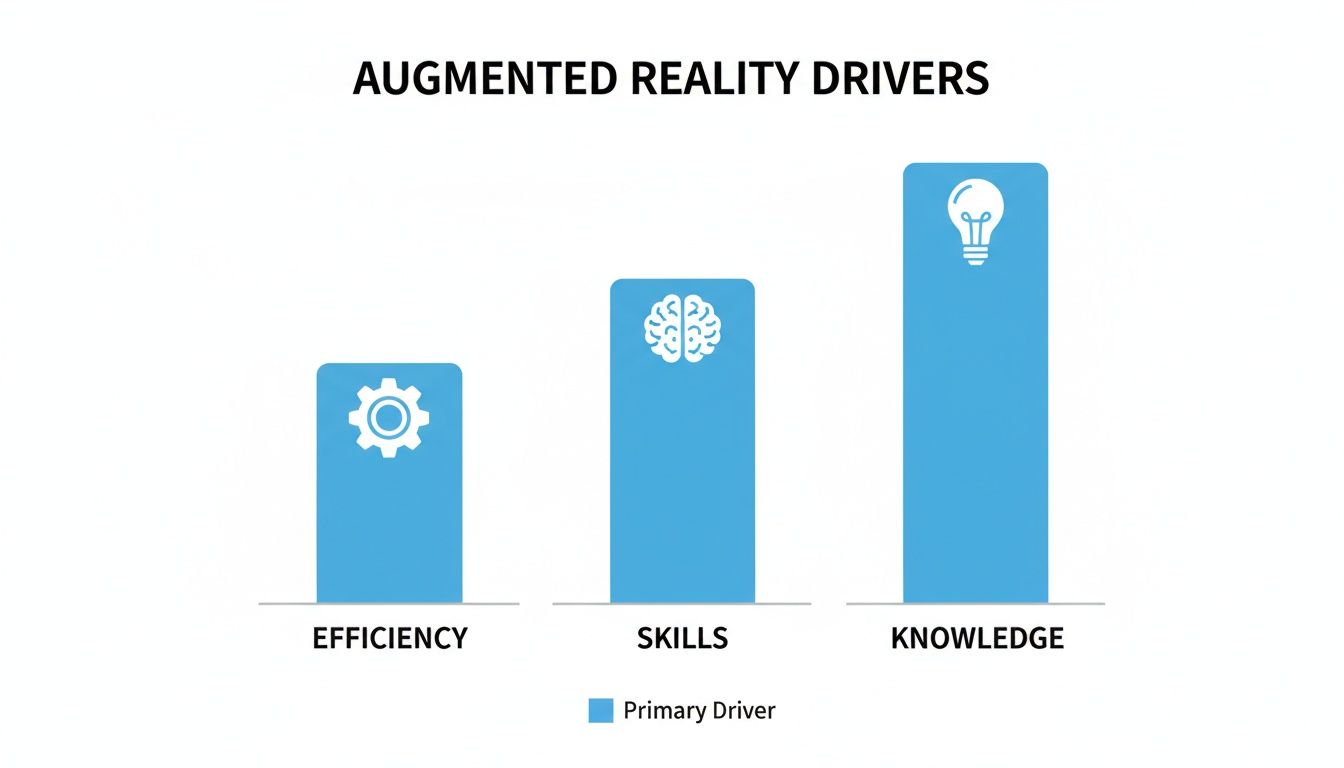
As you can see, AR directly addresses critical operational challenges. It is a powerful tool for boosting productivity, closing the skills gap, and capturing expert knowledge before it is lost.
Early adopters of AR are not just gaining a temporary competitive advantage. They are redesigning their training, service, and maintenance workflows for long-term efficiency and resilience.
Turning Market Stats into a Solid Business Case
For any decision-maker, these numbers tell a powerful story. The sustained, high-speed growth of the AR market confirms that this is a lasting technological shift. Investing in AR is quickly becoming a strategic imperative for industrial leaders focused on future-proofing their operations.
The business case becomes clear when connecting market data to on-the-ground benefits. A company facing a "silver tsunami" of retiring experts can use AR to capture a senior technician's step-by-step process and turn it into an interactive, guided workflow for new hires. This immediately helps close the skills gap, improves first-time fix rates, and reduces expensive downtime.
Alternatively, consider a business with a global field service team. Instead of flying experts around the world, they can equip technicians with AR-powered remote assistance tools. The expert sees exactly what the on-site technician sees, providing real-time guidance from thousands of miles away. The return on investment from saved travel costs alone is often immediate and easily measurable.
The applications are extensive, and you can explore more about which augmented reality industries are seeing the greatest impact.
Ultimately, the market growth provides the validation needed to champion AR adoption internally. It shifts the conversation from "if" to "how" to invest, giving leaders the confidence to back solutions that deliver measurable gains in productivity, safety, and operational excellence.
Core AR Technologies and Deployment Models
To understand the augmented reality landscape, it is essential to know its underlying technologies. These core components power the digital overlays, interactive guides, and real-time data that are transforming industrial work. This is less about memorizing technical jargon and more about understanding the available options—from the hardware your team wears to the software that drives the experience.
The entire system is a partnership between hardware and software. The hardware serves as the window through which employees view this blended reality, and the software acts as the brain determining what they see. A successful AR initiative requires excellence in both.
The Hardware Powering AR Experiences
The physical devices are the most tangible piece of the AR puzzle. They dictate how users interact with digital information layered onto their physical world. In the enterprise space, this primarily involves two main categories of hardware.
- Smart Glasses: These are the workhorses of industrial AR. Head-mounted devices put a small screen in a worker’s line of sight, allowing them to view digital information while keeping their hands free for equipment work or complex assembly tasks. This is ideal for maintenance, repair, and manufacturing workflows.
- Mobile Devices (Smartphones and Tablets): The device already in everyone’s pocket is a powerful and accessible entry point to AR. Using the built-in camera, phones and tablets can overlay instructions, 3D models, and data onto the real world. They are suitable for tasks where hands-free operation is not essential, such as site inspections, quality control checks, or client walkthroughs.
The right hardware always depends on the job. A field technician troubleshooting an HVAC unit benefits immensely from hands-free smart glasses. However, an architect showing a client a 3D model on a construction site will likely find a tablet more practical. For more technical details, our guide explains how augmented reality works.
Choosing Your Deployment Model: SaaS vs. On-Premise
After selecting the hardware, a software platform is needed to create, manage, and deliver the AR content. This leads to a critical decision regarding the deployment model. The two primary models, Software-as-a-Service (SaaS) and on-premise, each offer distinct advantages.
A SaaS model is comparable to leasing a fully furnished office. The provider manages all infrastructure, maintenance, security, and updates. You pay a subscription fee for access, allowing you to scale up or down as needed with minimal upfront IT overhead. It is typically the quickest way to get started.
Conversely, an on-premise deployment is like owning your own building. You host the software on your servers, giving you total control over data, security protocols, and integration with other internal systems. This is often the preferred choice for organizations with strict data privacy requirements or specific IT environments.
The decision between SaaS and on-premise is not just a technical choice; it is a strategic one. It aligns your AR initiative with your organization's core approach to IT security, cost management, and long-term scalability.
The table below breaks down how the two models compare across key business factors. It is also important to note that as AR advances, it relies heavily on fast, responsive communication networks. Understanding connectivity trends is key; learn more about the foundational role of 5G technology in emerging tech.
SaaS vs On-Premise AR Deployment Models
Choosing between a cloud-based service and a self-hosted solution impacts everything from budget to IT workload. This comparison can help you weigh the trade-offs for your specific needs.
| Factor | SaaS (Software-as-a-Service) | On-Premise |
|---|---|---|
| Initial Cost | Lower. Typically a subscription-based model with minimal upfront hardware costs. | Higher. Requires significant initial investment in server hardware and software licenses. |
| Scalability | High. Easily scale user licenses up or down based on current operational needs. | Moderate. Scaling requires additional investment in server capacity and infrastructure. |
| Maintenance | Minimal. The vendor manages all updates, patches, and server maintenance. | High. Your internal IT team is responsible for all maintenance and system upkeep. |
| Security | Vendor-Managed. Relies on the provider's security protocols and certifications. | Full Control. Your organization has complete control over data and security measures. |
| Implementation | Faster. Can be deployed quickly without the need for extensive IT setup. | Slower. Requires significant time for server setup, configuration, and integration. |
Ultimately, there is no single "best" answer. A SaaS model offers speed and flexibility, making it a strong choice for many businesses beginning their AR journey. An on-premise solution provides unmatched control and security, which is non-negotiable for others. The right path depends entirely on your operational realities and strategic goals.
Practical AR Use Cases Transforming Industries
The true value of augmented reality is demonstrated not in theory, but in the tangible results it delivers on the factory floor and in the field. This is where AR becomes a critical tool for solving expensive, real-world problems. By examining specific applications, we can see exactly how this technology impacts operational efficiency and enhances workforce capabilities.
We will break down three high-impact industrial applications that prove AR's value. These examples in immersive training, remote support, and maintenance workflows show precisely how AR creates measurable returns.
Immersive Training for a Skilled Workforce
Traditional training methods can be ineffective. Manuals are static, classroom learning is often disconnected from the actual job, and shadowing senior employees is slow and not scalable. AR transforms this by creating a learning environment that is both interactive and context-aware.
Imagine a new technician learning to assemble complex machinery. Instead of consulting a dense manual, they wear AR smart glasses that overlay digital instructions directly onto the equipment. Arrows point to specific bolts, short animations show the correct sequence, and critical torque values appear exactly where needed.
This approach offers clear benefits:
- Accelerated Learning: On-the-job training time is significantly reduced because employees learn by doing, with guidance at every step.
- Improved Retention: People retain what they do, not just what they read. This hands-on, interactive learning enhances knowledge retention.
- Enhanced Safety: Digital safety warnings and procedural checklists can be displayed in real-time, drastically reducing the risk of accidents.
This is applicable across many industries. To see how AR is making a difference in various fields, explore the applications of Augmented Reality in Health Care, where it is used for everything from surgical training to patient education.
Real-Time Remote Expert Assistance
Few things are as detrimental to an industrial operation as equipment downtime. When a critical machine fails, every minute results in lost revenue, but the expert who can fix it may be hundreds or thousands of miles away. AR-powered remote assistance is a game-changer in this scenario.
Consider a field technician facing an unfamiliar equipment failure. Using AR glasses or a tablet, they can stream their exact point of view to a senior engineer at headquarters. The remote expert sees what the technician sees and can guide them through the repair interactively, in real time.
AR closes the distance between your experts and your problems. It allows a single specialist to support a global team of technicians, instantly scaling expertise without the cost and delay of travel.
The expert can annotate the technician's live video feed, circling parts with digital markers or placing text instructions that "stick" to the physical equipment. This shared view eliminates guesswork and ensures the repair is done correctly the first time. The ROI is immediate and significant, with companies drastically reducing travel costs and equipment downtime.
For a deeper look into the possibilities, you can find extensive information on the various augmented reality applications driving these results.
Simplified Maintenance and Repair Workflows
Routine maintenance and complex repairs are vital to any industrial operation, but they often rely on cumbersome, paper-based procedures. AR digitizes these workflows, placing critical information directly in the user's line of sight and simplifying every step of the process.
Imagine a maintenance worker performing a scheduled inspection on an HVAC unit. Through their AR device, they see a digital checklist that automatically advances as each task is completed. If they need to view a schematic, a simple voice command overlays it directly on top of the physical unit, allowing for instant part identification.
This digital-first approach to maintenance delivers powerful benefits:
- Increased Accuracy: Step-by-step visual guidance minimizes the chance of human error, ensuring every job is performed to specification.
- Improved Efficiency: Technicians no longer waste time searching for the correct manual or schematic. All necessary data is available on demand.
- Better Data Capture: Work can be automatically documented with photos and time-stamped videos, creating a rich service history for compliance and future troubleshooting.
By transforming how technicians are trained, supported, and guided, AR provides a clear path to a more efficient, capable, and resilient workforce.
How to Measure the ROI of Your AR Investment
For any business leader, adopting new technology must be financially justifiable. Investing in the augmented reality landscape is no different. The decision must be supported by a solid business case that demonstrates a clear path to a return on investment (ROI). This involves moving beyond the technology's novelty to focus on tangible, measurable outcomes that impact the bottom line.
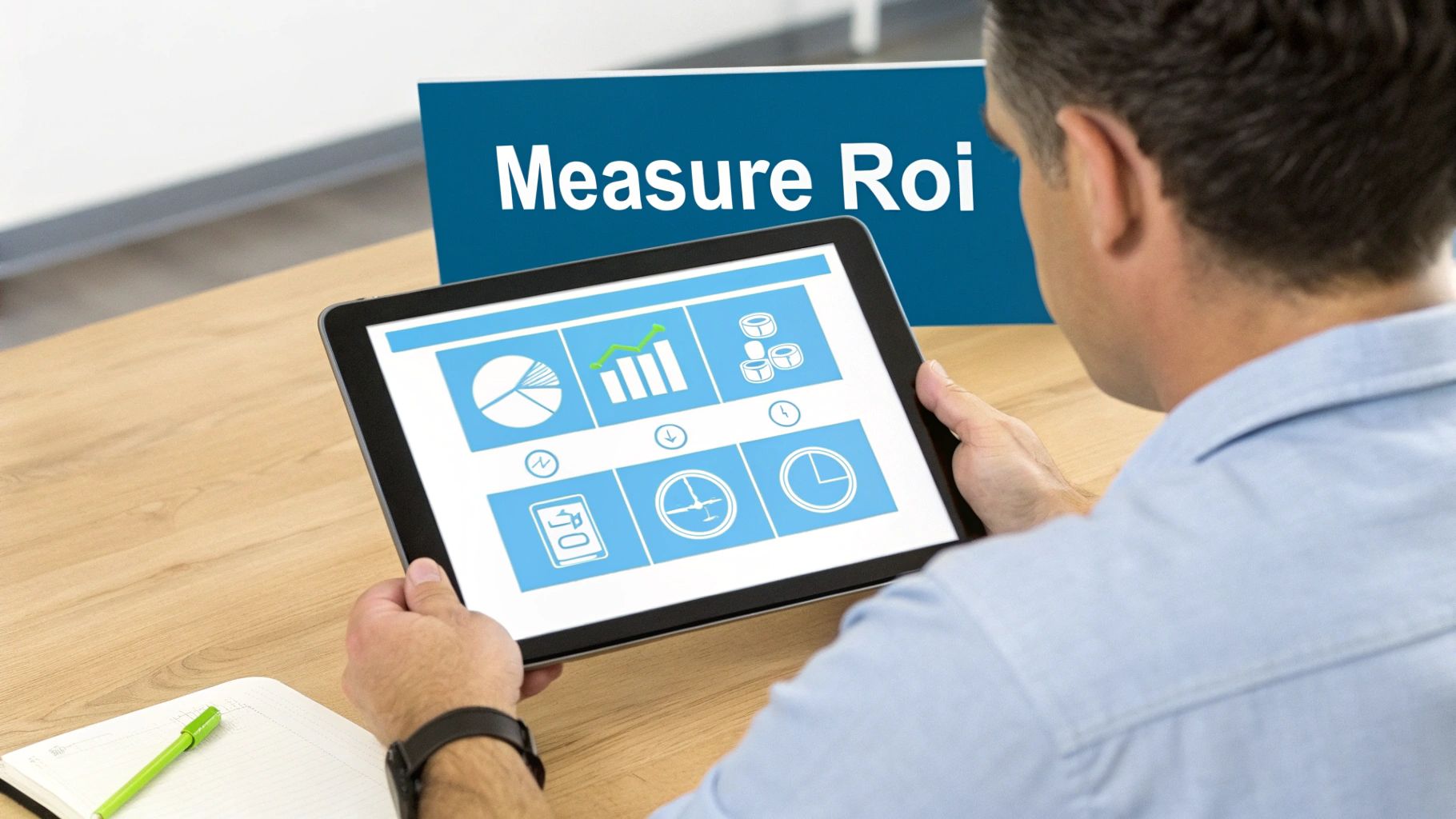
A practical framework for measuring AR's ROI begins with defining the right key performance indicators (KPIs). These metrics bridge the technology’s features to its financial impact, providing the hard data needed to prove its value to stakeholders.
Identifying Your Core Operational KPIs
Before demonstrating improvement, you must establish a baseline. What are your current operational costs and performance levels? By pinpointing the specific challenges you want AR to solve, you can select KPIs that tell a compelling story of efficiency gains and cost savings.
The most relevant metrics typically fall into a few key categories:
- Productivity Gains: This focuses on achieving more with existing resources. A key metric is task completion time—how much faster can a technician finish a repair or assembly with AR guidance compared to using a manual?
- Quality and Accuracy Improvements: Errors are costly. Tracking the first-time fix rate shows how AR reduces repeat visits and rework. A lower error rate in assembly or maintenance directly translates to less wasted material and improved product quality.
- Cost Reduction: This is often the most direct way to prove ROI. A major KPI is reduced travel expenses for expert support, which can often be cut by 75% or more with remote assistance tools.
- Training and Onboarding Efficiency: Measure the time-to-competency for new hires. AR can dramatically shorten the learning curve, potentially doubling training throughput without adding instructors or classrooms.
Building the Business Case with Concrete Examples
Once you have established your KPIs, you can build a compelling business case by translating operational improvements into financial terms. The goal is to draw a direct line from the AR investment to a measurable economic impact.
Measuring AR's ROI is not about abstract benefits. It is about connecting digital guidance directly to fewer truck rolls, faster machine uptime, and a more competent workforce. These are the numbers that justify the investment.
Consider these practical scenarios:
- Remote Assistance: A company spends $200,000 annually on travel for experts to conduct complex field repairs. By implementing an AR remote support solution, they eliminate 80% of these trips. This results in an immediate annual saving of $160,000, delivering a clear and rapid return on their software and hardware investment.
- Immersive Training: A manufacturer's average onboarding for a skilled technician takes six weeks. By using AR-guided workflows, they reduce that to three weeks. This not only halves the non-productive training time but also gets skilled workers on the production line twice as fast, directly boosting output.
By focusing on these specific, quantifiable metrics, you create a clear toolkit for proving the value of AR. This data-driven approach is crucial for securing budget approval, winning stakeholder support, and ensuring your deployment is set up for success.
Choosing the Right Partner in the AR Ecosystem
Successfully implementing augmented reality is about more than just technology—it's about finding the right partner. Navigating the augmented reality landscape requires a guide who understands not only the software and hardware but also the real-world operational challenges your teams face daily.
The right technology provider is a strategic ally, not just a vendor. They ensure your investment continues to deliver value long after the initial deployment.
When selecting a partner, look beyond impressive demonstrations. Prioritize providers with deep industrial expertise—those who understand your industry's language and have a proven track record of successful projects. A true partner is committed to your long-term success.
What to Look for in a Technology Partner
The market is crowded, but a few key attributes distinguish the best partners. Your evaluation should be focused on capabilities that will directly impact your operational goals and guarantee a smooth, scalable rollout.
Ensure any provider you consider can demonstrate strength in these critical areas:
- Proven Integration Capabilities: Your AR solution must integrate seamlessly with existing systems, such as your ERP or LMS. A partner with significant integration experience can prevent data silos and ensure information flows where it is needed.
- Deep Industrial Expertise: Find a partner who understands the realities of the factory floor or the daily work of a field service technician. This ensures the solution is one your frontline teams will adopt because it genuinely improves their work.
- Commitment to Long-Term Success: Consider what happens after launch. Look for a provider who offers ongoing support, hands-on training, and a clear product roadmap. This ensures your AR solution evolves with your business.
The ideal AR partner doesn’t just sell you software; they invest in your outcomes. They bring the expertise, support, and strategic guidance you need to turn your AR vision into a measurable operational reality.
The Power of a Strong Partner Ecosystem
A great technology provider brings a powerful ecosystem with them. A strong partner program drives innovation, providing access to the latest product updates, co-marketing support, and a community of industry experts. This collaborative environment ensures your AR investment continues to deliver value for years.
This is especially true in a market where software and services are dominant. Software and services constitute 93% of total revenue in the augmented reality market today. By 2030, that share is projected to remain at 83%.
This represents a USD 33.1 billion opportunity now, expected to grow to USD 192.8 billion. You can discover more insights about the AR market to explore these trends. This demonstrates why a partner’s service, support, and software roadmap are more critical than the specific hardware they utilize.
Got Questions About Enterprise AR? We've Got Answers.
Adopting augmented reality can raise practical questions for any business leader. Addressing these concerns is the best way to move from evaluation to confident implementation. Let's tackle a few of the most common questions from enterprises.
How Hard Is It Really to Integrate AR with Our Existing Systems?
Many leaders anticipate a complex IT overhaul, but that is rarely the case today. Modern AR platforms are designed for interoperability.
The best providers offer robust APIs and, just as importantly, expert guidance to ensure a smooth connection with your existing LMS, ERP, or Field Service Management software. The key is to find a partner with a proven track record of successful integrations. They will know how to tailor the solution to your IT infrastructure, whether through a simple SaaS model or a more customized on-premise deployment.
What’s a Realistic Timeframe to See a Return on Investment?
The timeframe for seeing a return depends on the application, but the results are often surprisingly fast.
- Remote Assistance: For remote support applications, the ROI is almost immediate. It is visible in reduced travel costs and significantly faster first-time fix rates.
- Immersive Training: With training solutions, a return can typically be seen within a few months. This is driven by faster onboarding, fewer production errors, and increased employee proficiency.
A reliable AR partner will help you build a clear business case from day one with realistic ROI projections.
"A core design principle for enterprise AR is user-friendliness. The goal is to empower frontline workers, not burden them with complex technology, ensuring smooth adoption for all users regardless of technical background."
Do Our Employees Need to Be Tech Wizards to Use This?
Absolutely not. The interfaces on today's smart glasses and mobile devices are designed to be highly intuitive, often utilizing simple voice commands, natural hand gestures, and clean visual overlays that guide users effectively.
A good AR provider also delivers effective training and onboarding to ensure a seamless transition. The objective is to make technology accessible and empowering for every member of your team, from a new apprentice to a 30-year veteran.
Ready to transform your training and service operations? AIDAR Solutions provides immersive AR and VR tools that deliver measurable results, from accelerating employee skills to slashing service times. Discover how our experts can build a solution that fits your unique operational needs.
Learn more at https://aidarsolutions.com