
The Top 7 Advantages of AR for Modern Business
At its heart, the power of augmented reality is simple: it dramatically improves efficiency, minimizes human error, and gets new people up to speed faster than ever before. AR works by overlaying critical digital information directly onto the physical world, giving your frontline workers the exact data they need, precisely when and where they need it.
How Augmented Reality Is Reshaping Business Operations
Imagine a technician trying to service a complex piece of industrial machinery. The traditional method involved flipping through a dense paper manual or using a tablet, splitting their attention between the screen and the machine.
With AR, they see digital instructions, schematics, and live performance data projected right onto the equipment itself. This is the practical power of AR, and it's bridging the gap between digital information and the physical world of work.
Think of it as a real-time, interactive guide that enhances human perception and decision-making. It completely changes how employees learn, perform tasks, and solve problems, moving them from abstract instructions to concrete, in-the-moment guidance.
From Concept to Core Business Tool
Augmented reality has evolved from a niche technology into a foundational tool for digital operations in many of the world's leading companies. Why the shift? Because it delivers clear, measurable results that impact the bottom line.
The core idea is simple but powerful: empower your workforce with context-aware information. This isn't just about providing data; it's about providing the right data, at the right time, in the most intuitive way possible. The key advantages of AR all flow from this principle:
- Improved Efficiency: AR-guided workflows cut out the time wasted searching for information. This directly translates to faster task completion and a significant boost in overall productivity.
- Reduced Human Error: When you have step-by-step visual instructions right in your line of sight, it’s much easier to follow procedures correctly. This significantly lowers the risk of expensive—and sometimes dangerous—mistakes.
- Enhanced Knowledge Transfer: Complex skills can finally be taught on the job. New hires can perform like seasoned pros, and you can capture the invaluable expertise of your veteran workers before they retire.
AR is a direct conduit for operational intelligence, delivering precisely what a worker needs to see to perform a task safely, accurately, and efficiently. It turns every employee into your most capable expert.
Beyond these immediate wins, AR is a vital piece of any serious digital transformation strategy. It aligns perfectly with how modern businesses are rethinking learning and development, a trend highlighted in the latest Top Trends in Technology for Education.
This technology isn't just another operational tool; it's an investment in a more capable, adaptable, and informed workforce. As companies fight for a competitive edge, truly understanding augmented reality for businesses is no longer optional—it's essential for smart planning and long-term growth.
Driving Operational Excellence with Measurable ROI
While overlaying digital information onto the physical world is fascinating, for any business, the real question is about tangible, measurable results. The advantages of AR aren't just abstract concepts; they’re about concrete improvements that hit your key performance indicators (KPIs), boost your bottom line, and give you a serious competitive edge.
This is where the technology meets financial reality. By weaving AR into daily workflows, companies move beyond just doing things differently and start doing them better—faster, cheaper, and with much more accuracy. The result is a direct, positive impact on operational excellence.
This diagram breaks it down, showing how AR’s advantages filter into three core pillars of your business: Efficiency, Accuracy, and Knowledge.
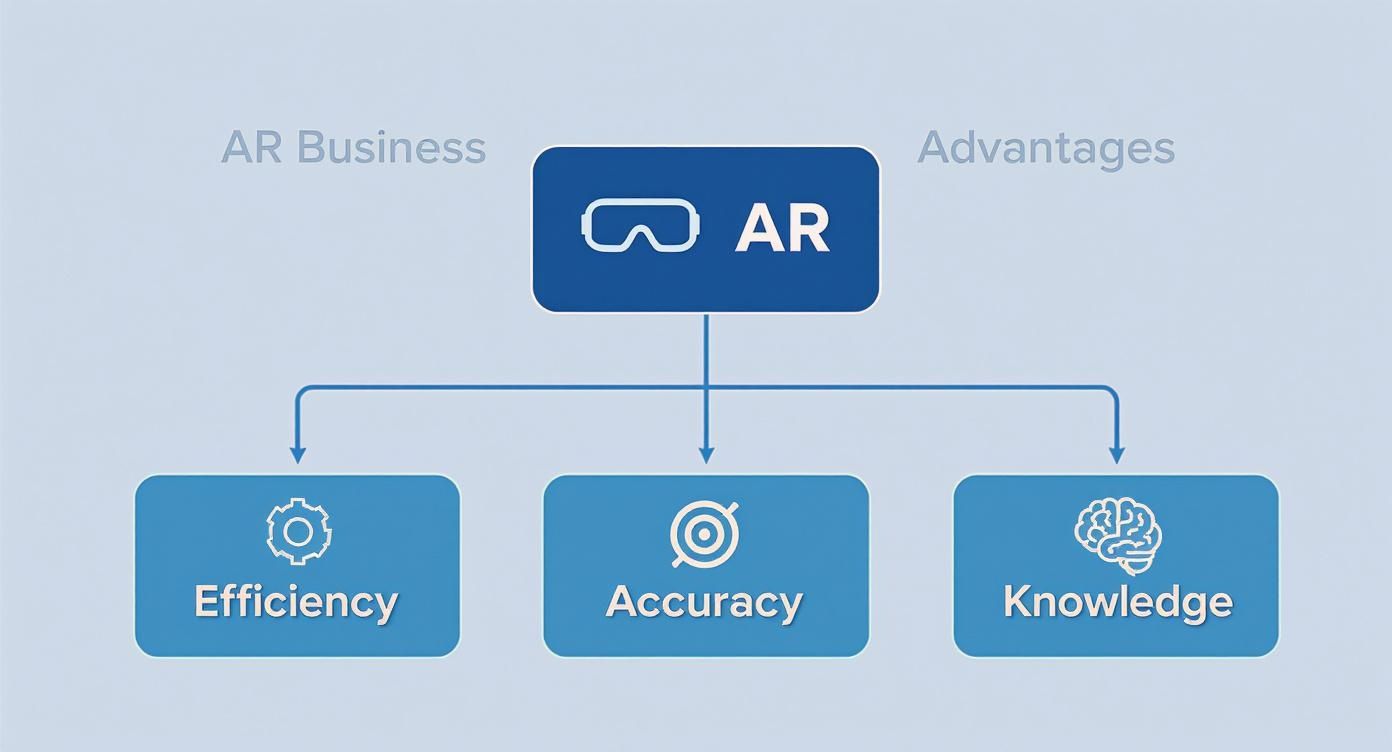
It’s clear how one technology can spark improvements across completely different, yet connected, areas of business performance.
Slashing Assembly Times and Production Errors
On the factory floor, every minute matters and every mistake costs. Traditional assembly lines often rely on static paper manuals or workers constantly glancing at a separate screen. Every time they look away, it’s an open door for inefficiency and error.
AR-guided workflows completely change this process.
Imagine an assembly technician wearing smart glasses. They see step-by-step instructions, schematics, and required torque values overlaid directly on their work, right in their line of sight. This hands-free guidance locks in the correct procedure every single time. The impact is immediate and significant, with many organizations seeing production mistakes drop by as much as 50%.
This boost in accuracy naturally speeds things up. When workers no longer have to stop and hunt for information, assembly cycles get faster, and throughput increases without cutting corners on quality. It's a straight line to higher productivity.
Revolutionizing Field Service Operations
AR’s impact is just as profound in field service, a world historically bogged down by high costs and logistical headaches. When a critical piece of equipment fails, the clock is ticking. But flying a senior expert to every site is expensive, slow, and often not feasible.
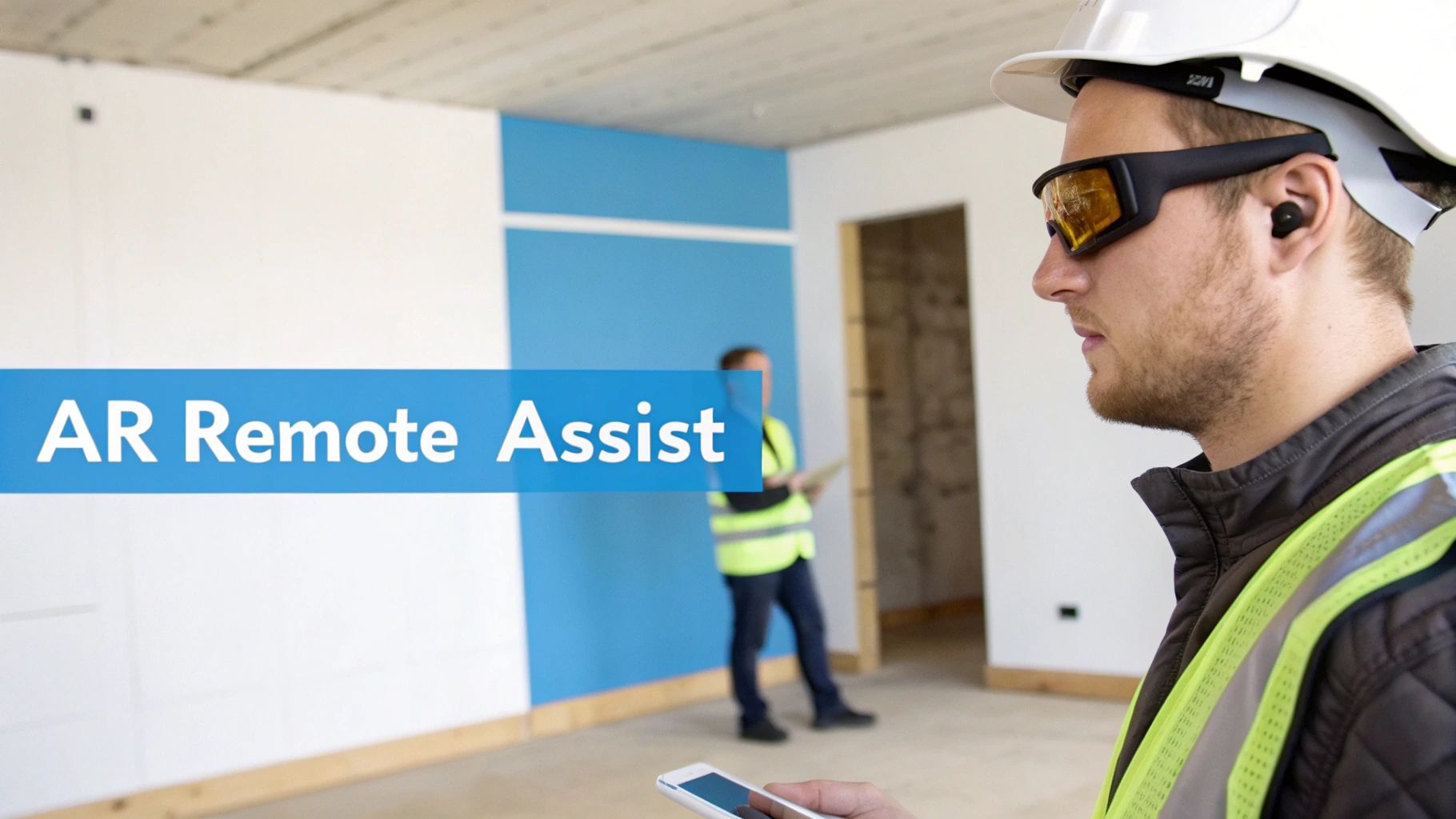
This is where AR-powered remote assistance comes in. It connects on-site technicians with off-site experts in real-time. A junior tech can share their point-of-view through smart glasses, letting an expert thousands of miles away see exactly what they see. The expert can then annotate the technician’s view with digital instructions, guiding them through the fix step-by-step.
This one capability delivers several powerful benefits:
- Skyrocketing First-Time Fix Rates: With an expert virtually on their shoulder, technicians are far more likely to diagnose and solve the issue correctly on the first visit, avoiding costly repeat trips.
- Massively Reduced Travel Costs: Instead of putting an expert on a plane, their knowledge can be deployed instantly to multiple sites in a single day. This can slash expert travel expenses by 75% or more.
- Lightning-Fast Issue Resolution: Problems that once took days to fix while waiting for an expert can now be sorted in hours, completely changing the game for service level agreements (SLAs).
These aren’t minor tweaks; they represent a fundamental shift in how service gets done. To really understand the financial upside, you need to look at the specific operational efficiency metrics that AR directly improves.
From Niche Tech to Business Essential
The rapid adoption of AR across industries isn’t happening by accident—it’s driven by these clear financial returns. In fact, the global AR market is projected to grow past USD 511 billion by 2030. That explosive growth proves that investing in AR is no longer a speculative "maybe" but a strategic necessity for operational leadership.
The table below breaks down exactly how AR features translate into hard numbers.
Mapping AR Advantages to Key Business KPIs
This table illustrates the direct correlation between specific AR capabilities and measurable improvements in critical business performance indicators.
| AR Advantage | Business Application | Impacted KPI | Potential Improvement |
|---|---|---|---|
| Guided Workflows | Manufacturing Assembly | Error Rate / Rework Rate | -50% |
| Remote Assistance | Field Service | First-Time Fix Rate (FTFR) | +30% |
| Hands-Free Information | Logistics & Warehousing | Order Picking Speed | +25% |
| AR-Based Training | Onboarding New Hires | Time to Competency | -40% |
| Expert Support | Field Service | Expert Travel Costs | -75% |
| Digital Overlays | Maintenance & Repair | Mean Time to Repair (MTTR) | -35% |
As you can see, the link between AR implementation and a healthier bottom line is undeniable. Each feature is designed to solve a specific operational bottleneck, leading directly to cost savings, increased productivity, and higher quality output.
Accelerating Knowledge Transfer and Employee Skills
One of the biggest challenges for any industrial company is watching decades of experience walk out the door when a veteran employee retires. That hard-won knowledge—the kind you can't just write down in a manual—is incredibly difficult to replace. This is where augmented reality completely changes the game.
Instead of handing a new hire a binder or sitting them in a classroom for a week, AR puts a digital mentor right in their ear, guiding them on the job. It's the ultimate "learn by doing" approach, where complex instructions are delivered right in the flow of work, helping new employees perform like seasoned pros from day one.
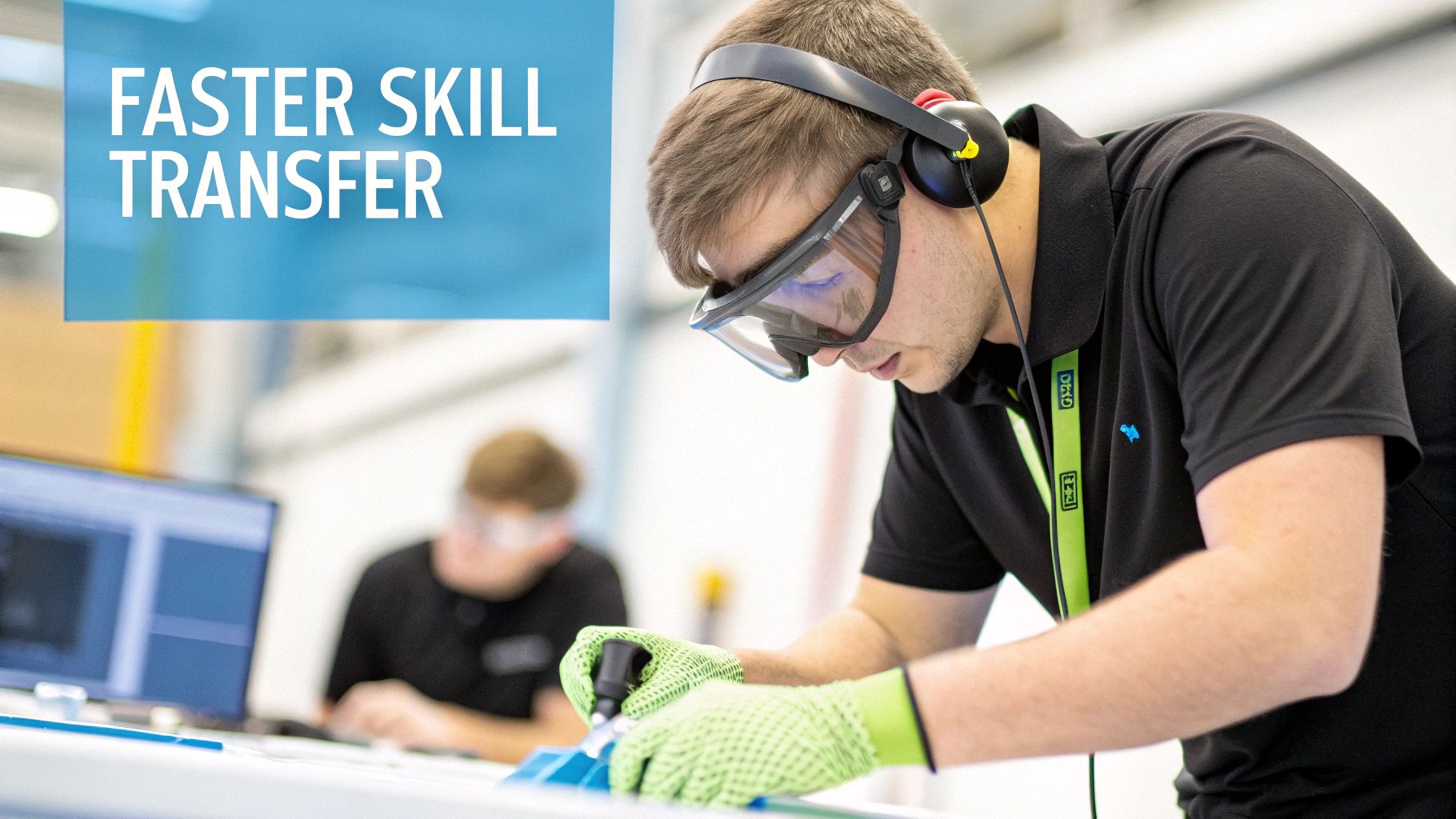
This kind of hands-on, interactive learning just sticks. When an employee is visually guided through each step of a task, the information is far more memorable than anything they could read on a page or hear in a lecture.
Bridging the Generational Skills Gap
The traditional apprenticeship model, where a rookie follows a senior expert, doesn't scale in today's fast-paced environment. AR essentially digitizes this mentorship, making expert knowledge available to anyone, anywhere, at any time.
Picture a new technician staring down a complex repair. Instead of stopping work to call for help, they can put on an AR device that overlays digital instructions directly onto the machine. The system can highlight the right parts, show which tools to use, and even play animations of the exact procedure. The technician gets the job done correctly and safely, all while building real, practical skills.
AR offers a massive leap forward from older methods:
- Paper Manuals: They are static, difficult to search, and often out of date. AR, in contrast, delivers dynamic, interactive information that's always current.
- Classroom Sessions: Theoretical knowledge is often forgotten before it's ever needed. AR delivers practical guidance at the exact moment of need.
- Video Tutorials: These require workers to constantly look away from their task to a separate screen. AR integrates the instructions seamlessly into their line of sight.
Augmented reality transforms training from a separate, disruptive event into a continuous, integrated part of the daily workflow. This approach not only builds skills but also boosts operational resilience by ensuring critical knowledge is never lost.
The results are felt on the bottom line almost immediately. Organizations see a huge reduction in onboarding time, which means new hires start contributing to the team much faster. To see how this plays out in the real world, it's worth exploring the specific applications of AR for training and how they are put into practice.
Building Organizational Resilience Through Modern Training
The impact of AR goes way beyond just one employee. It strengthens the entire operation. By creating standardized digital workflows, companies can ensure a consistent level of quality and safety across every team, no matter how experienced individual members are.
We're seeing this across countless industries. AR has brought significant advantages to fields like healthcare, education, and retail. For instance, the AR & VR market in healthcare alone is projected to hit USD 10.82 billion by 2025, growing at a CAGR of 36.1%. It's the same story in education, where the global AR & VR market was valued at USD 3.8 billion in 2023 and is expected to reach USD 14.2 billion by 2028.
This isn't just a niche trend; it’s a fundamental shift toward immersive tools that simply get better results. An assembly worker can master a new process without leaving their station. A field technician can get up to speed on new equipment remotely. This builds a more agile, adaptable workforce that's ready for whatever comes next.
All the talk about operational improvements is one thing, but seeing it happen on the factory floor or out in the field is another story entirely. To truly understand what AR can do, you have to look at where it’s already making a real, measurable difference every single day. Two of the biggest impact zones are, without a doubt, manufacturing and field service.
In these worlds, there’s no room for error. Everything comes down to precision, speed, and safety. AR is a game-changer here because it delivers visual guidance exactly when and where it’s needed, acting as an intelligent system for on-site live support services. Let's dig into a couple of scenarios that show how AR is solving real-world problems.
Use Case 1: Precision Assembly in Manufacturing
The manufacturing floor is a high-stakes environment of complex steps and microscopic tolerances. One wrong component or a bolt that’s not torqued correctly can mean expensive rework, scrapped materials, or a product failure down the road.
The Problem: An operator needs to build a complex hydraulic manifold with dozens of parts. The old way involves memorizing the steps or constantly looking away to check a 2D schematic on a screen. It’s slow, and the potential for mistakes is huge.
The AR Solution: The operator puts on AR smart glasses, and a 3D digital blueprint of the manifold is overlaid right onto their physical workstation. The system walks them through the entire build, step-by-step.
- Step Highlighting: The correct parts bin lights up, and a digital arrow points to the exact spot the component goes. No guesswork.
- Torque Verification: As they tighten a bolt, the AR display shows the required torque value in real-time and flashes green when it's perfect.
- Quality Checks: At critical points, the system calls for a visual check, overlaying a digital template to confirm everything is aligned perfectly.
The Benefit: This AR-guided process virtually eliminates assembly errors, which means a massive drop in rework. A brand-new hire can tackle this complex job with the accuracy of a 20-year veteran, slashing training time and boosting the line’s overall throughput. You get higher quality products, less waste, and a much more confident team.
Use Case 2: Remote Expertise for Field Service
Field service teams are in a constant logistical chess match. When a critical machine goes down at a client’s site, the clock is ticking. The problem is, your best technicians can't be everywhere at once, and flying them out to every single job is a massive drain on time and money.
The Problem: A junior tech is at a remote oil rig staring at a complex generator malfunction they’ve never encountered. The senior expert who knows this machine inside and out is a thousand miles away. Meanwhile, the client is losing thousands of dollars for every hour of downtime.
AR remote assistance closes the distance gap, allowing a single expert to deploy their knowledge to multiple locations simultaneously without ever leaving their desk. It turns a logistical nightmare into a simple, efficient collaboration.
The AR Solution: The on-site tech slips on a pair of AR smart glasses and hops on a video call with the remote expert. Instantly, the expert sees exactly what the tech is seeing, from their first-person point of view.
The expert can then draw and annotate right onto the technician's view. They can circle a specific valve that needs turning, draw arrows to show the correct sequence, or even freeze the frame to point out a tiny, hidden sensor. The back-and-forth and miscommunication disappear.
The Benefit: The problem gets fixed in a fraction of the time it would take to get the expert on a plane. The first-time fix rate jumps by over 30%, and expert travel costs are cut by 75% or more. The customer is back up and running in record time, which makes for a much happier, more loyal client. These are just two examples, but the range of powerful augmented reality industrial applications is growing every day, solving challenges all across the value chain.
Navigating a Successful AR Implementation
Getting the most out of augmented reality isn’t about just buying the latest tech; it’s about having a clear, strategic game plan. Like any powerful tool, its success depends on a well-thought-out approach that anticipates challenges and establishes smart practices from the get-go.
That journey starts with some critical choices about hardware and software. It’s all about laying a solid foundation that directly supports your operational goals.
Choosing the Right Tools for the Job
The first big decision is hardware. The device you choose directly shapes how usable and effective the AR experience will be, and there's no single "best" answer. The right choice is all about the specific work environment and the job that needs to be done.
-
Smartphones and Tablets: These are an excellent entry point into AR. Everyone already knows how to use them, they're readily available, and they work perfectly for applications like remote assistance or pulling up digital work instructions where being hands-free isn't the top priority.
-
AR Smart Glasses: When you get into manufacturing, assembly, or field service, hands-free operation becomes non-negotiable. This is where smart glasses are essential. They let technicians see and interact with digital information while keeping their hands on their tools and their eyes on the task.
Just as critical is making sure your AR software integrates with your existing enterprise systems. To create real value, the AR solution has to connect with platforms like your Enterprise Resource Planning (ERP) or Manufacturing Execution System (MES). This integration is what lets the AR application pull live work orders, check inventory data, or display technical schematics, ensuring the information you’re seeing is always current and correct.
A Phased Rollout for Sustainable Success
Trying to roll out AR across the entire company all at once is a recipe for failure. A much smarter strategy is to start with a focused pilot project. This approach lets you prove the value, fine-tune your process, and build real momentum.
A successful pilot project is the ultimate proof of concept. It zeros in on a specific, high-impact use case, measures its ROI against clear KPIs, and builds an undeniable business case for wider adoption.
Starting small takes the risk out of the investment and makes it much easier to get buy-in from key stakeholders. Once you’ve proven that AR can solve a real-world problem—like reducing assembly errors by 20% or slashing service resolution times—scaling it to other departments becomes a much simpler conversation.
This methodical approach also tackles one of the biggest hurdles for any new technology: user adoption. By bringing frontline workers into the pilot, you get invaluable feedback and create internal champions who can speak to the solution's benefits firsthand. That grassroots support is invaluable, especially as AR becomes more and more a part of our daily lives.
And that acceptance is growing fast. In the United States alone, roughly 90 million people used augmented reality in 2023. That number is expected to climb to over 100 million by 2025, which just goes to show how integrated this technology is becoming. Discover more insights about AR user adoption trends.
Ultimately, getting the best long-term value from your AR investment comes down to picking the right technology partner. You need someone who offers more than just software—look for a complete ecosystem of support, expert guidance, and a clear implementation roadmap. A true partner digs in to understand your unique challenges and helps you build a solution that can scale and adapt for the future.
Your Strategic Path Forward with AR
We’ve walked through the ins and outs of AR, and a clear picture has emerged. This isn't just another tech upgrade; it's a fundamental shift in how business gets done. We've seen how AR sharpens operations, gets new hires up to speed in record time, and delivers a return on investment you can actually measure.
These aren't just isolated victories, either. They all feed into a bigger strategy: building a company that’s more nimble, resilient, and ready for whatever comes next.
Think about it. You can slash assembly errors using guided digital instructions or close the skills gap by giving a technician on-demand expertise from a senior engineer who's miles away. AR gives your team the right information, right when they need it most. It turns complicated, multi-step jobs into simple, repeatable wins, which hits your bottom line directly by cutting costs and boosting what your team can accomplish.
From "What If" to "What's Next"
The proof is all there, but knowing is only half the battle. The real challenge is turning that knowledge into action. The good news? You don't have to tear everything down and start over. All it takes is one smart, strategic first step: picking a pilot project within your own operations.
The real power of AR isn’t unlocked by waiting for the perfect, company-wide plan. It’s realized by starting now. A focused pilot project can deliver tangible results in just a few months, building the momentum you need to scale up and claim a serious competitive edge.
So, where’s the bottleneck in your workflow? Is it a stubbornly high error rate on a specific assembly line? Field service calls that take forever to resolve? An onboarding process that drags on for weeks? These are the perfect candidates for an AR pilot.
By zeroing in on a single, nagging pain point, you can show real value, fast. That makes it a whole lot easier to build a rock-solid business case for more investment. This approach takes the risk out of adoption and makes sure your AR strategy is firmly planted in solving the problems you face every day. The advantages of AR are here for the taking, offering a clear path to not just improve what you’re doing now, but to completely redefine what’s possible for your business.
Common Questions We Hear About AR's Advantages
When leaders start exploring Augmented Reality, they naturally have some tough, practical questions. It's one thing to see the potential, but it's another to understand how it fits into your actual business. Let's tackle the big ones: ROI, system integration, and the hardware you'll need.
Getting clear, straightforward answers to these questions is the first step toward building a solid case for AR as a strategic tool, not just a flashy experiment.
What’s a Realistic ROI for an Enterprise AR Project?
While it always depends on the use case, most companies we work with start seeing a significant return within 12-18 months. The gains aren't abstract—they show up directly on the balance sheet.
Think about it this way: remote assistance can slash expert travel costs by over 50% while boosting first-time fix rates. In training, the ROI comes from getting new hires up to speed 30-40% faster. The smartest projects always start with a focused pilot program. They pick specific KPIs to track, build an undeniable business case, and then scale up.
The fastest way to prove ROI is to target a single, expensive pain point. If you can solve one persistent problem—like constant production mistakes or sending senior technicians on cross-country flights—the AR pilot quickly pays for itself and makes the case for a wider rollout.
How Does AR Plug Into Our Existing Software?
Modern AR platforms are designed for integration. They use APIs (Application Programming Interfaces) to connect directly into the systems you already rely on, whether it's an ERP, MES, or PLM.
This connection is what makes AR so powerful. It means the application can pull real-time data—like fresh work orders, current parts inventory, or the latest schematics—straight from your core systems. The digital information displayed to your technician is always accurate and relevant to the job at hand. It turns AR from a cool, isolated tool into a deeply integrated part of your digital nervous system.
What Kind of Hardware Do We Need to Get Started?
This is one of the best parts about AR today—you have options. Many teams can get started with the hardware they already have: smartphones and tablets.
For many remote assistance and digital work instruction scenarios, a phone or tablet is perfect. But for jobs that demand a technician's full attention and both of their hands—think complex assembly on a manufacturing line or a tricky repair in the field—AR smart glasses are the way to go. The right device always comes down to the specific job, the work environment, and how immersive the experience needs to be.
Ready to see how the advantages of AR can directly benefit your operations? The team at AIDAR Solutions specializes in creating and integrating AR applications that deliver measurable results in training and service. Explore our solutions and book a consultation today.

