Accelerated Learning Techniques That Actually Work
Accelerated learning is not merely about speed; it's a collection of science-backed methods designed to facilitate mastery of new information and skills more efficiently than traditional approaches. This guide moves beyond simple memorization to foster deeper understanding, long-term retention, and practical, real-world application.
Why We Need to Learn Faster Than Ever Before
The modern professional landscape is characterized by rapid change. Industries are shifting, and job requirements are evolving at an unprecedented rate. Consequently, conventional learning methods often struggle to keep pace. The growing gap between the skills companies require and the existing knowledge of the workforce creates persistent pressure to adapt.
Waiting years to master a new skill is no longer a viable option in today's competitive environment.
This is precisely where accelerated learning provides a critical advantage. It is not a collection of shortcuts but a strategic, proven approach to acquiring new competencies with greater speed and effectiveness. It empowers professionals to remain relevant, agile, and competitive in a dynamic job market.
The Core Principles of Efficient Learning
At its heart, accelerated learning is about optimizing the learning process. The entire approach is built on principles that align with the brain's natural mechanisms for processing and retaining information. Instead of passively attending a lecture or reading a manual, these techniques require active involvement from the learner.
To fully appreciate how this works, let's examine a few of the foundational principles.
A Quick Look at Accelerated Learning Principles
This table illustrates the fundamental differences between the accelerated approach and traditional learning methods.
| Principle | What It Means | Accelerated vs. Traditional Approach |
|---|---|---|
| Immersive Practice | Creating a focused, hands-on environment to engage deeply with the material. | Accelerated: A pilot training in a VR flight simulator. Traditional: Reading a textbook about aviation. |
| Active Recall | Actively retrieving information from memory rather than passively reviewing it. | Accelerated: Using self-quizzing techniques without consulting notes. Traditional: Rereading highlighted text. |
| Spaced Repetition | Revisiting information at strategically increasing intervals over time to counteract the "forgetting curve." | Accelerated: Using digital flashcard systems that present information just before it is forgotten. Traditional: Concentrated study sessions before an exam. |
The distinction is subtle but powerful.
By focusing on doing rather than just knowing, these methods transform learning from a passive activity into an active, results-driven process. They provide a clear pathway for professionals to not only keep pace but to gain a significant professional advantage.
Moving From Theory to Practical Advantage
The true power of these techniques is evident in their application. For instance, a company can use AR/VR simulations from a platform like AIDAR.SKILLS to train technicians on complex machinery. This allows them to practice in a safe, repeatable setting, making mistakes without real-world consequences. This type of immersive approach drastically reduces the time required for an individual to achieve proficiency.
By adopting these strategies, individuals and organizations can gain a substantial competitive edge. It is about building a toolkit for lifelong learning that is both highly efficient and effective. This ensures that as an industry evolves, skills and knowledge evolve in tandem, paving the way for sustained growth and success.
The Science of Building a Smarter Brain
To understand why certain accelerated learning methods are so effective, it is useful to think of the brain as a muscle. Just as targeted exercises build physical strength, specific mental workouts build stronger, more efficient neural connections. The objective is not just to absorb information, but to create permanent pathways that make recalling and using that knowledge feel second nature.
This process is fundamentally about building better memories. Consider a powerful personal memory—it is likely rich with sights, sounds, and emotions. The brain wove together a multi-sensory experience, linking different neural pathways into a solid, lasting memory.
Creating Stickier Knowledge
Traditional learning often engages only one sense at a time, such as sight for reading or sound for a lecture. This approach builds a fragile, single-lane neural pathway. Modern learning tools, particularly those utilizing Augmented and Virtual Reality, do the opposite. They create immersive, multi-sensory worlds that mirror how we naturally form our strongest memories.
When a technician uses a VR headset to practice a complex repair, they are not just watching a video. They are seeing components, hearing the machine operate, and physically performing the motions. This blend of seeing, hearing, and doing constructs a robust, multi-lane neural superhighway, making that skill far easier to access and apply under pressure.
Overcoming the Forgetting Curve
One of the greatest challenges in any training program is the natural human tendency to forget. The "forgetting curve" illustrates the rapid rate at which we lose new information if it is not actively reinforced. Studies show that individuals can forget 50-80% of what they learn within a few days if the information is not reinforced.
This is precisely where accelerated learning techniques demonstrate their value. They are designed as direct countermeasures to this natural memory decay, ensuring that the time and resources invested in training lead to long-term competence.
The core idea is to interrupt the forgetting process before it takes hold. By strategically reinforcing knowledge, we flatten that curve and transform fleeting information into a permanent skill.
Powerful Antidotes to Forgetting
How is this achieved? Two of the most effective methods for combating the forgetting curve are chunking and association. These concepts are simple yet powerful, forming the foundation of many learning programs because they align with how our brains prefer to process information.
-
Chunking Your Learning: This involves breaking down a large, complex topic into smaller, manageable pieces or "chunks." Instead of attempting to learn an entire engine repair process at once, a trainee might first master the disassembly of a single component. This prevents cognitive overload and allows for the development of mastery one step at a time.
-
Building Through Association: This technique involves linking new information to existing knowledge. For instance, when learning a new software interface, one might connect a new icon to a similar function in a familiar program. This creates a mental hook, making the new information much easier to find and retrieve later.
When multi-sensory immersion is combined with smart strategies like chunking and association, the learning process is fundamentally changed. We shift from a model of passive listening and rapid forgetting to one of active engagement and lasting skill acquisition—building a genuinely more capable brain in the process.
How Immersive Technology Supercharges Learning
Understanding the science behind accelerated learning is one thing; seeing it in action is another. Immersive technologies like Virtual Reality (VR) and Augmented Reality (AR) are where these powerful cognitive principles come to life, turning abstract theory into high-impact training tools. They are the practical expression of how our brains are wired to learn.
VR, for instance, creates a completely distraction-free environment. By eliminating the noise of a busy workplace, it allows for the deep, focused practice that is nearly impossible to achieve otherwise. This singular focus helps build strong neural pathways quickly and efficiently.
AR, on the other hand, achieves a similar result by integrating learning directly into the real world. Instead of removing an employee from their work environment, AR overlays digital information—such as instructions, diagrams, or warnings—directly onto their field of view. This creates an immediate "learn-by-doing" loop, one of the most effective accelerated learning techniques available.
Turning Concepts into Tangible Skills
The true advantage of immersive technology is its ability to create realistic, hands-on experiences. A sales team can enter a risk-free VR simulation to practice navigating a high-stakes negotiation with a difficult client, receiving instant feedback on their performance without jeopardizing a real account.
Similarly, an engineer can use AR glasses to see a step-by-step schematic projected directly onto a complex piece of equipment. They can practice the repair sequence multiple times, building muscle memory and confidence before interacting with the live system. In both scenarios, the learning is active, contextual, and deeply memorable.
These immersive experiences do more than just teach; they build competence. By allowing users to safely practice, make mistakes, and repeat complex tasks, they dramatically shorten the path from novice to expert.
Accelerated learning techniques, especially when paired with AI, are rapidly transforming talent development. By 2025, it is expected that over 80% of large global enterprises will use AI-driven platforms for upskilling, which can reduce the average time to proficiency by 35% compared to traditional methods.
Activating the Brain for Maximum Retention
Immersive training activates the brain in ways that passive methods—like reading a manual or watching a video—simply cannot. The infographic below breaks down some of the core cognitive principles that these technologies leverage to enhance learning retention.
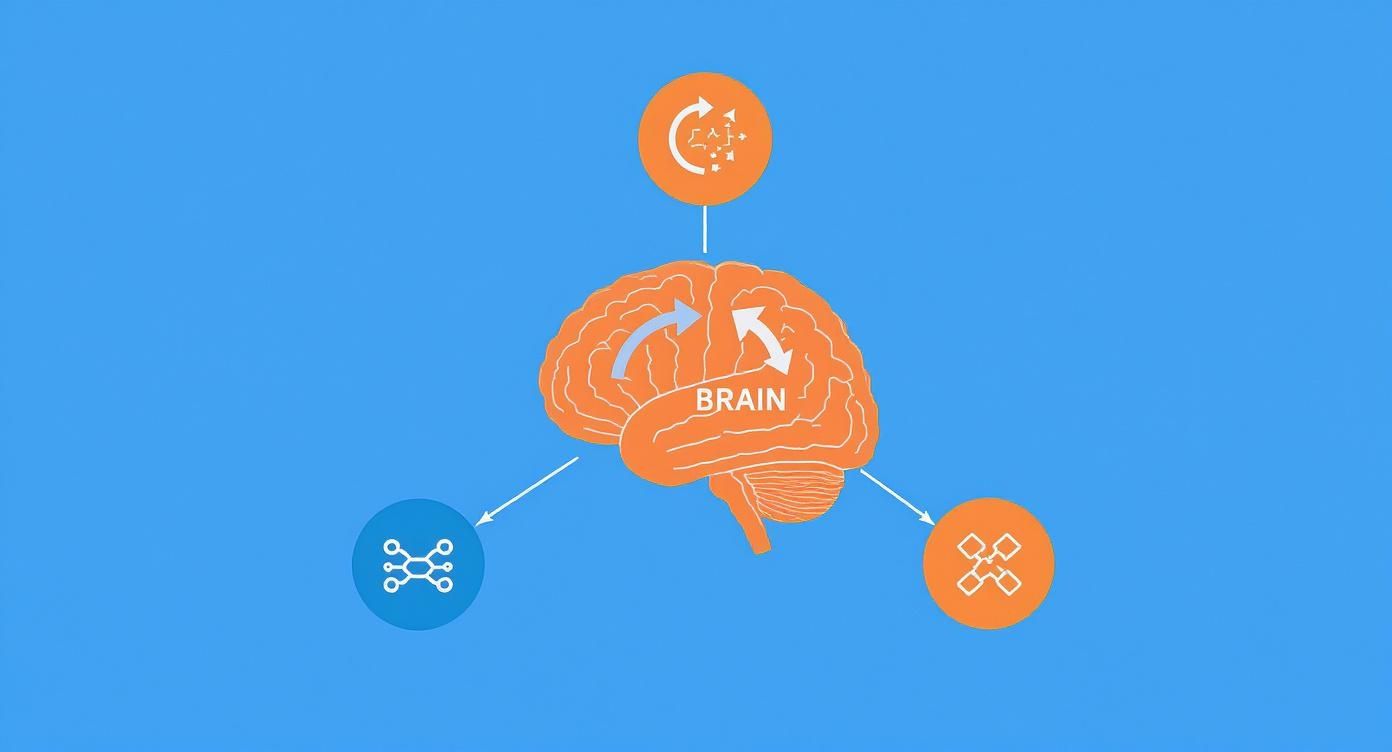
As the visual illustrates, core principles such as combating the forgetting curve, chunking information, and creating strong associations are central to effective learning. Immersive technologies are uniquely positioned to implement all three of these principles simultaneously.
The Practical Application of Immersive Learning
Platforms built around these concepts offer companies a significant advantage. They provide a space where theory meets practical application in a controlled, repeatable, and safe manner. You can explore this approach further in our guide on what is immersive learning.
This application is also becoming more intelligent. For example, the growing integration of AI-powered chatbots in education is transforming learning by providing users with instant, personalized support when they need it most.
Here’s a summary of how immersive technology directly applies accelerated learning principles:
- Immersive Practice: VR and AR are ideal tools for this, placing learners in realistic scenarios where they must actively apply their knowledge to solve problems.
- Active Recall: Simulations often require users to recall procedures or information from memory to advance, strengthening their ability to retrieve knowledge under pressure.
- Spaced Repetition: Training modules can be designed for users to revisit at strategic intervals, reinforcing skills and effectively combating the forgetting curve.
By blending cognitive science with powerful technology, these solutions offer a clear path to building a more skilled, confident, and agile workforce. They not only help people learn faster but also ensure that knowledge is retained for the long term.
Accelerated Learning in the Real World
While theory and cognitive science are foundational, the true test of these concepts is their real-world performance. Across various industries, organizations are replacing traditional training models with immersive, results-driven methods. The success stories highlight not just increased speed but also clear returns on investment in quality and safety.
These practical examples demonstrate that when learning is active, contextual, and immersive, the results are immediate and powerful. Businesses are discovering that the right training approach provides a significant operational advantage.
Revolutionizing Manufacturing and Assembly
Consider a large manufacturing plant facing high employee turnover. New assembly line workers required extensive time to reach proficiency. Their training involved shadowing senior staff and studying dense manuals—a slow process that often led to errors when they began working independently.
By implementing AR-guided instructions, the company transformed its onboarding process. New hires now wear AR glasses that overlay digital work instructions in their line of sight, highlighting correct parts and demonstrating assembly procedures.
This shift to a learning-by-doing model produced remarkable results:
- Training time was reduced by 50%, from four weeks to two.
- Assembly errors among new employees decreased by over 90% within the first month.
- Confidence and job satisfaction among new staff increased significantly.
This is a clear application of accelerated learning. It provides "just-in-time" support, breaks down complex tasks into manageable steps, and allows for practice in the actual work environment from day one.
Enhancing Precision in Healthcare
In the high-stakes field of healthcare, there is no margin for error. A forward-thinking healthcare system sought to improve patient outcomes for complex surgeries by creating a risk-free environment where surgeons could practice and perfect their skills before entering an operating room.
Using highly realistic VR simulations, surgical teams can now rehearse entire procedures. They encounter potential complications and practice their responses in a controlled setting, building both muscle memory and the critical decision-making skills needed under pressure.
The impact on patient safety and surgical outcomes has been profound. The healthcare system reported a significant reduction in patient complications for procedures where surgeons trained in VR, validating the power of immersive, repetitive practice.
This approach is one of many experiential learning examples demonstrating how simulation builds true expertise. By providing a safe space to fail and repeat, VR accelerates the journey from competence to mastery.
Mastering Soft Skills in the Corporate World
Accelerated learning is not limited to technical skills. A company needed to improve its managers' ability to handle difficult conversations, from performance reviews to conflict resolution. Traditional role-playing exercises felt artificial and did not adequately prepare them for real-world scenarios.
The company adopted a platform using AI-powered avatars in VR simulations. Managers could practice conversations with virtual employees who reacted realistically to their tone and word choice. After each session, they received instant, private feedback and performance analytics.
Many organizations are adopting these methods through dedicated corporate learning and development initiatives to build more effective leaders. This AI-driven coaching loop enabled managers to rapidly improve their communication strategies in a judgment-free environment, leading to more confident and capable leadership. AI platforms have been shown to reduce the time needed to master new skills by up to 40%.
Measuring the ROI of Smarter Training
For any business leader, the ultimate question is whether a new initiative delivers results. While compelling success stories show the potential of accelerated learning, its true value is proven by hard data. It is essential to move beyond anecdotes and focus on clear metrics that demonstrate a tangible return on investment (ROI).
Modern training platforms do more than just deliver content; they are powerful data-generating tools. This allows organizations to measure what truly matters and draw a direct line from training to business outcomes.
Key Metrics for Proving Value
To justify the investment in accelerated learning, it is crucial to track the right key performance indicators (KPIs). These are not vanity metrics like completion rates, but measures of actual on-the-job improvement that show the direct impact of better, faster training.
Here are some of the most important KPIs to monitor:
- Time-to-Competency: This metric measures the time it takes for a new hire to reach a specified level of proficiency. Accelerated methods often significantly reduce this time, enabling employees to become productive faster.
- Skill Retention Rates: This tracks how much trainees retain over time. Immersive practice builds stronger memory recall, which means less time and money spent on retraining.
- Error Reduction: In fields from manufacturing to healthcare, mistakes can be costly and dangerous. Tracking a decrease in on-the-job errors is a powerful way to demonstrate the financial ROI of smarter training.
The Power of Granular Data Analytics
Traditional training methods offer limited data. You might know who attended a workshop or passed a quiz, but you have little insight into how they learned or where they struggled.
This is where immersive learning platforms provide a significant advantage.
VR and AR simulations capture a vast amount of analytical data that was previously inaccessible. They can track a user’s every move and decision within the training environment, creating a detailed picture of their learning journey.
This data-driven approach shifts training from a cost center to a strategic investment. It provides undeniable proof of ROI and offers the insights needed to continuously refine programs for even better performance.
For instance, a platform can monitor a trainee’s gaze to see what they focus on, pinpoint moments of hesitation that signal uncertainty, and map their decision-making paths. This level of detail is invaluable for providing targeted feedback and addressing knowledge gaps. To get started, you can learn how to measure training effectiveness in our detailed guide.
From Corporate Training to Higher Education
The drive to measure learning outcomes extends beyond the corporate world. Accelerated learning techniques have gained significant traction in higher education, where demonstrating results is crucial.
For example, institutions using predictive analytics have seen up to a 20% improvement in student retention and a 15% increase in graduation rates over five years. The success of these programs is directly tied to their ability to show measurable improvements. You can discover more about how learning analytics is shaping educational outcomes in this market report.
The principle remains consistent across sectors. Whether training a seasoned engineer or educating a first-year student, the ability to measure progress and prove results is what distinguishes a great program. By focusing on concrete metrics, organizations can confidently adopt these powerful techniques and build a more competent and efficient workforce.
Implementing Accelerated Learning in Your Organization
If you are ready to introduce accelerated learning into your organization, where should you begin?
The most effective approach is a strategic one that starts with small, deliberate steps and builds momentum. Think of it as a smart upgrade rather than a complete overhaul.
The process begins by identifying the right starting point. Pinpoint your organization's most significant training challenges or the highest-risk tasks your teams face. This is your area of greatest opportunity.
Identify High-Impact Use Cases
Successful rollouts begin where the impact is greatest. Look for areas where better, faster training can deliver immediate, tangible value. These are often complex procedures, high-stakes roles, or positions that traditionally require a long time to master.
This is where accelerated learning techniques truly excel, as the return on investment is clear and demonstrable.
Consider common scenarios such as:
- Complex Machinery Operation: Training personnel on intricate equipment where a single mistake could be costly or dangerous.
- Safety and Compliance Procedures: Ensuring teams can execute critical safety protocols correctly under pressure, every time.
- High-Stakes Customer Interactions: Preparing sales or service staff to navigate difficult negotiations or sensitive client issues with confidence.
Once you have selected a target area, it’s time to prove the concept.
Launch a Pilot Program to Demonstrate Value
A small, focused pilot program is an effective tool for gaining organizational buy-in. Instead of proposing a massive, company-wide change, start small, measure your results, and build an undeniable case for expansion. A successful pilot provides the hard data and success stories needed to generate enthusiasm among leadership.
Design your pilot to be measurable from the outset. Track key metrics such as time-to-competency, error reduction rates, and employee feedback on the new approach. For organizations considering immersive technology, a well-planned pilot is essential. For guidance, you can learn more about how to create a successful virtual reality training program.
Proving these methods on a small scale creates a ripple effect. The success of a single pilot can build the confidence needed to drive adoption across the entire organization.
Integrate and Scale for Long-Term Success
With a successful pilot completed, the next step is to integrate and scale. This does not mean replacing your existing systems. Instead, it involves augmenting your current learning infrastructure, weaving in new tools and methods to make the entire ecosystem more powerful.
A critical part of scaling is fostering a culture of continuous improvement. Encourage teams to share their experiences and provide feedback. Use the data from your training platforms to refine modules and identify new opportunities. This creates a positive feedback loop where your training is always evolving to meet the real-world needs of your employees. Following this blueprint is key to successfully scaling these powerful accelerated learning techniques across your entire organization.
Common Questions About Accelerated Learning
When considering a new approach to training, practical questions naturally arise. Leaders need to understand the logistics, costs, and appropriate applications of these new methods to make an informed decision.
Let's address some of the most common questions about implementing accelerated learning techniques, particularly with immersive technology.
How Much Does an Immersive Learning Solution Cost?
This is a frequent first question, and the answer is: it varies. The investment can range from an accessible entry point for a single team to a full-scale, enterprise-wide system. The cost depends on the required scale and complexity.
However, the initial price is not the most critical number. The real story lies in the return on investment (ROI). The upfront cost is often offset by long-term gains, such as faster training, a dramatic reduction in on-the-job errors, and significant increases in team productivity. It is more productive to focus on the long-term value created, not just the initial expense.
Is This Approach Right for Every Type of Training?
While the core principles of accelerated learning can be applied broadly, immersive tools like VR and AR are particularly effective in specific areas. They are game-changers for training that is hands-on, procedural, or involves high-stakes situations where real-world mistakes would be dangerous or costly. Examples include complex equipment assembly, delicate surgical procedures, or critical safety drills.
For purely theoretical training, other accelerated methods might be more suitable. However, the underlying science of effective learning—active participation, spaced repetition, and multi-sensory engagement—is universally applicable. The key is to match the right tool to the training objective to achieve the greatest impact.
The most successful implementations occur when the technology solves a real business problem, transforming training from a compliance exercise into a powerful driver of performance.
How Do You Get Employees to Actually Use New Tech?
The adoption of any new technology is as much about people as it is about the hardware or software. Success requires demonstrating the direct benefits to employees. How does this make their job easier, safer, or help them improve their skills? When they see that it leads to faster mastery and greater confidence, they will be more receptive.
Involving employees early, even in the pilot phase, is also highly effective. When they have a voice in the process, they feel a sense of ownership. Finally, the technology must be user-friendly and effective. If the tools are intuitive and solve a genuine problem, adoption will follow naturally.
Ready to see how immersive accelerated learning techniques can transform your organization's training programs? Contact AIDAR Solutions today to discover how our VR and AR platforms can build a more skilled, efficient, and capable workforce. Learn more about AIDAR Solutions.