Preventive Maintenance Predictive Maintenance A Complete Guide
The fundamental difference between preventive maintenance and predictive maintenance boils down to a single question: what triggers the work order?
Preventive maintenance (PM) is driven by the calendar or usage metrics. It’s a disciplined, schedule-based approach where service is performed at fixed intervals. In contrast, predictive maintenance (PdM) is driven by real-time data. It uses condition-monitoring tools to forecast a failure, allowing you to act only when a problem is developing.
It’s the classic difference between changing a car's oil every 5,000 miles (preventive) versus changing it when a sensor indicates the oil’s lubricating properties are degrading (predictive).
Defining Your Maintenance Philosophy
Choosing the right maintenance strategy is a foundational operational decision. Your approach—whether the time-tested preventive model or the data-forward predictive method—will influence everything from budget allocation to production uptime. Understanding each philosophy is the first step toward building a program that protects your most valuable assets.
Preventive maintenance is a proactive strategy rooted in routine, scheduled work. The goal is to prevent failures by adhering to a strict calendar or usage-based schedule, often based on OEM recommendations. This approach brings predictability to both maintenance planning and budgeting.
Predictive maintenance represents a significant evolution. It moves away from fixed schedules in favor of real-time, condition-based action. By equipping assets with IoT sensors and leveraging data analytics, your team monitors the actual health of your equipment. This allows them to intervene with precision right before a failure is likely to occur.
The ultimate goal of any advanced maintenance program is to move from a state of reacting to failures to a state of proactively controlling asset health. This shift is critical for minimizing downtime and maximizing resource efficiency.
Core Differences at a Glance
For a structured approach to optimizing your operations, a quality MRO assessment guide can offer valuable insights. To explore the topic further, you can also review our complete guide on preventive maintenance vs. predictive maintenance.
The table below breaks down the fundamental distinctions between these two powerful strategies.
| Feature | Preventive Maintenance | Predictive Maintenance |
|---|---|---|
| Trigger | Time-based or usage-based schedule | Real-time asset condition data |
| Approach | Proactive, scheduled interventions | Proactive, condition-based interventions |
| Goal | Reduce failure probability through routine care | Intervene just-in-time before failure occurs |
| Cost Profile | Lower initial cost, potentially higher long-term costs due to unneeded work | Higher initial investment, lower long-term costs through efficiency |
| Best For | Lower-cost, non-critical, or predictable-failure assets | High-value, critical assets with detectable failure modes |
The Case for Preventive Maintenance
Preventive maintenance (PM) is built on a simple yet powerful principle: proactive care is better than reactive repair. The strategy is built around fixed schedules and manufacturer-recommended service intervals, bringing a necessary order to asset upkeep.
This involves performing routine work—inspections, lubrications, parts replacements—based on the calendar or operating hours, regardless of the machine's current performance.
This time-based approach creates predictability. Since maintenance work is scheduled in advance, planning becomes straightforward. Teams can align technicians, order parts, and schedule downtime with confidence, minimizing production disruptions. For many organizations, this structured method is the first major step away from a chaotic "run-to-failure" culture.
The financial upside is equally clear. Budgeting for planned maintenance is more stable than covering emergency repairs. Costs are known and can be spread across the fiscal year, avoiding the sudden, large expenses that accompany catastrophic equipment failure. This predictability is a significant advantage, especially when managing a large fleet of assets or operating on a tight budget.
The Strengths of a Scheduled Approach
Preventive maintenance is highly effective for assets that are not mission-critical or tend to fail in predictable ways. It's a practical, low-cost strategy for equipment where a breakdown would be inconvenient but not disastrous.
Here’s where it excels:
- Simple Planning: Work orders are triggered by time or usage, making it easy to set up and manage with a standard CMMS.
- Budget Stability: Costs are predictable and distributed over time, protecting against the financial shock of major, unexpected repairs.
- Proven Effectiveness: For many types of equipment, regular servicing is a reliable method for extending its lifespan and maintaining operational reliability.
At its heart, preventive maintenance is about imposing discipline. It establishes a baseline of proactive care that systematically cuts down the risk of common failures, laying the groundwork for a more mature asset management program.
Understanding the Inherent Limitations
However, the rigidity of preventive maintenance is also its greatest weakness. The strategy operates on a "one-size-fits-all" assumption about wear and tear, which often does not align with real-world operating conditions. This can lead to performing maintenance on equipment that is perfectly healthy.
This over-maintenance creates several problems. Technicians may waste valuable time servicing assets that don't need it, diverting them from more critical tasks. Furthermore, replacing parts that are still in good condition drives up inventory costs and creates unnecessary waste. Occasionally, the act of maintenance itself can introduce new issues, such as incorrect installation or component damage, creating a new point of failure.
In manufacturing, where unplanned downtime can be incredibly expensive, purely time-based strategies can be inefficient. While PM schedules provide consistent care, they often lead to unnecessary work that can inflate maintenance costs by 25-35% compared to more optimized approaches. Moving to a hybrid model that blends preventive routines with predictive insights can reduce this waste while extending asset life. You can find more insights on modern maintenance strategies at oxmaint.com.
Ultimately, while preventive maintenance is a fundamental strategy for many assets, its calendar-driven logic limits efficiency. It answers when to perform maintenance but cannot answer the more critical question: is this work actually necessary right now? That is where a more data-driven approach provides value.
Unlocking Predictive Maintenance Insights
Predictive maintenance (PdM) marks a significant advancement in asset management. It shifts from rigid, calendar-based schedules to a more intelligent, "just-in-time" model. Instead of servicing equipment based on a schedule, PdM uses technology to determine exactly when work is needed—right before a potential failure.
This approach is powered by a suite of advanced tools that continuously monitor machinery health. It begins with the Internet of Things (IoT) sensors, which act as a central nervous system for your assets, collecting vast amounts of real-time data on key operational parameters.
That raw data is then analyzed by sophisticated artificial intelligence (AI) and machine learning (ML) algorithms. These systems are trained to detect subtle signals and anomalies that appear long before a machine breaks down. By analyzing variables like vibration, temperature, and performance metrics, they identify the earliest warning signs of trouble.
The Core Technologies of PdM
The power of predictive maintenance lies in its ability to gather and interpret data with high accuracy. Several key technologies work together to make this possible.
- Vibration Analysis: Specialized sensors detect minuscule changes in a machine's vibration patterns. This is often the first indication of issues like bearing wear, misalignment, or imbalance in rotating equipment.
- Thermal Imaging: Infrared cameras can identify hotspots that point to electrical faults, friction, or lubrication problems—issues that are invisible to the naked eye until it is too late.
- Acoustic Analysis: Highly sensitive microphones can detect tiny air or gas leaks in pressurized systems or even identify stress fractures in mechanical parts by picking up high-frequency sounds.
Predictive maintenance transforms asset management from a practice based on historical averages to a science based on real-time evidence. The primary goal is to maximize uptime by eliminating both unexpected failures and unnecessary maintenance tasks.
Maximizing Efficiency and Uptime
Ultimately, the primary benefit of predictive maintenance is a significant increase in both asset uptime and resource efficiency. Companies that adopt this data-driven approach often see equipment availability increase by 10% to 20%. By intervening only when required, you avoid the costs of premature parts replacement and wasted labor—common issues with a purely preventive model.
For example, an energy plant can use acoustic sensors to monitor its turbines. The system could detect the unique sound of a hairline crack forming in a turbine blade weeks before it becomes a critical failure. This provides the maintenance team ample time to schedule a repair during a planned, low-demand period, preventing a catastrophic and costly outage. This type of foresight is the core of modern condition monitoring and predictive maintenance systems.
Navigating Implementation Challenges
Of course, transitioning to predictive maintenance presents challenges. The upfront investment in sensors, software, and data infrastructure can be substantial. However, a greater hurdle is often the need for a new skill set.
A successful PdM program depends on having personnel with data analysis expertise who can interpret the insights the system provides. Teams must be trained not only on how to use the new tools but also on how to trust the data and act on its recommendations. This cultural and technical shift is often the most difficult part of the transition, but the long-term payoff in operational stability and cost savings makes it a worthwhile endeavor.
Comparing Cost ROI and Operational Impact
When weighing preventive against predictive maintenance, the discussion inevitably turns to financial and operational metrics. While both are proactive strategies, their economic and logistical footprints differ significantly. A thorough analysis of cost structures, potential ROI, and day-to-day impact is essential for building a solid business case.
Preventive maintenance is financially straightforward. It is built on predictable, fixed costs, which keeps the barrier to entry low. Budgeting is simplified because expenses are tied directly to scheduled labor and parts replacements. This simplicity makes it an excellent first step for companies seeking to move away from a chaotic "run-to-failure" cycle, offering an immediate reduction in unexpected breakdowns.
Predictive maintenance, on the other hand, operates on a different economic model. It requires a larger upfront investment in technology—including sensors, software, and data infrastructure—but it promises a significantly lower total cost of ownership over time. The ROI is generated by eliminating unnecessary maintenance, drastically reducing unplanned downtime, and extending asset life by intervening only when data indicates a need.
Analyzing the Initial Investment
The upfront cost is a primary differentiator between these two strategies. A preventive program can be implemented with a basic CMMS (computerized maintenance management system) and a well-defined schedule, keeping initial capital expenditure manageable. It leverages existing technician skills and relies on established manufacturer guidelines.
In contrast, predictive maintenance requires a more substantial initial investment, primarily in condition-monitoring technology.
This data provides a sense of the key technologies driving modern predictive maintenance programs.
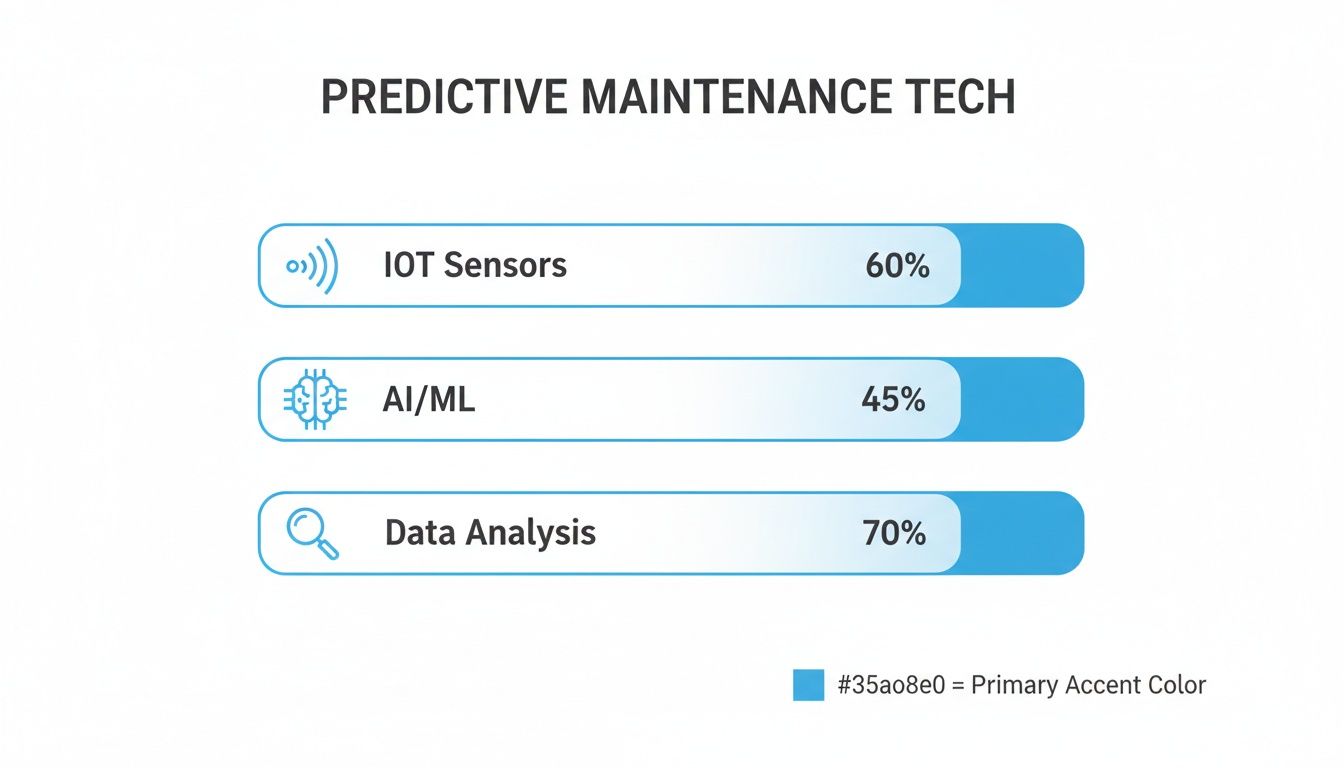
These tools form an interconnected ecosystem that collects and analyzes real-time asset health data, which is the foundation for making accurate failure predictions.
Long-Term Savings and Operational Efficiency
While predictive maintenance costs more to set up, its long-term financial benefits are compelling. A stark cost comparison shows its clear advantage, with some projections indicating it can reduce annual maintenance costs by as much as 34% for heavy equipment. For assets where downtime halts an entire production line, this translates to millions in saved productivity.
Preventive maintenance is suitable for simpler equipment, but its rigid schedule often leads to over-servicing healthy machines, which inflates ownership costs. Predictive maintenance inverts this model. By using live monitoring, it triggers work only when data flags an impending failure, which can lead to 40-60% better results in hybrid models. By allocating resources precisely where they are needed, you optimize labor, minimize parts waste, and can achieve overall cost savings of 25-35% in the long run. For a deeper analysis, you can explore these cost-saving maintenance strategies.
By shifting from a calendar-based to a condition-based approach, organizations can dramatically reduce wasted labor and materials. Technicians focus on assets that actually need attention, boosting both efficiency and morale.
This focus on data-driven intervention not only saves money but also creates a more stable operational environment. By identifying potential failures weeks or even months in advance, maintenance teams can schedule repairs during planned shutdowns, transforming a potential emergency into a routine work order.
Preventive vs Predictive Maintenance Key Metrics Compared
Comparing the two strategies across key business metrics can help clarify the decision-making process. The table below outlines the core differences in their financial and operational impact.
| Metric | Preventive Maintenance | Predictive Maintenance |
|---|---|---|
| Initial Investment | Low. Primarily involves scheduling software and labor planning. | High. Requires investment in sensors, software, and data infrastructure. |
| Long-Term Cost | Moderate. Can be inflated by unnecessary labor and parts replacement. | Low. Optimized through just-in-time repairs and reduced downtime. |
| Labor Requirement | High and scheduled. Work is performed regardless of asset condition. | Lower and targeted. Work is only performed when data indicates a need. |
| Impact on Asset Lifespan | Good. Routine care extends life but can introduce human error. | Excellent. Maximizes lifespan by addressing specific wear patterns before failure. |
| Downtime Impact | Reduces unplanned downtime but requires significant planned downtime. | Minimizes both planned and unplanned downtime by scheduling repairs efficiently. |
Ultimately, the choice between preventive maintenance predictive maintenance depends on asset criticality and organizational goals. While preventive maintenance establishes a vital baseline of proactive care, predictive maintenance offers a clear path to superior operational efficiency and financial returns, particularly for high-value assets.
Weaving Immersive Tech into Your Maintenance Strategy

Transitioning from a straightforward preventive schedule to a data-heavy predictive program is more than a technological upgrade; it is a fundamental shift in workforce operations. Technicians must become data interpreters, learn new diagnostic equipment, and handle complex repairs flagged by algorithms. This skills gap is a significant challenge, but it is one that immersive technologies like Augmented Reality (AR) and Virtual Reality (VR) are well-suited to address.
These are not futuristic concepts but practical, field-proven tools that solve the training and execution challenges of modern maintenance. By creating realistic digital environments, AR and VR de-risk the transition to advanced strategies. They provide teams with the confidence and hands-on competence to maximize the ROI of both preventive maintenance and predictive maintenance programs.
Speeding Up Skills with Virtual Reality Training
VR training platforms immerse technicians in a safe, controlled digital twin of their work environment. Within these simulations, they can practice complex repair procedures on new or critical equipment without any risk to themselves or the actual asset. This is a game-changer for mastering the non-routine repairs that predictive systems are designed to identify.
A practical use case is preparing for a complex, predictive-flagged repair on a critical pump. A technician can use VR to rehearse the entire multi-step disassembly and reassembly process, interacting with virtual components and tools. This builds muscle memory and familiarity, so when they perform the task on the real asset, it's executed faster and with fewer errors. Studies show immersive learning can reduce employee training time by up to 75% by allowing for risk-free repetition.
Immersive training transforms information from a dense technical manual into a tangible, interactive experience. It builds muscle memory and diagnostic intuition in a simulated space, which dramatically shortens the learning curve.
By standardizing training in VR, you ensure every technician—regardless of location or experience level—adheres to the same high standards of quality and safety. This consistency is invaluable for the effective execution of both preventive schedules and predictive interventions.
Giving Frontline Workers a Boost with Augmented Reality
While VR serves as the training ground, AR is the on-the-job force multiplier. AR-powered remote assistance connects frontline technicians with seasoned experts in real time, regardless of physical distance. This capability transforms how both planned jobs and unexpected emergencies are handled.
For instance, a junior technician on-site encounters a complex issue flagged by a predictive alert. Instead of waiting hours—or days—for a specialist to travel, they can wear AR glasses to share their exact point of view. The remote expert sees what the technician sees and can overlay digital instructions, diagrams, and data directly onto the live view of the machine. AI-powered platforms offering real-time agent assistance can further streamline this process.
This instant collaboration delivers significant benefits:
- Higher First-Time Fix Rates: With an expert virtually guiding them, technicians can diagnose and resolve problems correctly on the first attempt, minimizing repeat visits and asset downtime.
- Reduced Travel Costs: Senior specialists can support multiple sites from a central location, cutting associated travel expenses by as much as 75%.
- Enhanced Safety: AR can highlight specific hazards, such as high-voltage areas or high-temperature surfaces, ensuring safety procedures are followed precisely.
These tools are essential for maximizing the value of a blended preventive maintenance predictive maintenance strategy. To see more practical applications, explore our deep dive into augmented reality for maintenance. By integrating immersive solutions into your workflow, you build a maintenance team that is more agile, skilled, and prepared for the demands of a modern industrial environment.
Developing a Hybrid Maintenance Strategy
The most effective approach to modern asset management is not choosing between preventive and predictive maintenance—it’s blending them. A hybrid model involves applying the right level of attention to the right assets, creating a maintenance ecosystem that is both cost-effective and resilient. This strategy is not an "either/or" choice but a calculated combination of both philosophies.
The goal is to align your maintenance strategy with an asset's value and its failure risk. This means using schedule-based preventive maintenance for reliable, lower-cost equipment while reserving data-driven predictive techniques for your most critical, high-value machinery. Building such a balanced program requires a clear, step-by-step roadmap.
Establishing Your Foundational Layers
First, solidify your baseline. A robust preventive maintenance program is the foundation upon which a hybrid strategy is built. Ensure your current PM schedules are optimized, well-documented, and consistently followed for all relevant assets.
With a strong preventive framework in place, you can begin the crucial task of asset criticality assessment. This involves categorizing every piece of equipment based on its importance to your operations.
- Critical Assets: Equipment that, if it fails, would halt production or cause significant safety risks and financial losses. These are the prime candidates for predictive maintenance.
- Semi-Critical Assets: Machinery that is important but has some redundancy, or whose failure would cause manageable downtime. These assets often benefit from a mix of advanced preventive tasks and targeted condition monitoring.
- Non-Critical Assets: Lower-cost, easily replaceable equipment where a simple, schedule-based preventive plan is the most economical approach.
A hybrid strategy is fundamentally about resource optimization. It directs your most advanced tools and skilled technicians toward the assets that pose the greatest operational risk, while maintaining efficient, routine care for everything else.
Phasing in Predictive Technologies
After identifying your most critical assets, avoid a large-scale, disruptive rollout. Instead, begin with a focused pilot project. Select one or two high-value machines with a history of causing operational issues and use them to demonstrate the value of predictive technology. This approach minimizes risk and helps secure buy-in from stakeholders.
Next is data integration. A predictive program is only as effective as the data it receives. This means connecting your new IoT sensors and monitoring tools with your existing CMMS to create a seamless flow of information. The objective is to automate work order creation when a predictive alert is triggered, converting data insights directly into actionable tasks.
Finally, establish clear Key Performance Indicators (KPIs) to track the performance of your hybrid program. Metrics such as Mean Time Between Failures (MTBF), Overall Equipment Effectiveness (OEE), and maintenance cost per asset will provide concrete evidence of your program's impact. For a deeper look into this data-driven approach, our guide on predictive maintenance in manufacturing offers more detail.
At its core, this transition is a change management project. Success hinges on training your team to trust the data and adapt to new, condition-based workflows. Framing this shift as part of a broader digital transformation initiative helps align the entire organization, ensuring your hybrid preventive maintenance predictive maintenance strategy delivers sustainable results.
Common Questions About Maintenance Strategies
When evaluating a time-tested preventive maintenance program against a data-rich predictive model, many questions arise. Leaders need to understand the real-world implementation challenges, scalability, and the role of emerging technologies.
Let's address some of the most common questions to provide clear, practical answers for planning your maintenance strategy.
What's the Single Biggest Hurdle in Switching to PdM?
The primary challenges are twofold: the upfront investment and the cultural shift. The costs of sensors, software, and system integration are significant. However, the greater challenge is often transitioning the team from a calendar-based mindset to a data-driven one.
This requires asking personnel to trust analytics over the schedules they have followed for years. It involves training them not just on new tools but on a new way of thinking. Strong leadership and a well-planned, phased rollout are essential for building the confidence needed to embrace this change.
Can a Small Company Actually Benefit from Predictive Maintenance?
Yes. While large-scale predictive systems may seem suited only for large enterprises, the technology is becoming increasingly accessible.
For smaller businesses, the key is a strategic approach. Instead of attempting to monitor all assets at once, start with the most critical, high-value equipment—the assets that would halt operations if they failed. With more affordable cloud-based platforms and sensors, it is feasible to run a pilot project, prove the ROI, and scale from there. Often, preventing a single catastrophic failure on a key machine can justify the initial investment.
The decision to adopt predictive maintenance isn't about company size; it’s about asset criticality. For any business, the cost of unplanned downtime on a vital piece of machinery can be devastating.
How Do AR and VR Fit into a Hybrid Strategy?
Augmented and virtual reality are powerful tools for integrating preventive and predictive maintenance. For routine preventive tasks, VR can be used to create standardized, immersive training simulations. This ensures every technician, regardless of experience, performs critical checks consistently and correctly every time.
On the predictive side, AR remote support is a valuable asset. When a predictive alert flags a complex or unusual issue, an on-site technician can use an AR headset to get real-time, visual guidance from a senior engineer located anywhere in the world. This approach bridges skills gaps, reduces travel costs, and significantly improves the first-time fix rate.
By bringing immersive technologies into the fold, AIDAR Solutions helps your teams execute both preventive and predictive tasks faster and with far greater accuracy. See for yourself how our AR and VR platforms can help you navigate this transition and unlock new levels of efficiency. Learn more at https://aidarsolutions.com.