
What Is a Smart Glass Your Guide to Responsive Technology
Have you ever seen a window that can turn opaque with the flip of a switch? That’s the core concept behind smart glass. It’s an advanced material that shifts from transparent to tinted or fully opaque on command, offering instant control over privacy and light.
So, What Exactly Is Smart Glass?
Think of smart glass as an active, intelligent building material rather than a passive one. Instead of relying on manual blinds or shades, smart glass uses a trigger—like an electrical current, heat, or light—to instantly change its properties. This capability transforms glass from a simple barrier into a dynamic part of a facility's operational infrastructure.
At its core, smart glass is about control. It provides businesses with a more effective way to manage physical spaces, solving common operational challenges with both efficiency and practicality. This is not a futuristic concept; it's a proven technology that companies are currently using to improve their workplaces.
How Can It Benefit a Business?
Smart glass directly addresses several key business needs by fundamentally changing how we interact with our physical environment. Its primary capabilities include:
- On-Demand Privacy: Instantly switch glass from clear to opaque in conference rooms, executive offices, or sensitive R&D labs. This eliminates visual distractions and enhances confidentiality without the need for physical barriers.
- Significant Energy Savings: By managing solar heat gain, smart glass can significantly reduce a building's reliance on HVAC systems for cooling, leading to lower energy consumption.
- A More Comfortable Workspace: It mitigates harsh glare that causes eye strain and reduces focus. The result is a more productive and comfortable environment for employees.
- Enhanced Operational Security: In manufacturing plants or warehouses, it can obscure the view of proprietary processes or valuable equipment without sacrificing natural light.
The growth of this technology is supported by strong market data. The global smart glass market is estimated at around $8.47 billion in 2025 and is projected to reach $12.51 billion by 2029. You can find a detailed analysis in the smart glass market forecast on Research and Markets.
This is more than a trend. It's a clear indicator that businesses are adopting smarter, more adaptable building solutions that meet modern demands for efficiency, privacy, and sustainability.
How Smart Glass Technology Actually Works
While it may seem complex, the mechanism that allows smart glass to switch from clear to opaque is based on applied material science. The technology uses a thin film containing microscopic particles, which is typically laminated between two panes of glass. An electrical charge acts as a controller, instructing these particles on how to align and, consequently, how much light to let through.
When the power is off, the particles are arranged randomly, scattering light and making the glass appear opaque for instant privacy. When the power is on, an electrical current aligns the particles uniformly, creating a clear path for light to pass through and rendering the glass transparent. It's a straightforward principle with powerful applications.
The Core Technologies Driving Smart Glass
While the fundamental concept is consistent, a few key technologies are used, each with distinct advantages. Understanding the practical differences is crucial for selecting the right solution, as each type offers a unique combination of switching speed, clarity, and energy consumption.
The three main technologies are:
- Polymer Dispersed Liquid Crystal (PDLC): This technology offers the fastest switching speed, changing from opaque to clear in milliseconds. This makes it an ideal choice for applications like conference rooms where immediate privacy is required.
- Suspended Particle Device (SPD): This technology uses suspended micro-particles that align when a current is applied. SPD allows for variable tinting, offering precise control over glare and light levels much like a dimmer switch.
- Electrochromic (EC): This technology tints slowly and deliberately when a low-voltage current is applied. EC is highly energy-efficient because it only consumes power to change its state, not to maintain it, making it ideal for managing solar heat gain on a building's exterior.
For a deeper dive into these mechanisms, you can explore more about how smart glass works in our detailed guide.
This concept map breaks down the core benefits of smart glass: dynamic control, on-demand privacy, and better energy efficiency.
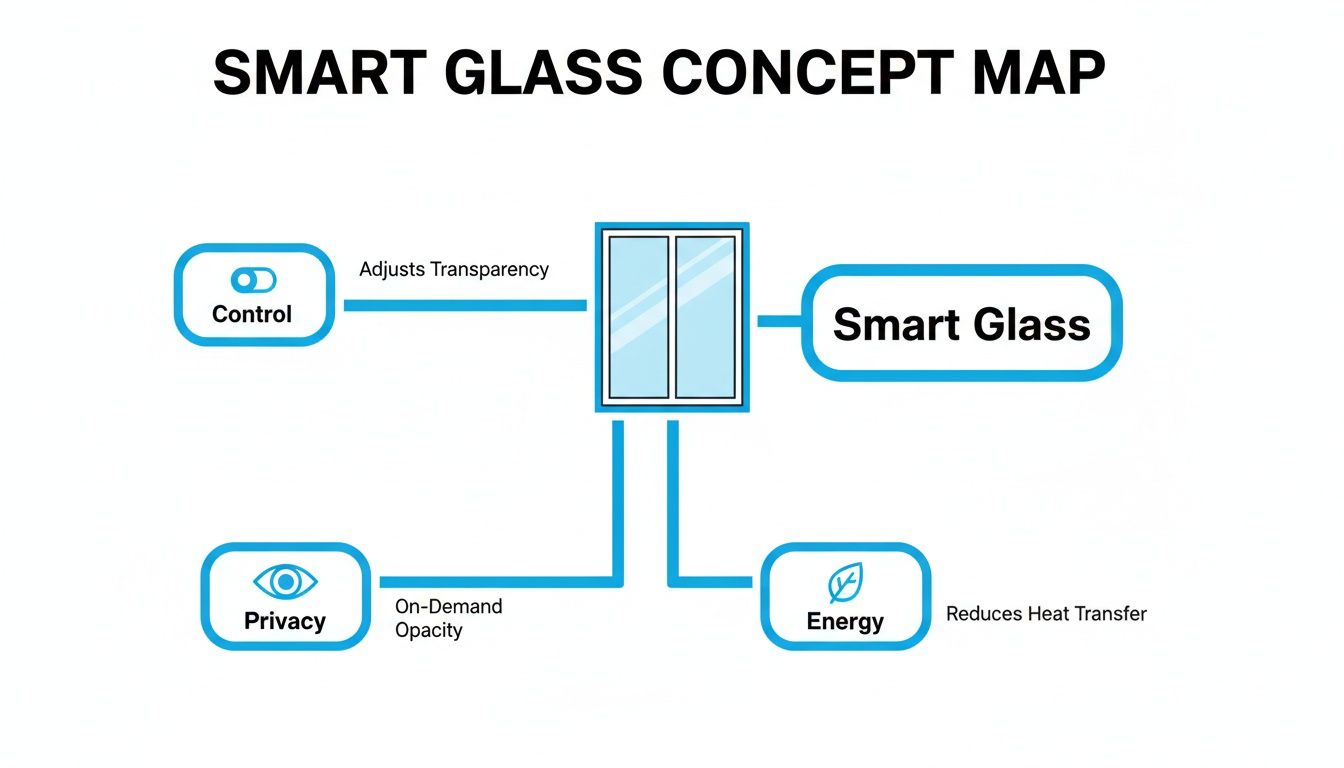
The map illustrates how a single technology connects three significant operational benefits, making it a versatile tool for any modern facility.
The core function of smart glass relies on manipulating how light passes through a medium. It’s a principle that requires a deep understanding of materials and optics. To grasp the scientific underpinnings that allow smart glass to function, further exploration into related fields such as advancements in photonics research can provide valuable context.
By choosing the right technology for the right problem—whether it's the rapid response of PDLC for an internal meeting room or the energy-saving tint of EC for exterior windows—you can ensure your investment delivers the maximum possible impact.
How Smart Glass Is Actually Used in the Real World

The technology behind smart glass is impressive, but its real value lies in solving tangible, everyday problems. It is a tool that provides on-demand control over light and visibility, creating smarter, more efficient environments that enhance productivity and safety in demanding sectors.
In high-stakes industrial settings, smart glass is far more than a simple window. It is an active component of the workspace, serving as a dynamic tool for creating a safer and more effective environment for workers.
Manufacturing and Assembly
On a busy assembly line, precision and focus are paramount. Environmental factors like sunlight can create intense glare on reflective parts or digital screens, leading to eye strain and costly mistakes.
Smart glass addresses this directly. By dynamically tinting exterior windows, manufacturers can maintain optimal lighting conditions throughout the day. Visual disruptions are minimized, allowing technicians to concentrate on detailed tasks. The result is improved quality control, fewer errors, and a more comfortable and less hazardous environment.
Logistics and Field Service
The applications extend beyond the factory floor. The cabins of service vans and commercial trucks function as mobile offices, often containing sensitive electronics like laptops, scanners, and diagnostic tools.
Sunlight can cause cabin temperatures to rise, potentially damaging vital equipment and creating uncomfortable conditions for the driver. Smart glass installed in vehicle windows can automatically adjust its tint to block solar heat, protecting equipment and keeping drivers more comfortable and alert.
Much of this is made possible through connectivity, placing smart glass at the heart of the broader Internet of Things (IoT) technologies that are reshaping industries. This allows for automated, data-driven adjustments.
By actively managing environmental factors like light and heat, smart glass contributes to operational resilience. It ensures that both people and their tools can perform at their best, regardless of external weather conditions.
The automotive sector, in particular, has adopted this technology to enhance both safety and comfort. It's no surprise that the global smart glass market is projected to grow from USD 6.42 billion in 2025 to USD 10.42 billion by 2030, with automotive applications being a significant driver.
Creating optimal viewing conditions is also a crucial factor for other visual technologies, such as AR smart glasses used for remote assistance. By controlling ambient light, smart glass can ensure digital overlays from an AR device are crisp and legible, a key requirement for effective remote support and training. You can read more about what we learned deploying AR smart glasses in enterprise settings in our executive summit recap.
Calculating the ROI of Smart Glass Technology
Integrating any new technology into your operations requires a solid business case. For smart glass, the return on investment (ROI) is measured not only in cost savings but also in gains in operational efficiency. While there is an upfront cost, the long-term value is realized through sustained performance improvements.
The most immediate benefit is energy efficiency. Smart glass that dynamically tints to block solar heat can significantly reduce the load on HVAC systems, particularly in facilities with large glass facades. This can result in a potential 30% reduction in HVAC energy use, a substantial saving that directly impacts the bottom line.
Putting Numbers to the Benefits
To secure buy-in, it is essential to move beyond hypotheticals and focus on concrete numbers. Calculating the ROI for smart glass involves analyzing key areas of your operations.
A good starting point is to review current energy bills and their seasonal fluctuations. From there, you can build a clearer picture by focusing on the KPIs that smart glass directly impacts:
- Reduced Energy Costs: Calculate potential savings based on your facility's size, local climate, and current HVAC load. A 25-40% reduction in related energy use is a realistic target, especially for buildings pursuing green certifications.
- Increased Productivity: A more comfortable work environment with less glare and stable temperatures leads to fewer distractions and errors. This can be measured by comparing output or error rates before and after deployment.
- Lower Maintenance Costs: When an HVAC system operates less intensively, wear and tear on expensive equipment is reduced. This can lead to fewer service calls and a longer lifespan for the system.
A Deeper Look at Productivity Gains
The impact of employee comfort on productivity should not be underestimated. When team members are not contending with screen glare or temperature fluctuations, they can maintain focus more effectively. This improves work quality and reduces errors—a critical factor in detail-oriented roles like manufacturing or quality control.
The link between a worker's environment and their efficiency is well-established. By creating an optimized workspace, smart glass empowers people to perform at their best, turning an architectural feature into a tool for operational excellence.
This is why the technology has become a cornerstone of modern building design, particularly in construction and commercial real estate. In fact, the sector accounted for 38.2% of market revenues, with projections showing the market growing from USD 11.16 billion in 2025 to USD 18.47 billion by 2030. According to insights on the global smart glass market from Mordor Intelligence, this growth is driven by green building codes that favor technologies delivering significant energy savings.
To help you start quantifying these improvements in your own organization, specialized tools can provide a useful framework. For example, our training ROI calculator is designed to measure the financial impact of efficiency gains, and its principles can easily be adapted to evaluate the productivity benefits of a better, smarter work environment.
Integrating Smart Glass Into Your Operations

When you are ready to incorporate smart glass into your facility, it's important to treat it as an integral part of your building's infrastructure, not merely as a standalone device.
For IT and operations leaders, this perspective is crucial. A robust integration strategy covering connectivity, security, and device management is necessary from the outset. The objective is to ensure your smart glass installation communicates seamlessly with existing building systems.
Consider your Building Management System (BMS), the central control system for your facility. When properly integrated, smart glass can react automatically to BMS data, adjusting its tint based on room occupancy, time of day, or live weather feeds. This is where significant efficiency gains are realized.
Connectivity and Network Security
Before installation, assess your network's readiness. Each smart glass panel or zone controller requires a reliable connection to send and receive commands, which brings network security to the forefront.
As these are IoT devices, they can represent potential network vulnerabilities. It is critical to secure the control network to prevent unauthorized access.
Here are key security protocols to implement:
- Network Segmentation: Isolate smart glass controls on a separate virtual local area network (VLAN). This is a non-negotiable step to prevent a potential breach from affecting other critical business systems.
- Strong Authentication: Use multi-factor authentication (MFA) for all administrative access. This ensures that only authorized personnel can make system changes.
- Encrypted Communications: All data transmitted between the control system and the glass panels must be encrypted to protect it from interception.
New Construction vs. Retrofitting Existing Buildings
The installation process for smart glass differs significantly between new construction projects and retrofitting existing structures.
Integrating this technology into a new build is generally more straightforward. Wiring and control systems can be planned from the ground up and incorporated directly into the blueprints.
Retrofitting presents a different set of challenges. It involves carefully running low-voltage wiring to each window, a process that can be complex in older buildings with thick walls and intricate layouts. While wireless control options are improving, they must be vetted carefully for reliability and security in your specific environment.
Regardless of the approach, the goal is the same: to create a seamless experience where the technology feels like a natural part of the building, not a cumbersome addition.
Proper integration also yields benefits in other areas. For example, when a technician receives remote assistance via AR, smart glass can automatically reduce glare, allowing the technician to see instructions clearly and work more effectively. By planning for software compatibility and device management upfront, smart glass becomes a powerful, integrated tool that enhances your entire operational ecosystem.
To see how this impacts maintenance workflows, check out our guide on augmented reality for maintenance.
Your Smart Glass Deployment Checklist
Initiating a smart glass project involves more than selecting technology; it requires a structured plan to ensure successful implementation and achievement of operational goals. This checklist serves as a roadmap to guide you through the evaluation and deployment process.
This framework helps turn a complex technical project into a manageable one with clear, achievable milestones, broken down into distinct phases to maintain focus and organization.
Phase 1: Strategic Planning
Before evaluating hardware, it is essential to define the project's purpose. A clear objective provides the foundation for all subsequent decisions and ensures the investment delivers its intended value.
- Define Your Primary Objectives: What specific problem are you trying to solve? Are you aiming to reduce HVAC costs, create on-demand privacy in meeting rooms, or improve comfort and focus on a production line? Be specific.
- Identify Key Stakeholders: Involve the right people from the beginning. Include leaders from Operations, IT, Facilities, and Finance. Early buy-in from all relevant departments is critical for a smooth rollout.
- Establish Success Metrics: How will you measure success? Define the metrics for determining your return on investment. This could include tracking energy consumption (kWh), monitoring employee productivity rates, or surveying staff about workspace comfort.
Phase 2: Technology and Vendor Selection
With your objectives defined, the next step is to find the right tools and partners. Not all smart glass solutions are the same, so thorough research is necessary.
Choosing a vendor is about more than just the product; it's about finding a partner who understands your operational needs and has a proven track record of successful enterprise deployments.
- Evaluate Technology Types: Match the technology to your specific use case. Determine whether the instant privacy switching of PDLC or the gradual, energy-saving tinting of SPD or EC is a better fit. Your goals from Phase 1 will guide this decision.
- Vet Potential Vendors: Request case studies, speak with references, and investigate their experience. Prioritize vendors who have worked in your industry and understand enterprise-level security and integration requirements.
Common Questions About Smart Glass
When decision-makers begin to research what smart glass is and how it might fit into their operations, several key questions consistently arise. Here are direct answers to the most common inquiries regarding cost, longevity, and system compatibility.
Is It Worth the Upfront Cost?
This is often the first question. While the initial investment for smart glass is higher than for traditional windows, a true assessment requires looking at the total cost of ownership.
The value is realized through long-term operational savings. By actively managing solar heat gain, smart glass can reduce a building's HVAC energy consumption by up to 30%. When factoring in lower energy bills and productivity gains from an improved workspace, the ROI is often achieved within a few years.
How Long Does It Actually Last?
Another major consideration is lifespan. Modern smart glass is engineered to be as durable as standard commercial-grade windows.
This is not a fragile, experimental technology. It is rigorously tested to withstand tens of thousands of switching cycles without performance degradation. You can expect it to be a reliable component of your building's infrastructure for many years, delivering consistent benefits without requiring frequent replacement.
Think of smart glass not as a temporary fix, but as a durable, long-term upgrade to your building’s core infrastructure, designed to perform reliably for decades.
Can It Support Augmented Reality Systems?
Finally, there is often interest in whether smart glass can improve the performance of AR systems. The answer is yes. For industrial AR applications where visual clarity is paramount, smart glass can create an optimal viewing environment.
By precisely controlling glare and ambient light, it ensures that digital overlays, instructions, or data projected onto an AR display are sharp and easy to read. This directly enhances the effectiveness of AR-based remote assistance and training platforms, where clear visuals are non-negotiable for safety and accuracy.
At AIDAR Solutions, our expertise is in applying AR and VR to solve tough industrial challenges. See how our immersive training and support platforms can make a real difference in your operations. Learn more at https://aidarsolutions.com.