A Guide to augmented reality in industry: Transform Training and Ops
Picture this: a transparent, interactive blueprint overlaid directly onto a real-world piece of machinery. That's augmented reality in industry. It's not science fiction anymore—it's a practical tool solving very real challenges on the factory floor, right now. This technology is already tackling tough problems like widening skills gaps, operational bottlenecks, and the high cost of flying experts around the world.
What Augmented reality in industry Looks Like on the Factory Floor
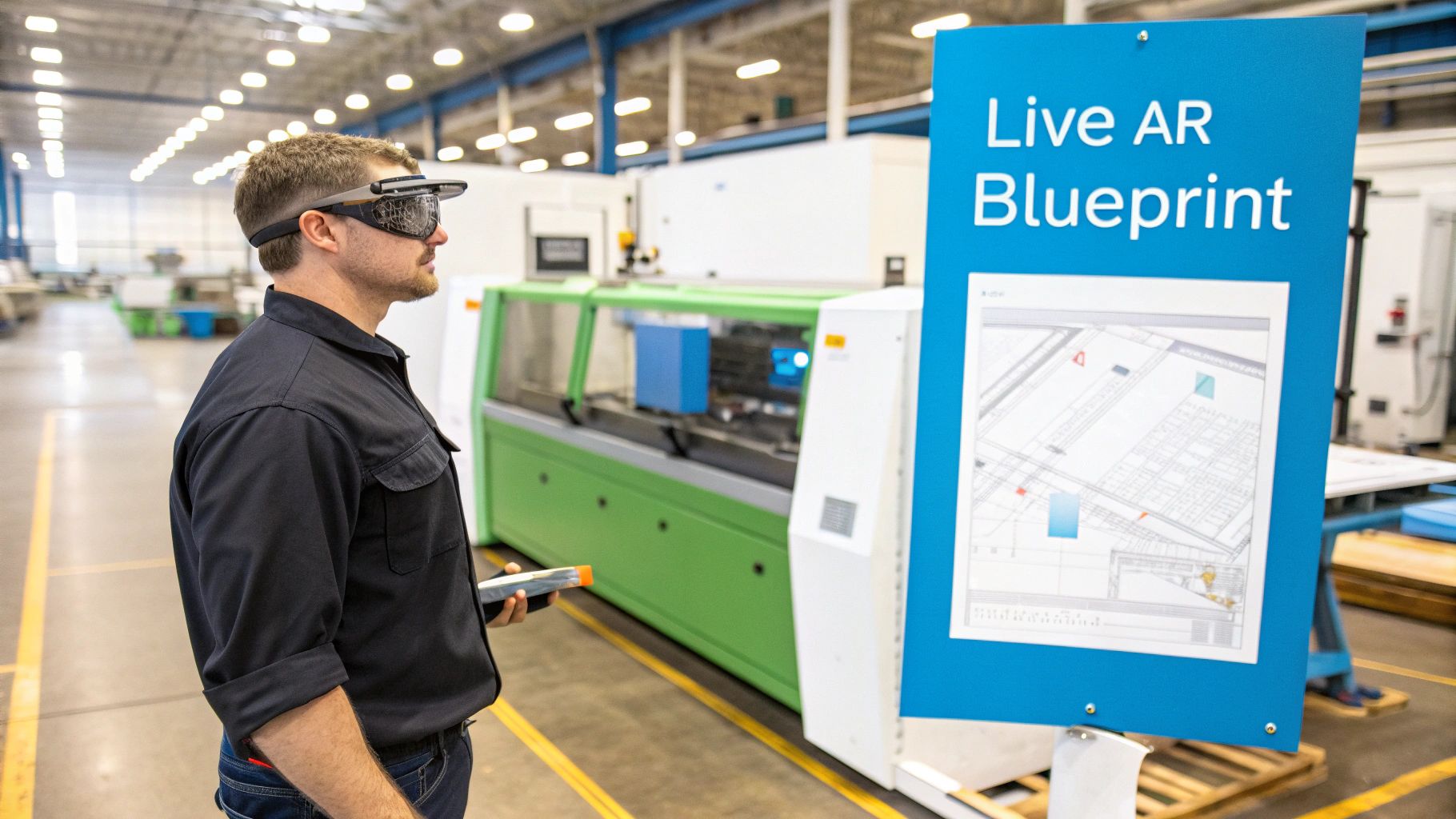
In a factory or field setting, augmented reality (AR) works by projecting digital information—think schematics, step-by-step instructions, or live performance data—onto a user's view of their physical surroundings. This isn't a separate virtual world, but an intelligent, interactive layer on top of existing reality.
This digital overlay provides frontline workers with the exact information they need, precisely when and where they need it. Instead of consulting a separate manual or waiting for a remote expert, a technician can simply look at a machine and see repair instructions displayed next to the relevant components.
From Concept to Practical Tool
The real value of industrial AR is its ability to translate complex data into simple, actionable steps within a worker's direct line of sight. This is what shifts the technology from a novel concept into a hands-on, problem-solving tool.
Consider these practical use cases:
- On the Assembly Line: A worker sees a digital guide highlighting the exact sequence of parts to install. This ensures every product is assembled correctly, reducing costly errors.
- During a Service Call: A field technician can stream their view back to a senior expert. That expert can then draw annotations directly onto the live video feed, pointing out exactly what to do next.
- In a Training Session: A new hire can safely walk through a complex, multi-step procedure on a piece of equipment, with AR prompts ensuring they follow every safety protocol.
AR provides a practical blueprint for improving industrial operations. It delivers tangible solutions to some of the most pressing challenges facing operations managers today, bridging the gap between digital information and physical tasks.
Setting the Stage for Real Change
This guide is designed to demonstrate how AR is being applied in real industrial settings and how you can map a path to applying it in your own operations to achieve measurable business results.
For a deeper look into its specific applications, learn more about augmented reality for manufacturing and see how it’s already boosting efficiency. The goal here is to show you that AR is an accessible and powerful tool you can use to achieve real, tangible outcomes.
How AR Is Changing the Game for Industrial Work
Augmented reality doesn't replace skilled workers; it enhances their capabilities. By layering critical digital information directly onto their physical surroundings, AR transforms how industrial work gets done. It empowers teams with real-time data, visual guides, and expert knowledge exactly when and where they need it most. Complex, multi-step processes become clear, intuitive actions.
This shift is most evident in four key areas: immersive training, remote expert support, guided maintenance, and smarter quality control. Each one targets a specific pain point on the factory floor or out in the field, turning operational challenges into opportunities for improvement.
Immersive Training and Upskilling
Traditional training methods often involve shadowing a veteran or deciphering dense paper manuals—both of which can be slow and inconsistent. AR revolutionizes this by creating a "learn-by-doing" environment where new hires and seasoned professionals can practice complex tasks in a completely safe, guided setting.
Imagine a trainee assembling a sensitive piece of machinery. Through AR glasses or a tablet, they see digital highlights on the correct parts, animations showing exactly how they fit together, and instant warnings if a step is performed incorrectly. This hands-on, interactive approach builds muscle memory and real confidence far more effectively than passive observation.
By providing a safe space for trial and error, augmented reality allows workers to master skills without risking damage to expensive equipment or causing production delays. This method has been proven to slash training time and lock in knowledge for the long haul.
Remote Expert Assistance
When a critical machine breaks down, every minute of downtime translates to lost revenue. The traditional solution of flying a senior expert to the site is both slow and expensive. AR eliminates this distance instantly.
A frontline technician can put on AR smart glasses and stream their exact point of view to a specialist located anywhere in the world. The remote expert sees what the tech sees and can provide immediate, over-the-shoulder guidance by drawing annotations, sharing schematics, and dropping digital markers right into the technician's line of sight.
This "see-what-I-see" capability is a significant driver of market growth. The global AR market is projected to hit USD 198.17 billion by 2025, with a compound annual growth rate of 38.5% through 2034. For industrial teams, this translates to tangible results: remote support tools can reduce service times and decrease expert travel by as much as 75%. You can get a deeper dive into these numbers in this augmented reality statistics report.
Streamlined Maintenance and Repair
Routine maintenance and complex repairs demand absolute precision. A single missed step or an incorrectly torqued bolt can lead to catastrophic equipment failure. AR acts as a digital guide, ensuring procedures are followed to the letter, every single time.
With AR-guided instructions, a maintenance worker can look at a pump and see a step-by-step checklist overlaid directly on the equipment. Each step could include:
- Visual cues that highlight the exact tool to use.
- Torque specs that appear right next to the relevant bolt.
- Animated instructions demonstrating a particularly tricky maneuver.
This type of digital assistance significantly reduces the potential for human error, empowering even less experienced technicians to perform tasks with the accuracy of a seasoned veteran. Standardizing procedures with visual guides is a cornerstone of building a successful augmented reality workflow.
Enhanced Quality Control
In manufacturing, quality is paramount. AR provides a powerful tool for visual inspection and assembly verification, helping workers catch mistakes the moment they happen.
During an assembly process, an AR application can superimpose a perfect digital model over the physical product. This allows the worker to instantly spot any deviation, whether it's a missing component, incorrect alignment, or a flawed part. This real-time feedback loop prevents defects from moving down the production line, saving significant time and reducing the material waste associated with rework. It effectively turns every worker into a quality control expert, embedding accuracy directly into the production process.
Measuring the Real-World Business Impact of AR
While the technology is impressive, the true value of augmented reality in industry is demonstrated through tangible, bottom-line results. AR delivers specific, quantifiable benefits that resonate with financial and operational leaders.
Every use case, from training to maintenance, directly translates into better efficiency, lower costs, and reduced risk.
Consider Remote Expert Assistance. It is a direct countermeasure to crippling downtime and inflated travel budgets. When an expert can remotely diagnose a problem, issues are resolved in hours, not days. This leads to a massive improvement in first-time fix rates.
The same principle applies to immersive AR training. This approach leads to provably lower error rates on the factory floor, which means less wasted material and fewer costly reworks. More importantly, it allows personnel to master hazardous procedures in a completely safe environment, positively impacting critical safety metrics.
Translating AR into Financial Wins
The business case for AR becomes undeniable when you connect its capabilities to core financial outcomes. The conversation quickly shifts from "what can it do?" to "what can it save?" and "what can it earn?" This direct link between technology and performance is essential for gaining executive buy-in.
These results are not hypothetical. Organizations are seeing significant improvements, such as halving their service times and quadrupling their training throughput, by integrating AR into their daily workflows. Gains of this magnitude make a powerful argument for adoption.
The following image breaks down how AR slots into key industrial workflows, from initial training to final quality checks.
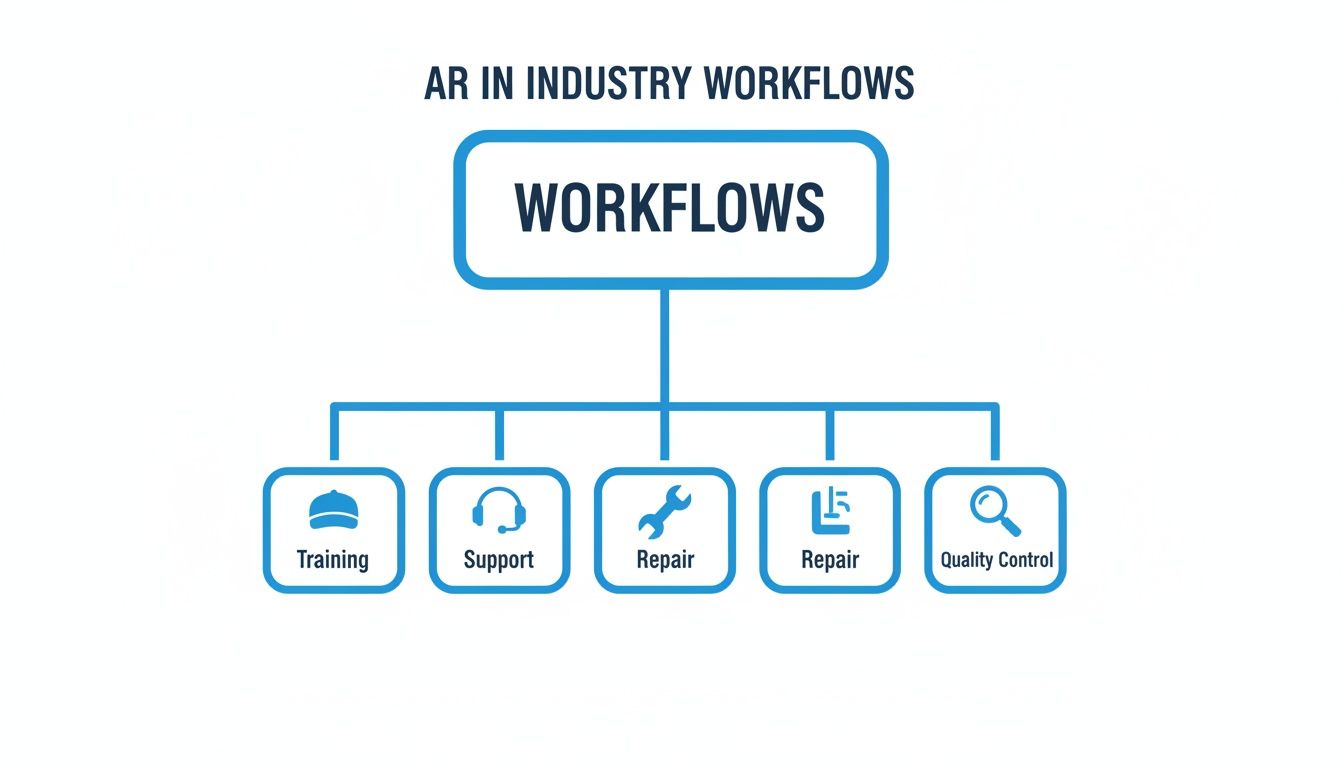
As you can see, AR supports the entire operational lifecycle, creating a truly connected and digitally assisted workforce.
Quantifying the Return on Investment
To build a solid business case, you need a clear framework that maps real-world industrial challenges to specific AR solutions and their corresponding key performance indicators (KPIs). Understanding these connections allows you to communicate in the language of leadership: return on investment (ROI).
The adoption of augmented reality in industry is accelerating for this reason. A 2023 Gartner survey found that 56% of retailers plan to invest in AR/VR by 2025. With global AR/VR revenues projected to hit over USD 100 billion by 2025, the economic momentum is undeniable.
The core value of industrial AR is its ability to convert operational improvements into measurable financial gains. By focusing on metrics like reduced travel, lower error rates, and faster task completion, you can build a powerful business case that demonstrates clear and compelling ROI.
To help structure this analysis, the following table draws a clear line from common problems to the AR tools that solve them and the metrics used to prove their effectiveness.
Mapping Industrial Challenges to AR Solutions and ROI
This table illustrates how specific augmented reality applications solve common industrial problems and the key performance indicators (KPIs) used to measure their financial and operational impact.
| Industrial Challenge | AR Solution (Example) | Key Performance Indicator (KPI) |
|---|---|---|
| High Travel Costs for Experts | Remote Expert Assistance | Reduced travel expenses, increased expert availability. |
| Slow Onboarding & Skills Gaps | Immersive Virtual Training | Decreased time-to-competency, higher knowledge retention. |
| Frequent Production Errors | Guided Assembly Workflows | Lower defect rates, reduced material waste. |
| Lengthy Equipment Downtime | AR-Assisted Maintenance | Improved First-Time Fix Rate (FTFR), shorter Mean Time to Repair (MTTR). |
| Inconsistent Quality Control | Digital Overlay Inspections | Increased inspection accuracy, fewer product recalls. |
| Workplace Safety Incidents | Simulated Hazard Training | Reduction in recordable safety incidents. |
Using a framework like this helps you align your AR strategy with specific business goals and prove its value every step of the way.
For a deeper dive into tracking these improvements, check out our guide on key operational efficiency metrics. It will help you set a baseline and effectively measure the impact of your AR implementation from day one.
Critical Factors for a Successful AR Rollout
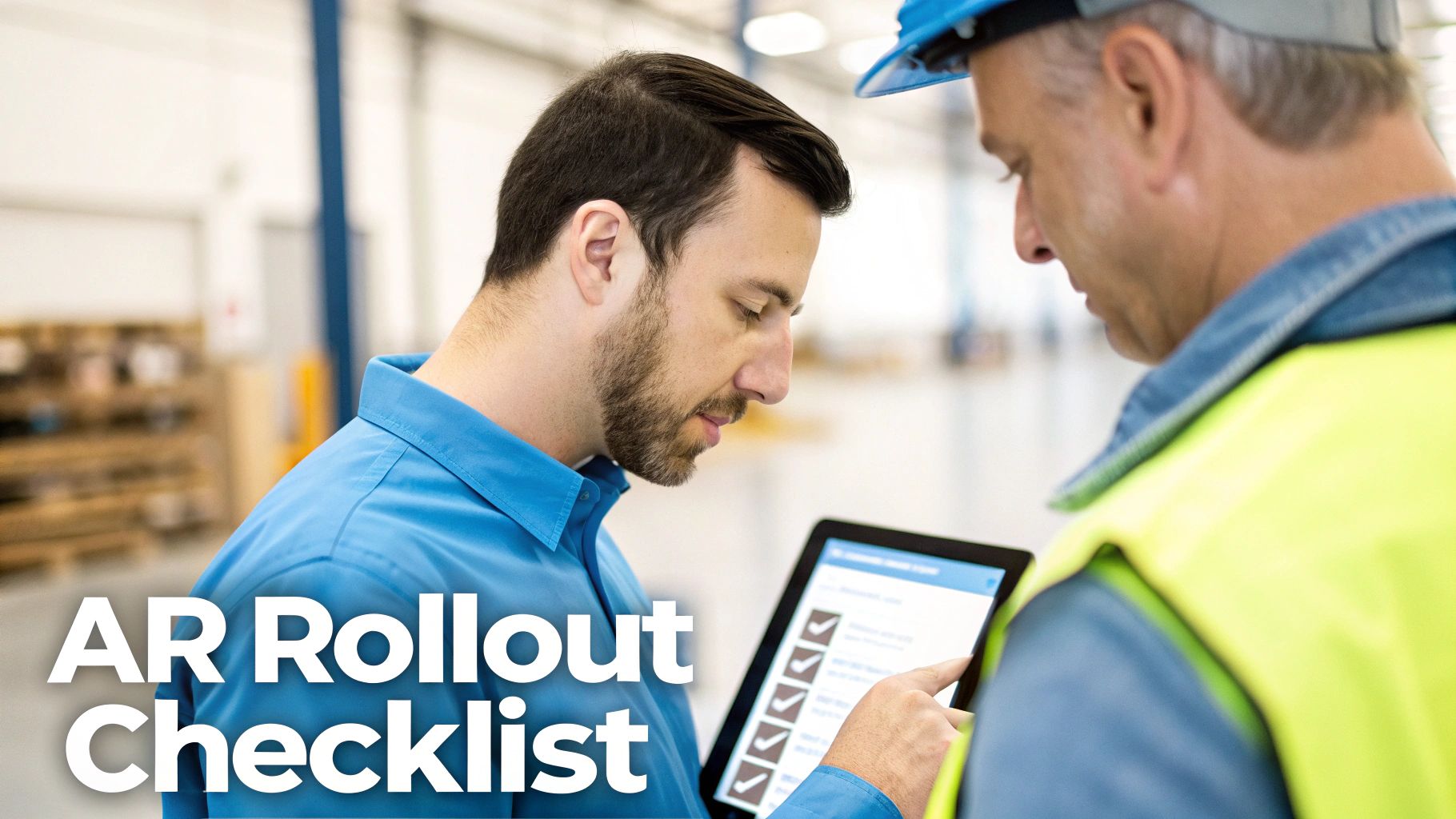
Successfully rolling out augmented reality depends on more than just the technology itself. For operations and IT leaders, a smooth launch requires careful planning across several critical areas—from the devices your team uses to the security protocols that protect your data.
Establishing these fundamentals separates a pilot project from a solution that genuinely drives value and integrates into daily work. Think of it as building a strong foundation; without it, even the most promising AR initiative can falter.
Choosing the Right Hardware for the Job
Your first major decision is the hardware. There is no single "best" device; the right choice depends entirely on the job at hand and the work environment. The goal is to empower your workers, not impede them.
The two main options are:
- Mobile Devices (Smartphones & Tablets): These are accessible and budget-friendly, making them ideal for tasks where a worker has a free hand—such as quick inspections, pulling up a digital manual, or initiating a remote support call.
- Industrial-Grade Smart Glasses: For complex, hands-on work like a intricate assembly or a delicate repair, smart glasses are the superior choice. They feed information directly into a user’s line of sight, keeping both hands free to safely and efficiently handle tools and equipment.
SaaS vs. On-Premise Deployment Models
Next, you must decide how to deploy the AR software. This decision has a major impact on scalability, control, and long-term maintenance. Each path offers different advantages depending on your company's IT policies and needs.
A Software-as-a-Service (SaaS) model is cloud-based, offering rapid deployment, automatic updates, and predictable subscription costs. It is a highly scalable approach that reduces the maintenance burden on your internal IT team.
An on-premise deployment keeps everything on your own servers, giving you total control over your data. This is often the preferred choice for organizations with strict data security requirements or for operations in locations with unreliable internet connectivity.
The right deployment model aligns with your company's security posture, scalability needs, and IT resources. A SaaS solution prioritizes flexibility and ease of use, while an on-premise setup offers maximum control and data security.
Connectivity and Data Security Protocols
For any augmented reality in industry solution to function effectively, solid connectivity is non-negotiable. Whether your team is on a remote oil rig or deep inside a factory, they need a stable connection to access data and communicate with experts. This may require investing in a more robust Wi-Fi network, private 5G, or ensuring your AR tools can function in offline or low-bandwidth modes.
Data security is equally critical. AR systems handle sensitive information, from proprietary machine schematics to live video of your facility. You must implement strong security protocols, including end-to-end data encryption, secure user authentication, and clear governance policies to protect your intellectual property. Understanding how to overcome common augmented reality challenges can help you prepare.
The Human Element Driving User Adoption
Finally, the most important piece of the puzzle is change management. The most advanced technology is useless if your team does not use it. Gaining buy-in comes down to clear communication, effective training, and demonstrating how the new tool improves their job.
Start by identifying enthusiastic "AR champions" on your team who can advocate for the change. Provide hands-on training that focuses not just on the technology, but on how it makes their specific tasks easier, safer, or faster. By focusing on the human element, you can ensure your AR rollout is a genuine upgrade to how your team works.
Your Step-By-Step AR Implementation Roadmap
Transitioning from interest in AR to a full-scale deployment can feel like a massive leap. The key is to follow a clear, methodical roadmap. Breaking down a major operational shift into manageable phases turns a daunting project into a series of predictable steps, ensuring your augmented reality in industry initiative builds momentum and delivers real value along the way.
This journey begins not with a huge investment, but with a focused, small-scale experiment. From there, you can thoughtfully select the right partners, expand the solution across your organization, and establish a system for continuous improvement.
Phase 1: Discovery and Pilot Program
First, identify a single, high-impact problem that AR can solve. Do not try to address everything at once. Look for a specific workflow where you can achieve a quick, measurable win.
Good candidates for a pilot program typically share these characteristics:
- High-Frequency Tasks: Processes that occur frequently. Small improvements here compound into significant gains.
- High Error Rates: Workflows known for common, costly mistakes are ideal for guided instructions.
- Expertise Bottlenecks: Situations where a few key experts are constantly in demand, creating delays.
Once you’ve identified a use case, run a small, controlled trial. The goal is to gather data and prove the concept's value to decision-makers. This pilot should be designed to validate the technology and build an internal business case supported by real numbers.
Phase 2: Vendor and Partner Selection
With a successful pilot completed, it's time to choose a long-term technology provider. This is more than a software purchase; you are selecting a partner who understands your industry and can support your growth. The right vendor should function as an extension of your team.
Here's what to look for when selecting a partner:
- Deep Industry Expertise: Have they solved problems in your specific sector before? A proven track record is essential.
- Integrated Platform: Look for a provider offering a cohesive suite of tools, such as remote service and training solutions, to avoid managing fragmented systems.
- Comprehensive Support: A strong partner provides a clear action plan, assists with integration, and offers ongoing support to ensure smooth operation.
Do not rush this phase. A partner with genuine industrial experience will help you avoid common pitfalls and achieve a positive ROI much faster.
The most successful AR programs are built on strong partnerships. A vendor who provides both a robust technology platform and strategic guidance is essential for navigating the complexities of a large-scale deployment and maximizing your return on investment.
Phase 3: Scaled Rollout and Expansion
After selecting your partner, it’s time to expand. A phased rollout involves carefully planning the logistics of deploying the AR technology to different departments, teams, and sites. A structured expansion minimizes disruption and ensures a consistent user experience.
Start by scaling to teams or departments adjacent to your original pilot group. Apply the lessons learned from the trial to refine your training materials and deployment process. Clear, constant communication is critical here to manage expectations and secure buy-in from new users.
Phase 4: Measuring Success and Continuous Optimization
An AR implementation is not a one-time project; it is an ongoing program. This final phase focuses on continuously tracking performance, gathering feedback, and refining your approach. You must establish clear Key Performance Indicators (KPIs) from the outset to prove your ROI.
Track metrics that tie directly back to your original business case, such as reductions in machine downtime, improvements in first-time fix rates, or a shorter training period for new hires. Regularly review this data with your technology partner to identify opportunities for improvement. This data-driven cycle of measure, refine, and repeat ensures your AR program continues to deliver increasing value over time.
Choosing the Right Technology Partner
The success of your AR initiative depends less on the technology itself and more on the partner you choose to implement it. This is not just another vendor purchase; you are selecting a collaborator who will guide your digital transformation. It is one of the most important decisions you will make.
A winning strategy starts with finding a partner who genuinely understands the pressures and complexities of your factory floor or field operations. Look for a team with a proven track record in your specific industry. They will know the pitfalls to avoid and can build solutions that meet your operational targets.
Beyond the Software Purchase
The best partners offer more than just a piece of software; they provide an entire platform. A single, unified suite for both immersive training and remote expert assistance is a game-changer. It means seamless integration and eliminates the challenge of managing a patchwork of disconnected systems. This holistic approach creates a powerful synergy across your entire workflow.
Deployment flexibility is also crucial. A partner offering both SaaS and on-premise models gives you options, allowing them to adapt to your company's unique security protocols and scalability needs. This ensures the investment pays off for years to come.
A true technology partner is focused on delivering measurable results. They don't just sell you a license and disappear. They work with you to build a solid action plan, handle complex integration work, and help you define the KPIs that prove the solution is working.
Look for a Strategic Guide
Ultimately, you are looking for a strategic guide, not just a supplier. They should be completely transparent about their implementation process and offer clear, continuous support to ensure your team adopts and benefits from the new tools.
When vetting partners, their experience with the broader manufacturing IT ecosystem can be a critical factor for a smooth rollout. Many companies find success by leaning on providers of specialized manufacturing IT services to ensure all systems, new and old, work in perfect harmony.
Choosing the right partner means teaming up with an expert who is as invested in your long-term success as you are. This partnership is the engine that will drive your AR strategy from a promising pilot to a core component of your operations, delivering real results and a powerful return on your investment.
Frequently Asked Questions About Industrial AR
As you explore augmented reality for your operations, many practical questions will arise. This is normal. Decision-makers often want to know about costs, integration with existing systems, and whether their team will actually use the technology. Let's address the most common questions.
How Much Does an Industrial AR Solution Cost?
There is no single price for an AR solution; costs vary based on scope and scale. A small pilot program running on a few tablets will represent a different investment than a full-scale deployment with dozens of industrial-grade smart glasses.
Costs can be broken down into a few key areas:
- Software Licensing: Typically a per-user, per-month subscription (SaaS), which keeps costs predictable and manageable.
- Hardware: This includes everything from smartphones and tablets to specialized AR headsets designed for industrial environments.
- Integration and Customization: This covers the work needed to connect the AR platform with your existing systems, such as your ERP or MES.
- Training and Support: A budget is needed to get your team proficient and comfortable with the new technology.
It is crucial to weigh these costs against the potential return. When you consider how AR can drastically reduce expert travel, minimize machine downtime, and make training more effective, the initial investment often becomes highly justifiable.
Will AR Integrate with Our Current Systems?
Yes, it should. A modern industrial AR platform should be designed to connect with the software you already use. A good AR partner will ensure their solution can integrate with your Enterprise Resource Planning (ERP), Manufacturing Execution Systems (MES), and other core operational platforms.
This integration elevates AR from a standalone tool to an extension of your digital infrastructure.
For example, a technician can pull up a work order on their headset, follow AR-guided steps to complete a repair, and once finished, the completed checklist can automatically update the ticket in your asset management system without manual entry.
How Do We Ensure Strong User Adoption?
This is a critical question. The best technology is ineffective if no one uses it. Gaining team buy-in requires focusing on the human element from the beginning. Start by clearly explaining the "why"—how this new tool will genuinely make their jobs easier, safer, and less frustrating.
The best approach is to involve frontline workers early. Include them in the pilot program, listen to their feedback, and empower them to become internal champions. They will be the most effective advocates for the new technology among their colleagues. Of course, comprehensive, hands-on training is non-negotiable.
When your team feels confident with the tools and sees firsthand how they help in their day-to-day tasks, adoption follows naturally. It is also helpful to stay current on the broader tech landscape; for example, understanding AR's role in Meta's future workplace vision can provide context on where these tools are heading.
Ready to see how augmented reality can transform your industrial operations? AIDAR Solutions provides a suite of powerful AR and VR tools designed to boost efficiency, slash training times, and deliver a rapid return on investment. Explore our solutions today.