Industrial Equipment Repair: Maximize Uptime with Pro Maintenance
Behind every product on the shelf and every package that arrives at your door, there's a hidden world of machinery keeping things moving. This is the domain of industrial equipment repair, and it’s far more than just fixing things when they break. Think of it as the pit crew for the global economy—fast, precise, and absolutely essential for winning the race against downtime.
The Hidden Engine of Global Industry
Picture a massive factory floor, a humming ecosystem of conveyor belts, robotic arms, and heavy presses all working in perfect harmony. Each piece is a vital organ. When one fails, the entire production line can seize up, costing a company thousands of dollars for every single minute of inactivity. This is where industrial equipment repair becomes the lifeblood of manufacturing, agriculture, and logistics.

It's a discipline that has evolved well beyond simple fixes. Today, it’s a whole spectrum of activities designed to maintain, restore, and optimize the machinery that powers modern industry. The real goal isn't just to react to breakdowns but to stop them from ever happening, ensuring operations run smoothly and productivity stays high.
Core Components of Effective Repair
Great industrial maintenance isn't a one-off task; it's a blend of deep expertise and smart, forward-thinking strategy. The whole field really rests on a few key pillars:
- Diagnostics and Troubleshooting: This is the detective work. It involves using advanced tools and hard-won experience to find the real root cause of a problem, not just patching up the symptoms.
- Component Restoration: Skilled technicians often rebuild or refurbish critical parts like engines, transmissions, and hydraulic systems. This breathes new life into them, helping to avoid the huge cost of a full replacement.
- Preventive Upkeep: This is all about routine, scheduled care—things like lubrication, changing filters, and regular inspections. It’s the nitty-gritty work that heads off wear and tear before it can cause a catastrophic failure.
Of course, to keep machinery running efficiently for the long haul, having access to quality essential industrial equipment parts is completely non-negotiable. It’s the backbone of the entire operation. Without the right components ready to go, even the best technicians can’t prevent long, painful stretches of downtime.
Why It Matters More Than Ever
In today's hyper-competitive market, operational efficiency isn't just a goal; it's a survival tactic. Unplanned downtime hits the bottom line directly, causing shipment delays, disrupting complex supply chains, and eroding customer trust.
A proactive approach to industrial equipment repair is no longer a cost center—it's a powerful driver of profitability. By minimizing unexpected failures and maximizing asset performance, organizations can achieve greater output, improve safety, and build a more resilient operation.
This guide will walk you through the shift from old-school reactive fixes to modern, data-driven maintenance strategies. We’ll look at the tools and technologies changing the game on the factory floor and give you a clear roadmap to getting the most out of your own repair programs.
From Reactive Fixes to Predictive Wins
Every approach to industrial equipment repair comes from a core philosophy—a specific way of thinking about when and how to step in. These strategies run the gamut, from the old-school "wait-and-see" method to sophisticated, data-driven forecasting. Getting a handle on this evolution is the first step to choosing the right path for your own operations.
The journey usually starts with reactive maintenance. This is the classic "if it ain't broke, don't fix it" school of thought. You simply run a machine until it breaks down, and only then do you perform a repair.
While it seems straightforward and requires zero upfront planning, the hidden costs are massive. A catastrophic failure doesn't just mean an expensive emergency fix; it kicks off a chain reaction of costly, unplanned downtime that can cripple your entire production line.
Moving Toward Proactive Care with Preventive Maintenance
A much better way to operate is with preventive maintenance. Think of this like your car's scheduled oil change. It's a proactive strategy where you perform maintenance at fixed intervals—either based on time or usage—to stop common failures before they ever happen.
For example, a conveyor belt motor might get lubricated every 500 operating hours, or hydraulic fluids might be replaced every six months, no matter what their current condition looks like. This calendar-based system drastically cuts down on unexpected breakdowns compared to just waiting for things to break.
By following manufacturer guidelines and looking at historical data, teams can get ahead of known wear-and-tear issues. This brings a much-needed layer of predictability to the factory floor, swapping chaotic emergencies for planned, controlled downtime.
The Ultimate Goal: Predictive Maintenance
The most advanced strategy is predictive maintenance (PdM), and it represents a huge shift in how we look at asset health. Instead of sticking to a rigid schedule, PdM uses real-time data from sensors to monitor the actual condition of equipment and predict exactly when a failure is likely to occur.
Imagine a machine that tells you, weeks in advance, that a specific bearing is about to fail. That’s the power of predictive analytics. It lets maintenance teams move from scheduled check-ups to condition-based action, performing industrial equipment repair with surgical precision only when it’s truly needed. You can dive deeper into how this works in our detailed guide on condition monitoring and predictive maintenance.
Predictive maintenance turns your equipment into a source of intelligence. By listening to what the machines are telling you through data, you can optimize maintenance resources, dramatically extend asset life, and all but eliminate unplanned downtime.
This smart approach is becoming a major force in the industry. The global industrial machinery repair service market, valued at $34.1 billion, is expected to grow to $60.27 billion by 2035. A big reason for this growth is that predictive technologies are boosting operational efficiency by up to 20-30% in some cases. You can find more insights on this trend by reviewing the full market research on industrial repair services.
Comparison of Maintenance Strategies
Deciding between these strategies isn't about just picking the most advanced one. It's about matching your approach to your operational maturity, budget, and how critical your assets are. Many facilities use a hybrid model—a non-critical pump might be left on a reactive schedule, while a mission-critical press gets the full suite of predictive sensors.
This table breaks down the key differences to help you see where each strategy fits best.
| Strategy | Trigger | Cost Profile | Downtime Impact | Best For |
|---|---|---|---|---|
| Reactive | Equipment Failure | Low initial cost, high emergency repair costs. | High, unplanned, and disruptive. | Non-critical assets where failure has minimal impact. |
| Preventive | Time or Usage Schedule | Moderate, predictable costs. Can lead to over-maintenance. | Low, planned, and controlled. | Critical equipment with known failure patterns. |
| Predictive | Real-Time Condition Data | Higher initial investment, lowest long-term costs. | Very low, planned with maximum lead time. | Mission-critical assets where downtime is unacceptable. |
Ultimately, the goal is to move along this spectrum, shifting away from chaotic fixes toward a state of controlled, data-informed reliability. Each step you take unlocks greater efficiency, safety, and profitability, turning your maintenance program from a necessary expense into a real strategic advantage.
The Modern Maintenance Professional's Toolkit
Today's maintenance professional is part detective, part data scientist. The days of relying on just a hunch and a trusty wrench are long gone. The modern toolkit is a sophisticated mix of physical tools that reveal a machine's inner secrets and powerful digital platforms that translate complex data into clear, actionable steps.
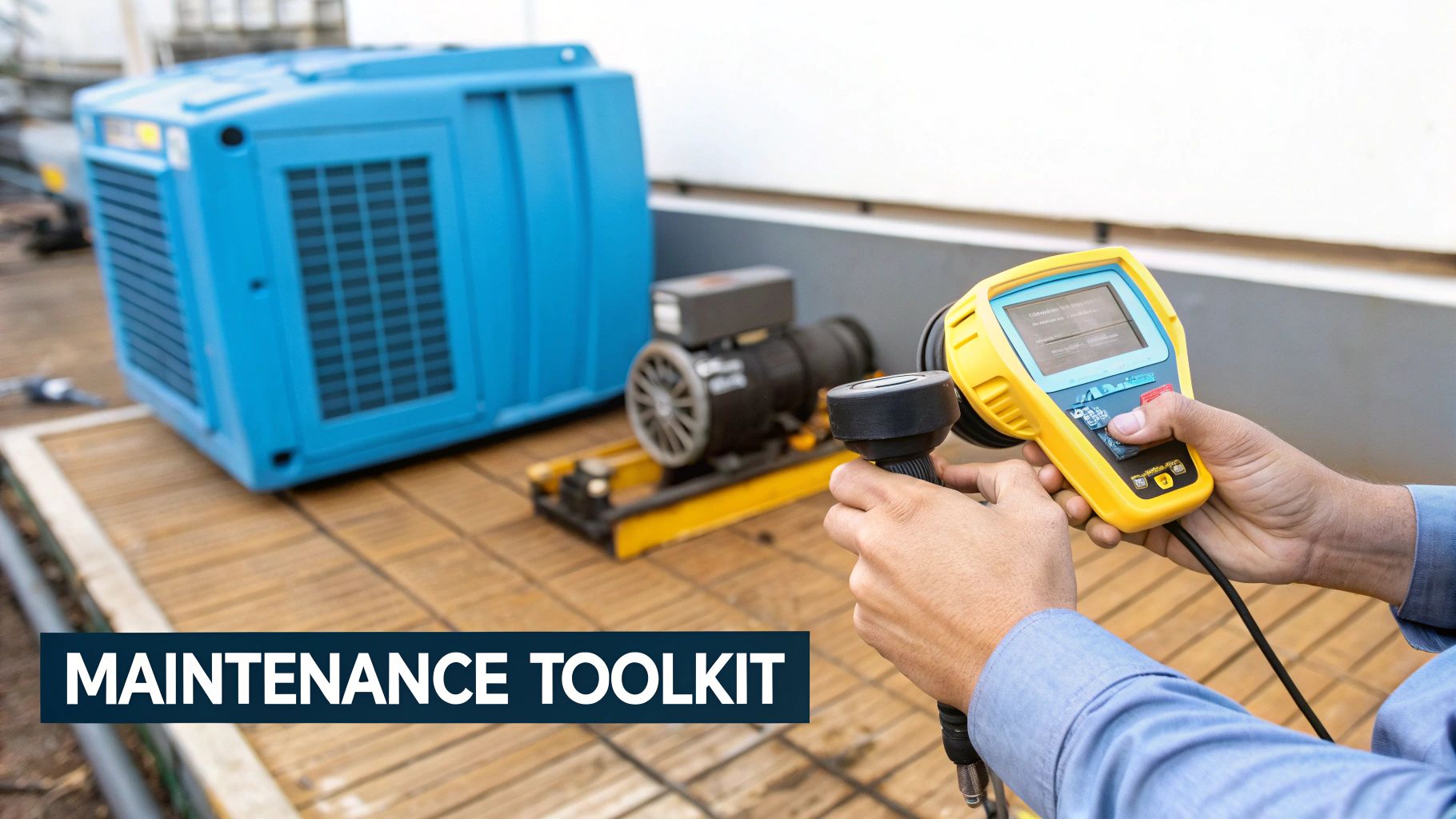
This blend of hardware and software is a game-changer. It allows maintenance teams to stop just reacting to failures and start diagnosing problems with incredible precision—often before anyone even notices a symptom. This is how maintenance evolves from a simple cost center into a real strategic advantage.
Foundational Diagnostic Hardware
Before we get into the software, a technician's real power starts with tools that can listen, see, and feel what's happening inside a machine. These instruments are the front-line senses, picking up on subtle signs of distress that are completely invisible to the naked eye. They provide the raw data needed for an accurate diagnosis.
Three key types of hardware form the bedrock of this modern toolkit:
- Vibration Analyzers: Think of these as a stethoscope for your equipment. By measuring the frequency and intensity of vibrations, technicians can "hear" internal problems like worn-out bearings, misalignment, or an unbalanced component long before it leads to a total breakdown.
- Thermal Cameras: These tools let you literally "see" heat. An overheating electrical connection or a poorly lubricated part lights up like a flare on a thermal image, pinpointing the exact source of stress.
- Oil Analysis Kits: A machine's oil is like its bloodstream. A quick analysis of a small sample can reveal microscopic metal particles, coolant leaks, or other contaminants. It’s like getting a detailed health report on internal parts without ever having to take the machine apart.
These tools are absolutely essential for any proactive maintenance strategy, giving you the ground-truth data that feeds the entire digital system.
The Digital Command Center
While the physical tools gather the clues, digital platforms are where the case gets solved. This software acts as the central nervous system, connecting all the data points, organizing workflows, and giving technicians the information they need to act with confidence. This is what enables truly data-driven industrial equipment repair.
A Computerized Maintenance Management System (CMMS) sits at the heart of it all. It’s a central database for everything maintenance-related, tracking work orders, managing parts inventory, and keeping a detailed history of every asset. It’s the system of record that ensures nothing falls through the cracks.
A well-implemented CMMS transforms maintenance from a list of disconnected tasks into a coordinated, measurable, and highly efficient operation. It creates a single source of truth for the entire team.
Next, Internet of Things (IoT) sensors provide a constant, real-time stream of health data. These small, often wireless sensors can be attached to critical equipment to monitor variables like temperature, pressure, and vibration 24/7. This nonstop flow of information is the fuel for any predictive maintenance model.
Finally, Artificial Intelligence (AI) and Machine Learning (ML) algorithms sift through this massive stream of IoT data. They spot subtle patterns and anomalies a human could never catch, accurately forecasting when a component is likely to fail. This turns raw data into a powerful predictive insight, allowing teams to schedule repairs for maximum efficiency and minimum disruption.
Of course, successfully interpreting this data requires specific expertise, which is why ongoing education is so critical. You can learn more about how teams are building these skills in modern maintenance technician training programs. This blend of human skill and machine intelligence isn't just a trend—it's the future of the industry.
Using AR and VR to Enhance Repair Operations
Augmented Reality (AR) and Virtual Reality (VR) are no longer theoretical concepts; they are practical, high-impact tools reshaping industrial equipment repair. These immersive technologies bridge the digital and physical worlds, providing technicians with powerful new ways to solve problems faster, work safer, and learn more effectively.

Instead of relying on paper manuals or 2D diagrams, technicians can now interact with digital information overlaid directly onto their physical environment. This shift from two-dimensional instructions to three-dimensional, hands-on guidance is a genuine game-changer for complex repairs.
AR-Powered Remote Assistance
Consider a scenario: a technician faces a complex hydraulic system failure. While skilled, they need guidance from a senior expert who is located hundreds of miles away. Previously, this situation required expensive travel and days of costly downtime. AR-powered remote assistance changes this dynamic entirely.
Using AR smart glasses, the on-site technician can stream their exact point-of-view to the remote expert in real-time.
With AR, distance is no longer a barrier to expertise. A senior specialist can be virtually present at any job site, at any time, providing precise, hands-on guidance without ever leaving their office. This drastically reduces expert travel costs—often by as much as 75%—and gets critical equipment back online in a fraction of the time.
From their own workstation, the expert can digitally annotate the technician's field of view—circling the correct valve, highlighting a specific wire, or overlaying a step-by-step schematic directly onto the machine. This "see-what-I-see" collaboration eliminates guesswork and significantly reduces the risk of error.
Immersive VR Training for Complex Repairs
Beyond real-time support, Virtual Reality offers a revolutionary approach to technician training. Traditionally, new personnel learned on actual equipment, a process that was not only slow but also carried significant risks. A single mistake could damage a multi-million-dollar asset or, more critically, cause an injury.
VR training eliminates these risks by creating a safe, controlled, and hyper-realistic digital learning environment. A trainee can wear a VR headset and be instantly transported to a perfect digital twin of a complex machine.
In this virtual space, they can practice intricate repair procedures repeatedly. They can dismantle a virtual engine, troubleshoot a simulated electrical fault, and build the muscle memory required for the job—all without any real-world consequences.
This hands-on, risk-free practice has a profound impact on skill acquisition and retention. The freedom to fail and learn in a virtual setting accelerates the learning curve, with some programs demonstrating that employees can master new skills up to 75% faster.
Key Use Cases for AR and VR in Maintenance
These technologies offer a broad range of practical applications across the entire maintenance workflow.
- Guided Work Instructions: Instead of a paper manual, a technician sees animated, step-by-step instructions projected directly onto their work area. This ensures procedures are followed with precision every time.
- Digital Twin Integration: A technician can view a piece of equipment through an AR device and see real-time data from its digital twin—such as temperature, pressure, or vibration—overlaid on the physical component, providing immediate diagnostic context.
- Safety and Hazard Simulation: VR can be used to conduct drills for hazardous scenarios, like a chemical spill or an electrical arc flash. This allows technicians to practice emergency protocols in a completely safe environment, preparing them for high-stakes situations.
By integrating these tools, companies not only repair equipment more efficiently but also build a more skilled, confident, and capable workforce. To learn more about how these technologies are driving new standards of excellence, explore our resources on augmented reality for maintenance. Adopting AR and VR is a clear step toward a smarter, more connected future for industrial repair.
Measuring What Matters in Equipment Repair
How do you know if your maintenance program is actually working? You stop guessing and start measuring the right things. In the world of industrial equipment repair, what gets measured gets managed. Key performance indicators (KPIs) give you a clear, data-backed picture of your operational health, turning vague goals like "improving efficiency" into results you can actually see.
Think of these metrics as the dashboard for your entire operation. They show you exactly where you're winning and where you need to double down on your efforts. They’re also your best tool for justifying new investments, proving value, and driving real, continuous improvement.
Core Metrics for Maintenance Success
Three specific KPIs are the bedrock of any solid maintenance measurement strategy. Together, they tell a complete story about how reliable your equipment is, how fast your team responds, and how productive your whole operation is.
- Mean Time Between Failures (MTBF): This one is all about reliability. It’s the average time a piece of equipment runs smoothly between breakdowns. A higher MTBF is a direct sign that your assets are dependable—and a clear win for your preventive or predictive maintenance program.
- Mean Time To Repair (MTTR): This metric is a measure of efficiency. It tracks the average time it takes to get a failed machine back online, from the moment it goes down until it’s running again. A lower MTTR means you have a skilled, responsive, and well-equipped repair team.
- Overall Equipment Effectiveness (OEE): This is the big-picture performance metric. OEE rolls three critical factors—availability (uptime), performance (speed), and quality (good output)—into a single percentage. A score of 100% is the gold standard, representing flawless production.
Tracking these numbers gives you a solid baseline to improve upon. To go even deeper, check out our guide on the most important operational efficiency metrics you can use to benchmark your performance.
Connecting Metrics to Business Outcomes
While KPIs like MTTR and MTBF are the language of the maintenance team, the C-suite speaks in dollars and cents. This is where calculating Return on Investment (ROI) becomes absolutely essential, especially when you’re pitching new tech like an AR remote assistance tool or a predictive maintenance platform. A solid ROI calculation closes the gap between operational tweaks and financial wins.
The formula itself is pretty simple: you weigh the total cost of the investment against the financial gains it brings back to the business.
ROI proves that strategic industrial equipment repair isn't a cost center—it's a profit driver. When you can quantify the savings from less downtime and longer asset life, you build a powerful business case for adopting smarter maintenance technologies.
Let’s say you’re trying to get approval for an AR remote support tool. You’d tally up the costs—software licenses, smart glasses, training—and put them up against the savings. Those savings would include things like eliminating expert travel costs, slashing your MTTR, and capturing the extra revenue from getting equipment back online that much faster.
The push for this kind of efficiency is a huge market driver. After all, repairing equipment often costs 40-60% less than buying new, and modern tech like IoT sensors can cut unplanned outages by as much as 50%. You can discover more insights about cost-efficiency in industrial repair and see its impact on the market. That kind of data makes a powerful argument for investing in tools that deliver real, measurable returns.
How to Implement a Modern Maintenance Program
Making the jump to a smarter, more data-driven maintenance strategy can feel like a massive undertaking. But it doesn't have to be a painful, all-at-once overhaul. The secret is to take it one step at a time, building momentum with a series of smart, calculated moves that show clear wins along the way. A solid roadmap is your best friend here.
This whole process starts with an honest look at where you are right now. The end goal is to shift your team away from constantly putting out fires and toward a proactive, intelligent approach to industrial equipment repair. By breaking it all down into four stages, you can make the transition smooth, sustainable, and, most importantly, show real results.
Stage 1: Assessment and Goal Setting
First thing’s first: you need to get a clear picture of your current maintenance operations. This isn't just about looking at schedules. You need to dive into the data and figure out what’s really causing your unplanned downtime. Which machines are the repeat offenders? What’s the real business impact when they go down?
Once you have that baseline, you can set specific, measurable goals. Think in concrete terms, like "cut downtime on Production Line A by 15% in six months" or "boost the MTBF of our critical CNC machines by 20%." Having these clear targets will keep your strategy on track and make it easy to prove the value of your efforts down the road.
Stage 2: Technology Selection and Pilot Program
With your goals locked in, it’s time to pick the right tech for a high-impact use case. Don't try to boil the ocean. Instead, pick one critical machine that's a known bottleneck and launch a small pilot program. This is your chance to test-drive new tools—like IoT sensors for predictive maintenance or AR for remote assistance—on a small, manageable scale.
A successful pilot gives you undeniable proof that the new approach works. It creates hard data that backs you up, making it much easier to get buy-in from management and the technicians on the floor. This focused test keeps risk low while giving you the best shot at a visible, early win.
Starting with a targeted pilot program is the most effective way to introduce new maintenance technology. It allows you to learn, adapt, and demonstrate a clear return on investment before committing to a facility-wide rollout.
This is where you start focusing on the metrics that matter. The pilot program should be designed to directly improve your Mean Time Between Failures (MTBF), Mean Time To Repair (MTTR), and Overall Equipment Effectiveness (OEE).
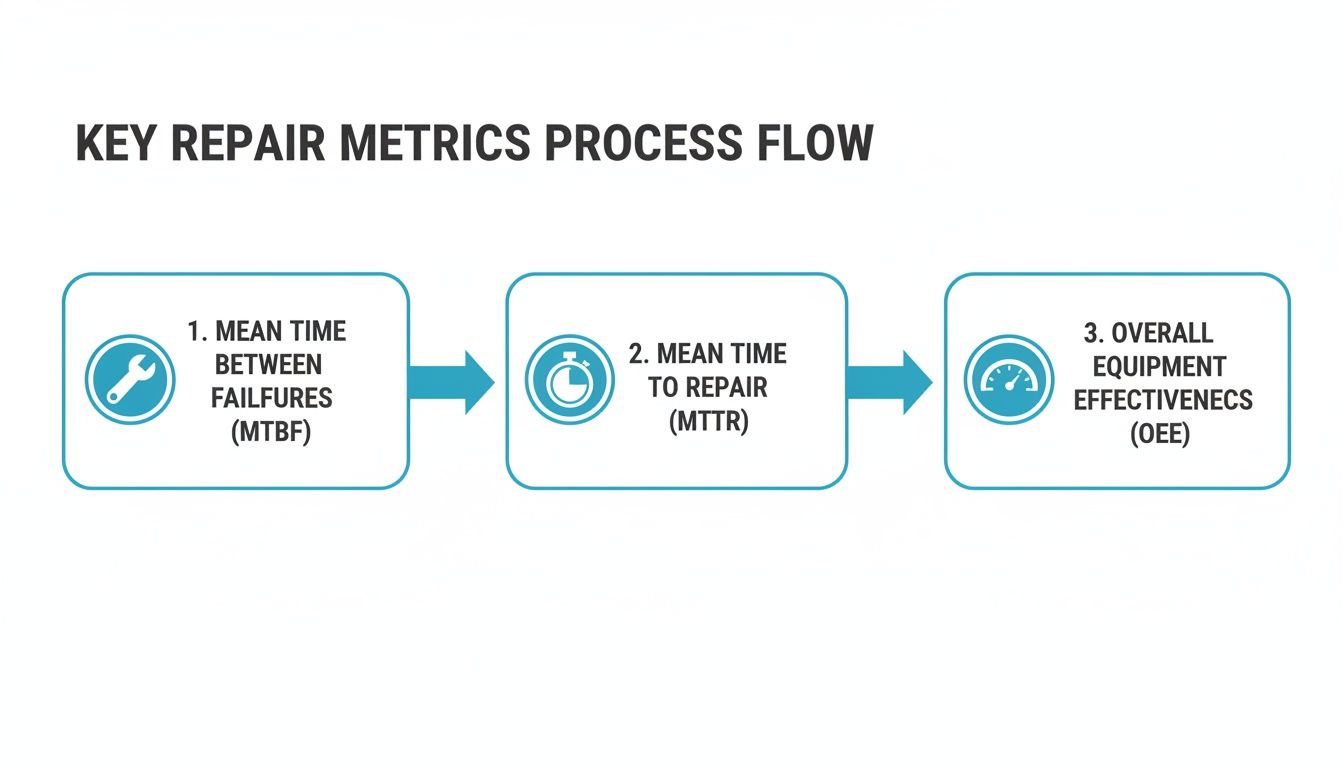
Tracking these core numbers lets you see exactly how your new strategies are impacting equipment reliability, repair speed, and overall productivity. It's about turning gut feelings into hard evidence.
Stage 3: Training and Change Management
Great tech is only half the battle; your people are the other half. Getting your technicians up to speed on the new tools and processes is absolutely essential. Before you even think about training, it’s smart to conduct a thorough training needs assessment to pinpoint skill gaps and build a program that actually addresses them.
At the same time, you have to manage the human side of this change. Be upfront about why this is happening. Explain how these new tools will make their jobs easier, safer, and more valuable. If you can get your team on board and excited, adoption will be a breeze.
Stage 4: Scaling and Continuous Improvement
Once your pilot has proven its worth, it's time to go big. Take what you learned from the pilot and create a standardized plan to roll out the solution to other critical assets across the facility. And the market is ready for it. The industrial maintenance services sector, already valued at over $58 billion, is expected to climb to nearly $77 billion in the next five years, driven by exactly this kind of modernization.
But implementation is never really "done." The data flowing from your new systems is a goldmine. Use it to constantly refine your maintenance strategy, get feedback from your team, and always be on the lookout for new ways to optimize. This cycle of measuring and improving is what turns a good maintenance program into a powerful strategic advantage for the business.
Have Questions? We Have Answers
Diving into modern industrial repair, especially with new tech in the mix, naturally brings up a few questions. Let's tackle some of the most common ones we hear from operations and maintenance leaders. Think of this as a quick-start guide to clearing up the practical side of things.
Where Do I Start If I Want to Move from Reactive to Preventive Maintenance?
The best first move is a simple but powerful one: audit your most critical assets. Pinpoint the machinery that would bring your operations to a grinding halt if it went down.
Once you have that shortlist, pull up the manufacturer's recommendations for upkeep and build a basic maintenance calendar. Starting small and focusing on your high-impact equipment makes the transition feel less overwhelming. It also lets you rack up some quick wins, building momentum before you roll the program out to the entire facility.
How Can We Justify the Cost of AR Remote Assistance Tools?
Building the business case for AR comes down to one thing: Return on Investment (ROI). Start by adding up what you’re currently spending on expert travel—flights, hotels, meals, and all the productive hours they lose just getting from Point A to Point B.
Then, you can map out the savings. Imagine your top expert solving problems at three different sites in the time it used to take them to travel to just one. The math starts to look pretty good, fast.
The real kicker is the dramatic drop in Mean Time To Repair (MTTR). When you solve problems faster, you slash downtime. That means more production, more revenue, and an argument that gets any leadership team to listen.
Don’t forget to highlight that faster repairs mean more uptime and a direct boost to your operational output. It's a powerful story to tell.
Is Predictive Maintenance Only an Option for Huge Corporations?
Not anymore. It’s true that early predictive maintenance (PdM) systems were incredibly expensive and complex, putting them out of reach for most. But that’s changed completely. The cost of IoT sensors has plummeted, and user-friendly, cloud-based analytics platforms have made PdM a real possibility for small and medium-sized businesses.
You can start smart by launching a pilot project on a single, critical piece of equipment. Using affordable sensors to track key indicators like vibration or temperature, you can prove the value and show a clear ROI before you even think about a larger-scale rollout. This low-risk approach puts advanced industrial repair within reach for just about anyone.
Ready to see how AR and VR can reshape your maintenance and training programs? AIDAR Solutions provides immersive tools that cut expert travel costs by up to 75% and get your team up to speed faster. Discover our solutions today.