How to Increase Manufacturing Productivity and Boost Output
To achieve a significant boost in manufacturing productivity, the first step is to identify the root causes of inefficiency. This involves more than meeting daily targets; it requires a thorough diagnosis of the hidden friction within your equipment, processes, and workforce. This deep analysis is the essential foundation for any meaningful improvement.
Finding the Real Source of Production Drag
Every plant manager aims for a factory floor that operates with perfect efficiency. The reality, however, often includes unexpected stoppages, delays, and hidden costs that erode output. The common reaction is to invest in new machinery or software, but this approach often fails to address the underlying issues.
To make a real impact, you must begin with a comprehensive assessment of your current operations to find the true source of production drag.
This process is not about assigning blame but about systematically identifying the constraints that limit your system's potential. It is analogous to a doctor performing diagnostics before prescribing treatment; a precise diagnosis is crucial for an effective solution.
Moving Beyond Surface-Level Metrics
Initial performance data can be misleading. A production line might meet its quota, but at what cost? Is it sustained by excessive overtime, high scrap rates, or frequent micro-stoppages that are not captured in daily reports?
To understand the complete picture, you need to dig deeper and establish a clear baseline. Start by tracking key operational efficiency metrics.
Focus your initial investigation on these areas:
- Dive into Production Data: Analyze historical performance logs to identify patterns. Does one machine consistently fail on a specific day? Do quality issues increase during a particular shift? Are product changeovers taking longer than scheduled? The data will reveal critical insights.
- Map Your Value Stream: Walk the factory floor and map every step of the production process, from raw material delivery to final shipment. This exercise effectively exposes non-value-added activities, such as unnecessary movement, waiting periods, and redundant quality checks.
- Talk to Your Frontline Team: Your operators and technicians possess invaluable information. They work with these processes daily and can identify small, persistent problems that data may not capture. Direct conversations can provide practical insights that are often missed in formal reports.
A common mistake is focusing solely on a single, obvious bottleneck. Often, a series of smaller, interconnected issues creates a cumulative drag on productivity, which is far more detrimental in the long run.
Uncovering Hidden Inefficiencies
Once you begin your investigation, you will likely find that problems fall into several common categories. While a machine may be a physical bottleneck, its underperformance could be due to an outdated process or a skills gap within the team.
For example, a CNC machine might appear to be the slow point in a process. However, a closer look may reveal that technicians spend 20 minutes searching for the correct tool before each job. In this case, the workflow is the problem, not the machine.
Similarly, a complex assembly step may be slowed by poorly written work instructions, forcing operators to rely on trial and error. These are the types of hidden inefficiencies that a thorough diagnostic process is designed to uncover.
This table highlights common symptoms observed on the factory floor and their potential underlying causes.
Common Manufacturing Bottlenecks and Their Symptoms
Use this as a quick reference to connect observations on the floor to potential root causes. It's a starting point for asking the right questions.
| Symptom | Potential Bottleneck Area | Example Diagnostic Question |
|---|---|---|
| Piles of work-in-progress (WIP) inventory | Downstream Process (e.g., Assembly, Finishing) | "Why is finished component inventory building up before the final assembly station?" |
| Upstream stations are frequently idle | Upstream Process (e.g., Materials Handling, Cutting) | "What's causing our cutting machines to wait so long for raw materials?" |
| High overtime hours in one department | Specific Machine or Manual Process | "Which specific task is forcing the packaging team to stay late three times a week?" |
| Frequent "micro-stoppages" or slowdowns | Machine Maintenance or Operator Skill Gap | "Is this machine jamming because it needs a new part, or does the operator need more training on setups?" |
| Consistently missed shipping deadlines | Entire Value Stream (e.g., Scheduling, QA) | "Where in the entire process, from order to shipment, are we losing the most time?" |
This diagnostic work provides a clear, data-backed understanding of your starting point and is essential for transitioning toward a smart factory. The evidence is compelling: firms that adopt advanced technologies have seen output-per-hour increase by 10% to 25% compared to those that have not, according to findings from the U.S. Bureau of Labor Statistics.
This foundational work ensures that any future investments—whether in processes, people, or technology—are targeted at the problems that will deliver the greatest impact.
Streamlining Operations with Lean and Automation
Once you've diagnosed what's holding your production back, the next phase is to actively streamline your operations. This involves a dual approach that combines the proven principles of lean manufacturing with the power of smart automation.
Together, these strategies create a system that is both highly efficient and resilient.
Lean manufacturing is a philosophy centered on the relentless elimination of waste. It empowers your team to view the production floor as a value stream where every step must directly contribute to the final product. Any activity that does not add value is a candidate for removal.
The process for identifying these drags on production is straightforward.
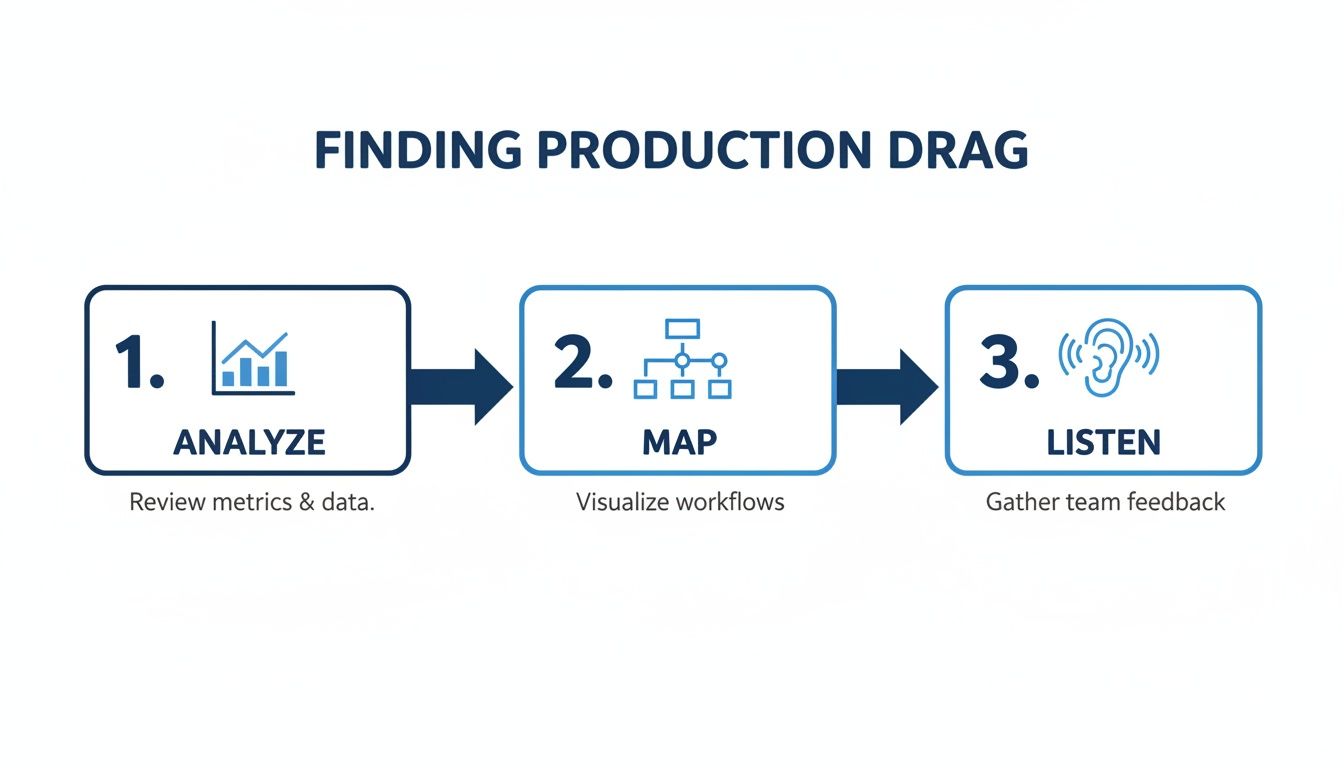
This cycle—analyzing data, mapping the workflow, and listening to your team—is the core of any successful lean initiative and provides a clear path to sustainable improvements.
Embracing Core Lean Principles on the Floor
Implementing lean principles does not require a complete facility shutdown. It begins with adopting a mindset of continuous improvement, or Kaizen, and applying practical tools to identify and eliminate the "eight wastes of lean" (often remembered by the acronym DOWNTIME).
These wastes include everything from overproduction to unnecessary movement of people or materials. The goal is to make these inefficiencies visible so they can be systematically addressed.
An effective starting point is the 5S methodology, a simple framework for creating a clean, organized, and high-performing workspace.
- Sort (Seiri): Remove all unnecessary tools, parts, and instructions from the workstation.
- Set in Order (Seiton): Arrange essential items logically for easy access and use.
- Shine (Seiso): Clean the workspace and equipment regularly to help identify potential issues like leaks or cracks early.
- Standardize (Seiketsu): Create clear, visual standards to ensure tasks are performed correctly and consistently.
- Sustain (Shitsuke): Make 5S a habit through regular audits and team involvement to maintain discipline.
A common error is treating 5S as a one-time cleaning event. True success comes from sustaining the discipline, transforming a chaotic workspace into a finely tuned environment where problems are easily identified.
Pairing Lean Processes with Smart Automation
While lean principles optimize human-driven processes, strategic automation is the ideal partner for handling repetitive, high-volume tasks prone to human error.
Automation should be viewed not as a replacement for employees but as a tool that frees them to focus on higher-value activities like problem-solving and quality control. For a closer look, you can explore the details in our guide on process automation in manufacturing and its benefits.
Capital investment and capacity utilization strategies are critical here. Smart investments in automation can directly increase output. For instance, if a factory increases its productive capital (such as robotics or new tooling) to raise the capital per worker by 20%, it can expect to see a 5–15% increase in output per worker over the next few years. These gains are derived from the more efficient use of new equipment.
However, productivity improvements must outpace rising input costs to lower the cost per unit. This balance highlights the need for strategic capital spending on modernization.
Here are a few practical ways to integrate automation:
- Robotics for Repetitive Tasks: Deploy collaborative robots (cobots) for monotonous jobs like machine tending, packaging, or simple assembly, freeing skilled operators for more complex work.
- IoT for Predictive Maintenance: Install sensors on critical equipment to monitor performance in real-time. This data can predict failures before they occur, allowing for proactive maintenance scheduling instead of reactive, costly breakdowns.
- Data Analytics for Performance Insights: Use software to collect and analyze production data. This provides a live view of Overall Equipment Effectiveness (OEE) and helps pinpoint bottlenecks as they emerge.
By combining the waste-elimination focus of lean with the precision of automation, you can build a powerful, optimized production system.
Empowering Your Workforce with Immersive Training
Technology and lean processes are force multipliers, but the true engine of any manufacturing operation is its people. The skill, confidence, and adaptability of your team are what differentiate you from the competition. Investing in your workforce is the most direct and sustainable path to achieving significant productivity gains.
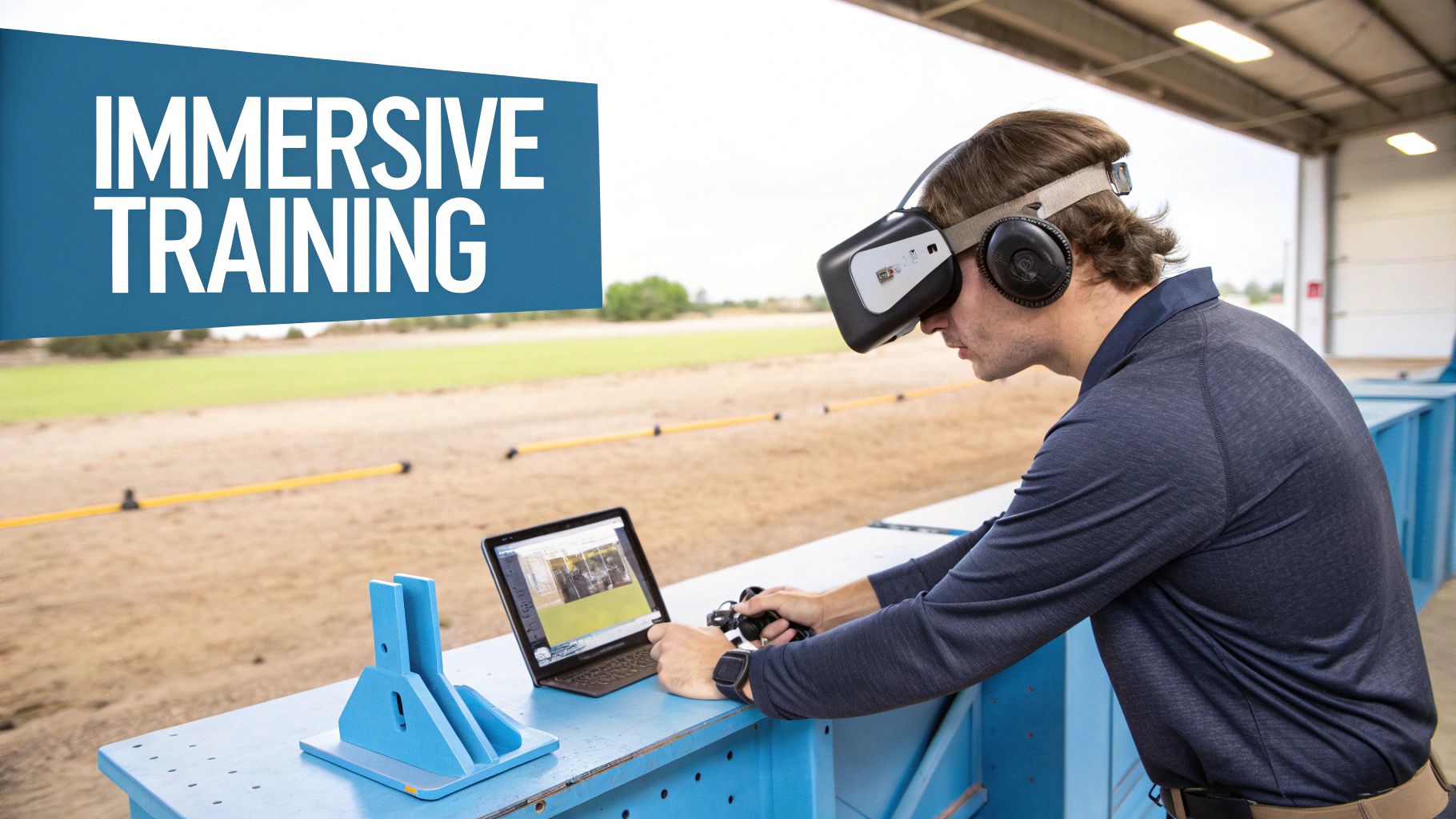
Immersive technologies like Augmented Reality (AR) and Virtual Reality (VR) are transforming workforce training. They provide a means to accelerate learning, reduce error rates, and enhance on-the-job efficiency in ways that traditional methods cannot.
Creating Experts with Virtual Reality Simulators
Traditional training methods, such as shadowing veteran employees or reading dense manuals, are often slow and result in inconsistent knowledge transfer. Virtual Reality changes this by creating hyper-realistic, safe training environments where employees can learn by doing.
For instance, a new hire can learn to operate a complex CNC machine in a VR simulation without occupying expensive equipment or risking a production stoppage. They can make mistakes, receive instant feedback, and repeat procedures until they achieve proficiency—all without using raw materials or requiring a senior operator's time.
The benefits of this approach are immediate and substantial:
- Drastically Reduced Onboarding Time: Trainees develop muscle memory and procedural knowledge much faster in a focused, repeatable virtual environment.
- Minimized Risk and Costly Errors: Mistakes are made in the simulation, not on the production floor, preventing equipment damage and material waste.
- Standardized, High-Quality Training: Every employee receives the same high-quality training, ensuring consistency and adherence to best practices from the start.
The key advantage of VR training is the confidence it builds. When an operator begins work on the factory floor after VR training, they are not just theoretically prepared—they have already performed the job dozens of times. This confidence translates directly into a higher first-pass yield and fewer errors.
Providing Instant Guidance with Augmented Reality
While VR is ideal for off-the-floor training, Augmented Reality excels by delivering digital intelligence directly to the frontline worker at the point of need. AR solutions can overlay digital work instructions, checklists, and 3D diagrams onto an employee’s real-world view of the equipment they are using.
Consider an operator performing a complex assembly or a maintenance technician executing a changeover. Instead of looking away to consult a manual, they can see the next step highlighted in their field of view through AR glasses. This contextual guidance significantly improves efficiency and accuracy. In fact, using augmented reality for training to improve on-the-job performance has become a major focus for forward-thinking manufacturers.
This approach effectively equips every team member with expert knowledge, eliminating the time lost to searching for information and reducing hesitation.
Comparing Traditional Training with AR/VR Training
To highlight the difference, let's compare immersive solutions with conventional methods. This table outlines the key advantages of adopting AR/VR training in a manufacturing context.
| Metric | Traditional Training Methods | Immersive AR/VR Training |
|---|---|---|
| Learning Retention | Low to moderate; relies on memorization and note-taking. | High; kinesthetic learning ("learning by doing") builds strong recall. |
| Error Rate | Higher initial error rates on live equipment as trainees learn. | Significantly lower; mistakes are made and corrected in a safe environment. |
| Resource Usage | Consumes raw materials, machine time, and senior employee supervision. | Minimal; uses no physical materials and frees up senior staff. |
| Safety | Poses potential risks to both trainees and live production equipment. | 100% safe; all training is conducted in a controlled virtual space. |
| Scalability | Difficult to scale; requires one-on-one time with experienced mentors. | Easily scalable; one simulation can be deployed to hundreds of employees. |
The advantages are clear and translate directly to the bottom line.
Workforce strategies focused on upskilling can increase manufacturing productivity by 5–20 percent. When these efforts are combined with digital tools like AR and VR, the synergy produces faster and larger productivity gains than focusing on technology or training alone.
To maximize these benefits, strong leadership is essential to guide the change. Investing in programs like executive coaching and leadership training to build high-performing teams ensures your managers have the skills to drive this new culture. When you invest in both your frontline team's skills and your leaders' capabilities, you create a powerful, top-to-bottom culture of efficiency.
Bring Your Experts to the Frontline, Instantly
Every minute a machine is idle, it costs money and directly impacts the bottom line. For some automotive manufacturers, an hour of downtime can cost as much as $2.3 million. Even for smaller operations, the principle is the same: when equipment stops, output ceases, deadlines are missed, and profit margins shrink.
The traditional solution—flying in a senior engineer—is slow and expensive, making it impractical in a fast-paced environment.
Augmented Reality (AR) offers a powerful and immediate solution. It eliminates the distance between your on-site technicians and your most experienced experts, creating a nimble maintenance operation that keeps production lines running.
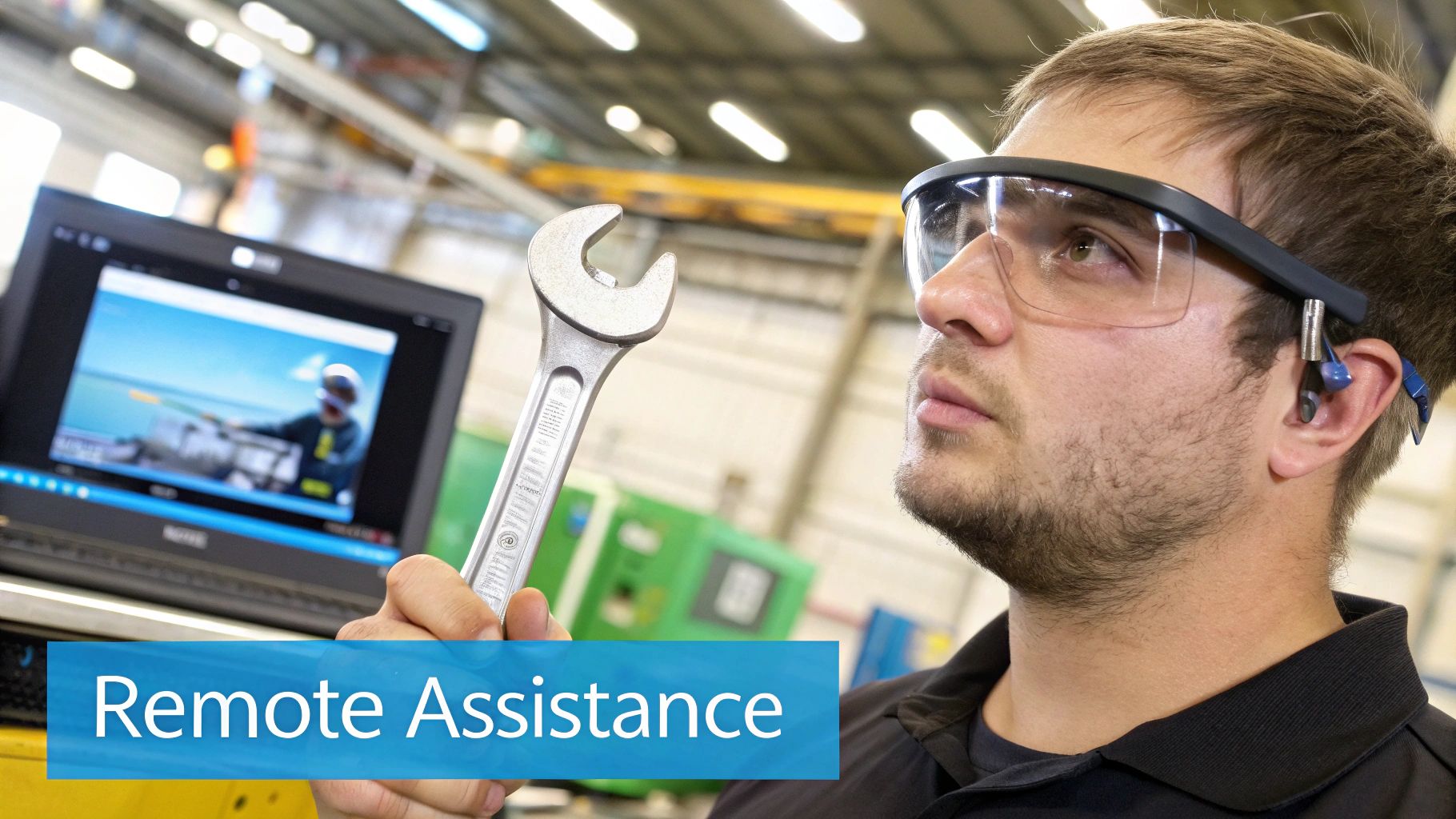
Imagine a critical machine on your production line stops, displaying an unfamiliar error code. Your on-site technician is skilled but has never encountered this issue. Instead of waiting days for a specialist to travel, the technician simply puts on a pair of AR glasses.
Bridge the Knowledge Gap in Real-Time
With a simple voice command, the technician starts a live video call, streaming their exact point-of-view to a senior engineer who could be hundreds of miles away. The remote expert sees precisely what the technician sees. This "see-what-I-see" capability is the core of effective remote support.
The expert can then guide the repair with remarkable precision. This is more than a phone call; they can visually add information directly into the technician's real-world view.
Here’s how it works in practice:
- Live Annotations: The expert can freeze the technician's view and draw digital arrows or circles to identify the exact component that needs attention. This eliminates ambiguity.
- Document Sharing: If a schematic is needed, the expert can display it in the technician's field of vision, ensuring they follow the correct procedure.
- 3D Model Overlays: For a complex repair, the expert can overlay a 3D digital model of a part onto the physical machine, showing exactly how components should be assembled.
The true value of AR remote assistance extends beyond faster problem resolution. It also serves as an on-the-job training tool, transferring high-level knowledge directly to your frontline team with every guided repair.
This immediate access to expertise transforms your entire maintenance workflow. The significant costs and delays associated with travel are eliminated. Problems that once took days to resolve can now be solved in hours, or even minutes. This has a direct and substantial impact on shortening your mean-time-to-repair (MTTR)—a critical metric for any manufacturing facility.
The Real-World Business Impact of AR Support
Integrating this technology into your operations does more than improve productivity; it builds a more resilient and efficient foundation for your entire facility. The benefits are clear and impact everything from your budget to your team's skill set. When you implement a system of augmented reality remote assistance, you will see real, measurable improvements.
Your best experts are no longer a bottleneck. They become a force multiplier, available to support any technician, at any plant, at a moment's notice. This creates a more agile and responsive maintenance team, capable of tackling any challenge without disrupting the production schedule.
Any productivity initiative is only as good as the results it delivers. To gain buy-in for your projects and cultivate a culture of continuous improvement, you need a clear, data-driven way to measure the impact of your changes. This is not about guesswork; it's about demonstrating tangible value with a clear return on investment (ROI).
The first step is to move beyond subjective assessments and focus on the key performance indicators (KPIs) that truly matter on the factory floor. These metrics provide an objective snapshot of your performance before and after a change, arming you with the hard data needed to build a compelling business case.
Defining Your Core Productivity KPIs
To measure success accurately, you must track the right data. While every facility is unique, a few core KPIs serve as a universal language for performance. Establishing these provides a solid foundation for understanding your operational health.
Three of the most powerful metrics are:
-
Overall Equipment Effectiveness (OEE): This is the gold standard for measuring manufacturing productivity. It combines three critical factors—Availability (uptime), Performance (speed), and Quality (good parts)—into a single percentage. It reveals how much of your planned production time is genuinely productive. While world-class operations achieve around 85%, many plants operate closer to 60%, indicating a significant amount of hidden capacity waiting to be unlocked.
-
First-Pass Yield (FPY): This simple yet powerful metric measures the percentage of products that are manufactured correctly the first time, without needing rework or being scrapped. A high FPY reflects a stable, high-quality process. Improving it reduces waste in materials, labor, and machine time.
-
Cycle Time: This is the total time required to produce one unit, from the start of the process to the end. Reducing cycle time is the most direct way to increase throughput and meet customer demand faster. It compels you to identify and eliminate every bottleneck in your value stream.
By tracking these KPIs before implementing a new process or technology, you establish a clear baseline. After the change is implemented, you measure them again to quantify the exact improvement.
Calculating the ROI of New Technologies
Calculating the ROI for a simple process improvement can be straightforward. However, for technology investments like AR and VR, the process involves connecting the technology's benefits directly to tangible cost savings and efficiency gains. You are not just buying a tool; you are investing in better outcomes.
Let’s walk through how to calculate the ROI for an AR remote assistance tool.
-
Calculate Cost Savings from Reduced Travel:
- Before AR: Determine the number of trips your experts take annually and multiply it by the average cost per trip (flights, hotels, etc.). For example: 10 trips/year x $2,000/trip = $20,000.
- With AR: Estimate how many of these trips can be eliminated. If AR allows you to resolve 75% of issues remotely, you save $15,000 per year.
-
Quantify the Value of Increased Uptime:
- Before AR: Analyze your average Mean-Time-to-Repair (MTTR) and determine your cost of downtime per hour. For example: 4 hours MTTR x $10,000/hour downtime cost = $40,000 per incident.
- With AR: If remote guidance helps you reduce MTTR by 50% (to 2 hours), each incident now costs only $20,000. Across multiple machine failures, these savings accumulate quickly.
The true ROI of technology includes not only easily quantifiable metrics like travel costs but also "soft" benefits with hard financial impacts, such as improved worker safety, higher employee retention, and enhanced knowledge transfer across your organization.
The same principle applies to VR training. You can quantify the ROI by calculating the reduction in material waste during onboarding, tracking lower accident rates, and measuring how much faster new hires reach full competency. A safer, more skilled team contributes directly to the bottom line.
A safe and efficient workplace is a profitable one. To better understand the broader financial benefits, you can learn more about how occupational hygiene can boost your bottom line. This data-driven approach transforms spending into a strategic investment, proving that boosting manufacturing productivity is a direct path to financial health.
Your Burning Questions on Manufacturing Productivity, Answered
Embarking on a major productivity overhaul often raises challenging questions. It's one thing to have a plan on paper, but navigating real-world hurdles—from convincing the team on the floor to making the case for investing in new tools—is another matter. This section addresses the most common questions from manufacturing leaders who are ready to drive change.
This is intended to be a practical guide to help you anticipate challenges and move forward with confidence.
How Do I Get My Team to Actually Use New Tech?
Introducing new technology, especially solutions like AR or VR, can be met with skepticism. Frontline workers might perceive it as another complicated system to learn or, worse, a threat to their job security. Gaining their buy-in is the single most critical factor for success.
The key is to frame the technology as a tool that makes their jobs easier, not one that replaces them.
- Show, Don't Just Tell: Instead of discussing productivity gains in the abstract, demonstrate how AR remote assistance provides an expert's guidance in seconds, eliminating the need to wait hours for a callback. Let an operator experience how VR training allows them to master a new machine without pressure or risk, building genuine confidence.
- Create Internal Champions: Avoid a top-down approach. Identify a few respected, tech-curious team members and involve them in a pilot program. Let them test the technology and become its advocates. A positive endorsement from a trusted peer is more effective than any management directive.
- Make the Training Painless (and Hands-On): Poor training can kill adoption rates. Initial sessions must be well-structured and supportive. Once your team feels competent with the new tools, they will begin to see them as an essential part of their daily work.
A common mistake is for leaders to focus so much on ROI that they forget the people. If your team feels that new technology is being imposed on them rather than implemented for them, it is unlikely to succeed. Involve them in the process, and they will be the ones who ensure its success.
What Are the Biggest Roadblocks I Should Expect?
Anticipating potential problems is crucial. While every facility has unique challenges, a few common issues often arise when integrating advanced systems.
First is the classic problem of integrating new systems with legacy equipment. Most facilities use a mix of machinery from different eras. The key is to choose platforms designed for this reality. Start with a pilot project on a single production line to resolve integration issues before attempting a full-scale rollout.
Another potential obstacle is unreliable network connectivity. Streaming AR support and collecting real-time data from machines require a stable connection. Before implementation, conduct a thorough assessment of your Wi-Fi coverage on the factory floor. Addressing dead zones is essential.
Finally, there's the challenge of scaling a pilot program. A solution that works perfectly with a small, motivated team may not scale effectively to the entire workforce. Document everything from your pilot—successes, failures, and all feedback. This documentation will serve as a playbook for a smoother, facility-wide launch, ensuring that early success can be replicated.
Ready to see how immersive AR and VR solutions can overcome these challenges and deliver real productivity gains on your factory floor? The team at AIDAR Solutions specializes in building practical, high-impact applications for training and remote support. We will help you create a clear roadmap and prove the ROI at every step. Discover how AIDAR can transform your operations.