A Practical Guide to Automation Manufacturing Processes
When people talk about automation in manufacturing, they're really talking about using technology—everything from robotics to smart software—to get things done with less direct human input. It’s more than just swapping a person for a machine; it's a fundamental shift in how work gets done. By letting systems handle the repetitive, high-speed, or intricate tasks, you unlock huge gains in speed, precision, and consistency.
The Symphony of Modern Manufacturing
Think about the difference between a lone luthier crafting a single violin and a full orchestra playing a symphony. The luthier works sequentially, meticulously finishing one step before starting the next. It’s craftsmanship, but it’s slow.
The orchestra, on the other hand, is a masterpiece of synchronized production. Each musician has a specialized role and plays their part at the exact right moment, all guided by a conductor. This is what automation brings to the factory floor.
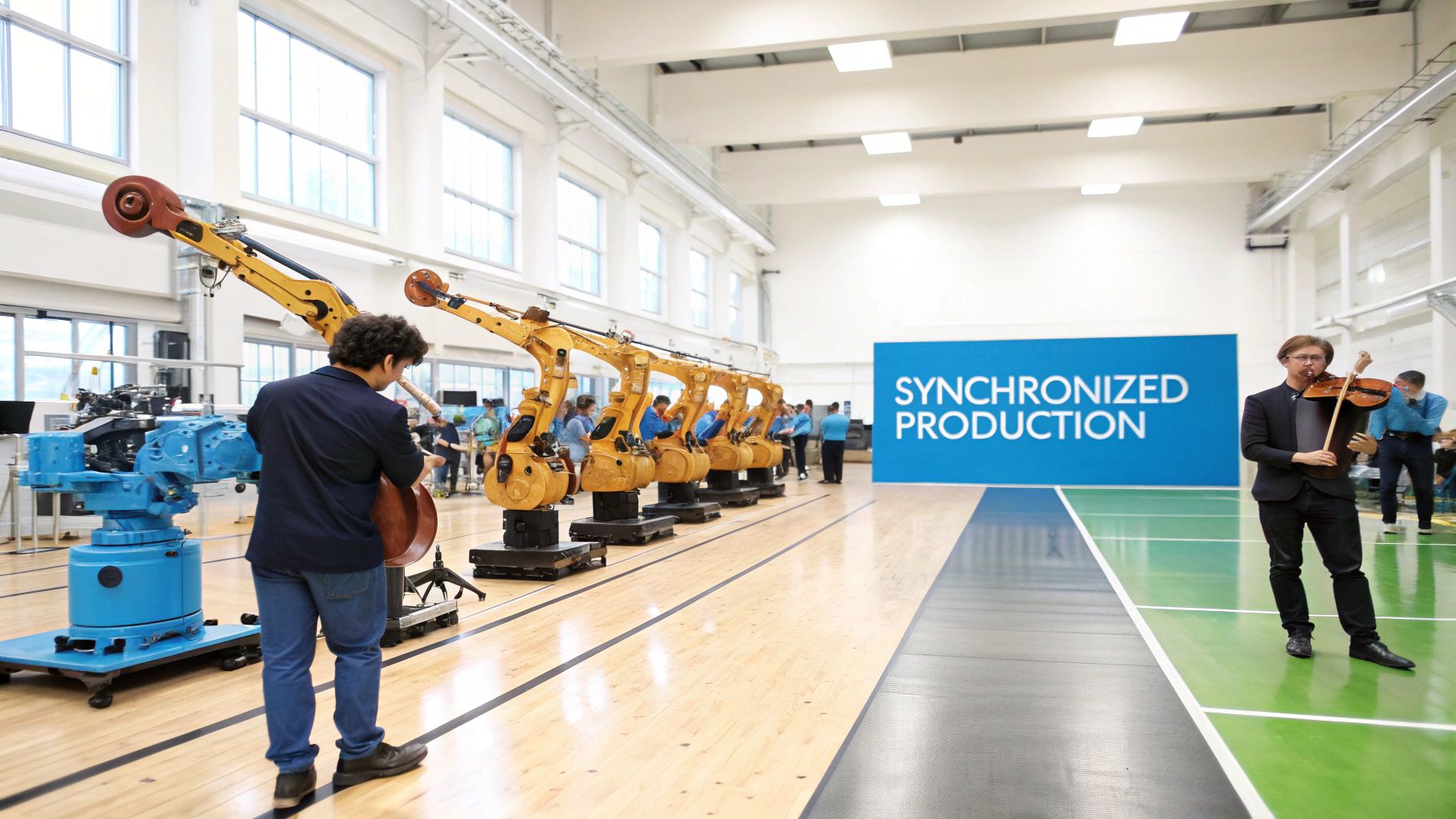
Your specialized machines, robots, and control systems are the expert musicians. The overarching automation system is the conductor, making sure every weld is made, every part is placed, and every component is assembled perfectly on cue. This symphony doesn't just play one tune; it can adapt to different compositions, which brings us to the three main types of automation.
Fixed Automation: The Master of Repetition
Fixed automation, often called "hard automation," is built for one job and one job only. It's the undisputed king of doing the same thing over and over again, flawlessly.
Picture a bottling plant that fills tens of thousands of identical soda bottles every hour. The machinery is specifically designed for that bottle size, that cap, and that liquid. It’s incredibly fast and efficient, which is why it’s the go-to for mass production where product designs don't change for years. The upfront investment is steep and it’s completely inflexible—a new bottle design means a massive, expensive overhaul. But for sheer volume, nothing beats its low per-unit cost.
Programmable Automation: Built for Batches
Next up is programmable automation, which introduces a welcome dose of versatility. Here, the equipment is designed to handle different product variations. Its actions are dictated by a software program that you can change or update.
This is the sweet spot for batch production. A factory might run 5,000 units of Product A, then re-program the machines to produce 3,000 units of a slightly different Product B. That changeover does involve some downtime while the new instructions are loaded, but it’s far cheaper than buying a whole new set of machines. You see this all the time in industries like consumer electronics, where the same assembly line might produce several different smartphone models.
Flexible Automation: Customization on Demand
Finally, we have flexible automation, the most agile and advanced of the trio. This is where manufacturing gets really exciting. A flexible system can switch between different products with almost zero downtime.
These systems rely on sophisticated robotics and intelligent control systems to handle a high mix of products in very small batches—sometimes as small as a single unit.
This is the kind of agility that makes things like mass customization and just-in-time production possible. A flexible line can build a red sedan, followed immediately by a blue SUV, and then a white pickup truck, all without ever stopping for a major reconfiguration.
Comparing Types of Manufacturing Automation
Choosing the right approach depends entirely on your production goals. This table breaks down the three types of automation to help you see where your operation might fit.
| Automation Type | Production Volume | Product Variety | Key Characteristic | Best For |
|---|---|---|---|---|
| Fixed Automation | Very High | Very Low | Specialized, single-purpose equipment | Mass production of a single, stable product (e.g., beverage bottling) |
| Programmable Automation | Medium to High | Low to Medium | Can be reprogrammed for new product batches | Batch production with predictable variations (e.g., electronics assembly) |
| Flexible Automation | Low to High | Very High | Highly adaptable system, minimal changeover time | High-mix, low-volume, or customized orders (e.g., modern automotive) |
Ultimately, the goal is to match the automation strategy to your business reality. Are you a high-volume producer of a single item, or do you need the agility to respond to custom orders on the fly? Answering that question is the first step toward building your own manufacturing symphony.
The Core Technologies Powering Smart Factories
Behind every slick automated process, there’s a powerful stack of hardware and software humming away in concert. This is the central nervous system, skeleton, and brain of a smart factory, turning abstract ideas about efficiency into something you can see and measure on the shop floor. Getting to know this toolkit is the first step toward picturing how automation could reshape your own operations.
At the ground level, you have Programmable Logic Controllers (PLCs). Think of a PLC as the direct foreman for a single machine or a small cell. It's a rugged, industrial-grade computer that takes sensor data and spits out commands based on a pre-set program. In short, it tells a machine precisely when to start, stop, turn, or lift. For decades, PLCs have been the reliable workhorses giving machines their marching orders.
Building on that, we have robotics. If PLCs are the foremen, industrial robots are the highly skilled, tireless workforce. They are the physical hands of automation, taking on tasks like welding, painting, assembly, and packaging with a level of precision and endurance that's simply not humanly possible. From the massive robotic arms you see on an automotive line to smaller "cobots" designed to work right alongside people, robotics brings brute strength and unwavering consistency to physical jobs.
Orchestrating the Entire Factory Floor
While PLCs and robots are great at handling specific tasks, you need a higher-level intelligence to coordinate the whole show. That's where the Manufacturing Execution System (MES) comes in. The MES is essentially the factory's brain—a software solution that monitors, tracks, and controls the entire production lifecycle, from the moment raw materials arrive until the finished goods ship out.
It connects all the individual players—the machines, workstations, and operators—to make sure the entire symphony of production runs without a hitch. An MES gives managers a real-time window into what’s happening everywhere, allowing them to optimize workflows, manage inventory on the fly, and keep quality control tight across the board.
The dashboard below gives you a feel for how complex operational data gets visualized, much like how an MES offers a single, unified view of all factory processes.
An interface like this is absolutely crucial. It’s what turns the raw data flooding in from the factory floor into actionable insights that managers and operators can actually use.
The Rise of Data-Driven Manufacturing
Modern automation is about more than just following pre-programmed instructions; it's about actively learning and adapting. The two keys to this are the Industrial Internet of Things (IIoT) and Artificial Intelligence (AI). IIoT refers to the massive network of sensors embedded in machinery, collecting a constant stream of data on everything from temperature and vibration to output rates.
This firehose of data is the fuel for AI and Machine Learning algorithms. Understanding the different AI automation functions is key, as these systems analyze the patterns in IIoT data to do some amazing things. They can predict when a machine is likely to fail, spot tiny inefficiencies in a production line, or even automatically tweak machine settings for peak performance.
This predictive capability is a total game-changer. Instead of reacting to breakdowns after they happen, manufacturers can schedule maintenance proactively, saving countless hours of unplanned downtime and squeezing more life out of their equipment.
The incredible potential here is driving massive investment. The industrial automation market is projected to hit USD 206.3 billion in 2024 and is expected to grow at a compound annual rate of 10.8%, reaching nearly USD 378.6 billion by 2030.
Empowering the Human Operator
Finally, automation isn't just about the machines. Advanced tech is also changing how people interact with these complex systems. Augmented Reality (AR) and Virtual Reality (VR), in particular, are opening up entirely new ways to handle training and support. You can explore more about the new technologies in manufacturing that are truly reshaping the industry.
For instance, Virtual Reality (VR) allows new operators to train on complex machinery in a completely safe, simulated environment. This practical benefit slashes the learning curve and eliminates the risk of a trainee damaging expensive equipment. They can practice procedures, troubleshoot virtual problems, and build muscle memory long before they ever set foot on the factory floor, ensuring they are competent and confident from day one.
How Automation Drives Real Business Results
Let's be honest—the technology behind automation is impressive, but it’s the real-world, measurable impact on the business that truly matters. Bringing automation into your facility isn't about collecting shiny new toys; it’s about driving concrete outcomes that directly boost your bottom line. These results show up everywhere: in production quality, operational speed, and, crucially, workforce safety.
One of the first and most obvious wins is a massive leap in product quality. Even the most skilled human operator gets tired. Consistency wavers, and tiny errors can creep in, compromising a finished product. Automated systems? They perform with unshakable precision, executing the exact same weld, measurement, or assembly thousands of times over without the slightest deviation. This consistency absolutely slashes defect rates and cuts down on material waste from scrapped parts.
Beyond just making things better, automation is a powerhouse for cranking up throughput. An automated line can run 24/7 without coffee breaks or shift changes, dramatically increasing the number of units a facility can pump out. This gives you the agility to meet unpredictable customer demand, shorten lead times, and scale up your entire operation without a proportional spike in labor costs.
Measuring What Matters: Key Performance Indicators
To really grasp the power of your automation efforts, you have to track the right numbers. Vague goals like "making things more efficient" won't cut it. You need hard data to prove value and justify the next round of investment. This is where Key Performance Indicators (KPIs) come in—they translate operational improvements into the language of financial and strategic wins.
The core tech of a smart factory—PLCs, robotics, and IIoT—all work in concert to churn out the data needed for this kind of deep-dive analysis.
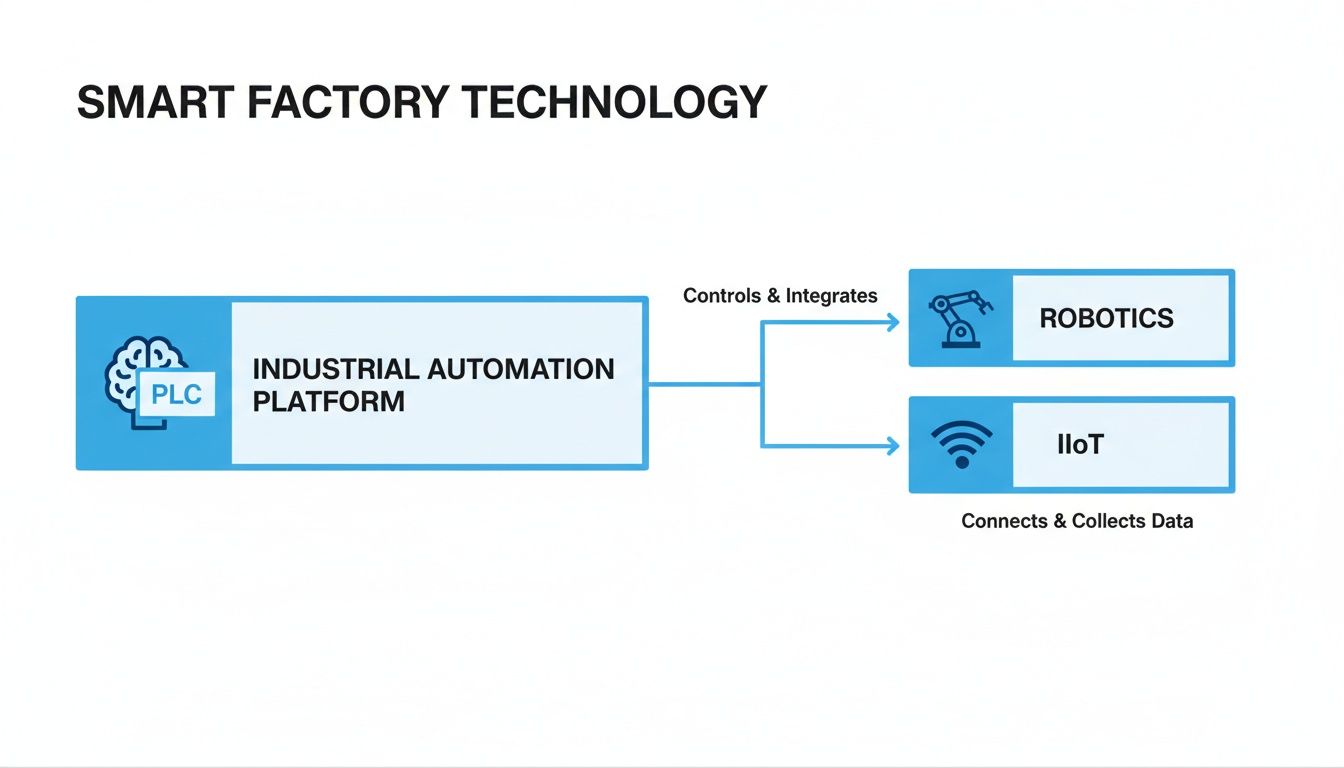
As you can see, it's an interconnected system. The control systems (PLCs) act as the brain, the robotics are the muscle, and the IIoT sensors are the nerves, all feeding information back to a central hub for precise monitoring and control.
Here are a few of the most critical KPIs for proving the success of your automation projects:
- Overall Equipment Effectiveness (OEE): This is the gold standard for measuring manufacturing productivity. It bundles availability (uptime), performance (speed), and quality (good parts) into a single, powerful score that tells you exactly how close you are to perfection.
- Scrap Rate Reduction: This one is simple and direct. By tracking the percentage of material that ends up in the bin due to defects, you can put a real number on the quality improvements automation delivers. A lower scrap rate means less money wasted.
- Cost Per Unit: This KPI breaks down the total cost to produce a single item. Automation hammers this number down by increasing throughput and slashing waste, giving you a crystal-clear picture of your financial return.
Focusing on metrics like these shifts the entire conversation. Instead of talking about the cost of the technology, you start talking about the value it creates. A 5% bump in OEE or a 20% drop in scrap rates provides the hard evidence you need to not only justify your current projects but also to champion future ones.
Tracking Automation ROI with Key KPIs
To connect the dots between automation initiatives and business outcomes, it's helpful to see which benefits link directly to which KPIs. This table breaks it down, showing how to measure the real-world impact of your investments.
| Benefit | Associated KPI | How Automation Improves It | Example Metric |
|---|---|---|---|
| Increased Throughput | Overall Equipment Effectiveness (OEE) | Robots and automated lines run 24/7 with minimal downtime, boosting the 'Availability' component of OEE. | Increase in units produced per shift from 500 to 750. |
| Improved Product Quality | Scrap Rate / First Pass Yield | Machines perform tasks with consistent precision, reducing errors and defective parts. | Reduction in scrap rate from 4% to less than 1%. |
| Lower Operating Costs | Cost Per Unit | Higher output and less waste mean the cost to produce each individual item decreases significantly. | Cost per unit drops from $1.25 to $0.95. |
| Enhanced Worker Safety | Lost Time Injury Frequency Rate (LTIFR) | Robots take over dangerous, repetitive, and physically demanding jobs, reducing human exposure to risk. | A 50% reduction in reported ergonomic injuries year-over-year. |
By tracking these metrics diligently, the return on investment becomes clear, quantifiable, and easy to communicate to stakeholders.
Creating a Safer and More Valuable Workplace
The ripple effects of automation go far beyond the balance sheet and right to the well-being of your team. Let's face it, many manufacturing jobs involve tasks that are physically brutal, mind-numbingly repetitive, or downright hazardous. Handing those duties over to robots—like lifting heavy components, working with toxic chemicals, or operating in extreme temperatures—slashes the risk of workplace injuries.
But this isn't just about improving safety stats. It frees your people from monotonous labor and opens the door for them to take on higher-value roles that require uniquely human skills like critical thinking, problem-solving, and process oversight. In an automated facility, the human role evolves from manual laborer to skilled technician and system manager. You end up with a more engaged, more capable, and ultimately more valuable workforce.
You can dive deeper into how to track these kinds of improvements by exploring various operational efficiency metrics that capture the performance of both your machines and your people.
Your Step-By-Step Automation Implementation Roadmap
So you’re ready to bring automation into your manufacturing facility. It feels like a massive undertaking, right? The key is to break it down. Instead of a giant leap, think of it as a structured journey with clear, manageable phases. A solid roadmap is what keeps you from making expensive mistakes and ensures every step you take builds on the last, guiding your project from a good idea to a full-blown success.
We can boil this entire journey down to three logical stages: Assess, Pilot, and Scale.
This phased approach is absolutely critical. It’s the bridge between knowing you need to automate and actually pulling it off. The data tells a compelling story here: while a whopping 92% of manufacturing leaders agree automation is essential for staying competitive, a mere 37% have managed to automate at scale. That’s a massive 55 percentage-point gap between strategy and reality. With 73% planning to ramp up their automation investments soon, a clear roadmap is no longer a "nice-to-have"—it's the only way to turn those plans into results, as detailed in recent industry reports on the state of manufacturing automation.
Phase 1: Assess Your Current Processes
The first move isn’t buying a single robot. It’s about getting an almost uncomfortably deep understanding of your current operations. You need to become an expert on your own shop floor to pinpoint exactly where automation will deliver the biggest, fastest wins.
Go on the hunt for tasks that are repetitive, notorious for errors, physically grueling, or just plain slow—the classic bottlenecks that everyone complains about. This is where you map everything out. Using software specifically designed to document processes is a game-changer, creating a clear blueprint of how things actually work today. This gives you a performance baseline to measure against later.
With that map in hand, you can start prioritizing. Look for opportunities that tick these boxes:
- High Potential for ROI: Where would automation deliver the most bang for your buck? Think cost savings, quality boosts, or just getting more product out the door.
- Technical Feasibility: Is the tech for this specific task mature and reliable? You don't want to be a guinea pig for unproven solutions.
- Minimal Disruption: Can you automate this piece of the puzzle without shutting down the entire production line for weeks?
Phase 2: Launch a Targeted Pilot Project
Once you've identified your prime candidate, it's time for a small-scale test run. This is your pilot project. The goal here is simple: prove the concept, learn some valuable lessons, and build momentum, all while keeping risk to an absolute minimum.
Think of a successful pilot as your best internal marketing tool. It’s a powerful case study that makes it infinitely easier to get the green light for bigger investments down the road. Your pilot needs a sharp focus with clear, measurable goals. Don't try to boil the ocean by automating a whole department. Pick one thing. Maybe it’s a single work cell or one specific task, like bringing in a cobot to handle packaging or setting up an automated quality inspection station.
Treat the pilot like a science experiment. Form a hypothesis (e.g., "Automating this task will slash cycle time by 15%"), run the test, and be obsessive about collecting data to prove it. This data-driven approach removes the guesswork and builds real confidence in the technology.
Phase 3: Scale and Optimize Your Solution
With a win from your pilot project, it's time to go big. The final phase is scaling the solution across the rest of the organization. This is where a surprising number of companies get stuck in "pilot purgatory," where great ideas never grow beyond their initial scope.
To sidestep that trap, you need a formal scaling strategy. Take everything you learned from the pilot—the good, the bad, and the ugly—and build a standardized deployment template. This plan should cover it all, from buying and integrating the equipment to training your team and updating maintenance schedules.
Scaling should be iterative, not a one-and-done rollout. Expand to the next logical production line, measure the results, fine-tune your approach, and repeat. This methodical expansion ensures each new implementation is smoother and more effective than the last, creating a cycle of continuous improvement that maximizes the return on your automation investment.
Preparing Your Workforce for The Future of Manufacturing
Rolling out new automation manufacturing processes is as much about your people as it is about the technology. A truly successful transition hangs on how well you prepare your team for this new reality, turning any fear of replacement into genuine excitement for empowerment.
This is the human side of the equation, and it demands a real strategy.
The heart of that strategy is change management. You have to build a culture where employees see automation not as a threat, but as a powerful tool. A tool that frees them from dangerous, repetitive, and frankly, boring work.
When people aren't stuck on mind-numbing manual tasks, they can step into higher-value roles that need what humans do best: critical thinking, creativity, and complex problem-solving. This shift from manual operator to system overseer is what workforce development in a smart factory is all about.
Upskilling with Immersive Technology
Let's be clear: reskilling your existing team is almost always smarter and more cost-effective than hiring from scratch. But traditional classroom training can be slow, clunky, and even risky when dealing with new, complex machinery. This is exactly where immersive technologies like Augmented and Virtual Reality (AR/VR) change the game.
VR training solutions provide a safe, controlled, and incredibly effective space for employees to learn. They can practice operating and maintaining new automated systems inside a realistic digital twin of the factory floor. They learn procedures, troubleshoot simulated problems, and build muscle memory—all without a single risk to themselves or the multi-million dollar equipment.
This hands-on approach builds skill and confidence long before the new systems are even fully installed.
By immersing teams in the new environment before it goes live, you crush the skills gap. You ensure they're ready and capable from the moment you flip the switch.
Empowering Technicians with Remote Expertise
Beyond the initial training, the right tech can make your whole team more capable and resilient. When an automated line goes down, every second of downtime is money burning. Flying in the right expert can take hours or even days, a disaster for production schedules.
AR-powered remote assistance platforms solve this instantly. A technician on the floor can use smart glasses to share their live point-of-view with a senior engineer who might be hundreds of miles away, putting an expert's eyes and hands anywhere in the world right when they are needed.
- Real-Time Guidance: The remote expert can draw digital instructions, pull up diagrams, and place notes directly into the onsite technician’s view, guiding them step-by-step through a complex fix.
- Reduced Travel: This immediately slashes the need for expert travel, saving a massive amount of time and money while shrinking your company's carbon footprint.
- Knowledge Transfer: Every single remote support call becomes a live training session, upskilling your frontline workers right there on the job.
By bringing in these powerful tools, you’re not just managing the change automation brings—you’re actively building a more skilled, adaptable, and empowered team. You can dive deeper into building a future-ready crew by exploring these effective workforce development strategies. This proactive investment in your people is the real key to unlocking everything your automation journey has to offer.
Automation in Action: From Theory to the Factory Floor
Theory and roadmaps are great for planning, but nothing drives the point home like seeing automation work its magic in the real world. Let's move past the diagrams and look at how leading companies are using automation to crush bottlenecks, solve nagging challenges, and get real, measurable results. These stories aren't just inspiring; they're templates for what’s possible.
The basic idea is refreshingly simple: find a high-impact problem and point the right technology at it. Often, this means targeting tasks that are too dangerous, mind-numbingly repetitive, or demand a level of precision that’s tough for even the most skilled human to maintain, shift after shift.
Automotive Titans Welding with Unfailing Precision
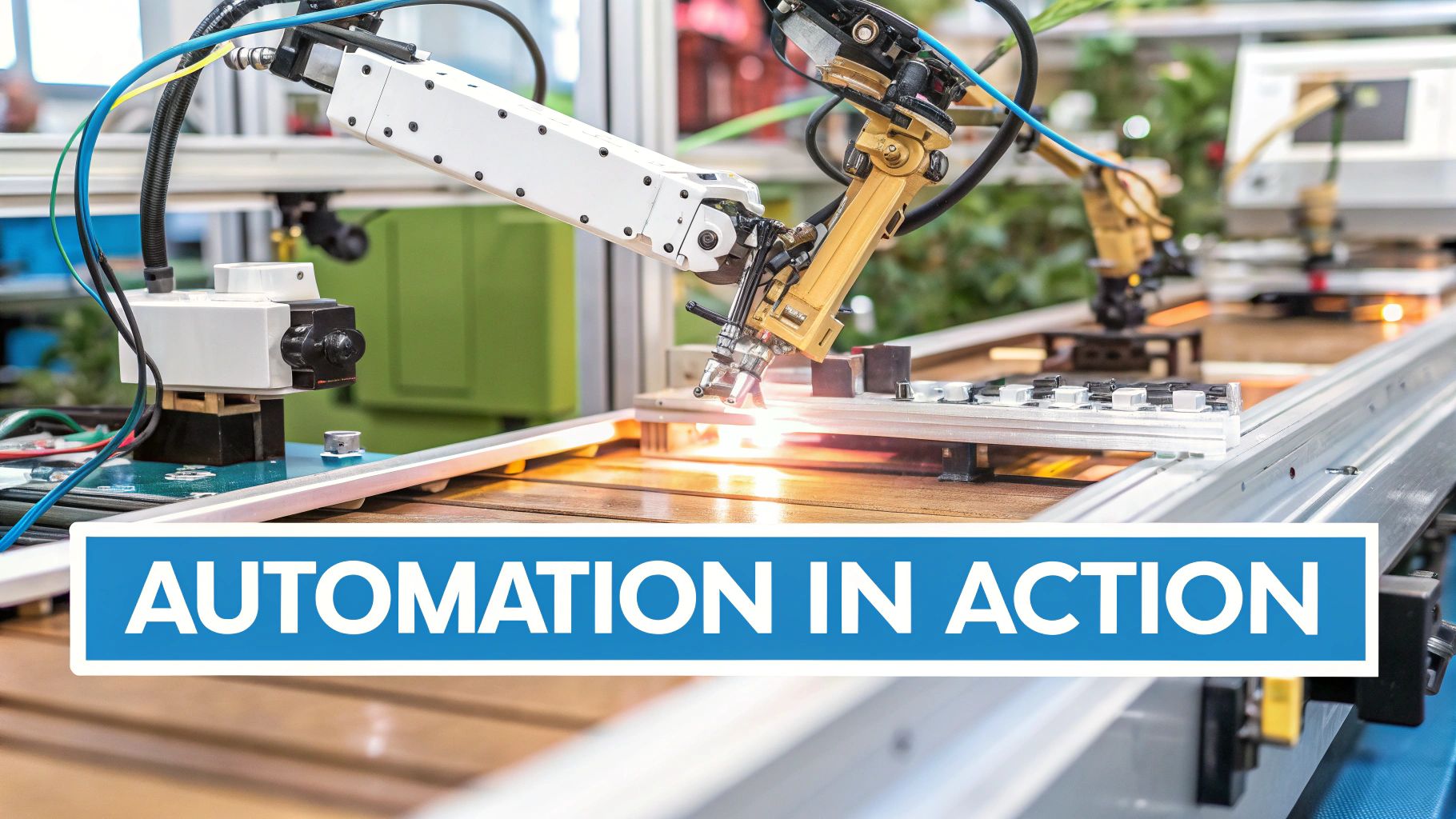
The auto industry has been playing with robots for decades, and they've gotten exceptionally good at it. Step onto a modern assembly line, and you'll see a symphony of industrial robots performing tasks like spot welding and painting with flawless accuracy.
- The Challenge: Every single weld on a car's frame has to be perfect to meet brutal safety standards. It’s a job where human fatigue can lead to tiny, yet critical, errors.
- The Automation Solution: Huge, multi-axis robotic arms are programmed to execute thousands of welds on each vehicle. They work in perfect harmony, applying the exact heat and pressure every single time, without ever getting tired.
- The Outcome: A massive drop in weld defects. This doesn't just mean a stronger, safer car; it also cranks up production speed in a big way.
Electronics Manufacturing at Blistering Speeds
When you’re dealing with microscopic components, automation isn't just a "nice to have"—it's the only way to play. Assembling a printed circuit board (PCB) is the perfect example.
A human operator could never hope to match the speed or pinpoint accuracy required. But automated "pick-and-place" machines? They can position thousands of tiny components per hour, running 24/7 without a single slip-up. This is what makes it possible to mass-produce everything from our smartphones to our laptops while keeping quality sky-high.
The real win here is the fusion of speed and quality. Automation eliminates the trade-off, letting manufacturers produce complex electronics at scale with near-perfect yields.
Getting Consumer Goods Packaged and Shipped Faster
For companies making consumer packaged goods (CPG), the final stretch is often the biggest headache. Getting products boxed, stacked on pallets, and out the door quickly is everything when it comes to meeting retail demand.
- The Challenge: Manually packing and palletizing is slow, physically punishing work that frequently gums up the entire facility's workflow.
- The Automation Solution: Companies now use collaborative robots (cobots) to work right alongside people, packing boxes at a consistent, speedy clip. From there, automated palletizers stack the boxes into perfect, stable cubes ready for shipping.
- The Outcome: Fulfillment speed goes through the roof, workplace injuries from heavy lifting plummet, and warehouse space is used far more efficiently.
These examples make one thing clear: successful automation isn't about replacing people. It's about empowering your entire operation to hit a higher gear. By automating the right tasks, companies unlock new levels of efficiency and can even layer on advanced strategies, like those in our guide to predictive maintenance in manufacturing, to keep their new robotic workforce running in peak condition.
Common Questions on Manufacturing Automation
Diving into automation brings up a lot of questions. It's only natural. Most leaders we talk to are wrestling with the same concerns about where these technologies fit and what it all means for their business. Here are some straight-talking answers to the questions we hear most often.
We’re a Smaller Company. Where Do We Even Start?
The smartest move for a small or medium-sized business is to start small. Forget the idea of a full factory overhaul. Instead, hunt down a single, high-impact bottleneck in your current process. Look for a task that’s repetitive, a headache, and prone to human error—the one thing that always seems to slow everyone else down.
Maybe it’s a manual quality check where tired eyes lead to mistakes, or a packaging station that just can't keep up. Automating that one spot with a collaborative robot or a simple sensor system gives you a perfect, contained pilot project. When that pilot delivers a clear, measurable win, you not only get a great ROI but also the hard data and momentum you need to justify the next step.
Is Automation Going to Replace Our Entire Workforce?
This is probably the biggest myth out there. The real goal of modern automation isn't about replacing people—it’s about empowering them. The strategy is to pull your team away from the jobs that are monotonous, physically draining, or just plain dangerous.
This shift frees up your people to focus on high-value work that only humans can do: critical thinking, creative problem-solving, and managing complex systems. They stop doing the work and start orchestrating it. Of course, this means you have to be serious about upskilling and retraining, turning today’s operators into tomorrow’s expert technicians.
How Do We Actually Calculate the ROI on This?
A true ROI calculation goes way beyond just looking at labor costs. To get the full picture, you have to factor in all the other operational and financial wins that automation unlocks. A solid analysis should always include:
- Increased Throughput: How many more units can you actually get out the door and sell?
- Reduced Material Waste: Put a number on the savings from a lower scrap rate and fewer bad parts.
- Improved Product Quality: What's the real cost of customer returns, warranty claims, and rework? Calculate how much you’ll save.
- Enhanced Worker Safety: Tally up the savings from fewer accidents and potentially lower insurance premiums.
When you bring all these pieces together, the financial case for automation suddenly becomes a lot stronger and a whole lot more convincing.
Ready to empower your workforce and boost operational efficiency? The experts at AIDAR Solutions can design an immersive AR/VR training and support strategy that prepares your team for the future of manufacturing. Explore our solutions today.