
A Guide to Virtual Reality Training Software
For decades, corporate training has run on a predictable script: slideshows, dense manuals, and click-through quizzes. While these methods can check a box, they often fall short when it comes to building real, practical skills.
The result? Low engagement, poor retention, and a team that isn't fully prepared for the complex challenges they'll face on the job.
Moving Beyond Traditional Employee Training
The core problem has always been the gap between knowing something and doing it. Traditional training is like reading a book about how to fly a plane—it gives you the theory, but it doesn't prepare you for the cockpit.
This is where virtual reality training software changes the game. It is the flight simulator. It lets you practice, make mistakes, and build muscle memory, all without any of the real-world consequences.
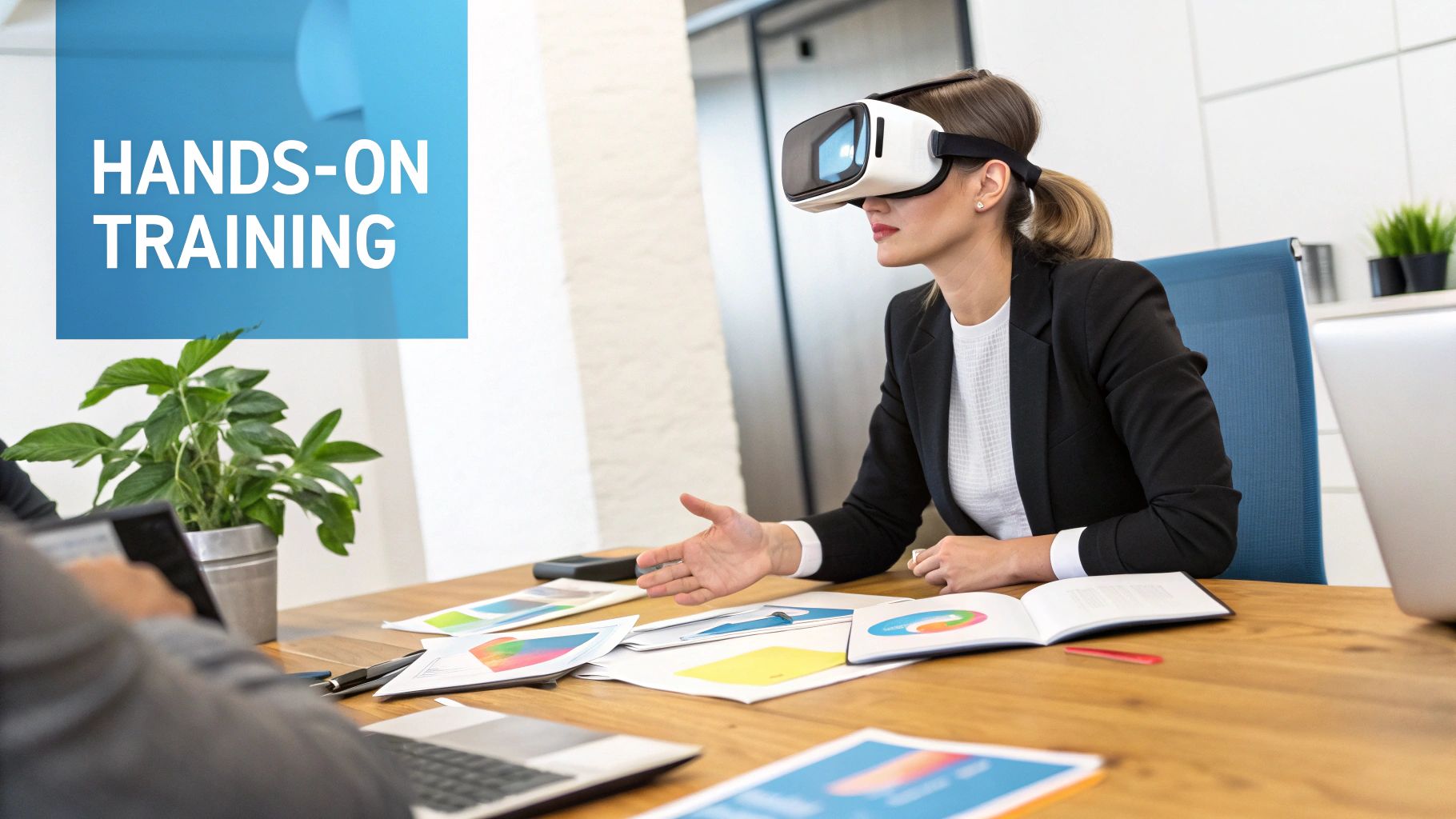
From Passive Learning to Active Doing
This move from passive listening to active doing is critical. By placing employees into realistic, interactive scenarios, VR turns them from an audience into participants.
This hands-on approach is the heart of immersive learning, and it ensures that skills aren't just memorized—they're deeply understood and can be applied with confidence. We dive deeper into this concept in our guide explaining what is immersive learning.
The numbers back this up. Research shows that VR training can boost learning effectiveness by about 76% over conventional methods. Trainees often finish courses up to four times faster and report a staggering 275% increase in confidence when it's time to use their new skills.
On top of that, 95% of participants in VR-based soft skills training felt better prepared for workplace interactions, showing a clear and measurable return on the investment.
Building Competence in a Risk-Free World
One of the greatest benefits of VR training is its ability to create a safe space for failure. Employees can practice high-stakes tasks—like operating heavy machinery, performing a delicate medical procedure, or navigating a challenging customer conversation—without any risk to themselves, others, or company property.
This risk-free environment encourages people to experiment and repeat tasks until they get them right. Instead of fearing mistakes, learners see them as a core part of the growth process.
Ultimately, this method cultivates a workforce that isn't just knowledgeable, but truly competent. By closing the gap between theory and practice, VR training makes sure your team is ready to perform safely and effectively from day one. It's a fundamental shift in how we think about corporate education—one focused on building practical skills that drive tangible business results.
What Exactly Is Virtual Reality Training Software?
So, what are we really talking about when we say virtual reality training software? Think of it less as a piece of software and more like a digital practice field where your team can learn, experiment, and master skills without any real-world consequences. This is not just about putting on a headset and watching a 360-degree video. This is a fully interactive, simulated world built to mirror real job scenarios in detail.
The key difference is active participation. Instead of just watching how a task is done, trainees are physically doing it. They can pick up virtual tools, operate complex machinery, or navigate tricky conversations with AI-powered avatars. This hands-on approach builds muscle memory that sticks, making the transition from training to the actual job seamless.
The Three Core Components
To deliver these immersive experiences, you need three key ingredients working in perfect harmony. It’s similar to a theatre production: you need the stage, the actors, and the director to make the show come alive. Each part is essential for creating a learning scenario that feels real and gets results.
The infographic below breaks down how these three elements come together.
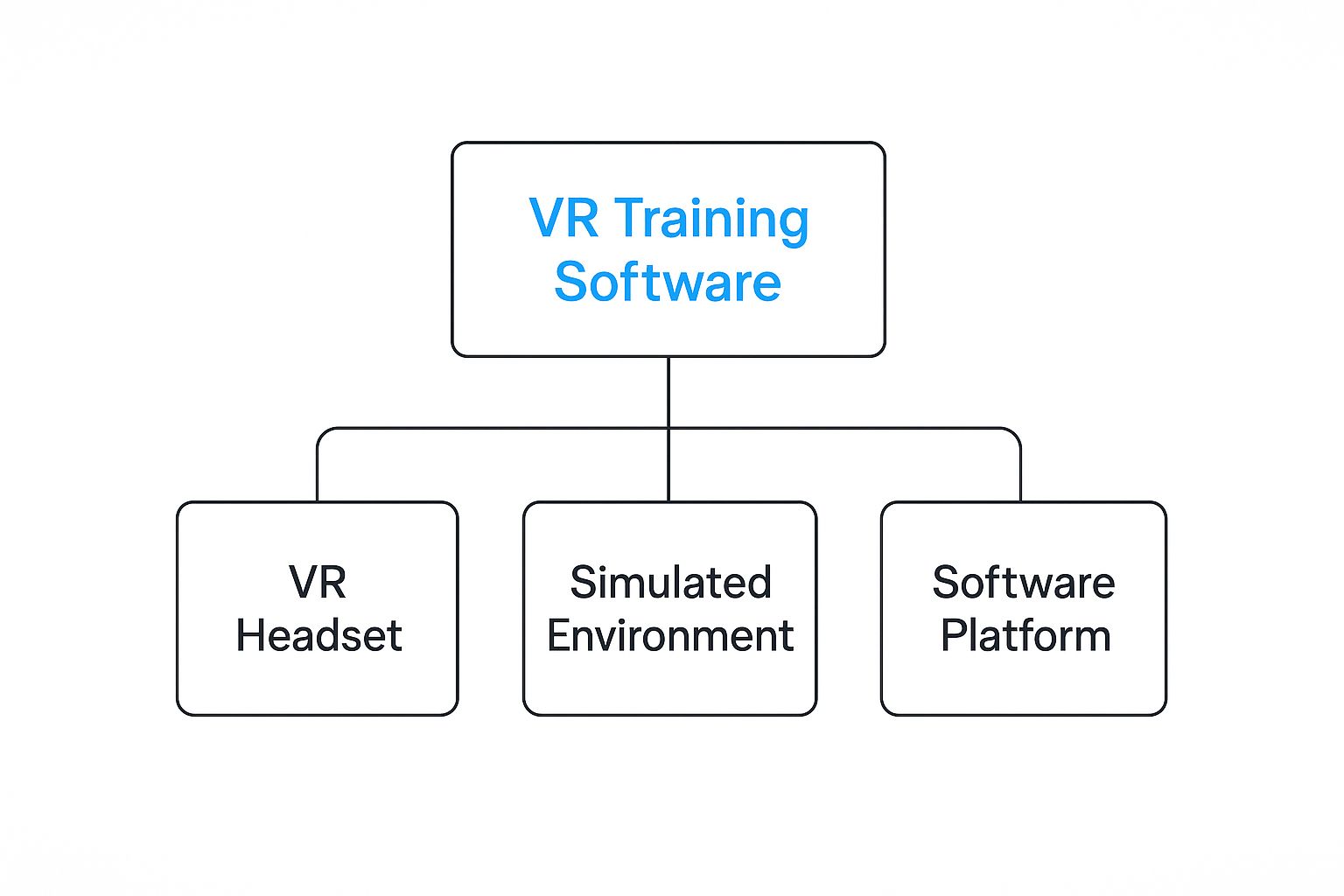
As you can see, the software platform is the central hub, connecting the hardware with the digital world to deliver a single, unified training experience.
Let's take a closer look at each piece of the puzzle:
-
The VR Headset (The Window): This is the physical gear that transports the user into the virtual world. Modern headsets do more than just display images; they track head and hand movements, letting you look around and interact with digital objects just as you would in real life. It’s your gateway to the experience.
-
The Simulated Environment (The Stage): This is the digital twin of a real workspace. It could be a bustling factory floor, a high-stakes operating room, or a customer-facing retail store. The environment is built with painstaking detail to make sure the training feels authentic and directly applicable to the user's job.
-
The Software Platform (The Director): This is the brains of the whole operation. The platform runs the training modules, tracks every action the user takes, offers instant feedback, and collects data for later analysis. This is what transforms the experience from a technology demonstration into a powerful, measurable training tool. If you want to dive deeper, we have a whole guide on what is virtual reality training.
The Power of Integration
These three components are impressive on their own, but the real advantage is realized when they’re integrated seamlessly. Businesses are catching on, which is why the market is expanding. The global immersive training market was valued at USD 16.4 billion in 2024 and is expected to grow to USD 69.6 billion by 2030. VR is leading the charge, claiming about 46% of the market share thanks to its incredibly engaging nature.
The true value of virtual reality training software is its ability to create a feedback loop. Trainees act, the system measures their performance, and it provides immediate feedback, allowing for rapid skill development in a controlled setting.
While VR provides the immersive front-end, it often plugs into a company's broader learning ecosystem. Integrating with a robust LMS website development helps manage the entire learning journey, from VR modules to traditional e-learning. This gives organizations a complete picture of employee development, creating a powerful platform for building a world-class workforce.
What Makes a Great VR Training Platform?
Not all virtual reality training software is the same. There is a significant difference between a simple 360-degree video and a powerful, enterprise-grade simulation that actually builds skills. The difference lies in a specific set of features—these are the engines that turn a virtual environment from a novelty into a high-impact training tool.
Without these capabilities, the experience is passive and won't build the real-world competence your business needs. Understanding what to look for provides a clear checklist for selecting the right platform. A solid piece of software doesn't just immerse a user; it must actively guide, measure, and sharpen their performance.
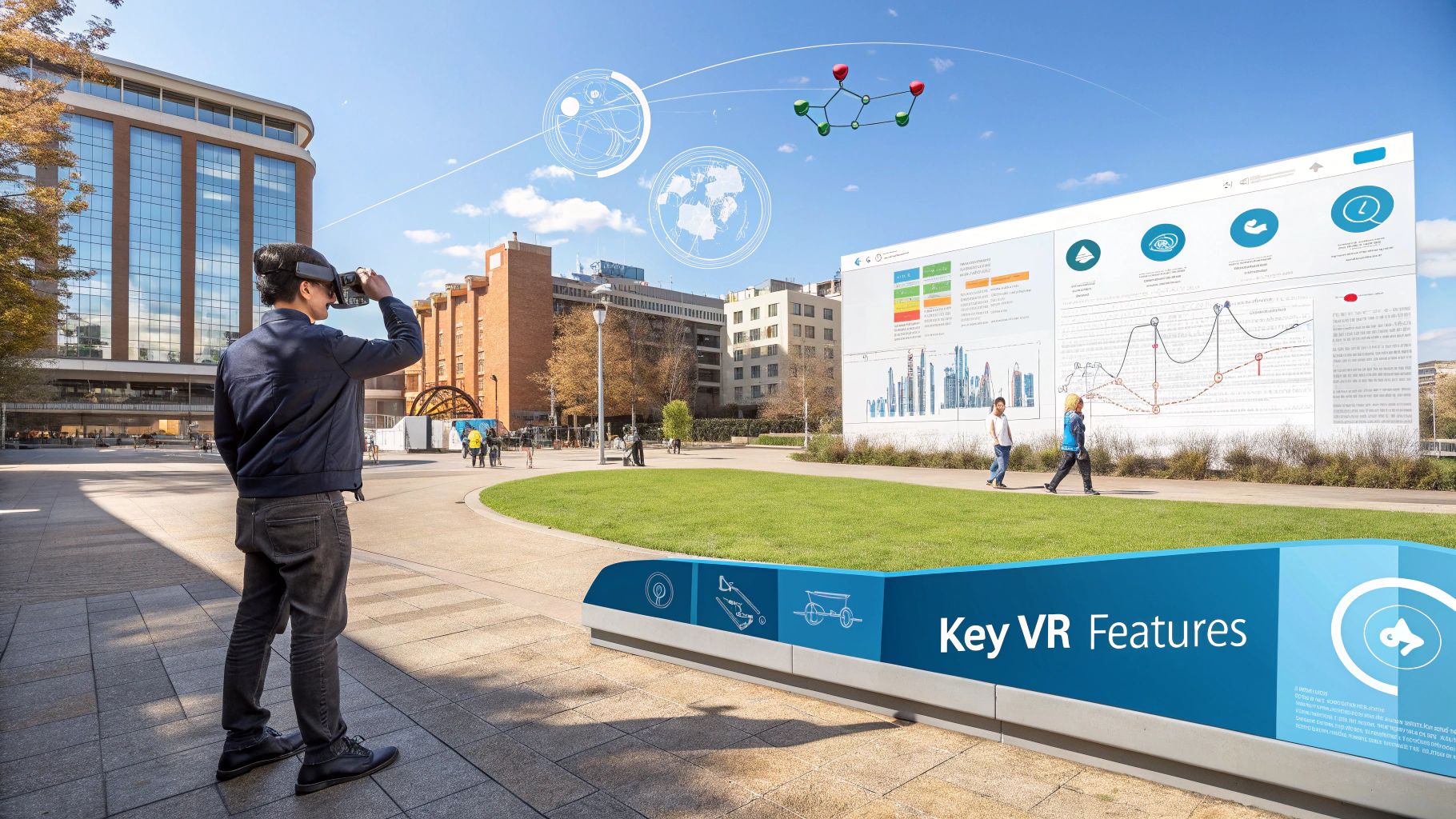
When you're evaluating different options, you'll want to dig into the specifics. The table below breaks down the must-have features of any enterprise-level VR training software and, more importantly, why they matter for your team.
Essential Features of Enterprise VR Training Software
| Feature | Description | Primary Benefit |
|---|---|---|
| Realistic Scenario Authoring | Tools to build and customize complex, multi-step scenarios that mirror real job tasks, including variables and unexpected problems. | Enables direct skill transfer from the virtual world to the workplace by creating true-to-life practice environments. |
| Interactive Object Manipulation | The ability for users to pick up, inspect, and use virtual objects with realistic physics and haptic feedback. | Builds muscle memory and deep procedural understanding through hands-on practice that passive observation can’t replicate. |
| Performance Analytics | Systems that capture and analyze every user action, tracking metrics like completion time, error rates, gaze, and hesitation. | Provides objective, data-driven insights into performance, revealing specific skill gaps for targeted coaching. |
| Multi-User Collaboration | Allows multiple users to enter the same simulation from different locations to practice teamwork and communication as avatars. | Builds team cohesion and coordinated response skills in a shared, risk-free environment without logistical hassles. |
Think of these features as the non-negotiables. They are the building blocks that allow for realistic practice, objective measurement, and scalable deployment across your entire organization.
Deeper Dive into the Core Features
Realistic Scenario Authoring
This is the bedrock of effective VR training. It's about creating and tweaking scenarios that perfectly mirror what your employees do every day. We're not talking about generic templates here. A great platform lets trainers build out complex, multi-step procedures, introduce variables, and simulate the exact problems people face on the job.
For an electrician, a scenario shouldn't just be about connecting wires. It needs to involve diagnosing a fault, selecting the right tools from a virtual kit, and adhering to precise safety protocols. When you can author these kinds of detailed, true-to-life situations, the training becomes immediately useful back in the real world.
Interactive Object Manipulation
Real learning happens by doing, not just watching. This means trainees need to be able to pick up, inspect, and use virtual objects just like they would in real life. The best software delivers realistic physics and haptic feedback, making every interaction feel natural.
Picture a manufacturing trainee learning to assemble a complex machine. They need to be able to grab individual parts, feel the subtle buzz of a power tool, and see what happens when a component is fitted incorrectly. This direct, hands-on manipulation is what builds crucial muscle memory and a deep understanding of the process.
The goal of interaction isn't just to keep people engaged; it's to build cognitive and motor skills. When a trainee’s virtual actions have realistic consequences, the learning sticks, leading to fewer mistakes on the job.
Top-tier platforms offer a huge range of interactive options, ensuring just about any hands-on task can be copied accurately. Whether it's turning a valve or making a delicate surgical cut, the level of interactivity is a direct sign of the software's training power.
Data-Driven Performance Analytics
This might be the most powerful feature of modern virtual reality training software. It can capture and analyze every single thing a user does. Unlike traditional training where a supervisor's feedback can be subjective, VR provides hard, granular data on performance.
And it goes way beyond a simple pass or fail. Advanced analytics can track things like:
- Task Completion Time: How quickly does a trainee get through a procedure?
- Error Rates: Where are they consistently making mistakes?
- Gaze Tracking: What are they looking at? This shows their focus and situational awareness.
- Hesitation Metrics: It can even pinpoint moments of uncertainty right before a critical action.
For example, the data might show that a technician always pauses for 3.5 seconds before shutting off a specific valve in an emergency drill. That's a clear, actionable insight you can use for targeted coaching. Checking out the different virtual reality training solutions available can show you how this kind of data leads to real business improvements.
Multi-User Collaboration
Many critical jobs depend on teamwork. VR is uniquely suited to help teams practice working together in a shared virtual space. This feature lets multiple users jump into the same simulation from wherever they are, see each other as avatars, and solve a problem as a team.
Think of a surgical team rehearsing a complicated operation, coordinating their movements and communication in real time. Or a fire crew practicing an emergency response, with each member playing their specific role. This kind of collaborative practice builds team chemistry and ensures everyone is on the same page for high-stakes scenarios—all without the logistical challenge of getting everyone into the same room.
What VR Training Actually Does for Your Business
While the technology behind virtual reality training software is impressive, its real value lies in the tangible results it delivers. This isn't just about modernizing your L&D department; it's a strategic investment to make your workplace safer, more efficient, and ultimately, more profitable. When people can practice and fail in a world without consequences, the benefits stop being theoretical and start appearing on your balance sheet.
This is where the platform features connect directly to real-world wins. It builds a solid business case by delivering measurable improvements exactly where they count, whether that’s on the factory floor or at the customer service desk.
A Massive Leap in Workplace Safety
In high-risk industries, safety is paramount. VR lets your team walk through their most dangerous tasks—handling hazardous chemicals, working on high-voltage equipment, or operating heavy machinery—without a shred of physical risk.
Consider a utility company training its crew on complex power grid repairs. Instead of putting them in a live-wire situation, trainees can run through every single step in a lifelike simulation. They build muscle memory for safety protocols and learn to spot hazards instinctively, which dramatically reduces accidents when they're on the actual job.
By running teams through worst-case scenarios in a controlled digital space, you can prepare them for a wide range of situations. This proactive approach to safety doesn't just lower incident rates; it also reduces associated costs from workers' comp claims and operational downtime.
Real, Measurable Cost Savings
Traditional training can be expensive. The costs for travel, physical supplies, equipment wear-and-tear, and instructor time accumulate quickly, especially for companies with a global footprint.
- Slash Travel Expenses: A global retailer can roll out the exact same customer service training to thousands of employees across different continents without booking a single flight.
- Eliminate Material Waste: A manufacturing firm can train new welders or machinists without consuming expensive raw materials or risking damage to pricey equipment while they learn.
- Minimize Operational Downtime: Technicians can learn to fix complex machinery in a simulation, meaning you don't have to shut down a valuable production line just for training.
These savings add up to a clear and compelling ROI, turning the initial investment in a VR program into a sound financial decision. For a deeper dive into all the financial and operational upsides, check out the full breakdown of the benefits of virtual reality training.
Accelerating Employee Onboarding and Skill Development
Every business wants to shorten the time it takes for new hires to become productive. Virtual reality training software accelerates the learning curve by letting people practice their jobs repeatedly until they’ve mastered the skills.
This "learn by doing" approach helps new team members build confidence and competence far more quickly than traditional methods. A logistics company, for example, can get new forklift operators certified faster and more safely, getting them out on the warehouse floor and contributing sooner. It’s a direct line to better productivity and a more agile workforce.
The market’s explosive growth is a testament to these outcomes. The AR and VR training market is projected to skyrocket from USD 18.27 billion in 2025 to an incredible USD 600.5 billion by 2035. This growth is being fueled by industries like healthcare and defense that depend on VR to replicate hazardous environments for safe, effective training. You can see the full research on this growing market at futuremarketinsights.com.
Real-World Impact Across Major Industries
Theory is one thing, but the true impact of virtual reality training software is most evident when you see it solving actual, on-the-ground problems. This isn't a one-size-fits-all gadget; it's a precision instrument that adapts to the specific challenges of different sectors. From the factory floor to the operating room, VR is building a safer, smarter, and more efficient workforce.
Let's move past abstract benefits and look at how real companies are using immersive simulations to achieve their goals. These aren't futuristic concepts—they're practical stories of VR driving measurable results.
Manufacturing: Perfecting Complex Assembly
Imagine a factory building intricate industrial machinery. One small mistake on the assembly line can trigger costly downtime or, even worse, a serious safety incident. The traditional way of training involved having new hires shadow a seasoned professional, a slow process that often meant taking a valuable machine offline.
VR training changes that dynamic entirely. New technicians can step into a perfect digital twin of the assembly line. They can grab, place, and install every single component in the right order, and the system provides instant feedback if they miss a step.
The advantages here are huge:
- Zero Production Downtime: Training no longer interrupts operations. The real assembly line continues running at full capacity.
- Massive Error Reduction: Technicians can practice a complex assembly dozens of times, building muscle memory that translates to a staggering 90% reduction in first-time errors on the actual floor.
- Safer Learning: Trainees get comfortable handling heavy parts and mastering safety protocols without any physical risk.
Healthcare: Sharpening Surgical Precision
In the high-stakes world of surgery, there is zero margin for error. A surgeon's skill is measured in millimeters, where the smallest deviation can have life-altering consequences. For decades, practice was limited to cadavers or observation, neither of which offers repeatable, hands-on experience.
Now, a leading healthcare system is using a VR platform to let entire surgical teams rehearse complex operations together. Surgeons, nurses, and anesthesiologists all meet in a shared virtual operating room as avatars, running through their coordinated roles.
They can perform an entire procedure, from the first incision to the final stitch, identifying communication breakdowns and perfecting their teamwork in a completely risk-free space. This builds a more confident, coordinated team, which directly leads to better patient outcomes.
The simulation also captures a wealth of data, flagging moments of hesitation or tiny deviations from best practices—details that would be impossible to spot during a live surgery.
Logistics: Fast-Tracking Operator Certification
For any global logistics company, training and certifying forklift operators is a constant operational challenge. The traditional approach consumes resources: you need dedicated space, a physical forklift, and a supervisor watching every move to prevent accidents.
One such company has supplemented this with a VR simulation. Candidates are placed into a virtual warehouse filled with dynamic obstacles, tight corners, and tricky loads. The software evaluates their spatial awareness, control, and safety compliance before they ever climb into a real machine.
The results were immediate:
- Faster Certification: The time it took to get a new operator trained, certified, and working on the floor was slashed by 40%.
- Fewer Accidents: By screening out high-risk candidates early and drilling safe habits from day one, on-the-job forklift incidents dropped dramatically.
- Serious Cost Savings: The company saved significantly on fuel, equipment wear-and-tear, and the cost of damaged inventory during the training phase.
These examples make it clear: virtual reality training is no longer a novelty. It's a practical, results-driven tool that helps organizations build mastery, reduce risk, and drive operational excellence wherever it's deployed.
How to Choose the Right VR Training Partner
Selecting the right virtual reality training software isn't like buying an off-the-shelf product. It's more like entering a strategic partnership. The company you choose becomes a key player in your entire learning ecosystem, so you need to look past the feature lists and find a genuine partner.
This is about finding a provider whose technology, support, and vision align with your long-term goals. A great partner doesn’t just sell you software; they help you build a training framework that’s effective, sustainable, and delivers real results. It all starts with asking the right questions.
Assess Platform Scalability and Flexibility
Think about the bigger picture. Your training needs will grow and change. A platform that works for a small pilot group might not be suitable when you try to roll it out to a thousand employees across different continents. The solution you pick today must be ready for your tomorrow.
This is where you need to examine the underlying architecture. Is the software built to handle a large, distributed user base? Get clear answers on these points:
- Deployment Options: Can you run it on-premise for maximum data security, or is it a cloud-based SaaS model for easy access? A flexible partner should be able to offer both.
- User Management: How simple is it to add new users, create different training groups, and assign specific modules? It shouldn't require an IT degree.
- Hardware Agnosticism: Are you locked into a single headset brand, or does the software support a wide range of current and future hardware? Avoid getting stuck with outdated tech.
A platform that scales properly grows with your business, not against it.
Evaluate Content Creation and Customization
The core of any VR program is its content. You have to decide if a library of pre-built modules will meet your needs, or if you require fully custom simulations that perfectly mirror your unique machines and procedures. A good partner will help you figure this out, not just push whatever they sell.
The real game-changer is how content gets made and updated. A strong partnership should empower your own L&D team to manage and even create their own content—without needing to call in a team of developers for every little tweak.
Ask potential vendors about their content tools. Do they have a no-code or low-code authoring environment? Can your own subject matter experts jump in and build or modify training scenarios? If you do need something highly specific, how fast can they develop a custom simulation? Finding the right balance between ready-made content and full customization is crucial.
Scrutinize Integration and Support Capabilities
Your VR training software cannot be a silo. To get a complete picture of employee progress, it needs to connect smoothly with the systems you already use, especially your Learning Management System (LMS). This is non-negotiable. You need performance data from VR training to flow right back into your central employee records.
Just as important is what happens after the sale. A true partner provides more than a generic help desk. They should offer strategic guidance on implementation, help you define what success looks like, and remain available to make sure you’re getting a clear return on your investment. Before you sign anything, get a crystal-clear understanding of their support structure and their plan for your long-term success.
Common Questions About VR Training Software
When you start looking into immersive technology, a few practical questions almost always come up. Answering them helps demystify virtual reality training software and makes the path forward a lot clearer.
Getting a handle on the costs, tech requirements, and how it all fits together is the key to making an informed decision. Let's tackle the most common questions head-on.
How Much Does VR Training Software Cost?
There's no single price tag, and the investment can vary widely depending on what you need. Think of it like buying a car: a standard model will cost much less than a custom-built, high-performance vehicle designed just for you. A simple, off-the-shelf training module licensed per user is on the lower end, while a fully custom simulation that mirrors your unique machinery is a bigger investment.
So, what drives the cost?
- Content Complexity: How detailed and interactive does the virtual world need to be?
- Number of Users: Are you training a team of 10 or a workforce of 1,000?
- Hardware: You'll need to factor in the initial cost of VR headsets and the computers to run them.
- Support and Maintenance: Think of this as ongoing upkeep—fees for updates, tech support, and content management.
While there's an upfront cost, the smart approach is to look at the long-term savings. Many businesses see a fantastic return when they calculate the money saved on travel, materials, and—most importantly—costly safety incidents.
Do We Need a Dedicated Technical Team?
Not necessarily. The good news is that modern VR training software is built for learning and development professionals, not coders. Many platforms come with intuitive dashboards that let your non-technical staff manage users, assign training, and track progress with ease.
Some of the more advanced solutions even have no-code authoring tools. This puts the power directly into the hands of your own subject matter experts, letting them build or tweak training scenarios themselves. Of course, when you're choosing a partner, you'll want to make sure they have a team of experienced Virtual Reality Developers who can build a rock-solid solution that’s just right for you.
Can This Software Integrate with Our Current LMS?
Yes, and it absolutely should. Seamless integration with your existing Learning Management System (LMS) is a core feature of any serious, enterprise-level platform. It’s what keeps your training ecosystem from becoming a collection of disconnected parts.
Top-tier VR software uses industry standards like SCORM and xAPI to communicate directly with your LMS. This means all that rich performance data—completion rates, proficiency scores, detailed skill assessments—flows right back into your central system. Your VR training doesn't become a data island; it makes your overall picture of employee development even sharper.
Ready to see how immersive simulations can truly change the game for your workforce? At AIDAR Solutions, we build powerful VR training programs that deliver real, measurable results—from getting new hires up to speed faster to dramatically cutting operational risks. Discover how our solutions can work for you.


Comment(01)