What is Immersive Learning? A Guide to Transforming Employee Training
Imagine learning to be a firefighter by reading a manual. Now, picture stepping into a realistic, blazing simulation to practice extinguishing flames in a controlled environment.
That leap from theory to hands-on practice is the core of immersive learning. It is a training methodology that uses technologies like Virtual Reality (VR) and Augmented Reality (AR) to place learners directly into simulated, lifelike environments for skill development.
Redefining Learning Through Experience
Immersive learning is essentially ‘learning by doing’ elevated by technology. It effectively closes the gap between theoretical knowledge and the practical ability to perform a task under pressure.
Instead of passively consuming information from a screen or textbook, learners become active participants in realistic scenarios. This approach creates powerful, memorable training experiences, allowing employees to practice complex or high-risk skills in a completely safe, controlled space. It’s a fundamental shift from watching to doing, and it is redefining the possibilities for professional development.
By engaging learners in authentic, experiential, and often community-based environments, immersive learning fosters a deepened educational experience, heightened connection, and increased engagement.
Key Components of Immersive Training
Immersive training is not simply traditional eLearning with updated graphics. It integrates several key components that make it a uniquely effective methodology.
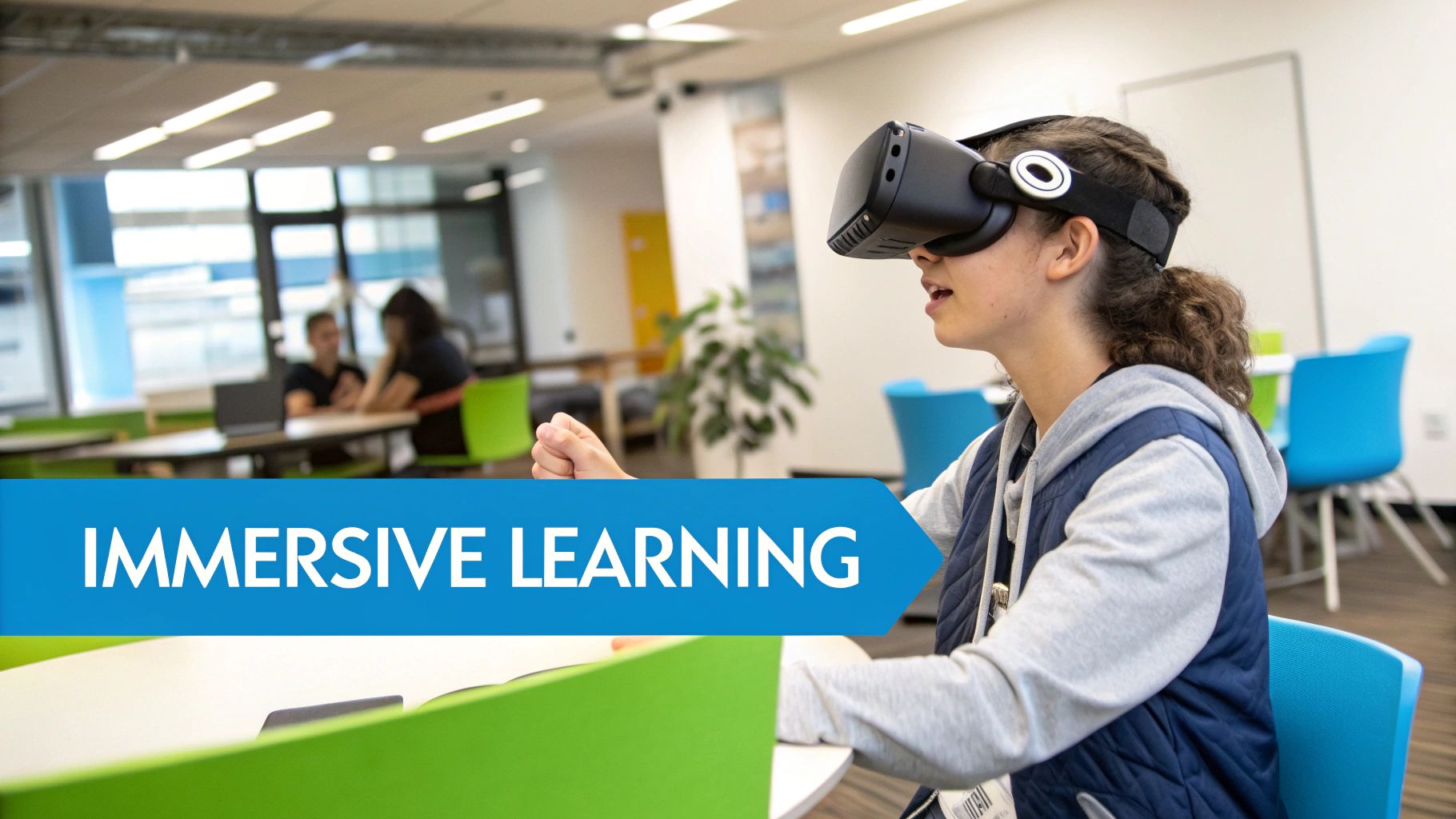
Here’s what makes it work:
- Realistic Simulations: Learners are placed in environments that replicate real-world job conditions. This can range from operating complex machinery to navigating a difficult customer service interaction.
- Active Participation: Learners are required to make decisions, perform tasks, and see the immediate consequences of their actions. This active involvement accelerates skill mastery.
- A Safe Space for Failure: Mistakes are transformed from risks into valuable learning opportunities. Trainees can practice high-stakes procedures without any real-world risk to themselves, equipment, or customers.
- Targeted Feedback: The system tracks performance, pinpoints areas for improvement, and provides immediate, data-driven feedback to guide the learner's progress.
Combining these elements helps build a more confident and competent workforce. It is an interactive approach that ensures skills are not just learned but are truly mastered. To explore practical applications, you can learn more about AR for training and its specific use cases.
Immersive Learning vs Traditional Learning
To fully appreciate the impact of immersive learning, it is useful to compare it with traditional training methods. The contrast highlights why many organizations are moving towards more experiential approaches.
| Aspect | Traditional Learning | Immersive Learning |
|---|---|---|
| Engagement | Passive (reading, listening) | Active (doing, interacting) |
| Environment | Classroom or 2D screen | Realistic 3D simulations |
| Risk Factor | Theoretical risks discussed | No real-world risk, safe to fail |
| Feedback | Delayed, often from an instructor | Immediate and data-driven |
| Retention | Lower, relies on memorization | Higher, based on experience |
| Application | Focuses on "knowing" | Focuses on "doing" |
As the table shows, the shift is from a knowledge-transfer model to a skill-mastery model. One approach tells you how to do something, while the other lets you actually do it.
The Technology Powering Immersive Experiences
The technology behind immersive learning is a suite of tools that blend the digital and physical worlds to create unique training environments. Understanding these core technologies is key to appreciating their practical applications for solving specific business challenges.
Virtual Reality (VR) completely transports a user to a different place. By wearing a headset, a learner is fully enveloped in a simulated, 360-degree digital world, blocking out external distractions. This total immersion makes VR an ideal tool for practicing high-stakes situations. For example, a surgeon can rehearse a complex operation with zero risk to a patient, or a technician can learn to operate heavy machinery in a simulated factory where mistakes are a safe part of the learning process.
Augmenting the Real World
Augmented Reality (AR) does not replace the user's world but instead adds digital layers to it. Using a smartphone, tablet, or smart glasses, AR overlays digital information—such as text, images, or 3D models—onto the real-world view. A practical use case is an engineer viewing an engine and seeing holographic repair instructions hovering over the specific parts that require service. AR is ideal for procedural guidance, remote assistance, and delivering just-in-time training directly on the job.
Finally, Mixed Reality (MR) advances this concept further by anchoring digital objects to the real world, allowing users to interact with them as if they were physically present. It represents the most seamless blend of our physical and digital realities.
The objective of these technologies is not just novelty; it is to create an intuitive and realistic experience. To be effective, these applications must adhere to solid user experience (UX) design principles to ensure interactions are engaging and logical for the user.
Each technology offers a different level of immersion, making it suitable for different tasks. The key to a successful program is matching the right technology to the specific training goal.
Measurable Benefits of Immersive Training
Beyond the technological innovation, immersive learning delivers tangible business outcomes that positively impact the bottom line. It is a strategic investment in building a more skilled, confident, and efficient workforce. The primary value lies in its ability to translate practice in a virtual world into flawless performance in the real one. For instance, a retail associate can practice handling difficult customer scenarios in VR without jeopardizing customer satisfaction or brand reputation. This is where skills are refined—in a risk-free environment.
Driving Strategic Advantages
The business case for immersive training is built on four pillars that deliver measurable results and contribute to a more capable organization.
- Drastically Improved Knowledge Retention: Learning by doing creates stronger neural pathways than passive observation. Employees remember procedures because they have physically performed them, leading to fewer errors on the job.
- Risk-Free Skill Development: High-stakes tasks can be practiced repeatedly until they become second nature. This is particularly valuable in fields like manufacturing or healthcare, where a single mistake can be costly or dangerous.
- Higher Employee Engagement: Interactive, gamified training is inherently more engaging than traditional methods like slideshow presentations. Engaged employees are more motivated to complete their training, accelerating the upskilling process.
- Scalable and Consistent Training: A single VR or AR program can be deployed to thousands of employees globally, ensuring every person receives the same high-quality training, regardless of location. Explore the benefits of virtual reality training in our detailed guide.
This shift toward hands-on, simulated learning reflects a significant market trend. The global immersive training sector, valued at approximately USD 17.9 billion in 2025, is projected to reach USD 174.9 billion by 2035. This explosive growth is driven by its proven ability to reduce costs associated with travel, materials, and operational downtime. You can discover more about the growth of the immersive training market on meticulousresearch.com.
How Industries Are Using Immersive Learning Today
The true value of immersive learning becomes evident in its real-world applications. Across various industries, companies are using AR and VR to solve tangible business problems and transform how employees acquire critical skills safely and efficiently. These are not futuristic concepts but practical applications delivering measurable results today. The rapid adoption rate of this technology underscores its effectiveness.
This chart illustrates the significant growth of immersive learning in recent years.
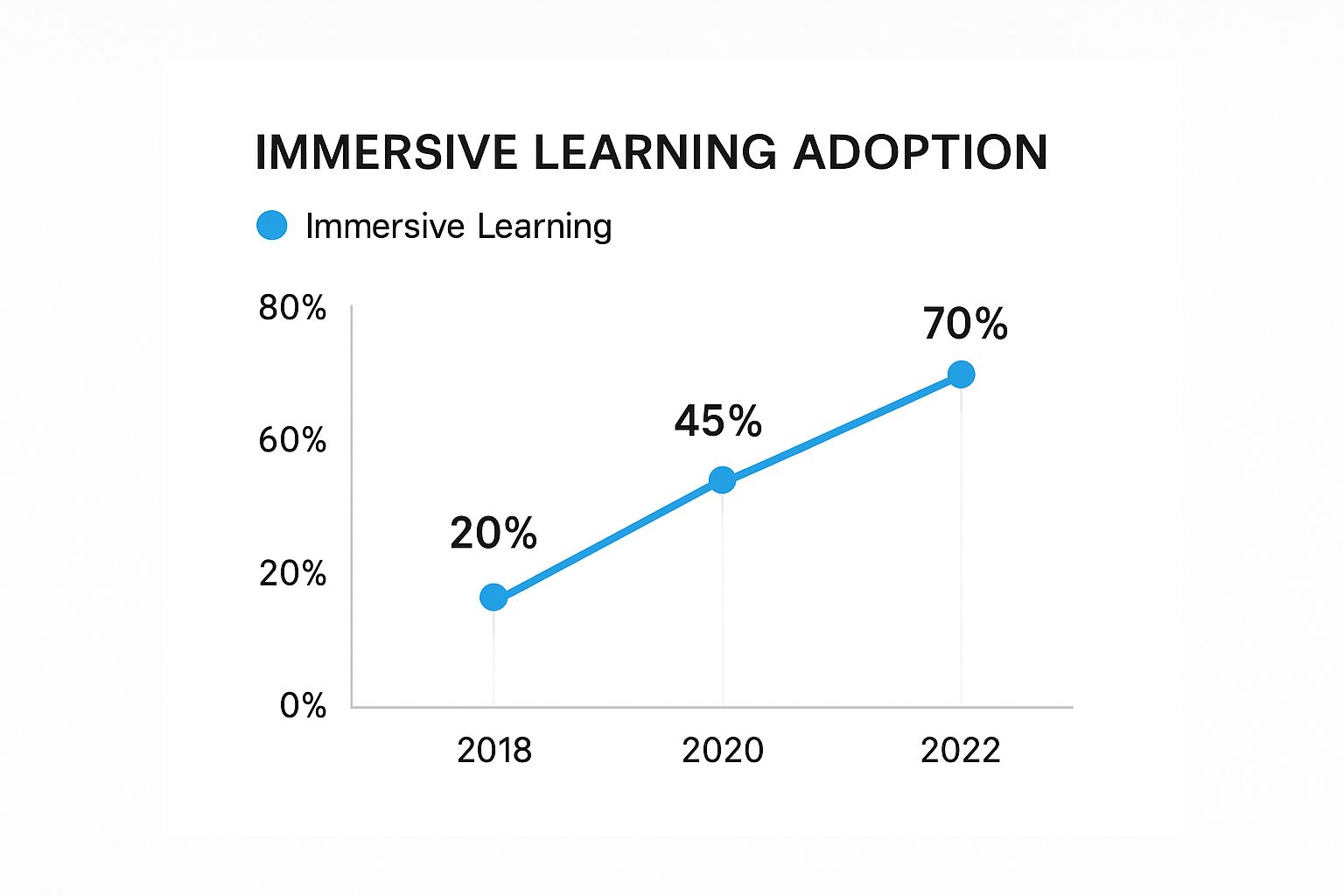
The clear upward trend shows that organizations are increasingly investing in these powerful training solutions.
Applications in High-Stakes Environments
In healthcare, this technology is transforming training for high-stakes situations. Surgeons can enter a virtual operating room to practice complex procedures repeatedly before treating a real patient. This process builds muscle memory and precision in a risk-free environment, boosting confidence and improving patient outcomes.
The manufacturing sector is realizing similar benefits. A new assembly line worker can wear AR glasses that display step-by-step digital instructions directly onto the machinery. This real-time guidance reduces errors, accelerates onboarding, and maintains quality standards without requiring constant supervision from a senior employee.
Logistics and transportation also benefit from these safe, simulated environments.
For example, forklift operators can be trained in a bustling, virtual warehouse where they learn to navigate tight spaces and handle heavy loads without any risk of damaging actual products or causing accidents.
This growth is making a significant market impact. The global virtual reality training market reached USD 9.09 billion in 2023 and is forecasted to climb to USD 28.7 billion by 2030, demonstrating its growing importance. You can explore these VR training and education statistics to see the full picture.
Immersive Learning Applications by Industry
To provide a clearer picture of its versatility, the table below breaks down how different sectors are using VR and AR to solve specific, industry-wide challenges.
| Industry | VR Use Case Example | AR Use Case Example |
|---|---|---|
| Healthcare | Surgical students practice complex operations in a simulated operating room. | A nurse uses AR glasses to see a patient's veins overlaid on their arm for easy IV placement. |
| Manufacturing | New employees train on a virtual assembly line to learn procedures without risk. | A technician sees digital maintenance instructions overlaid on a machine in real-time. |
| Construction | Workers conduct safety walkthroughs of a virtual construction site to spot hazards. | An architect uses an AR-enabled tablet to visualize a 3D building model on-site. |
| Logistics | Forklift operators navigate a busy, simulated warehouse to practice maneuvering. | A warehouse picker gets AR-guided directions in their smart glasses to find items faster. |
| Retail | Employees practice handling difficult customer scenarios with virtual avatars. | A customer uses their phone to see how a new sofa would look in their living room. |
These examples represent just a fraction of the possibilities, but they illustrate the flexibility and power of this technology when applied to real-world business needs. These practical use cases prove that immersive learning is a fundamental tool for building a more skilled, efficient, and safe workforce.
Implementing Your First Immersive Learning Program
Launching an immersive learning program is more manageable than it may seem. The most successful implementations start small, prove their value, and scale from there, rather than attempting a company-wide rollout from the outset.
The first step is to identify the areas where your team faces the greatest challenges or where mistakes are most costly or dangerous. Focus on high-stakes problems, such as complex assembly procedures or critical safety protocols. These are the areas where immersive technology can deliver the most significant and immediate impact.
Launch a Focused Pilot Program
Once a key challenge has been identified, the next step is to launch a small-scale pilot program. The goal is to test the solution, gather feedback, and build a solid business case for a larger investment. A successful pilot demonstrates the potential of the technology to key stakeholders.
Keep the pilot focused on a specific group and a clear, measurable goal.
- Define Clear Objectives: Be specific about what you want to achieve. Set measurable targets, such as "reduce onboarding time by 20%" or "decrease critical errors by 50%."
- Collect User Feedback: Engage with trainees to understand their experience. Was the simulation intuitive? Did they feel more confident afterward? This direct feedback is invaluable for refining the program.
- Track Performance Data: Analyze the data generated by the platform. Measure learning speed, decision accuracy, and overall skill improvement.
Selecting the Right Technology Partner
Choosing the right partner is as critical as the technology itself. You need a partner who understands your industry's unique challenges and can align the technology with your business goals. A strong partner will collaborate with you to define success metrics and ensure the solution integrates smoothly into your existing training ecosystem. This partnership is essential for creating an effective virtual reality training program that delivers measurable results.
The demand for these solutions is growing rapidly. The market for immersive learning technology is projected to increase from USD 52.7 billion in 2025 to USD 631.8 billion by 2035. This indicates a seismic shift toward simulation-based training. You can explore these immersive learning market insights on metatechinsights.com for more details.
The Future of Professional Development Is Immersive
Immersive learning represents a significant evolution in skill development. It marks a transition from passive learning methods—such as presentations and manuals—to active, hands-on mastery where individuals learn by doing.
This approach is quickly becoming a cornerstone of modern corporate training. The benefits are clear: higher knowledge retention, safe practice environments, and unprecedented scalability. It closes the gap between knowing something in theory and being able to execute it in practice, which builds a more confident and capable workforce.
Adopting immersive learning is no longer just an innovative option—it's a competitive necessity for organizations focused on building a resilient, highly skilled team.
Preparing for What's Next
For today's business leaders, the question is not if they should explore this technology, but where it can solve their most pressing training challenges. From reducing onboarding time to improving safety compliance, the potential applications are vast. This technology addresses issues that traditional training methods have historically struggled to solve. Reviewing the top trends in online learning shows how central these immersive methods are becoming.
Ultimately, integrating immersive solutions prepares your company and your team for long-term success. It is an investment in a future where employees can master complex skills faster and more effectively, ensuring they are ready for any challenge ahead.
Got Questions About Immersive Learning?
Adopting a new training methodology naturally raises questions. Here are answers to some of the most common inquiries from leaders considering immersive learning.
Isn't This Technology Expensive to Implement?
While there is an upfront investment in hardware and software development, the long-term return on investment (ROI) is substantial. The cost depends on the complexity of the required simulation, but savings on travel, physical training materials, and operational downtime often eclipse the initial expenditure. For example, a single VR program can train thousands of employees globally, eliminating the need for instructor travel and associated costs.
What’s the Real Difference Between VR and AR in Training?
The simplest way to differentiate them is replacement versus enhancement.
Virtual Reality (VR) completely replaces a user's surroundings with a fully simulated world. It is ideal for practicing high-stakes procedures or operating dangerous machinery in a 100% safe and controlled environment.
Augmented Reality (AR) enhances the user's real-world view by overlaying digital information. This makes it perfect for on-the-job guidance, such as displaying repair instructions directly on a piece of equipment.
How Do We Measure the Success of a Program?
Success is measured using hard data that demonstrates a direct impact on the business. Tracking the right key performance indicators (KPIs) is crucial.
Key metrics to monitor include:
- Skill Acquisition Speed: How much faster do employees master skills compared to traditional methods?
- Error Reduction: Is there a measurable decrease in on-the-job mistakes post-training?
- Employee Confidence Levels: Do post-training surveys indicate that teams feel more prepared?
- Task Completion Time: Are employees completing their work more efficiently?
By tracking these specific outcomes, you can build a clear business case that proves the value of your investment in immersive learning.
Ready to see how immersive learning can sharpen your organization's training and boost operational efficiency? AIDAR Solutions builds expert-led AR and VR applications that deliver measurable results, from faster onboarding to serious cost savings. Discover our solutions today.