
Virtual Reality Training Solutions That Drive Results
Virtual reality training is a transformative approach for building employee skills in a safe, controlled setting. It's best understood not as a game, but as a flight simulator for any profession. It effectively bridges the common gap between theoretical knowledge and practical application.
What Exactly Are Virtual Reality Training Solutions?
Consider how an individual typically learns to repair complex machinery, perform a delicate medical procedure, or handle a challenging customer complaint. The process often starts with manuals, videos, or shadowing a senior employee. There is always a significant leap between that initial learning and genuine, confident competence.
Virtual reality training solutions eliminate that leap. They immerse employees directly into a hyper-realistic, 3D simulation of their actual workspace.
Instead of merely watching or reading, trainees are actively doing. They can pick up virtual tools, operate controls, and interact with avatars just as they would on the job. This hands-on, "learning-by-doing" approach aligns with how the human brain processes and retains information. It builds strong neural pathways and muscle memory, cementing skills far more effectively than passive learning methods.
Building Skills Without Risk
Perhaps the most significant benefit is the complete removal of real-world consequences. A new manufacturing technician can practice assembling a high-value product without wasting materials or breaking expensive equipment. A medical student can perform a surgical procedure repeatedly until it becomes second nature, all without putting a single patient at risk.
This "safe space to fail" is a critical advantage. It encourages individuals to experiment and learn from their mistakes without fear, which is where the deepest learning occurs. They build real confidence alongside their competence.
Virtual reality is focused on creating experience-based learning. It moves beyond telling people what to do and instead lets them actually do it, building muscle memory for complex tasks long before they step onto the factory floor or into an operating room.
A common misconception is that VR is only for onboarding new hires. While it is highly effective for that purpose, its power extends much further. It can be used to upskill an existing team on new equipment, conduct safety certification drills, or deliver refresher courses that have a lasting impact.
To provide a clearer picture, let's compare VR training with traditional methods.
Traditional Training vs Virtual Reality Training
This table breaks down the essential differences in how people learn, engage, and maintain safety with each approach.
| Attribute | Traditional Training (Classroom, Manuals) | Virtual Reality (VR) Training |
|---|---|---|
| Learning Style | Passive (reading, listening) | Active ("learning-by-doing") |
| Knowledge Retention | Lower; typically around 20% after one week | Higher; studies show up to 75% or more |
| Engagement | Often low; can feel disconnected from the job | Extremely high; fully immersive and interactive |
| Safety | Risk of injury or equipment damage in hands-on practice | 100% risk-free simulated environment |
| Mistake Correction | Consequences can be costly or dangerous | Mistakes are safe learning opportunities |
| Scalability | Difficult and expensive to scale consistently | Highly scalable; deployable anywhere, anytime |
| Consistency | Varies by instructor and location | Perfectly consistent training for every user |
As you can see, VR isn't just a minor upgrade; it represents a fundamental shift in how organizations can prepare their people for their roles.
These sophisticated VR programs are a specialized form of employee onboarding and training software, and understanding this broader technology category helps put their role into context. Ultimately, VR delivers a scalable, consistent, and deeply engaging training experience that prepares the workforce for real-world challenges more effectively than any other method.
The Core Benefits of Immersive Learning
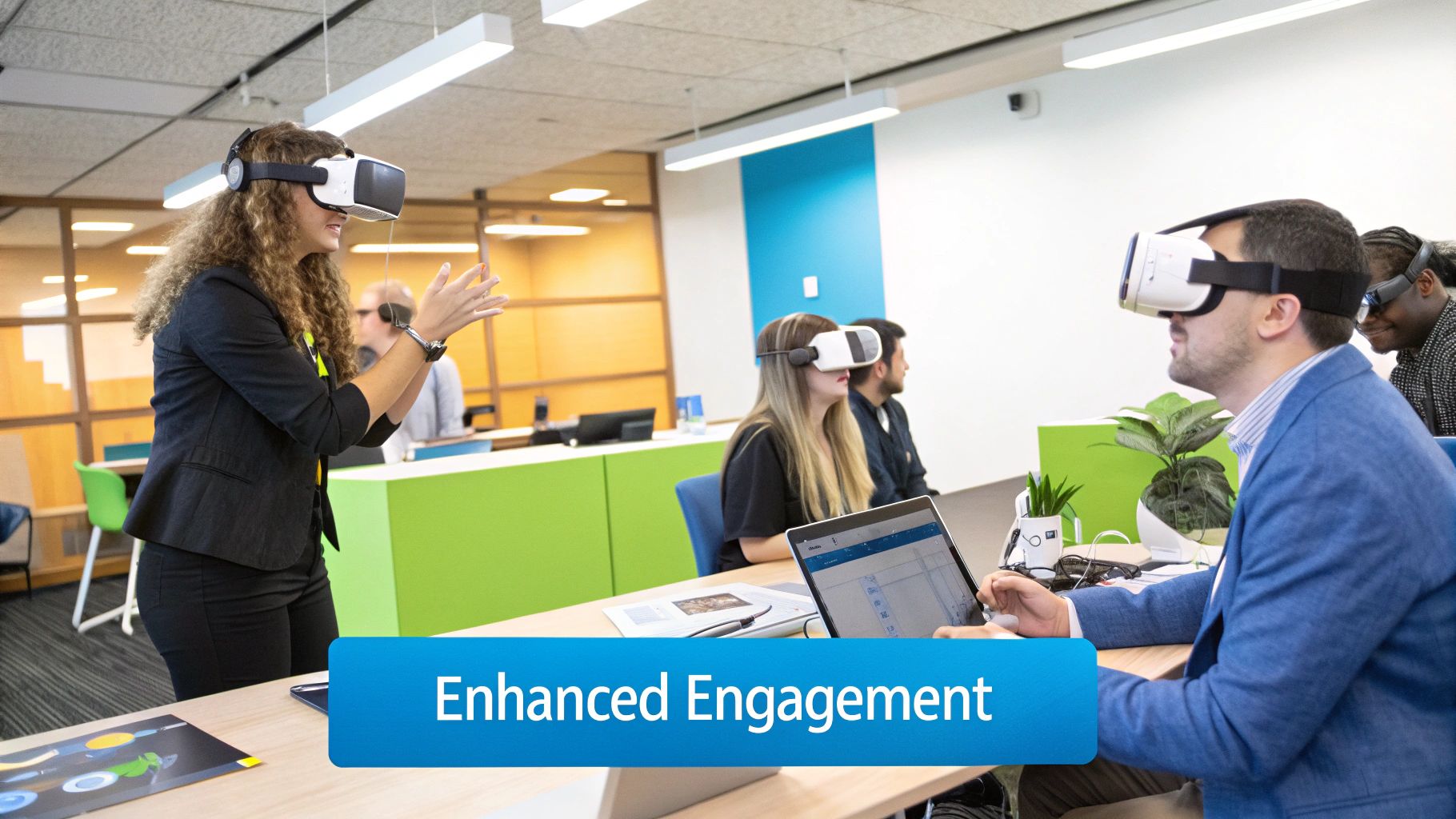
Transitioning to immersive training is more than a simple technology upgrade. It's a fundamental shift in how skills are developed. Instead of asking employees to memorize abstract concepts from a manual, virtual reality training solutions invite them to learn by doing. This hands-on approach delivers powerful, tangible benefits for the business.
The effectiveness lies in "learning by doing." When a trainee physically performs the motions of a task in a simulation, their brain retains the information far more effectively than if they had simply read about it. This process creates stronger neural pathways and muscle memory, which is why knowledge retention rates are significantly higher.
This direct engagement also accelerates learning. Data shows that employees using VR can complete training programs up to four times faster than those in a traditional classroom setting. The reason is straightforward: it’s a focused, engaging environment where every minute is spent on practical application, not just theory.
Superior Skill Acquisition and Safety
One of the most immediate advantages is providing trainees with a space to practice complex or hazardous tasks in a completely safe environment. Consider training a technician on a new piece of heavy machinery or guiding a surgeon through a rare but critical procedure.
In a VR simulation, mistakes are not costly accidents—they are valuable learning moments. A trainee can repeat a difficult step a dozen times to perfect it without damaging equipment, halting production, or causing physical harm. This "safe space to fail" builds genuine confidence and competence. You can explore these key advantages further by reading our detailed guide on the benefits of virtual reality training.
To further enhance engagement and retention, many organizations incorporate gamification strategies for eLearning. These techniques can transform training from a requirement into a compelling challenge.
Demonstrating Clear Return on Investment
Beyond improved learning outcomes, virtual reality training delivers a clear and measurable return on investment. The financial benefits come from several key areas:
- Reduced Travel Costs: Training can be deployed to employees anywhere in the world, eliminating the significant expenses of flights, hotels, and instructor fees for on-site sessions.
- Minimized Material Waste: Trainees can practice on virtual equipment without consuming raw materials or causing wear and tear on physical assets, resulting in direct cost savings.
- Fewer Workplace Accidents: Better-trained employees make fewer mistakes. This directly leads to fewer costly workplace incidents and associated insurance claims.
The impact is real and significant. Studies have shown that VR training can improve learning outcomes by approximately 76% compared to traditional methods. With the global market for VR training reaching an estimated $9.09 billion in 2023, its effectiveness is widely recognized. This combination of faster learning, enhanced safety, and substantial cost savings builds an undeniable business case for adopting immersive training.
Practical Applications Across Key Industries
The theory behind immersive learning is compelling, but its true value becomes apparent in practical application. Across a wide range of industries, virtual reality training solutions are transitioning from a novelty to an essential tool for solving real, high-stakes business problems. These are not abstract concepts—they are targeted solutions for genuine operational challenges.
Let's examine how this technology is applied in real-world scenarios. Each example highlights a company facing a specific challenge, using a VR solution, and achieving a measurable improvement.
Manufacturing and Technical Skills
Consider a busy factory floor. Shutting down an entire production line for training is incredibly costly. At the same time, new technicians must learn to operate and repair complex, expensive machinery. This is a prime use case for VR.
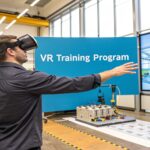
A trainee puts on a headset and is instantly transported to a perfect digital twin of the factory. They can practice a full maintenance routine—from shutdown sequences to replacing specific parts—without ever touching the real equipment. They can repeat the process until it becomes second nature, building both skill and confidence. The result is a new hire who is operationally ready from day one, which reduces downtime and eliminates the risk of costly mistakes.
Virtual reality training allows individuals to practice complex jobs as many times as necessary. It moves the learning process out of a high-risk, high-cost production environment and into a zero-risk, zero-cost virtual one. This prepares people faster without slowing down the business.
This is a game-changer in specialized fields like the automotive industry. To see more, explore how the automotive industry trains employees in virtual reality to build skills more quickly and safely.
Healthcare and Medical Procedures
In healthcare, there is zero room for error. For a surgeon, the ability to walk through a complex procedure in VR before entering the operating room is invaluable. They can familiarize themselves with a patient's specific anatomy or practice a rare surgical technique in a completely safe, risk-free environment.
This benefit extends beyond surgeons. Nurses can use simulations to improve their skills in everything from inserting an IV to responding to a cardiac arrest. They are placed in realistic scenarios and receive instant feedback on their performance, ensuring they are fully prepared to provide the best care when it matters most.
- Problem: High-stakes surgical procedures require extensive practice.
- Solution: VR simulations allow surgeons to rehearse difficult steps repeatedly.
- Outcome: Improved surgical precision and safer outcomes for patients.
Customer Service and Soft Skills
Not all critical skills involve machinery or medicine. Soft skills, such as de-escalating an angry customer, are notoriously difficult to teach in a classroom setting. Role-playing exercises often feel awkward and fail to capture the pressure of a real interaction.
Virtual reality training provides a superior alternative. A customer service agent can enter a simulation and face an AI-powered avatar playing the role of an upset customer. The agent must use their communication and problem-solving skills to guide the conversation toward a positive resolution.
The simulation can even adapt to the agent's tone of voice and word choices, creating a highly realistic training ground for building empathy and resolving conflict. This leads to more confident employees and, ultimately, higher customer satisfaction.
How to Implement a VR Training Program
Implementing virtual reality training is not about taking a leap of faith; it's about following a structured plan. A well-designed implementation roadmap is what separates a flashy tech demo from a program that delivers real, measurable business results. The process begins not with purchasing headsets, but with a careful analysis of your operational needs.
The first step is a thorough Needs Analysis. This is where you identify the specific job roles and skills that are best suited for a VR environment. Focus on tasks that are high-risk, involve expensive equipment, occur infrequently, or follow complex, multi-step procedures. A great example is how a global brand like Nestlé used VR to standardize its quality control training across different facilities. You can get the full story in our case study on Nestlé's virtual reality implementation.
Content and Platform Selection
Once you know what you need to train, the next key decision is how. You will face a choice between off-the-shelf modules and custom content.
- Off-the-shelf solutions are pre-made programs covering common skills like forklift operation or fire safety. They are quicker to implement and more budget-friendly for general training needs.
- Custom solutions are developed from the ground up to perfectly replicate your unique machinery, proprietary processes, or specific work environments. While they require a larger initial investment, they deliver training that is precisely tailored to your operations.
This phase is critical for long-term success. The right platform will not only host your content but also integrate with your existing systems.
This infographic breaks down the core stages of implementing a VR training program.
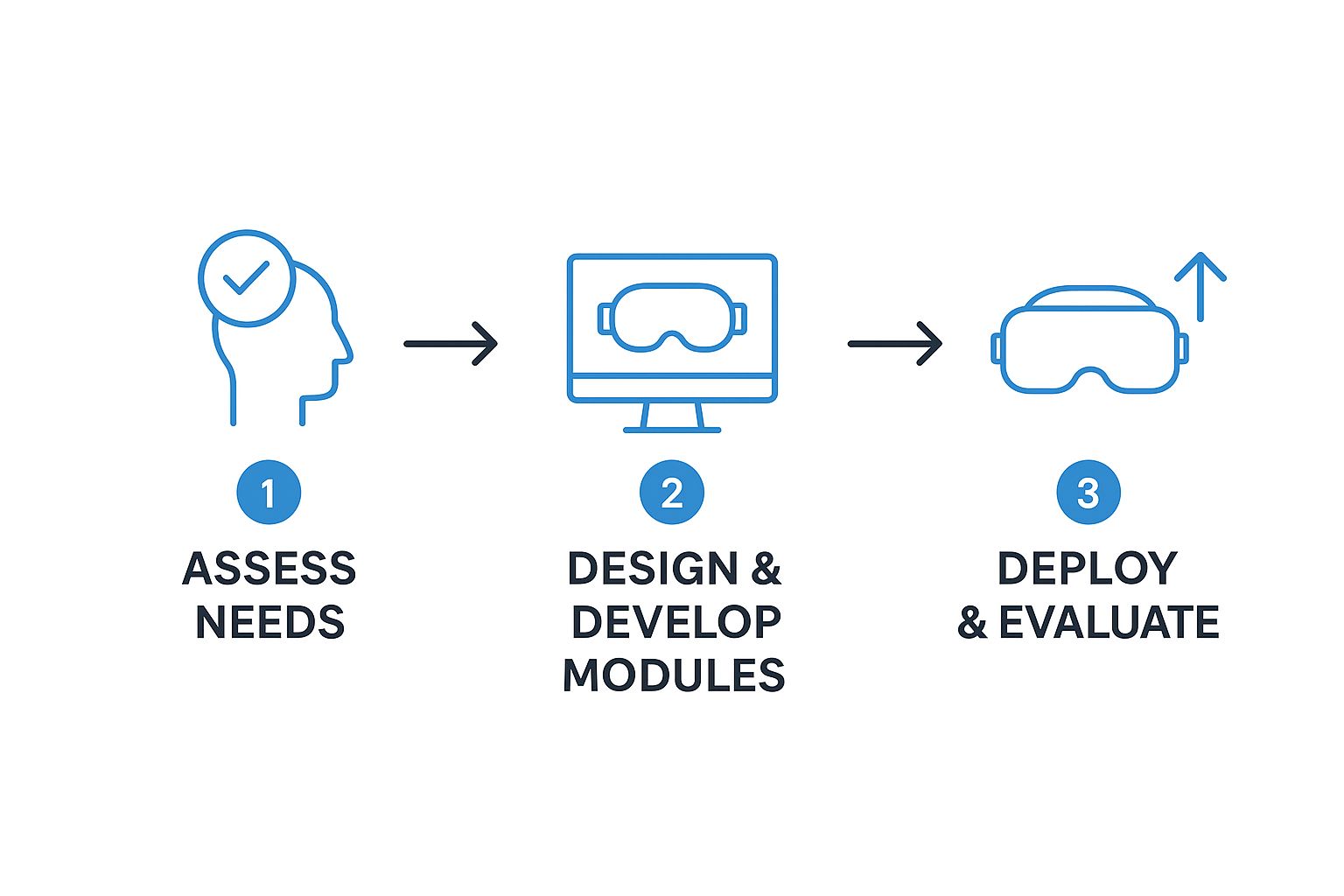
As you can see, a successful rollout progresses logically from needs assessment to deployment and evaluation. Each step builds on the last, creating a solid foundation.
Launching a Pilot Program
Before considering a company-wide rollout, launch a pilot program. Involve a small, representative group of employees to go through the training. This is your opportunity to gather direct feedback on the user experience, content quality, and any technical issues. The data and testimonials collected here are invaluable—they provide the evidence needed to build a compelling business case and secure buy-in from key stakeholders for a larger deployment.
A pilot program is the most effective way to prove value and resolve any issues. It transforms VR training from a theoretical concept into a tangible, tested solution with measurable results.
The market for these immersive training technologies is growing rapidly. The sector was valued at approximately $16.4 billion in 2024 and is projected to reach nearly $69.6 billion by 2030. This growth is driven by technological advancements that are making simulations more realistic and effective than ever.
Scaling and Integration
Once your pilot program has proven successful, the final step is to scale the program across the organization. This involves creating a solid plan for distributing hardware, onboarding new users, and providing technical support.
A strategic implementation often involves integrating VR with your existing learning management system (LMS) for seamless content delivery. You can find excellent insights into leveraging an LMS for training delivery that can offer valuable guidance. This connection allows you to track progress and performance data from your VR modules within your existing training ecosystem, providing a single, unified view of all learning activities.
Measuring the Return on Your VR Investment
For any business leader, demonstrating value is paramount. Adopting virtual reality training solutions is not just about implementing new technology; it is a strategic investment that must show a clear, positive impact on the bottom line. To achieve this, we must move beyond anecdotal evidence and focus on hard, quantifiable metrics that demonstrate a strong return on investment (ROI).
A logical starting point is tracking direct cost savings. Consider the expenses eliminated by drastically reducing or completely removing the need for employee travel—no more flights, hotels, or venue rentals for in-person training. These savings are immediately reflected in your budget.
Quantifying Operational Improvements
However, direct savings are only the beginning. The true value of VR training is revealed through operational gains. The data collected within each simulation provides a clear window into employee performance and skill levels, allowing you to track specific, measurable improvements over time.
Key performance indicators to monitor include:
- Error Rate Reduction: Compare the number of mistakes made by employees trained in VR versus those trained through traditional methods. A lower error rate directly translates to less material waste, higher product quality, and fewer costly reworks.
- Productivity Gains: Measure how quickly your VR-trained team members complete tasks compared to their peers. Every increase in speed and efficiency contributes to higher output without increasing labor costs.
- Safety Incident Reduction: In many industries, this is the most critical metric. A decrease in workplace accidents and safety violations not only reduces costs associated with insurance premiums and operational downtime but also fosters a genuinely safer environment for your people.
When you focus on concrete data points like fewer errors and faster task completion, you build an undeniable business case. VR training then shifts from being viewed as an expense to a provable, profitable investment in your workforce's capability and safety.
Building the Business Case
Finally, don't overlook the impact on employee retention. Engaged employees who feel confident and competent in their roles are far more likely to remain with the company. This reduces the significant hidden costs associated with recruiting, hiring, and onboarding new staff. Our guide on the key benefits of virtual reality training delves deeper into these advantages.
By weaving these different data points together—cost avoidance, productivity boosts, safety improvements, and better retention—you create a compelling narrative backed by solid numbers. This data-driven approach proves that virtual reality training solutions are a direct contributor to your company’s growth and operational excellence.
Common Questions About VR Training
Even when the benefits are clear, it is natural to have practical questions before integrating a new technology into your operations. Making an informed decision requires straightforward answers about virtual reality training solutions. Let's address some of the most common questions from businesses.
How Much Does a Virtual Reality Training Solution Cost?
The cost of a VR training solution varies depending on your specific requirements.
The investment for VR training is contingent on the complexity of your objectives. Off-the-shelf modules for common skills like public speaking or safety procedures are generally the most affordable and provide an excellent entry point. Conversely, a fully custom simulation that precisely replicates your specialized machinery or complex, high-stakes procedures will naturally require a larger upfront investment.
Hardware, such as VR headsets, is a separate cost, but these devices have become much more accessible and affordable in recent years. We recommend starting with a well-defined pilot program. This allows you to test the technology, measure the initial ROI, and build a solid business case before a wider rollout.
Is VR Training Difficult for Non-Technical Employees?
No, it is not. This is one of the most common misconceptions.
Modern VR systems are designed to be intuitive. The vast majority of employees, regardless of their technological proficiency, can learn to use a headset and navigate a simulation within a few minutes. The process is often as simple as looking where you want to go and using a straightforward hand-held controller.
A well-designed program makes the technology feel transparent. The focus remains on the training task, not on managing the hardware. User interfaces are intentionally streamlined to make the entire experience feel immersive and natural, not intimidating.
Can VR Training Integrate with Our Current LMS?
Yes, it can. This is a standard feature for most professional virtual reality training platforms today.
Using established industry standards like xAPI or SCORM, these advanced training solutions can communicate directly with your company's existing Learning Management System (LMS). This integration is crucial. It means all the valuable data from your VR modules—completion rates, performance metrics, and individual progress—is fed back into the system you already use. This provides a single, unified view of all your team's learning activities without the need to manage multiple platforms.
Ready to see how immersive learning can directly benefit your operations? AIDAR Solutions specializes in creating virtual reality training programs that reduce risk, accelerate skill acquisition, and deliver a clear return on investment. Explore our solutions at https://aidarsolutions.com to start building a more capable and confident workforce.
Comment(01)