Boosting Productivity Improvement in Manufacturing Industry
Improving productivity in manufacturing isn't just about increasing the speed on the assembly line. It is the strategic discipline of generating more value from operations while utilizing fewer resources—less labor, capital, and materials.
The fundamental goal is to work smarter, not harder. This involves identifying and eliminating waste in all its forms, making every part of the process more efficient. In today's dynamic global market, this is not a discretionary initiative; it is a requirement for competitive survival.
The Urgent Case for Manufacturing Productivity Improvement
In today’s interconnected economy, manufacturing leaders face multifaceted pressures, from volatile supply chains to fierce international competition. In this environment, standing still is not just falling behind; it is a direct path to obsolescence. Consistent productivity improvement has shifted from a long-term goal to an immediate survival tactic.
Consider a modern factory as a high-performance racing team. A race is not won in a single, dramatic move. Victory is the sum of hundreds of small, continuous adjustments: a slightly faster pit stop, a minor tweak to an engine's calibration, a more efficient line through a corner.
Each incremental gain, seemingly insignificant on its own, compounds into a decisive competitive advantage. In manufacturing, these adjustments manifest as refined processes, an upskilled workforce, and the adoption of smarter technology.
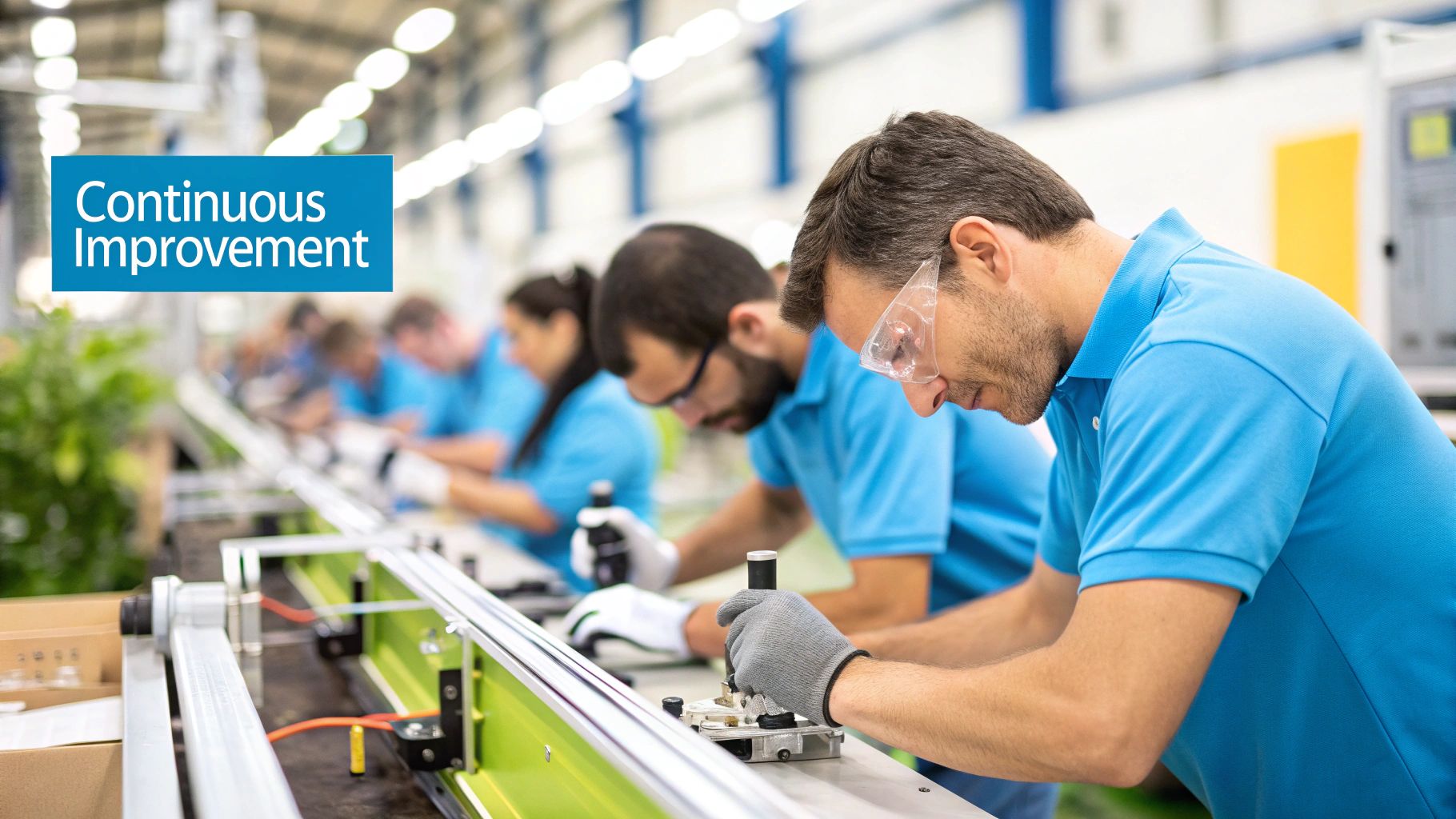
Why the Pressure Is Mounting
A few core pressures are forcing this evolution, turning operational efficiency from a best practice into a necessity. These challenges demand that manufacturers find new ways to extract more value from every asset, process, and person on the floor.
To gain a clearer picture, let's examine what is pushing productivity to the forefront versus what is holding it back.
Key Drivers and Common Bottlenecks in Manufacturing Productivity
| Productivity Drivers | Common Bottlenecks |
|---|---|
| Technological Adoption: Smart sensors, automation, and data analytics. | Legacy Systems: Outdated equipment and software that inhibit modern integration. |
| Lean Methodologies: A culture focused on eliminating all forms of waste. | Process Inefficiencies: Redundant steps, poor workflow, and wasted motion. |
| Skilled Workforce: Well-trained employees who can adapt and problem-solve. | Skills Gaps: Lack of qualified personnel to operate new tech or processes. |
| Data-Driven Decisions: Using real-time KPIs to guide operational choices. | Lack of Visibility: Decisions made without accurate operational data. |
| Process Optimization: Continuously refining workflows for better output. | Equipment Downtime: Unplanned stops that bring production to a grinding halt. |
| Supply Chain Agility: Flexible and resilient sourcing and logistics. | Supply Chain Disruptions: Unpredictable shortages and logistical hurdles. |
These are not just abstract concepts; they are the daily realities of the factory floor. The scale of global change makes this even more urgent. Between 1990 and 2023, global manufacturing value added exploded from US$3.3 trillion to over US$13 trillion.
This massive growth was fueled by significant productivity shifts. A single factory hour in many parts of Asia now produces several times more value than it did two decades ago, according to data from the World Bank. This forces competitors everywhere to adapt or be left behind.
This global shift highlights a critical reality: when a 10–20% productivity gap can determine which plant gets the next major contract, even small gains from faster worker training or reduced equipment downtime translate directly into millions of dollars in added output.
The goal is to turn these pressures into advantages. Strategies that focus on boosting workforce skills, minimizing errors, and cutting non-productive periods are no longer optional.
For instance, optimizing maintenance schedules and response times is one of the most direct paths to higher output. Learning how to reduce downtime in manufacturing provides a powerful lever for immediate productivity gains. This guide will explore practical, technology-driven solutions that make these improvements possible, offering a clear path to building a more resilient and competitive operation.
Measuring What Matters with Key Performance Indicators
You cannot improve what you do not measure. To drive real productivity gains in manufacturing, you first need a clear, objective assessment of your operations. This is where Key Performance Indicators (KPIs) become essential. They serve as the vital signs on your factory’s dashboard, translating complex processes into clear, understandable metrics.
A skilled mechanic can diagnose an engine misfire by sound. Similarly, KPIs like Overall Equipment Effectiveness (OEE), First Pass Yield (FPY), and cycle time each tell a specific story about your plant's health. They help identify underlying issues long before they escalate into critical failures.
The Three Core Metrics of Production Health
Instead of being overwhelmed by data, leading manufacturers focus on a handful of metrics that provide the most actionable insights. These core KPIs help diagnose the root causes of inefficiency—from obvious equipment downtime and rework to the subtle process delays that quietly erode margins.
- Overall Equipment Effectiveness (OEE): This is the gold standard. OEE combines three critical factors—Availability (uptime), Performance (speed), and Quality (good parts)—into a single, powerful percentage. An OEE score of 100% represents the ideal state: producing only good parts, as fast as possible, with zero downtime.
- First Pass Yield (FPY): A deceptively simple metric, FPY tracks the percentage of products manufactured correctly the first time, without rework. A high FPY indicates a stable, reliable process. A low FPY is a red flag pointing to problems with materials, machinery, or worker skill.
- Cycle Time: This KPI measures the total time required to produce a single unit, from the first step to the last. Monitoring cycle time helps identify bottlenecks where products are idle or being handled inefficiently.
Mastering these operational efficiency metrics is the first step toward building a data-driven improvement plan. It allows you to stop guessing and start taking precise, targeted action.
Connecting KPIs to Bottom-Line Results
Tracking these numbers is not merely an administrative exercise; it directly impacts financial performance. Every percentage point gained in OEE or FPY translates into real capital by reducing waste, lowering operating costs, and increasing throughput without new equipment investment.
There is a clear line from the shop floor to the balance sheet. A 1–2% annual productivity improvement may not sound dramatic, but its effects compound. Over a decade, a factory that boosts its output per hour by just 2% each year will produce approximately 22% more with the exact same labor input.
This data-first approach is reflected in the broader economy. National data reveals how quickly process adjustments and workforce investments can translate into measurable output. For instance, in the U.S. manufacturing sector, quarterly productivity can swing from sharp drops to gains of over 3%, often driven by how well companies re-engineer their workflows and invest in better tools and training.
This highlights the urgency for every manufacturer to measure what matters. Even small, consistent gains can create a massive competitive advantage over time.
Proven Strategies for Enhancing Manufacturing Operations
To achieve meaningful productivity gains on the factory floor, a playbook that marries time-tested principles with modern tools is required. It is not about choosing one or the other but about systematically eliminating inefficiency while building more intelligent, resilient processes. This approach is what separates market leaders from the competition.
The journey begins with foundational methods that have proven their worth for decades, creating a culture of continuous improvement essential for any high-performing plant. Once that foundation is solid, digital strategies can be layered on to amplify every effort.
The Pillars of Operational Excellence
At the heart of manufacturing efficiency lie two powerful philosophies: Lean Manufacturing and Six Sigma. While they approach the problem from slightly different angles, they share the same goal: delivering maximum value by eliminating waste and variation.
- Lean Manufacturing: This is a relentless pursuit of waste in all its forms. This extends beyond scrap material to include wasted motion, excess inventory, unnecessary waiting time, and over-production—anything that does not add direct value to the final product.
- Six Sigma: This is a data-driven methodology for achieving near-perfect quality. It is laser-focused on identifying and eliminating the root causes of process variation, making outcomes so consistent and predictable that defects become exceedingly rare.
Implementing these principles is not a one-off project; it is a cultural shift. It empowers every team member to constantly question existing processes and actively search for better, smarter ways to work.
Bridging to Digital Manufacturing Strategies
With that solid foundation in place, modern digital tools can act as powerful accelerators, providing the visibility and foresight to elevate operational efficiency. Two of the most impactful strategies today are Digital Twins and Predictive Maintenance.
This is where key metrics come into play, helping track the success of these strategies. These include Overall Equipment Effectiveness (OEE), First Pass Yield (FPY), and Cycle Time.
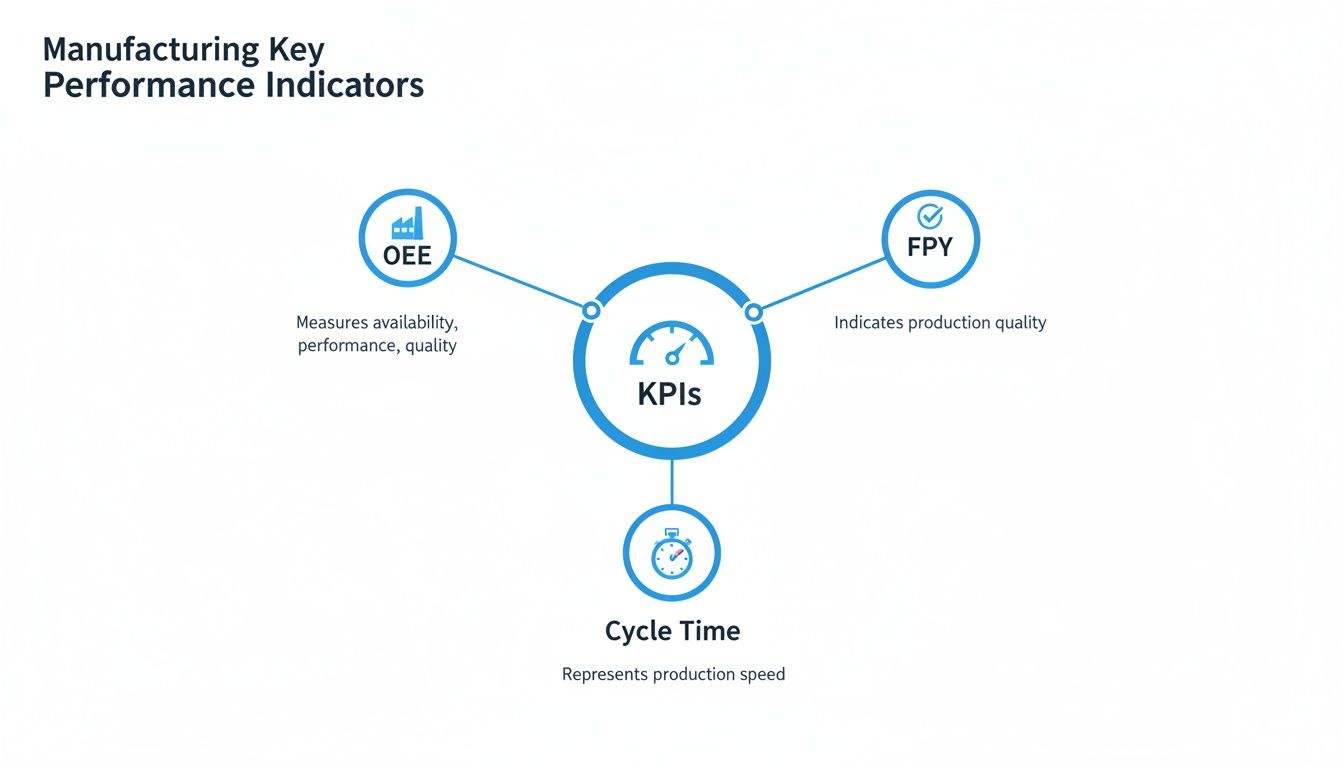
These KPIs are the language of a modern factory, translating complex floor activity into clear, actionable data.
The Factory Sandbox: Digital Twins
Imagine having a perfect, risk-free copy of your entire factory to test any change without consequence. This is the power of a Digital Twin. It is a living virtual model of a physical process, machine, or even a full production line, constantly fed with real-time data from sensors on the floor.
With a Digital Twin, you can simulate the impact of changing a production schedule, reconfiguring a layout, or introducing new equipment—all without disrupting actual operations. It is a virtual sandbox for optimization.
This allows engineers and managers to pinpoint bottlenecks, run endless "what-if" scenarios, and validate improvements before committing capital or incurring downtime. It replaces expensive trial-and-error with calculated, data-driven decisions.
The Early Warning System: Predictive Maintenance
Unplanned downtime is the ultimate productivity killer. Predictive Maintenance (PdM) is the strategy to combat it. Instead of waiting for a machine to fail (reactive) or servicing it on a rigid schedule (preventive), PdM uses data to predict when a failure is likely to occur.
Sensors monitor equipment conditions like vibration, temperature, and performance, while algorithms analyze the data for minute anomalies that signal impending trouble. This creates an intelligent early warning system, allowing maintenance teams to schedule repairs proactively, long before a catastrophic failure halts production. Studies show this approach can reduce maintenance costs by up to 40% and cut unplanned downtime by as much as 50%.
Even specific processes like packaging see huge gains from optimization. For instance, using tools like automated pallet wrapping machines can boost efficiency, cut labor costs, and improve load security. By combining foundational principles like Lean with advanced digital tools, manufacturers can build a comprehensive system for driving productivity.
Accelerating Skills with Immersive Workforce Training
While machinery and processes can be optimized, the true engine of productivity improvement in manufacturing is your people. A state-of-the-art factory floor is only as effective as the skilled technicians operating, maintaining, and troubleshooting its complex systems. The challenge is that traditional training methods often struggle to keep pace with technology, creating a skills gap that can hinder your entire operation.
Consider the conventional model: classroom lectures followed by on-the-job shadowing. This approach is slow, costly, and carries inherent risks. A new hire learning on live equipment can make a simple mistake that leads to expensive scrap, damaged machinery, or a safety incident. This turns training into a bottleneck, forcing senior technicians to divide their time between critical work and mentoring new team members.
A Flight Simulator for the Factory Floor
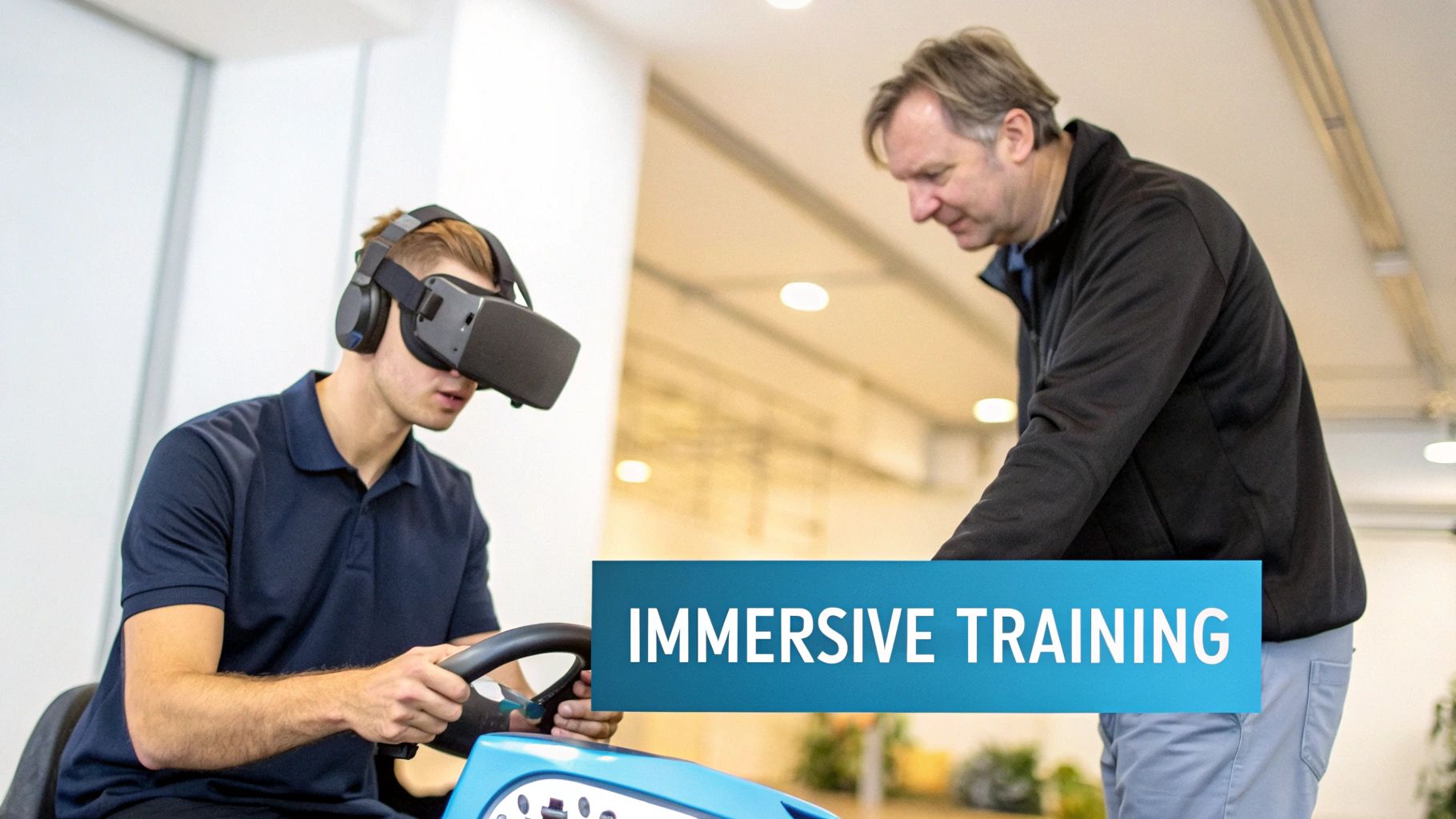
Forward-thinking manufacturers are breaking this cycle with immersive technologies like Augmented and Virtual Reality (AR/VR). These are not futuristic concepts but practical tools delivering measurable results today. The idea is simple yet profound: what if you could provide your team with a "flight simulator" for your most critical machinery?
Imagine a new technician needing to learn a complex assembly sequence or a hazardous maintenance procedure. Instead of reviewing a dense manual or observing from a distance, they put on a VR headset. Instantly, they are standing before a perfect digital replica of their workstation.
In this completely risk-free virtual environment, they can practice the procedure repeatedly. They can see inside the machine, make mistakes without consequences, and build the muscle memory required for complex, hands-on tasks. This active, learn-by-doing training significantly outperforms passive learning in terms of comprehension and retention.
From Weeks to Days: Supercharging Onboarding and Upskilling
The effect on your training timeline is dramatic. A trainee can accumulate the equivalent of months of on-the-job experience in a matter of weeks, or even days. This approach systematically builds their competence and confidence before they ever set foot on the actual production line.
This accelerated learning curve delivers a cascade of benefits that directly improve productivity metrics:
- Fewer Mistakes: Technicians who have practiced a task dozens of times in a simulation are far less likely to err on real equipment, directly improving your First Pass Yield (FPY).
- Less Waste: Fewer errors mean less scrap material and fewer hours spent on rework, contributing directly to the bottom line.
- Safer Operations: Practicing high-stakes procedures like lockout/tagout in a virtual space reinforces safety protocols, reducing the risk of workplace accidents.
- Faster Time-to-Competency: New hires become valuable, productive team members in a fraction of the usual time, reducing the strain on veteran staff.
For those interested in the science behind this approach, our guide on what is immersive learning breaks down the cognitive principles that drive its effectiveness.
Comparing Traditional vs. Immersive XR Training
To illustrate the difference between the two approaches, a side-by-side comparison is useful. The table below outlines traditional classroom and shadowing methods against modern immersive XR solutions.
| Metric | Traditional Methods | Immersive XR Solutions |
|---|---|---|
| Learning Retention | Low (5-20% after 24 hours) | High (75-90% retention) |
| Safety Risk | High (mistakes on live equipment) | Zero (risk-free virtual environment) |
| Time to Competency | Long (weeks to months) | Short (days to weeks) |
| Equipment Downtime | Required for hands-on training | None (decoupled from production) |
| Scalability | Difficult and resource-intensive | Easy (deploy anywhere, anytime) |
| Cost | High long-term costs (travel, scrap, downtime) | Lower total cost of ownership |
It is clear that while traditional methods have served their purpose, immersive training offers a more efficient, safer, and ultimately more productive path forward.
The real game-changer is the ability to decouple training from the production schedule. You no longer have to wait for a machine to be taken offline. Training can happen anytime, anywhere, enabling continuous skill development across the entire workforce.
By transforming how skills are taught and reinforced, immersive training directly addresses one of the biggest variables in manufacturing productivity: the human element. It gives employees the confidence and competence to perform their jobs safely and efficiently from day one, building a more agile, skilled, and productive team.
Transforming Maintenance with AR-Powered Remote Support
In any manufacturing operation, unplanned equipment downtime is a silent killer of productivity. Every minute a critical machine is idle, the consequences ripple outward—production targets are missed, labor costs accumulate, and delivery schedules are jeopardized. The traditional approach to resolving a complex breakdown is often slow and inefficient.
It is a familiar scenario for most plant managers. A machine fails, and the on-site technician is unable to diagnose the problem. The issue requires a specialist, a senior engineer who may be located hundreds of miles away. Production halts while that expert travels to the site, a process that can take hours or even days, racking up significant costs in lost output and travel expenses.
This reactive, travel-dependent model is a massive bottleneck in the pursuit of productivity improvement in the manufacturing industry. However, a fundamental shift is underway, transforming maintenance from a slow-motion crisis into a rapid, digitally-guided resolution.
The Power of See-What-I-See Technology
The solution lies in Augmented Reality (AR) powered remote assistance. Imagine a frontline worker encountering that same complex equipment failure. Instead of making a phone call and attempting to describe intricate mechanical parts, they put on a pair of AR smart glasses.
With a single command, they can share their exact point-of-view in real-time with the off-site expert. The specialist sees precisely what the technician sees, as if they were standing on the factory floor. This “see-what-I-see” capability is the foundation for a much smarter approach to maintenance.
From there, the expert can digitally guide the entire fix. Using their own screen, they can draw arrows, circle specific components, or overlay step-by-step instructions directly onto the technician's view. These digital annotations appear locked onto the real-world equipment, providing clear, unmistakable guidance.
A Clear Path to Faster Fixes
This approach completely changes the maintenance process. Miscommunication is virtually eliminated. Instead of saying, “No, not that valve, the one to the left,” the expert can simply draw a glowing circle around the correct one.
This brings a new level of clarity and precision to complex tasks, empowering the on-site technician to perform advanced repairs with the confidence of an expert providing direct oversight. While understanding concepts like different preventive and corrective maintenance strategies is vital, AR support elevates how those strategies are executed.
The benefits accumulate quickly, leading to a powerful return on investment:
- Slashed Downtime: Problems are diagnosed and resolved in minutes or hours, not days.
- Drastically Reduced Travel Costs: The need for expert travel is often reduced by 75% or more.
- Improved First-Time-Fix Rates: With expert guidance, repairs are done correctly the first time, preventing repeat failures.
For any business looking to make this leap, exploring a dedicated augmented reality remote assistance platform is the most practical first step. It provides the tools to connect your entire workforce instantly.
This technology closes the skills gap on demand. It multiplies the effectiveness of your most experienced engineers, allowing them to support multiple sites in a single day without ever leaving their office.
This level of efficiency is more critical than ever. Recent data shows that U.S. manufacturing productivity has experienced significant swings, including declines in 2022 and 2023. This highlights a key reality for plant managers: real improvement now depends on smarter processes and tools that eliminate non-productive time. As you can learn more about U.S. manufacturing productivity trends from the Federal Reserve, it is clear that tools like AR remote support offer a direct way to combat these pressures and recover lost output faster than traditional methods ever could.
Charting Your Course: An Implementation Roadmap That Actually Works
Even the most powerful technology is ineffective if your team does not adopt it. Integrating advanced tools like AR and VR onto the factory floor requires more than just deploying new hardware. It demands a thoughtful strategy that accounts for both the technology and the people who will use it daily. The objective is to move from concept to full-scale rollout without encountering major roadblocks, ensuring you extract maximum value from your investment in manufacturing productivity improvement.
A clear, actionable plan separates a smooth transition from a disruptive one. It begins by addressing a real, tangible problem and proving the solution's worth on a small scale before scaling up.
Start Small, Win Big: Launching a Pilot Project
The most prudent way to begin is with a tightly focused pilot project. This approach minimizes risk, allows for rapid demonstration of results, and, most importantly, creates internal champions who will advocate for the new technology. A successful pilot becomes your ironclad business case for a wider rollout, built on hard data from your own operations.
Here is a blueprint for execution:
- Pinpoint a High-Impact Use Case: Do not try to solve every problem at once. Focus on a single, persistent pain point. Is there a specific machine that experiences frequent downtime? A complex assembly process prone to errors? Select a problem where a clear win will be obvious to everyone.
- Define Success Metrics: How will you measure the pilot's success? You need measurable KPIs from the outset. This could be reducing average repair time, lowering the error rate on a specific task, or accelerating new hire onboarding.
- Ensure Stakeholder Alignment: Involve key players from day one. This includes the frontline technicians who will use the tools, the maintenance supervisors managing the workflows, and the IT personnel who will support the system. Their insights are invaluable for a seamless integration.
From Resistance to Adoption: Managing the Human Side of Change
Change can be met with resistance. The human element will ultimately determine the project's success, so it must be addressed proactively.
The key is to frame this technology not as a threat to human skill, but as a tool that empowers your team. Demonstrate how it makes their jobs easier, safer, and more efficient. When your team sees the direct benefits for themselves, adoption occurs naturally.
To achieve this, over-communicate and offer robust support. Conduct hands-on workshops where employees can try the technology. Create training resources that are simple to access and use. And when you achieve early wins, celebrate them. Showcase the positive impact these new tools are having. This is how you turn skeptics into evangelists and ensure the technology becomes a valued, permanent part of your daily operations.
Frequently Asked Questions
Once manufacturing leaders see the potential of immersive technology, a few practical questions typically arise. Here are direct answers regarding ROI, implementation, and team adoption for AR and VR.
What Is the Typical ROI for AR and VR Solutions?
The return on investment for AR and VR can be rapid and substantial. It is not uncommon for manufacturing partners to see a 50% reduction in equipment service times or reduce expert travel costs by 75%. These results can translate into a tangible ROI within a few months.
For training, value is derived from accelerating new hire proficiency. When a new team member becomes skilled and productive faster, you directly reduce waste and errors, which boosts overall output. While the exact ROI varies by project, it is always tied to measurable improvements in uptime, quality, and workforce efficiency.
How Should We Start a Pilot Project for AR or VR?
The best approach is to start small and focused. Attempting to solve every problem at once is a recipe for a stalled project. Instead, identify a single, high-impact pain point that is widely recognized on your factory floor.
Good candidates for a pilot project often include:
- A specific machine notorious for complex and frequent downtime.
- A difficult assembly task where errors are a persistent issue.
- An onboarding process that is too long and consumes the time of your senior staff.
A targeted pilot allows you to measure results without ambiguity, gather honest feedback from end-users, and build a powerful, data-driven case for a broader rollout. A successful pilot creates champions for the technology and proves its value before a major investment is made.
This step-by-step approach de-risks the process and sets you up for a successful, scalable implementation.
Are AR and VR Solutions Difficult for Our Workforce to Adopt?
Not at all. Modern immersive tools are designed for rapid user adoption. With intuitive interfaces on today’s smart glasses and VR headsets, most workers become comfortable with the technology in under an hour with minimal formal training.
The key to success is not the technology itself—it is effective change management. High adoption rates depend on how these new tools are introduced. It is critical to involve your frontline workers in the selection and pilot process.
You must demonstrate how this technology makes their jobs easier and safer, not more complicated. Providing hands-on support during the initial rollout is essential for building their confidence and turning them from skeptics into advocates. When implemented correctly, the technology becomes just another trusted tool in their belt.
Ready to see how immersive solutions can drive real productivity in your operations? AIDAR Solutions specializes in AR and VR applications that accelerate training and make remote support seamless. Discover how we can help you achieve measurable results.