
Modern Maintenance Technician Training Programs
Maintenance technician training programs are the bedrock of a well-run facility. At their core, they are structured courses designed to build the essential mechanical, electrical, and diagnostic skills your team needs to install, repair, and maintain mission-critical machinery. Think of them as the strategic blueprint for keeping your operations humming and your workplace safe.
Why The Old Way of Training Technicians Is Ineffective
The traditional playbook for training maintenance technicians is becoming obsolete. For decades, the go-to method was a simple mix: classroom lectures paired with on-the-job shadowing, where a new technician followed a seasoned professional. That approach was sufficient when machines were purely mechanical, but it is dangerously outdated for today's high-tech industrial environment.
Modern equipment isn't just nuts and bolts; it’s a complex integration of mechanical systems, sophisticated electronics, and interconnected software. Relying on a purely observational training model in this environment is slow, risky, and impossible to scale. It cannot keep up with the pace of technological change.
The Two Major Factors Forcing a Change
Companies are facing pressure from two sides, making traditional training methods inadequate. First, there is the demographic shift—the "silver tsunami." An entire generation of experienced maintenance experts is heading into retirement, and they are taking decades of hard-won institutional knowledge with them.
At the same time, the machinery itself is becoming exponentially more complex. Technicians are no longer just mechanics. They are technologists who need to understand robotics, interpret sensor data, and work with predictive maintenance software.
Here's the challenge in a nutshell: companies have to transfer deep institutional knowledge to a new generation of technicians while also teaching them to manage technology that didn't even exist ten years ago. This is why a modern training program isn't just a benefit; it's a critical strategic investment.
The aviation industry is a perfect case study. Boeing forecasts a global need for 710,000 new maintenance technicians by 2044. The pressure is on, especially when you learn that the average certified aircraft technician is 54 years old, with 40% over the age of 60. It's a clear signal that the industry is facing a massive skills gap that only effective, modern training can fill.
The New Standard for Building Real Skills
To build a maintenance team that is both resilient and highly skilled, a new approach is necessary. The future of technician training is a blended strategy, one that combines the irreplaceable value of hands-on practice with the safety and scale that technology offers.
This new standard is built on a few key pillars:
- Structured Hands-On Labs: These are safe, controlled environments where technicians can practice on real or simulated equipment without interrupting production.
- Blended Learning Models: This involves mixing self-paced online modules with live, instructor-led sessions. It’s a flexible approach that accommodates different learning styles and busy schedules.
- Immersive Technologies: Augmented Reality (AR) and Virtual Reality (VR) are transformative. They create hyper-realistic training scenarios, allowing technicians to practice dangerous or complex repairs in a zero-risk environment. It is a powerful way to accelerate skill-building. You can learn more about immersive learning and see how it works in practice.
Ultimately, modern training isn't just about fixing what breaks. It's about creating a proactive, data-savvy maintenance culture that prevents failures before they happen. That is how you build a real competitive advantage.
Designing a Future-Ready Training Curriculum
Crafting an effective training program for maintenance technicians requires a strategic approach. It is necessary to balance timeless principles—the fundamentals of mechanics and electronics—with the skills needed to manage today's intelligent, data-driven machinery.
This isn't about just creating a long checklist of topics to cover. The real goal is to build a logical learning path, starting with a rock-solid foundation and methodically building up to specialized, high-level expertise. A technician who only knows basic mechanics is as limited as one who only understands software; both are unprepared for the real world.
The curriculum has to be designed to build competencies, not just track completed modules. This is the key. It ensures technicians understand the why behind their actions, giving them the confidence to troubleshoot problems they’ve never seen before. If you're looking to build out this kind of robust framework, digging into the principles of competency-based training programs for your workforce is a great place to start.
The Foundational Pillars of Maintenance Skills
Every great structure needs a solid foundation, and a maintenance technician’s skillset is no different. Before anyone dives into complex diagnostics or predictive analytics, they have to master the core principles that make all industrial equipment function. These are the non-negotiables.
Think of them as the building blocks of a successful maintenance career:
- Mechanical Systems: This covers hands-on skills. We’re talking gears, belts, bearings, alignment, and proper lubrication. It’s the physical "how" behind every machine's operation.
- Electrical Theory and Safety: Technicians absolutely must understand AC/DC circuits, read schematics, and execute lockout/tagout procedures flawlessly. This isn't just about fixing things; it's about keeping people safe.
- Hydraulics and Pneumatics: Much industrial equipment—from presses to conveyor systems—runs on fluid and air power. Understanding how these systems work is critical for troubleshooting.
Without mastering these pillars, any advanced training is built on shaky ground. Get these basics right, and your technicians can approach any machine with a real understanding of how it is supposed to work.
Building Advanced Competencies for Modern Machinery
Once that foundation is in place, the curriculum needs to address the complexities of modern industrial technology. This is where a technician goes from being a reactive "fixer" to a proactive problem-solver. Advanced competencies are all about using data and technology to prevent failures before they happen.
The biggest shift in maintenance today is the move from a reactive "break-fix" model to a proactive, predictive one. Your training program needs to empower technicians to lead this change, not just keep up with it.
To deliver both foundational and advanced content effectively, it’s worth exploring the different SaaS LMS platforms available. The right platform can help you manage and track a technician’s journey from basic skills to more specialized, expert-level knowledge.
You can see this progression clearly when you compare the skills of a new hire to those of a seasoned pro.
Maintenance Technician Skill Progression
Here’s a look at how a technician’s capabilities evolve as they move from foundational knowledge to advanced expertise.
| Skill Category | Foundational Competencies (Entry-Level) | Advanced Competencies (Senior/Specialist) |
|---|---|---|
| Diagnostics | Uses multimeters and gauges; follows troubleshooting flowcharts. | Interprets sensor data (vibration, thermal); uses diagnostic software. |
| Systems | Focuses on individual components (motors, pumps, valves). | Understands integrated systems (PLC, HMI, robotics). |
| Maintenance Strategy | Executes scheduled preventive maintenance tasks. | Implements predictive maintenance using data analysis and CMMS. |
This table maps out the journey. It's not just about learning more information; it’s about learning to think differently and use sophisticated tools to keep equipment running at its peak. When you structure your curriculum this way, you create a clear career path that develops true experts—the kind of people who can maintain the smart factories of today and tomorrow.
Using Technology for Real-World, Hands-On Learning
Traditional hands-on learning, while essential, has its limits. Shadowing an expert is slow. Letting a new technician practice on live equipment is risky. And pulling production machinery offline for training is a logistical and financial challenge.
This is where today’s maintenance technician training programs are taking a massive leap forward. They’re using technology to build powerful, practical learning experiences that are highly effective.
Imagine a new technician using an augmented reality headset. As they approach a complex hydraulic pump, digital overlays appear, highlighting key components, streaming real-time pressure readings, and guiding them through a diagnostic sequence step-by-step. This is the new reality of on-the-job training.
This shift isn't just a "nice-to-have"—it's critical for building a competent team. The skills a modern technician needs are layered, starting with basic hands-on abilities and building toward complex, systems-level thinking.
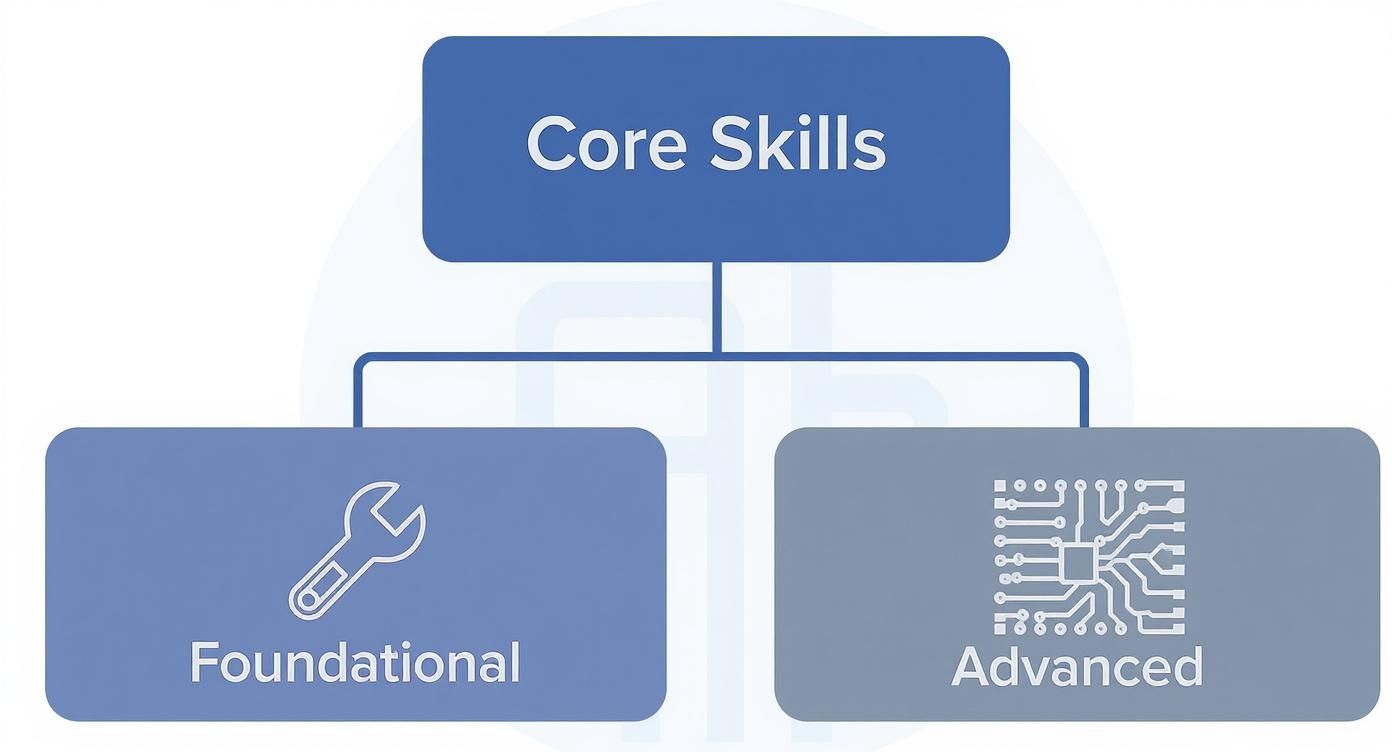
As you can see, you can't get to advanced diagnostics on a circuit board without first mastering the foundational skills with a wrench and a multimeter.
A Risk-Free Digital Sandbox
One of the most powerful applications of this technology is with Virtual Reality (VR), creating a learning environment that’s safe, repeatable, and incredibly effective. VR simulations place technicians into a photorealistic digital twin of their actual work environment, letting them practice high-stakes procedures with zero real-world consequences.
Consider a dangerous shutdown procedure for a high-voltage system. In the past, this was learned by observation. With VR, a trainee can run that entire sequence a dozen times, making mistakes and learning from them in a completely safe digital space.
This builds more than just knowledge. It builds muscle memory and confidence. When the technician finally faces that situation in reality, the procedure feels familiar, almost second nature, slashing the risk of human error.
This application is also ideal for practicing rare but critical repairs. Instead of waiting for a machine to break down once every two years, technicians can simulate the failure on demand, ensuring they’re ready when it really counts.
Augmented Reality for On-the-Floor Guidance
While VR is ideal for off-site simulation, Augmented Reality (AR) provides value directly on the factory floor. AR enhances the real world by overlaying digital information—like instructions, schematics, or even a remote expert's guidance—onto a technician's view. It turns any piece of equipment into an interactive lesson.
Here’s how teams are using it right now:
- Step-by-Step Procedural Guidance: A technician can look at a machine and see animated instructions showing exactly which bolt to turn next or which wire to connect.
- Remote Expert Assistance: A junior technician can stream their point-of-view to a senior expert hundreds of miles away. That expert can then add digital annotations on the junior tech's screen, pointing out the exact problem in real time.
- Data Visualization: By pointing their device at a component, a technician can instantly see live sensor data, like temperature or vibration levels, without having to connect separate diagnostic tools.
This technology closes the gap between knowing what to do and actually doing it, delivering support exactly when and where it's needed. If you're looking to bring this to your team, understanding the ins and outs of maintenance augmented reality solutions is the perfect place to start.
A Blended Strategy for the Best Results
The most effective training programs do not rely on a single method. Instead, they build a blended learning strategy that pulls from the best of every world: the human connection of instructor-led sessions, the practical wisdom of on-the-job mentorship, and the safety and scale of immersive tech.
Technology is quickly becoming a core part of the curriculum. The International Data Corporation (IDC) predicts a massive $4.1 billion will be invested in AR and VR for industrial maintenance by 2024. This isn't just a trend; it's a fundamental shift in how maintenance work gets done.
This kind of tech integration is becoming standard in other high-stakes fields, too. For instance, the lessons from Medical Training Simulations in XR show how immersive tech is already used for precise, compliant training in healthcare, offering a proven model for industrial teams. By blending these innovative tools with tried-and-true methods, you can speed up learning and build a maintenance team that's ready for anything.
Putting Your New Training Program into Action

Moving from a carefully designed curriculum to a living, breathing training program that actually works takes a smart rollout strategy. An excellent plan on paper can fall flat without thoughtful execution. This roadmap will help you turn your concept into reality, ensuring the program builds real skills and delivers a measurable impact on the business—without disrupting operations.
The first step is always to look inward. Before you can build up your team's skills, you have to know where the gaps are. A thorough skills gap analysis is the bedrock of any effective maintenance technician training program. This means getting real about your current team's abilities and measuring them against the competencies they need to maintain your specific equipment, both today and in the future.
This isn’t just about pointing out weaknesses; it's about uncovering opportunities. It shows you exactly where to direct your training investment for the biggest impact, whether that’s in basic electrical theory or advanced PLC troubleshooting. The data you gather here fuels the next phase: defining what success actually looks like.
Defining Clear Learning Objectives
Once you have a clear picture of what your team needs, you can set sharp, measurable learning objectives. Vague goals like “improve technician skills” are ineffective—they're impossible to track and lead to unfocused training. What you need are concrete outcomes that tie directly to how well your plant runs.
The best training programs are built on specific, actionable goals. A solid objective clearly states what a technician will be able to do after a module, how well they need to do it, and under what conditions.
For instance, a weak objective is "learn hydraulics." A strong one sounds like this: "After completing the hydraulics module, the technician will be able to diagnose and replace a faulty directional control valve on the HX-5 press within 45 minutes, following all safety protocols." This kind of clarity leaves no room for guesswork and makes it simple to measure a technician's progress and the program's overall impact.
Securing Buy-In and Assembling Your Team
Even the most brilliant plan will go nowhere without support from the right people. Getting that buy-in must start at the top. When you present your program to senior leadership, don't talk about it as a cost—frame it as a business solution. Connect your training goals to the numbers they care about, like reduced downtime, lower repair costs, and better first-time fix rates.
At the same time, you need to bring in your most valuable players: your experienced technicians. These individuals hold a treasure trove of institutional knowledge that you will never find in a manual. Involving them as mentors or subject matter experts gives your program instant credibility and ensures the content is grounded in the real-world problems your team faces every day. Their involvement turns a top-down mandate into a genuine team effort.
Here’s a good way to structure your internal team:
- Executive Sponsor: A leader who will champion the program and secure the resources you need.
- Program Manager: The L&D or operations leader who owns the implementation and tracks progress.
- Senior Technician Mentors: The seasoned professionals who help build content and guide the trainees.
Launching a Pilot Program
Before you roll out the training to your entire department, start with a pilot program. Select a small, representative group of technicians and run them through it. This is your chance to test everything—the curriculum, the delivery methods, the assessments—in a controlled setting. A pilot is your critical feedback loop, letting you see what works and, more importantly, what doesn’t.
Think of it as a trial run. You'll find logistical snags, pinpoint confusing content, and get honest feedback from the only people whose opinions truly matter: the learners. Use that feedback to fine-tune every part of the program. This cycle of testing and refining helps you iron out all the wrinkles, paving the way for a smooth, full-scale launch that avoids operational headaches and gets you maximum results right out of the gate.
Measuring Training ROI and Choosing a Partner
Any investment in a modern maintenance technician training program needs to pay for itself. The old view of training as just another expense is no longer viable. To get buy-in, you have to prove it can be a profit center, and that means building a solid business case connecting every training module to tangible improvements on the factory floor—and a clear Return on Investment (ROI).
The most direct way to do this is by focusing on the numbers that matter—the key performance indicators (KPIs) that leadership actually cares about. When your technicians improve, your equipment runs more reliably. The proof is in the data.
Key Metrics for Tracking Training Success
It is time to measure concrete outcomes. These are the metrics that bridge the gap between a training simulation and real-world performance, giving you undeniable proof that your program is working.
Here are the essential KPIs you should be watching:
- Mean Time to Repair (MTTR): This is the classic metric. It's the average time from when a machine goes down to when it's back up and running. A well-trained tech diagnoses and fixes problems faster, causing your MTTR to drop.
- First-Time Fix Rate: How often are repairs done right the first time? A high rate means less rework, less wasted time, and less downtime. It’s a direct reflection of a technician's confidence and skill.
- Reduction in Safety Incidents: Good training on things like lockout/tagout procedures isn't just about compliance—it keeps people safe. Fewer accidents protect your team and cut down on the significant costs that come with any incident.
- Equipment Uptime: This is the ultimate goal. Keeping the machinery running. A steady increase in uptime is powerful proof that your team’s proactive and preventive skills are making a real difference.
When you tie your training efforts directly to these numbers, your business case practically writes itself. To make it even easier, you can plug your own numbers into our training ROI calculator and see the potential financial impact for yourself.
Selecting the Right Training Partner
Choosing a vendor isn't just a procurement task; it's a strategic decision that will shape your team's success for years. The right partner does more than just sell you content. They become an extension of your team, helping you hit your long-term operational goals.
The market for this kind of specialized training is growing, which indicates how critical it is. Just look at aviation—the global maintenance training market was valued at around USD 4,408.95 million in 2024 and is expected to hit over USD 6,707.72 million by 2032. That kind of growth shows a massive demand for skilled techs and effective training. You can find more insights on the aviation maintenance training market at consegicbusinessintelligence.com.
When you're evaluating potential partners, your focus has to be on finding someone who understands your specific operational challenges and has the technology to solve them. A one-size-fits-all approach is a recipe for disappointment.
Use this checklist to cut through the noise and find a partner who’s truly aligned with where you want to go.
Critical Questions for Potential Vendors
- Industry Expertise: Do you have experience in our industry (manufacturing, energy, aerospace, etc.)? Can you provide case studies?
- Technology Scalability: Can your platform grow with us? We might start with a small pilot group, but we need a solution that can be deployed across multiple sites.
- Customization Capabilities: How easily can your content be tailored to our specific machines and procedures?
- Implementation and Support: What does your onboarding process look like? And what kind of ongoing support can we expect after implementation?
Asking sharp, direct questions like these will help you see past the marketing and find a true partner who is invested in your success.
Frequently Asked Questions
When you're looking to launch or overhaul a maintenance technician training program, many of the same questions tend to arise. Leaders in L&D and Operations are often navigating similar challenges, so let's clarify a few of the most common ones.
How Long Does a Typical Maintenance Technician Training Program Take?
The timeline for a program is shaped entirely by its goals and the technicians' starting skill levels.
For a new hire, a foundational program covering core mechanical and electrical principles will likely run somewhere between four to six weeks. This is enough time to build a solid base. However, if you’re aiming for a comprehensive program with certifications for specialized equipment, you could be looking at anywhere from three to twelve months.
For seasoned technicians, upskilling is much faster. A focused workshop on new predictive maintenance software or a specific robotic arm could be just a few days. The goal is to move away from one-off training events and build a culture of continuous learning where skill development is an ongoing part of the job.
What Is the Best Way to Train for Hands-On Skills with Limited On-Site Access?
This is a significant challenge for many facilities, and it’s exactly where modern training technology like Virtual Reality (VR) provides value. Taking production equipment offline is costly, and it is risky for inexperienced technicians to learn on live, high-stakes machinery. Simulations are the answer.
VR lets your technicians practice complex, multi-step procedures on a digital twin—a perfect virtual replica of your actual equipment. This creates a completely safe sandbox where they can:
- Practice difficult steps repeatedly until they achieve proficiency.
- Make mistakes and observe the consequences with zero real-world danger or cost.
- Build the muscle memory needed to make their actions automatic.
Augmented Reality (AR) complements this approach by overlaying digital instructions onto physical equipment to guide a trainee step-by-step. For most organizations, a blended approach is the sweet spot: use immersive simulations to build proficiency, then follow up with scheduled, supervised time on the actual machines. It’s the most efficient and effective path forward.
How Do We Justify the Investment in a New Training Program to Management?
You must communicate in terms of business outcomes and ROI, not just training features. Shift the focus from curriculum and technology and build a solid business case around the metrics that matter to leadership.
Start by quantifying your current pain points. What is the real-world cost of unplanned equipment downtime? How much do repeat repairs and safety incidents actually cost your organization? Once you have those figures, you can show exactly how a highly skilled team will drive them down.
An effective pitch isn't about cost; it's about value. Instead of saying "This training costs $50,000," try this: "An investment of $50,000 in this program is projected to cut our unplanned downtime by 15%, saving the company an estimated $200,000 a year."
A great way to get buy-in is to propose a small-scale pilot program with crystal-clear success metrics. It minimizes the risk and gives you hard data to prove the program's value before you ask for a full-scale rollout.
Should We Build Our Training Program In-House or Use an External Provider?
This decision comes down to balancing your team's bandwidth, your timeline, and your larger strategic goals. Each path has its own advantages and disadvantages.
Building everything in-house gives you maximum control. You can tailor every single module to your specific machines and workflows. However, be prepared for a major upfront investment in content creation, your subject matter experts’ time, and the technology platform itself.
Partnering with a specialized provider is often a much faster and more cost-effective way to get started. These companies bring deep industry experience, proven training frameworks, and ready-to-use technology like AR and VR that would be a massive project to build from scratch.
For many, a hybrid model is the perfect solution. You can engage a vendor for the core curriculum and technology platform, then have your internal experts customize it with the specific knowledge that’s unique to your facility. This allows you to get the best of both worlds: speed and expertise from a partner, with the tailored, insider knowledge that only your team has.
Ready to see how immersive AR and VR can transform your maintenance training? The team at AIDAR Solutions specializes in creating hands-on, risk-free learning experiences that build skills faster and deliver a clear return on investment. Explore our solutions today to build a more competent, confident, and effective maintenance workforce.

