
Top 11 Industrial Best Practices to Boost Efficiency
In a competitive industrial landscape, leaders face constant pressure to boost efficiency, reduce costs, and maintain uncompromising quality. Achieving these goals isn't about working harder; it's about working smarter. This requires a strategic shift from outdated methods to proven industrial best practices that systematically eliminate waste, optimize workflows, and empower teams. The primary challenge, however, is bridging the gap between theory and practical, scalable application. How can organizations adopt these principles and accelerate their impact?
The answer is found in the convergence of established methodologies with transformative technologies like Augmented and Virtual Reality (AR/VR). This guide details essential industrial best practices, offering a clear roadmap for manufacturing and field service teams. We will explore how each practice can be supercharged with immersive technology, providing specific use cases that drive tangible results. By integrating advanced solutions for virtual training or remote expert assistance, you can fast-track employee competency, streamline complex maintenance, and build a resilient, future-ready operation. This article moves beyond incremental gains to unlock a new level of industrial excellence.
1. Lean Manufacturing: Eliminating Waste, Maximizing Value
Lean Manufacturing is a cornerstone of modern industrial best practices, providing a systematic method to minimize waste without sacrificing productivity. Originating from the Toyota Production System, this philosophy centers on creating more value for customers with fewer resources by relentlessly identifying and eliminating the “seven wastes” (Muda): transport, inventory, motion, waiting, overproduction, over-processing, and defects.
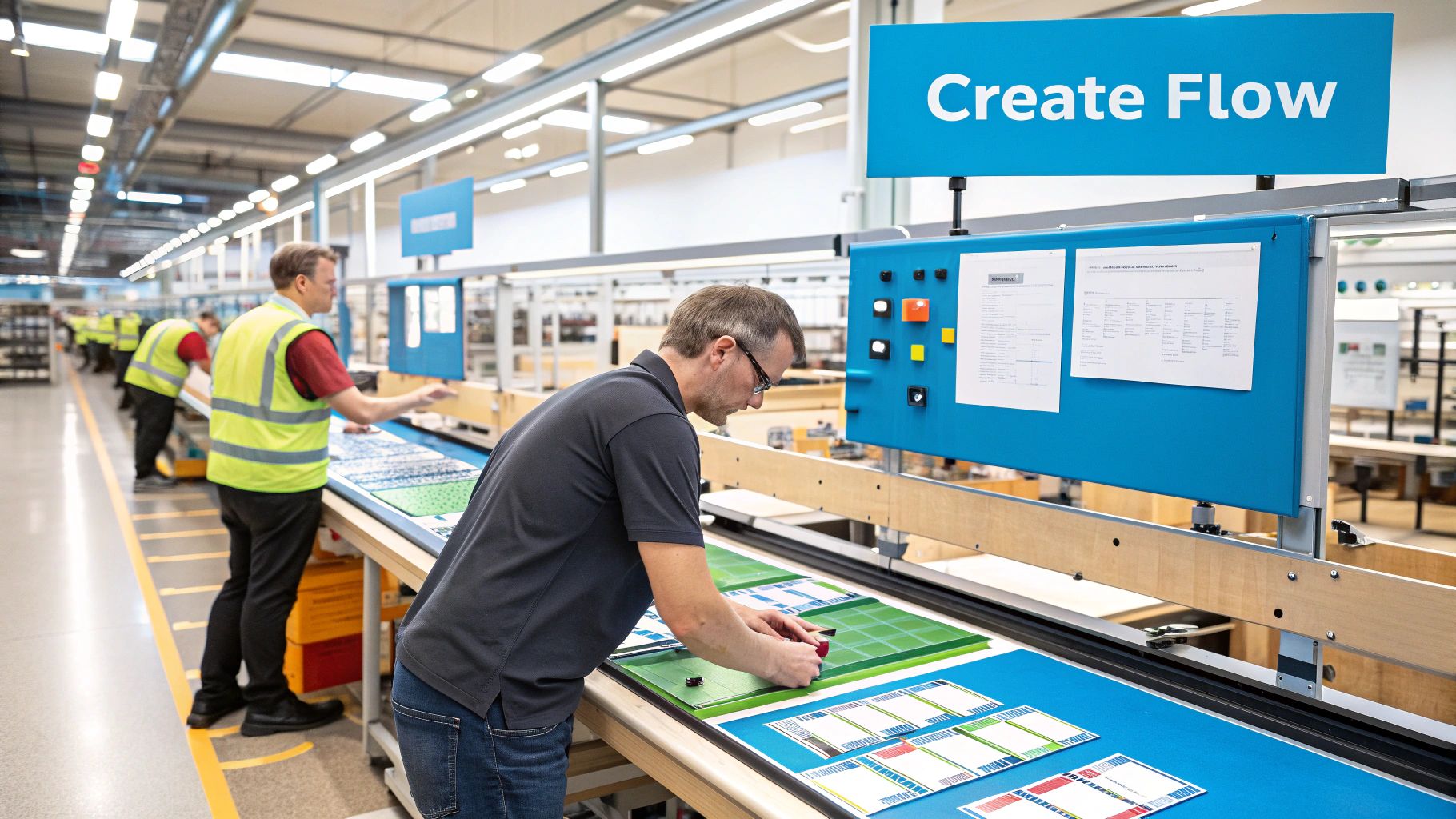
This approach creates a culture of continuous improvement, as famously demonstrated by Toyota, Boeing, and General Electric. To dive deeper into the practical steps for eliminating waste and maximizing value, consider exploring resources on implementing Lean processes.
The AR/VR Advantage
Immersive technologies like Augmented and Virtual Reality dramatically accelerate Lean adoption. AR overlays can guide technicians through standardized work, projecting instructions directly onto equipment to reduce motion waste and errors. VR simulations allow teams to practice value stream mapping and identify production bottlenecks in a risk-free virtual plant floor before committing to physical changes.
Key Insight: Using AR for remote assistance directly combats two of the seven wastes. It eliminates the need for expert travel (transport waste) and drastically cuts equipment downtime (waiting waste) by providing immediate virtual support, connecting on-site technicians with off-site experts instantly.
Actionable Implementation Tips
- Start with Value Stream Mapping: Visually map your entire process from start to finish to clearly identify areas of waste.
- Train All Teams: Ensure everyone, from the shop floor to the executive suite, understands core Lean principles to foster a unified culture.
- Utilize Visual Management: Implement tools like Kanban boards to make workflows, progress, and problems visible to everyone at a glance.
- Measure and Track: Consistently monitor key performance indicators (KPIs) to validate improvements and identify new opportunities for optimization.
2. Six Sigma: A Data-Driven Path to Near-Perfection
Six Sigma stands as a powerful industrial best practice, offering a disciplined, data-driven approach to eliminate defects and improve quality. Unlike philosophies focused primarily on waste, Six Sigma targets process variation, aiming for near-perfection with a goal of no more than 3.4 defects per million opportunities. It achieves this through a structured methodology, most famously DMAIC (Define, Measure, Analyze, Improve, Control).
Pioneered by Motorola and famously championed by General Electric, this methodology delivers substantial financial returns by reducing costs associated with poor quality. For organizations pursuing Six Sigma's goal of near-perfect quality, establishing stringent document quality control is a critical foundational step to ensure process standards are accurately captured and followed. To see how this applies directly to production, explore insights on manufacturing quality improvement.
The AR/VR Advantage
Augmented and Virtual Reality are transforming Six Sigma projects by making complex data tangible. AR can overlay statistical process control (SPC) charts directly onto a machine, giving operators real-time feedback on performance and variation. VR simulations can be used to train "Green Belts" and "Black Belts" in the DMAIC process, allowing them to practice problem-solving on virtual production lines without disrupting actual operations.
Key Insight: AR-guided workflows enforce standardized procedures with unparalleled precision, directly addressing the “Control” phase of DMAIC. By projecting step-by-step digital instructions onto the work area, these solutions ensure that process improvements are sustained and variation is minimized, preventing a relapse into old, inefficient habits.
Actionable Implementation Tips
- Define Clear Project Goals: Select projects with a measurable impact on customer satisfaction and a clear return on investment.
- Invest in Training: Ensure team members are properly trained in Six Sigma methodologies and statistical tools to drive effective analysis.
- Secure Leadership Buy-In: Strong, visible sponsorship from leadership is crucial for overcoming resistance and securing necessary resources.
- Focus on Data: Base all decisions on rigorous statistical analysis, not on assumptions or anecdotal evidence.
3. Total Productive Maintenance (TPM): Empowering Teams, Maximizing Uptime
Total Productive Maintenance (TPM) is a foundational industrial best practice that fundamentally shifts the responsibility for routine maintenance from dedicated technicians to the equipment operators themselves. This strategy empowers operators with ownership, transforming them into the first line of defense against equipment failure. TPM’s core goal is to achieve near-perfect production by eliminating breakdowns, slowdowns, and defects through proactive, employee-led maintenance activities.
This collaborative approach has delivered remarkable results for industry leaders. Nissan, for instance, reduced equipment breakdowns by 80%, while Harley-Davidson improved overall productivity by 40% after implementing TPM principles. The strategy fosters a culture where everyone is invested in equipment health, maximizing operational efficiency and asset lifespan. For more insights on innovative maintenance strategies, explore discussions from leading industry events like the Maintenance Trade Show in Dortmund.
The AR/VR Advantage
Augmented Reality supercharges TPM by placing critical knowledge directly in the hands of operators. Using AR-powered devices, employees can access interactive, step-by-step guides for autonomous maintenance tasks like cleaning, lubrication, and inspection. These visual overlays ensure tasks are performed correctly and consistently, dramatically reducing errors and training time. VR can be used to simulate complex maintenance scenarios, allowing operators to practice responding to potential failures in a safe, controlled environment.
Key Insight: AR empowers operators to perform tasks previously reserved for specialists. With a solution that provides standardized digital work instructions overlaid on machinery, an operator can follow complex autonomous maintenance routines with precision, ensuring perfect execution and boosting equipment reliability.
Actionable Implementation Tips
- Launch a Pilot Program: Start with a single machine or production line to refine your process and demonstrate early wins before a full-scale rollout.
- Provide Comprehensive Training: Equip all operators with the skills and knowledge needed to perform their new maintenance responsibilities effectively.
- Establish Clear OEE Targets: Use Overall Equipment Effectiveness (OEE) as a key metric to track progress and identify areas for improvement.
- Celebrate Small Wins: Recognize and reward teams for achieving maintenance milestones to build momentum and reinforce the TPM culture.
4. 5S Workplace Organization
As a foundational element of industrial best practices, the 5S Workplace Organization method provides a systematic framework for creating and maintaining a clean, safe, and highly efficient work environment. This methodology, originating from Japanese manufacturing, uses five principles: Seiri (Sort), Seiton (Set in Order), Seiso (Shine), Seiketsu (Standardize), and Shitsuke (Sustain). Its goal is to eliminate waste derived from poor organization, lost tools, and unsafe conditions.
This powerful system drives productivity by making workflows intuitive and minimizing non-value-added activities. Companies like Toyota and Ford famously use 5S to reduce setup times and defects, while organizations like Virginia Mason Medical Center have adapted it to improve patient safety. For a deeper understanding of its history and application, explore resources on Takashi Osada's philosophy.
The AR/VR Advantage
Immersive technologies simplify and sustain 5S initiatives. Using AR, technicians can see digital overlays showing the correct placement for tools and equipment, enforcing the "Set in Order" principle with precision. VR can be used to train employees on 5S principles in a simulated environment, allowing them to practice sorting and organizing a virtual workspace without disrupting live operations. This interactive training enhances retention and speeds up adoption across the entire facility.
Key Insight: AR-powered digital checklists and audit tools can be used to execute the "Standardize" and "Sustain" phases more effectively. Instead of paper forms, auditors use a headset or tablet to follow guided inspection routes, capture photographic evidence of non-compliance, and instantly log corrective actions, ensuring long-term adherence.
Actionable Implementation Tips
- Start with a Pilot Area: Select one specific work cell or area to implement 5S first to demonstrate its benefits and refine your process.
- Visualize Progress: Take "before" and "after" photos to create a powerful visual record of the improvements, motivating teams to continue.
- Involve All Employees: Empower the people who do the work to design the organization systems, fostering a sense of ownership and accountability.
- Conduct Regular Audits: Make 5S audits a routine part of operations to ensure standards are maintained and to identify opportunities for further improvement.
5. Industry 4.0 and Smart Manufacturing
Industry 4.0 represents the fourth industrial revolution, merging physical production with smart digital technology. This best practice integrates IoT sensors, artificial intelligence, and automation to create intelligent, connected manufacturing environments. The core goal is to enable real-time data collection, analysis, and decision-making, which optimizes production processes and opens the door for mass customization and operational agility.
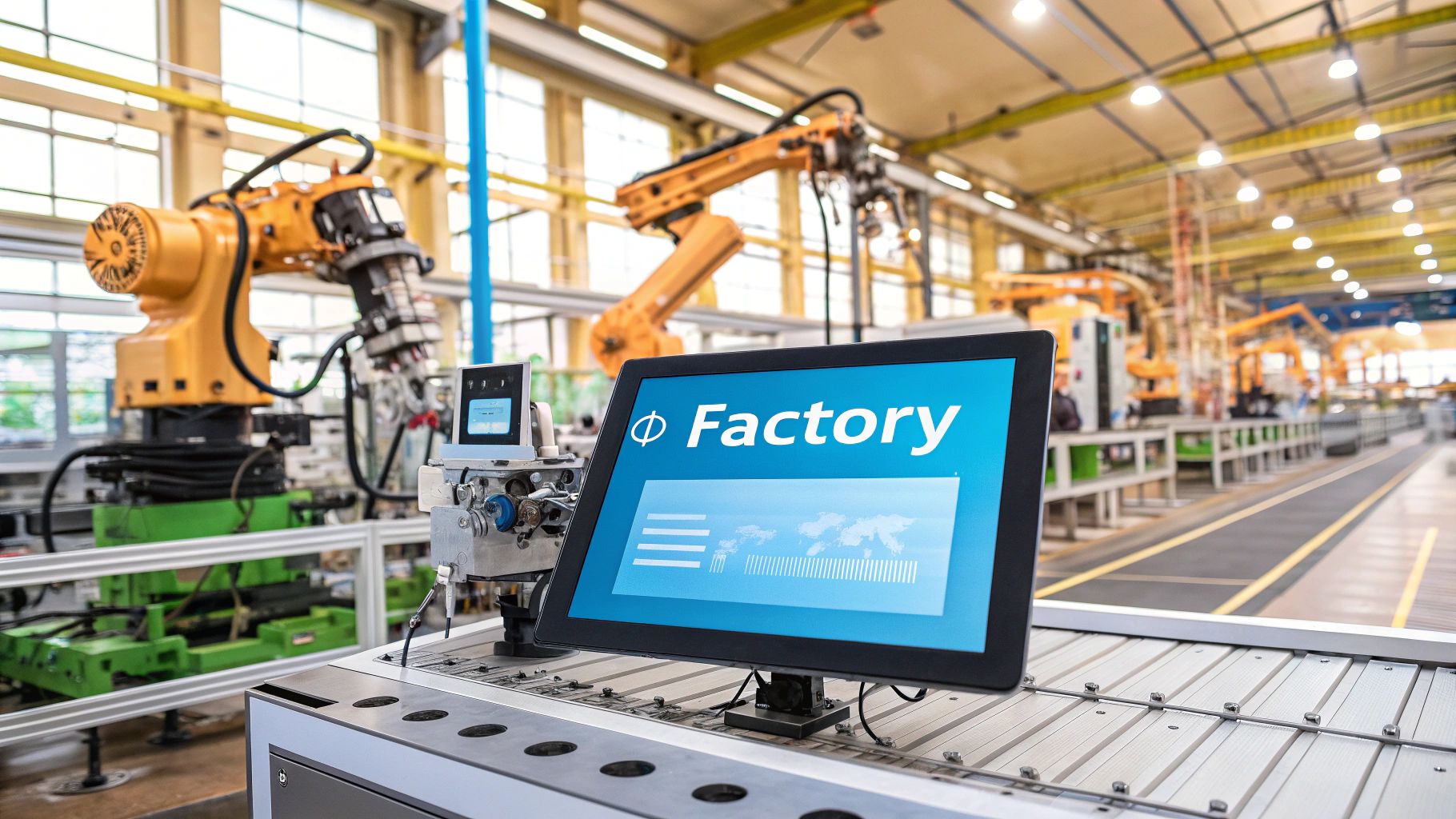
This transformative approach is championed by industrial leaders like Siemens, whose Amberg Electronics Plant achieved a 99.9988% quality rate, and Bosch, which has implemented Industry 4.0 across 250 plants globally. To understand how immersive technologies fit into this revolution, explore the role of augmented reality for manufacturing.
The AR/VR Advantage
Augmented and Virtual Reality are key enablers of Industry 4.0, acting as the human-machine interface for the smart factory. AR applications visualize real-time data from IoT sensors directly onto physical equipment, allowing technicians to see performance metrics, identify anomalies, and receive guided instructions without looking away from their work. VR can be used to create digital twins of entire production lines, enabling teams to simulate changes, test new layouts, and train on complex processes in a safe, virtual environment.
Key Insight: Integrating AR into a smart factory ecosystem provides a direct link between digital insights and human action. An operator can instantly see an alert from a predictive maintenance system overlaid on the specific machine component, along with step-by-step AR repair guidance, turning data into immediate, value-driven activity.
Actionable Implementation Tips
- Start with Pilot Projects: Identify a high-impact, low-risk area to launch a pilot project to prove the concept and demonstrate a clear return on investment.
- Prioritize Cybersecurity: Invest in robust cybersecurity infrastructure from the very beginning to protect connected systems and sensitive operational data.
- Develop Digital Literacy: Create comprehensive training programs to upskill your workforce, ensuring they are comfortable and proficient with new digital tools.
- Focus on Interoperability: Choose scalable technology platforms that can easily integrate with your existing systems and grow with your operational needs.
6. Kaizen: Cultivating a Culture of Continuous Improvement
Kaizen is a foundational philosophy among industrial best practices, promoting small, ongoing, positive changes to improve all aspects of a business. This Japanese concept, meaning "change for the better," involves every employee, from the assembly line to the C-suite, in a relentless pursuit of incremental enhancements. It prioritizes creating a culture of continuous learning and improvement over large, disruptive overhauls.
This approach has driven monumental success stories, such as Toyota’s legendary suggestion system and Lockheed Martin’s 30% reduction in aircraft production time. By empowering all team members to identify and solve problems, Kaizen embeds a powerful engine for innovation directly into daily operations, as detailed by the Kaizen Institute.
The AR/VR Advantage
Augmented and Virtual Reality are powerful catalysts for Kaizen, enabling teams to visualize and test improvements with unprecedented speed and accuracy. AR can overlay proposed workflow modifications directly onto the factory floor, allowing workers to trial changes without disrupting production. VR simulations provide a sandbox environment for teams to run focused Kaizen events, collaboratively reconfiguring production lines and processes to identify efficiency gains in a risk-free virtual setting.
Key Insight: Using AR for standardized work instructions directly supports Kaizen. When an improvement is identified, the digital instructions can be updated instantly across all devices, ensuring the new best practice is adopted immediately and uniformly, eliminating implementation delays.
Actionable Implementation Tips
- Empower All Employees: Create a simple system for everyone, regardless of their role, to submit improvement ideas.
- Implement and Iterate Quickly: Act on small, feasible suggestions immediately to build momentum and show that contributions are valued.
- Celebrate Small Wins: Regularly recognize individuals and teams who contribute to successful improvements to reinforce the Kaizen culture.
- Run Focused Kaizen Events: Dedicate specific time blocks (often called "Kaizen blitzes") for teams to tackle and solve a particular problem.
7. Statistical Process Control (SPC): Data-Driven Quality Assurance
Statistical Process Control (SPC) is a foundational industrial best practice that employs statistical methods to monitor, control, and improve a process. Developed by Walter Shewhart, this methodology focuses on identifying and controlling process variations, allowing teams to move from a reactive "detection" model to a proactive "prevention" model. By analyzing real-time data, SPC distinguishes between common cause and special cause variation, ensuring processes operate efficiently and consistently.
This data-driven approach is critical in high-precision industries. Intel, for example, relies heavily on SPC to maintain the stringent quality standards required in semiconductor manufacturing. Similarly, pharmaceutical companies use SPC to meet FDA compliance by ensuring production consistency and product safety, making it a cornerstone of modern quality assurance.
The AR/VR Advantage
Augmented Reality transforms SPC from abstract charts into an intuitive, real-time tool on the plant floor. Operators equipped with AR glasses can view live control charts and performance data overlaid directly onto their machinery. If a process variable drifts toward an upper or lower control limit, the system can trigger an immediate visual alert in the operator’s field of view, prompting corrective action before a defect ever occurs. VR can be used to simulate different process scenarios, training staff on how to interpret SPC data and react to out-of-control signals in a safe, controlled environment.
Key Insight: Integrating AR with SPC systems provides operators with instant, contextualized data at the point of action. This eliminates the need to check a separate monitoring station, reducing response time and empowering workers to maintain process stability directly.
Actionable Implementation Tips
- Identify Critical Characteristics: Begin by applying SPC to the most critical-to-quality (CTQ) characteristics of your product or process.
- Train Operators: Ensure that the teams running the processes understand basic statistical concepts, control charts, and the "why" behind SPC.
- Establish Reaction Plans: Clearly define the steps operators should take when a process shows signs of going out of control.
- Leverage Software: Use specialized SPC software to automate data collection, analysis, and visualization, making the process more efficient and less prone to error.
8. Poka-Yoke (Error Prevention): Building Quality into the Process
Poka-Yoke, Japanese for "mistake-proofing," is an indispensable industrial best practice that designs processes to prevent human errors before they happen. Developed by Toyota engineer Shigeo Shingo, this technique focuses on creating systems where the correct action is the only one possible, or where mistakes are immediately flagged for correction. It shifts the focus from inspecting for defects to building quality into every step of an operation.
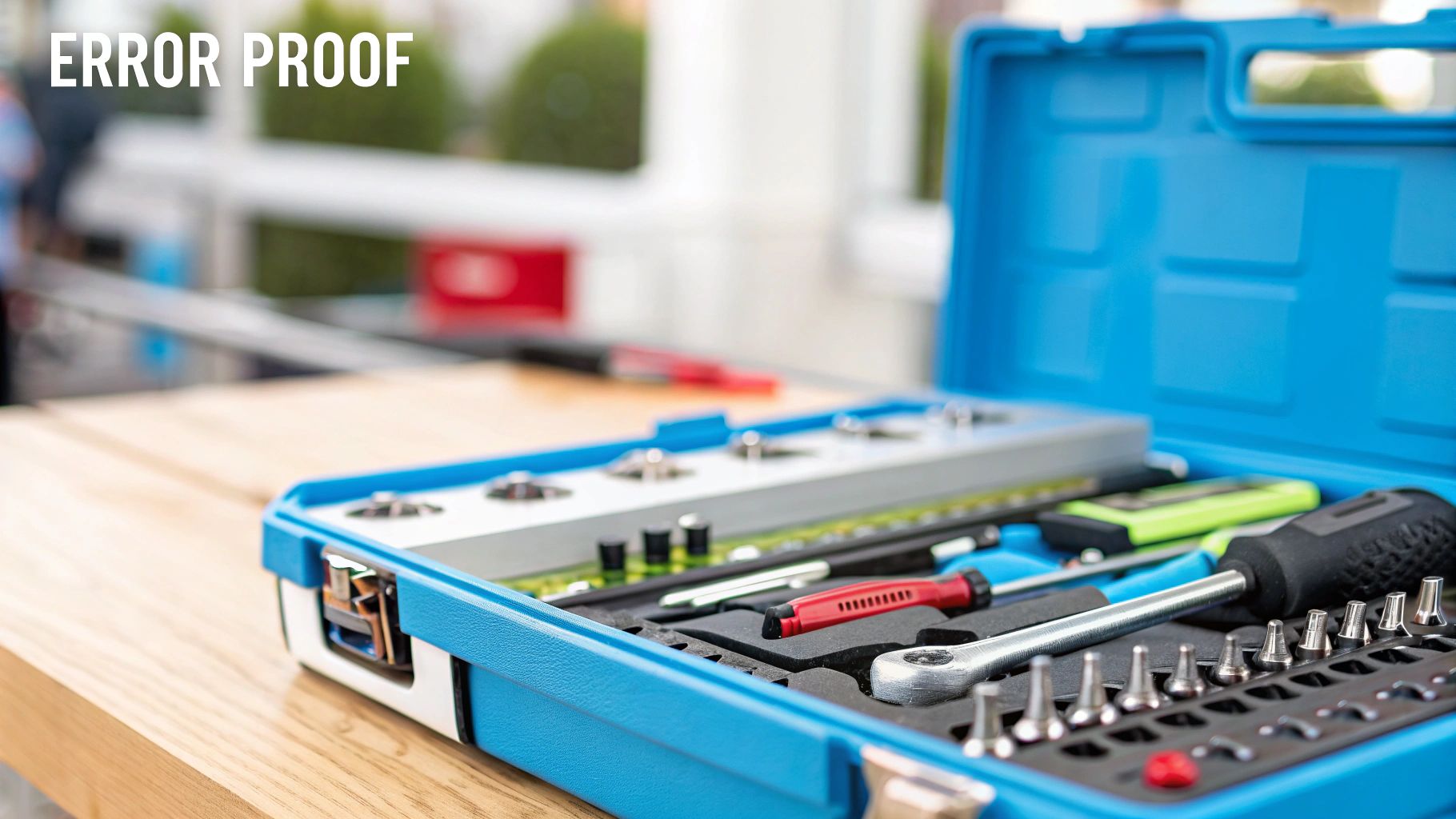
This method is embedded in everyday design, from USB ports that only fit one way to washing machines that won't run with the door open. In an industrial context, it translates to fixtures that only hold parts in the correct orientation or automated checklists that won't allow a process to advance until all steps are verified.
The AR/VR Advantage
Augmented Reality supercharges Poka-Yoke by providing dynamic, intelligent mistake-proofing. AR-guided work instructions can overlay digital cues, such as color-coding and arrows, directly onto a workstation, guiding an operator’s hands to the correct bin or tool. If an operator attempts to grab the wrong component, the system can generate an immediate visual and audible alert, effectively creating a digital Poka-Yoke that prevents the error in real-time.
Key Insight: Digital Poka-Yoke using AR is far more flexible than physical jigs. It can be updated instantly for new product variants without any hardware changes, making it ideal for high-mix, low-volume manufacturing environments.
Actionable Implementation Tips
- Identify Common Errors: Start by observing your processes and using data to pinpoint where mistakes most frequently occur.
- Engage the Operators: Involve front-line workers in designing mistake-proofing solutions. They have the deepest understanding of the workflow and potential failure points.
- Favor Simplicity: The most effective Poka-Yoke devices are simple, inexpensive, and intuitive, requiring minimal training to understand.
- Test and Refine: Thoroughly test any new mistake-proofing mechanism before full implementation to ensure it works reliably without creating new problems.
9. Root Cause Analysis (RCA): Solving Problems at the Source
Root Cause Analysis (RCA) is a disciplined, systematic approach for identifying the true origin of a problem, moving beyond merely treating its symptoms. This industrial best practice uses structured methods like the "5 Whys" or Fishbone (Ishikawa) diagrams to investigate failures and prevent them from recurring. By digging deeper into an incident, organizations can uncover fundamental flaws in processes or systems.
This methodology is critical in high-stakes industries, from NASA's mission failure analyses to patient safety investigations in healthcare. For a comprehensive look at applying these techniques, you can find valuable insights on advanced maintenance problem-solving.
The AR/VR Advantage
AR and VR transform RCA from a theoretical exercise into an immersive investigation. Technicians can use AR to replay equipment sensor data visually overlaid on the physical machine, helping them pinpoint the exact moment and location a fault occurred. VR allows cross-functional teams from different locations to gather in a virtual replica of the incident site, collaboratively analyzing evidence and reconstructing events without disrupting the actual work area.
Key Insight: Using AR inspection tools, teams can document an incident site with geo-tagged photos, videos, and notes. This creates an accurate, shareable digital record that serves as the foundation for a thorough and data-driven Root Cause Analysis, ensuring no detail is lost.
Actionable Implementation Tips
- Assemble a Cross-Functional Team: Include operators, maintenance staff, engineers, and management to gain diverse perspectives on the problem.
- Focus on Systems, Not Blame: The goal is to identify process and system failures, not to assign personal fault. This fosters an open and honest investigative culture.
- Use Multiple Analysis Tools: Combine techniques like the 5 Whys with a Fishbone diagram to validate findings and ensure all potential causes are explored.
- Follow Up and Verify: After implementing corrective actions, continuously monitor the process to confirm that the solution was effective and the problem has not resurfaced.
10. Value Stream Mapping (VSM): Visualizing the Flow of Value
Value Stream Mapping (VSM) is a foundational industrial best practice for visualizing, analyzing, and improving all the steps in a delivery process. This Lean tool goes beyond a simple flowchart by mapping both material and information flows required to bring a product from raw material to the customer. It provides a holistic view of the current state, making it easier to identify waste, reduce process cycle times, and implement truly impactful improvements.
This method has driven significant results for industry leaders like Boeing, which used VSM to reduce assembly time for its 737 aircraft, and Amazon, which applies VSM principles to optimize warehouse operations. To effectively visualize the flow of value, exploring various process mapping techniques can help identify inefficiencies and opportunities for improvement.
The AR/VR Advantage
Immersive technology transforms VSM from a static, two-dimensional exercise into a dynamic, interactive experience. Teams can use VR to build and walk through a virtual model of the entire value stream, identifying physical and logistical bottlenecks that are not obvious on paper. AR can then overlay future state designs onto the real-world factory floor, allowing workers to visualize and provide feedback on proposed changes to workstation layouts or material flow paths before any physical assets are moved.
Key Insight: VSM is fundamentally about making the invisible visible. AR/VR takes this to the next level, allowing teams to not just see the process flow but to virtually experience it, leading to more intuitive and effective problem-solving.
Actionable Implementation Tips
- Walk the Gemba: Create your map by physically walking the process path. Do not rely on assumptions or old documentation.
- Form a Cross-Functional Team: Involve representatives from every stage of the value stream, including operators, logistics, and management, for a comprehensive perspective.
- Focus on One Product Family: Avoid complexity by initially mapping a single, high-impact product or service family.
- Map Both States: Always create a "current state" map to understand your baseline before designing an improved "future state" map.
11. Total Quality Management (TQM): A Holistic Commitment to Excellence
Total Quality Management (TQM) is a comprehensive management philosophy centered on achieving long-term success through customer satisfaction. Unlike methods that focus on specific processes, TQM is an organization-wide effort that integrates all functions—from design and manufacturing to sales and service—to continuously improve the quality of products and services. It instills a culture where every employee is responsible for upholding quality standards.
This approach is characterized by its focus on customer needs, total employee involvement, process-centered thinking, and a commitment to continuous improvement. Industry leaders like Toyota and Xerox have long embedded TQM principles into their corporate DNA, using it to drive market leadership and operational excellence. TQM provides the cultural framework that enables more specific methodologies like Six Sigma and Lean to thrive.
The AR/VR Advantage
AR and VR solutions provide powerful tools to support a TQM culture. VR training modules can immerse employees in customer-centric scenarios, helping them understand the real-world impact of quality on user experience. AR can deliver in-the-moment quality control guidance by overlaying digital checklists, measurement tolerances, and best-practice examples directly onto a workstation. This ensures quality standards are met at every step of the process, not just at final inspection.
Key Insight: AR empowers every employee to be a quality champion. By providing instant access to visual standards and work instructions, AR technology makes it easier for front-line workers to perform tasks correctly the first time, reducing rework and reinforcing a "zero-defect" mindset.
Actionable Implementation Tips
- Secure Top-Down Commitment: TQM requires unwavering commitment and active participation from senior leadership to succeed.
- Focus on the Customer: Use customer feedback as the primary driver for all quality improvement initiatives.
- Empower and Train Employees: Provide continuous training and empower employees to take ownership of quality within their roles.
- Measure and Analyze: Use data to track quality performance, identify root causes of problems, and measure the impact of improvements.
11 Industrial Best Practices Comparison
| Methodology | Implementation Complexity 🔄 | Resource Requirements ⚡ | Expected Outcomes 📊 | Ideal Use Cases 💡 | Key Advantages ⭐ |
|---|---|---|---|---|---|
| Lean Manufacturing | Medium to High – cultural change & continuous support needed | Moderate – training & gradual rollout | Waste reduction, faster production, higher quality | Manufacturing operations seeking efficiency & quality | Reduces waste and lead times; improves quality & engagement |
| Six Sigma | High – requires statistical expertise & certifications | High – extensive training & tools | Near-perfect quality, defect reduction | Complex process improvement with measurable financial impact | Structured problem-solving; strong quality improvements |
| Total Productive Maintenance (TPM) | Medium to High – involves all employees, training intensive | Moderate to High – training & maintenance focus | Reduced downtime, longer equipment life | Equipment-heavy operations aiming for reliability | Increases equipment uptime, enhances skills & reduces cost |
| 5S Workplace Organization | Low to Medium – straightforward principles, requires ongoing discipline | Low – minimal costs, employee involvement | Safer, cleaner, and more organized workplace | Any workplace needing organization and waste elimination | Easy to implement; improves safety and productivity |
| Industry 4.0 & Smart Manufacturing | Very High – complex integration and upskilling needed | Very High – capital investment & training | Real-time optimization, mass customization | Advanced manufacturing seeking digital transformation | Enhances flexibility, efficiency, predictive maintenance |
| Kaizen (Continuous Improvement) | Low to Medium – incremental changes, requires culture change | Low – employee involvement & engagement | Gradual, sustainable improvements | Organizations aiming for continuous culture improvement | Low risk, high engagement, sustainable long-term gains |
| Statistical Process Control (SPC) | Medium – requires statistical skills and data analysis | Moderate – training and software | Early detection of quality issues | Processes needing quality control via data monitoring | Objective data use; consistent quality maintenance |
| Poka-Yoke (Error Prevention) | Low to Medium – simple design but creative solutions required | Low – generally low-cost implementations | Reduced errors and defects | Processes prone to human error | Prevents errors at source; simple and inexpensive |
| Root Cause Analysis (RCA) | Medium to High – requires skilled facilitators and time | Moderate – training diverse teams | Long-term problem resolution | Complex problem-solving and failure analysis | Prevents recurrence by addressing true causes |
| Value Stream Mapping (VSM) | Medium – detailed mapping and cross-functional coordination | Moderate – time for mapping and analysis | Identification of waste, bottlenecks | Process improvement and lean planning | Provides holistic process view; guides prioritization |
| Total Quality Management (TQM) | High – requires a complete cultural shift | High – long-term commitment and training | Improved customer satisfaction, higher quality | Organizations seeking a holistic, customer-focused culture | Creates a sustainable culture of quality and improvement |
From Theory to Transformation: Activating Your Industrial Strategy
Navigating the landscape of industrial best practices can feel like an overwhelming task. From the foundational principles of Lean Manufacturing and Six Sigma to the continuous improvement engine of Kaizen and the error-proofing genius of Poka-Yoke, each methodology offers a powerful lens through which to view and refine your operations. The eleven practices we have explored are not isolated tactics; they are interconnected components of a holistic strategy designed to build a resilient, efficient, and forward-thinking industrial enterprise.
The core takeaway is that sustainable success no longer hinges on methodology alone. The true competitive advantage emerges when these proven frameworks are supercharged with transformative technology. Implementing Total Productive Maintenance (TPM) is crucial, but empowering technicians with AR-guided workflows to execute those maintenance tasks flawlessly is a game-changer. Similarly, adopting the 5S methodology is effective, but using immersive VR simulations to train employees on workplace organization creates a safer, more deeply ingrained understanding from day one.
Activating Your Next Steps
Moving from knowledge to action is the most critical step. The journey toward operational excellence is continuous, not a one-time project. Begin by identifying the most significant friction points in your current processes.
- Is downtime your biggest challenge? Focus on implementing TPM and Root Cause Analysis, augmented with remote expert support via AR to resolve issues faster.
- Are quality control and defects hurting your bottom line? Prioritize Six Sigma, Statistical Process Control (SPC), and Poka-Yoke, using digital work instructions to ensure every step is followed correctly.
- Is employee training slow and inefficient? Leverage VR and AR to create immersive, on-demand training modules that accelerate learning and improve knowledge retention, directly supporting your continuous improvement goals.
The synergy between established industrial best practices and emerging digital tools creates a powerful flywheel effect. Better data from smart manufacturing initiatives feeds more accurate SPC. Clearer workflows from Value Stream Mapping (VSM) become the blueprint for AR-guided tasks. This integration is where theory becomes transformation, turning abstract goals into tangible, daily operational realities. Embracing this fusion of strategy and technology is how you not only solve today's problems but also build an agile foundation capable of meeting the challenges of tomorrow.
Ready to bridge the gap between your operational strategy and frontline execution? Discover how AIDAR Solutions can bring your industrial best practices to life with powerful, intuitive AR and VR platforms. Visit AIDAR Solutions to learn how our technology can accelerate training, streamline maintenance, and unlock new levels of productivity for your team.

