Augmented reality training solutions: Elevate Skills and Safety
Augmented reality training solutions provide on-the-job guidance by overlaying digital information—like instructions, 3D models, or schematics—directly onto an employee's view of the real world. This approach transforms static knowledge into interactive, real-time support, significantly accelerating skill acquisition and reducing operational errors.
The Next Leap in Workforce Development
Developing a skilled workforce safely and efficiently is a primary challenge in today's complex industrial landscape. Traditional training methods, reliant on dense manuals and classroom lectures, often result in slow onboarding and costly mistakes on the factory floor. Augmented reality training solutions are fundamentally changing this dynamic, evolving from a futuristic concept into a practical, results-driven tool for modern enterprises.
A traditional training manual is like a paper map. While the information is present, it requires an employee to divert attention from their task, interpret complex diagrams, and translate abstract steps into real-world actions. This constant context-switching is a formula for inefficiency and error.
A New Model for On-the-Job Guidance
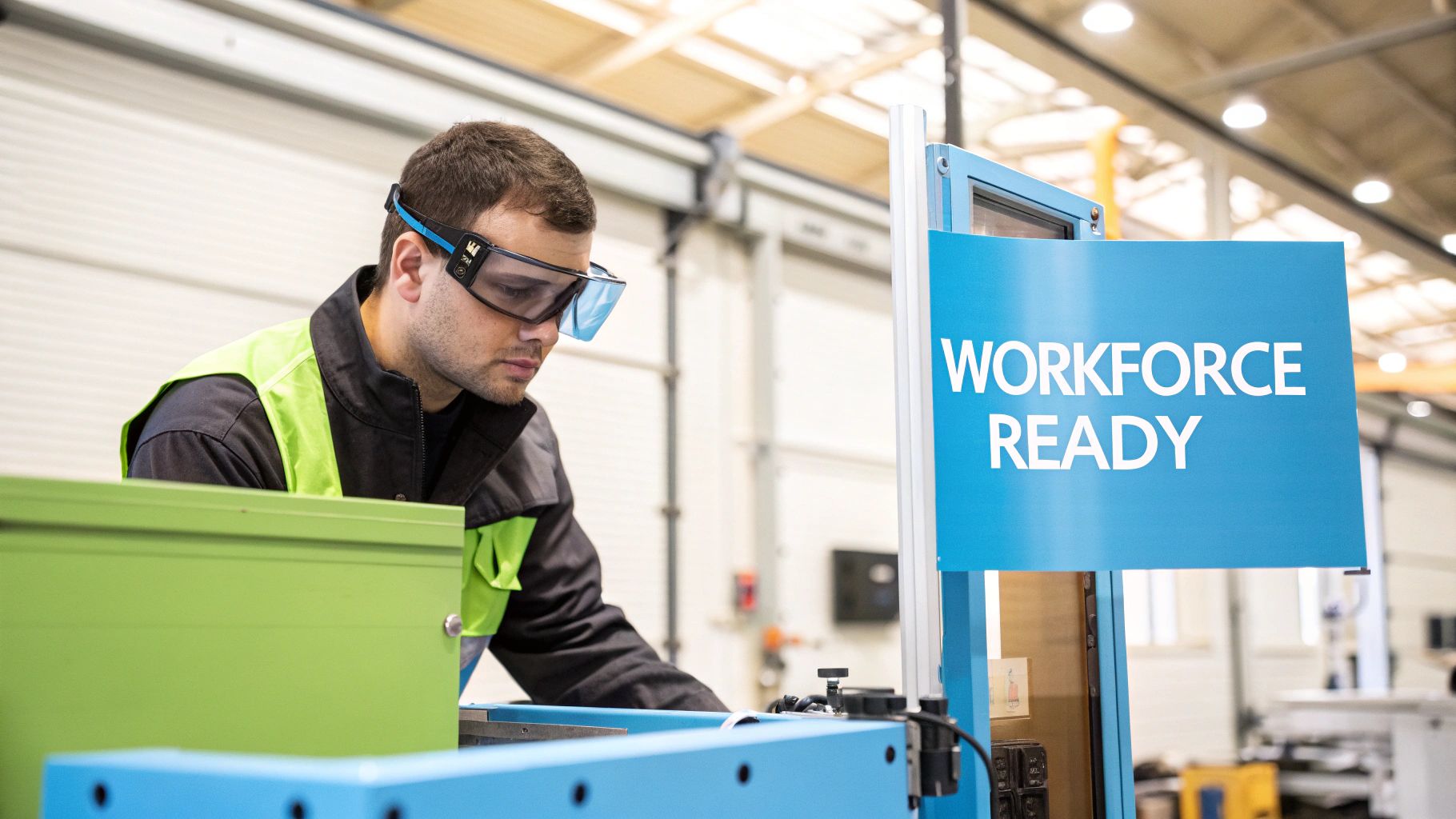
AR, in contrast, functions like a live, turn-by-turn GPS for hands-on tasks. It guides employees through complex procedures with high precision by projecting digital instructions onto the equipment they are working with. This "see-what-I-see" method eliminates guesswork and empowers technicians to perform tasks correctly on the first attempt. You can learn more about how XR is empowering the workforce of tomorrow in our detailed article.
This hands-on, guided learning model bridges the gap between knowing and doing. It ensures your people aren't just trained, but are genuinely competent and confident in their jobs from day one.
As we go through this guide, we'll examine the core business benefits that make these solutions so compelling. You'll see exactly how real organizations are achieving:
- Faster Skill Acquisition: By placing instructions directly in the context of the task, AR significantly shortens the learning curve for new hires and helps veteran employees acquire new skills rapidly.
- Drastically Reduced Errors: Visual guidance minimizes the potential for human error in complex assembly, maintenance, and quality control procedures.
- Enhanced Workplace Safety: Trainees can practice on virtual machinery or receive step-by-step guidance on hazardous tasks without real-world risk.
These advantages are more than just bullet points; they establish the foundation for a compelling business case. We’ll show you how augmented reality training solutions deliver a measurable and powerful return on investment, turning your workforce development program into a true engine for operational excellence.
What Are the Real-World Benefits of AR Training?
Moving beyond theory, the business case for augmented reality training is built on solid, measurable advantages. These platforms do not merely add a layer of technology to existing methods; they fundamentally reshape how employees learn, perform their jobs, and maintain safety. By focusing on the right key performance indicators, the return on investment becomes clear.
At its core, AR shifts training from a passive, memory-based activity into an active, hands-on experience. This shift is a game-changer for boosting both knowledge retention and an employee's confidence. Instead of just reading a manual, a technician sees digital instructions overlaid directly onto the machine they're working on, guiding them through a complex repair step-by-step.
Speed Up Skills, Slash Errors
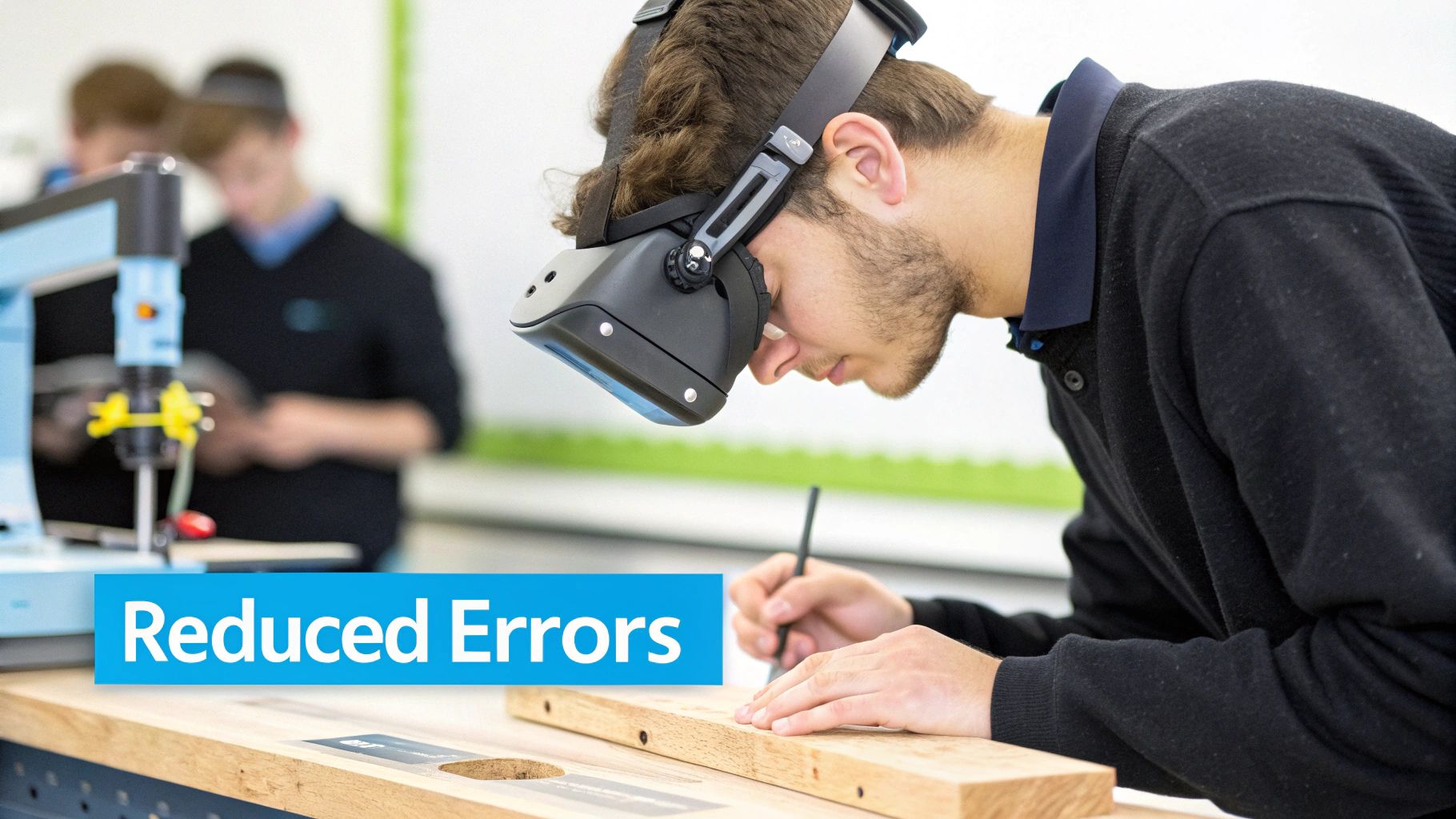
This immersive approach drastically reduces the learning curve. In industrial settings, AR training is proven to accelerate skill development, with studies showing up to a 75% faster learning curve and 90% higher knowledge retention compared to traditional methods. When employees learn by doing, the knowledge is retained more effectively. It’s a perfect example of experiential learning in action.
This "learning-by-doing" model has a direct, positive impact on operational quality. By providing clear visual guidance exactly where it's needed, AR eliminates guesswork and dramatically reduces human error during complex assembly, maintenance, or inspection tasks.
This manifests in several key ways:
- Better First-Time Fix Rates: Technicians using AR guidance are far more likely to resolve issues correctly on the first attempt.
- Less Rework and Scrap: Precise, visual instructions lead to a sharp decline in production mistakes, saving significant costs on materials and labor.
- Standardized Workflows: AR ensures that every employee follows the exact same best-practice procedure, every single time, leading to greater consistency.
Boost Workplace Safety and Efficiency
Safety is another area where AR delivers substantial value. It allows for training on dangerous machinery or in hazardous environments within a completely controlled, risk-free digital space. New hires can practice intricate procedures on a "digital twin" of a machine before they ever touch the real, high-stakes equipment.
By letting trainees make mistakes without any real-world consequences, AR builds crucial muscle memory and situational awareness. It’s a proactive approach that significantly reduces the potential for costly accidents and injuries on the job.
Our own guide on augmented reality safety dives deeper into how this technology is helping create much safer places to work. A safer workplace is almost always a more efficient one.
Furthermore, AR-powered remote assistance transforms the deployment of expert knowledge. Instead of flying a senior engineer to a remote site, they can virtually "look over the shoulder" of a local technician through an AR headset. The expert can annotate the technician's field of view, share diagrams, and provide real-time guidance to resolve problems in minutes, not days. This capability alone delivers a significant ROI by:
- Slashing travel costs for top experts.
- Minimizing equipment downtime with faster problem-solving.
- Improving knowledge transfer from seasoned veterans to the next generation of technicians.
Cumulatively, these benefits provide the hard data needed to justify an investment in AR training. It proves this isn't just a technology upgrade—it's a strategic move toward a smarter, safer, and more productive workforce.
How AR Training Actually Works in the Real World
Understanding the theory of augmented reality training solutions is one thing, but seeing them in action is another. The true power of this technology becomes clear when you move past concepts and look at how it solves specific, high-stakes problems on the ground. Discussing faster learning curves is interesting, but watching a new technician flawlessly assemble a complex engine on their first try is compelling.
Let's explore how these solutions are addressing everyday challenges across major industrial sectors. The pattern is simple but effective: identify a pressing operational challenge, deploy a targeted AR solution, and achieve a real, measurable result. This is happening today on factory floors and in the field.
Manufacturing Assembly and Quality Control
On a busy factory floor, maintaining high quality while meeting production quotas is a constant pressure. A single mistake in an assembly sequence can trigger a cascade of problems, including costly rework, wasted materials, and significant delays. Traditional reliance on paper manuals or "tribal knowledge" is inconsistent and presents a steep learning curve for new hires.
AR provides a direct solution. An assembly worker puts on a pair of smart glasses, and as they look at a piece of machinery, digital instructions appear overlaid on the components.
- Step-by-step guidance: The AR display highlights the exact bolts to tighten, showing the correct sequence and even the required torque specifications.
- Automated quality checks: The device's camera can instantly verify that a step was performed correctly before unlocking the next one, creating a perfect digital audit trail.
- Access to schematics: If the worker encounters an issue, they can pull up a 3D model of the part, rotating and inspecting it from every angle without leaving their workstation.
The result is a significant reduction in assembly errors, faster onboarding, and an enhanced level of quality control. It transforms a complex, memory-based process into a simple, guided workflow that drives consistency.
Field Service and Remote Expertise
Now, consider a junior field technician dispatched to a remote wind turbine to fix a critical failure. They face a problem they have never encountered before, and every minute of downtime is costly. The traditional solution involved flying a senior expert to the site, a process that could take hours or even days.
With an AR-powered remote assistance tool, the solution is immediate. The field technician puts on their smart glasses and starts a video call with a senior expert at headquarters.
The expert sees exactly what the technician sees, live. They can then draw on the technician's view, circling specific components, popping up technical documents, and walking them through the entire repair, step-by-step.
This "see-what-I-see" capability is a genuine force multiplier for your most experienced personnel. If you want to understand the hardware that makes these immersive environments possible, it's worth exploring devices like the Apple Vision Pro. A great breakdown can be found in A Fintech Leader's Guide to the Apple Vision Pro. The business impact is substantial, turning a potential crisis into a quick, efficient resolution.
In fact, AR-powered immersive training is already making waves in manufacturing and maintenance, delivering 75% reductions in expert travel and cutting service times in half. The market's growth tells the story: valued at USD 16,401.8 million in 2024, it's projected to hit USD 69,590.5 million by 2030. You can dig into the numbers in this full report on the immersive training market.
Complex Maintenance and Repair Operations
Finally, consider the immense challenge of maintaining complex assets like aircraft engines or power plant turbines. These are tasks where precision is paramount, and a mistake can have catastrophic consequences. The procedural manuals are voluminous, often thousands of pages that take technicians years to master.
Augmented reality transforms these dense manuals into interactive, 3D work instructions. A maintenance engineer can look at an engine and see a digital overlay of its internal parts, complete with animated guides walking them through a delicate multi-step procedure. This offers several game-changing advantages:
- Procedural Adherence: It ensures that even the most complex jobs are performed exactly according to procedure, boosting safety and ensuring compliance.
- Contextual Data: Technicians can view live sensor data, access maintenance histories, and check part numbers directly on the equipment they’re working on.
- Hands-Free Operation: Because instructions are displayed in their line of sight, technicians can keep both hands on their tools, which is both safer and more efficient.
These real-world examples demonstrate that AR isn't just another training gimmick—it’s a powerful operational tool. By delivering the right information to the right person at the exact moment of need, augmented reality training solutions are helping industrial companies work smarter, safer, and far more effectively.
Your Roadmap for AR Implementation
Adopting any new technology can feel like a massive undertaking, but a strategic plan can transform a daunting project into a series of achievable wins. Implementing augmented reality training solutions is no different. The key is a phased approach that starts small and scales with proven success, minimizing risk and building momentum along the way.
The journey begins not with a company-wide initiative, but with a tightly focused pilot project. The purpose is to prove the concept in a controlled setting where you can measure everything and learn what works before scaling up.
Start With a High-Impact Pilot
First, identify a single, persistent problem that AR can solve. Look for a workflow that is a known production bottleneck or a consistent source of errors. A complex assembly process with a high rework rate is a perfect candidate. So is a maintenance task that frequently requires an expert to travel to the site.
Once you have your target, define what success looks like with concrete metrics. Vague goals like "improving efficiency" are insufficient. You need specific metrics that will capture leadership's attention.
- Time Reduction: Can you reduce the average time to complete a specific maintenance task by 25%?
- Error Rate: Aim to decrease assembly errors on a particular workflow by 40%.
- Onboarding Speed: Can a new hire be brought up to speed in half the time?
Securing buy-in from key stakeholders—from the plant manager to the IT team—is essential. Frame the project not as a technology experiment, but as a direct solution to one of their most significant challenges. Working with an experienced augmented reality consulting partner at this stage can be invaluable, helping you build a robust strategy from the outset.
Choose Your Deployment Model
As you plan the pilot and consider future expansion, you will need to decide on a deployment model. This decision impacts initial cost, scalability, data security, and maintenance responsibilities. The two primary options are Software as a Service (SaaS) and on-premise.
SaaS is a cloud-based, subscription model where the vendor manages all backend infrastructure. This means lower upfront costs, automatic updates, and rapid implementation. It is an excellent choice for pilot projects and for companies that need to remain flexible.
On-premise involves installing and running the software on your own company servers. This provides complete control over your data and allows for extensive customization, but it requires a significant initial investment in hardware and the IT resources to manage it.
The right model depends on your company's specific requirements regarding security, budget, and IT capabilities. SaaS often provides the agility to launch a pilot quickly, while an on-premise model may be necessary for industries with strict data regulations.
Here's a quick breakdown to help you weigh the options:
SaaS vs On-Premise AR Solution Deployment
| Factor | SaaS (Software as a Service) | On-Premise |
|---|---|---|
| Initial Cost | Low (subscription-based) | High (licenses, hardware, infrastructure) |
| Deployment Speed | Fast (days or weeks) | Slow (months, requires internal setup) |
| Scalability | High (easy to add/remove users) | Limited (requires hardware upgrades) |
| Maintenance | Managed by the vendor | Managed by your internal IT team |
| Data Security | Handled by vendor (check compliance) | Maximum control, managed in-house |
| Customization | Limited to vendor's offerings | High degree of customization possible |
| Updates | Automatic and included | Manual, requires IT resources |
Ultimately, the best choice aligns with your long-term strategy. The process itself, from problem to solution, is fairly straightforward.
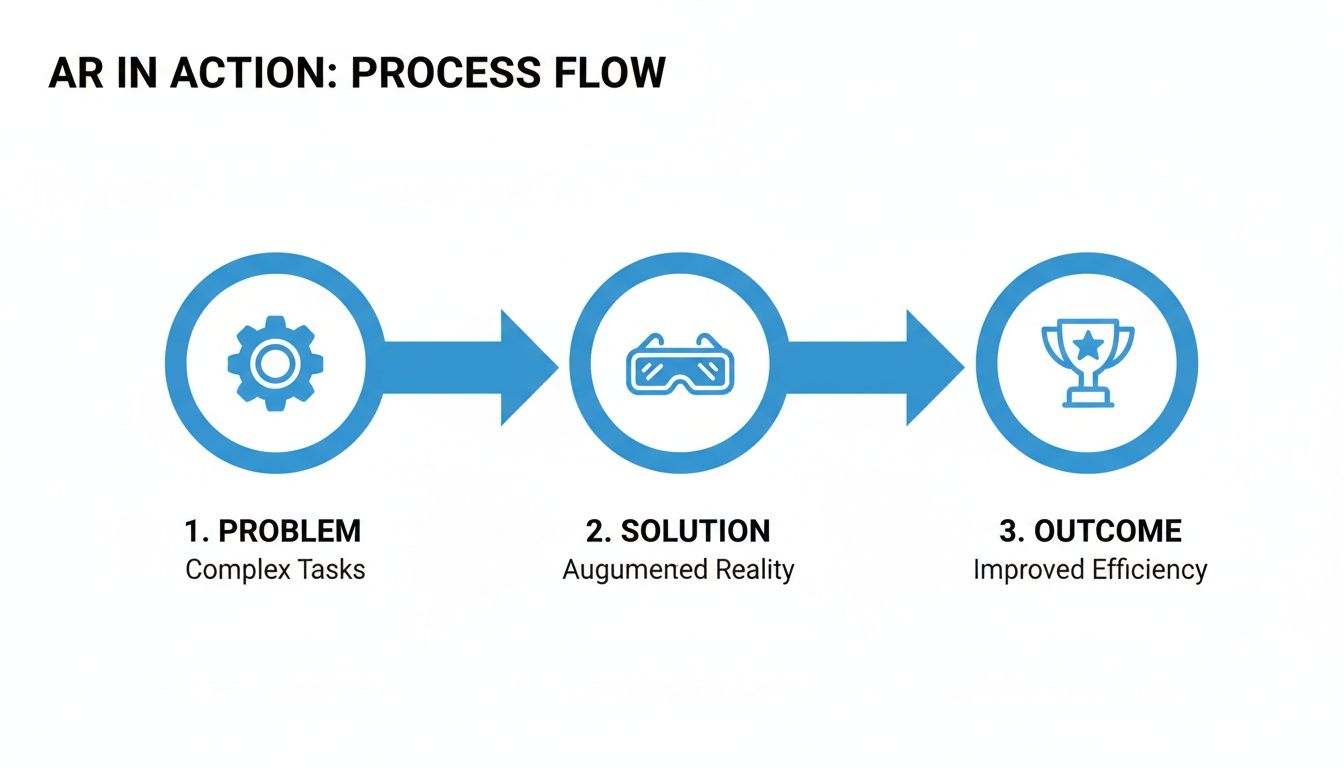
This visual shows just how simple the core idea is: you identify a challenge, deploy an AR solution, and get a measurable improvement in performance.
Scale Your Success Intelligently
With a successful pilot completed and hard data to support its value, you are ready to expand. Scaling means rolling out your augmented reality training solutions to other teams, departments, or even entire facilities.
One of the biggest hurdles at this stage is content creation. The most effective rollouts empower your own subject matter experts—the veteran technicians who know the equipment best—to create training guides themselves using simple, no-code authoring tools.
Hardware also becomes a more significant consideration. While smartphones and tablets are great for getting started, more complex, hands-on work will likely benefit from dedicated smart glasses.
Finally, you need to ensure the AR platform integrates with your existing enterprise systems. Connecting it to your Learning Management System (LMS) or Product Lifecycle Management (PLM) software is crucial for making AR a seamless part of your operations rather than another standalone tool.
Finding the Right Partner (Not Just a Vendor)
Selecting a provider for your augmented reality training solutions is one of the most critical decisions you will make. This is not a simple technology purchase; it is a strategic partnership that can determine the success of your entire AR initiative. You are looking for a partner who functions as an extension of your own team and is genuinely invested in your long-term success.
A compelling demonstration is one thing, but the real value lies in a partner's ability to deliver, scale, and support a solution that effectively solves your business problems. You are not just buying software. You are investing in a relationship with a team that has the deep industry knowledge to guide you from a small pilot to a full-scale enterprise deployment.
Look Beyond the Tech Demo
The single most important factor is proven industry expertise. A partner who understands the pressures and workflows of your sector—whether manufacturing, field service, or logistics—will deliver immediate impact. They understand your challenges and can anticipate roadblocks before they arise.
Next, consider their integration capabilities. Your AR solution cannot operate in isolation. A top-tier partner will have a solid track record of connecting their platform with your core enterprise systems, like your LMS, PLM, or maintenance software. This integration embeds AR directly into your day-to-day operations and creates a seamless flow of data.
Key Evaluation Criteria
To help you evaluate potential partners, here is a practical checklist of what truly matters.
- A Platform That Scales: Can their platform grow with you? It needs to handle everything from simple, off-the-shelf applications for a pilot program to fully custom solutions for a complex, company-wide rollout.
- Easy Content Creation Tools: How is training content created? Look for partners with intuitive, no-code authoring tools. This empowers your own subject matter experts to build and update training modules themselves, without requiring a team of developers.
- Real Long-Term Support: What happens after implementation? A true partner provides comprehensive training, responsive technical support, and a dedicated success manager to ensure you are deriving maximum value from your investment.
The True Measure of a Partnership
Ultimately, you need a partner who is as focused on your outcomes as you are. They should be transparent about their implementation process, provide clear timelines, and help you define the metrics that will prove the ROI of the program.
Ask for case studies and references from existing clients. Hearing directly from organizations that have already undergone this process is invaluable.
Choosing a partner is a commitment. Find one who is transparent, has proven expertise in your industry, and offers a clear path to scale. Their success should be directly tied to yours.
This careful evaluation ensures you find an augmented reality training solutions provider who can meet your needs today and has the vision to support your growth tomorrow. A great partner doesn't just sell you technology; they empower you to build a more skilled, efficient, and safer workforce.
Measuring the ROI of Your AR Program
Ultimately, any new enterprise technology must answer one simple question: what is the return on investment? Augmented reality training solutions are no different. While qualitative benefits like improved morale are valuable, a strong business case requires hard numbers that connect investment to operational gains. This is how you secure executive buy-in and prove the program’s value.
It all starts by tracking the right Key Performance Indicators (KPIs). Your KPIs should directly correlate with the core challenges you set out to solve with AR. The goal is to demonstrate a tangible financial impact.

Key Metrics for AR Training ROI
To build a rock-solid ROI case, you need to capture savings and productivity gains across several key areas. These metrics paint a clear before-and-after picture, showing exactly what the technology is contributing to your bottom line.
- Reduced Training Time: This is a straightforward calculation of the hours saved in onboarding new hires or upskilling your current team. If AR reduces training time from 80 hours to 40, you have gained 40 hours of productive labor per employee.
- Lower Error Rates: Track the reduction in assembly mistakes, rework orders, and wasted materials. Every error prevented is a direct cost saving.
- Decreased Travel Expenses: Sum the savings from using AR-powered remote assistance instead of flying experts to job sites. This includes not just airfare but also hotels, meals, and lost productivity during transit.
- Improved First-Time Fix Rates: In field service, this is a critical metric. Measure the increase in problems solved on the first visit, which eliminates costly follow-up appointments and improves customer satisfaction.
- Minimized Equipment Downtime: Connect faster, more accurate repairs to increased operational uptime. Every hour a critical machine is running instead of being idle contributes to revenue.
Calculating the Financial Impact
Let's consider a brief example. A manufacturing company invests $100,000 in an AR training solution for its 50 field service technicians.
Before AR, 20% of their service calls required a senior expert to travel to the site, at an average cost of $2,000 per trip. With AR remote assistance, this travel is eliminated for their 500 annual service calls.
Annual Travel Savings: (500 calls * 20%) * $2,000/trip = $200,000
In this one area alone, the AR program delivers a 2x return in the first year. This is before factoring in savings from reduced errors or faster onboarding. For a more detailed analysis, you can input your own numbers into tools like our training ROI calculator to model your specific scenario.
This kind of clear financial impact is why adoption is accelerating. The market for AR and VR in training is projected to grow from USD 9,087.2 million in 2025 to USD 600,544.0 million by 2035. As detailed in the market analysis from Future Market Insights, this growth indicates a clear shift from niche technology to an essential enterprise tool, especially in industries where hands-on skills are critical.
By connecting your investment to these clear, quantifiable outcomes, you prove that augmented reality training solutions are not just an innovation—they are a powerful driver of operational excellence and a sound financial decision.
Your Questions About AR Training, Answered
Adopting new technology often raises questions. When business leaders evaluate augmented reality for training, common concerns include cost, hardware requirements, and the process for creating training content. Let's address these directly.
How Much Does an Augmented Reality Training Solution Cost?
The cost can vary significantly based on the deployment model (SaaS vs. on-premise), the number of users, and the hardware selected. A smart approach is to begin with a focused pilot program, which offers a lower-cost entry point to prove the value before committing to a full enterprise rollout.
However, the primary consideration is not cost, but return on investment (ROI). We regularly see companies achieve a full payback in just 12-18 months. This return is driven by measurable savings, such as reduced expert travel costs, prevention of production errors, and significant gains in overall efficiency.
What Hardware Is Required for AR Training?
The good news is that AR training is highly flexible and often compatible with devices your team already uses. Simpler applications, such as remote expert assistance or digital work instructions, run effectively on standard smartphones and tablets. This makes it easy to get started without a major upfront hardware investment.
For more complex, hands-on tasks—such as intricate assembly or maintenance procedures—dedicated smart glasses are the ideal solution. Devices like the Microsoft HoloLens or the RealWear Navigator allow technicians to keep their hands on their tools while digital instructions are overlaid in their field of view. This enhances both safety and task accuracy.
How Do We Create Content for AR Training Modules?
Most industrial companies already possess a valuable asset for content creation: their existing 3D CAD models from engineering departments. A good technology partner can efficiently transform these designs into interactive, hands-on AR training experiences, meaning you are not starting from scratch.
Furthermore, modern AR platforms often include no-code authoring tools. This empowers your own subject matter experts—the people who know your equipment best—to create, modify, and deploy training modules themselves, with no programming skills required. This self-service capability is key to scaling AR training effectively across the entire organization.
Ready to see how AIDAR Solutions can transform your workforce development and deliver measurable ROI? Explore our immersive AR and VR applications and start building a more skilled, efficient, and safer team today. Learn more at AIDAR Solutions.