Augmented Reality and Business A Practical Guide to Driving Growth
For a long time, augmented reality felt like something out of a sci-fi movie—a compelling concept, but not something readily applicable to daily business operations. That perception is changing rapidly. AR is no longer a distant, futuristic idea; it's a practical tool available today, overlaying critical digital information onto the real world and transforming how frontline workers perform their jobs.
The New Reality of Business Operations
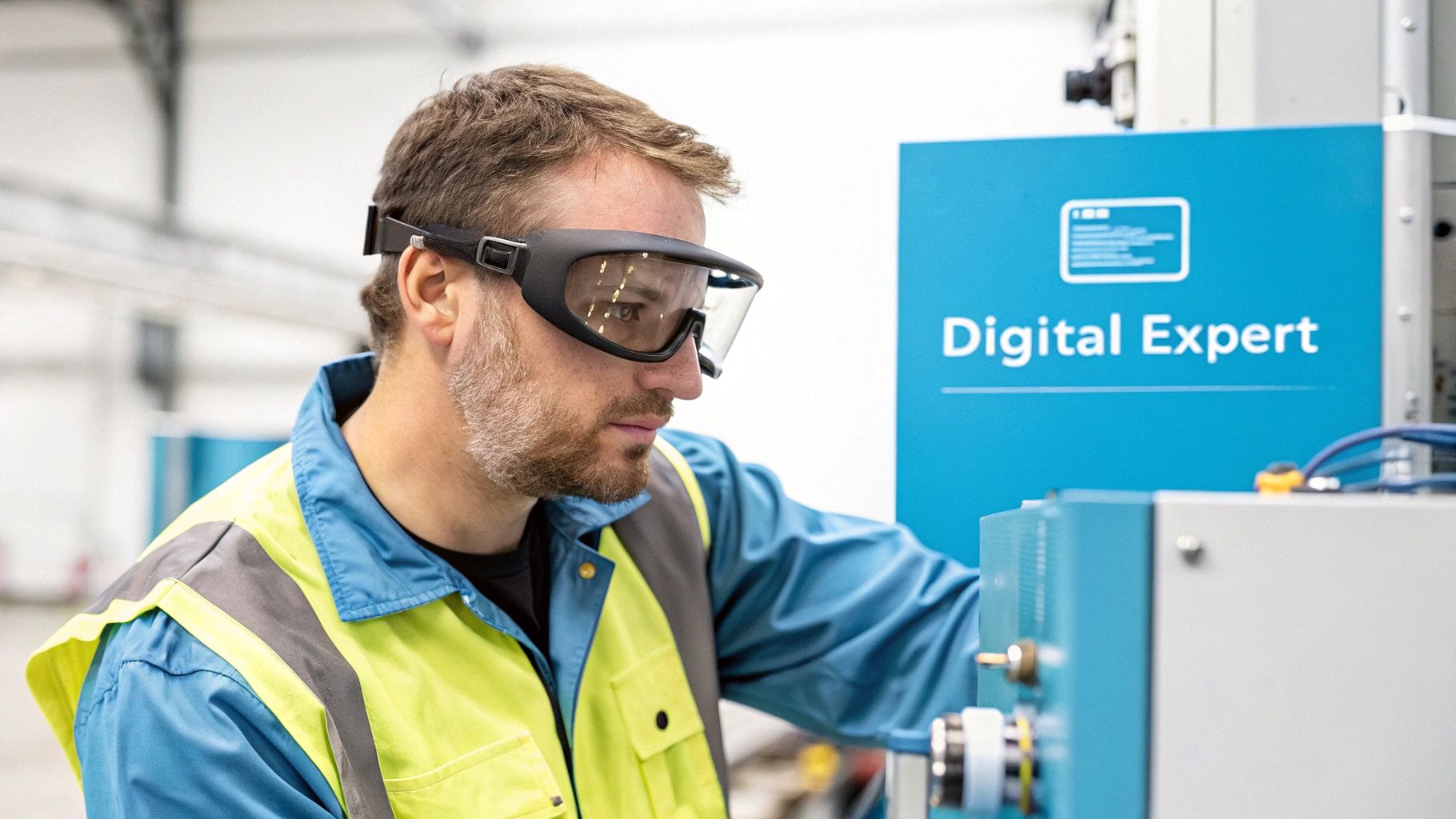
Augmented reality has moved beyond theoretical applications and is now solving tangible problems that businesses face every day. It acts as a digital expert, standing beside employees to guide them through complex tasks with live data visualizations, step-by-step instructions, and remote assistance from specialists located anywhere in the world.
This technology is proving its worth by addressing some of the most persistent operational challenges. The focus is not just on creating novel customer experiences, but on building a smarter, more capable, and safer workforce. Integrating AR into core business processes is no longer a novelty—it's a competitive advantage that is already delivering measurable returns.
A Market Demonstrating Clear Value
The market data confirms the trend. The rapid adoption of AR is fueling significant market growth, with the global augmented reality market projected to reach $87.3 billion in 2025, a substantial increase from $62.9 billion in 2024. This growth is a clear signal that businesses across every sector are realizing tangible value from AR solutions.
Even more telling is the mobile AR market, which is projected to expand from $30.6 billion in 2025 to $113.6 billion by 2030. This demonstrates how deeply AR is becoming integrated into mainstream operations.
By layering digital information onto the physical world, AR empowers employees to see what needs to be done, how to do it correctly, and get expert help without leaving their workstation. This translates directly into improved productivity and lower operational costs.
Laying the Groundwork for a Smarter Operation
AR solutions are designed to enhance human capabilities, not replace them. By delivering the right information exactly when and where it is needed, companies can unlock a new level of operational excellence. As businesses integrate new technologies, the user experience becomes critical. Significant effort goes into the principles of futuristic user interface design in AR/VR to ensure these digital overlays are intuitive and effective.
The core benefits of bringing AR into your business include:
- Boosting Efficiency: AR-guided workflows can significantly reduce the time required to complete complex assembly, maintenance, and inspection tasks.
- Improving Safety: Clear visual warnings and procedural guidance delivered directly into a worker's line of sight help minimize human error in high-stakes environments.
- Enhancing Training: AR allows employees to learn and practice new skills in immersive, hands-on simulations within a safe, controlled setting, which drastically improves knowledge retention.
Practical Use Cases Transforming Key Industries
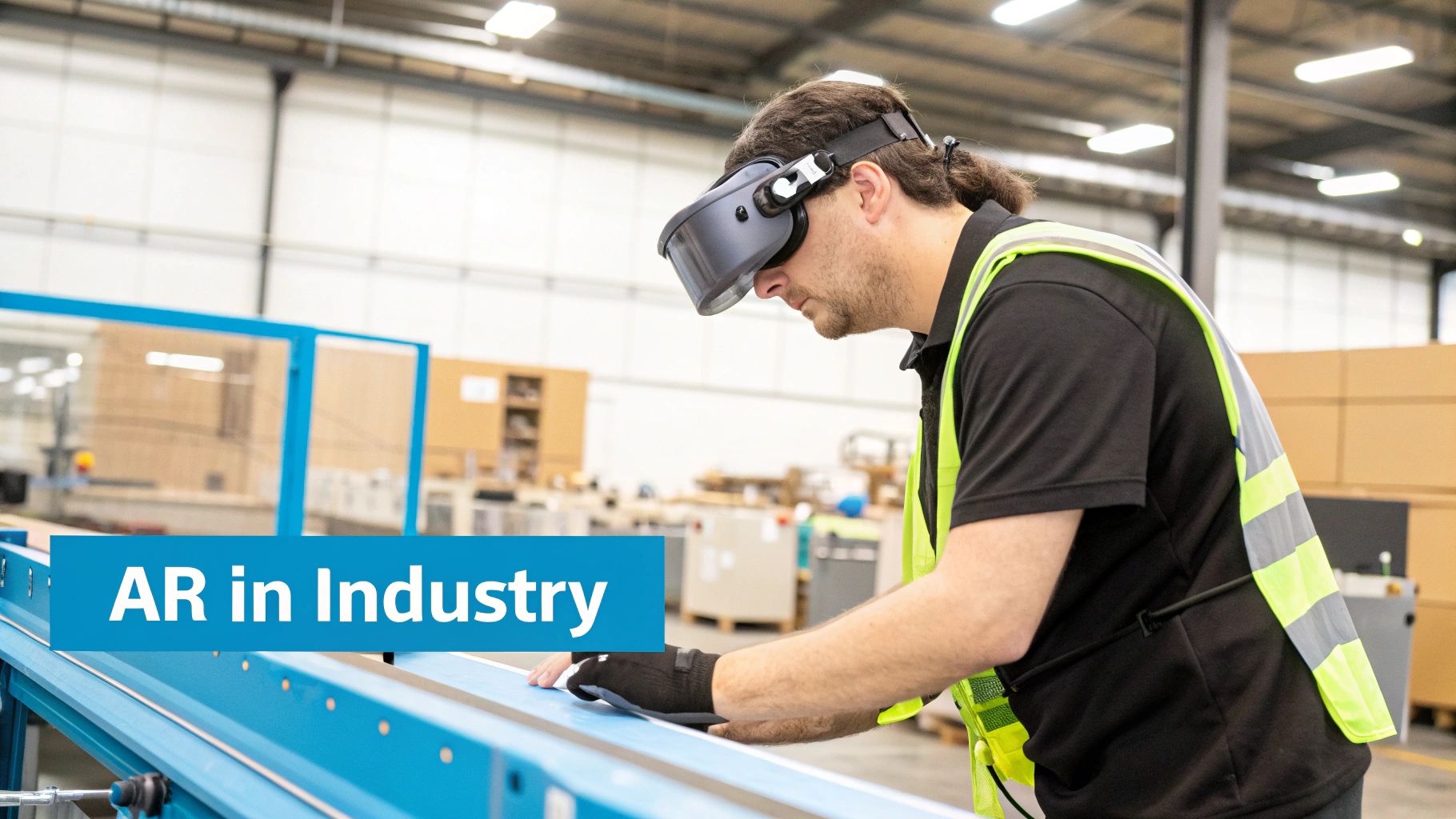
The value of augmented reality becomes clear when you see it solving tangible problems—on the factory floor, in the field, or during employee training. This is where AR transitions from a futuristic concept into a practical tool, overlaying a digital layer of information precisely where frontline workers need it most.
AR technology is effectively addressing common operational challenges such as production mistakes, expensive machine downtime, and the persistent skills gap. By integrating AR into daily operations, companies are transforming complex tasks into simple, guided workflows, making work safer, faster, and more accurate.
To better visualize where AR can make an impact, here is a breakdown of its applications across different business functions.
AR Applications Across Business Functions
| Business Function | AR Application | Primary Benefit |
|---|---|---|
| Manufacturing | AR-Guided Assembly & Quality Control | Reduce production errors and increase assembly speed. |
| Field Service | Remote Expert Assistance ("See-What-I-See") | Improve first-time fix rates and reduce travel costs. |
| Training & L&D | Immersive, Hands-On Simulations | Boost knowledge retention and create a safe learning environment. |
| Logistics | Vision Picking in Warehouses | Increase picking accuracy and speed up order fulfillment. |
| Sales & Marketing | Interactive Product Previews & Demos | Enhance customer engagement and shorten sales cycles. |
This table provides a snapshot of AR's adaptability. Now, let's explore some of the most impactful areas in more detail.
Revolutionizing Manufacturing and Assembly
In manufacturing, precision is paramount. A minor error during assembly can lead to significant rework, wasted materials, and costly delays. AR addresses this problem by projecting digital instructions, schematics, and quality checklists directly onto the equipment a worker is building.
Consider an assembly technician wearing smart glasses. As they view a complex engine, the AR software highlights exactly which bolts to tighten, displays the correct torque specifications, and even shows a 3D animation of the proper sequence. This eliminates the need to look back and forth between a paper manual or a laptop, reducing cognitive load and the potential for error.
With AR-guided assembly, some businesses have nearly eliminated production errors, while increasing assembly speed by 25% or more. It’s a powerful fusion of digital precision and human skill.
This approach not only accelerates processes but also streamlines the onboarding of new hires, allowing them to become proficient more quickly and with greater confidence. For a closer look at these applications, our guide on augmented reality industrial applications offers more detailed examples.
Empowering Field Service Operations
Field service technicians often work under immense pressure, facing complex machinery on-site, sometimes alone. An incorrect diagnosis can lead to repeat visits, dissatisfied customers, and increased costs. AR remote assistance fundamentally changes this dynamic.
Using an AR-enabled tablet or headset, a technician in the field can stream their point of view directly to a senior expert in an office anywhere in the world. The expert sees exactly what the on-site technician sees and can annotate the live video feed with drawings, pointers, and notes to guide the technician through the repair step-by-step. This "see-what-I-see" support transforms every field call into a collaborative effort.
- Improved First-Time Fix Rates: Providing junior technicians with on-demand access to senior expertise helps resolve problems correctly on the first visit.
- Reduced Expert Travel: Your most experienced specialists can support multiple teams remotely, reducing travel costs and making their knowledge more scalable.
- Enhanced Safety: The remote expert can identify potential hazards and guide the technician through proper safety protocols in real time.
Redefining Learning and Development
Traditional training methods can fall short when preparing employees for complex, hands-on jobs. Classroom lectures may feel disconnected from real-world applications, while on-the-job training can be risky or disruptive. AR bridges this gap by creating an immersive, yet safe, training environment.
New hires can use AR to practice assembling or maintaining a virtual machine layered over a physical stand-in. They receive real-time, step-by-step instructions and immediate feedback in a controlled space where mistakes do not cause damage or injury. This hands-on, interactive learning has been shown to improve knowledge retention by up to 90% compared to passive methods like watching a video or reading a manual.
Whether practicing an emergency shutdown procedure or a delicate repair, AR training builds muscle memory and genuine confidence. It ensures that when an employee steps onto the factory floor, they are not just knowledgeable—they are experienced.
Measuring the Tangible Benefits and ROI of AR
The adoption of any new technology ultimately depends on its return on investment. The link between augmented reality and business success is found in hard numbers and measurable KPIs. The value of AR lies not in its novelty, but in its proven ability to deliver quantifiable improvements to the bottom line.
For industrial applications, the data is compelling. Businesses using AR-guided workflows report dramatic reductions in production errors—some by as much as 40%. This increased precision directly reduces material waste, rework hours, and costly delays, creating an immediate and clear financial impact.
The benefits extend to workforce development. Employee training time, a significant cost for any company, can be reduced by up to 50% with immersive AR simulations. This means new hires become productive faster, and existing employees can acquire new skills with greater confidence and retention.
Quantifying Operational Gains
To build a solid business case, it is essential to connect AR adoption to specific, measurable metrics. Vague goals like "improving efficiency" are insufficient. Instead, focus on concrete KPIs that demonstrate how AR is impacting operations.
Key metrics to track include:
- First-Time Fix Rate (FTFR): For field service teams, AR remote assistance improves the number of issues resolved on the first visit, reducing repeat calls and increasing customer satisfaction.
- Mean Time to Repair (MTTR): Providing technicians with instant access to expert guidance and digital work instructions helps them diagnose and resolve problems faster, minimizing equipment downtime.
- Error Reduction Percentage: In manufacturing and assembly, tracking the decrease in human errors provides a direct measure of AR's impact on quality control and production consistency.
- Training Completion and Competency Rates: Measure how quickly employees master new skills and observe a noticeable drop in post-training support requests.
Calculating the financial return on these improvements is straightforward. For instance, using a training ROI calculator can show how reducing training time and boosting skill retention translate into real cost savings and productivity gains.
The Financial Impact on Customer-Facing Applications
The ROI of augmented reality is just as powerful in customer-facing applications, particularly in retail and e-commerce. AR bridges the gap between online browsing and an in-store experience, giving consumers the confidence to make purchases from anywhere. This has a significant effect on both sales and customer loyalty.
Augmented reality is a powerful tool for converting browsers into buyers. It empowers customers to visualize products in their own space—from trying on a watch to placing a new sofa in their living room—which dramatically reduces purchase anxiety.
This confidence translates directly into sales. Companies using AR have reported conversion rates up to 40% higher than those without. Furthermore, AR-enabled online stores can achieve conversion rates 94% higher than their non-AR counterparts. The impact on returns is equally impressive, with AR helping retailers reduce product returns by 25-40%, addressing a major industry challenge. More details on these AR retail statistics on sqmagazine.co.uk are available.
By focusing on these verifiable statistics and clear business metrics, you can build a compelling, data-driven case for investing in augmented reality. The evidence is clear: AR is not an expense, but a strategic investment that delivers substantial and measurable returns across the entire business.
Your Roadmap for Successful AR Implementation
Integrating augmented reality into your business requires a clear, strategic plan to move from an initial concept to a solution that your team uses effectively. This journey needs a solid roadmap to navigate both the technology and the human elements involved.
The process begins by identifying the specific operational challenges that AR is uniquely suited to solve. This is not about adopting new technology for its own sake, but about finding high-impact areas where AR can deliver real, measurable improvements to daily work.
Phase 1: Identify High-Impact Use Cases
The first step is discovery. Before implementing a solution, you must understand the root of the problem. This involves consulting with frontline workers, managers, and operational leads to identify the biggest friction points—the inefficiencies, errors, or knowledge gaps causing the most significant issues.
Is it the time your team spends on complex assembly tasks? The high cost of sending experts to remote sites? Or the extended ramp-up time for new hires on specialized equipment? Once you have identified these critical areas, you can set clear, measurable goals for your AR project.
A successful AR implementation is built on a foundation of clear objectives. Avoid vague goals like "improve training." Instead, aim for specific targets, such as "reduce new-hire onboarding time by 40%" or "increase first-time fix rates by 15% within six months."
This strategic approach is captured in the three core phases of AR adoption.
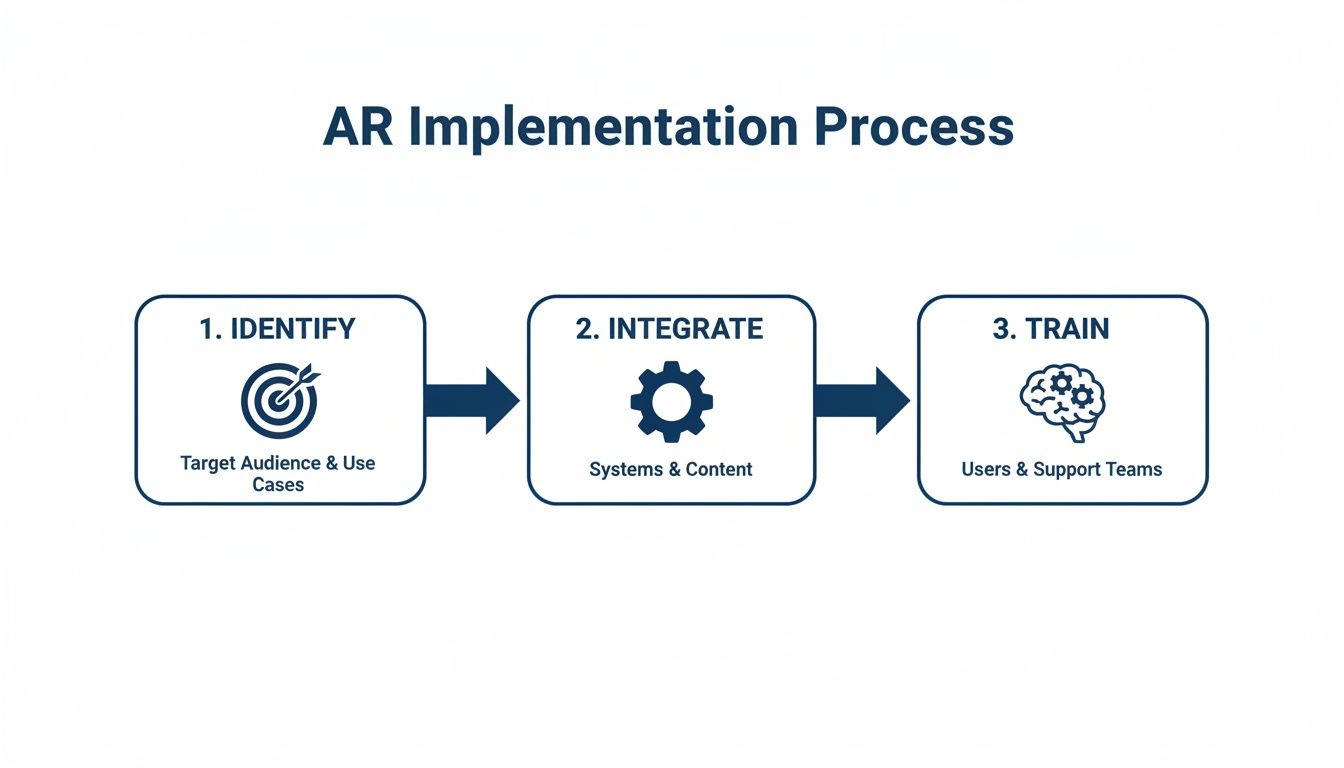
This flow—Identify, Integrate, and Train—highlights a critical point: the technology is supported by two vital, human-centric steps. Defining the right problem upfront and preparing your team for the change are just as important as the technical integration.
Phase 2: Integrate with Existing Systems
Once your goals are defined, the focus shifts to technical implementation. An AR solution should not operate in isolation; it needs to integrate with the systems your business already uses. Proper integration is key to creating a unified digital environment where information flows seamlessly.
For example, your AR work instructions may need to pull real-time data from your Enterprise Resource Planning (ERP) system or log completed tasks back into your Customer Relationship Management (CRM) platform. This ensures data consistency and makes the AR tool a natural part of your existing workflow.
During this phase, several critical technical decisions must be made:
- Deployment Model: Will you choose a cloud-based SaaS solution for its flexibility and scalability, or do your security requirements necessitate an on-premise setup?
- Hardware Selection: Which devices are best suited for your team and their work environment? Options include smart glasses, tablets, and smartphones.
- Data Security: How will you protect sensitive company and customer data that is accessed and displayed through the AR application?
As you develop your plan, leveraging specialized implementation support can help simplify the complexity and avoid technical roadblocks. The right partner can guide you through these decisions, ensuring a smooth and secure integration.
Phase 3: Drive Adoption Through Change Management
The most advanced technology is ineffective if your team does not use it. Therefore, the final and most critical phase of your roadmap is focused on people. Successful AR deployment requires a thoughtful change management strategy.
It begins with clear communication. Explain the "why" behind the new technology—how it will make employees' jobs easier, safer, and more effective. Involve key team members early in the process to become advocates who can champion the new tools among their peers.
Comprehensive training is non-negotiable. Conduct hands-on sessions that mimic real-world scenarios rather than simply demonstrating how to turn on a device. This builds the confidence needed to use the tool effectively when it matters most. To understand how these guided digital processes are structured, you can explore our guide on the augmented reality workflow and how to tailor it to your needs.
By following this three-phase roadmap—Identify, Integrate, and Train—you are not just deploying new technology. You are orchestrating a successful transformation that your team will embrace and that will deliver lasting value to your organization.
Choosing the Right AR Partner and Solutions
Selecting the right augmented reality solution is a critical decision. It is not just about the technology you purchase today; it is about laying the foundation for your entire AR strategy for years to come. This process is less like buying software and more like hiring a key team member—you need a partner who understands your operational challenges and is invested in helping you achieve your business goals.
The market offers a wide range of options, from plug-and-play products to fully customized platforms. To navigate this landscape, you need a clear framework for what matters most. This ensures you select a solution that not only solves today’s problems but can also scale and adapt as your business evolves.
Key Evaluation Criteria for AR Solutions
When evaluating AR solutions, it is easy to become overwhelmed by technical jargon. It is important to focus on the core factors that impact usability, scalability, and value.
A smart evaluation focuses on these key areas:
- Platform Scalability: Can the solution grow with your business? A solution effective for a small pilot must also be able to handle a full-scale rollout across multiple sites without requiring a complete overhaul.
- Device Compatibility: Your team works in various environments with different devices. Your AR solution should be compatible with a range of hardware, from smartphones and tablets to industrial-grade smart glasses.
- Ease of Content Creation: How simple is it for your in-house experts to create and modify AR instructions? Look for an intuitive, no-code authoring tool. This empowers your team to create workflows without needing developer assistance for minor changes.
Off-the-Shelf Products vs. Custom-Built Solutions
One of the first decisions is whether to choose an off-the-shelf product or a custom-built solution. Neither is inherently superior; the right choice depends on your specific needs, budget, and in-house technical resources.
An off-the-shelf solution is ready-made software that allows for faster deployment and typically has a lower upfront cost. These are ideal for standard applications like remote assistance or digital work instructions where the existing features meet most of your requirements.
A custom-built solution, on the other hand, is designed from the ground up for your specific needs. It offers complete flexibility and can be perfectly integrated with your proprietary systems. However, this option requires more time and a larger budget.
Often, the optimal choice lies in the middle: a configurable platform that provides a proven core but allows for extensive customization. This hybrid approach combines the speed of a ready-made product with the flexibility to adapt it to your unique requirements.
The Importance of a True Partnership
Beyond technical specifications, the quality of your relationship with the vendor is crucial. A true partner does more than just sell a product. They become invested in your success, providing robust support, effective training, and strategic advice to ensure you maximize the return on your investment.
When vetting potential vendors, ask detailed questions about their support services. What does their onboarding process look like? What are their response times for technical issues? What training materials do they provide? A good partner will have a clear plan to get your team up to speed and will support you as you scale.
Ultimately, you are looking for a collaborator who can help you think strategically about your AR initiatives. For companies seeking expert guidance, exploring augmented reality consulting services can provide a clear roadmap, ensuring the chosen solution aligns with your long-term vision.
The Tipping Point: AR is Now Mainstream, and Your Business Needs a Plan
The most compelling reason for integrating augmented reality into your business is user adoption. AR is no longer a niche technology; it is rapidly becoming a standard way people expect to interact with the world, both as customers and as employees. This rapid growth is a trend that businesses cannot afford to ignore.
This shift is establishing a new baseline for user expectations. Customers, already accustomed to interactive digital experiences, are beginning to seek more immersive ways to engage with brands. Simultaneously, the next generation of talent will enter the workforce with the expectation that modern, intuitive AR tools will be available to help them perform their jobs more effectively.
A Rapidly Expanding Audience
The scale of AR adoption is staggering and signals a major behavioral shift. Globally, forecasts indicate that an astounding 75% of the global population will be active AR users by 2025. This widespread familiarity significantly lowers the barrier to entry for any business considering AR adoption.
In the United States, the trend is equally clear. The number of AR users is projected to climb to 100.1 million in 2025 and continue to grow to 106.9 million by 2027. This means a large portion of your customer base and workforce is not just aware of AR—they are actively using it. You can find more details in these virtual and augmented reality adoption trends on avasant.com.
This is not just a trend; it's a fundamental shift in how people expect to receive information and engage with digital content. For businesses, the question is no longer if you should adopt AR, but how quickly you can integrate it to remain competitive.
The Business Imperative: Staying Relevant in an AR-Ready World
This growing user base has a direct and immediate impact on your business strategy. Proactively adopting AR is quickly transitioning from a "nice-to-have" innovation to a "must-have" for staying competitive. Ignoring this shift is analogous to ignoring e-commerce two decades ago—a decision that could leave your business struggling to catch up.
Here is what this user growth means for your business:
- Heightened Customer Expectations: Customers will soon view AR-powered features—like virtual furniture placement or interactive product manuals—as a standard part of their experience.
- A New Standard for Employee Tools: To attract and retain top talent, you must provide the best tools. For many hands-on roles, AR-guided instructions and remote expert assistance will become the norm.
- The Need for a Proactive Strategy: Waiting to see what competitors do is a losing strategy. Companies that act now to integrate AR into their operations will be the ones that capture market share and define the future of their industries.
Your Top Questions About AR in Business, Answered
Despite the clear benefits, it is natural for business leaders to have practical questions before investing in augmented reality. Let's address some of the most common inquiries.
How Long Does an AR Implementation Take?
The timeline depends on the scope of the project. A pilot program using a ready-made remote assistance tool could be operational in just a few weeks.
However, a full-scale rollout that deeply integrates AR with existing ERP or CRM systems requires a more extended timeline. A custom project of that magnitude could take several months to properly plan, develop, and deploy across the organization.
Isn't This AR Technology Expensive?
This is a common misconception. The cost of entry for AR has decreased significantly. A large capital expenditure is no longer a prerequisite. Many of the most powerful AR platforms now operate on a subscription (SaaS) model, making the initial investment much more manageable.
This approach allows you to start small with a single use case, prove its value, and then scale your investment as you see positive results.
While it is easy to focus on the initial price, the real story is in the ROI. When you achieve a 50% reduction in service times or cut expert travel costs by 75%, the technology often pays for itself much faster than anticipated.
What Kind of Hardware Do My Employees Need?
Another myth is that industrial AR requires a specialized, expensive headset for every employee. While smart glasses are ideal for certain complex, hands-on tasks, many valuable AR applications work perfectly on devices your team already uses.
A good AR platform should be flexible and run smoothly across various hardware types:
- Smartphones
- Tablets
- Smart glasses
This flexibility allows you to select the right tool for the right task, ensuring the technology is practical and helpful for each individual in their specific work environment.
Ready to see how augmented reality can deliver measurable results for your operations? AIDAR Solutions offers expert guidance and powerful tools to accelerate your digital journey. Explore our AR and VR solutions and start building a more efficient, capable workforce today.