
The Ultimate Guide to the Application of Augmented Reality in Industry
Augmented reality overlays digital information—such as instructions, 3D diagrams, or live data—directly onto the physical world. In an industrial setting, this technology replaces paper manuals and support calls with interactive, hands-on guidance that appears precisely where a worker needs it. It is a direct, effective way to close skills gaps and reduce costly operational downtime.
How AR Is Reshaping Industrial Operations
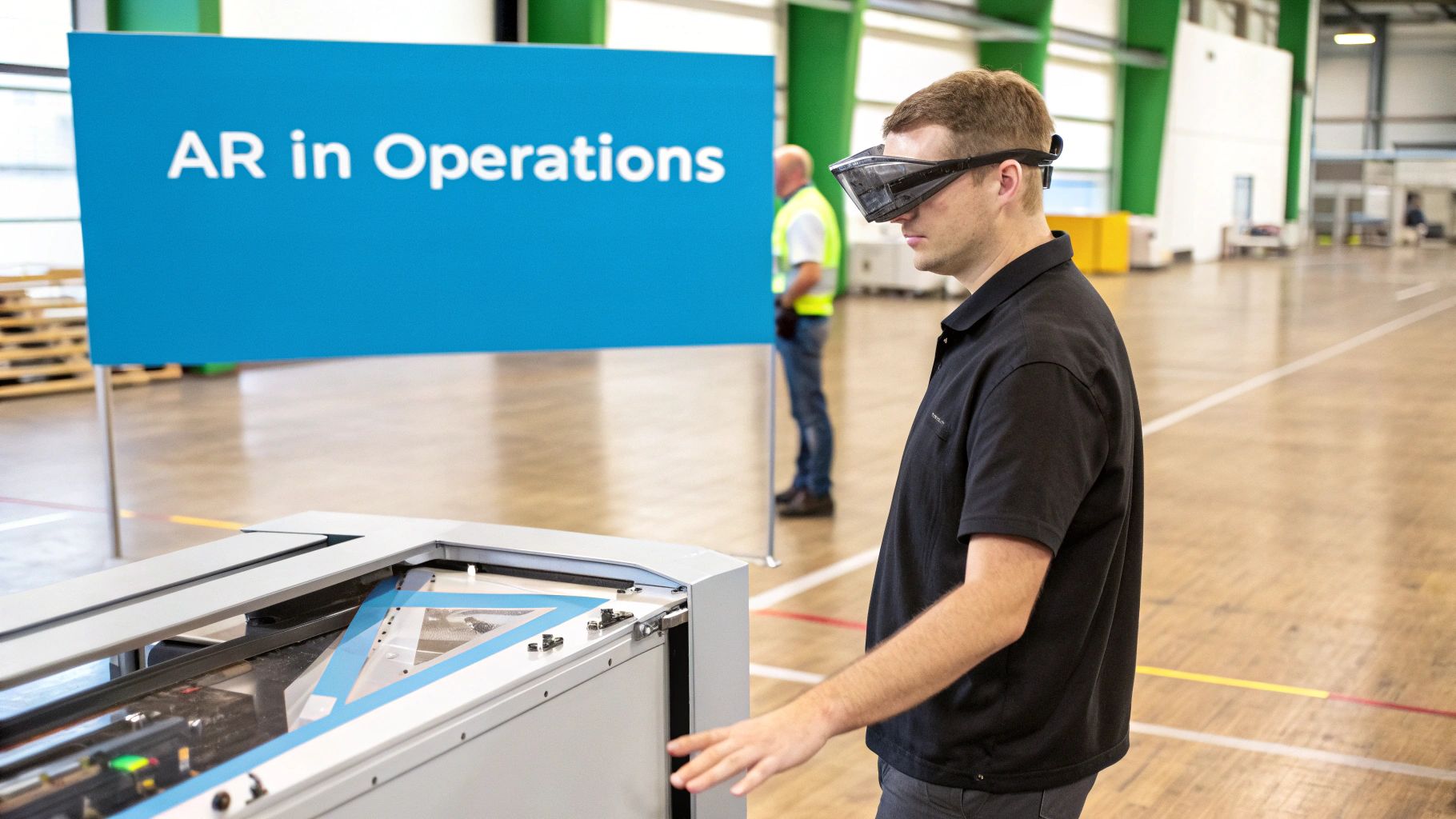
Consider a scenario where a technician faces a complex machine failure hundreds of miles from the nearest expert. Instead of waiting days for help to arrive, they can now have a specialist digitally present, guiding their hands with absolute precision. This is no longer science fiction; it is the new reality AR brings to the factory floor and the field.
This technology bridges the gap between digital data and the physical world. It directly addresses some of the most persistent operational challenges, from skills shortages to inefficient workflows, by delivering critical information exactly when and where it is needed most.
Key Industrial Applications of Augmented Reality
The power of AR lies in its practical uses that deliver immediate, tangible value. Three core applications are proving their worth in manufacturing, field service, and other industrial sectors:
- Remote Assistance: This allows a frontline worker to share their real-time view with an expert anywhere in the world. The expert can then annotate the technician’s screen, place 3D diagrams onto the equipment, and guide the repair with pinpoint accuracy, eliminating travel costs and delays.
- Guided Workflows: Instead of using cumbersome paper manuals, step-by-step digital instructions are projected directly onto the machinery. This visual guidance reduces human error, accelerates production cycles, and simplifies quality control.
- Immersive Training: Organizations can create realistic, risk-free training environments where new hires can practice complex, high-stakes tasks. This approach shortens learning curves and builds a more skilled, confident, and capable workforce.
When you frame the application of augmented reality as a direct solution to these real-world challenges, its value becomes clear. This is not a futuristic concept; it is a proven tool delivering measurable results today.
A Market Poised for Growth
This shift from theory to practice is fueling significant market expansion. The global AR market, valued at USD 5.9 billion in 2019, is on track to reach an estimated USD 89 billion by 2026, representing a compound annual growth rate of 46.3%. You can read the full analysis on the AR market growth. This growth is driven by the wider availability of AR-capable devices and the undeniable ROI companies are experiencing.
For enterprise leaders, understanding these applications is the first step toward building a more connected, efficient, and resilient workforce. For a deeper analysis, review our guide to augmented reality for industry and its strategic benefits.
Transforming Workforce Training with Immersive AR
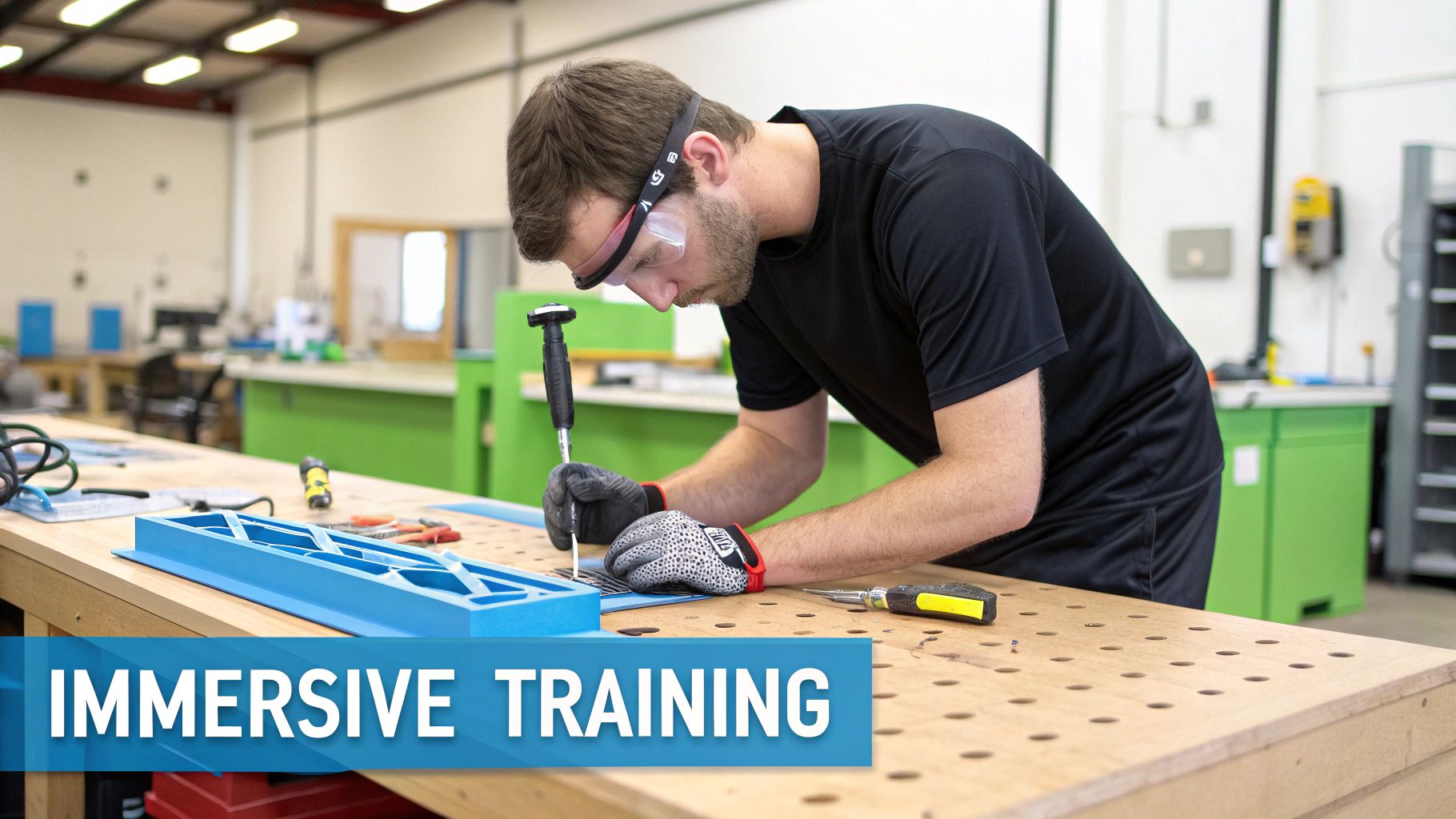
Traditional workforce training often involves extensive manuals, classroom sessions, or shadowing experienced professionals. While these methods can be effective, they are often slow, costly, and can present safety risks when learning on live, expensive machinery.
This is where a key application of augmented reality fundamentally changes the approach to training.
AR creates realistic training environments where mistakes do not result in costly damage or injury. It closes the gap between knowing what to do and knowing how to do it. With AR, teams learn by doing, not just by listening.
Reimagining On-the-Job Learning
Imagine a new hire assembling a complex component for the first time. Instead of referencing a 2D diagram, they wear AR glasses. Instantly, 3D animations and clear instructions are overlaid onto their physical workspace, guiding their hands with precision.
This interactive guidance shows them which part to select, where it goes, and the correct torque to apply. The system confirms each step in real time, building muscle memory and confidence without requiring constant supervision. This method significantly shortens the learning curve.
By turning abstract instructions into tangible actions, AR-based training makes complex processes feel intuitive. It’s the difference between reading a map and having a GPS guide you turn-by-turn.
This hands-on, contextual learning improves knowledge retention because employees are physically engaged in the task, not just passively observing. It is particularly effective for kinesthetic learners who need to perform an action to truly understand it.
The Quantifiable Benefits of Immersive Training
Shifting to AR training is about more than an enhanced learning experience; it is about delivering measurable results that impact the bottom line. When trainees practice on virtual equipment, you eliminate material waste and the risk of damaging expensive machinery. This zero-risk environment is critical in high-stakes industries like aerospace, energy, and advanced manufacturing.
In fact, the application of augmented reality in enterprise manufacturing is one of the fastest-growing areas for the technology. Data shows that AR can reduce training costs by up to 40% and help employees master new skills up to 75% faster. For corporate learning managers, this can mean quadrupling training throughput without increasing the amount of physical equipment required for practice. You can dive deeper into the latest market reports on AR's industrial impact.
Key performance improvements include:
- Reduced Training Time: Skills that previously took weeks to learn can now be mastered in a few days.
- Lower Error Rates: Guided digital workflows prevent mistakes before they occur, leading to higher-quality work from the start.
- Increased Safety: New hires can practice hazardous procedures, such as lockout/tagout protocols, in a completely safe simulation.
- Improved Knowledge Retention: Interactive, hands-on learning is more memorable than reading a manual.
Scaling Expertise Across the Enterprise
One of the most significant challenges for large organizations is knowledge drain, which occurs when veteran employees retire and take decades of experience with them. AR offers a powerful solution to this problem.
You can digitize an expert's knowledge into a guided AR workflow, effectively standardizing best practices. This allows you to deploy high-quality, consistent training across the entire organization, regardless of location. A new hire in a satellite office receives the same elite-level instruction as someone at headquarters. To see how this works in practice, explore our detailed article on augmented reality and training.
This ability to democratize expertise ensures every team member has the skills needed to perform their job correctly and safely. For L&D and operations leaders, this results in a more skilled, confident, and agile workforce—built faster and more cost-effectively than ever before.
Revolutionizing Maintenance with AR Remote Assistance
Picture a field technician facing a critical equipment failure at a remote site. The machine is down, production has stopped, and the senior expert with the solution is thousands of miles away. In the past, this scenario led to costly delays, emergency travel, and dissatisfied customers.
This is precisely where another powerful application of augmented reality transforms the situation. AR remote assistance creates an instant, direct link between on-site teams and seasoned experts, regardless of their location. It digitally provides frontline workers with an expert’s guidance.
Bridging the Distance with Digital Guidance
Using an AR-enabled device—a smartphone, tablet, or smart glasses—a technician can share their real-time point of view with a remote specialist. The expert sees exactly what the technician sees, eliminating the confusion and miscommunication common with standard phone or video calls.
However, this is more than just a video call. The key advantage is the remote expert's ability to interact with the technician's environment in real time.
- Live Annotations: The expert can draw, circle, or place arrows directly onto the live video feed to highlight a specific component or show the technician exactly where to focus.
- 3D Model Overlays: They can superimpose detailed 3D diagrams or schematics onto the physical equipment, offering an intuitive visual guide for complex repairs.
- Document Sharing: Manuals or checklists can be sent and displayed instantly within the technician’s field of view, ensuring all necessary information is immediately accessible.
This interactive support empowers even a junior technician to address a difficult problem with the confidence of a seasoned professional. For organizations looking to improve their service operations, our guide on augmented reality remote assistance provides a deeper look into these capabilities.
The core value is simple but profound. It transforms a one-person job into a collaborative effort, instantly bringing your best minds to any problem, anywhere in the world.
The Massive Business Impact of Remote Support
Incorporating AR into your remote assistance workflow delivers a measurable impact on your bottom line. The operational and financial benefits are immediate and substantial, addressing some of the biggest challenges in field service and maintenance.
This application of augmented reality delivers hard, quantifiable returns. Businesses often see a dramatic reduction in expert travel costs—sometimes by as much as 75%. Eliminating the need to fly specialists to job sites results in significant savings on flights, hotels, and lost productivity.
Beyond cost savings, the effect on efficiency is just as significant. Service resolution times can be reduced by up to 50%. Instead of a machine being down for days waiting for an expert to arrive, problems can often be diagnosed and fixed in a matter of hours, minimizing downtime and maintaining customer satisfaction.
Enhancing First-Time Fix Rates
One of the most critical metrics for any service organization is the First-Time Fix Rate (FTFR). When a technician resolves an issue on the first visit, it saves the company money, boosts asset uptime, and builds customer trust. AR remote assistance directly improves this crucial KPI.
With an expert guiding their every move, technicians are far more likely to diagnose the problem correctly and complete the repair successfully on the first attempt. They have the right information and guidance at the exact moment they need it. This not only makes them more efficient but also serves as a powerful on-the-job training tool, upskilling the entire workforce with every service call.
Ultimately, this advanced application of augmented reality empowers your frontline team. It provides them with the tools to solve complex problems independently and efficiently, transforming maintenance operations from a cost center into a driver of value and customer loyalty.
Streamlining Complex Assembly and Manufacturing
In high-stakes industries like aerospace and automotive, precision is fundamental. The smallest mistake can cascade into costly rework, serious safety risks, and significant production delays. Traditional methods rely on paper schematics or static CAD models, which often create a disconnect between the digital blueprint and the physical work on the factory floor.
This is exactly where a powerful application of augmented reality comes in. AR bridges that gap by projecting dynamic, interactive digital work instructions directly onto a technician's view of the physical environment. It transforms a complex, multi-step process into a simple, guided workflow.
Enhancing Precision with Digital Overlays
Imagine an assembly line worker wearing smart glasses. As they look at an engine block, a 3D digital guide appears, highlighting the exact spot for the next component. The system displays the correct part number, the precise torque setting for a bolt, and even plays a short animation of the required action.
This is more than just viewing instructions; it is interacting with them. After the worker completes a step, the system can use computer vision to verify the action was performed correctly before proceeding to the next instruction. This real-time validation is a game-changer for quality assurance.
- Error Reduction: Visual guidance virtually eliminates the guesswork that leads to human error, ensuring parts are installed correctly the first time.
- Accelerated Production: Workers no longer need to stop to consult a separate screen or manual. This reduces time on every step, speeding up the entire assembly cycle.
- Simplified Quality Control: With automated verification, each step becomes a quality checkpoint, catching potential issues immediately instead of at final inspection.
By projecting digital information directly onto the task at hand, AR removes ambiguity and empowers workers to perform complex jobs with greater accuracy and confidence. It is like giving every technician a built-in expert guide.
This infographic highlights the operational wins that companies are seeing when they strategically use AR for maintenance and assembly.
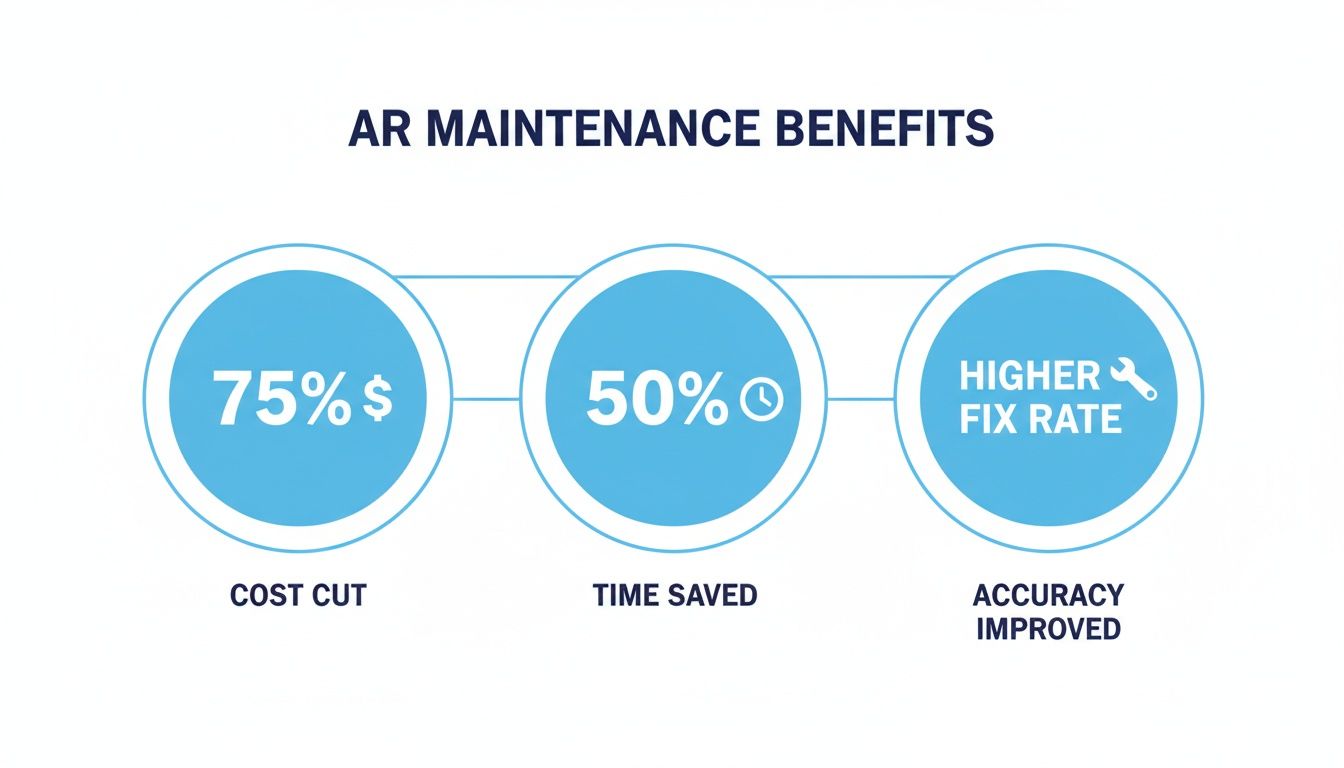
The takeaway is clear: AR delivers significant reductions in operational costs and time, while boosting the quality and accuracy of the work performed.
Capturing Data for Optimization and Compliance
Beyond guiding the work, this application of augmented reality creates a valuable digital thread. Every action, verification, and timestamp can be automatically logged and stored. This builds a detailed, auditable record of the entire assembly process for every unit produced.
For managers focused on lean manufacturing principles, this data is invaluable. It provides clear insights into production bottlenecks, identifies steps where workers frequently encounter issues, and offers hard data for continuous process improvement. In highly regulated industries, this digital "as-built" record is essential for proving compliance and ensuring full traceability.
The demand for these solutions is growing rapidly. The augmented reality market is projected to reach USD 169.97 billion by 2026 and is forecast to grow to USD 1,050.56 billion by 2033. A major driver of this growth is hardware like smart glasses, which currently hold a 58% market share, enabling technicians to receive real-time guidance that reduces waste and risk. You can dig into more in-depth research on the AR market's future to see the full picture.
By bringing AR to the factory floor, manufacturers are not just improving a single process; they are building a smarter, more connected operation. To see how these tools are being put to work, take a look at our deep dive into augmented reality for manufacturing.
Weaving AR into Your Existing Enterprise Systems
Understanding that AR can solve problems is one thing; integrating it with existing systems is another. This is where practical application begins. The goal is not to replace your entire technology stack, but to intelligently augment what is already in place.
This process requires thoughtful planning. You must ensure the chosen AR platform works with your current tools, not against them. A successful rollout depends on getting hardware selection, software compatibility, and data security right from the start. When done correctly, AR feels less like a new tool and more like a natural extension of your daily workflows.
Choosing the Right Hardware for the Job
The device your team uses is the physical bridge to their digital instructions. There is no single "best" piece of hardware; the right choice depends entirely on the job and the environment in which it is performed.
Consider these common options:
- Smartphones and Tablets: These are an excellent starting point. Your team is already familiar with them, they are portable, and the initial investment is minimal. They are well-suited for many remote assistance scenarios and digital checklists where hands-free operation is not required.
- Smart Glasses: For complex, hands-on assembly or maintenance, smart glasses are transformative. They allow workers to keep their hands on their tools while crucial information is projected into their line of sight, improving both safety and efficiency.
- Ruggedized Devices: Harsh industrial environments can damage standard consumer electronics. Rugged tablets and glasses are purpose-built to withstand drops, dust, and moisture, ensuring they function when needed most.
Ensuring Seamless Software and Data Integration
An AR solution that operates in isolation is a missed opportunity. To maximize its value, the platform must communicate with the systems that run your business, such as your Enterprise Resource Planning (ERP) or Manufacturing Execution System (MES).
This connection creates a two-way flow of information. For example, a work order from your MES can automatically trigger the correct AR-guided workflow for a technician. Once the job is complete, the AR system can send data back, confirming task completion and logging key metrics for compliance and analysis.
The most effective integration strategy is one where data flows effortlessly between systems. This turns your AR platform from a standalone tool into an integral part of your company’s central nervous system, driving smarter, data-informed decisions.
Data security is non-negotiable. A flexible solutions partner can offer multiple deployment options, from secure cloud-based (SaaS) models to on-premise installations, ensuring alignment with your organization's specific IT policies and security protocols.
Launching a Successful Pilot Program
The best way to demonstrate the value of a new technology is to prove it on a small scale first. A well-designed pilot program is the perfect way to gain stakeholder buy-in and build momentum for a wider rollout.
Here is a simple four-step process to structure an effective pilot:
- Identify a High-Impact Use Case: Begin by focusing on a specific, persistent problem. This could be a machine with a high failure rate, a complex assembly process creating bottlenecks, or the frequent need to fly experts to remote sites.
- Define Clear KPIs: Establish what success looks like from the outset. Measure metrics like Mean Time to Repair (MTTR), First-Time Fix Rate, or assembly time before and after introducing AR.
- Select a Champion Team: Choose a small, enthusiastic group of users to participate. Their feedback will be invaluable for refining the process, and their success stories will turn them into internal advocates.
- Analyze and Report on ROI: After the pilot, analyze the data and present a clear business case showing the return on investment. Quantifiable results, such as a 50% reduction in service resolution time, are compelling evidence.
For a broader look at where augmented reality is heading and how it might fit into workplace communication, it's worth exploring Meta's vision for AR in the workplace. A thoughtful implementation plan, guided by a knowledgeable partner, ensures your first foray into augmented reality is a genuine success story.
Measuring the ROI of Your AR Investment
Justifying any new technology investment requires moving beyond initial excitement to focus on tangible financial benefits. For augmented reality, building a compelling business case involves connecting its capabilities directly to the Key Performance Indicators (KPIs) that matter most to senior leadership and operational managers.
This data-driven approach provides a clear way to measure success and prove the real-world value of your AR initiative. It shifts the conversation from "this is interesting" to "this is essential."
Key Metrics That Define AR Success
To accurately assess the impact an application of augmented reality is having, you need to track specific, quantifiable metrics. These numbers directly reflect improvements in efficiency, cost savings, and the quality of your output.
Keep a close eye on these key operational metrics:
- Mean Time to Repair (MTTR): This metric measures the average time required to repair a failed piece of equipment. AR remote assistance reduces this time by providing immediate virtual access to an expert.
- First-Time Fix Rate (FTFR): This is the percentage of service calls resolved on the first visit. AR provides technicians with the information and support needed to solve problems correctly the first time, dramatically improving this rate.
- Employee Training Time: This measures how quickly a new hire becomes a productive team member. Immersive AR training can reduce this ramp-up time by as much as 75%.
- Error Rates: This tracks the frequency of mistakes during complex assembly or maintenance. AR-guided workflows act as a digital safety net, significantly reducing errors and improving quality.
Calculating a Simple, Powerful ROI
One of the most straightforward ways to demonstrate a return on investment is by calculating direct cost savings, especially those related to travel. When you deploy AR for remote assistance, you eliminate the need to fly experts to various locations, saving thousands of dollars on each avoided trip.
Imagine an expert who makes two trips a month, with each one costing $2,500 in flights, hotels, and per diems. By swapping those trips for AR remote support sessions, the company saves $60,000 a year from just one expert.
This simple calculation is a powerful and undeniable starting point for your business case.
When you add the value of reduced machine downtime and faster service resolutions, the financial argument for the application of augmented reality becomes incredibly strong. This clear, data-backed ROI is what is needed to gain buy-in and justify scaling the technology across your entire organization.
Got Questions About Putting AR to Work?
When considering new technology, it is important to ask practical questions about implementation, integration, and scaling. Addressing these common concerns is key to making an informed decision.
This section tackles the most frequent questions to demystify how AR fits into an existing industrial environment.
What Kind of Hardware Do We Actually Need to Get Started?
There is no single, rigid answer. The right hardware depends on the specific job, offering significant flexibility.
For many field service or remote support tasks, you can begin with the ruggedized tablets and smartphones your teams may already use. This approach lowers the initial barrier to entry.
However, for work that requires two free hands—such as intricate assembly, quality assurance, or complex maintenance—dedicated smart glasses are the most effective solution. A good solutions partner will help you select the ideal tool for the task and your budget, ensuring a proper fit.
How Does AR Play Nice with Our Existing Software?
Modern AR platforms are not designed to be isolated systems. A successful application of augmented reality depends on its ability to communicate with the systems you already use to run your business.
These platforms are designed to connect with your Enterprise Resource Planning (ERP), Manufacturing Execution Systems (MES), or Learning Management Systems (LMS) using APIs. This creates a seamless, two-way flow of data. You can pull work orders from your ERP directly into an AR headset or send completed task data back to your core systems for compliance and tracking. The right technology partner will handle the integration to make AR a natural extension of your digital ecosystem.
Think of AR less as a replacement for your current software and more as a powerful visual layer that makes all your existing data more useful and actionable for the people on the factory floor.
Can We Scale This from a Small Pilot to a Full Enterprise Rollout?
Absolutely. Starting with a small, focused pilot is the most effective strategy. Identify one specific, high-impact problem—such as reducing downtime on a mission-critical machine—and solve it with a targeted pilot program.
This approach delivers a clear, measurable ROI on a small scale, which is the best way to gain support from both management and end-users. Modern AR platforms, especially those delivered as a service (SaaS), are built to scale. You can expand from one team to multiple departments, and eventually across global sites, while managing everything centrally for consistency and control.
Ready to see how a practical application of augmented reality can start solving your biggest operational headaches? The experts at AIDAR Solutions can help you design a focused pilot program that proves the value and builds a roadmap for enterprise-wide success. Let's start the conversation.

