What is spatial learning? Unlock VR/AR training that accelerates skills
Ever wonder why you can navigate your kitchen in the dark but still forget something you just read in a training manual? The answer lies in a powerful, built-in learning system we all have: spatial learning.
It’s the simple, intuitive way we learn by physically interacting with the world around us. It’s about doing, not just reading. This method taps into our brain's natural talent for creating mental maps, making learning feel less like a chore and more like a genuine experience.
What Is Spatial Learning in Simple Terms?

Think about the last time you put together a piece of flat-pack furniture. You probably glanced at the instructions, but the real learning happened when you picked up the pieces, felt how they fit together, and physically built the object.
That's spatial learning in a nutshell. It turns abstract diagrams and text into muscle memory and real, tangible skill. It’s a completely different beast from traditional learning, which often leans heavily on memorizing facts from a page or a screen. Spatial learning is active, hands-on, and builds a deep, lasting understanding of how things work in a physical space.
The Power of Context and Interaction
Our brains are hardwired to learn spatially. We do it every day without thinking, creating mental maps to get around our homes, offices, and even entire cities. This cognitive superpower is incredibly efficient because it's so deeply ingrained in our neurology. When we learn something within a three-dimensional context, we light up those same powerful neural pathways, which is why the information sticks.
Just look at the difference between two training approaches:
- Traditional: Forcing an employee to read a dry, 200-page technical manual to learn how to operate a complex machine.
- Spatial: Letting them interact with a 3D digital twin of that same machine, where they can virtually take it apart and reassemble it.
The second method wins every time because it mimics how we naturally explore and figure things out. This type of contextual, hands-on training is the very heart of immersive learning, a strategy that uses modern technology to build incredibly effective educational experiences.
To make the distinction crystal clear, here’s a quick comparison.
Comparing Traditional and Spatial Learning
| Attribute | Traditional Learning | Spatial Learning |
|---|---|---|
| Method | Passive (reading, listening) | Active (doing, interacting) |
| Context | Abstract, theoretical | Concrete, environmental |
| Cognitive Load | High (memorization-based) | Low (intuitive, experience-based) |
| Engagement | Often low | High, fully immersive |
| Retention | Lower, requires repetition | Higher, builds muscle memory |
| Application | Theoretical knowledge | Practical, job-ready skills |
This table shows just how different the two approaches are. One is about information transfer, while the other is about genuine capability building.
Spatial learning bridges the gap between knowing what to do and knowing how to do it. It converts theoretical knowledge into practical, real-world capability by placing the learner directly within the context of the task.
By tapping into this powerful and natural learning style, companies can help their teams master complex tasks, sharpen their situational awareness, and perform their jobs with far more confidence and accuracy. It’s about finally creating training that actually prepares people for the real world.
The Cognitive Science Behind Spatial Learning
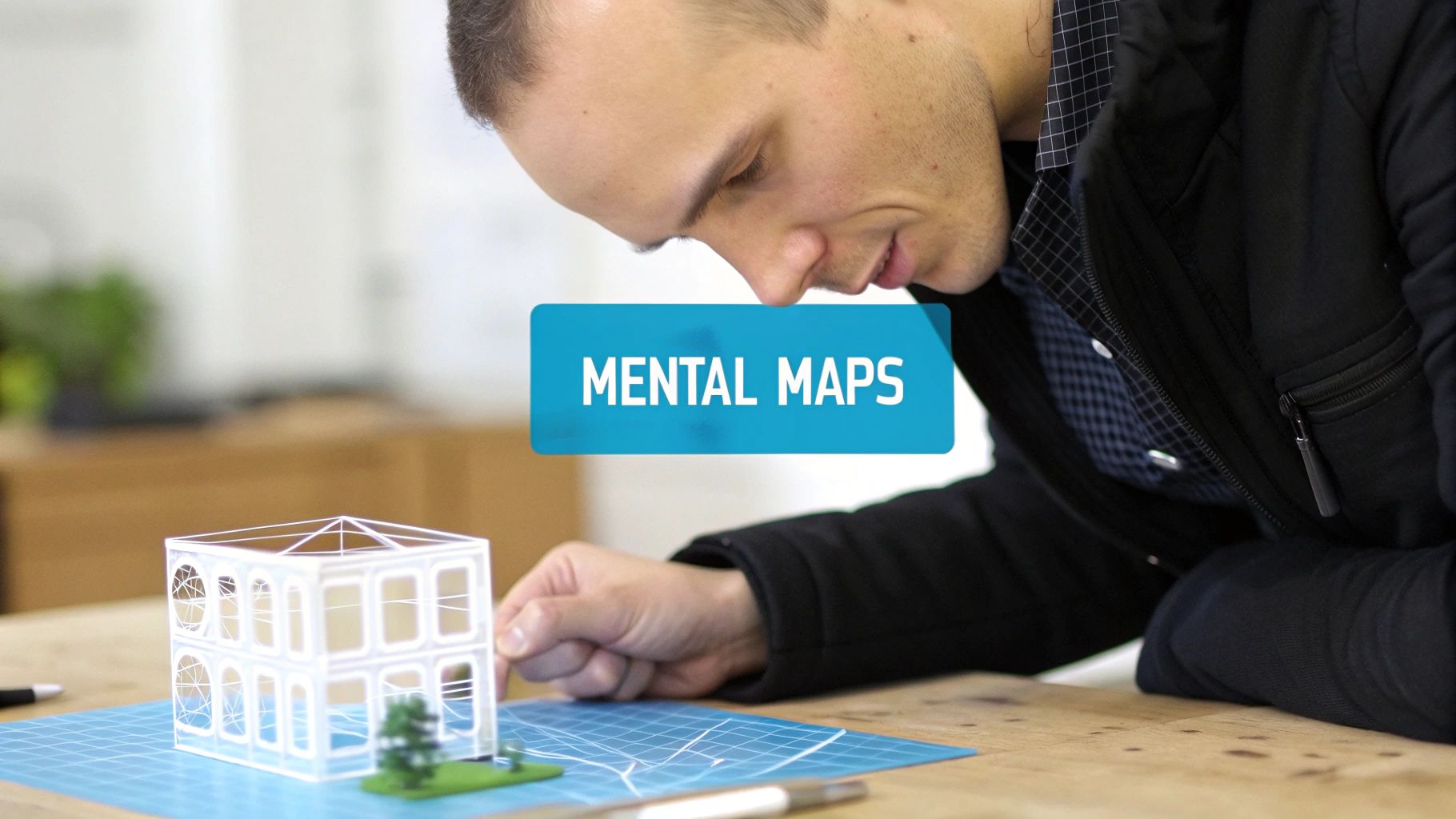
To really get why spatial learning works so well, we have to look under the hood at how our brains are wired. This isn’t just another training fad; it’s a method that taps into our most basic cognitive functions. For millennia, our brains evolved to navigate and understand 3D space—a skill that was once essential for survival.
This hardwired ability means we are all natural mental map builders. When you learn to assemble a piece of equipment by actually doing it (physically or virtually), you're not just memorizing steps from a list. You're creating a rich, multi-sensory map of the object, its parts, and the whole process in your mind.
Activating the Brain’s Built-In GPS
At the center of this is a part of the brain called the hippocampus. Think of it as your brain’s internal GPS. It’s the very thing that’s responsible for spatial memory and navigation, letting you walk through your house in the dark or recall the layout of your office without a second thought.
When training taps into these deep-seated neural pathways, learning becomes far more intuitive and sticky. Instead of forcing the brain to decode abstract text and diagrams, spatial learning speaks its native language—the language of space, orientation, and physical interaction. The result is deeper understanding and much, much better long-term recall.
By simulating real-world environments, VR and AR training directly engages the hippocampus. This forges stronger neural connections and helps build genuine "muscle memory" for complex procedures, turning theoretical knowledge into practical, instinctive skill.
Modern neuroscience backs this up. One study featured in Science discovered that a curriculum built around spatial skills actually improved reasoning. It did this by boosting the connection between the brain’s spatial mapping regions and the dorsolateral prefrontal cortex, a key hub for problem-solving. It’s clear proof that spatial training fundamentally enhances how we think.
From Brain Science to Real-World Performance
This brain-first approach has a direct impact on performance in the workplace. Immersive training solutions built on spatial learning principles help employees master complex tasks faster and with fewer errors.
Just look at the benefits:
- Improved Situational Awareness: Pilots in flight simulators build an instinctive feel for their cockpit and surroundings, which is non-negotiable in high-stakes situations.
- Faster Decision-Making: Field technicians who’ve practiced a repair in a VR simulation can diagnose and fix problems on-site in a fraction of the time.
- Reduced Cognitive Load: Instead of trying to translate a flat, 2D manual into a 3D task, AR overlays give workers information right where they need it. This frees up mental bandwidth to focus on the job itself.
These aren't small tweaks. They're the payoff you get when you align your training methods with our natural cognitive wiring. By shifting from passive learning to active, immersive experiences, companies can build a far more competent and confident workforce. You can see more on how this is achieved with accelerated learning techniques designed for today’s industrial challenges.
Putting Spatial Learning to Work in Your Industry
While the brain science is fascinating, the real magic of spatial learning happens on the factory floor and out in the field. This is where theory gets its hands dirty and delivers real, measurable results. We're talking about a genuine shift—moving away from dusty, outdated training methods and toward something dynamic, intuitive, and just plain more effective.
Think about a new technician facing a complex repair. The old way? They'd spend hours flipping through a dense paper manual, trying to match flat, 2D diagrams to the real, 3D machine in front of them. It's a slow, frustrating process, and one tiny misinterpretation can lead to a costly mistake.
Now, let's replay that scene with AR. The same technician, now wearing smart glasses, simply looks at the equipment. Instantly, a digital overlay highlights the exact components they need to check. Step-by-step instructions appear right in their line of sight, and they can even "see through" panels to understand how everything fits together.
Spatial learning transforms workers from passive information consumers into active problem-solvers. By embedding learning directly into the physical workspace, it dramatically accelerates comprehension and builds confidence.
From Manuals to Interactive Simulations
Virtual reality simulations are another powerful way to put this to work. A newly hired assembly line worker can run through a complex, multi-step procedure in a completely risk-free VR environment. They can mess up, learn from their mistakes, and repeat the process until it's second nature—all without wasting a single piece of material or causing a minute of downtime.
This hands-on, virtual approach brings some serious advantages:
- Accelerated Onboarding: New hires get up to speed in a fraction of the time, since they can practice tasks over and over before touching live equipment.
- Reduced Error Rates: Training in a realistic simulation builds muscle memory, which translates to far fewer mistakes on the job.
- Enhanced Safety: Employees can safely practice responding to rare but dangerous scenarios, like an emergency shutdown, so they're prepared if the worst happens.
And these ideas aren't just for industrial settings. For anyone in education, understanding these principles is key, because creating optimal learning environments is critical for keeping students engaged and helping them retain knowledge, no matter the subject.
Driving Measurable Operational Improvements
At the end of the day, adopting spatial learning is about one thing: better performance. These benefits aren't just theories on a whiteboard; they show up directly in your key operational metrics. When you empower your team to learn faster and work with greater precision, the return on investment becomes crystal clear.
These improvements are especially game-changing for complex industrial jobs. For example, using AR in manufacturing directly tackles common challenges, leading to less downtime and better first-time fix rates. This move from static guides to interactive, on-the-job support is the foundation of modern workforce training.
How VR and AR Unlock True Spatial Learning
Most traditional training methods have a fundamental flaw: they force our brains to do a lot of heavy lifting. We’re constantly trying to translate flat, 2D information—like text in a manual or a diagram on a screen—into a three-dimensional world. This mental translation is slow, clumsy, and a perfect recipe for mistakes.
Virtual Reality (VR) and Augmented Reality (AR) don’t just improve this process; they get rid of the translation step altogether. They plug directly into our brain’s natural ability to learn spatially.
VR does this by dropping us into completely immersive digital worlds where the risks are zero. Imagine a new technician learning a dangerous emergency shutdown procedure. Instead of just reading about it, they can put on a headset and practice the entire sequence in a perfect simulation of a power plant.
They can run through it a dozen times, building the muscle memory and confidence needed to act decisively when it really counts—all without ever facing real-world danger or causing thousands in downtime. This is what makes VR so powerful: it allows people to master skills through repetition in scenarios that are too risky, expensive, or rare to recreate in real life.
Bringing Digital Intelligence to the Real World
Augmented Reality takes a different, but just as powerful, approach. It doesn’t replace the real world; it adds a layer of digital intelligence on top of it. AR overlays instructions, diagrams, and data directly onto physical equipment right in front of you.
Picture a field service agent tackling a complex machine repair. With AR glasses, they’d see interactive arrows pointing to the exact part to replace and animated guides showing precisely how to remove it. This kind of real-time, on-the-spot guidance turns a complicated job into a series of simple, manageable steps.
This tech is a cornerstone of modern workforce training. If you're curious about the distinctions and how these realities blend, we break it all down in our guide on what is XR technology. By serving up context-aware information exactly when and where it's needed, AR massively reduces mental strain and slashes the potential for human error.
The Proven Impact on Learning Outcomes
And this isn't just theory—the results are in. One study on a spatial learning platform, for example, showed a massive 11 percent jump in algebra test scores by letting students physically interact with math concepts. This isn't just about digitizing old textbooks; it’s about completely rethinking how we learn.
By placing learners inside the problem, VR and AR create a direct link between knowledge and action. This deepens procedural understanding and ensures skills are not just memorized, but truly mastered.
This shift in learning is also happening in other fields. For instance, advanced AI interior design software uses similar spatial principles to let people visualize and walk through redesigned spaces before committing. It’s another example of how spatial tools are weaving themselves into our professional lives.
For any organization serious about preparing its people for complex, hands-on work, these technologies are no longer a "nice-to-have." They are an essential part of building a more capable, confident, and effective team.
Measuring the Real-World Impact on Your Bottom Line
Sure, immersive training sounds impressive, but any smart business strategy has to deliver a measurable return on investment. The good news is that the benefits of spatial learning aren't some fuzzy, abstract concept. They show up directly in your key performance indicators (KPIs) and have a clear, quantifiable impact on your bottom line.
By moving from theory to tangible metrics, you can build a powerful business case for adopting immersive solutions. This isn’t just about making training more engaging—it's about making it fundamentally more efficient and cost-effective.
Translating Training into Hard Numbers
The real magic of spatial learning is its ability to build real-world competence quickly and safely. This translates directly into operational metrics that both L&D leaders and operations managers care deeply about.
You'll often see the most immediate improvements in a few key areas:
- Faster Onboarding: New hires get up to speed in a fraction of the time. This shrinks the non-productive training window and accelerates their time-to-competency.
- Lower Error Rates: When employees can practice complex tasks in a risk-free simulation, they build muscle memory. That muscle memory drastically cuts down on mistakes and material waste on the actual job.
- Improved First-Time Fix Rates: Technicians trained in VR or guided by AR are far more likely to solve a problem correctly on their first visit, which is a huge win for customer satisfaction and operational efficiency.
This infographic breaks down some of the key impacts we're seeing from both immersive VR and real-world AR training.
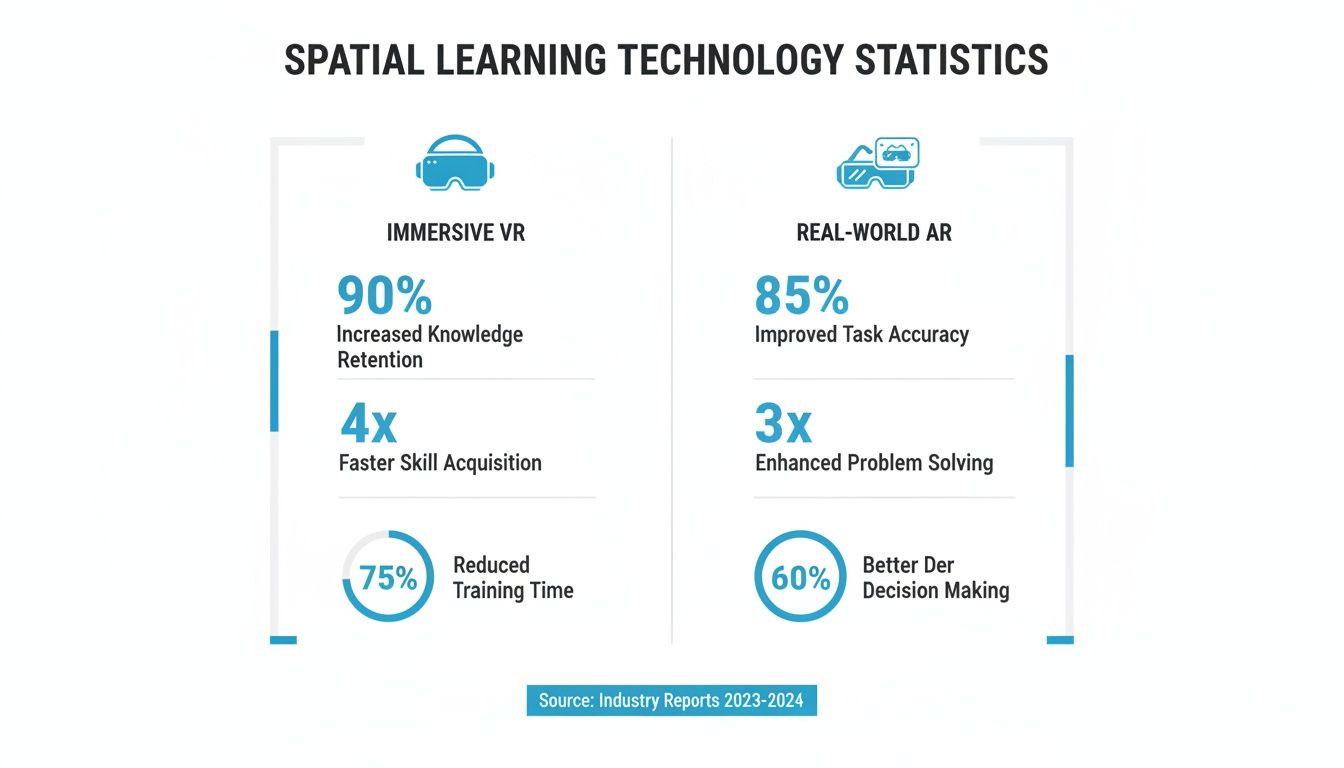
The data speaks for itself. Both technologies drive significant gains, from faster skill acquisition in VR to massive efficiency boosts with real-time AR support on the factory floor.
The Proven Advantage of Spatial Visualization
This isn't just anecdotal, either. The impact of this approach is backed by extensive research. A study focused on education found that when students used spatial visualization tools, their related skills shot up by 25%. The control group? They only saw a 5% increase.
Over time, those students went on to achieve better grades, score higher on standardized tests, and experience fewer failures. If you want to dive into the numbers, you can explore the full study on spatial skill development.
By connecting training directly to operational outcomes, spatial learning programs prove their worth not just as a learning tool, but as a strategic business investment that drives efficiency, safety, and profitability.
Building Your Business Case with Data
Want to demonstrate the ROI for your own organization? It's simpler than you think. Start by benchmarking your current performance before you roll anything out. Track metrics like onboarding time, material wastage costs, equipment downtime, and even the travel expenses for sending experts to a site.
After implementing a spatial learning program, you can measure the improvements against those baselines. The resulting data will paint a clear, undeniable picture of the program's value, showing exactly how investing in smarter training directly contributes to a stronger, more resilient operation.
Common Questions About Implementing Spatial Learning
Implementing a new training methodology like spatial learning naturally raises practical questions. For L&D and operations leaders, understanding the real-world implications of adopting VR and AR solutions is critical. Let’s address some of the most common concerns.
Isn't This Just a More Expensive Version of Hands-On Training?
While both approaches are active, comparing spatial learning via VR/AR to traditional hands-on training is like comparing a modern flight simulator to a textbook. Physical training is valuable but limited by equipment availability, safety risks, and scalability challenges.
AR/VR solutions overcome these limitations. VR provides a safe, infinitely repeatable virtual environment for practicing high-stakes procedures without tying up real machinery or risking injury. This is invaluable for emergency protocols that are impossible to replicate safely on-site. AR enhances live training by overlaying digital instructions, reducing the need for constant expert supervision and minimizing costly errors during the learning process.
Which Job Roles Benefit Most from This Type of Training?
Spatial learning delivers the most significant impact in roles where procedural accuracy, complex physical tasks, and 3D visualization are critical.
Key applications include:
- Manufacturing Assembly: Ensuring precise, sequential task completion.
- Equipment Maintenance and Repair: Accelerating diagnosis and improving first-time fix rates on complex machinery.
- Field Service Operations: Providing on-demand guidance to technicians working on unfamiliar equipment.
- Logistics and Warehousing: Optimizing workflows and improving spatial efficiency.
Essentially, any role where mistakes lead to costly downtime, safety incidents, or material waste is a prime candidate. AR and VR create a controlled digital space for teams to achieve mastery before performing tasks in a live operational environment.
Is This Technology Difficult to Implement and Scale?
The idea of deploying VR and AR can seem daunting, but modern platforms are designed for enterprise adoption without requiring a complete overhaul of your IT infrastructure.
A successful rollout begins with a targeted pilot program. Identify a specific business challenge, prove the value with clear metrics in a controlled setting, and then build a scalable deployment strategy based on that proven success.
This strategic, phased approach minimizes disruption and focuses on delivering a measurable return on investment quickly. With flexible solutions available, you can select a deployment model that aligns with your organization's operational needs and technical capabilities.
How Do We Prove the ROI of a Spatial Learning Program?
The return on investment for spatial learning is demonstrated through direct improvements in key business metrics. You can quantify cost savings by tracking reductions in trainer travel, material waste from training errors, and equipment downtime.
Productivity gains are equally measurable. Track improvements in time-to-competency for new hires and increases in first-time fix rates for field technicians. Crucially, you can measure and document enhanced safety compliance and fewer workplace incidents. By benchmarking these KPIs before and after implementation, you create a data-driven business case that clearly illustrates the program's bottom-line impact.
Ready to see how spatial learning can really move the needle for your team's performance? AIDAR Solutions provides immersive AR and VR training platforms that accelerate skills and deliver a clear return on investment. Explore our solutions and book a demo today.