10 Actionable Knowledge Management Best Practices for Industrial XR in 2025
In today's industrial landscape, the most critical asset isn't on the balance sheet; it's the tacit knowledge locked away in the minds of your most experienced technicians. As workforces evolve and operational complexity grows, traditional knowledge management methods like static manuals and siloed document repositories fall short. The challenge is no longer just storing information, but activating it at the point of need. This requires a strategic shift toward dynamic, immersive systems that capture, distribute, and scale expertise effectively.
To truly transform industrial expertise into a competitive advantage, it's vital to implement foundational knowledge management best practices that address the capture, organization, and sharing of information across your organization. Building upon those principles, this article outlines 10 actionable strategies specifically tailored for industrial enterprises. We will focus on how Extended Reality (XR) technologies like Augmented and Virtual Reality are revolutionizing how teams learn, solve problems, and drive operational excellence.
Each practice is a practical blueprint for building a resilient, high-performing workforce. You will learn how to:
- Capture expert knowledge before it walks out the door.
- Distribute critical skills and procedures on-demand, directly in the field.
- Measure the impact of knowledge transfer on key performance indicators.
We will explore everything from creating a centralized knowledge repository with XR integration to implementing real-time expert guidance and tracking skills with competency-based mapping. This is your guide to moving beyond outdated methods and establishing a robust system for continuous improvement and competitive advantage.
1. Centralized Knowledge Repository with XR Integration
A core component of effective knowledge management best practices is establishing a single source of truth. This means creating a unified, easily accessible platform that houses all critical organizational knowledge, from standard operating procedures (SOPs) and safety protocols to complex troubleshooting guides. For industrial enterprises, integrating this repository with Extended Reality (XR) transforms static documents into dynamic, contextual experiences. Instead of reading a manual, technicians can see 3D holographic overlays directly on equipment, guiding them through a repair step-by-step.
This approach ensures consistency across global operations, drastically reducing errors and improving first-time fix rates. It democratizes expertise by capturing the wisdom of seasoned professionals and making it available on-demand to newer employees, directly at their point of need. Centralized knowledge platforms with AR capabilities allow for the standardization of maintenance and training across facilities, ensuring every operator follows the same best practice.
How to Implement This Practice
- Start Small, Scale Smart: Begin by digitizing high-impact, frequently used procedures like equipment changeovers or critical safety checks.
- Create Immersive Content: Use a professional AR/VR authoring platform to create immersive training modules and work instructions. These assets become the dynamic core of your repository.
- Establish Governance: Implement a content governance process with subject matter expert (SME) review cycles to ensure all information remains accurate and up-to-date. Tag content meticulously with equipment IDs and process flows for intuitive search.
- Provide Contextual Access: Deploy a solution that allows field technicians to pull up specific, AR-enhanced guides on their smart glasses or tablets simply by looking at a piece of equipment. Learn more about the fundamentals of XR technology.
Key Takeaway: A centralized repository isn't just a digital library; when enhanced with XR, it becomes a proactive, intelligent system that delivers expert knowledge directly into the user's field of view, bridging the gap between information and action.
2. Structured Knowledge Capture from Subject Matter Experts (SMEs)
An organization's most valuable knowledge often resides in the minds of its most experienced employees. A critical knowledge management best practice involves systematically capturing this tacit expertise from Subject Matter Experts (SMEs) and converting it into explicit, reusable assets. This process goes beyond simple documentation; it's about extracting the nuances of diagnostic reasoning, troubleshooting instincts, and decision-making under pressure that separate experts from novices. For industrial settings, this means preserving decades of hands-on experience before it walks out the door upon retirement.
This strategic approach prevents knowledge loss and accelerates the development of the next generation of technicians and engineers. By transforming expert workflows into structured, immersive VR and AR training scenarios, companies can replicate complex, real-world challenges in a safe and controlled environment. This ensures that expert-level problem-solving becomes a scalable, institutional asset rather than an individual skill.
How to Implement This Practice
- Identify and Prioritize SMEs: Conduct a "retirement risk" analysis to identify key experts with unique, undocumented knowledge. Prioritize capturing their insights on critical or complex operations first.
- Use Structured Frameworks: Employ structured interview techniques and record video demonstrations as SMEs perform complex tasks. Focus on the "why" behind their actions, not just the "how."
- Build Immersive Scenarios: Leverage a dedicated authoring tool to transform this captured expertise into interactive VR training modules. Involve the original SME in validating the simulation to ensure its accuracy and realism.
- Enable Peer-to-Peer Transfer: Use a remote assistance platform to facilitate mentoring sessions, where an SME can guide a junior technician through a live task using AR annotations, effectively transferring knowledge in real-time at the point of need.
Key Takeaway: Structured knowledge capture is an insurance policy against brain drain. By systematically converting expert intuition into tangible, immersive learning assets, you ensure that high-level skills are retained, standardized, and propagated throughout the entire organization.
3. Immersive Scenario-Based Learning for Procedural Knowledge
Procedural knowledge is best learned by doing, but practicing complex or hazardous tasks on live equipment is often impractical and dangerous. This is where immersive, scenario-based learning becomes a critical component of modern knowledge management best practices. By creating realistic, interactive 3D simulations in Virtual Reality (VR), enterprises can allow technicians to practice high-stakes procedures like emergency shutdowns or intricate assembly sequences in a completely safe, controlled environment. This builds not just procedural memory but also critical decision-making skills.
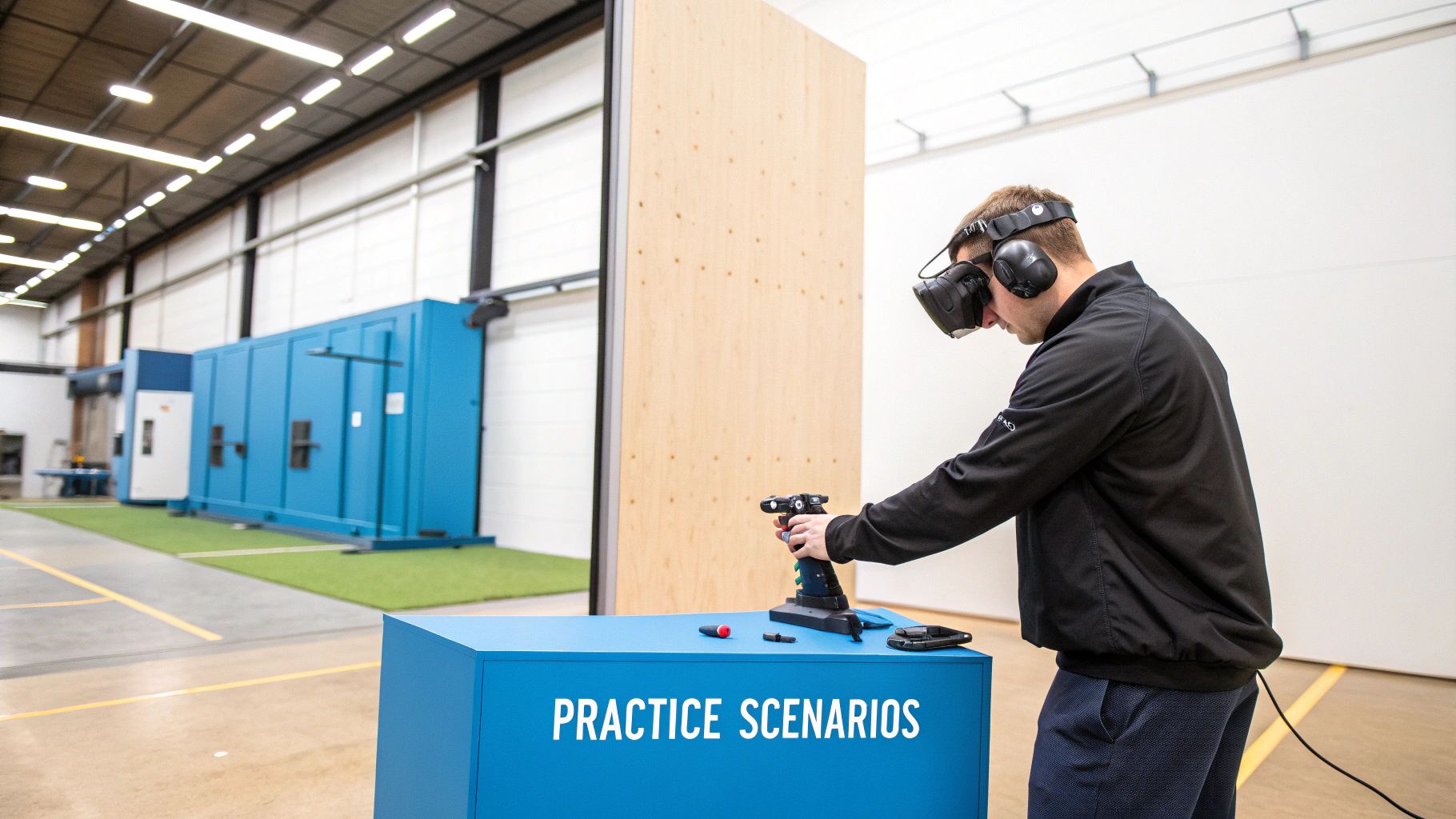
This method moves beyond passive learning, enabling trainees to experience the consequences of their actions without real-world risk. For instance, companies have demonstrated significant reductions in assembly errors by using VR training and have leveraged similar simulations to drastically lower safety incidents. The goal is to build muscle memory and situational awareness so that when a real-life event occurs, the correct response is instinctive. This practice is essential for transferring the implicit knowledge of seasoned experts into a scalable, repeatable training format.
How to Implement This Practice
- Prioritize High-Impact Scenarios: Start by developing VR simulations for high-risk procedures (e.g., lockout/tagout) or tasks where errors are costly.
- Create Realistic Training Modules: Use a professional platform to author detailed, interactive VR scenarios. Incorporate failure modes to teach technicians how to identify and recover from mistakes.
- Analyze Performance Data: Implement analytics to track user performance within the simulations. Identify common error points and areas where trainees struggle to provide targeted, personalized coaching.
- Gamify for Engagement: Introduce gamification elements like scoring, leaderboards, or timed challenges to boost motivation and knowledge retention. This also allows for regular skill validation. Discover more about immersive learning and its benefits.
Key Takeaway: Immersive scenario-based learning transforms knowledge transfer from a passive exercise into an active experience. It allows employees to safely fail, learn, and master complex procedures, ensuring they are prepared and competent before ever touching live equipment.
4. Real-Time Expert Guidance Through Remote Presence Technology
One of the most impactful knowledge management best practices is to eliminate the distance between experts and frontline workers. This involves deploying remote collaboration tools that use Augmented Reality to connect field technicians with seasoned specialists in real time. Instead of waiting for an expert to travel to a site, a technician can wear smart glasses or use a tablet to share their exact point of view, allowing the remote expert to provide live guidance with AR overlays, annotations, and step-by-step instructions directly on the technician's screen.
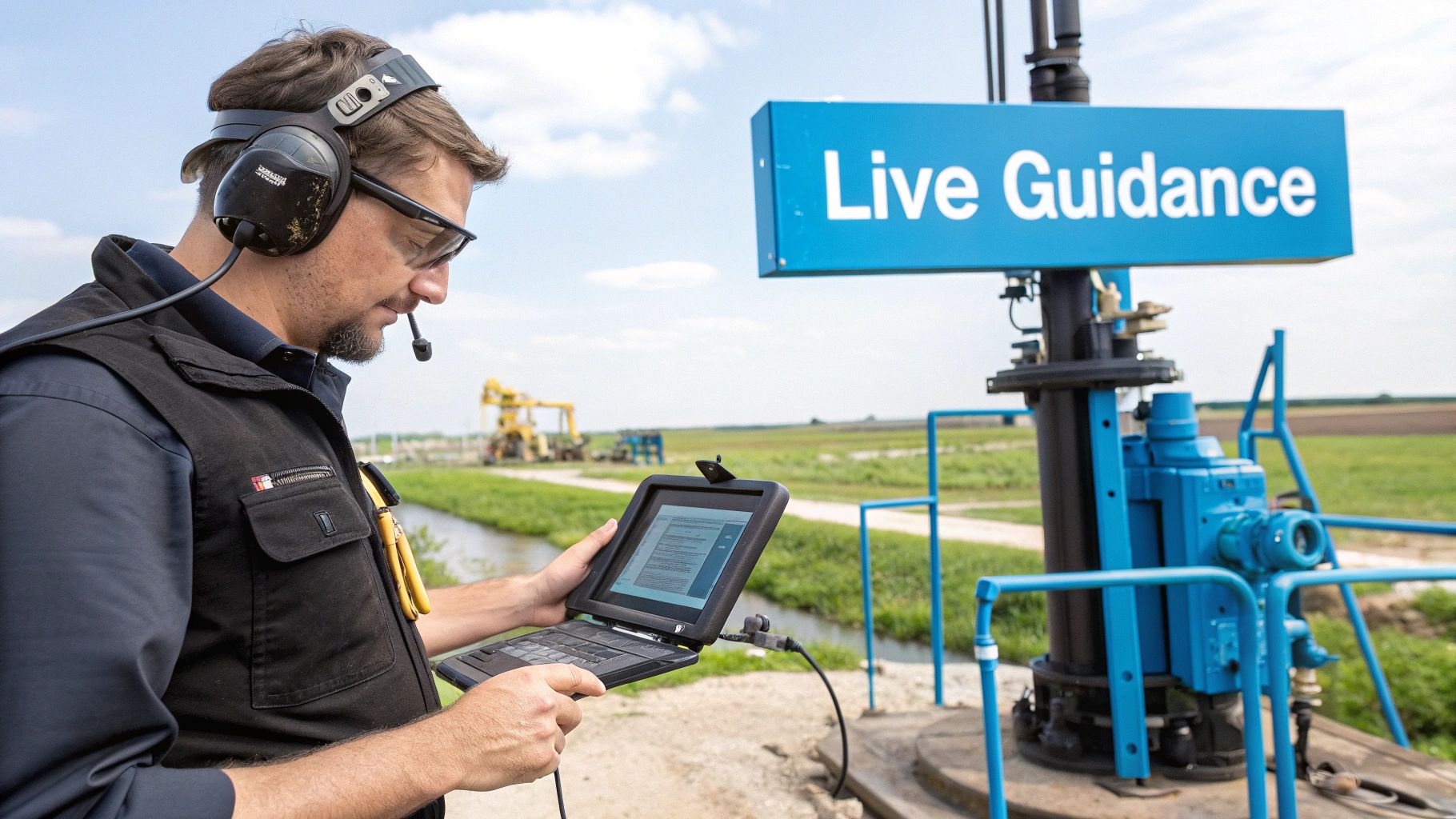
This approach dramatically compresses problem-resolution times and democratizes expertise across an entire organization, ensuring that even complex, unexpected issues are resolved correctly on the first attempt. Leading industrial companies leverage this technology to support global service teams, instantly connecting technicians with the precise expertise needed to diagnose and repair complex machinery. This immediate access to knowledge not only boosts first-time fix rates but also serves as a powerful, on-the-job training tool.
How to Implement This Practice
- Establish Expert Pools: Create and organize specialized groups of subject matter experts (SMEs) based on equipment type, failure category, or geographical region to streamline routing of support requests.
- Deploy a Robust Platform: Implement a tool designed for industrial environments that provides low-latency video streaming, AR annotations, and secure communication, ensuring clear and effective guidance.
- Train Both Sides: Train experts on how to communicate and teach effectively through a visual, remote medium. Simultaneously, equip technicians with the skills to operate the devices and clearly present problems to the remote SME.
- Integrate and Escalate: Define clear escalation protocols for when a problem requires on-site intervention. Use performance data from remote sessions to identify recurring issues that can be turned into standardized AR work instructions. Learn more about the power of AR-powered remote assistance.
Key Takeaway: Real-time remote guidance transforms knowledge management from a static retrieval process into a dynamic, collaborative conversation. It allows you to project your best experts anywhere in the world, instantly, turning every challenge into a solved problem and a learning opportunity.
5. Communities of Practice (CoPs) for Collaborative Learning
Beyond formal documentation, one of the most powerful knowledge management best practices involves harnessing the collective intelligence of your workforce. Communities of Practice (CoPs) are groups of professionals who share a common interest or discipline and come together to share challenges, validate solutions, and co-create best practices. This peer-to-peer learning model accelerates innovation and fosters a culture where knowledge is actively and collaboratively refined, moving beyond static repositories to dynamic, living expertise.
This approach transforms tacit, experience-based knowledge into an explicit, shared asset. For industrial enterprises, CoPs can connect technicians across different sites, allowing them to troubleshoot novel equipment failures or optimize maintenance routines in near real-time. By fostering these communities, companies can accelerate knowledge sharing between disparate manufacturing facilities, ensuring process improvements are diffused rapidly.
How to Implement This Practice
- Establish a Clear Charter: Define the CoP’s purpose, goals, and target members. Start with a high-value area like welding techniques, predictive maintenance analytics, or safety protocol improvements.
- Facilitate Collaborative Problem-Solving: Use a VR platform to create complex virtual simulations of equipment faults. CoP members can collaboratively tackle these scenarios, discuss outcomes, and codify the most effective solutions.
- Document and Distribute Insights: Ensure that valuable solutions and best practices identified within the CoP are documented. These insights can then be formalized into new work instructions or training modules within your central knowledge base.
- Empower On-the-Job Collaboration: Equip CoP members with remote assistance tools, enabling an expert in one facility to provide live, AR-guided support to a technician in another. This real-time collaboration session can be recorded and shared as a learning asset for the entire community.
Key Takeaway: Communities of Practice institutionalize collaborative learning, creating a feedback loop where practical field experience continually enriches your formal knowledge base and accelerates skill development across the entire organization.
6. Competency-Based Knowledge Mapping and Skills Tracking
Effective knowledge management best practices go beyond simply storing information; they involve strategically developing and verifying workforce capabilities. This means defining the specific competencies required for each role, from entry-level operator to master technician, and systematically mapping employee skills against those benchmarks. By identifying knowledge gaps, organizations can deliver targeted training and track measurable skill development over time, ensuring the right person has the right skills for any given task.
This structured approach transforms training from a cost center into a strategic investment in operational readiness. It connects learning directly to performance outcomes, ensuring that knowledge transfer results in quantifiable improvements in safety, quality, and efficiency. Leading industrial companies use comprehensive competency frameworks to guide career progression and ensure consistent standards across global operations, linking development directly to business objectives.
How to Implement This Practice
- Define Core Competencies: Work with frontline managers and subject matter experts (SMEs), not just HR, to define the critical skills and knowledge needed for each role. Break them down into clear proficiency levels (e.g., Novice, Proficient, Expert).
- Assess and Map Skills: Use an XR training platform to create objective, performance-based assessments. These hands-on AR scenarios measure an employee's ability to apply knowledge, providing a clear picture of their current competency level.
- Create Targeted Development Plans: Use the skill gap analysis to build individual learning paths. Assign specific immersive training modules to address identified weaknesses and guide employees toward the next proficiency level.
- Track and Certify Progress: As employees complete training and pass assessments, their skill profiles are automatically updated. This creates a real-time, dynamic skills matrix that managers can use for resource allocation and succession planning. Learn more about building effective competency-based training programs.
Key Takeaway: Competency mapping shifts the focus from "who was trained" to "who is capable." It creates a data-driven system for cultivating expertise, mitigating skill-based risks, and building a more agile and proficient industrial workforce.
7. Iterative Knowledge Refinement Through Use and Feedback Loops
Static documentation quickly becomes obsolete in a dynamic industrial environment. One of the most critical knowledge management best practices involves treating knowledge assets not as final drafts, but as living documents. This means establishing a continuous improvement cycle where content is constantly refined based on real-world use and direct feedback from the technicians who rely on it every day. By integrating feedback mechanisms directly into the workflow, procedures become more accurate, relevant, and effective over time.
This approach transforms knowledge from a top-down directive into a collaborative asset. When a technician in the field discovers a more efficient way to perform a task or finds an instruction unclear, they can immediately report it. This model ensures that the collective intelligence of the entire workforce is captured and used to enhance operational excellence. For example, a system can track which AR-guided procedures generate the most questions, automatically flagging them for review by a subject matter expert.
How to Implement This Practice
- Embed Feedback Channels: Integrate simple, one-click feedback buttons ("Was this helpful?") or short comment forms directly within the AR work instructions.
- Establish Rapid Review Cycles: Create a streamlined process to acknowledge, review, and implement high-impact suggestions quickly. Assign a specific "owner" to each procedure who is responsible for its accuracy and updates.
- Leverage Analytics: Use your knowledge platform to identify high-friction content. Analyze data on which procedures are paused most frequently, take longer than expected, or correlate with support calls to proactively identify areas for improvement.
- Acknowledge Contributions: Foster a culture of continuous improvement by publicly recognizing and rewarding employees whose feedback leads to significant process enhancements. This encourages ongoing engagement with your knowledge management system.
Key Takeaway: Knowledge management thrives when it's a two-way street. By building robust feedback loops, you empower your frontline workers to become active participants in refining best practices, ensuring your knowledge base evolves with your operations.
8. Cross-Functional Knowledge Integration and Process Documentation
Effective knowledge management best practices extend beyond siloed expertise. True operational excellence comes from documenting and integrating knowledge across entire end-to-end business processes, illustrating how functions like maintenance, operations, and supply chain interrelate. Instead of optimizing a single department’s tasks, this approach focuses on optimizing the total value stream, preventing bottlenecks and miscommunication between teams. This holistic view ensures that a decision made in one area, such as a maintenance deferral, is understood in terms of its impact on production schedules and quality control.
This integrated system fosters a culture of shared ownership and systems thinking. For example, by documenting the precise hand-off criteria between a production shutdown and an emergency maintenance task, both teams can coordinate seamlessly, minimizing downtime. This principle is used in complex manufacturing to integrate quality, maintenance, and production documentation, ensuring every function contributes to the final product's integrity. It transforms knowledge from a departmental asset into a strategic organizational capability.
How to Implement This Practice
- Map the Value Stream: Use value stream mapping to visually document how information, materials, and actions flow between departments. Identify key decision points and hand-offs.
- Develop Cross-Functional Scenarios: Use a simulation platform to create immersive training scenarios that require collaboration between different roles, such as coordinating a complex equipment changeover involving both operations and maintenance personnel.
- Establish a Governance Committee: Create a cross-functional steering committee to own and maintain process documentation, ensuring it reflects the integrated reality of operations, not just individual department views.
- Create Role-Specific Views: Within your knowledge system, provide role-specific views of the end-to-end process. For instance, a technician's guide can show not only the repair steps but also include escalation criteria for informing production supervisors. Learn more about how to structure digital work instructions.
Key Takeaway: Integrating knowledge across functions breaks down operational silos, enabling teams to see the bigger picture. This holistic approach ensures that local actions are aligned with global business goals, optimizing total process performance rather than isolated tasks.
9. Microlearning and Just-In-Time Knowledge Delivery
Traditional, lengthy training sessions are often ineffective on the factory floor. One of the most impactful knowledge management best practices is adopting microlearning, which breaks down complex information into small, focused modules (typically 5-15 minutes). This approach enables just-in-time knowledge delivery, allowing technicians to access the exact guidance they need at the moment of need, directly on their mobile device or AR headset, without disrupting their workflow.
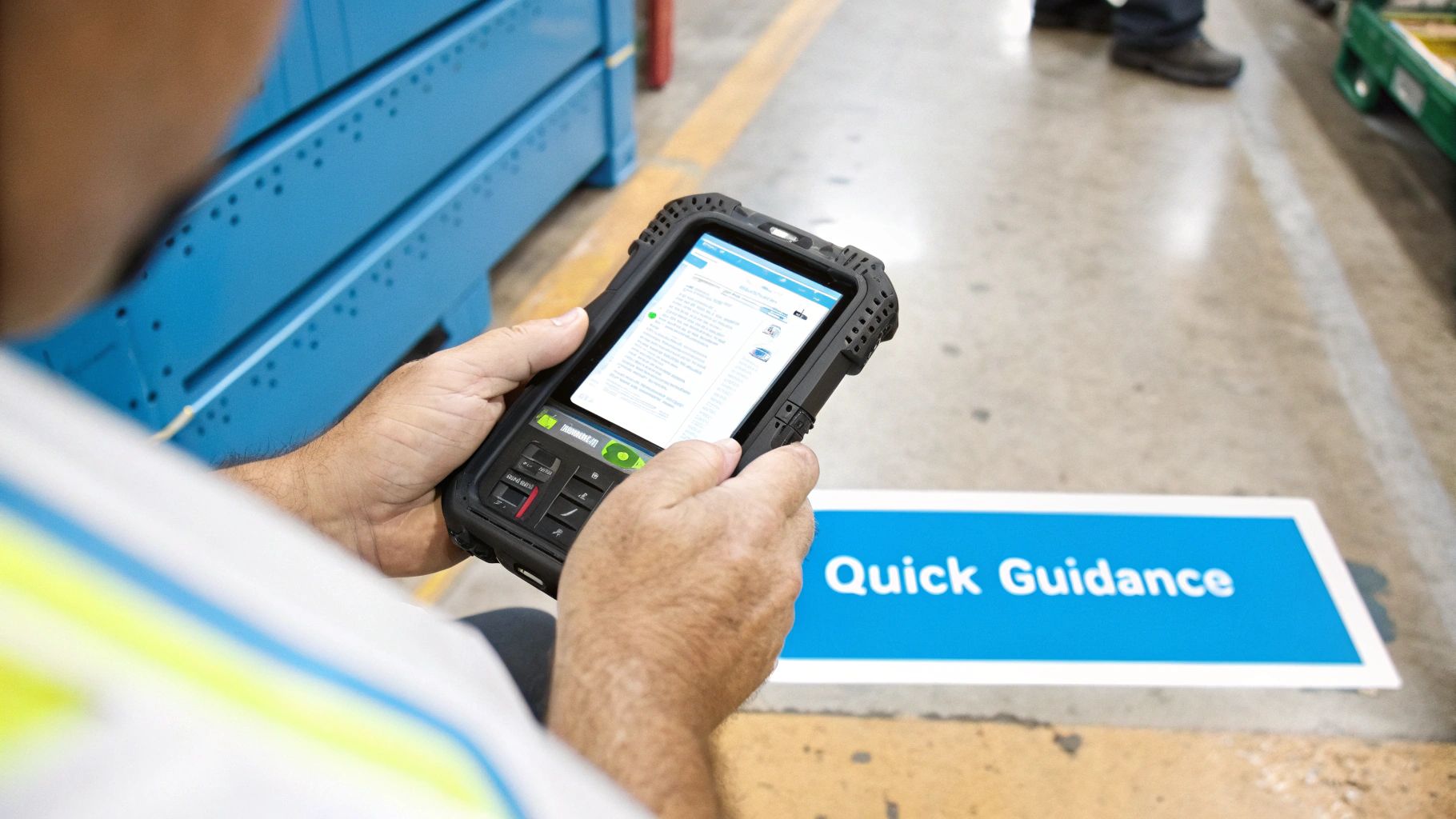
This method respects the cognitive load of frontline workers, improving knowledge retention and reducing the time spent searching for information. Instead of a one-hour training course, a technician can watch a two-minute video on torque specifications or follow a five-step AR-guided checklist for a specific sensor calibration. This on-demand model turns knowledge from a scheduled event into a continuous, integrated part of daily operations, directly boosting productivity and competence.
How to Implement This Practice
- Identify High-Impact Topics: Use analytics to identify the most frequent support requests or recurring procedural errors. Prioritize these for microlearning content creation.
- Design for the Point of Need: Create bite-sized content like short instructional videos, interactive checklists, or AR-powered work instructions using a dedicated authoring tool. Ensure all content is mobile-first and easily digestible.
- Embed Learning into the Workflow: Don't just store micro-lessons in a separate app. Use a platform that can embed these learning modules directly into AR overlays on equipment, making them contextually available.
- Reinforce with Spaced Repetition: Schedule follow-up micro-lessons or quick quizzes over time to combat the forgetting curve and ensure long-term knowledge retention.
Key Takeaway: Just-in-time microlearning shifts knowledge delivery from a disruptive "pull" model (searching a database) to a seamless "push" model, where targeted insights are delivered precisely when and where they can make the biggest operational impact.
10. Knowledge Security, Compliance, and Data-Driven Knowledge Analytics
Effective knowledge management best practices extend beyond creation and distribution; they must also encompass robust security, regulatory compliance, and performance measurement. This involves a dual-focus approach: first, protecting sensitive intellectual property (IP) through governance like role-based access and encryption, and second, using analytics to measure how knowledge assets impact operational outcomes. This transforms knowledge from a passive resource into a secure, strategic, and measurable asset.
By integrating these controls, organizations can confidently deploy advanced tools while adhering to strict industry standards. For instance, manufacturers can use AR for training on proprietary formulas while ensuring only authorized personnel can access the procedures. Similarly, suppliers can maintain formal audit trails for AR-guided assembly processes, proving compliance. This strategic combination ensures that critical knowledge is not only protected but also optimized for maximum business impact.
How to Implement This Practice
- Classify and Control: Start by classifying knowledge assets based on sensitivity (e.g., public, confidential, restricted). Implement role-based access controls within your knowledge platform to ensure users only see information relevant and approved for their role.
- Secure Remote Collaboration: When using remote assistance tools for sensitive equipment, ensure the platform provides end-to-end encryption for video streams and data exchange. Utilize features like session recording for audit trails and compliance reviews.
- Establish Governance Workflows: Create clear ownership and approval workflows for all knowledge content. All procedures, especially those created with AR/VR tools, should go through a formal review by subject matter experts before publication to ensure accuracy and safety.
- Measure What Matters: Leverage built-in analytics to connect knowledge consumption with performance. Track metrics like competency progression, first-time fix rates, and reduction in safety incidents. Use this data to identify knowledge gaps and prove the ROI of your training and support initiatives.
Key Takeaway: Integrating robust security and analytics is non-negotiable. It ensures your most valuable asset, organizational knowledge, is both rigorously protected and actively contributing to measurable improvements in efficiency, safety, and operational excellence.
10-Point Knowledge Management Best Practices Comparison
| Item | Implementation Complexity (🔄) | Resource Requirements (⚡) | Expected Outcomes (⭐ / 📊) | Ideal Use Cases (💡) | Key Advantages (⭐) |
|---|---|---|---|---|---|
| Centralized Knowledge Repository with XR Integration | High — cross-system integration; 3–12+ months 🔄 | Very high — XR asset dev, platform, localization, infra ⚡ | Consistency; 50–75% faster onboarding; reduced downtime 📊 | Global plants; standard procedures; remote maintenance 💡 | Single source of truth; analytics-driven gaps; remote expertise ⭐ |
| Structured Knowledge Capture from SMEs | Medium–High — scheduling + elicitation 🔄 | Moderate — SME time, knowledge engineers, recording tools ⚡ | Preserves tacit expertise; faster ramp-up; standardized best practices 📊 | Retirement-risk SMEs; complex troubleshooting; succession planning 💡 | Captures decision logic; creates reusable scenarios ⭐ |
| Immersive Scenario-Based Learning for Procedural Knowledge | Medium–High — realistic simulation dev; VR ops 🔄 | High — VR hardware, content dev, training space ⚡ | 50–75% faster learning; 50% fewer mistakes; 4× throughput 📊 | High-risk tasks; emergency drills; heavy-equipment training 💡 | Safe failure practice; measurable competency gains ⭐ |
| Real-Time Expert Guidance Through Remote Presence Technology | Medium — connectivity + integration; protocols 🔄 | Moderate — rugged devices, bandwidth, expert pools ⚡ | ~50% MTTR reduction; lower travel costs; faster resolution 📊 | Field repairs; remote sites; urgent breakdowns 💡 | Scales experts; documents sessions; reduces miscommunication ⭐ |
| Communities of Practice (CoPs) for Collaborative Learning | Low–Medium — facilitation & governance 🔄 | Low — meeting time, collaboration platforms ⚡ | Faster innovation diffusion; improved problem-solving; engagement 📊 | Cross-site knowledge sharing; continuous improvement initiatives 💡 | Leverages collective intelligence; builds learning culture ⭐ |
| Competency-Based Knowledge Mapping and Skills Tracking | Medium — framework design & alignment 🔄 | Moderate — assessments, LMS, manager time ⚡ | Clear skill gaps; objective promotion/hiring; measurable ROI 📊 | Certification paths; role-based development; succession planning 💡 | Targets training to gaps; supports career paths ⭐ |
| Iterative Knowledge Refinement Through Use and Feedback Loops | Low–Medium — governance + review workflows 🔄 | Low–Moderate — feedback tooling, SME review cycles ⚡ | Keeps content current; fewer support tickets; continuous improvement 📊 | Rapidly changing procedures; frontline-sourced updates 💡 | User-driven updates; faster issue detection ⭐ |
| Cross-Functional Knowledge Integration and Process Documentation | High — multi-function coordination; upkeep 🔄 | High — mapping tools, stakeholder time, governance ⚡ | Better end-to-end performance; fewer handoff errors 📊 | Complex value streams; crisis coordination; process optimization 💡 | Optimizes total process; improves cross-team coordination ⭐ |
| Microlearning and Just-In-Time Knowledge Delivery | Low–Medium — chunking & organization 🔄 | Moderate — content production, mobile/AR delivery ⚡ | Higher application; 20–40% better retention; faster access 📊 | On-the-job reference; frequent, routine tasks; point-of-need help 💡 | Timely, low-friction learning; easy updates ⭐ |
| Knowledge Security, Compliance, and Data-Driven Knowledge Analytics | High — governance, legal, and tech integration 🔄 | Very high — IAM, encryption, logging, analytics platforms ⚡ | Protected IP; auditability; links training to MTTR/quality 📊 | Regulated industries; sensitive IP; audit-heavy environments 💡 | Balances security with insight; measurable impact ⭐ |
Activating Your Knowledge: From Strategy to Execution
The journey through these ten knowledge management best practices reveals a powerful truth for industrial enterprises: managing knowledge is no longer a passive, archival process. It is an active, dynamic strategy for building a more resilient, skilled, and efficient workforce. From establishing a centralized XR-integrated repository to leveraging data-driven analytics for continuous improvement, each practice represents a crucial component in constructing a robust knowledge ecosystem. The era of static manuals and siloed expertise is giving way to a new paradigm where knowledge is immersive, contextual, and available at the precise moment of need.
The core theme woven throughout these strategies is the powerful synergy between people, processes, and technology. Simply adopting a new tool is not enough. The true transformation occurs when you empower your Subject Matter Experts to capture their invaluable experience through structured processes, and then use technology like Augmented Reality to amplify and distribute that knowledge in a way that resonates with the modern frontline worker. Practices like immersive, scenario-based learning and real-time expert guidance are no longer futuristic concepts; they are practical, high-impact solutions to today's most pressing challenges, such as the skilled labor gap and the need for operational excellence.
From Blueprint to Reality: Your Actionable Path Forward
Moving from understanding these best practices to implementing them can feel daunting. The key is to adopt a phased, strategic approach that builds momentum and delivers tangible results quickly. Instead of attempting a complete overhaul at once, focus on creating a clear roadmap.
Here are your immediate, actionable next steps:
- Conduct a Knowledge Audit: Before you build, you must understand your foundation. Identify your most critical knowledge assets, locate where your most significant knowledge gaps exist, and pinpoint the Subject Matter Experts whose expertise is most at risk. This audit will highlight the highest-priority areas for your initial efforts.
- Launch a Pilot Program: Select one or two high-impact practices to pilot. For many organizations, structured knowledge capture from SMEs (Practice #2) combined with immersive scenario-based learning (Practice #3) offers the fastest return on investment. Choose a single critical procedure or piece of equipment and use it as your test case.
- Define and Measure Success: Revisit the KPIs discussed for each practice. For your pilot, choose 3-5 key metrics to track, such as a reduction in training time, a decrease in error rates, or an improvement in first-time fix rates. Demonstrating measurable success is vital for securing buy-in for a broader rollout.
Key Takeaway: The goal is not to implement all ten practices overnight. The goal is to start a cultural shift where knowledge is viewed as a strategic asset. By starting small, proving value, and scaling intelligently, you create a sustainable framework for continuous learning and performance improvement.
Mastering these concepts is more than an operational upgrade; it's a competitive differentiator. Organizations that effectively activate their institutional knowledge are better equipped to adapt to market changes, onboard new talent faster, and maintain a higher standard of quality and safety. To truly activate your knowledge and ensure its long-term impact, especially in dynamic environments, it's vital to implement robust knowledge management best practices for growing teams that support scalability and continuous learning. By embedding these principles into your operational DNA, you are not just managing information; you are future-proofing your workforce and building a lasting foundation for enterprise-wide success.
Ready to transform your knowledge strategy into a competitive advantage? AIDAR Solutions provides the XR platform to bring these best practices to life, from immersive training with AIDAR.SKILLS to real-time expert support with AIDAR.SERVICE. Explore how our platform can help you capture, distribute, and apply critical knowledge where it matters most by visiting AIDAR Solutions.