
Solving Augmented Reality Challenges in Business
While the promise of augmented reality is huge, many businesses are hitting the brakes. They're staring down a road filled with very real augmented reality challenges, from staggering costs and clunky hardware to the nightmare of content creation and the pressure to prove it’s all worth it.
Confronting the Reality of AR Adoption
Augmented reality (AR) has the power to completely reshape how industrial companies operate by layering digital information right onto the physical world. For industries like manufacturing and field service, this isn't just a gimmick; it's a direct line to better efficiency, safety, and training. Imagine a technician seeing step-by-step repair guides through smart glasses while their hands are free, or a new hire learning an assembly line with interactive 3D models guiding their every move.
But getting from that exciting vision to a successful rollout means taking a hard look at the obstacles. The journey is almost always more complicated than it seems, echoing the same growing pains seen with any major technology deployment.
Key Hurdles on the Path to AR Integration
Getting AR right involves a lot more than just buying a few headsets. It's a company-wide effort that hits finance, IT, and operations. The main sticking points usually fall into a few key areas:
- Significant Initial Investment: Enterprise-grade AR hardware and custom software require a substantial upfront budget.
- Technical and UX Barriers: Can the device survive a drop on the factory floor? Does the battery last a full shift? Is it comfortable enough to wear for hours? These practical issues can stop adoption in its tracks.
- Content Creation Bottleneck: Building and maintaining a library of accurate, optimized 3D models and instructions for your AR apps is a massive undertaking.
- Measuring ROI: You have to prove to stakeholders that the investment is paying off. That means tracking the right metrics to show real, tangible value.
As we confront the broader reality of AR adoption, insights into the increasing presence of virtual reality in real estate highlight the ongoing evolution and market integration of immersive technologies. This guide will serve as your strategic roadmap, breaking down each of these augmented reality challenges with actionable solutions.
Getting past these roadblocks is what separates a promising pilot from a program that actually scales and makes an impact. The first step is understanding what you're up against, which is a process not unlike navigating other major https://aidarsolutions.com/digital-transformation-challenges/. This guide is designed to cut through the hype and give you a practical playbook for turning potential AR pitfalls into a real competitive advantage—and making sure your investment actually pays off.
Navigating High Costs and Hardware Hurdles
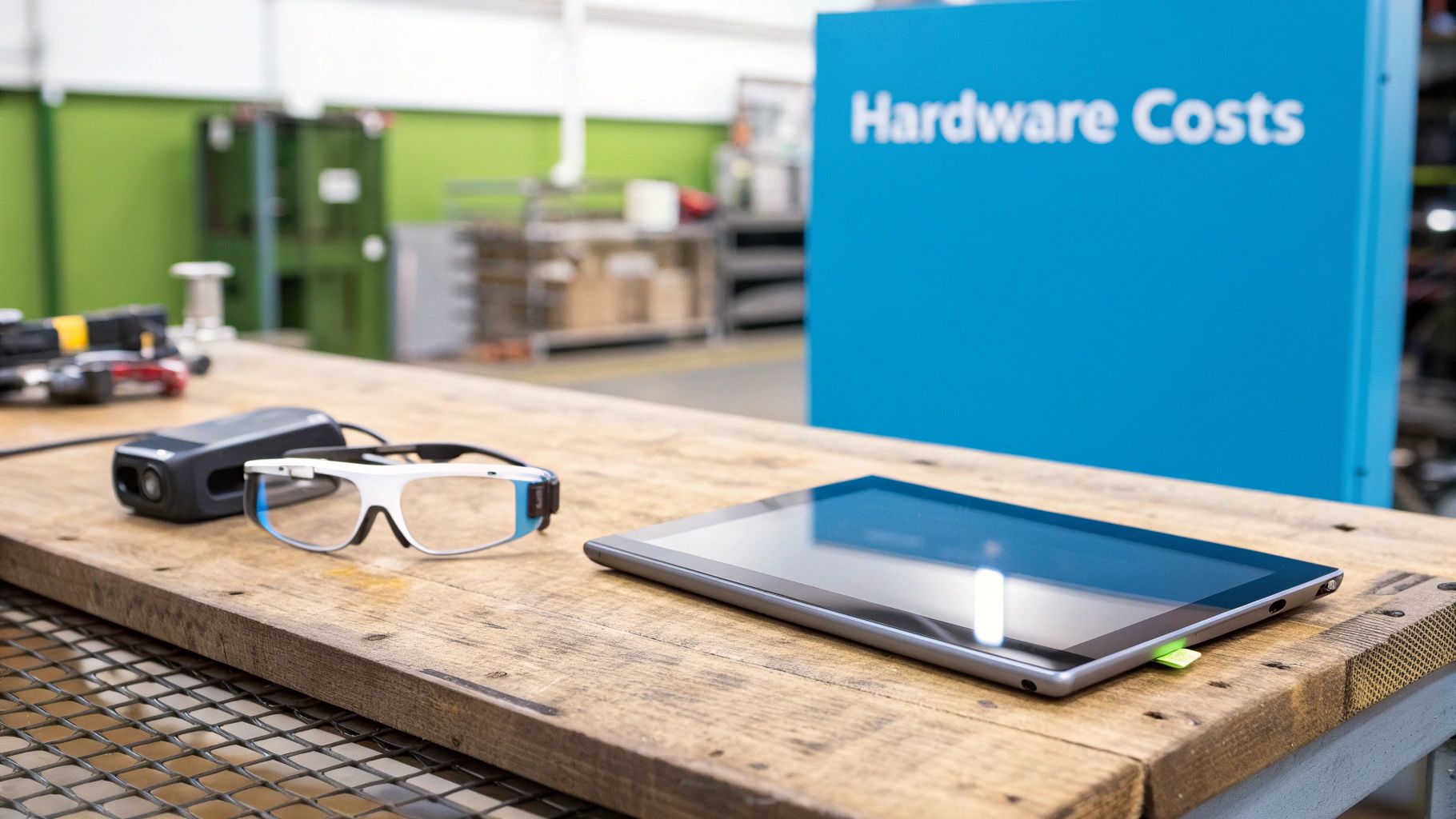
Let’s be honest: one of the first, and biggest, hurdles any organization hits when looking into AR is the price tag. The initial investment can feel steep. While the long-term ROI is absolutely there, the upfront cost for both the specialized hardware and the sophisticated software can stop a promising project dead in its tracks.
This isn't just about buying a few headsets. The true cost of getting an AR program off the ground and running smoothly is much broader. Think of it like the early days of mainframe computers—the tech was powerful and built for a purpose, but it required a serious commitment of resources to get it in the door, set up, and maintained.
Unpacking the True Cost of an AR Initiative
To budget properly, you have to look at the whole picture. That initial sticker price on a pair of smart glasses? That's just the tip of the iceberg. A real-world AR project has several moving parts, and they all have costs attached.
- Enterprise-Grade Hardware: Consumer AR glasses aren't going to survive on a factory floor. You need industrial-grade smart glasses—the kind that are ruggedized to handle drops, dust, and moisture—and they can run several thousand dollars a pop.
- Custom Software Development: It's rare that an off-the-shelf app perfectly matches your specific workflow for a manufacturing line or a field service call. You'll almost always need some level of custom development to integrate with your existing systems and actually deliver value.
- Ongoing Maintenance and Support: AR isn't a "set it and forget it" technology. Just like any other critical business system, it needs ongoing maintenance, software updates, and user support, all of which need to be factored into the operational budget.
This financial reality is a big reason we see a gap between big corporations and smaller businesses adopting AR. A recent analysis pointed out that enterprise-grade projects often demand investments between $50,000 and $200,000. It’s no surprise, then, that only 28% of small and medium-sized businesses have dipped their toes in, compared to 56% of large enterprises.
Before diving in, it’s crucial to map out all potential expenses to get a realistic view of the total investment. This table breaks down the common cost components you'll encounter in a typical enterprise AR project.
Breaking Down a Typical AR Project Budget
| Cost Component | Typical Price Range | Key Considerations |
|---|---|---|
| Hardware | $1,000 – $5,000+ per unit | Durability, battery life, comfort for all-day wear, and processing power. |
| Software Licensing | $50 – $300 per user/month | Per-user vs. site licenses; look for platforms that offer scalability. |
| Custom Development | $25,000 – $150,000+ | Varies based on complexity, integrations with ERP/MES, and 3D content needs. |
| Implementation & Training | $5,000 – $50,000 | Includes initial setup, workflow integration, and training for end-users and admins. |
| Maintenance & Support | 15-25% of initial cost, annually | Covers software updates, bug fixes, hardware repairs, and helpdesk support. |
| Content Creation | $10,000 – $100,000+ | Cost to create or convert 3D models, instructional videos, and procedural guides. |
Understanding these figures from the start prevents budget overruns and helps set realistic expectations for stakeholders about what it truly takes to succeed with AR.
The Practical Limitations of Current Hardware
Beyond the money, the physical hardware itself presents its own set of challenges. A device that looks sleek in a boardroom demo might be impractical in the tough reality of an industrial setting. How usable the hardware is day-to-day is just as important as its tech specs.
For instance, a technician on an assembly line needs a battery that lasts a full eight-hour shift. If their smart glasses die after just a few hours, the whole workflow grinds to a halt, and any productivity gains vanish. The device also has to be comfortable enough to wear all day without causing headaches or eye strain.
Right now, AR hardware often forces a trade-off. You might find a device with a brilliant, high-res display and tons of processing power, but it’s heavy and the battery life is terrible. On the flip side, a lighter, more comfortable device might not have the horsepower for complex 3D overlays.
Choosing the right device means weighing these trade-offs against your specific needs. A headset that’s perfect for a remote expert call (where video streaming is key) could be useless for a complex assembly task that needs stable, detailed 3D models.
This is exactly why major technology firms are investing billions into XR. It’s a strong signal that the hardware is on the cusp of a major leap forward—becoming more powerful, more ergonomic, and more affordable. To learn more about this trend, check out our article on how Apple and Samsung's multi-billion dollar investment in XR is a critical signal for every enterprise.
Overcoming Technical and User Experience Barriers
Even the most powerful AR solution is destined to fail if the people it’s supposed to help won't actually use it. Beyond the initial cost, the biggest roadblocks are often rooted in the day-to-day realities of how the tech works and feels. If a device is uncomfortable, unreliable, or difficult to connect to existing systems, adoption will stall before it ever gets a chance to prove its worth.
The technology has to serve the user, not the other way around. Providing a new tool that is too heavy, runs out of power mid-job, or requires complex operation will result in it being set aside. The exact same principle applies here.

The Human Factor in AR Adoption
The human element is a frequently overlooked piece of the AR puzzle. For frontline workers in manufacturing or field service, a device isn't just an accessory—it's a core part of their work environment. Addressing human-factor issues is critical to a successful implementation.
Several human-factor issues can make or break an implementation:
- All-Day Ergonomics: An AR headset must be light and balanced enough for someone to wear for a full shift. Headaches, neck strain, or general discomfort are guaranteed to create resistance from your team.
- Motion Sickness and Cognitive Load: A poorly designed AR experience can cause disorientation, especially during complex tasks that require a lot of head movement. The goal is to reduce a user's mental strain, not add to it with confusing digital clutter.
- Battery Life Limitations: The constant battle for better battery life is a major hurdle. Most enterprise-grade headsets only offer a few hours of continuous use, which is a non-starter for an eight-hour shift. This limitation forces workflow interruptions and kills productivity.
These aren't just minor gripes; they are critical barriers. In fact, 42% of AR users report discomfort after prolonged use, according to recent surveys. You can find more stats on AR market growth and user experience on inairspace.com. Tackling these UX issues head-on is non-negotiable.
The Challenge of Enterprise System Integration
On the technical side, one of the most significant challenges is getting your new AR platform to communicate with your existing enterprise systems. Your business already runs on a backbone of software—an ERP, an MES, you name it. These systems hold all the critical data that makes AR useful: work orders, inventory levels, schematics, and compliance checklists.
This integration is almost never a simple "plug-and-play" situation. It requires careful planning and specialized expertise to build a reliable data pipeline.
Getting AR to work with legacy systems is like trying to connect a modern smart home hub to a house with 1950s wiring. You can't just plug it in and expect it to work. You need a skilled professional to bridge the gap, ensure a stable connection, and make sure everything communicates correctly without causing problems.
This isn't just an anecdotal pain point. A 2024 Gartner survey found that 53% of enterprises name technical limitations as their primary barrier to AR adoption. And of that group, 41% specifically pointed to the challenge of IT infrastructure integration.
Strategies for a User-Centric Rollout
Beating these technical and UX barriers means you have to be proactive and put your people first. Instead of pushing technology onto your team, you need to pull them into the process.
- Run Pilot Programs with Real Users: Before you even think about a full-scale deployment, run pilot programs with a small group of the actual end-users. Get their direct, unfiltered feedback on device comfort, how easy the interface is to use, and any friction in the workflow.
- Select Hardware for the Environment: Choose AR devices that are genuinely suited to your work conditions. A dusty, high-vibration factory floor demands a very different piece of hardware than a sterile cleanroom or an outdoor field service job.
- Design Intuitive Workflows: This is the key. You have to make the user's job easier, not harder. Focus on designing an intuitive augmented reality workflow that simplifies complex tasks and presents information clearly and concisely, right in their line of sight.
Solving the AR Content Creation Bottleneck
An augmented reality application is only as good as the digital content it displays. This simple fact leads us to one of the biggest—and most frequently overlooked—augmented reality challenges: the massive undertaking of creating and managing a library of 3D content at scale. Many companies successfully select hardware and run a pilot, only to encounter the 'content bottleneck'.
This is the point where the demand for high-quality, accurate, and optimized digital assets completely outstrips the company's ability to produce them. The reality is that building AR experiences requires a specialized skillset and a robust technical pipeline to get right.

The Skills Gap and Technical Hurdles
The first problem is expertise. 3D modeling isn't a standard skill on most industrial maintenance or manufacturing teams. This leaves organizations with a difficult choice: hire experienced 3D artists or attempt to upskill their current staff. Both paths require a significant investment of time and money.
Even with the right people, major technical hurdles remain. For example, a CAD file for a piece of machinery is typically incredibly detailed and large—perfect for engineers, but a performance nightmare for an AR headset with limited processing power.
It’s like trying to fit an entire architectural blueprint onto a small sticky note. You can't just shrink it. You have to carefully redraw the most essential parts, stripping away useless details so it’s clean and instantly understandable without overwhelming the person wearing the headset.
This optimization process, known as decimation or polygon reduction, is a non-negotiable step. Without it, the AR application will lag, freeze, or fail to load the models. This creates a frustrating, unusable experience for the technician trying to get a job done.
Data Governance and The Need for a Single Source of Truth
The challenges multiply when considering data management. In any large factory, equipment designs are constantly being updated. A single machine might have dozens of versions, each with small but critical differences. Using an outdated 3D model in an AR-guided repair is not just inefficient—it can be dangerous.
This is where strict data governance and version control become absolutely mission-critical. Your AR content pipeline must be locked into a single source of truth, without exception. This ensures that technicians always see the correct, up-to-the-minute information for the specific asset in front of them.
Here are the key protocols you need for managing AR content:
- Robust Version Control: Put a system in place that tracks every single change to a 3D model and its instructions. Outdated versions need to be archived so they can't be used by mistake.
- Secure Asset Management: Protecting proprietary designs and your intellectual property is paramount. Your content management system must have rock-solid security to prevent data leaks or unauthorized access.
- Clear Data Governance Policies: Define exactly who is responsible for creating, approving, and updating AR content. This clarity kills confusion and ensures accountability.
Streamlining Content Creation with Modern Platforms
Thankfully, a new wave of authoring platforms is emerging to tackle this bottleneck head-on. These tools are designed to simplify and speed up the whole content creation process, often without requiring you to become a 3D modeling expert. They offer features like drag-and-drop interfaces for building instructions and automated tools for optimizing those heavy CAD files.
When these platforms are combined with artificial intelligence, the process becomes even more efficient. To see how this works, you can learn more about how AI is accelerating XR technologies like augmented reality in our detailed guide. These solutions empower your subject matter experts—the engineers and senior technicians who know the equipment inside and out—to create their own AR training and service guides.
This approach democratizes content creation, finally breaking down the bottleneck and making it possible to scale an AR program effectively across your entire organization.
Proving ROI and Scaling Your AR Program
A successful pilot program is a fantastic start, but it's just the beginning. The real test comes when you try to scale that small, controlled experiment into a full-blown enterprise deployment. This is where a whole new set of augmented reality challenges pop up.
The biggest hurdle? Proving a clear Return on Investment (ROI). Without it, you'll never get the long-term funding and executive support needed to grow. Your AR initiative will get stuck in "pilot purgatory" instead of becoming a core operational tool. To build a solid business case, you have to move past anecdotal success stories and get down to hard numbers—tangible metrics that directly impact the bottom line.
Defining Your Key Performance Indicators
To prove AR's worth, you need to be tracking the right Key Performance Indicators (KPIs) from day one. These metrics are your evidence, translating operational wins into the financial language that gets stakeholders' attention. The key is to tie your KPIs directly to the problems your AR solution was brought in to solve.
For manufacturing, field service, and training, a few high-impact KPIs consistently tell a powerful story:
- First-Time Fix Rate (FTFR): This is the gold standard in field service. A higher FTFR means fewer repeat visits. That’s an immediate reduction in travel costs and labor hours, not to mention a huge boost in customer satisfaction.
- Mean Time to Repair (MTTR): How long does it take, on average, to get a piece of equipment back online? Tracking this shows exactly how AR-guided instructions slash costly downtime. In fact, some reports show AR can cut average repair times by as much as 40%.
- Error Rate Reduction: In complex assembly or maintenance, a single mistake can be costly. AR overlays can nearly eliminate human error, and documenting that drop provides a rock-solid argument for better quality control and less rework.
- Training Time and Competency: Forget long classroom sessions. With AR, you can measure how quickly new hires get up to speed. On-demand, interactive guidance accelerates learning, cutting both the time and the cost of traditional training.
Building a Phased Rollout Strategy
Avoid a large, company-wide rollout from the start. This approach is often a recipe for disaster. A phased rollout is the smarter move, which lets you learn, adapt, and build momentum along the way. You mitigate risk and gather the proof you need to justify the next stage of investment.
A phased rollout acts like a series of checkpoints. You start with a well-defined pilot to prove the concept and gather initial ROI data. Success at this stage unlocks the resources for the next phase, creating a virtuous cycle of proven value and expanding support.
This methodical expansion makes sure you don't get ahead of your organization's ability to adapt. Each phase should have clear goals, specific user groups, and concrete KPIs to hit before you even think about moving on.
Overcoming Common Scaling Pitfalls
Scaling an AR program isn't just about the tech—it's about people. Many promising initiatives fail not because the hardware malfunctioned, but because the organization was not prepared for the change.
To ensure your rollout is smooth, get out in front of these common roadblocks:
- Lack of Executive Buy-In: You need a champion in the C-suite from the very beginning—someone who sees the strategic value of AR. Use the hard data from your pilot to build a business case that speaks their language: efficiency, cost savings, and a real competitive edge.
- Inadequate Change Management: You can't just hand a technician a headset and expect immediate adoption. You need a formal change management plan. That means clear communication explaining why this is happening, proper training, and a support system for users as they learn new workflows.
- Ignoring User Feedback: The people on the front lines are your best source of intelligence. Their insights are invaluable. Set up continuous feedback loops to find out what’s working, what isn’t, and where you can improve. An AR solution that evolves based on what users actually need is one that will be adopted and scaled successfully.
Your Blueprint for a Winning AR Rollout
Successfully navigating the world of augmented reality takes more than innovative tech; it demands a clear, strategic blueprint. Think of this as your roadmap, turning the insights we've covered into a practical plan for your business. The goal here isn't to fear the challenges, but to see them as manageable steps on your journey to operational excellence.
This blueprint gives you a step-by-step framework to take your AR initiative from a promising idea to something that actually generates real value. It’s all about being methodical, focusing on your people, and letting data guide your decisions.
Step 1: Pinpoint the Highest-Impact Use Case
Before you write a single line of code or buy a single headset, you need to know exactly what business problem you’re trying to solve. Don't lead with the technology; lead with the pain point. Is your biggest headache machine downtime? Are you trying to get new hires up to speed faster? Or is it all about improving first-time fix rates for your field techs?
Pick one specific, high-impact use case for your initial pilot. A narrowly focused project with crystal-clear success metrics is far more likely to prove its worth and get you the buy-in needed to expand later. Trying to solve too many problems at once is a common recipe for failure.
Step 2: Choose the Right Technology Partner
Picking your tech partner is easily one of the most critical decisions you'll make. You need someone who understands the unique augmented reality challenges of your industry, whether you’re in manufacturing, field service, or logistics. A real partner does more than just sell you software—they act as a strategic advisor.
Your ideal partner should have a proven track record of:
- Deep Industry Expertise: They need to speak your language and understand the gritty details of your operational environment.
- Scalable and Secure Platforms: The solution has to grow with you and meet tough enterprise-grade security standards. No exceptions.
- Comprehensive Support: From day one of implementation to ongoing training and troubleshooting, they should be in it for the long haul, totally committed to your success.
Step 3: Plan for Content and System Integration
The content bottleneck and system integration are two of the biggest technical hurdles you'll face. You need to tackle them head-on, right from the planning phase. Work with your partner to map out how the AR platform will plug into your existing enterprise systems, like your MES or ERP. This is non-negotiable for a seamless flow of data, which is what gives your frontline workers the real-time, contextual information they need.
At the same time, build out a content strategy. Figure out who will create and maintain the 3D models and digital work instructions. Modern authoring platforms can empower your own subject matter experts to build this content, which dramatically cuts down your reliance on specialized 3D artists and breaks the bottleneck before it even starts.
A successful AR initiative must be woven into the fabric of your organization’s broader strategy. To ensure your AR initiatives align with broader business goals and successfully navigate implementation challenges, it’s beneficial to explore foundational strategies like understanding digital transformation principles.
Step 4: Execute a Phased and Measured Rollout
Finally, roll out your project in carefully planned phases. Avoid a "big bang" approach. Start with a controlled pilot program involving a small, dedicated group of end-users. This initial phase is your golden opportunity to gather hard data, collect priceless user feedback, and fine-tune your workflows.
Use the KPIs and ROI data from this pilot to build a powerful business case for the next phase. This measured, evidence-based approach minimizes risk, builds momentum, and proves value at every single step. It’s this clarity and confidence that will empower you to lead a successful AR initiative that delivers real, lasting value to your organization.
Got Questions About AR Challenges? We've Got Answers.
When you're looking at bringing AR into your operations, a lot of questions naturally pop up. It’s a big step, after all. We've heard many of them, so we’ve put together some straight-to-the-point answers to the most common queries from business leaders.
Think of a successful rollout as a simple, four-step journey. It’s all about moving from a great idea to a company-wide reality.
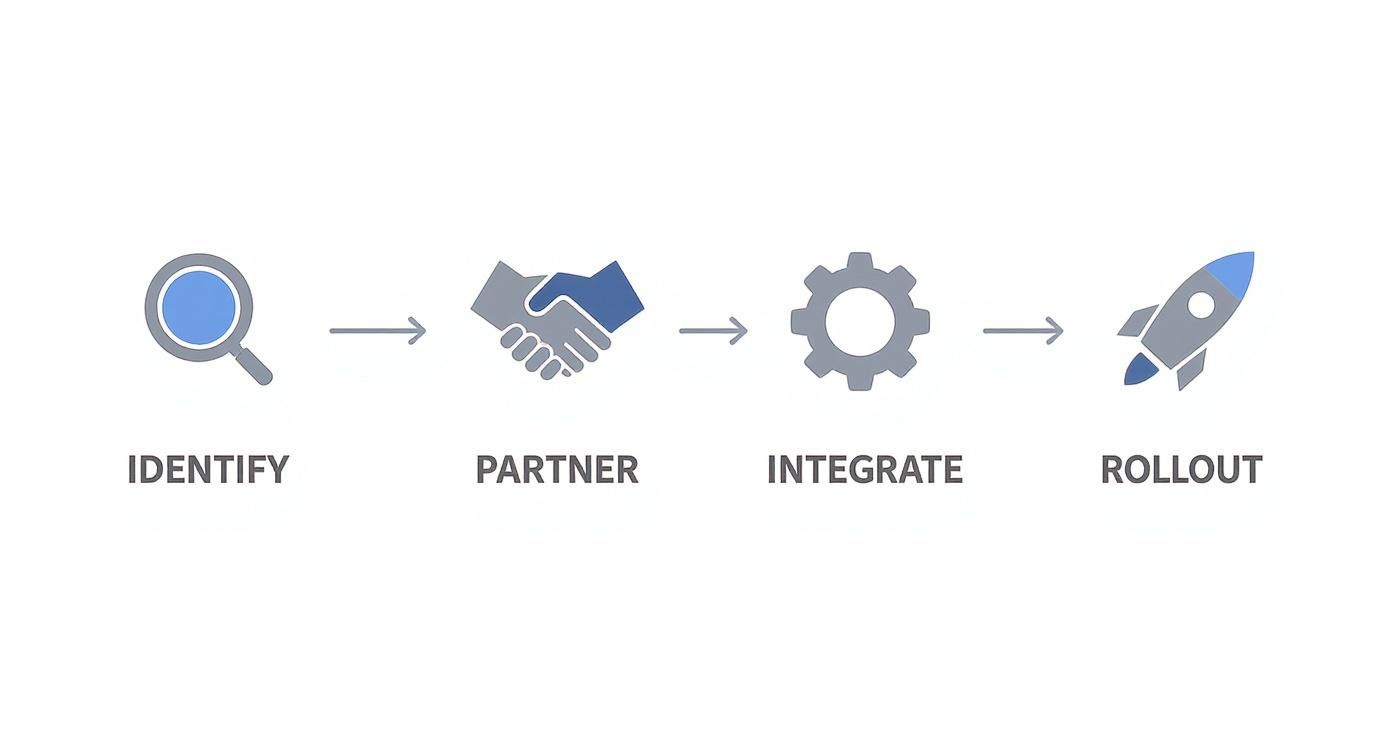
This roadmap keeps things grounded, making sure you move from identifying a real-world problem to a smart, phased deployment.
What's the Single Biggest Hurdle in AR Right Now?
You might think it’s the cost of the hardware or the tech itself, but those are becoming less of an issue. The real stumbling block, time and again, is the content creation bottleneck.
An AR headset is just a piece of plastic without a solid library of 3D models and step-by-step digital instructions. Far too many companies get excited about the tech but completely underestimate the time, skill, and sheer effort it takes to build and maintain all that content. It’s this oversight that can grind a promising AR project to a halt.
How Do We Actually Measure if AR is Working?
Forget vague promises of "improved efficiency." You need to tie AR's performance to the numbers that actually matter to your bottom line. Success is all about tracking specific, hard-hitting Key Performance Indicators (KPIs).
Here’s what to focus on:
- First-Time Fix Rate (FTFR): This is a gold-standard metric in field service. Are your techs solving problems on the first visit?
- Mean Time to Repair (MTTR): How much faster are you getting critical equipment back online? Every minute of downtime costs money.
- Error Rate Reduction: This directly shows AR's impact on quality control, reducing rework and waste.
- Training Time: Are new hires getting up to speed faster? This proves AR is shrinking the skills gap and accelerating onboarding.
The goal is simple: turn operational wins into clear financial value. When you can show a 25% reduction in repair time or a 15% jump in first-time fix rates, you’re not just talking about cool tech—you’re building a rock-solid business case for expansion.
At AIDAR Solutions, we turn these challenges into competitive advantages. Our team helps you pinpoint the highest-impact use cases and roll out AR solutions that deliver real ROI. Whether it's accelerating learning with AIDAR.SKILLS or revolutionizing maintenance with AIDAR.SERVICE, we build the blueprint for your success.
See how we can help you get started by visiting https://aidarsolutions.com.

